
Deuteronomy 15:4

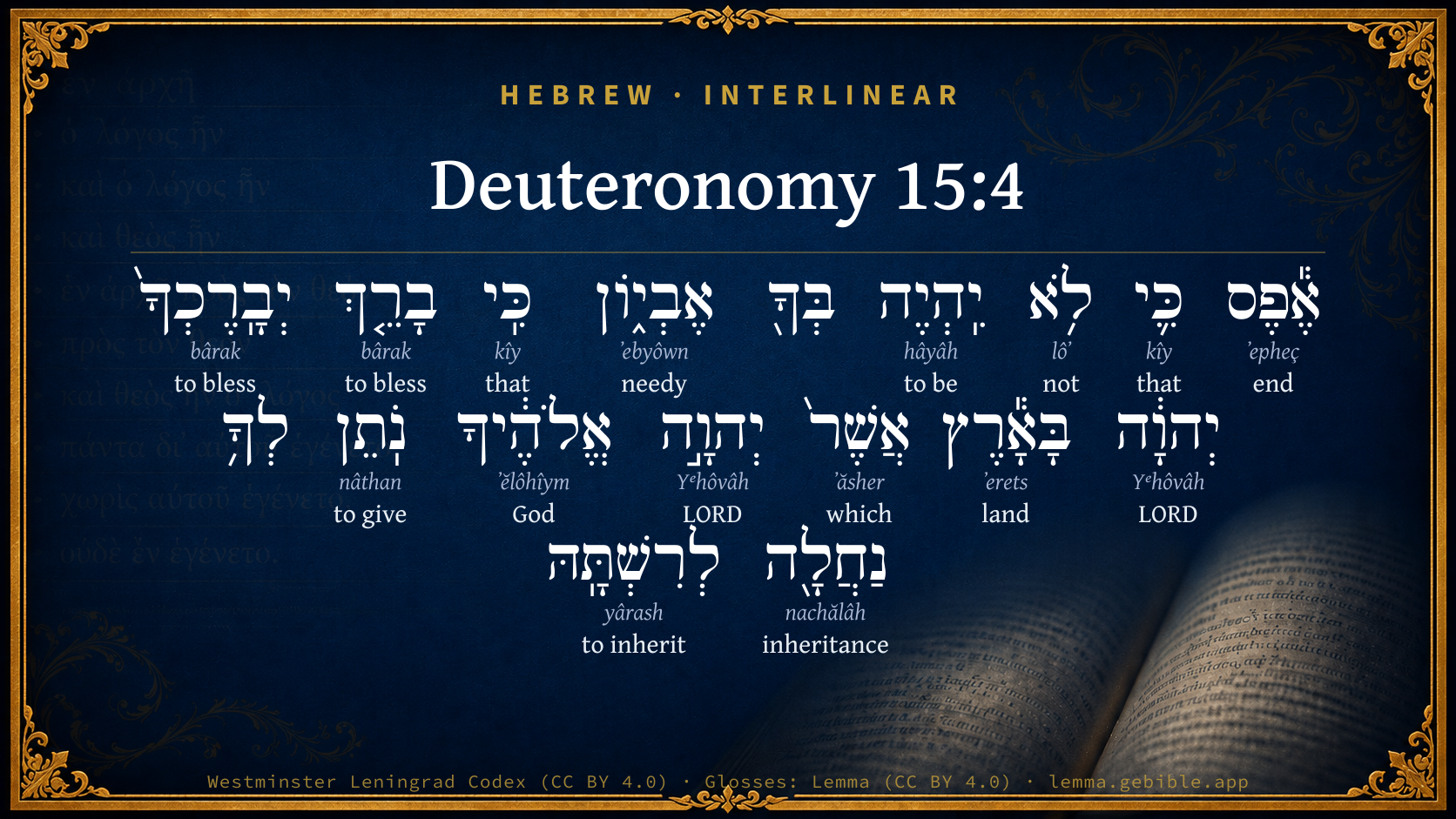
Hebrew (Westminster Leningrad Codex) Deuteronomy 15:4 appears in the Hebrew Old Testament. The text above is from the Westminster Leningrad Codex. Each word links to its Strong’s number, a concise gloss, and parsing drawn from the Open Scriptures Hebrew Bible morphology. Click any word for its full Brown-Driver-Briggs (BDB) entry.
Download image
Cite this verse

Deuteronomy 15:4 (World English Bible). Public Domain. Lemma interlinear Bible study tool, https://lemma.gebible.app/v/deuteronomy/15/4.

Show BibTeX & RIS
BibTeX
RIS
English Translation
However there shall be no poor with you; (for Yahweh will surely bless you in the land which Yahweh your God gives you for an inheritance to possess it;)
World English Bible · Public Domain
Download a study sheet

One document with this verse’s original text, its word-by-word gloss line, the meaning frame, cross-references with their text, attributed commentary, and full source and license credits — printable, and it pastes into notes with its structure intact.

This verse Autodidact and up

Study sheet (.html) Plain text (.txt)

A passage Seminary Student

Up to 50 verses in one chapter. A passage sheet keeps up to 6 commentary sources and 12 cross-references per verse, in the order this page ranks them, and says so on the sheet whenever that leaves anything out. Ask for a single verse and you get the Autodidact verse sheet above.

Everything on this page stays free to read, with no account — the sheet is a download of what is already on screen, not access to it.

Want to remove ads? Support Godless Engineer
Compare translations 3

The same verse in 3 English versions, stacked beneath the original-language interlinear above. Click any original word for its lexicon entry.

Each is an independent rendering of the whole verse — the interlinear is not word-aligned to these translations.

Highlighted words mark where these versions differ — a whole-verse word diff, not a word-by-word alignment.

  • World English Bible Public Domain
    However there shall be no poor with you; (for Yahweh will surely bless you in the land which Yahweh your God gives you for an inheritance to possess it;)
  • King James Version Public Domain
    Save when there shall be no poor among you; for the LORD shall greatly bless thee in the land which the LORD thy God giveth thee for an inheritance to possess it:
  • unfoldingWord Literal Text CC BY-SA 4.0
    However, there should be no poor among you (for blessing, Yahweh will bless you in the land that Yahweh your God is giving to you an inheritance, to possess it),

unfoldingWord Literal Text — © unfoldingWord, licensed CC BY-SA 4.0. Word-aligned USFM3 via Door43 (git.door43.org/unfoldingWord/en_ult).

Versions to compare (up to 4)

3 of 4 selected

Show all 18 translations

Every available English version of this verse, each an independent rendering of the whole verse.

  • World English Bible Public Domain
    However there shall be no poor with you; (for Yahweh will surely bless you in the land which Yahweh your God gives you for an inheritance to possess it;)
  • Berean Standard Bible Public Domain
    There will be no poor among you, however, because the LORD will surely bless you in the land that the LORD your God is giving you to possess as an inheritance,
  • Majority Standard Bible Public Domain
    There will be no poor among you, however, because the LORD will surely bless you in the land that the LORD your God is giving you to possess as an inheritance,
  • King James Version Public Domain
    Save when there shall be no poor among you; for the LORD shall greatly bless thee in the land which the LORD thy God giveth thee for an inheritance to possess it:
  • American Standard Version (1901) Public Domain
    Howbeit there shall be no poor with thee; (for Jehovah will surely bless thee in the land which Jehovah thy God giveth thee for an inheritance to possess it;)
  • Revised Version (1885) Public Domain
    Howbeit there shall be no poor with thee; (for the LORD will surely bless thee in the land which the LORD thy God giveth thee for an inheritance to possess it;)
  • Geneva Bible (1599) Public Domain
    Saue when there shall be no poore with thee: for the Lord shall blesse thee in the land, which the Lord thy God giueth thee, for an inheritance to possesse it:
  • Douay-Rheims (1899) Public Domain
    And there shall be no poor nor beggar among you: that the Lord thy God may bless thee in the land which he will give thee in possession.
  • Young's Literal Translation Public Domain
    only when there is no needy one with thee, for Jehovah doth greatly bless thee in the land which Jehovah thy God is giving to thee -- an inheritance to possess it.
  • Literal Standard Version CC BY-SA 4.0
    except there is an end [when] no poor [are] with you; for YHWH greatly blesses you in the land which your God YHWH is giving to you [for] an inheritance to possess it,
  • Unlocked Literal Bible CC BY-SA 4.0
    However, there should be no poor among you (for Yahweh will surely bless you in the land that he gives you as an inheritance to possess),
  • unfoldingWord Literal Text CC BY-SA 4.0
    However, there should be no poor among you (for blessing, Yahweh will bless you in the land that Yahweh your God is giving to you an inheritance, to possess it),
  • Darby Bible Public Domain
    save when there shall be no one in need among you; for Jehovah will greatly bless thee in the land that Jehovah thy God giveth thee for an inheritance to possess it,
  • World Messianic Bible Public Domain
    However there will be no poor with you (for the LORD will surely bless you in the land which the LORD your God gives you for an inheritance to possess)
  • Webster's Bible Public Domain
    Save when there shall be no poor among you; for the LORD shall greatly bless thee in the land which the LORD thy God giveth thee for an inheritance to possess it:
  • Free Bible Version CC BY-SA 4.0
    However, you shouldn't have poor people among you, for the Lord will really bless you in the country that the Lord your God is giving you to own.
  • Bible in Basic English Public Domain
    But there will be no poor among you; for the Lord will certainly give you his blessing in the land which the Lord your God is giving you for your heritage;
  • JPS Tanakh (1917) Public Domain
    Howbeit there shall be no needy among you — for the LORD will surely bless thee in the land which the LORD thy God giveth thee for an inheritance to possess it —

Literal Standard Version (2020), Covenant Press — licensed CC BY-SA 4.0. Text via the HelloAO Bible API (eBible.org). Unlocked Literal Bible (unfoldingWord) — licensed CC BY-SA 4.0. Text via the HelloAO Bible API (eBible.org). unfoldingWord Literal Text — © unfoldingWord, licensed CC BY-SA 4.0. Word-aligned USFM3 via Door43 (git.door43.org/unfoldingWord/en_ult). Free Bible Version, Dr. Jonathan Gallagher — licensed CC BY-SA 4.0. Text via the HelloAO Bible API (eBible.org).

Word by word

More ways to search: Search by grammar → Find every occurrence → Compare this word →

Practice this passage: Drill this verse → Learn its vocabulary →

אֶ֕פֶס
ʼepheç
H657
“end”
Noun, Common, Masculine, Singular, Absolute
Part of Speech
Noun
Type
Common
Gender
Masculine
Number
Singular
State
Absolute
Full BDB Definition

Origin: from H656

TWOT: 147a

ceasing, end, finality
  1. כִּ֛י kîy H3588 “that” Conjunction
  2. לֹ֥א lôʼ H3808 “not” Particle, Negative
  3. יִֽהְיֶה hâyâh H1961 “to be” Verb, Qal, Imperfect, 3rd Person, Masculine, Singular
  4. אֶבְי֑וֹן ʼebyôwn H34 “needy” Adjective, Adjective, Masculine, Singular, Absolute
  5. כִּֽי kîy H3588 “that” Conjunction
  6. בָרֵ֤ךְ bârak H1288 “to bless” Verb, Piel, Infinitive Absolute
  7. יְבָֽרֶכְךָ֙ bârak H1288 “to bless · you” Verb, Piel, Imperfect, 3rd Person, Masculine, Singular + Suffix, Personal, 2nd Person, Masculine, Singular
  8. יְהוָ֔ה Yᵉhôvâh H3068 “LORD” Noun, Proper
  9. בָּאָ֕רֶץ ʼerets H776 “in/at the · land” Preposition, Determined + Noun, Common, Both, Singular, Absolute
  10. אֲשֶׁר֙ ʼăsher H834 “which” Particle, Relative
  11. יְהוָ֣ה Yᵉhôvâh H3068 “LORD” Noun, Proper
  12. אֱלֹהֶ֔יךָ ʼĕlôhîym H430 “God(s) · your” Noun, Common, Masculine, Plural, Construct + Suffix, Personal, 2nd Person, Masculine, Singular
  13. נֹֽתֵן nâthan H5414 “giving” Verb, Qal, Participle Active, Masculine, Singular, Absolute
  14. נַחֲלָ֖ה nachălâh H5159 “inheritance” Noun, Common, Feminine, Singular, Absolute
  15. לְרִשְׁתָּֽהּ yârash H3423 “to inherit · her” Preposition + Verb, Qal, Infinitive Construct + Suffix, Personal, 3rd Person, Feminine, Singular

About this verse

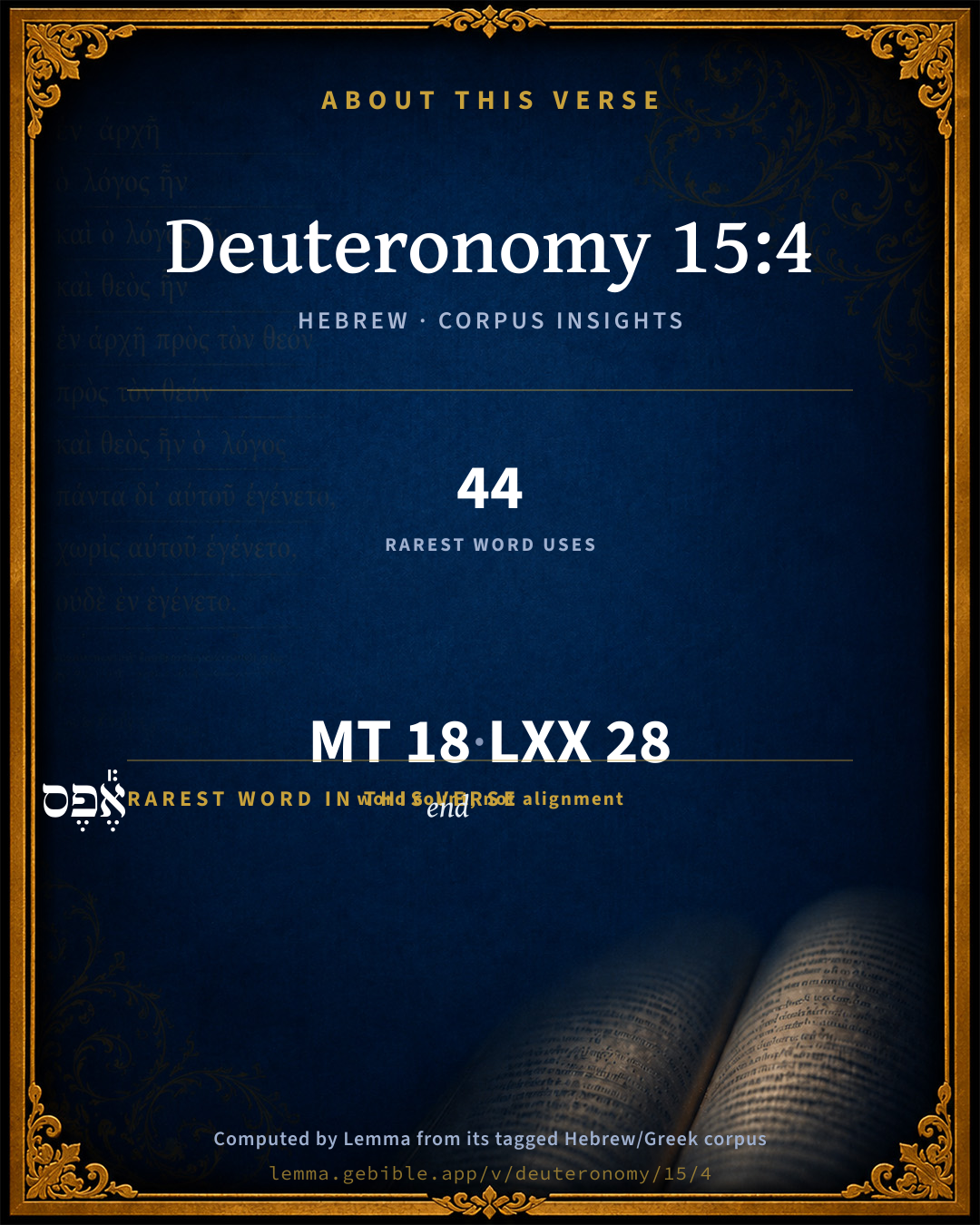
These counts appear in no published source. They are computed here, from the morphology-tagged text and Lemma’s own curated glosses. What Lemma adds →

18
words
13
distinct lemmas
Pentateuch
section

Shared distinctive vocabulary

אֶ֕פֶס end H657 occurs in 43 verses of the Hebrew Bible. Also found in:

Grammatical profile

  • 5 verbs
  • 6 nouns
  • 1 adjective
  • 2 prepositions
  • 2 conjunctions
  • 2 particles

Verb forms

  • יִֽהְיֶה Qal · Imperfect
  • בָרֵ֤ךְ Piel · Infinitive Absolute
  • יְבָֽרֶכְךָ֙ Piel · Imperfect
  • נֹֽתֵן Qal · Participle Active
  • לְרִשְׁתָּֽהּ Qal · Infinitive Construct

Repetition

Words recur within this verse — often emphatic in Hebrew:

  • בָרֵ֤ךְ to bless H1288 ×2
  • יְהוָ֔ה LORD H3068 ×2
  • כִּ֛י that H3588 ×2

Hebrew & Septuagint length

In English translation the verse runs 29 words from the Hebrew and 40 from the Septuagint (LXX English) — closely comparable.

A rough comparison of the two English renderings, which tokenize alike — not a word-level alignment.

Word counts can differ between the Hebrew and the Greek without any difference in meaning — e.g. the Hebrew direct-object marker אֵת has no separate Greek word, and Greek often adds the article ὁ.

In the original languages it is 18 Hebrew tokens and 28 Greek tokens — but the two are counted differently (Hebrew bundles its prefixes and suffixes into one token; the Greek is in lemma form), so that isn’t a like-for-like length.

Cross-references

7

Topical passages linked to Deuteronomy 15:4 in the Treasury of Scripture Knowledge — connected by theme and wording, ordered by reader-vote popularity; previews shown in the World English Bible.

  • Proverbs 28:27 One who gives to the poor has no lack; But one who closes his eyes will have many curses.
  • Isaiah 58:10–11 and if you draw out your soul to the hungry, and satisfy the afflicted soul: then shall your light rise in darkness, and your obscurity be as the noonday;
  • Deuteronomy 14:29 and the Levite, because he has no portion nor inheritance with you, and the foreigner living among you, and the fatherless, and the widow, who are within your gates, shall come, and shall eat and be satisfied; that Yahweh your God may bless you in all the work of your hand which you do.
  • Deuteronomy 28:1–8 It shall happen, if you shall listen diligently to the voice of Yahweh your God, to observe to do all his commandments which I command you this day, who Yahweh your God will set you on high above all the nations of the earth:
  • Proverbs 11:24–25 There is one who scatters, and increases yet more. There is one who withholds more than is appropriate, but gains poverty.
  • Deuteronomy 28:11 Yahweh will make you plenteous for good, in the fruit of your body, and in the fruit of your cattle, and in the fruit of your ground, in the land which Yahweh swore to your fathers to give you.
  • Proverbs 14:21 He who despises his neighbor sins, But blessed is he who has pity on the poor.

Cross-references courtesy of OpenBible.info (CC BY 4.0).

Hebrew and Greek witnesses Masoretic Hebrew ↔ Greek Septuagint

The same verse in the two great witnesses to the Old Testament, shown verse-for-verse.

These are two independent witnesses, not word-aligned to each other, and the Septuagint is shown in lemma (dictionary) form.

Hebrew Deuteronomy 15:4 Masoretic · Westminster Leningrad Codex

אֶ֕פֶס כִּ֛י לֹ֥א יִֽהְיֶה בְּךָ֖ אֶבְי֑וֹן כִּֽי בָרֵ֤ךְ יְבָֽרֶכְךָ֙ יְהוָ֔ה בָּאָ֕רֶץ אֲשֶׁר֙ יְהוָ֣ה אֱלֹהֶ֔יךָ נֹֽתֵן לְךָ֥ נַחֲלָ֖ה לְרִשְׁתָּֽהּ

However there shall be no poor with you; (for Yahweh will surely bless you in the land which Yahweh your God gives you for an inheritance to possess it;)

World English Bible · Public Domain

Greek LXX Deuteronomy 15:4 Septuagint · lemma form

ὅτι οὐ εἰμί ἐν σύ ἐνδεής ὅτι εὐλογέω εὐλογέω σύ κύριος ὁ θεός σύ ἐν ὁ γῆ ὅς κύριος ὁ θεός σύ δίδωμι σύ ἐν κλῆρος κατακληρονομέω αὐτός

For thus there shall not be a poor person in the midst of you, for the Lord your God will surely bless you in the land which the Lord your God gives you by inheritance, that you should inherit it.

LXX2012 (modern English Septuagint) · Public Domain

On this verse, The Cambridge Bible for Schools and Colleges discusses the Septuagint’s reading. Read the note in Commentary ↓

Hebrew: Westminster Leningrad Codex (CC BY 4.0). Greek: Septuagint (public domain); English from LXX2012 (modern English Septuagint) (Public Domain). How the Septuagint differs from the Hebrew →

Targum (Aramaic paraphrase)

2

The Targum is the ancient Jewish Aramaic paraphrase of the Hebrew Scriptures — an interpretive translation, not the Hebrew text itself. Onkelos (literal) and Pseudo-Jonathan (expansive) render the Torah, and Jonathan the Prophets. Coverage is partial: where no permissively-licensed English translation exists for a verse, only the Aramaic is shown. This is verse-level text, not a word-by-word alignment to the Hebrew.

  1. Targum Onkelos Torah (Genesis–Deuteronomy)
    לְחוֹד אֲרֵי לָא יְהֵי בָךְ מִסְכֵּנָא אֲרֵי בָרָכָא יְבָרֵכִנָךְ יְיָ בְּאַרְעָא דִי יְיָ אֱלָהָךְ יָהֵב לָךְ אַחֲסָנָא לְמֵירְתַהּ

    (no public-domain English translation for this verse)

    Targum Onkelos — Aramaic: “Onkelos Genesis” (public domain); “Onkelos Exodus” (public domain); “Onkelos Leviticus” (public domain); “Onkelos Numbers” (public domain); “Onkelos Deuteronomy” (public domain). English: “Sefaria Community Translation” (CC0 1.0 (public-domain dedication)); “J.W. Etheridge. The Targums of Onkelos and Jonathan Ben Uzziel on the Pentateuch. London: Longmans, Green, 1862” (public domain). Text via Sefaria.

  2. Targum Pseudo-Jonathan Torah (Genesis–Deuteronomy)
    לְחוֹד אִין אַתּוּן עֲסִיקִין בְּמִצְוָתָא דְאוֹרַיְיתָא לָא יֶהֱוֵי בְכוֹן מַסְכְּנָא אֲרוּם בְּרָכָא יְבָרְכֵכוּן יְיָ בְּאַרְעָא דַיְיָ אֱלָהָכוֹן יָהֵיב לְכוֹן אַחְסָנָא לְמֵירְתָהּ

    If you will only be diligent in the precepts of the law, there will be no poor among you; for, blessing, the Lord will bless you in the land which the Lord your God will give you for a possession to inherit;

    Targum Pseudo-Jonathan — Aramaic: “Targum Jonathan on Genesis” (public domain); “Targum Jonathan on Exodus” (public domain); “Targum Jonathan on Leviticus” (public domain); “Targum Jonathan on Numbers” (public domain); “Targum Jonathan on Deuteronomy” (public domain). English: “The Targum of Jonathan ben Uzziel, trans. J. W. Etheridge, London, 1862” (public domain). Text via Sefaria.

Commentary

Notes on Deuteronomy 15:4 from classic Christian and Jewish commentators (each source and its license shown beneath its notes). The classic Christian expositions comment on the surrounding passage and are grouped to its opening verse, so a note may address several verses; the Jewish commentaries on the Tanakh (Rashi and others) are per-verse, so they appear only where the commentator wrote on this verse.

Lemma curates 59 commentaries, every one of them public domain or Creative Commons licensed, each selected and text-cleaned for this edition rather than reprinted as found. About our sources →

The Cambridge Bible for Schools and Colleges

gen. ed. J. J. S. Perowne

4. Howbeit there shall be no poor with thee] Dillm. etc. transl.: should be no poor. But this is not a correct rendering of the Heb. which uses the positive form of the vb.; and it weakens the writer’s confident emphasis on his ideal. He is stating not so much what should be as what shall be, if only (raḳ: see on Deu_10:15) Israel obeys the law (Deu_15:5). See introd. note above. The rest of Deu_15:4 is a parenthesis, and probably a later expansion.

for the Lord will surely bless thee] Sam., LXX add thy God; cp. Deu_2:7, Deu_28:8.

giveth thee for an inheritance, etc.] See on Deu_4:21.

The Cambridge Bible for Schools and Colleges (gen. ed. J. J. S. Perowne; Cambridge University Press, 1878–1918) — public domain. Text from a community e-Sword module.

Trapp's Complete Commentary

John Trapp

Deu 15:4 Save when there shall be no poor among you; for the LORD shall greatly bless thee in the land which the LORD thy God giveth thee [for] an inheritance to possess it:

Ver. 4. Save when there shall be no poor.] Here, as in sundry other places of the new translation, the margin is better than the text, as giving a good reason of the former law, To the end that there be no poor amongst you, that is, extreme poor by your exactions. Of a cruel creditor it is said, {Psa 10:9} that "he lieth in wait to catch the poor; he doth catch the poor when he draws him into his net," that is, into bonds, debts, mortgages, as Chrysostom expounds it.

John Trapp, A Commentary or Exposition upon All the Books of the Old and New Testament (1647–1656) — public domain. Text from a community e-Sword module.

The Biblical Illustrator

Joseph S. Exell

Deu_15:4-11

Save when there shall be no poor among you.

Rural poverty

These two sentences (Deu_15:4; Deu_11:1-32) seem, at first sight, to contradict one another. There are three ways of reading the fourth verse. Save when there shall be no poor among you, says the text. To the end that there be no poor, reads the margin. Howbeit, there shall be no poor with thee, runs the Revised Version. The explanation may be briefly put thus: There would always be poor people among them; howbeit, they must not let them be poor, i.e. not let them sink down in poverty.

I. The existence of poverty. My own experience has been that those who are most hurt cry out least. The most deserving, and generally the most pitiful, cases of distress have to be looked for. But, say some, is it not their own fault that they are so badly off? No doubt it often is so. Idleness, drink, waste, folly, incapableness may all cause poverty; but what of that? We cannot stand by and see people starve. It would be easier to die by hanging than hunger; but we do not even hang people except for high treason or murder. Much more must we not by any sin of omission condemn the innocent to suffer with the guilty--the hardworking wife or the helpless children for the sake of the worthless husband or father. The fact is that poverty is largely the consequence of an unequal struggle between the strong and the weak.

II. The duty of relieving poverty. Look at what Moses taught the Israelites.

1. That prevention is better than cure. There was never to be a bitter cry of outcast Canaan.

(1) We may use our influence to encourage better education. With the next generation more intelligent, temperate, and capable, pauperism will be less.

(2) We may exert our influence towards giving the labourer a heartier interest in the land he tills.

(3) We may inculcate a love of independence. Poverty is no sin, but pauperism is a reproach, and should be felt as such.

2. That each nation, or community, or church, should care for its own poor.

3. That charity should be systematic. The time was precise--every third year; the quantity was precise--one tenth; the object was precise--thy poor brother.

Contrast with these laws of Moses the teaching of Christ.

1. The law of Moses aimed at preventing poverty. Christ came and found men poor. He did more than prevent; He cured. To heal sickness is a harder task than to maintain health. To deliver the needy when he crieth is often more difficult than to preserve him before he has had occasion to cry. Moses provided for keeping people up who were not overthrown; Christ actually went down to the low dark depths, and raised those who were sunk there.

2. Moses taught that each nation, or community, or church, should care for its own. To go beyond that was permitted, but not enjoined. Christ taught a much broader truth than that--charity without distinction. Our neighbour is not the person who lives next door to us, or who has most affinity with us; but the person who is nearest to our helping hand, even though he be a Jew and we are Samaritans. Our first duty is to our own, but not our last. Charity begins at home, but does not end there.

3. Moses was systematic, but Christ was above systems. There was no fixed standard with Him, except this. Sell all that thou hast and distribute unto the poor. There was no stint in His giving. It was not certain objects of His kindness whom He blessed: Whosoever will, let him come. It was not every few years merely that He was benevolent; but yesterday, today, and forever. (Charles T. Price.)

The poor laws of the Bible; or, rules and reasons for the relief of the distressed

I. The rules that are here suggested for the relief of the poor.

1. Contiguity. It is the poor in thy land. Those living nearest us, other things being equal, have the first claim on our charity. Let it bless as it goes; work as the leaven in the meal, from particle to particle, until it gives its spirit to the mass.

2. Heartiness. Thou shalt not harden, etc. The heart must go with the deed.

3. Liberality. Open thine hand wide unto him. The liberality of men is not to be judged by the sums they subscribe, but by the means they possess.

II. The reasons that are here suggested for the relief of the poor.

1. Your relationship to the poor. He is thy brother. He has the same origin, the same nature, the same great Father, the same moral relationships, as thyself.

2. The imprecation of the poor. And he cry, etc.

3. The blessedness insured to the friend of the poor.

4. The Divine plan as to the permanent existence of the poor. (Homilist.)

General Gordons benevolence

A poor dragoman told me that General Gordon used to come often to his house in Jerusalem when he and his wife lay ill, and that he would take any cushion or mat and put it on the floor as a seat, there being no chairs or furniture, and sit down with his Testament to read and speak to them about Christ. But his zeal did not end with such easy philanthropy. Ascertaining that a doctors account had been incurred to the amount of three pounds, he went off secretly and paid it. Far away at Khartoum, he still thought of one whom he had thus striven to lead into the fold of Christ, and sent a letter to him which reached Jerusalem almost at the same time as the news of its writers death. That letter, said the poor Copt, I would not part with for all that is in the world. General Gordon was a real Christian. He gave away all he had to the poor in Jerusalem and the villages round, and the people mourn for him as for their father.

Kindness to the poor

A poor sewing girl, who went to the late Dr. John F. Gray for advice, was given a, phial of medicine and told to go home and go to bed. I cant do that, doctor, the girl replied, for I am dependent on what I earn every day for my living. If thats so, said Dr. Gray, Ill change, the medicine, a little. Give me back that phial. He then wrapped around it a ten-dollar bill, and returning it to her, reiterated his order, Go home and go to bed, adding, take the medicine, cover and all. He who takes account of the cups of cold water will not forget such deeds of kindness and charity. Oh to hear Him say at the last, Ye have done it unto Me!

The misery of a niggardly spirit

In Rochester there lived a wealthy man who made a great profession of religion; he knelt at communion seasons and attended church with great regularity, but be would not give one shilling to the poor, nor to any other person. In the year 1862, I asked a trifle of money from him to relieve some families who were in great distress, but he refused, saying, I am a poor man, sir; I am a poor man. Listen to what this thorny-ground hearer said, as he lay with glazing, dying eyes, to a clergyman who, noticing his lips move, bent down to catch the whisper, Ninety thousand pounds, and I must leave it all behind me! If there be among you a poor man of one of thy brethren.

Brotherly love

As God had chosen all Israel, so He desired that they should love as brethren. Each was to stand by the other, and all were to be zealous for the Divine honour. Thus they would bear, in contradistinction to the heathen, the character of a people consecrated to God. But even in Israel there were rich and poor, happy and unhappy. Wherever men went the poor and afflicted would be met with. Therefore the people were exhorted to hold heart and hand open--not to harden the heart nor shut the hand. Each was to be ready to stand by his fellow to see that his brother should not suffer.

I. Gods people ever have sympathy with their brethren.

1. If we belong to the people of God--if this were so in Israel, much more should it be among Christians--then there will be in our hearts a tender feeling toward our fellow men--a feeling implanted by God Himself. The heart will say: This is thy brother; help him. This results from Gods love in the heart, which leads the brethren to love one another.

2. But this tender-heartedness can be destroyed and the heart be hardened, even among Christians, and this against the light of conscience. They often do as it is rumoured the New Zealanders did with their children. They pressed down the necks of the children under a flinty stone in order to harden them, so Christians make their hearts sometimes hard as flints through avariciousness. The avaricious heart ever thinks: This belongs to me and to no one else, and none shall share it.

3. This is not well-pleasing to God. He sees that by covetousness men are led to destruction, and to reject His love toward them. For when men are so hard-hearted, how can they have the love of God in them?

II. The hearts and hands of Gods people are open toward their brethren.

1. When this is so, then the love of God has full scope in their hearts; and thus He causes through those open hands and hearts much good to flow out into this evil world. For to His children who are ever ready to give to those who need He will give yet more, so that from their increased store they may give yet more fully to others, and that thus these also may learn to praise God.

2. Therefore he who has a kind heart and open hand will experience and receive a blessing. As he gives, so he receives. It is with such as with Cornelius: Thy prayers and thine alms are come up before God. Thus, too, the way is made open for the reception of Gods gifts both temporal and spiritual. Let us all, then, endeavour to preserve a tender heart, arid not let our heart be hardened. (J. C. Blumhardt.)

And he cry unto the Lord against thee.--

The cry of the poor

The poor cry to heaven--from the scenes of oppressive labour, from wretched hovels, from beds of straw, shivering in the cold, from the depths of starvation, they cry! Many a poor mother in these blood-freezing nights hugs to her shivering bosom her starving infant, and tries to hush its cries of cold and hunger with the wails of her own broken heart. God alone knows the cries that rise and pierce the heavens every night from this great country--as the cant is. Alas! Alas! that from this land, overflowing with luxuries and burdened with wealth, such wails of wretchedness should rise! Against whom do they cry? Against their Maker? No! The most unobservant of them can scarcely fail to discover that He sends food enough for all. Besides, deep and ineradicably rooted in the heart of all is the sentiment that God is good--a sentiment this, which seems to me the core of conscience. Against the overreaching monopolist, the iron-hearted miser, the ruthless oppressor, the man who has the power to help but not the heart. Against all selfish men and unrighteous laws that grind the people down, they cry--and cry with unremitting vehemence too. Will He hear? Is the ear of Him who heard of old the cries of the enslaved millions in Egypt, and interposed with avenging thunders for their rescue, grown heavy? Nay, modern oppressor! Those cries shall be answered; not a solitary wail shall die away unheeded. Woe to the nation that oppresses the poor! Woe! and again, woe! when retribution comes, as come it must. (Homilist.)

The poor shall never cease out of the land.--

Gods ordinance of rich and poor

I. The perpetual existence of the poor amongst us. You must become reconciled to your poverty. And if you would become really reconciled to it do not regard it as something inflicted by the misgovernment or the management of your fellow men. Put it before you in the light this text puts it, as Gods ordinance and Gods will concerning you; as something that rulers and governors can no more drive out of the world than they can drive midnight out of it, or sickness, or pain, or sorrow. Poverty is to be alleviated, and it is to be removed if honest industry will remove it; but if not so, it is to be welcomed and borne. I could tell you where it often comes from. From the poor mans own idleness, improvidence, intemperance, and waste; from the foolish indulgence of children; from the still more criminal indulgence of self. But even then it is from God; it is Gods way of showing displeasure against these things. And when it comes not from these things, where does it come from? Often from a love that neither you nor I, nor any angel above us, can measure. The same love that provided a Saviour and built a heaven for sinners now sends poverty often to sinners, to turn them to that Saviour and heaven.

II. Our duty towards the poor. Now if we looked only at the declaration in the first part of the text, and were disposed to reason on it, we might say, Be our duty to the poor what it may, we must not interfere with their poverty; it is Gods will they should be poor, and we must not interfere with His will. This would be like saying, God has sent sickness amongst us, and we must not make use of any means to cure or relieve it; or, He has made the winter, and we will do nothing to mitigate the rigour of it; or, He has created the darkness, and it is wrong to have lights in our dwelling to enlighten it. Many of what we call the evils of our condition are designed of God to bring into lawful and healthy action the powers of mans mind and the feelings of mans heart, and this evil of poverty among the number. The poor shall never cease out of the land; that is My will, says God. Therefore I command thee--what? to let the needy alone in their poverty? No; I have placed them in the land to call forth and exercise thy bounty. The painful work is Mine--I have ordained poverty; the pleasant work shall be thine--thou shalt relieve it. Thou shalt open thine hand wide unto thy brother, to thy poor and to thy needy in thy land. It is a touching circumstance that not only is the general duty of what we call charity to the poor enjoined in Scripture, but so great is the interest God takes in it that the measure and manner of it are strongly enjoined. Here we are told, in the first place, that it must be liberal. Thou shalt open thine hand wide unto thy brother. And it must be extensive charity; that is, as extensive as we can make it. I will not give my money, we sometimes say, to this man or that; he has no claim on me; I must keep the little I have to spare for those who have claims on me. But look again, Thou shalt open thine hand wide unto thy brother--to thy brother first, to those who from relationship or from some other cause seem to have claims on thee; but not to thy brother only, to thy poor and to thy needy in thy land. The words are multiplied; to those who have no claims whatever on thee but their poverty and their need. And it must be also a cheerful charity.

III. We may go on now to the motives by which we are urged to the exercise of this grace. For these, some of you may be ready to say, I must turn to the Gospel. But no, the God of the Gospel is the God of the law also, the God of the Christian Church was the God of the ancient Church, and there is no motive urged now on us in these Gospel days which was not urged in substance on the Jews in the days of old.

1. For instance, to begin, our own mercies are made use of under the Gospel to impel us to show mercy to others. Freely ye have received, our Lord says, freely give. Now look at this chapter. Thou shalt open thine hand wide unto thy brother, to thy poor and to thy needy--why? For the Lord thy God, the sixth verse says, is opening His hand wide unto thee; He is blessing thee, and blessing thee as abundantly as He said He would; the Lord thy God blesseth thee as He promised thee.

2. But again, the special love of God to the poor is another reason why our hands should be opened to them. Of all the books that were ever written, no book manifests such care for the poor as the Bible. This has often been noticed by those who have closely studied this book, and many others with it, as one of the many internal evidences of its Divine original. But turn to the tenth chapter of the part of it now before us, the nineteenth verse. Love ye therefore the stranger, says God. And why? Ye yourselves, He adds, were strangers in the land of Egypt. But this is not the only reason; read what goes before. The Lord Himself loveth the stranger. The Lord loveth the stranger, love ye therefore the stranger, says God. And this applies with much greater force to the widow and fatherless. If natural feeling, as we call it--if our own parental feelings--do not incline us to open our hand to them, let the feelings of God towards them incline us to do so. I love the fatherless, He says; let us, for His sake, because He loves them, love them also.

3. But here is a third motive pressed on you; this opening of our hand to the poor will lead the Lord to open His hand to us. For this thing, we read in the verse before the text--for this thing the Lord thy God shall bless thee in all thy works, and in all that thou puttest thine hand unto. This is the legal promise, you may say. And true, it is; but the Lord is not less bountiful or less generous under the Gospel than under the law. (U. Bradley, M. A.)

Duty of the Church towards the poor

Consider--

I. That poverty is a real evil which, without any impeachment of the goodness or wisdom of providence, the constitution of the world actually admits.

II. That providential appointment of this evil in subservience to the general good, brings a particular obligation upon men in civilised society to concur for the immediate extinction of the evil wherever it appears. (Bp. Horsley.)

Poverty no accident

The poor shall never cease out of the land. That is a remark which is not understood. Poverty is not an accident; there is a moral mystery connected with poverty which has never yet been found out. The sick chamber makes the house, the infirm member of the family rules its tenderest thinking. Poverty has a great function to work out in the social scheme, but whilst we admit this we must not take the permanence of poverty as an argument for neglect; it is an argument for solicitude, it is an appeal to benevolence, it is an opportunity to soften the heart and cultivate the highest graces of the soul. It is perfectly true that the bulk of poor people may have brought their poverty upon themselves, but who are we that we should make rough speeches about them? What have we brought upon ourselves? If we are more respectable than others, it is still the respectability of thieves and liars and selfish plotters. We, who are apparently more industrious and virtuous and regardful, are not made of different clay, and are not animated by a different blood. It is perfectly true that a thousand people may have brought todays poverty upon themselves, and they will have to suffer for it; but beyond all these accidents or incidents there is the solemn fact that poverty is a permanent quantity, for moral reasons which appeal to the higher instincts of the social commonwealth. We have that we may give, we are strong that we may support the weak, we are wise that we may teach the ignorant. Let this mind be in you, which was also in Christ Jesus. No man has the slightest occasion or reason for reproaching any other man, except in relation to the immediate circumstance. If the assize were on a larger scale, and we were all involved in the scrutiny, the issue would be this, There is none righteous, no, not one. (J. Parker, D. D.)

Open thine hand wide unto thy brother.--

The duty of Christian charity

I. It is due to the constitution of society. The poor always ye have with you. We shall perhaps think correctly on the subject if we admit as the will of God that in every state of society there shall be poor, and that a provision for the production of this fact is laid in the gifts of His providence, in the constitution of men, and in the scheme of His moral government.

II. Charity is due to ourselves. It is due to ourselves, as we would wish with uprightness to discharge the duties of that station in which we are placed. To administer relief to the poor is graciously connected with our present comfort and our future well-being. The very act of charity is accompanied with the most refined complacency; it is answering that sympathy which is born in the heart of every man, and which, unless stifled by unnatural discipline, calls loudly for gratification. They are happy who are the objects of your bounty, but ye who have experienced it can tell that it is more blessed to give than to receive. Connected with this is that blessing over our worldly concerns which maketh rich, and to which is added no sorrow. And let it be remembered, that prosperity is but for a season; now, therefore, it is time to lay up a store of good deeds, the remembrance of which shall be the best support when misfortune overtakes the prosperous. Let it be remembered yet again that what possessions men have are not their own, but are the property of their Master, who hath committed it to their stewardship. All their opportunities, and all their means of doing good, must he accounted for.

III. It is due to religion--to a religion which is in its origin, its effects, its principle, and its precepts a system of charity; a religion which, originating in the love of God, proposes to restore to happiness and dignity those who are poor, and miserable, and wretched, and blind, and naked. They to whom mercy is shown should be merciful. This is what Christianity requires, nay, what it affirms to be the amount and the criterion of a genuine profession.

IV. It is due to the poor. As a something voluntary is implied in the idea of charity, it may sound paradoxical to speak of the rights of the poor on the charity of the rich. But the incongruity is only in sound, for it is an acknowledged maxim of civil economy that the poor (the industrious poor, of whom only I now speak) have an absolute right to be supported by the State, whose agriculture, commerce, and manufactures have benefited by their exertions. Further, the poor have a right as brethren, and this is a right which the heart of a Christian cannot deny.

V. It is due to the age in which we live--an age characterised for beneficence, an age distinguished above all others for the magnitude of its political events, for the advancement of science, for the general diffusion of literature, and more especially for a spirit that has amalgamated all classes of society, the most opposite ranks and professions, into one mass, and stamped the whole with benevolence. (A. Waugh, M. A.)

The best mode of charity

It is of importance not only that we should do good, but that we should do it in the best manner. A little judgment and a little reflection added to the gift does not merely enhance the value, but often gives to it the only value which it possesses, and even prevents that mischief of which thoughtless benevolence is sometimes the cause.

1. Mankind can never be too strongly or too frequently cautioned against self-deception. If a state of vice be a state of misery, a state of vice of which we are ignorant is doubly so, from the increased probability of its duration. It is surprising how many men are cheated by flighty sentiments of humanity into a belief that they are humane, how frequently charitable words are mistaken for charitable deeds, and a beautiful picture of misery for an effectual relief of it.

2. Another important point in the administration of charity is a proper choice of the objects we relieve. To give promiscuously is better, perhaps, than not to give at all, but instead of risking the chance of encouraging imposture, discover some worthy family struggling up against the world, a widow with her helpless children, old people incapable of labour, or orphans destitute of protection and advice; suppose you were gradually to attach yourselves to such real objects of compassion, to learn their wants, to stimulate their industry, and to correct their vices; surely these two species of charity are not to be compared together in the utility or in the extent of their effects, in the benevolence they evince or in the merits they confer.

3. The true reason why this species of charity is so rarely practised is that we are afraid of imposing such a severe task upon our indolence, though, in truth, all these kinds of difficulties are extremely overrated. When once we have made ourselves acquainted with a poor family, and got into a regular train of seeing them at intervals, the trouble is hardly felt and the time scarcely missed; and if it is missed, ought it to be missed?

4. These charitable visits to the poor, which I have endeavoured to inculcate, are of importance, not only because they prevent imposture by making you certain of the misery which you relieve, but because they produce an appeal to the senses which is highly favourable to the cultivation of charity. He who only knows the misfortunes of mankind at second hand and by description has but a faint idea of what is really suffered in the world. We feel, it may be said, the eloquence of description, but what is all the eloquence of art to that mighty and original eloquence with which nature pleads her cause; to the eloquence of paleness and of hunger; to the eloquence of sickness and of wounds; to the eloquence of extreme old age, of helpless infancy, of friendless want! What pleadings so powerful as the wretched hovels of the pool, and the whole system of their comfortless economy!

5. You are not, I hope, of opinion that these kinds of cares devolve upon the clergy alone, as the necessary labours of their profession, but upon everyone whose faith teaches And whose fortune enables him to be humane.

6. Nor let it be imagined that the duties which I have pointed out are much less imperative because the law has taken to itself the protection of the poor; the law must hold out a scanty relief, or it would encourage more misery than it relieved: the law cannot distinguish between the poverty of idleness and the poverty of misfortune; the law degrades those whom it relieves, and many prefer wretchedness to public aid; do not, therefore, spare yourselves from a belief that the poor are well taken care of by the civil power, and that individual interference is superfluous. Many die in secret,--they perish and are forgotten.

7. Remember that every charity is short-lived and inefficacious which flows from any other motive than the right. There is a charity which originates from the romantic fiction of humble virtue and innocence in distress, but this will be soon disgusted by low artifice and scared by brutal vice. The charity which proceeds from ostentation can exist no longer than when its motives remain undetected. There is a charity which is meant to excite the feelings of gratitude, but this will meet with its termination in disappointment. That charity alone endures which flows from a sense of duty and a hope in God. This is the charity that treads in secret those paths of misery from which all but the lowest of human wretches have fled; this is that charity which no labour can weary, no ingratitude detach, no horror disgust; that toils, that pardons, that suffers, that is seen by no man, and honoured by no man, but, like the great laws of nature, does the work of God in silence, and looks to future and better worlds for its reward. (Sydney Smith, M. A.)

The Biblical Illustrator, edited by Joseph S. Exell (c. 1880s–1900s) — public domain. Text from a community e-Sword module.

Joseph Benson's Commentary

Deu 15:4. Save when there shall be no poor — The words may be rendered thus, as in the margin of our Bibles: To the end that there be no poor among you. And so they contain a reason of this law; namely, that none be empoverished and ruined by a rigid exaction of debts. For the Lord shall greatly bless thee — If in this and other things you be obedient, God will so abundantly bless you that you shall be well able to forbear the requiring of your debts on the sabbatic year.

Joseph Benson's Commentary on the Old and New Testaments (1811–1818) — public domain. Text from a community e-Sword module.

Tyndale Open Study Notes

Tyndale Open Resources

15:4 If Israel lived in perfect obedience to the covenant, there would be no poor in the nation. However, this ideal was never realized in ancient Israel, and poverty was very much an issue.

Tyndale Open Study Notes — © Tyndale Open Resources, licensed CC BY-SA 4.0. Text via the HelloAO Bible API.

Geneva Bible (1599)

Geneva Bible translators

For if thy debtor be rich, he may be constrained to pay.

Geneva Bible (1599) marginal notes — public domain. Text via Bolls.life.

Jamieson, Fausset & Brown

Robert Jamieson, A. R. Fausset & David Brown

Save when there shall be no poor man among you--Apparently a qualifying clause added to limit the application of the foregoing statement [Deu 15:3]; so that "the brother" to be released pointed to a poor borrower, whereas it is implied that if he were rich, the restoration of the loan might be demanded even during that year. But the words may properly be rendered (as on the Margin) to the end, in order that there may be no poor among you--that is, that none be reduced to inconvenient straits and poverty by unseasonable exaction of debts at a time when there was no labor and no produce, and that all may enjoy comfort and prosperity, which will be the case through the special blessing of God on the land, provided they are obedient.

Jamieson, Fausset & Brown — Commentary Critical and Explanatory on the Whole Bible (1871) — public domain (CC PDM 1.0). Text via the HelloAO Bible API.

Adam Clarke's Commentary

Verse 4. There shall be no poor] That is, comparatively; see De 15:11.

Adam Clarke's Commentary on the Bible (1810–1826) — public domain. Text from a community e-Sword/MySword module.

Ellicott's Commentary for English Readers

(4) Save when there shall be no poor (man) among you.—This clause is the source of a very interesting passage in the Acts of the Apostles, Deu_4:34, “Great grace was upon them all, for neither was there among them any (one) that lacked” The words at the beginning of the verse in Hebrew, “save when” may also be rendered (as in the Margin) “to the end that,” or “to such an extent that there shall be no poor man among you.” Those who can well afford to pay need not be excused from their obligations.

For the Lord thy God shall greatly bless thee.—So in Act_4:33, “Great grace was upon them all.” The blessing need not be equal and universal prosperity, if those who have the good things of this world will always remember the poor to such an extent that no member of the community shall be left in want.

A Bible Commentary for English Readers, edited by Charles John Ellicott (1878–1897) — public domain. Text from a community e-Sword module.

John Gill's Exposition

Save when there shall be no poor among you,.... Then such a law could not take place, there would be no debts to be released; for this was never designed to screen rich persons from the payment of their just debts, or whoever were in a capacity of so doing, only such as were really poor, and unable to pay; and it supposes that this might sometimes be the case, that there were none poor in Israel, or needed the benefit of such a law; and, according to the Targum of Jonathan, it is suggested there would be none, if they were observant of the commands of God: and some take it for a promise, rendering the words "nevertheless" (c), notwithstanding such a law:

there shall be no poor among you; but then it must be understood conditionally: others interpret this as the end to be answered by this law, "to the end (d) there may be no poor among you"; by observing this law, all debts being released once in seven years, it would prevent persons falling into distress and poverty, to such a degree as to be in want, and become beggars; and Julian the emperor observes, that none of the Jews begged (e), which he attributes to the care that was taken of their poor:

for the Lord shall greatly bless thee in the land which the Lord thy God giveth thee for an inheritance to possess it; which is either a reason why there would be no poor, should they observe the commandments of the Lord; or a reason why they should release the debts of the poor because they were so greatly blessed with a fruitful land, which brought them such an increase, as enabled them to free their poor debtors, when in circumstances unable to pay them.

(c) "veruntamen", Munster. (d) "To the end that there be not", Ainsworth; so the margin of the Bible. (e) Opera, par. 2. Ep. 49. p. 204.

John Gill's Exposition of the Whole Bible (1746–1763) — public domain (CC PDM 1.0). Text via the HelloAO Bible API.

Haydock's Catholic Bible Commentary

There shall be no poor, &c. It is not to be understood as a promise, that there should be no poor in Israel, as appears from ver. 11, where we learn that God’s people would never be at a loss to find objects for their charity: but it is an ordinance that all should do their best endeavours to prevent any of their brethren from suffering the hardships of poverty and want. (Challoner) --- Beggar, is not expressed, though it be implied in Hebrew or the Septuagint, which connect this with the preceding verse, (Haydock) "because (or save when) there shall be no poor among you;" as if the rich could not derive the benefit from the remission of debts. (Vatable) --- God had made abundant provision for the poor. He might have prevented any from falling into distress. (Calmet) --- But he suffered this sometimes to take place, to try the dispositions both of the rich and of the poor. (Haydock) --- If they had faithfully complied with his laws, he would not have permitted them to fall into the last degree of misery. (Calmet) --- He allows no public begging, which all well regulated nations discountenance. (Menochius) --- The Jews carefully relieve their brethren. They gather alms, and one of the judges distributes what may be sufficient for the ensuing week. (Leo, p. i. c. 14.) --- Those who refused to give according to their abilities, were formerly ordered by the Sanhedrim to be scourged, till they had complied with their duty; and sometimes, things were taken forcibly from their houses. (Maimonides) --- They relieve the distressed in proportion to their former condition. (Selden, Jur. vi. 6.)

George Leo Haydock (1774–1849), Haydock's Catholic Family Bible and Commentary, 1859 edition — public domain. Excludes Psalms (Douay-Rheims chapter numbering differs from Protestant) and Deuterocanonical books (Catholic canon only).

Matthew Poole's English Annotations

When there shall be no poor: so the words are an exception to the foregoing clause, which they restrain to the poor, and imply that if his brother was rich, he might exact his debt of him in that year. And indeed this law seems to be chiefly, if not wholly, designed and given in favour to the poor and to the borrower, as is manifest from Deu 15:6-11. But the words are and may be rendered thus, as in the margin of our Bibles, To the end that there be no poor among you. And so they contain a reason of this law, to wit, that none be impoverished and ruined by a rigid and unseasonable exaction of debts. They may also be translated thus, Nevertheless of a truth, or assuredly, (as the particle chi is oft used,) there shall be no poor along you; and the sense may be this, Though I impose this law upon you, which may seem hard and grievous, yet the truth is, supposing your performance of the conditions of God’s covenant, you shall not have any great occasion to exercise your charity and kindness in this matter, for God will greatly bless you, &c., so as you shall be in a capacity of lending, and few or none of you will have need to borrow, and thereby to expose his brethren to the inconvenience and burden of this law. Thus the connexion is plain and easy, both with the foregoing and following words.

Object. It is said, the poor should never cease, Deu 15:11.

Answ. That also is true, and affirmed by God, because he foresaw they would not perform their duty, and therefore would bereave themselves of the promised blessing.

The Lord shall greatly bless thee; and therefore this will be no great inconvenience nor burden to thee.

Matthew Poole's English Annotations on the Holy Bible (1683–1685) — public domain. Text from a community e-Sword/MySword module.

Whedon's Commentary on the Bible

Daniel D. Whedon

4. Save when there shall be no poor among you — The literal rendering of the passage is, Except that there shall yet be with thee a poor man. The meaning seems simply to be, “Thou must release the debt for the year except when there be no poor person concerned, a contingency which may happen, for the Lord shall greatly bless thee.” — Speaker’s Commentary.

Daniel D. Whedon (gen. ed.), Commentary on the Old and New Testaments (1874–1909) — public domain. Text from a community e-Sword module.

The Pulpit Commentary

Save when there shall be no poor among you; rather, only that there shall be no poor among you; q.d., this ordinance is not intended to prevent creditors seeking the payment of their just debts, but only to prevent there being poor in the land. The reason assigned is that the Lord would greatly bless them in the land which he had given them, so that the creditor would be no loser by refraining from exacting his debt from his brother in the seventh year.

The Pulpit Commentary (1880–1919), ed. H.D.M. Spence-Jones & Joseph S. Exell — public domain. Text from a community e-Sword module.

John Wesley's Explanatory Notes

Save when there shall be no poor - The words may be rendered thus, as in the margin of our Bibles, To the end that there be no poor among you. And so they contain a reason of this law, namely, that none be impoverished and ruined by a rigid exaction of debts.

John Wesley, Explanatory Notes Upon the Whole Bible (1754–1765) — public domain. Text via the GEBible commentary corpus.

Keil & Delitzsch

C. F. Keil & F. Delitzsch

"Only that there shall be no poor with thee." יהיה is jussive, like the foregoing imperfects. The meaning in this connection is, "Thou needest not to remit a debt to foreigners in the seventh year; thou hast only to take care that there is no poor man with or among thee, that thou dost not cause or increase their poverty, by oppressing the brethren who have borrowed of thee." Understood in this way, the sentence is not at all at variance with Deu 15:11, where it is stated that the poor would never cease out of the land. The following clause, "for Jehovah will bless thee," etc., gives a reason for the main thought, that they were not to press the Israelitish debtor. The creditor, therefore, had no need to fear that he would suffer want, if he refrained from exacting his debt from his brother in the seventh year.

Keil & Delitzsch — Biblical Commentary on the Old Testament (1861–1891) — public domain (CC PDM 1.0). Text via the HelloAO Bible API. (Old Testament only.)

unfoldingWord translationNotes

Door43 World Missions Community

no poor

The nominal adjective "poor" can be stated as an adjective. AT: "no poor people" or "no one who is poor" (See: Nominal Adjectives)

the land that he gives

This refers to the land of Canaan.

he gives you as an inheritance to possess

The land that Yahweh is giving to his people is spoken of as if it were an inheritance that Yahweh is giving them. (See: Metaphor)

if only you diligently listen to the voice of Yahweh your God

Here the metonym "voice of Yahweh" refers to what Yahweh himself says. AT: "if only you are careful to obey what Yahweh your God says" (See: Metonymy)

you will lend ... you will not borrow

The word "money" is understood. You can make the full meaning of this statement clear. AT: "you will lend money ... you will not borrow money" (See: Ellipsis)

to many nations ... over many nations

Here "nations" represents the people. AT: "to the people of many nations ... over the people of many nations" (See: Metonymy)

you will rule over many nations, but they will not rule over you

Here "rule over" means to be financially superior. This means basically the same thing as the previous part of the sentence. (See: Parallelism)

translationWords

Yahweh

bless

inherit

possess

voice

God

command

promise

nation

rule

unfoldingWord translationNotes — © Distant Shores Media and the Door43 World Missions Community, licensed CC BY-SA 4.0. Source: git.door43.org/Door43/en_tn.

Rashi

Rabbi Shlomo Yitzchaki (Rashi)

אפס כי לא יהיה בך אביון HOWBEIT THERE SHALL BE NO NEEDY AMONG YOU — But further on (v. 11) it states, “For the needy shall never cease out of the land”! But the explanation is: When you do the will of the Omnipresent the needy will be amongst the others and not amongst you, if, however, you do not the will of the Omnipresent, the needy will be amongst you (Sifrei Devarim 114:1).

אביון denotes a person who is more destitute than an עני. The term אביון (from the root אבה “to long for”, “to desire”; cf. Rashi on Exodus 23:6) denotes one who longs for everything (because he lacks everything) (Leviticus Rabbah 34:6).

Rashi on the Tanakh — English translations: “The Judaica Press complete Tanach with Rashi, translated by A. J. Rosenberg” (CC BY 4.0); “Pentateuch with Rashi's commentary by M. Rosenbaum and A.M. Silbermann, 1929-1934” (public domain); “The Metsudah Tanach series, Lakewood, N.J” (CC BY 4.0); and “The Book of Joshua, Metsudah Publications, 1997” (CC BY 4.0). Text via Sefaria.

Ibn Ezra

Rabbi Abraham ibn Ezra

End it. The reason that I told you not to claim the loan money back from someone during the shemitah is because there is no need. If all Yisroel, or the majority, would listen to the voice of Hashem there would be no poverty amongst you such that you would have to loan money to the poor. You would all lend money to many gentiles.

Ibn Ezra on the Tanakh — English translations: “Sefaria Community Translation” (CC0 1.0 (public-domain dedication)); “Yalkut, Sifsei Chachomim Chumash, Metsudah Publications, 2009” (CC BY 4.0); and “Commentary of Ibn Ezra on Isaiah - trans. by M. Friedlander, 1873” (public domain). Text via Sefaria.

Lesson kit

Teaching starters — assembled from the data on this page, not authored interpretation. Every prompt links to the verse data it draws on. Edit before teaching.

Deuteronomy, in the Pentateuch, opens this verse with 18 words (13 distinct Hebrew lemmas). Its most distinctive word is ʼepheç (“end”). A historical commentator’s framing appears above. Read the whole chapter for the surrounding context.

Discussion questions

  1. The word ʼepheç carries the sense “end.” How does it shape the verse?
  2. How does Numbers 13:28, which shares the word «end», read alongside this verse?
  3. What does the repetition of “to bless” (2× in this one verse) do in this verse?
  4. These translations render this verse differently; the difference is in the English rendering, not the original. What questions does that raise?
  5. «יִֽהְיֶה» is a Qal Imperfect verb. How does that grammatical form shape the action described?
  6. Compare how The Cambridge Bible for Schools and Colleges and Trapp's Complete Commentary read this verse. Where do they agree or differ?

Things to notice

Reading settings

Reading text

Shown beneath each verse's original-language words.

Old Testament
Old Testament edition

Read the OT as the Masoretic Hebrew (MT) or the Greek Septuagint (LXX).

English shown for the Greek Septuagint (in the Hebrew ↔ Greek comparison).

Comparing translations? Open the Compare panel on any verse page to stack up to four side by side.