
Deuteronomy 15:9

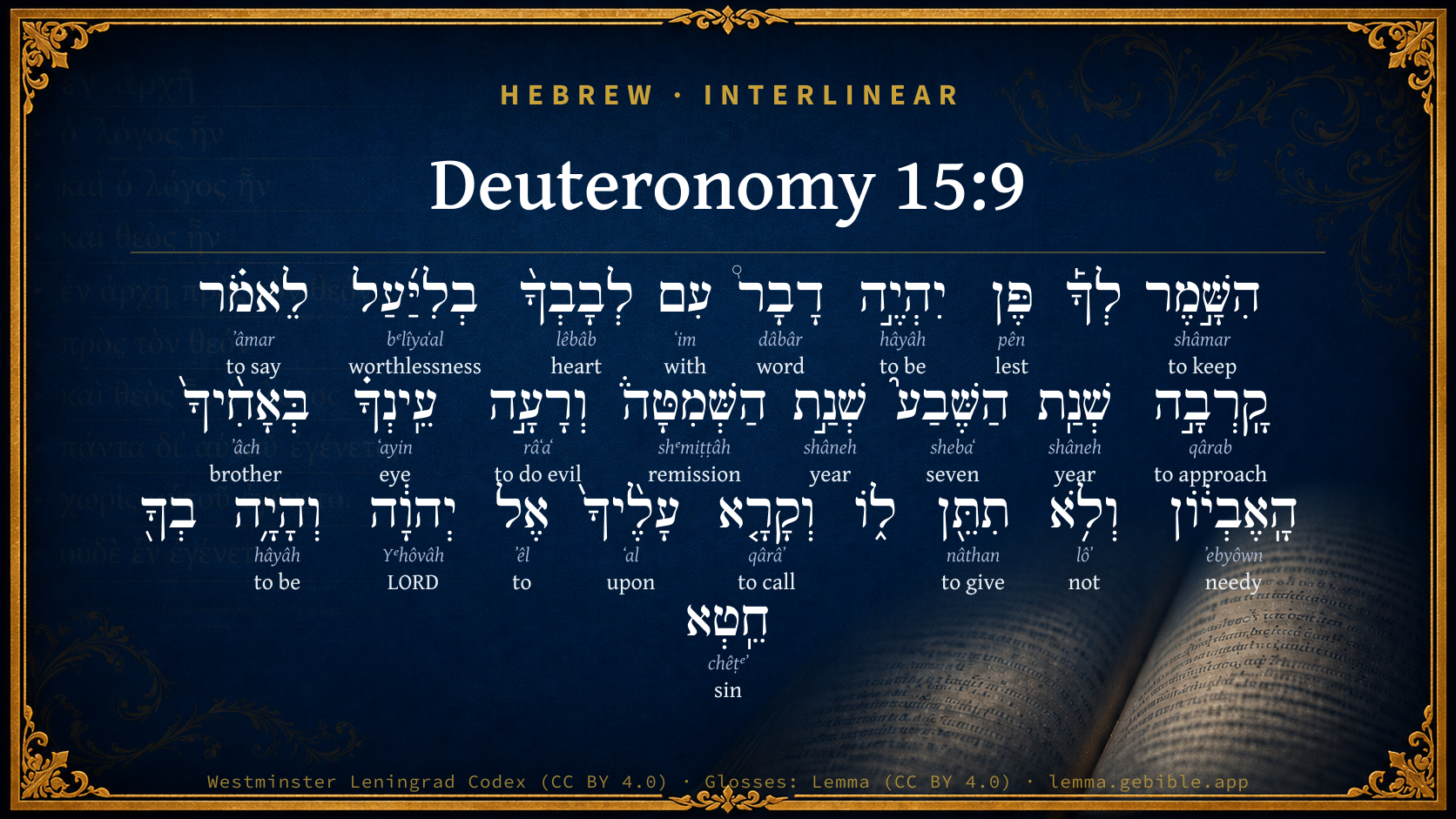
Hebrew (Westminster Leningrad Codex) Deuteronomy 15:9 appears in the Hebrew Old Testament. The text above is from the Westminster Leningrad Codex. Each word links to its Strong’s number, a concise gloss, and parsing drawn from the Open Scriptures Hebrew Bible morphology. Click any word for its full Brown-Driver-Briggs (BDB) entry.
Download image
Cite this verse

Deuteronomy 15:9 (World English Bible). Public Domain. Lemma interlinear Bible study tool, https://lemma.gebible.app/v/deuteronomy/15/9.

Show BibTeX & RIS
BibTeX
RIS
English Translation
Beware that there not be a base thought in your heart, saying, The seventh year, the year of release, is at hand; and your eye be evil against your poor brother, and you give him nothing; and he cry to Yahweh against you, and it be sin to you.
World English Bible · Public Domain
Download a study sheet

One document with this verse’s original text, its word-by-word gloss line, the meaning frame, cross-references with their text, attributed commentary, and full source and license credits — printable, and it pastes into notes with its structure intact.

This verse Autodidact and up

Study sheet (.html) Plain text (.txt)

A passage Seminary Student

Up to 50 verses in one chapter. A passage sheet keeps up to 6 commentary sources and 12 cross-references per verse, in the order this page ranks them, and says so on the sheet whenever that leaves anything out. Ask for a single verse and you get the Autodidact verse sheet above.

Everything on this page stays free to read, with no account — the sheet is a download of what is already on screen, not access to it.

Want to remove ads? Support Godless Engineer
Compare translations 3

The same verse in 3 English versions, stacked beneath the original-language interlinear above. Click any original word for its lexicon entry.

Each is an independent rendering of the whole verse — the interlinear is not word-aligned to these translations.

Highlighted words mark where these versions differ — a whole-verse word diff, not a word-by-word alignment.

  • World English Bible Public Domain
    Beware that there not be a base thought in your heart, saying, The seventh year, the year of release, is at hand; and your eye be evil against your poor brother, and you give him nothing; and he cry to Yahweh against you, and it be sin to you.
  • King James Version Public Domain
    Beware that there be not a thought in thy wicked heart, saying, The seventh year, the year of release, is at hand; and thine eye be evil against thy poor brother, and thou givest him nought; and he cry unto the LORD against thee, and it be sin unto thee.
  • unfoldingWord Literal Text CC BY-SA 4.0
    Watch yourselves, lest there be a wicked matter in your heart, saying, ‘The seventh year, the year of remission, near,’ and you do wrong in your eyes against your poor brother and do not give to him, and he calls out to Yahweh about you, and it would be sin for you.

unfoldingWord Literal Text — © unfoldingWord, licensed CC BY-SA 4.0. Word-aligned USFM3 via Door43 (git.door43.org/unfoldingWord/en_ult).

Versions to compare (up to 4)

3 of 4 selected

Show all 18 translations

Every available English version of this verse, each an independent rendering of the whole verse.

  • World English Bible Public Domain
    Beware that there not be a base thought in your heart, saying, The seventh year, the year of release, is at hand; and your eye be evil against your poor brother, and you give him nothing; and he cry to Yahweh against you, and it be sin to you.
  • Berean Standard Bible Public Domain
    Be careful not to harbor this wicked thought in your heart: “The seventh year, the year of release, is near,” so that you look upon your poor brother begrudgingly and give him nothing. He will cry out to the LORD against you, and you will be guilty of sin.
  • Majority Standard Bible Public Domain
    Be careful not to harbor this wicked thought in your heart: “The seventh year, the year of release, is near,” so that you look upon your poor brother begrudgingly and give him nothing. He will cry out to the LORD against you, and you will be guilty of sin.
  • King James Version Public Domain
    Beware that there be not a thought in thy wicked heart, saying, The seventh year, the year of release, is at hand; and thine eye be evil against thy poor brother, and thou givest him nought; and he cry unto the LORD against thee, and it be sin unto thee.
  • American Standard Version (1901) Public Domain
    Beware that there be not a base thought in thy heart, saying, The seventh year, the year of release, is at hand; and thine eye be evil against thy poor brother, and thou give him nought; and he cry unto Jehovah against thee, and it be sin unto thee.
  • Revised Version (1885) Public Domain
    Beware that there be not a base thought in thine heart, saying, The seventh year, the year of release, is at hand; and thine eye be evil against thy poor brother, and thou give him nought; and he cry unto the LORD against thee, and it be sin unto thee.
  • Geneva Bible (1599) Public Domain
    Beware that there be not a wicked thought in thine heart, to say, The seuenth yeere, the yeere of freedome is at hand: therefore it grieueth thee to looke on thy poore brother, and thou giuest him nought, and he crie vnto the Lord against thee, so that sinne be in thee:
  • Douay-Rheims (1899) Public Domain
    Beware lest perhaps a wicked thought steal in upon thee, and thou say in thy heart: The seventh year of remission draweth nigh; and thou turn away thy eyes from thy poor brother, denying to lend him that which he asketh: lest he cry against thee to the Lord, and it become a sin unto thee.
  • Young's Literal Translation Public Domain
    `Take heed to thee lest there be a word in thy heart -- worthless, saying, Near `is' the seventh year, the year of release; and thine eye is evil against thy needy brother, and thou dost not give to him, and he hath called concerning thee unto Jehovah, and it hath been in thee sin;
  • Literal Standard Version CC BY-SA 4.0
    Take heed to yourself lest there be a worthless word in your heart, saying, The seventh year [is] near, the year of release; and your eye is evil against your needy brother, and you do not give to him, and he has called to YHWH concerning you, and it has been sin in you;
  • Unlocked Literal Bible CC BY-SA 4.0
    Be careful not to have a wicked thought in your heart, saying, 'The seventh year, the year of release, is near,' so that you will not be stingy in regard to your poor brother and give him nothing; he might cry out to Yahweh about you, and it would be sin for you.
  • unfoldingWord Literal Text CC BY-SA 4.0
    Watch yourselves, lest there be a wicked matter in your heart, saying, ‘The seventh year, the year of remission, near,’ and you do wrong in your eyes against your poor brother and do not give to him, and he calls out to Yahweh about you, and it would be sin for you.
  • Darby Bible Public Domain
    Beware that there be not a wicked thought in thy heart, saying, The seventh year, the year of release, is at hand; and thine eye be evil against thy poor brother, and thou givest him nought; and he cry against thee to Jehovah, and it be sin in thee.
  • World Messianic Bible Public Domain
    Beware that there not be a wicked thought in your heart, saying, “The seventh year, the year of release, is at hand,” and your eye be evil against your poor brother and you give him nothing; and he cry to the LORD against you, and it be sin to you.
  • Webster's Bible Public Domain
    Beware that there be not a thought in thy wicked heart, saying, The seventh year, the year of release, is at hand; and thy eye shall be evil against thy poor brother, and thou shalt give him naught; and he shall cry to the LORD against thee, and it shall be sin to thee.
  • Free Bible Version CC BY-SA 4.0
    Make sure you don't think evil thoughts like, “The seventh year is coming up when debts will be canceled,” so that you look down on the poor with a sneer and refuse to give them anything. They will complain to the Lord about you, and you will be found guilty of sin.
  • Bible in Basic English Public Domain
    And see that there is no evil thought in your heart, moving you to say to yourself, The seventh year, the year of forgiveness is near; and so looking coldly on your poor countryman you give him nothing; and he will make an outcry to the Lord against you, and it will be judged as sin in you.
  • JPS Tanakh (1917) Public Domain
    Beware that there be not a base thought in thy heart, saying: 'The seventh year, the year of release, is at hand'; and thine eye be evil against thy needy brother, and thou give him nought; and he cry unto the LORD against thee, and it be sin in thee.

Literal Standard Version (2020), Covenant Press — licensed CC BY-SA 4.0. Text via the HelloAO Bible API (eBible.org). Unlocked Literal Bible (unfoldingWord) — licensed CC BY-SA 4.0. Text via the HelloAO Bible API (eBible.org). unfoldingWord Literal Text — © unfoldingWord, licensed CC BY-SA 4.0. Word-aligned USFM3 via Door43 (git.door43.org/unfoldingWord/en_ult). Free Bible Version, Dr. Jonathan Gallagher — licensed CC BY-SA 4.0. Text via the HelloAO Bible API (eBible.org).

Word by word

More ways to search: Search by grammar → Find every occurrence → Compare this word →

Practice this passage: Drill this verse → Learn its vocabulary →

הַשְּׁמִטָּה֒
shᵉmiṭṭâh
H8059
“the · remission”
Particle, Definite Article + Noun, Common, Feminine, Singular, Absolute
Part of Speech
Particle + Noun
Type
Common
Gender
Feminine
Number
Singular
State
Absolute
Full BDB Definition

Origin: from H8058

TWOT: 2408a

letting drop of exactions, (temporary) remitting, release (from debt)
  1. הִשָּׁ֣מֶר shâmar H8104 “keep” Verb, Niphal, Imperative, 2nd Person, Masculine, Singular
  2. פֶּן pên H6435 “lest” Conjunction
  3. יִהְיֶ֣ה hâyâh H1961 “to be” Verb, Qal, Imperfect, 3rd Person, Masculine, Singular
  4. דָבָר֩ dâbâr H1697 “word” Noun, Common, Masculine, Singular, Absolute
  5. עִם ʻim H5973 “with” Preposition
  6. לְבָבְךָ֨ lêbâb H3824 “heart · your” Noun, Common, Masculine, Singular, Construct + Suffix, Personal, 2nd Person, Masculine, Singular
  7. בְלִיַּ֜עַל bᵉlîyaʻal H1100 “worthlessness” Noun, Common, Masculine, Singular, Absolute
  8. לֵאמֹ֗ר ʼâmar H559 “to say” Preposition + Verb, Qal, Infinitive Construct
  9. קָֽרְבָ֣ה qârab H7126 “to approach” Verb, Qal, Perfect, 3rd Person, Feminine, Singular
  10. שְׁנַֽת shâneh H8141 “year of” Noun, Common, Feminine, Singular, Construct
  11. הַשֶּׁבַע֮ shebaʻ H7651 “the · seven” Particle, Definite Article + Adjective, Cardinal number, Feminine, Singular, Absolute
  12. שְׁנַ֣ת shâneh H8141 “year of” Noun, Common, Feminine, Singular, Construct
  13. וְרָעָ֣ה râʻaʻ H7489 “and · to do evil” Conjunction + Verb, Qal, Sequential Perfect, 3rd Person, Feminine, Singular
  14. עֵֽינְךָ֗ ʻayin H5869 “eye · your” Noun, Common, Both, Singular, Construct + Suffix, Personal, 2nd Person, Masculine, Singular
  15. בְּאָחִ֨יךָ֙ ʼâch H251 “in/at · brother · your” Preposition + Noun, Common, Masculine, Singular, Construct + Suffix, Personal, 2nd Person, Masculine, Singular
  16. הָֽאֶבְי֔וֹן ʼebyôwn H34 “the · needy” Particle, Definite Article + Adjective, Adjective, Masculine, Singular, Absolute
  17. וְלֹ֥א lôʼ H3808 “and · not” Conjunction + Particle, Negative
  18. תִתֵּ֖ן nâthan H5414 “to give” Verb, Qal, Imperfect, 2nd Person, Masculine, Singular
  19. וְקָרָ֤א qârâʼ H7121 “and · to call” Conjunction + Verb, Qal, Sequential Perfect, 3rd Person, Masculine, Singular
  20. עָלֶ֨יךָ֙ ʻal H5921 “upon · you” Preposition + Suffix, Personal, 2nd Person, Masculine, Singular
  21. אֶל ʼêl H413 “to” Preposition
  22. יְהוָ֔ה Yᵉhôvâh H3068 “LORD” Noun, Proper
  23. וְהָיָ֥ה hâyâh H1961 “and · to be” Conjunction + Verb, Qal, Sequential Perfect, 3rd Person, Masculine, Singular
  24. חֵֽטְא chêṭᵉʼ H2399 “sin” Noun, Common, Masculine, Singular, Absolute

About this verse

These counts appear in no published source. They are computed here, from the morphology-tagged text and Lemma’s own curated glosses. What Lemma adds →

28
words
23
distinct lemmas
Pentateuch
section

Notable vocabulary

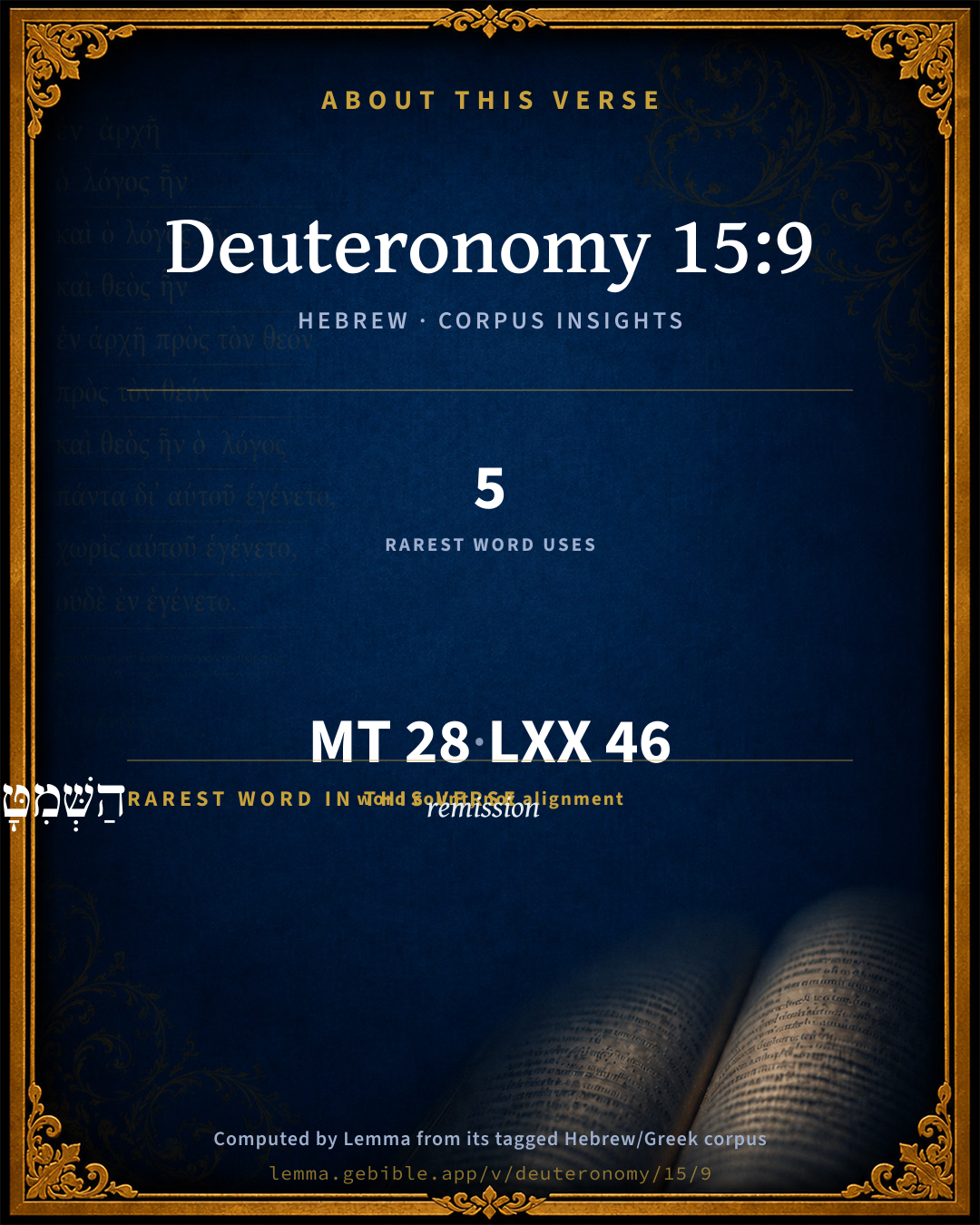
The rarest word here is הַשְּׁמִטָּה֒ remission H8059 — appearing just 5 times in the whole Hebrew Bible.

Shared distinctive vocabulary

הַשְּׁמִטָּה֒ remission H8059 occurs in 4 verses of the Hebrew Bible. Also found in:

Grammatical profile

  • 8 verbs
  • 10 nouns
  • 2 adjectives
  • 6 prepositions
  • 1 conjunction
  • 1 particle

Verb forms

  • הִשָּׁ֣מֶר Niphal · Imperative
  • יִהְיֶ֣ה Qal · Imperfect
  • לֵאמֹ֗ר Qal · Infinitive Construct
  • קָֽרְבָ֣ה Qal · Perfect
  • וְרָעָ֣ה Qal · Sequential Perfect
  • תִתֵּ֖ן Qal · Imperfect
  • וְקָרָ֤א Qal · Sequential Perfect
  • וְהָיָ֥ה Qal · Sequential Perfect

Repetition

Words recur within this verse — often emphatic in Hebrew:

  • יִהְיֶ֣ה to be H1961 ×2
  • שְׁנַֽת year H8141 ×2

Hebrew & Septuagint length

In English translation the verse runs 49 words from the Hebrew and 63 from the Septuagint (LXX English) — closely comparable.

A rough comparison of the two English renderings, which tokenize alike — not a word-level alignment.

Word counts can differ between the Hebrew and the Greek without any difference in meaning — e.g. the Hebrew direct-object marker אֵת has no separate Greek word, and Greek often adds the article ὁ.

In the original languages it is 28 Hebrew tokens and 46 Greek tokens — but the two are counted differently (Hebrew bundles its prefixes and suffixes into one token; the Greek is in lemma form), so that isn’t a like-for-like length.

Cross-references

24

Topical passages linked to Deuteronomy 15:9 in the Treasury of Scripture Knowledge — connected by theme and wording, ordered by reader-vote popularity; previews shown in the World English Bible.

  • Deuteronomy 24:15 in his day you shall give him his hire, neither shall the sun go down on it; for he is poor, and sets his heart on it: lest he cry against you to Yahweh, and it be sin to you.
  • Matthew 20:15 Isn't it lawful for me to do what I want to with what I own? Or is your eye evil, because I am good?'
  • Exodus 22:23 If you take advantage of them at all, and they cry at all to me, I will surely hear their cry;
  • Jeremiah 17:10 I, Yahweh, search the mind, I try the heart, even to give every man according to his ways, according to the fruit of his doings.
  • Mark 7:21–22 For from within, out of the hearts of men, proceed evil thoughts, adulteries, sexual sins, murders, thefts,
  • James 5:9 Don't grumble, brothers, against one another, so that you won't be judged. Behold, the judge stands at the door.
  • Exodus 3:7 Yahweh said, "I have surely seen the affliction of my people who are in Egypt, and have heard their cry because of their taskmasters, for I know their sorrows.
  • Job 34:28 So that they caused the cry of the poor to come to him, He heard the cry of the afflicted.
  • Proverbs 23:6 Don't eat the food of him who has a stingy eye, And don't crave his delicacies:
  • Proverbs 28:22 A stingy man hurries after riches, And doesn't know that poverty waits for him.
  • Matthew 15:19 For out of the heart come forth evil thoughts, murders, adulteries, sexual sins, thefts, false testimony, and blasphemies.
  • James 5:4 Behold, the wages of the laborers who mowed your fields, which you have kept back by fraud, cry out, and the cries of those who reaped have entered into the ears of the Lord of Hosts.
  • Deuteronomy 15:1 At the end of every seven years you shall make a release.
  • Deuteronomy 28:54–56 The man who is tender among you, and very delicate, his eye shall be evil toward his brother, and toward the wife of his bosom, and toward the remnant of his children whom he has remaining;
  • Psalms 9:12 For he who avenges blood remembers them. He doesn't forget the cry of the afflicted.
  • Proverbs 4:23 Keep your heart with all diligence, For out of it is the wellspring of life.
  • Proverbs 21:13 Whoever stops his ears at the cry of the poor, He will also cry out, but shall not be heard.
  • Proverbs 24:9 The schemes of folly are sin. The mocker is detested by men.
  • Matthew 25:41–45 Then he will say also to those on the left hand, 'Depart from me, you cursed, into the eternal fire which is prepared for the devil and his angels;
  • Romans 7:8–9 But sin, finding occasion through the commandment, produced in me all kinds of coveting. For apart from the law, sin is dead.
  • James 4:5 Or do you think that the Scripture says in vain, "The Spirit who lives in us yearns jealously"?
  • James 4:17 To him therefore who knows to do good, and doesn't do it, to him it is sin.
  • 1 Peter 4:9 Be hospitable one to another without grumbling.
  • 1 John 3:15–17 Whoever hates his brother is a murderer, and you know that no murderer has eternal life remaining in him.

Cross-references courtesy of OpenBible.info (CC BY 4.0).

Hebrew and Greek witnesses Masoretic Hebrew ↔ Greek Septuagint

The same verse in the two great witnesses to the Old Testament, shown verse-for-verse.

These are two independent witnesses, not word-aligned to each other, and the Septuagint is shown in lemma (dictionary) form.

Hebrew Deuteronomy 15:9 Masoretic · Westminster Leningrad Codex

הִשָּׁ֣מֶר לְךָ֡ פֶּן יִהְיֶ֣ה דָבָר֩ עִם לְבָבְךָ֨ בְלִיַּ֜עַל לֵאמֹ֗ר קָֽרְבָ֣ה שְׁנַֽת הַשֶּׁבַע֮ שְׁנַ֣ת הַשְּׁמִטָּה֒ וְרָעָ֣ה עֵֽינְךָ֗ בְּאָחִ֨יךָ֙ הָֽאֶבְי֔וֹן וְלֹ֥א תִתֵּ֖ן ל֑וֹ וְקָרָ֤א עָלֶ֨יךָ֙ אֶל יְהוָ֔ה וְהָיָ֥ה בְךָ֖ חֵֽטְא

Beware that there not be a base thought in your heart, saying, The seventh year, the year of release, is at hand; and your eye be evil against your poor brother, and you give him nothing; and he cry to Yahweh against you, and it be sin to you.

World English Bible · Public Domain

Greek LXX Deuteronomy 15:9 Septuagint · lemma form

προςἔχω σεαυτοῦ μή γίγνομαι ῥῆμα κρυπτός ἐν ὁ καρδία σύ ἀνόμημα λέγω ἐγγίζω ὁ ἔτος ὁ ἕβδομος ἔτος ὁ ἄφεσις καί πονηρεύομαι ὁ ὀφθαλμός σύ ὁ ἀδελφός σύ ὁ ἐπιδέω καί οὐ δίδωμι αὐτός καί βοάω κατά σύ πρός κύριος καί εἰμί ἐν σύ ἁμαρτία μέγας

Take heed to yourself that there be not a secret thing in your heart, an iniquity, saying, The seventh year, the year of release, draws near; and your eye shall be evil to your brother that is in lack, and you shall not give to him, and he shall cry against you to the Lord, and there shall be great sin in you.

LXX2012 (modern English Septuagint) · Public Domain

Hebrew: Westminster Leningrad Codex (CC BY 4.0). Greek: Septuagint (public domain); English from LXX2012 (modern English Septuagint) (Public Domain). How the Septuagint differs from the Hebrew →

Targum (Aramaic paraphrase)

2

The Targum is the ancient Jewish Aramaic paraphrase of the Hebrew Scriptures — an interpretive translation, not the Hebrew text itself. Onkelos (literal) and Pseudo-Jonathan (expansive) render the Torah, and Jonathan the Prophets. Coverage is partial: where no permissively-licensed English translation exists for a verse, only the Aramaic is shown. This is verse-level text, not a word-by-word alignment to the Hebrew.

  1. Targum Onkelos Torah (Genesis–Deuteronomy)
    אִסְתַּמַר לָךְ דִילְמָא יְהֵי פִתְגָם עִם לִבָּךְ בִּרְשַׁע לְמֵימַר קְרִיבָא שַׁתָּא שְׁבִיעֲתָא שַׁתָּא דִשְׁמִטְתָא וְתַבְאֵשׁ עֵינָךְ בְּאָחוּךְ מִסְכֵּנָא וְלָא תִתֵּן לֵהּ וְיִקְרֵי עֲלָךְ קֳדָם יְיָ וִיהֵי בָךְ חוֹבָא

    (no public-domain English translation for this verse)

    Targum Onkelos — Aramaic: “Onkelos Genesis” (public domain); “Onkelos Exodus” (public domain); “Onkelos Leviticus” (public domain); “Onkelos Numbers” (public domain); “Onkelos Deuteronomy” (public domain). English: “Sefaria Community Translation” (CC0 1.0 (public-domain dedication)); “J.W. Etheridge. The Targums of Onkelos and Jonathan Ben Uzziel on the Pentateuch. London: Longmans, Green, 1862” (public domain). Text via Sefaria.

  2. Targum Pseudo-Jonathan Torah (Genesis–Deuteronomy)
    אִסְתַּמָּרוּ לְכוֹן דִּלְמָא יְהֵי פִּתְגָם עִם לִבְּכוֹן דְּזָדָנוּתָא לְמֵימָר קְרֵיבַת שַׁתָּא שְׁבִיעֲתָא שַׁתָּא דִשְׁמִיטְתָא וְתִבְאַשׁ עֵינֵיכוֹן בְּאָחוּכוֹן מִסְכֵּנָא וְלָא תִתְּנוּן לֵיהּ וְיִקְבּוֹל עֲלֵיכוֹן קֳדָם יְיָ וִיהֵי בְּכוֹן חוֹבָא

    Beware lest there be a word in thy proud heart, saying: The seventh year, the year of release, is at hand, and your eye become evil toward your poor brother, so as to be not willing to give to him, and he cry against you to the Lord, and there be guilt upon you.

    Targum Pseudo-Jonathan — Aramaic: “Targum Jonathan on Genesis” (public domain); “Targum Jonathan on Exodus” (public domain); “Targum Jonathan on Leviticus” (public domain); “Targum Jonathan on Numbers” (public domain); “Targum Jonathan on Deuteronomy” (public domain). English: “The Targum of Jonathan ben Uzziel, trans. J. W. Etheridge, London, 1862” (public domain). Text via Sefaria.

Commentary

Notes on Deuteronomy 15:9 from classic Christian and Jewish commentators (each source and its license shown beneath its notes). The classic Christian expositions comment on the surrounding passage and are grouped to its opening verse, so a note may address several verses; the Jewish commentaries on the Tanakh (Rashi and others) are per-verse, so they appear only where the commentator wrote on this verse.

Lemma curates 59 commentaries, every one of them public domain or Creative Commons licensed, each selected and text-cleaned for this edition rather than reprinted as found. About our sources →

Trapp's Complete Commentary

John Trapp

Deu 15:9 Beware that there be not a thought in thy wicked heart, saying, The seventh year, the year of release, is at hand; and thine eye be evil against thy poor brother, and thou givest him nought; and he cry unto the LORD against thee, and it be sin unto thee.

Ver. 9. And he cried unto the Lord.] Who is the poor man’s king, as James V of Scotland was termed for his charity.

John Trapp, A Commentary or Exposition upon All the Books of the Old and New Testament (1647–1656) — public domain. Text from a community e-Sword module.

Joseph Benson's Commentary

Deu 15:9-10. Beware — Suppress the first risings of such uncharitableness.

And thine eye be evil — Envious, unmerciful, unkind, as this phrase means, Pro 23:6; that is, thou grudge to relieve him. The opposite to this is a bountiful eye, Pro 22:9. And it be sin unto thee — Charged upon thee as a sin. Thy heart shall not be grieved — That is, thou shalt give, not only with an open hand, but with a willing and cheerful mind, without which thy very charity is uncharitable, and not accepted by God.

Joseph Benson's Commentary on the Old and New Testaments (1811–1818) — public domain. Text from a community e-Sword module.

Geneva Bible (1599)

Geneva Bible translators

Hebrew, thine eye is evil.

Geneva Bible (1599) marginal notes — public domain. Text via Bolls.life.

Adam Clarke's Commentary

Verse 9. Beware that there be not a thought in thy wicked heart] לבבך בליעל lebabecha beliyaal, thy belial heart, that is, thy good-for-nothing or unprofitable heart; See Clarke on De 13:13.

And thine eye be evil] An evil eye signifies a covetous disposition. See the same form of expression used by our Lord in the same sense. Mt 6:23. If thine eye be evil - If thou be a covetous person. Evil eye is by our Lord opposed to single eye, i. e., a person of a liberal, benevolent mind. Covetousness darkens the soul; liberality and benevolence enlighten it.

And he cry unto the Lord against thee] What a consolation to the poor and the oppressed, that they have a sure friend in God, who will hear their cry and redress their grievances!

Adam Clarke's Commentary on the Bible (1810–1826) — public domain. Text from a community e-Sword/MySword module.

The Cambridge Bible for Schools and Colleges

gen. ed. J. J. S. Perowne

9. Beware] be on guard with respect to thyself; see on Deu_4:9.

a base thought in thine heart] Lit. a word or thing in thine heart, baseness, or worthlessness: beliya‘al; see on Deu_13:13 (14).

thine eye be evil] cruel or grudging, Deu_28:54; Deu_28:56; the opposite of tender or compassionate.

and it be sin unto thee] ‘that which we think our Prudence oft proves sin to us’ (M. Henry).

The Cambridge Bible for Schools and Colleges (gen. ed. J. J. S. Perowne; Cambridge University Press, 1878–1918) — public domain. Text from a community e-Sword module.

John Gill's Exposition

Beware that there be not a thought in thy wicked heart,.... "Or, thy heart of Belial" (f); thy worthless heart, and which is without a yoke not subjected to the law of God, as every carnal heart is; and in which Belial, Satan, the prince of this world, works effectually, and inclines to evil thoughts, afflictions, and desires, which are to be guarded against:

saying, the seventh year, the year of release, is at hand: perhaps next year, or within a few months:

and thine eye be evil against thy brother, and thou give him nought; being of an uncompassionate and covetous disposition, shall refuse to give or lend him anything on this consideration, because the year of release will quickly come, when, if poor and unable to pay him, he would be obliged to release his debt:

and he cry unto the Lord against thee; go to the throne of grace, and in prayer bring a charge, and lodge a complaint of unkindness and uncharitableness: and it be a sin unto thee; the Lord shall reckon it as a sin, a very heinous one, and call to an account for it.

(f) "corde tuo Belial", Montanus.

John Gill's Exposition of the Whole Bible (1746–1763) — public domain (CC PDM 1.0). Text via the HelloAO Bible API.

Haydock's Catholic Bible Commentary

Eyes. Hebrew, "and thy eye be evil against," &c. This expression denotes one who is a prey to the base passions of avarice, jealousy, envy, &c., chap. xxviii. 54., and Matthew xx. 15. (Calmet) --- A sin, or draw on punishment. (Menochius) --- "If thou hast not fed, thou hast killed" thy neighbour in extreme want. (St. Ambrose, Off. ii. 7.) (Worthington)

George Leo Haydock (1774–1849), Haydock's Catholic Family Bible and Commentary, 1859 edition — public domain. Excludes Psalms (Douay-Rheims chapter numbering differs from Protestant) and Deuterocanonical books (Catholic canon only).

Matthew Poole's English Annotations

Beware that there be not a thought in thy wicked heart; suppress the first risings and inward motions of such uncharitableness.

Thine eye be evil, i.e. envious, unmerciful, unkind, as this phrase is used, Pro 23:6; Mat 20:15; as a good eye notes the contrary disposition, Pro 22:9.

It be sin, i.e. it be charged upon thee as a sin, and as a great sin, as the word sin sometimes signifies, as Pro 24:9; Joh 15:24; Jam 4:17.

Matthew Poole's English Annotations on the Holy Bible (1683–1685) — public domain. Text from a community e-Sword/MySword module.

Whedon's Commentary on the Bible

Daniel D. Whedon

9. Beware that there be not a thought in thy wicked heart — The original is very forcible. Lest there be a wicked thing in thy heart.

Daniel D. Whedon (gen. ed.), Commentary on the Old and New Testaments (1874–1909) — public domain. Text from a community e-Sword module.

The Pulpit Commentary

A thought in thy wicked heart; literally, a thing in thy heart worthlessness, i.e. a thing which is worthless and unworthy. The word used is belial (lYliB), which does not denote that which is wicked so much as that which is worthless. Thus, "a man of Belial" is a worthless fellow not necessarily a wicked man. (of Deu_13:13) And it be sin unto thee; i.e. entail guilt upon thee, and so expose thee to the Divine displeasure.

The Pulpit Commentary (1880–1919), ed. H.D.M. Spence-Jones & Joseph S. Exell — public domain. Text from a community e-Sword module.

John Wesley's Explanatory Notes

Beware - Suppress the first risings of such uncharitableness. It be sin - That is, it be charged upon thee as a sin.

John Wesley, Explanatory Notes Upon the Whole Bible (1754–1765) — public domain. Text via the GEBible commentary corpus.

Keil & Delitzsch

C. F. Keil & F. Delitzsch

Thus they were also to beware "that there was not a word in the heart, worthlessness," i.e., that a worthless thought did not arise in their hearts (בּליּעל is the predicate of the sentence, as the more precise definition of the word that was in the heart); so that one should say, "The seventh year is at hand, the year of release," sc., when I shall not be able to demand what I have lent, and "that thine eye be evil towards thy poor brother," i.e., that thou cherishest ill-will towards him (cf. Deu 28:54, Deu 28:56), "and givest him not, and he appeals to Jehovah against thee, and it becomes sin to thee," sc., which brings down upon thee the wrath of God.

Deu 15:10

Thou shalt give him, and thy heart shall not become evil, i.e., discontented thereat (cf. Co2 9:7), for Jehovah will bless thee for it (cf. Pro 22:9; Pro 28:27; Psa 41:2; Mat 6:4).

Keil & Delitzsch — Biblical Commentary on the Old Testament (1861–1891) — public domain (CC PDM 1.0). Text via the HelloAO Bible API. (Old Testament only.)

unfoldingWord translationNotes

Door43 World Missions Community

not to have a wicked thought in your heart, saying

Here "heart" represents a person's mind. AT: "not to think a wicked thought" (See: Metonymy)

The seventh year, the year of release, is near

It is implied that because the year of release will happen soon, the person thinking this will be reluctant to help a poor person since it is likely that the poor person will not have to pay him back. The full meaning of this statement can be made clear. (See: Assumed Knowledge and Implicit Information)

The seventh year

The word "seventh" is the ordinal number for seven. (See: Ordinal Numbers)

the year of release

"the year to cancel debts"

is near

Something that will happen soon is spoken of as if it were physically near. AT: "will happen soon" (See: Metaphor)

so that you will not be stingy in regard to your poor brother and give him nothing

"so that you are not stubborn and refuse to give anything to your fellow Israelite"

cry out to Yahweh

"shout to Yahweh for help"

it would be sin for you

"Yahweh will consider what you have done to be sinful"

your heart must not be sorry

Here "heart" represents the whole person. AT: "you should not regret it" or "you should be happy" (See: Synecdoche and Litotes)

in all that you put your hand to

Here "put your hand to" represents the whole person and work that he has done. AT: "in all that you do" (See: Synecdoche)

translationWords

evil

heart

cry

sin

bless

works

hand

unfoldingWord translationNotes — © Distant Shores Media and the Door43 World Missions Community, licensed CC BY-SA 4.0. Source: git.door43.org/Door43/en_tn.

Rashi

Rabbi Shlomo Yitzchaki (Rashi)

וקרא עליך AND HE CRY [UNTO THE LORD] AGAINST THEE — One might think this is a command (“he shall call against thee”). Scripture, however, states, (Deuteronomy 24:15) “[At his day thou shalt give him his hire … he is poor], so that he may not call against thee [unto the Lord]” (Sifrei Devarim 117:5).

והיה בך חטא AND IT BE SIN UNTO THEE — under any circumstances, even if he does not cry against thee. But if this be so, to what end is it written “and he cry against thee”? It suggests that I will make greater haste to punish thee because of him who cries, than because of one who does not cry (Sifrei Devarim 117:5).

Rashi on the Tanakh — English translations: “The Judaica Press complete Tanach with Rashi, translated by A. J. Rosenberg” (CC BY 4.0); “Pentateuch with Rashi's commentary by M. Rosenbaum and A.M. Silbermann, 1929-1934” (public domain); “The Metsudah Tanach series, Lakewood, N.J” (CC BY 4.0); and “The Book of Joshua, Metsudah Publications, 1997” (CC BY 4.0). Text via Sefaria.

Lesson kit

Teaching starters — assembled from the data on this page, not authored interpretation. Every prompt links to the verse data it draws on. Edit before teaching.

Deuteronomy, in the Pentateuch, opens this verse with 28 words (23 distinct Hebrew lemmas). Its most distinctive word is shᵉmiṭṭâh (“remission”). A historical commentator’s framing appears above. Read the whole chapter for the surrounding context.

Discussion questions

  1. The word shᵉmiṭṭâh carries the sense “remission.” How does it shape the verse?
  2. Deuteronomy 15:1 shares the word «remission» with this verse. How do the two illuminate each other?
  3. “to be” occurs 2× in this one verse. What is the effect of the repetition?
  4. These translations render this verse differently. What is at stake in choosing one wording over another?
  5. The verb «הִשָּׁ֣מֶר» is Niphal Imperative. How does its form color the action?
  6. Reading how Trapp's Complete Commentary and Joseph Benson's Commentary read this verse, where do the two commentators agree and where do they part?

Things to notice

Reading settings

Reading text

Shown beneath each verse's original-language words.

Old Testament
Old Testament edition

Read the OT as the Masoretic Hebrew (MT) or the Greek Septuagint (LXX).

English shown for the Greek Septuagint (in the Hebrew ↔ Greek comparison).

Comparing translations? Open the Compare panel on any verse page to stack up to four side by side.