
Nehemiah 2:13

Hebrew (Westminster Leningrad Codex) Nehemiah 2:13 appears in the Hebrew Old Testament. The text above is from the Westminster Leningrad Codex. Each word links to its Strong’s number, a concise gloss, and parsing drawn from the Open Scriptures Hebrew Bible morphology. Click any word for its full Brown-Driver-Briggs (BDB) entry.
Download image
Cite this verse

Nehemiah 2:13 (World English Bible). Public Domain. Lemma interlinear Bible study tool, https://lemma.gebible.app/v/nehemiah/2/13.

Show BibTeX & RIS
BibTeX
RIS
English Translation
I went out by night by the valley gate, even toward the jackal's well, and to the dung gate, and viewed the walls of Jerusalem, which were broken down, and the gates of it were consumed with fire.
World English Bible · Public Domain
Download a study sheet

One document with this verse’s original text, its word-by-word gloss line, the meaning frame, cross-references with their text, attributed commentary, and full source and license credits — printable, and it pastes into notes with its structure intact.

This verse Autodidact and up

Study sheet (.html) Plain text (.txt)

A passage Seminary Student

Up to 50 verses in one chapter. A passage sheet keeps up to 6 commentary sources and 12 cross-references per verse, in the order this page ranks them, and says so on the sheet whenever that leaves anything out. Ask for a single verse and you get the Autodidact verse sheet above.

Everything on this page stays free to read, with no account — the sheet is a download of what is already on screen, not access to it.

Want to remove ads? Support Godless Engineer
Compare translations 3

The same verse in 3 English versions, stacked beneath the original-language interlinear above. Click any original word for its lexicon entry.

Each is an independent rendering of the whole verse — the interlinear is not word-aligned to these translations.

Highlighted words mark where these versions differ — a whole-verse word diff, not a word-by-word alignment.

  • World English Bible Public Domain
    I went out by night by the valley gate, even toward the jackal's well, and to the dung gate, and viewed the walls of Jerusalem, which were broken down, and the gates of it were consumed with fire.
  • King James Version Public Domain
    And I went out by night by the gate of the valley, even before the dragon well, and to the dung port, and viewed the walls of Jerusalem, which were broken down, and the gates thereof were consumed with fire.
  • unfoldingWord Literal Text CC BY-SA 4.0
    And I went out at the gate of the valley at night, even to the face of the spring of the dragon, and to the gate of dung. And I was looking intently at the walls of Jerusalem, seeing that they were broken down, and its gates had been consumed by fire.

unfoldingWord Literal Text — © unfoldingWord, licensed CC BY-SA 4.0. Word-aligned USFM3 via Door43 (git.door43.org/unfoldingWord/en_ult).

Versions to compare (up to 4)

3 of 4 selected

Show all 18 translations

Every available English version of this verse, each an independent rendering of the whole verse.

  • World English Bible Public Domain
    I went out by night by the valley gate, even toward the jackal's well, and to the dung gate, and viewed the walls of Jerusalem, which were broken down, and the gates of it were consumed with fire.
  • Berean Standard Bible Public Domain
    So I went out at night through the Valley Gate toward the Well of the Serpent and the Dung Gate, and I inspected the walls of Jerusalem that had been broken down and the gates that had been destroyed by fire.
  • Majority Standard Bible Public Domain
    So I went out at night through the Valley Gate toward the Well of the Serpent and the Dung Gate, and I inspected the walls of Jerusalem that had been broken down and the gates that had been destroyed by fire.
  • King James Version Public Domain
    And I went out by night by the gate of the valley, even before the dragon well, and to the dung port, and viewed the walls of Jerusalem, which were broken down, and the gates thereof were consumed with fire.
  • American Standard Version (1901) Public Domain
    And I went out by night by the valley gate, even toward the jackal's well, and to the dung gate, and viewed the walls of Jerusalem, which were broken down, and the gates thereof were consumed with fire.
  • Revised Version (1885) Public Domain
    And I went out by night by the valley gate, even toward the dragon’s well, and to the dung gate, and viewed the walls of Jerusalem, which were broken down, and the gates thereof were consumed with fire.
  • Geneva Bible (1599) Public Domain
    And I went out by night by the gate of the valley, and came before the dragon well, and to the dung porte, and vewed the walles of Ierusalem, howe they were broken downe, and the portes thereof deuoured with the fire.
  • Douay-Rheims (1899) Public Domain
    And I went out by night by the gate of the valley, and before the dragon fountain, and to the dung gate, and I viewed the wall of Jerusalem which was broken down, and the gates thereof which were consumed with fire.
  • Young's Literal Translation Public Domain
    And I go out through the gate of the valley by night, and unto the front of the fountain of the dragon, and unto the gate of the dunghill, and I am measuring about the walls of Jerusalem, that are broken down, and its gates consumed with fire.
  • Literal Standard Version CC BY-SA 4.0
    And I go out through the Valley Gate by night, and to the front of the Dragon Fountain, and to the Refuse Gate, and I am inspecting the walls of Jerusalem, that are broken down, and its gates consumed with fire.
  • Unlocked Literal Bible CC BY-SA 4.0
    I went out by night by the Valley Gate, toward the Jackal's Well and to the Dung Gate, and inspected the walls of Jerusalem, which had been broken open, and the wooden gates were destroyed by fire.
  • unfoldingWord Literal Text CC BY-SA 4.0
    And I went out at the gate of the valley at night, even to the face of the spring of the dragon, and to the gate of dung. And I was looking intently at the walls of Jerusalem, seeing that they were broken down, and its gates had been consumed by fire.
  • Darby Bible Public Domain
    And I went out by night by the valley-gate, even toward the jackal-fountain, and to the dung-gate; and I viewed the walls of Jerusalem, which were in ruins, and its gates were consumed with fire.
  • World Messianic Bible Public Domain
    I went out by night by the valley gate toward the jackal’s well, then to the dung gate; and I inspected the walls of Jerusalem, which were broken down, and its gates were consumed with fire.
  • Webster's Bible Public Domain
    And I went out by night by the gate of the valley, even before the dragon-well, and to the dung-port, and viewed the walls of Jerusalem, which were broken down, and their gates were consumed with fire.
  • Free Bible Version CC BY-SA 4.0
    So I rode in the dark through the Valley Gate toward the Spring of the Serpent and the Refuse Gate, and I inspected Jerusalem's walls that had been knocked over and the gates that had been burned down.
  • Bible in Basic English Public Domain
    And I went out by night, through the doorway of the valley, and past the dragon's water-spring as far as the place where waste material was put, viewing the walls of Jerusalem which were broken down, and the doorways which had been burned with fire.
  • JPS Tanakh (1917) Public Domain
    And I went out by night by the valley gate, even toward the dragon's well, and to the dung gate, and viewed the walls of Jerusalem, which were broken down, and the gates thereof were consumed with fire.

Literal Standard Version (2020), Covenant Press — licensed CC BY-SA 4.0. Text via the HelloAO Bible API (eBible.org). Unlocked Literal Bible (unfoldingWord) — licensed CC BY-SA 4.0. Text via the HelloAO Bible API (eBible.org). unfoldingWord Literal Text — © unfoldingWord, licensed CC BY-SA 4.0. Word-aligned USFM3 via Door43 (git.door43.org/unfoldingWord/en_ult). Free Bible Version, Dr. Jonathan Gallagher — licensed CC BY-SA 4.0. Text via the HelloAO Bible API (eBible.org).

Word by word

More ways to search: Search by grammar → Find every occurrence → Compare this word →

Practice this passage: Drill this verse → Learn its vocabulary →

הָאַשְׁפֹּ֑ת
ʼashpôth
H830
“the · ash heap”
Particle, Definite Article + Noun, Common, Masculine, Singular, Absolute
Part of Speech
Particle + Noun
Type
Common
Gender
Masculine
Number
Singular
State
Absolute
Full BDB Definition

Origin: plural of a noun of the same form as H827 , from H8192 (in the sense of scraping)

TWOT: 2441b

ash heap, refuse heap, dung-hill
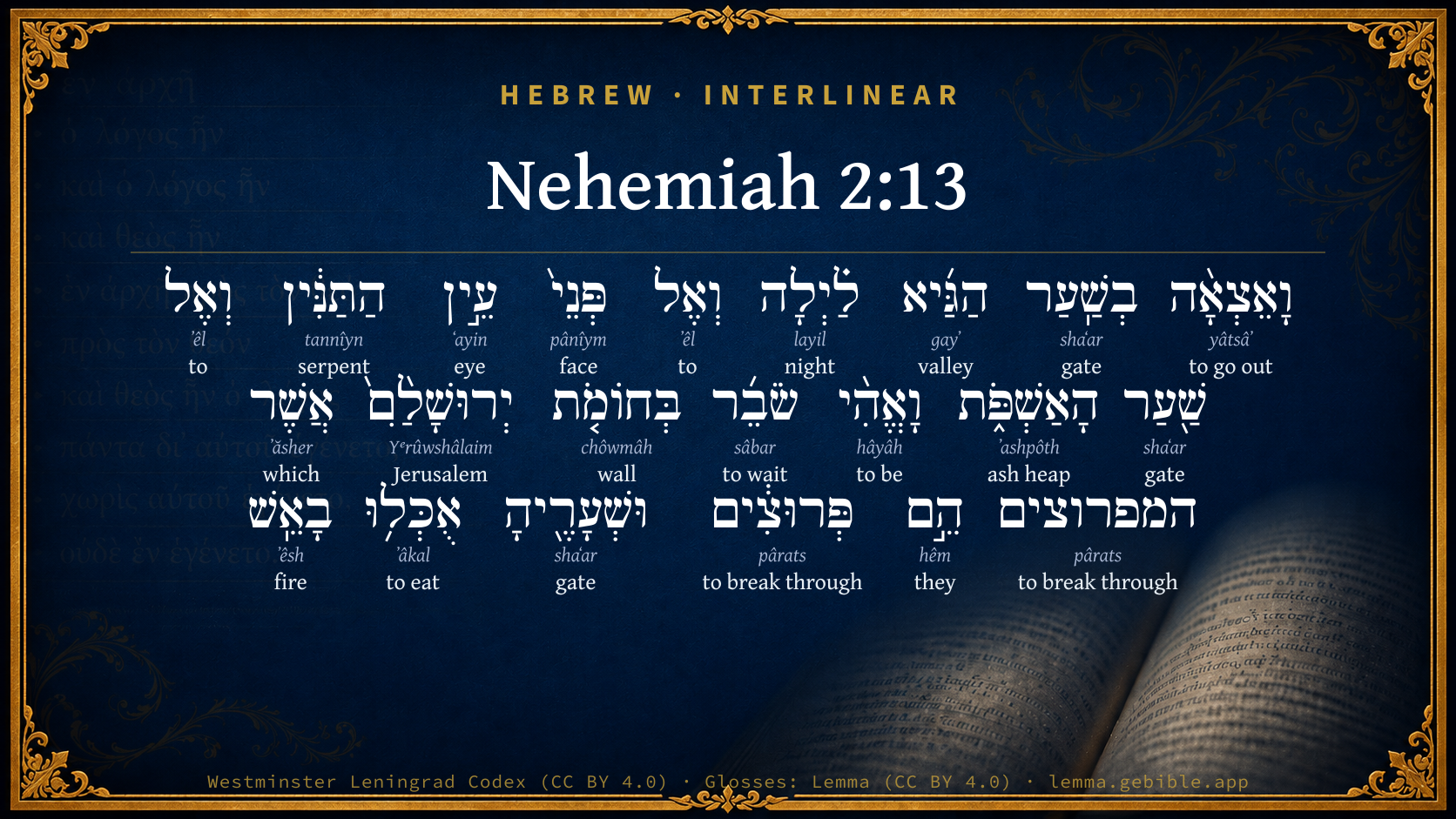
  1. וָאֵצְאָ֨ה yâtsâʼ H3318 “and · to go out” Conjunction + Verb, Qal, Sequential Imperfect, 1st Person, Common, Singular + Suffix, h
  2. בְשַֽׁעַר shaʻar H8179 “in/at · gate of” Preposition + Noun, Common, Masculine, Singular, Construct
  3. הַגַּ֜יא gayʼ H1516 “the · valley” Particle, Definite Article + Noun, Common, Both, Singular, Absolute
  4. לַ֗יְלָה layil H3915 “night” Noun, Common, Masculine, Singular, Absolute
  5. וְאֶל ʼêl H413 “and · to” Conjunction + Preposition
  6. פְּנֵי֙ pânîym H6440 “face(s) of” Noun, Common, Both, Plural, Construct
  7. עֵ֣ין ʻayin H5869 “eye” Noun, Proper
  8. הַתַּנִּ֔ין tannîyn H8577 “serpent” Noun, Proper
  9. וְאֶל ʼêl H413 “and · to” Conjunction + Preposition
  10. שַׁ֖עַר shaʻar H8179 “gate of” Noun, Common, Masculine, Singular, Construct
  11. וָאֱהִ֨י hâyâh H1961 “and · to be” Conjunction + Verb, Qal, Sequential Imperfect, 1st Person, Common, Singular
  12. שֹׂבֵ֜ר sâbar H7663 “waiting” Verb, Qal, Participle Active, Masculine, Singular, Absolute
  13. בְּחוֹמֹ֤ת chôwmâh H2346 “in/at · walls of” Preposition + Noun, Common, Feminine, Plural, Construct
  14. יְרוּשָׁלִַ֨ם֙ Yᵉrûwshâlaim H3389 “Jerusalem” Noun, Proper
  15. אֲשֶׁר ʼăsher H834 “which” Particle, Relative
  16. המפרוצים pârats H6555 “the · broken through” Particle, Definite Article + Verb, Pual, Participle Passive, Masculine, Plural, Absolute
  17. הֵ֣ם hêm H1992 “they” Pronoun, Personal, 3rd Person, Masculine, Plural
  18. פְּרוּצִ֔ים pârats H6555 “broken through” Verb, Qal, Participle Passive, Masculine, Plural, Absolute
  19. וּשְׁעָרֶ֖יהָ shaʻar H8179 “and · gates · her” Conjunction + Noun, Common, Masculine, Plural, Construct + Suffix, Personal, 3rd Person, Feminine, Singular
  20. אֻכְּל֥וּ ʼâkal H398 “to eat” Verb, Qal Passive, Perfect, 3rd Person, Common, Plural
  21. בָאֵֽשׁ ʼêsh H784 “in/at the · fire” Preposition, Determined + Noun, Common, Both, Singular, Absolute

About this verse

These counts appear in no published source. They are computed here, from the morphology-tagged text and Lemma’s own curated glosses. What Lemma adds →

22
words
18
distinct lemmas
Historical
section

Notable vocabulary

The rarest word here is הָאַשְׁפֹּ֑ת ash heap H830 — appearing just 7 times in the whole Hebrew Bible.

Shared distinctive vocabulary

הָאַשְׁפֹּ֑ת ash heap H830 occurs in 7 verses of the Hebrew Bible. Also found in:

Grammatical profile

  • 6 verbs
  • 12 nouns
  • 1 pronoun
  • 2 prepositions
  • 1 particle

Verb forms

  • וָאֵצְאָ֨ה Qal · Sequential Imperfect
  • וָאֱהִ֨י Qal · Sequential Imperfect
  • שֹׂבֵ֜ר Qal · Participle Active
  • המפרוצים Pual · Participle Passive
  • פְּרוּצִ֔ים Qal · Participle Passive
  • אֻכְּל֥וּ Qal Passive · Perfect

Repetition

Words recur within this verse — often emphatic in Hebrew:

  • בְשַֽׁעַר gate H8179 ×3
  • המפרוצים to break through H6555 ×2
  • וְאֶל to H413 ×2

Cross-references

8

Topical passages linked to Nehemiah 2:13 in the Treasury of Scripture Knowledge — connected by theme and wording, ordered by reader-vote popularity; previews shown in the World English Bible.

  • Nehemiah 1:3 They said to me, The remnant who are left of the captivity there in the province are in great affliction and reproach: the wall of Jerusalem also is broken down, and the gates of it are burned with fire.
  • 2 Chronicles 26:9 Moreover Uzziah built towers in Jerusalem at the corner gate, and at the valley gate, and at the turning [of the wall], and fortified them.
  • Nehemiah 2:3 I said to the king, Let the king live forever: why should not my face be sad, when the city, the place of my fathers' tombs, lies waste, and the gates of it are consumed with fire?
  • Nehemiah 2:17 Then said I to them, You see the evil case that we are in, how Jerusalem lies waste, and the gates of it are burned with fire: come, and let us build up the wall of Jerusalem, that we be no more a reproach.
  • Nehemiah 3:13–14 The valley gate repaired Hanun, and the inhabitants of Zanoah; they built it, and set up the doors of it, the bolts of it, and the bars of it, and one thousand cubits of the wall to the dung gate.
  • Nehemiah 2:15 Then went I up in the night by the brook, and viewed the wall; and I turned back, and entered by the valley gate, and so returned.
  • Nehemiah 12:31 Then I brought up the princes of Judah on the wall, and appointed two great companies who gave thanks and went in procession. [One went] on the right hand on the wall toward the dung gate;
  • Jeremiah 5:10 Go up on her walls, and destroy; but don't make a full end: take away her branches; for they are not Yahweh's.

Cross-references courtesy of OpenBible.info (CC BY 4.0).

Hebrew and Greek witnesses Masoretic Hebrew ↔ Greek Septuagint

The same verse in the two great witnesses to the Old Testament, shown verse-for-verse.

These are two independent witnesses, not word-aligned to each other, and the Septuagint is shown in lemma (dictionary) form.

Hebrew Nehemiah 2:13 Masoretic · Westminster Leningrad Codex

וָאֵצְאָ֨ה בְשַֽׁעַר הַגַּ֜יא לַ֗יְלָה וְאֶל פְּנֵי֙ עֵ֣ין הַתַּנִּ֔ין וְאֶל שַׁ֖עַר הָאַשְׁפֹּ֑ת וָאֱהִ֨י שֹׂבֵ֜ר בְּחוֹמֹ֤ת יְרוּשָׁלִַ֨ם֙ אֲשֶׁר המפרוצים הֵ֣ם פְּרוּצִ֔ים וּשְׁעָרֶ֖יהָ אֻכְּל֥וּ בָאֵֽשׁ

I went out by night by the valley gate, even toward the jackal's well, and to the dung gate, and viewed the walls of Jerusalem, which were broken down, and the gates of it were consumed with fire.

World English Bible · Public Domain

Greek LXX Structure differs

The Septuagint has no separate book of Nehemiah. Its Greek text is the second half of Esdras B (2 Esdras), chapters 11–23; Ezra is the first half (1–10).

A verse-for-verse comparison isn’t shown here because the chapters and verses don’t line up. Switch to the LXX edition with the MT / LXX toggle above to read the Greek directly.

On this verse, The Cambridge Bible for Schools and Colleges discusses the Septuagint’s reading. Read the note in Commentary ↓

Hebrew: Westminster Leningrad Codex (CC BY 4.0). Greek: Septuagint (public domain); English from a public-domain English Septuagint. How the Septuagint differs from the Hebrew →

Commentary

Notes on Nehemiah 2:13 from classic Christian and Jewish commentators (each source and its license shown beneath its notes). The classic Christian expositions comment on the surrounding passage and are grouped to its opening verse, so a note may address several verses; the Jewish commentaries on the Tanakh (Rashi and others) are per-verse, so they appear only where the commentator wrote on this verse.

Lemma curates 59 commentaries, every one of them public domain or Creative Commons licensed, each selected and text-cleaned for this edition rather than reprinted as found. About our sources →

The Cambridge Bible for Schools and Colleges

gen. ed. J. J. S. Perowne

13. by the gate of the valley] R.V. by the valley gate. The R.V. rendering is preferable, showing that Nehemiah is not merely defining the position of the gate but is referring to it by its recognised name.

The valley-gate is mentioned again in Neh_3:13. The king Uzziah according to 2Ch_26:9 had fortified this gate with towers. We may safely identify this gate as the chief gate in the western wall of Jerusalem, and as thus corresponding to the modern Jaffa Gate, although very possibly not standing at precisely the same spot. There were two well-known valleys outside the walls of Jerusalem, (1) the ‘valley’ or ‘ravine’ (gai) of Hinnom or ‘the son of Hinnom,’ i.e. Gehenna, cf. Jos_15:8; Jos_18:16; 2Ki_23:10; 2Ch_28:3; 2Ch_33:6; Neh_11:30; Jer_7:31-32; Jer_19:6; (2) the ‘valley’ or ‘brook’ or ‘watercourse’ (nakhal) of Kedron. In the present verse the word for ‘valley’ is ‘gai,’ and this fact coupled with the general topographical description here and in Neh_3:13, shows that ‘the valley-gate’ was the western gate leading out into the ravine of Hinnom.

Recent investigations, however, have given rise to the supposition that pre-exilic Jerusalem was much smaller in circuit and that the western wall passed down the valley of the Tyropoeon. If so, ‘the valley-gate’ would be the gate opening into the Tyropoeon, which in those days was a considerable ravine but has since become almost completely choked with accumulations of ruin. According to this view the Tyropoeon is to be identified with the Valley of the Son of Hinnom.

even before the dragon well] R.V. even towards the dragon’s well. The LXX. misreading the less common word in the Hebrew for ‘dragon,’ renders καὶ πρὸς στὸμα πηγῆς τῶν συκῶν. The name is doubtless connected with some sanctuary at this fountain in prehistoric times, when ‘living water’ was associated with the worship of a deity often represented by a ‘dragon.’ Prof. Robertson Smith (Religion of the Semites, pp. 156, 157) calls attention to ‘the connection of jinns in the form of dragons or serpents with sacred or healing springs’ … ‘The river of Coele-Syria, the Orontes, was carved out, according to local tradition, by a great dragon, which disappeared in the earth at its source.’ The explanation that the well was so called ‘because some curious large watersnake or crocodile was kept in it in Nehemiah’s time’ may be disregarded as fanciful and improbable.

The identification of the well is uncertain. By some it has been identified with ‘En-Rogel,’ near ‘the serpent’s stone,’ the stone of Zoheleth (1Ki_1:9). But see Neh_2:15. By others it has been identified with ‘the fountain of Gihon’ (1Ki_1:33). Neither of these suggestions suits the present verse, from which we gather that ‘the dragon fountain stood on the W. or S.W. wall of the city.’ If it was a spring in the Tyropoeon Valley, it has long since been choked up. ‘The rock-hewn conduit which has been found running along the bed of the Tyropoeon Valley’ (Sir Chas. Wilson’s Jerusalem, p. 113, 1889) may very well have conducted the water from such a spring. The ‘serpent,’ or Mamilla Pool, lay at the N. end of the modern Hinnom Valley (Joseph. Bell. Jud. v. 3. 2).

dung port] R.V. dung gate. The A.V. probably introduced the rendering ‘port’ as an intentional variation. For ‘port’ as the old English word for ‘gate,’ compare in the Prayer-book Version Psa_9:14, ‘within the ports of the daughter of Sion.’ Shakespeare, Coriolanus, i. 7, ‘So let the ports be guarded’ (see The Bible Word-Book, by W. Aldis Wright).

The dung-gate was probably so called because the refuse of the town was carried out through this gate. Some scholars suppose this to be the same as ‘the gate Harsith’ or ‘gate of potsherds’ mentioned in Jer_19:2. It is mentioned also in Neh_3:13-14; Neh_12:31. The proposal to identify it with the modern ‘dung-gate,’ the ‘Bâb-el-Mughâribe,’ is very natural; but the similarity of the name may be misleading. We might however assume that such a gate would be near the Southern extremity of the city, or at any rate not far from the lowest depression in the neighbourhood of the city.

and viewed the walls, &c.] ‘viewed,’ that is, ‘surveyed,’ as in Shakespeare Hen. V. ii. 4, ‘Therefore, I say ‘tis meet we all go forth To view the sick and feeble parts of France.’—So the Vulg. ‘considerabam.’

The Hebrew word, ‘shobhêr,’ which it translates is very unusual in this sense. It ordinarily means to ‘break’ or ‘burst,’ and hence some have rendered ‘and broke my way through the walls,’ and even ‘made my way over the broken fragments;’ while the LXX. has καὶ ᾔμην συντρίβων ἐν τῷ τείχει Ἱερουσαλήμ. The similar late Hebrew verb ‘sabhar,’ rendered ‘hope’ (Est_9:1; Isa_38:18; Psa_119:166), ‘wait’ (Psa_104:27; Psa_145:15), ‘tarry’ (Rth_1:13), is probably only a variant of the word which occurs here. It was the misunderstanding of this word which caused Rashi to suggest in his note on Neh_2:12 that the object of Nehemiah and his companions was to break down portions of the wall that remained, in order that on the next morning the Jews might the more readily assent to his proposals!

broken down, … consumed with fire] Cf. Neh_1:3, Neh_2:3. It is uncertain whether the Hebrew text had ‘wall’ or ‘walls.’ The LXX. and Latin versions both have the singular (τείχει, murum). The traditional Hebrew vocalization favours the plural.

13–15. Nehemiah’s tour of inspection[1]

[1] The Topography of the Walls of Jerusalem, in pre-Maccabean times, remains in great obscurity. The places mentioned in Neh_2:13-15; Neh_2:3; Neh_12:37-39 cannot as yet be said to have been certainly identified except in one or two instances. So long as those who are best acquainted with the subject, differ widely from one another, we may be content to forbear expressing any decided opinion, until further evidence be brought to light.

The Cambridge Bible for Schools and Colleges (gen. ed. J. J. S. Perowne; Cambridge University Press, 1878–1918) — public domain. Text from a community e-Sword module.

Trapp's Complete Commentary

John Trapp

Neh 2:13 And I went out by night by the gate of the valley, even before the dragon well, and to the dung port, and viewed the walls of Jerusalem, which were broken down, and the gates thereof were consumed with fire.

Ver. 13. By the gate of the valley] By which men went into the valley of Jehoshaphat, Joe 3:2; Joe 3:12. The Septuagint call it Portam Galilae, the gate of dead men’s skulls; because that way they went out to Golgotha.

Even before the dragon well] So called, either because some venomous serpent had been found there; or because the waters ran out of the mouth of a brazen serpent; or because they ran creepingly, softly, as the waters of Shiloah, Isa 8:6.

And to the dung port] Where was their common dunghill, a sewer to the city; near whereunto ran the brook Kidron, or the town sewer.

And viewed the wall of Jerusalem] Junius rendereth it, Ubi effringebam de muris, Where I broke off a piece of the wall; sc. that I might try the soundness or unsoundness of that which remaineth of it, that I might know whether it needed to be all pulled down, or whether it might be built upon. Our translators read it, sober, not shober; and thence the different interpretation.

Which were broken down] Asher hem perutsim: Hem, with an open Mem, which is not usual ( הס pro המ); to set forth, as some think, the rupture and openness of the walls, so much bewailed by this good man in this chapter. The final form for the î was not used. {Hebrew Text Note}

John Trapp, A Commentary or Exposition upon All the Books of the Old and New Testament (1647–1656) — public domain. Text from a community e-Sword module.

Joseph Benson's Commentary

Neh 2:13. I went out by night — The footmen who accompanied him directing and leading him in the way. His design was to go around the city, to observe the compass and condition of the walls and gates, that he might make sufficient provisions for the work. By the gate of the valley — Of which see Neh 3:13. Even before the dragon-well — A fountain of water so called, either from some figure of a dragon or serpent which was by it, or from some living dragon which had taken up its abode there when the city was desolate. To the dung-port — Through which they used to carry the dung out of the city.

Joseph Benson's Commentary on the Old and New Testaments (1811–1818) — public domain. Text from a community e-Sword module.

Tyndale Open Study Notes

Tyndale Open Resources

2:13 Jackal’s Well might have been En-rogel, a water source located about 400 yards [365 meters] south of the city, or the pool of Siloam, which is filled by water flowing through Hezekiah’s meandering, serpentine tunnel. • The Dung Gate (called the “Gate of Broken Pots” in Jer 19:2) at the southern end of the western wall (see Neh 3:13) led to the Hinnom Valley, where inhabitants of the city threw their garbage.

Tyndale Open Study Notes — © Tyndale Open Resources, licensed CC BY-SA 4.0. Text via the HelloAO Bible API.

Jamieson, Fausset & Brown

Robert Jamieson, A. R. Fausset & David Brown

I went out by night by the gate of the valley--that is, the Jaffa gate, near the tower of Hippicus.

even before the dragon well--that is, fountain on the opposite side of the valley.

and to the dung port--the gate on the east of the city, through which there ran a common sewer to the brook Kedron and the valley of Hinnom.

Jamieson, Fausset & Brown — Commentary Critical and Explanatory on the Whole Bible (1871) — public domain (CC PDM 1.0). Text via the HelloAO Bible API.

Adam Clarke's Commentary

Verse 13. The dragon well] Perhaps so called because of the representation of a dragon, out of whose mouth the stream issued that proceeded from the well.

Dung port] This was the gate on the eastern side of the city, through which the filth of the city was carried into the valley of Hinnom.

Adam Clarke's Commentary on the Bible (1810–1826) — public domain. Text from a community e-Sword/MySword module.

Ellicott's Commentary for English Readers

(13) The gate of the valley, opening on Hinnom, to the south of the city. Nehemiah passed by “the dragon well,” nowhere else mentioned, and not now to be traced, and surveyed the ruins from the “dung port,” whence offal was taken to the valley of Hinnom.

A Bible Commentary for English Readers, edited by Charles John Ellicott (1878–1897) — public domain. Text from a community e-Sword module.

John Gill's Exposition

Then I went on to the pool of the fountain, and to the king's pool..... That led to the fountain Siloah or Gihon, so called; it was the way to the potter's field, to Bethlehem, Hebron, Gaza, and Egypt. Rauwolff says (t) there is still standing on the outside of the valley Tyropaeum (which distinguishes the two mountains Zion and Moriah) the gate of the fountain, which hath its name, because it leadeth towards the fountain of Siloah, called the king's pool:

but there was no place for the beast that was under me to pass; because of the heaps of rubbish that lay there.

(t) Travels, par. 3. c. 3. p. 227.

John Gill's Exposition of the Whole Bible (1746–1763) — public domain (CC PDM 1.0). Text via the HelloAO Bible API.

Albert Barnes' Notes on the Bible

The gate of the valley - A gate opening on the valley of Hinnom, which skirted Jerusalem to the west and south. The exact position is uncertain; as is also that of “the dragon well.”

The dung port - The gate by which offal and excrements were conveyed out of the city, and placed eastward of the valley-gate.

Albert Barnes' Notes on the Bible (1834–1885) — public domain. Text from a community e-Sword/MySword module.

Haydock's Catholic Bible Commentary

Valley of Cedron, on the east, (Calmet) or west, near Calvary. (Menochius) (Tirinus) --- Dragon. Hebrew Tannin, or "great fish," which might be kept there, unless the fountain was famous for the appearance of some dragon, or the water proceeded from the mouth of a brazen one. Septuagint have read thanim, "figs." The fountain of Siloc might have many names. (Calmet) --- Viewed. Septuagint, "I walked upon the wall of Jerusalem, which these men are demolishing or clearing away," &c. (Haydock)

George Leo Haydock (1774–1849), Haydock's Catholic Family Bible and Commentary, 1859 edition — public domain. Excludes Psalms (Douay-Rheims chapter numbering differs from Protestant) and Deuterocanonical books (Catholic canon only).

Matthew Poole's English Annotations

I went out by night; the footmen which accompanied him directing and leading him in the way. his design was to go round about the city, to observe the compass and condition of the walls and gates, that he might make sufficient provisions for the work.

By the gate of the valley; of which see Neh 3:13.

Before the dragon well; a fountain of water so called, either from some figure of a dragon or serpent which was by it; or from some living dragon which abode there when the city was desolate; for dragons delight to be in desolate places, and nigh to springs of water, as divers have observed.

To the dung-port; through which they used to carry the dung out of the city.

Matthew Poole's English Annotations on the Holy Bible (1683–1685) — public domain. Text from a community e-Sword/MySword module.

Whedon's Commentary on the Bible

Daniel D. Whedon

13. The gate of the valley — The gate that opened into the valley of Gihon, on the west side of the city, and just at the point where that valley takes a bend off towards the northwest. This would be at the northwestern corner of Zion, where afterwards stood the Tower of Hippicus, erected by Herod.

Before the dragon well — The modern upper pool of Gihon, towards which the gate just mentioned must have opened. What gave it this name is now unknown.

The dung port — Why our translators rendered the same word port here, which they render gate above, is not apparent. This dung gate is supposed to have been at or near the southwestern corner of the city wall, where the filth and garbage of this part of the city were carried out and thrown down into the deep valley below. See on Neh_3:13.

Daniel D. Whedon (gen. ed.), Commentary on the Old and New Testaments (1874–1909) — public domain. Text from a community e-Sword module.

The Pulpit Commentary

The valley gate. A gate on the western or south-western side of Jerusalem, opening towards the valley of Hinnom. There are no means of fixing its exact position. It was one of those which Uzziah fortified. (2Ch_26:9) The dragon well. Dean Stanley suggests that "the dragon well" is the spring known generally as "the pool of Siloam," and that the legend, which describes the intermittent flow of the Siloam water as produced by the opening and closing of a dragon s mouth, had already sprung up ("Lectures on the Jewish Church," Third Series, p. 125); but the Siloam spring seems to lie too far to the eastward to suit the present passage, and is most likely represented by the "king"s pool" of ver. 14. The dung port. "The gate outside of which lay the piles of the sweepings and offscourings of the streets" ("Stanley," 1. s.c.); situated towards the middle of the southern wall.

The Pulpit Commentary (1880–1919), ed. H.D.M. Spence-Jones & Joseph S. Exell — public domain. Text from a community e-Sword module.

John Wesley's Explanatory Notes

I went - The footmen who accompanied him directing and leading him in the way. His design was to go round the city, to observe the compass and condition of the walls and gates, that he might make sufficient provisions for the work.

John Wesley, Explanatory Notes Upon the Whole Bible (1754–1765) — public domain. Text via the GEBible commentary corpus.

Keil & Delitzsch

C. F. Keil & F. Delitzsch

"And I went out by night by the valley-gate, and towards the dragon-well, and to the dung-gate." אל־פּני, in the direction towards. The dragon-well only occurs here by this name. Judging from its position between the valley-gate and the dung-gate, it is either identical with the well of Gihon (Robinson, Palestine, ii. p. 166), whose waters supply the upper and lower pools in the valley of Gihon, the present Birket el Mamilla and Birket es Sultan, or situate in its immediate neighbourhood. The valley-gate is the modern gate of the city leading to the valley of Gihon, and situated at or near the present Jaffa gate; see rem. on Neh 3:13. The dung-gate (האשׁפּת שׁער), which in Neh 3:13 also is placed next the valley-gate, and was a thousand cubits distant therefrom, must be sought for on the south-western side of Zion, where a road, to the south of Nebi Dd and the Zion gate, now descends into the valley of Hinnom, towards Sr Baher. "And I viewed the walls of Jerusalem which lay broken down, and its gates which were consumed by fire." The word שׁבר, which the lxx read, "I was breaking down," gives no tolerable sense; for it cannot mean, I broke through the walls, or, I made a path through the ruins. Many MSS, however, and several editions, offer שׂבר; and R. Norzi informs us that D. Kimchi and Aben Ezra read שׁבר. שׂבר, of which only the Piel occurs in Hebrew, answers to the Aramaean סבר, to look to something; and to the Arabic sbr, to investigate; and ב סבר means to look on, to consider, to direct the eyes and thoughts to some object. In the open מ of הם Hiller conjectures that there is a trace of another reading, perhaps מפרצים; comp. Neh 1:3.

Keil & Delitzsch — Biblical Commentary on the Old Testament (1861–1891) — public domain (CC PDM 1.0). Text via the HelloAO Bible API. (Old Testament only.)

unfoldingWord translationNotes

Door43 World Missions Community

General Information:

A few men accompanied Nehemiah on this inspection, but he speaks in the first person because he was the primary person. (See: First, Second, or Third Person)

I went out by night by the Valley Gate

"At night, I went out through the Valley Gate"

Jackal

a wild dog

Dung Gate

Presumably, refuse was removed from the city through this gate.

which had been broken open, and the wooden gates were destroyed by fire

This can be stated in active form. AT: "which Israel's enemies had broken open, and the wooden gates which their enemies had destroyed with fire" (See: Active or Passive)

translationWords

cistern

dung

gate

Jerusalem

fire

fountain

king

unfoldingWord translationNotes — © Distant Shores Media and the Door43 World Missions Community, licensed CC BY-SA 4.0. Source: git.door43.org/Door43/en_tn.

Rashi

Rabbi Shlomo Yitzchaki (Rashi)

And I went out through the Gate of the Valley I went out through that gate at night with the men who were with me toward En Hattannin and the Dung Gate in the wall of the city; and I broke the wall, and the wall was easily cast down and broken because it had been burned with fire.

which were breached which are those places that were breached, and they breached them more.

Rashi on the Tanakh — English translations: “The Judaica Press complete Tanach with Rashi, translated by A. J. Rosenberg” (CC BY 4.0); “Pentateuch with Rashi's commentary by M. Rosenbaum and A.M. Silbermann, 1929-1934” (public domain); “The Metsudah Tanach series, Lakewood, N.J” (CC BY 4.0); and “The Book of Joshua, Metsudah Publications, 1997” (CC BY 4.0). Text via Sefaria.

Ibn Ezra

Rabbi Abraham ibn Ezra

ואהי שובר And I surveyed - From "He will think (ויסבר) of changing" (Daniel 7:25). And from the language of the Sages of Blessed Memory: speculation (סברא). And the meaning is I was thinking about and studying the walls.

Ibn Ezra on the Tanakh — English translations: “Sefaria Community Translation” (CC0 1.0 (public-domain dedication)); “Yalkut, Sifsei Chachomim Chumash, Metsudah Publications, 2009” (CC BY 4.0); and “Commentary of Ibn Ezra on Isaiah - trans. by M. Friedlander, 1873” (public domain). Text via Sefaria.

Lesson kit

Teaching starters — assembled from the data on this page, not authored interpretation. Every prompt links to the verse data it draws on. Edit before teaching.

Nehemiah, in the Historical, opens this verse with 22 words (18 distinct Hebrew lemmas). Its most distinctive word is ʼashpôth (“ash heap”). A historical commentator’s framing appears above. Read the whole chapter for the surrounding context.

Discussion questions

  1. How does “ash heap” (ʼashpôth) shape what this verse is saying?
  2. How does 1 Samuel 2:8, which shares the word «ash heap», read alongside this verse?
  3. What does the repetition of “gate” (3× in this one verse) do in this verse?
  4. The translations on this page render this verse differently — a whole-verse word diff, not a word-by-word alignment. What might account for the different wordings?
  5. «וָאֵצְאָ֨ה» is a Qal Sequential Imperfect verb. How does that grammatical form shape the action described?
  6. Compare how The Cambridge Bible for Schools and Colleges and Trapp's Complete Commentary read this verse. Where do they agree or differ?

Things to notice

Reading settings

Reading text

Shown beneath each verse's original-language words.

Old Testament
Old Testament edition

Read the OT as the Masoretic Hebrew (MT) or the Greek Septuagint (LXX).

English shown for the Greek Septuagint (in the Hebrew ↔ Greek comparison).

Comparing translations? Open the Compare panel on any verse page to stack up to four side by side.