

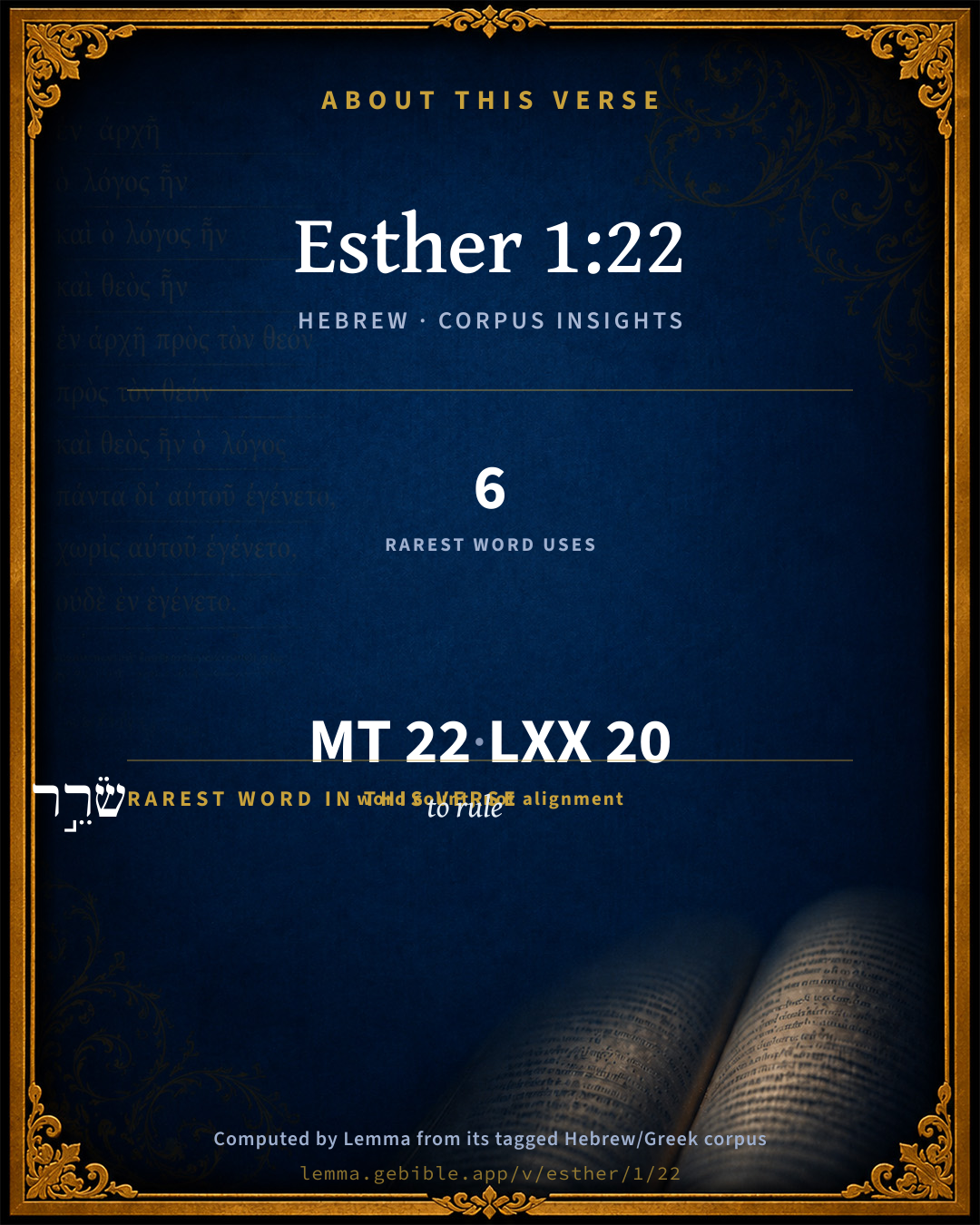
Esther 1:22

Hebrew (Westminster Leningrad Codex) Esther 1:22 appears in the Hebrew Old Testament. The text above is from the Westminster Leningrad Codex. Each word links to its Strong’s number, a concise gloss, and parsing drawn from the Open Scriptures Hebrew Bible morphology. Click any word for its full Brown-Driver-Briggs (BDB) entry.
Download image
Cite this verse

Esther 1:22 (World English Bible). Public Domain. Lemma interlinear Bible study tool, https://lemma.gebible.app/v/esther/1/22.

Show BibTeX & RIS
BibTeX
RIS
English Translation
for he sent letters into all the king's provinces, into every province according to the writing of it, and to every people after their language, that every man should bear rule in his own house, and should speak according to the language of his people.
World English Bible · Public Domain
Download a study sheet

One document with this verse’s original text, its word-by-word gloss line, the meaning frame, cross-references with their text, attributed commentary, and full source and license credits — printable, and it pastes into notes with its structure intact.

This verse Autodidact and up

Study sheet (.html) Plain text (.txt)

A passage Seminary Student

Up to 50 verses in one chapter. A passage sheet keeps up to 6 commentary sources and 12 cross-references per verse, in the order this page ranks them, and says so on the sheet whenever that leaves anything out. Ask for a single verse and you get the Autodidact verse sheet above.

Everything on this page stays free to read, with no account — the sheet is a download of what is already on screen, not access to it.

Want to remove ads? Support Godless Engineer
Compare translations 3

The same verse in 3 English versions, stacked beneath the original-language interlinear above. Click any original word for its lexicon entry.

Each is an independent rendering of the whole verse — the interlinear is not word-aligned to these translations.

Highlighted words mark where these versions differ — a whole-verse word diff, not a word-by-word alignment.

  • World English Bible Public Domain
    for he sent letters into all the king's provinces, into every province according to the writing of it, and to every people after their language, that every man should bear rule in his own house, and should speak according to the language of his people.
  • King James Version Public Domain
    For he sent letters into all the king's provinces, into every province according to the writing thereof, and to every people after their language, that every man should bear rule in his own house, and that it should be published according to the language of every people.
  • unfoldingWord Literal Text CC BY-SA 4.0
    And he sent letters to all the provinces of the king, to province by province according to its own writing, and to people by people according to its own tongue: that every man should be ruling in his house and speaking according to the tongue of his people.

unfoldingWord Literal Text — © unfoldingWord, licensed CC BY-SA 4.0. Word-aligned USFM3 via Door43 (git.door43.org/unfoldingWord/en_ult).

Versions to compare (up to 4)

3 of 4 selected

Show all 18 translations

Every available English version of this verse, each an independent rendering of the whole verse.

  • World English Bible Public Domain
    for he sent letters into all the king's provinces, into every province according to the writing of it, and to every people after their language, that every man should bear rule in his own house, and should speak according to the language of his people.
  • Berean Standard Bible Public Domain
    He sent letters to all the provinces of the kingdom, to each province in its own script and to each people in their own language, proclaiming that every man should be master of his own household.
  • Majority Standard Bible Public Domain
    He sent letters to all the provinces of the kingdom, to each province in its own script and to each people in their own language, proclaiming that every man should be master of his own household.
  • King James Version Public Domain
    For he sent letters into all the king's provinces, into every province according to the writing thereof, and to every people after their language, that every man should bear rule in his own house, and that it should be published according to the language of every people.
  • American Standard Version (1901) Public Domain
    for he sent letters into all the king's provinces, into every province according to the writing thereof, and to every people after their language, that every man should bear rule in his own house, and should speak according to the language of his people.
  • Revised Version (1885) Public Domain
    for he sent letters into all the king’s provinces, into every province according to the writing thereof, and to every people after their language, that every man should bear rule in his own house, and should publish it according to the language of his people.
  • Geneva Bible (1599) Public Domain
    For he sent letters into all the prouinces of the King, into euery prouince according to the writing thereof, and to euery people after their language, that euery man should beare rule in his owne house, and that he should publish it in the language of that same people.
  • Douay-Rheims (1899) Public Domain
    And he sent letters to all the provinces of his kingdom, as every nation could hear and read, in divers languages and characters, that the husbands should be rulers and masters in their houses: and that this should be published to every people.
  • Young's Literal Translation Public Domain
    and sendeth letters unto all provinces of the king, unto province and province according to its writing, and unto people and people according to its tongue, for every man being head in his own house -- and speaking according to the language of his people.
  • Literal Standard Version CC BY-SA 4.0
    and sends letters to all provinces of the king, to province and province according to its writing, and to people and people according to its tongue, for every man being head in his own house—and speaking according to the language of his people.
  • Unlocked Literal Bible CC BY-SA 4.0
    He sent out letters to all the royal provinces, to each province in its own writing, and to each people in their own language. He ordered that every man should be master of his own household. This decree was given in the language of each people in the empire.
  • unfoldingWord Literal Text CC BY-SA 4.0
    And he sent letters to all the provinces of the king, to province by province according to its own writing, and to people by people according to its own tongue: that every man should be ruling in his house and speaking according to the tongue of his people.
  • Darby Bible Public Domain
    And he sent letters into all the king's provinces, into every province according to the writing thereof, and to every people according to their language, That every man should bear rule in his own house, and should speak according to the language of his people.
  • World Messianic Bible Public Domain
    for he sent letters into all the king’s provinces, into every province according to its writing, and to every people in their language, that every man should rule his own house, speaking in the language of his own people.
  • Webster's Bible Public Domain
    For he sent letters into all the king's provinces, into every province according to the writing of it, and to every people after their language, that every man should bear rule in his own house, and that it should be published according to the language of every people.
  • Free Bible Version CC BY-SA 4.0
    He sent letters to all provinces in the empire, in each province's script and language, that every man should rule his own home, and use his own mother tongue.
  • Bible in Basic English Public Domain
    And sent letters to all the divisions of the kingdom, to every division in the writing commonly used there, and to every people in the language which was theirs, saying that every man was to be the ruler in his house, and that this order was to be given out in the language of his people.
  • JPS Tanakh (1917) Public Domain
    for he sent letters into all the king's provinces, into every province according to the writing thereof, and to every people after their language, that every man should bear rule in his own house, and speak according to the language of his people.

Literal Standard Version (2020), Covenant Press — licensed CC BY-SA 4.0. Text via the HelloAO Bible API (eBible.org). Unlocked Literal Bible (unfoldingWord) — licensed CC BY-SA 4.0. Text via the HelloAO Bible API (eBible.org). unfoldingWord Literal Text — © unfoldingWord, licensed CC BY-SA 4.0. Word-aligned USFM3 via Door43 (git.door43.org/unfoldingWord/en_ult). Free Bible Version, Dr. Jonathan Gallagher — licensed CC BY-SA 4.0. Text via the HelloAO Bible API (eBible.org).

Word by word

More ways to search: Search by grammar → Find every occurrence → Compare this word →

Practice this passage: Drill this verse → Learn its vocabulary →

שֹׂרֵ֣ר
sârar
H8323
“ruling”
Verb, Qal, Participle Active, Masculine, Singular, Absolute
Part of Speech
Verb
Stem
Qal
Form
Participle Active
Gender
Masculine
Number
Singular
State
Absolute
Full BDB Definition

Origin: a primitive root

TWOT: 2295

to be or act as prince, rule, contend, have power, prevail over, reign, govern - (Qal) to rule over, govern - (Hithpael) to lord it over
  1. וַיִּשְׁלַ֤ח shâlach H7971 “and · to send” Conjunction + Verb, Qal, Sequential Imperfect, 3rd Person, Masculine, Singular
  2. סְפָרִים֙ çêpher H5612 “books” Noun, Common, Masculine, Plural, Absolute
  3. אֶל ʼêl H413 “to” Preposition
  4. כָּל kôl H3605 “all of” Noun, Common, Masculine, Singular, Construct
  5. מְדִינ֣וֹת mᵉdîynâh H4082 “provinces of” Noun, Common, Feminine, Plural, Construct
  6. הַמֶּ֔לֶךְ melek H4428 “the · king” Particle, Definite Article + Noun, Common, Masculine, Singular, Absolute
  7. אֶל ʼêl H413 “to” Preposition
  8. מְדִינָ֤ה mᵉdîynâh H4082 “province” Noun, Common, Feminine, Singular, Absolute
  9. וּמְדִינָה֙ mᵉdîynâh H4082 “and · province” Conjunction + Noun, Common, Feminine, Singular, Absolute
  10. כִּכְתָבָ֔הּ kâthâb H3791 “like/as · writing · her” Preposition + Noun, Common, Masculine, Singular, Construct + Suffix, Personal, 3rd Person, Feminine, Singular
  11. וְאֶל ʼêl H413 “and · to” Conjunction + Preposition
  12. עַ֥ם ʻam H5971 “people” Noun, Common, Masculine, Singular, Absolute
  13. וָעָ֖ם ʻam H5971 “and · people” Conjunction + Noun, Common, Masculine, Singular, Absolute
  14. כִּלְשׁוֹנ֑וֹ lâshôwn H3956 “like/as · tongue · his” Preposition + Noun, Common, Both, Singular, Construct + Suffix, Personal, 3rd Person, Masculine, Singular
  15. לִהְי֤וֹת hâyâh H1961 “to be” Preposition + Verb, Qal, Infinitive Construct
  16. כָּל kôl H3605 “all of” Noun, Common, Masculine, Singular, Construct
  17. אִישׁ֙ ʼîysh H376 “man” Noun, Common, Masculine, Singular, Absolute
  18. בְּבֵית֔וֹ bayith H1004 “in/at · house · his” Preposition + Noun, Common, Masculine, Singular, Construct + Suffix, Personal, 3rd Person, Masculine, Singular
  19. וּמְדַבֵּ֖ר dâbar H1696 “and · speaking” Conjunction + Verb, Piel, Participle Active, Masculine, Singular, Absolute
  20. כִּלְשׁ֥וֹן lâshôwn H3956 “like/as · tongue of” Preposition + Noun, Common, Both, Singular, Construct
  21. עַמּֽוֹ ʻam H5971 “people · his” Noun, Common, Masculine, Singular, Construct + Suffix, Personal, 3rd Person, Masculine, Singular

About this verse

These counts appear in no published source. They are computed here, from the morphology-tagged text and Lemma’s own curated glosses. What Lemma adds →

22
words
14
distinct lemmas
Historical
section

Notable vocabulary

The rarest word here is שֹׂרֵ֣ר to rule H8323 — appearing just 6 times in the whole Hebrew Bible.

Shared distinctive vocabulary

שֹׂרֵ֣ר to rule H8323 occurs in 5 verses of the Hebrew Bible. Also found in:

Grammatical profile

  • 4 verbs
  • 15 nouns
  • 3 prepositions

Verb forms

  • וַיִּשְׁלַ֤ח Qal · Sequential Imperfect
  • לִהְי֤וֹת Qal · Infinitive Construct
  • שֹׂרֵ֣ר Qal · Participle Active
  • וּמְדַבֵּ֖ר Piel · Participle Active

Repetition

Words recur within this verse — often emphatic in Hebrew:

  • מְדִינ֣וֹת province H4082 ×3
  • עַ֥ם people H5971 ×3
  • כָּל all H3605 ×2
  • כִּלְשׁוֹנ֑וֹ tongue H3956 ×2
  • אֶל to H413 ×3

Hebrew & Septuagint length

In English translation the verse runs 45 words from the Hebrew and 25 from the Septuagint (LXX English) — the Septuagint runs noticeably shorter here. See the side-by-side →

A rough comparison of the two English renderings, which tokenize alike — not a word-level alignment.

Word counts can differ between the Hebrew and the Greek without any difference in meaning — e.g. the Hebrew direct-object marker אֵת has no separate Greek word, and Greek often adds the article ὁ.

In the original languages it is 22 Hebrew tokens and 20 Greek tokens — but the two are counted differently (Hebrew bundles its prefixes and suffixes into one token; the Greek is in lemma form), so that isn’t a like-for-like length.

Cross-references

10

Topical passages linked to Esther 1:22 in the Treasury of Scripture Knowledge — connected by theme and wording, ordered by reader-vote popularity; previews shown in the World English Bible.

  • Esther 3:12 Then were the king's scribes called in the first month, on the thirteenth day of it; and there was written according to all that Haman commanded to the king's satraps, and to the governors who were over every province, and to the princes of every people, to every province according to the writing of it, and to every people after their language; in the name of king Ahasuerus was it written, and it was sealed with the king's ring.
  • Esther 8:9 Then were the king's scribes called at that time, in the third month Sivan, on the three and twentieth [day] of it; and it was written according to all that Mordecai commanded to the Jews, and to the satraps, and the governors and princes of the provinces which are from India to Ethiopia, one hundred twenty-seven provinces, to every province according to the writing of it, and to every people after their language, and to the Jews according to their writing, and according to their language.
  • Ephesians 5:22–24 Wives, be subject to your own husbands, as to the Lord.
  • 1 Timothy 2:12 But I don't permit a woman to teach, nor to exercise authority over a man, but to be in quietness.
  • Daniel 3:29 Therefore I make a decree, that every people, nation, and language, which speak anything evil against the God of Shadrach, Meshach, and Abednego, shall be cut in pieces, and their houses shall be made a dunghill; because there is no other god who is able to deliver after this sort.
  • Daniel 4:1 Nebuchadnezzar the king, to all the peoples, nations, and languages, who dwell in all the earth: Peace be multiplied to you.
  • Luke 16:8 "His lord commended the dishonest manager because he had done wisely, for the children of this world are, in their own generation, wiser than the children of the light.
  • Acts 2:5–11 Now there were dwelling in Jerusalem Jews, devout men, from every nation under the sky.
  • 1 Corinthians 14:19–20 However in the assembly I would rather speak five words with my understanding, that I might instruct others also, than ten thousand words in another language.
  • Titus 2:4–5 that they may train the young women to love their husbands, to love their children,

Cross-references courtesy of OpenBible.info (CC BY 4.0).

Hebrew and Greek witnesses Masoretic Hebrew ↔ Greek Septuagint

The same verse in the two great witnesses to the Old Testament, shown verse-for-verse.

Here the Septuagint runs noticeably shorter than the Hebrew — LXX2012 (modern English Septuagint) 25 words vs World English Bible 45. A rough length comparison of the two English translations, not a word-level alignment — read both below.

These are two independent witnesses, not word-aligned to each other, and the Septuagint is shown in lemma (dictionary) form.

Hebrew Esther 1:22 Masoretic · Westminster Leningrad Codex

וַיִּשְׁלַ֤ח סְפָרִים֙ אֶל כָּל מְדִינ֣וֹת הַמֶּ֔לֶךְ אֶל מְדִינָ֤ה וּמְדִינָה֙ כִּכְתָבָ֔הּ וְאֶל עַ֥ם וָעָ֖ם כִּלְשׁוֹנ֑וֹ לִהְי֤וֹת כָּל אִישׁ֙ שֹׂרֵ֣ר בְּבֵית֔וֹ וּמְדַבֵּ֖ר כִּלְשׁ֥וֹן עַמּֽוֹ

for he sent letters into all the king's provinces, into every province according to the writing of it, and to every people after their language, that every man should bear rule in his own house, and should speak according to the language of his people.

World English Bible · Public Domain

Greek LXX Esther 1:22 Septuagint · lemma form

καί ἀποστέλλω εἰς πᾶς ὁ βασιλεία κατά χώρα κατά ὁ λέξις αὐτός ὥστε εἰμί φόβος αὐτός ἐν ὁ οἰκία αὐτός

and sent into all his kingdom through the several provinces, according to their language, in order that men might be feared in their own houses.

LXX2012 (modern English Septuagint) · Public Domain

On this verse, The Cambridge Bible for Schools and Colleges discusses the Septuagint’s reading. Read the note in Commentary ↓

Hebrew: Westminster Leningrad Codex (CC BY 4.0). Greek: Septuagint (public domain); English from LXX2012 (modern English Septuagint) (Public Domain). How the Septuagint differs from the Hebrew →

Commentary

Notes on Esther 1:22 from classic Christian and Jewish commentators (each source and its license shown beneath its notes). The classic Christian expositions comment on the surrounding passage and are grouped to its opening verse, so a note may address several verses; the Jewish commentaries on the Tanakh (Rashi and others) are per-verse, so they appear only where the commentator wrote on this verse.

Lemma curates 59 commentaries, every one of them public domain or Creative Commons licensed, each selected and text-cleaned for this edition rather than reprinted as found. About our sources →

Trapp's Complete Commentary

John Trapp

Est 1:22 For he sent letters into all the king’s provinces, into every province according to the writing thereof, and to every people after their language, that every man should bear rule in his own house, and that [it] should be published according to the language of every people.

Ver. 22. That every man should have rule in his own house] Aequum sane edictum, modo moderatum, A righteous decree, had it been but rightly made use of, and not abused to tyranny and rough dealing. Aristotle saith, that the husband ought to have a civil power over his wife, as being her better in honour, speech, gravity, and dignity. Menander and Euripides say the same, holding it unfit that the hen should crow, that the woman should usurp authority over the man; this nature and Scripture do both condemn. But why should these Persian princes at this time send forth such an edict as this? Was it because this good law of nature began to be depraved and obliterated among them, as it was among the Egyptians, where the queen is more honoured than the king, and in private houses the wife than the husband, as Diodorus Siculus reporteth? Or had they a mind to divulge their own shame, and to tell the world that they were least masters at home, and must therefore have a law made to force obedience? Or was it not, lastly, to countenance the king’s rash and unlawful putting away of his wife, for so light a cause; like as Cambyses, their recent king, having a mind to marry his own sister, made a law, that any man should have liberty to do the like? Whatever it was that moved them to send forth this decree, surely there was little need to excite men to use their authority over their wives, since they are apt enough to do so without bidding. Therefore St Paul, after, wives submit yourselves unto your own husbands, doth not say, and subjoin, husbands rule over your wives, but, husbands love your wives, and be not bitter against them, Col 3:19.

And that it should be published according to the language of every people] That so being particularly understood, it might appear more authentic and weighty, and so take away the hatred from the lawgivers for the wrong they had done the queen. Some render it thus, that he should speak according to the language of his own people, that is, say they, that each man should keep and observe the liberty of his own nation, by commanding his people, and governing his own family, without any contradiction.

John Trapp, A Commentary or Exposition upon All the Books of the Old and New Testament (1647–1656) — public domain. Text from a community e-Sword module.

Joseph Benson's Commentary

Est 1:22. That it should be published according to the language of every people — That all sorts of persons, not men only, but women also, might understand it, and therefore be inexcusable if they did not comply with it.

Joseph Benson's Commentary on the Old and New Testaments (1811–1818) — public domain. Text from a community e-Sword module.

Tyndale Open Study Notes

Tyndale Open Resources

1:22 The decree was published in each region in its own script and language so that the decree would be understood by every language group in the vast Persian Empire. • every man should be the ruler of his own home: It was already the cultural norm throughout the ancient Near East at that time that men ruled their houses. The decree added legal enforcement of the custom.

Tyndale Open Study Notes — © Tyndale Open Resources, licensed CC BY-SA 4.0. Text via the HelloAO Bible API.

Geneva Bible (1599)

Geneva Bible translators

That is, that the wife should be subject to the husband and at his commandment.

Geneva Bible (1599) marginal notes — public domain. Text via Bolls.life.

Adam Clarke's Commentary

Verse 22. That every man should bear rule in his own house] Both God's law and common sense taught this from the foundation of the world. And is it possible that this did not obtain in the Persian empire, previously to this edict? The twentieth verse has another clause, That all wives shall give to their husbands honour, both to great and small. This also was universally understood. This law did nothing. I suppose the parade of enactment was only made to deprive honest Vashti of her crown. The Targum adds, "That each woman should speak the language of her husband." If she were even a foreigner, she should be obliged to learn and speak the language of the king. Perhaps there might be some common sense in this, as it would oblige the foreigner to devote much time to study and improvement; and, consequently, to make her a better woman, and a better wife. But there is no proof that this was a part of the decree. But there are so many additions to this book in the principal versions, that we know not what might have made a part of it originally.

Adam Clarke's Commentary on the Bible (1810–1826) — public domain. Text from a community e-Sword/MySword module.

Ellicott's Commentary for English Readers

(22) He sent letters.—The Persian Empire was the first to possess a postal system (see esp. Herod. vii. 98). The Greek word for “compel,” in Mat_5:41; Mat_27:32, is simply a corruption of the Persian word for the impressment of men and horses for the royal service.

That every man should . . .—The following words are, literally, be ruling in his own house, and speaking according to the language of his own people. The former clause may probably be taken as a proof of the existence of an undue amount of female influence generally in Persia; the second clause is more doubtful. The English Version does distinct violence to the Hebrew, perhaps because the literal rendering yielded a somewhat peculiar sense. Taking the words exactly as they stand, they can only mean that in a house where two or more languages are used, from the presence of foreign wives, the husband is to take care that his own language is not supplanted by any of theirs. This is intelligible enough, but is perhaps rather irrelevant to what goes before.

A Bible Commentary for English Readers, edited by Charles John Ellicott (1878–1897) — public domain. Text from a community e-Sword module.

The Cambridge Bible for Schools and Colleges

gen. ed. J. J. S. Perowne

22. he sent letters into all the king’s provinces] There was an excellent system of posts in Persia, which, according to Herodotus, was in full working order in the time of Xerxes. See further on Est_3:13.

to every people after their language] It would be interesting to know in detail the languages in which these letters may be supposed to have been written. We cannot, however, hope to attain completeness in our list, although there are a considerable number which we may confidently include, as spoken by the subjects of an Empire reaching ‘from India even unto Ethiopia’ (see Est_1:1 with note). They may be classed as follows:

(1) Semitic. In Babylonia Assyrian or the cognate Babylonian was the language of the government, while probably Aramaic, which is closely akin to these, was commonly spoken. This last, it would appear, was used throughout a large portion of the Persian Empire, and Aramaic inscriptions—one of them bearing date in the fourth year of Xerxes[61]—have been found in a country as distant from the centre of Persian rule as Egypt. The great Semitic family of languages, of which Aramaic is a member, prevailed in more or less varying forms (in addition to the above-named Assyrian and Babylonian) in a large part of the Persian king’s dominions, viz. Phoenician, Arabic, Hebrew, and Western or Biblical Aramaic.

[61] See the Palaeographical Society’s Oriental Series, plate lxiii.

(2) Turanian. In parts of Assyria and Babylonia there may also have been surviving dialects which belong to a wholly different group of languages, and formed the speech of the old Accadian and Sumerian population. These were branches of the Turanian or Agglutinative family of which Turkish is one of the representatives at the present day. To this class also belonged Georgian, the most important of the languages spoken on the southern side of the principal Caucasus range.

(3) Aryan. This great family, to which can be traced most of the languages of modern Europe, would include Sanscrit and Prakrit, the latter of which is the mother of a large number of the Indian dialects, Zend, the old language of Bactria, and, lastly, the language of Greece, which doubtless at the time of Xerxes was making its way steadily eastward from the country of its birth.

and should publish it according to the language of his people] The literal rendering of the Hebrew is that every man should be ruling in his own house and speaking according to the language of his own people. This has been explained to refer to cases where men had taken wives from other nations. The wife then must conform to her husband as regards the matter in question, and the language used in the family must be the mother tongue of the latter (so the Targum). The clause will thus be a particular application of the general ordinance that ‘every man should bear rule in his own house.’ Nehemiah (Neh_13:23 f.) points out as one of the evils of marriages between Jews and non-Jews confusion of language on the part of the children of such unions.

It is, however, doubtful if the text is sound, and a conjecture has been widely adopted, which involves the change of not more than one Heb. consonant.[62] The meaning then will be, and shall speak whatsoever seems good to him, i.e. shall give whatever orders he chooses. In favour of this emendation it is pointed out that the new verb introduced by it into the Heb. text is one which, though not very frequent elsewhere, occurs in three other passages in this Book (Est_3:8, Est_5:13, Est_7:4). On the other hand it is dubious whether the construction which it involves is permissible Hebrew. The LXX. omits the words, and translates the preceding clause, so that they might have fear in their houses, meaning apparently, so that the husbands might be respected at home.[63]

[62] כָּל־שֹׁוֶה עִמּוֹ instead of כִּלְשׁוֹן עַמּוֹ.

[63] ὥστε εἶναι φόβον αὐτοῖς ἐν ταῖς οἰκίαις αὐτῶν.

The Cambridge Bible for Schools and Colleges (gen. ed. J. J. S. Perowne; Cambridge University Press, 1878–1918) — public domain. Text from a community e-Sword module.

John Gill's Exposition

For he sent letters unto all the king's provinces,.... The one hundred and twenty seven provinces, Est 1:1, which, according to the Targum, were written and sealed with his own seal; which is very probable:

into every province according to the writing thereof, and to every people after their language; that is, these letters were written in the language, and in the characters in which that language was written, used in each of the provinces to which these letters were sent, that they might be easily read and understood by all: the sum of which was:

that every man should bear rule in his own house; be prince, lord, and master there, and his commands obeyed, not only by his children and servants, but by his wife also:

and that it should be published according to the language of every people; but as this is expressed, or at least implied, in the first clause of this verse, it should rather be rendered, "and that he should speak according to the language of his people"; and so is the latter Targum; it seems as if a man, who had married a woman in another country, in complaisance to her had neglected his own native tongue, and used hers in the family, by which means he lost, or seemed to lose, his authority in it: now, to guard against this, this part of the law was made; and, according to Jarchi, the husband was to compel his wife to learn and speak his language, if she was a foreigner; to which agrees the first Targum, which paraphrases the whole thus,"that a man rule over his wife, and oblige her to speak according to the language of her husband, and the speech of his people;''and, in later times, Bahram Gaur forbid any other language, besides the Persian, to be used within his port, either in speaking or writing (b).

(b) Vid. Castel. Lexic. Persic. col. 266.

Next: Esther Chapter 2

John Gill's Exposition of the Whole Bible (1746–1763) — public domain (CC PDM 1.0). Text via the HelloAO Bible API.

Albert Barnes' Notes on the Bible

He sent letters - The Persian system of posts incidentally noticed in the present book Est 3:12-15; Est 8:9-14, is in entire harmony with the accounts of Herodotus and Xenophon.

Into every province according to the writing thereof - The practice of the Persians to address proclamations to the subject-nations in their own speech, and not merely in the language of the conqueror, is illustrated by the bilingual and trilingual inscriptions of the Achaemenian monarchs, from Cyrus to Artaxerxes Ochus, each inscription being of the nature of a proclamation.

The decree was not unnecessary. The undue influence of women in domestic, and even in public, matters is a feature of the ancient Persian monarchy. Atossa completely ruled Darius. Xerxes himself was, in his later years, shamefully subject to Amestris. The example of the court would naturally infect the people. The decree therefore would be a protest, even if ineffectual, against a real and growing evil.

And that it should be published ... - Render it: “and speak the language of his own people;” in the sense that the wife’s language, if different from her husband’s, should in no case be allowed to prevail in the household.

Albert Barnes' Notes on the Bible (1834–1885) — public domain. Text from a community e-Sword/MySword module.

Matthew Poole's English Annotations

That all sorts of persons, not men only, (who by study or travel many times understand divers languages,) but the women also, might understand it, and therefore be inexcusable if they did not comply with it; for which end it was not only written in each language, for that writing might come but to few hands, but moreover it was published in the several cities and towns by such persons as used to publish the king’s edicts. Others, that he should speak in the language of his own people, i.e. that men should not, in compliance with their wives, who were oft of other nations and languages, inure themselves to it, and bring their wives’ language into the family; but that men should use their own proper language, and cause their wives and children to use it; this being one sign of dominion, and therefore frequent after this time among the Greeks and Romans, who, together with their victorious arms, brought in their language into other countries, and in a great measure imposed it upon them.

Matthew Poole's English Annotations on the Holy Bible (1683–1685) — public domain. Text from a community e-Sword/MySword module.

Whedon's Commentary on the Bible

Daniel D. Whedon

22. He sent letters — Herodotus (viii, 98) thus describes the Persian system of letter carrying: “There is nothing mortal that proceeds faster than these messengers. They detail and arrange so many men and horses as there are days’ journeys, a horse and a man being appointed for each day’s journey, and neither snow, nor rain, nor heat, nor night prevents them from finishing their allotted race as soon as possible. The first racer delivers his message to the second, and the second to the third, and so on.”

Every province according to the writing thereof — That is, according to its written alphabetical character in use in each province.

To every people after their language — According to their vernacular dialect. The same alphabetical character might be used, as is still common, for several different languages. The bilingual and trilingual inscriptions of Persia and other oriental lands are standing evidences and illustrations of the ancient practice of writing public documents in various characters and languages.

That every man should bear rule in his own house — No doubt the king’s letters contained much more than this, but we have here only the general purport of the royal decree. Rawlinson remarks that “the undue influence of women in domestic, and even in public, matters is a feature of the ancient Persian monarchy. Herodotus (vii, 8) tells us that Atossa completely ruled Darius. Xerxes himself was, in his later years, shamefully subject to Amestris. (Ibid., 9:111.) The example of the court would naturally infect the people. The decree would, therefore, seem to have been not so much an idle and superfluous act as an ineffectual protest against a real and growing evil.” (Com. in loco.) If the decree itself be considered unnecessary and absurd, let it be remembered that this was not the only absurd thing which Xerxes did.

And that it should be published — Our version is here faulty. The latter part of the verse should be rendered, That every man rule in his own house, and speak according to the language of his own people. That is, not only should every man be lord in his family, but he should require his own native language to be used by his wife and children. Multitudes throughout the empire married foreign wives, and the use of different languages in the same household may have often led to other troubles besides those mentioned in Neh_13:24. Foreign wives were therefore required to learn the language of their husbands, in order that the husband’s pre-eminence and authority in his own house might be the better maintained. Some critics have sought to emend the text, so as to make it read, speak all that suited him; but this reading is purely conjectural, sustained by no parallel, and yields but a trivial thought.

Daniel D. Whedon (gen. ed.), Commentary on the Old and New Testaments (1874–1909) — public domain. Text from a community e-Sword module.

The Pulpit Commentary

For he sent. Rather, and he sent." Besides publishing the decree, Ahasuerus sent letters prescribing certain things, viz.:

1. That every man should bear rule in his own house; and,

2. That every man should speak his own language in his family, andnot that of his wife, if it were different.

This is the plain meaning of the existing text, which cannot bear either of the senses suggested in the Authorised Version.

Rule in the house.

The purport of the edict here recorded was good, although there seems something almost ludicrous in the feelings and the fears which prompted its framers and promulgators. "That every man should bear rule in his own house" seems scarcely a regulation to be prescribed by political authority.

I IT IS A PRINCIPLE FOUNDED UPON NATURAL, DIVINE AUTHORITY. It is written upon the very constitution of human nature that a wife should be directed by her husband, and children by their father. If purpose is visible anywhere, it is in this domestic law.

II IT IS A PRINCIPLE SANCTIONED BY SCRIPTURE. From the first it was said to the woman, "Thy desire shall be to thy husband, and he shall rule over thee." The apostle thus admonishes the female sex: "Wives, submit yourselves to your own husbands, as it is fit in the Lord." "The husband," we are told, "is the head of the wife.

III THE RULE IN QUESTION SHOULD BE COMMENDED BY THOUGHTFUL WISDOM ON THE PART OF HIM WHO EXERCISES IT. If the husband is a fool, it is not easy for the wife to submit. Bat if he be a man of knowledge, experience, and self-control, the wife will usually, gladly and gratefully, be guided by his desires and requests.

IV THIS SWAY SHOULD BE EXERCISED WITH GENTLENESS AND FORBEARANCE. Nothing is more hateful or contemptible than the rule of a domestic tyrant, and such a rule encourages either rebellion or deceit. Children lose all respect for an unreasonable and passionate father. The household with such a head is wretched indeed. Affection and consideration should be manifest in the demeanour and requirements of all in authority over a family.

V SUCH A RULE SHOULD BE ACKNOWLEDGED WITH FRANK SUBMISSION. Women are very much what men make them. Let them be treated with affection and courtesy, and the response will usually be cheerful compliance.

VI SUCH A RULE IS CONTRIBUTIVE TO ORDER AND HAPPINESS. The family is so far like the state; tyranny awakens resentment and provokes resistance, whilst a righteous and considerate rule is acknowledged with gratitude, and is productive of happiness. A home where there is anarchy is a hell upon earth; a home where a woman rules is a monstrous and loathsome spectacle. Darius and Xerxes are said, both of them, to have been too much governed by their wives. History abounds with instances in which the legitimate power of the wives of kings has been exceeded, and in which kings" mistresses have corrupted courts, and to some degree nations also.

The Pulpit Commentary (1880–1919), ed. H.D.M. Spence-Jones & Joseph S. Exell — public domain. Text from a community e-Sword module.

Rashi

Rabbi Shlomo Yitzchaki (Rashi)

and speak according to the language of his nationality He can compel his wife to learn his language if her native tongue is different.

Rashi on the Tanakh — English translations: “The Judaica Press complete Tanach with Rashi, translated by A. J. Rosenberg” (CC BY 4.0); “Pentateuch with Rashi's commentary by M. Rosenbaum and A.M. Silbermann, 1929-1934” (public domain); “The Metsudah Tanach series, Lakewood, N.J” (CC BY 4.0); and “The Book of Joshua, Metsudah Publications, 1997” (CC BY 4.0). Text via Sefaria.

Lesson kit

Teaching starters — assembled from the data on this page, not authored interpretation. Every prompt links to the verse data it draws on. Edit before teaching.

Esther, in the Historical, opens this verse with 22 words (14 distinct Hebrew lemmas). Its most distinctive word is sârar (“to rule”). The Greek Septuagint runs shorter here. A historical commentator’s framing appears above. Read the whole chapter for the surrounding context.

Discussion questions

  1. The word sârar carries the sense “to rule.” How does it shape the verse?
  2. Numbers 16:13 shares the word «to rule» with this verse. How do the two illuminate each other?
  3. “province” occurs 3× in this one verse. What is the effect of the repetition?
  4. Compared with the Hebrew, the Septuagint runs shorter here. What questions does that raise?
  5. These translations render this verse differently; the difference is in the English rendering, not the original. What questions does that raise?
  6. The verb «וַיִּשְׁלַ֤ח» is Qal Sequential Imperfect. How does its form color the action?
  7. Reading how Trapp's Complete Commentary and Joseph Benson's Commentary read this verse, where do the two commentators agree and where do they part?

Things to notice

Reading settings

Reading text

Shown beneath each verse's original-language words.

Old Testament
Old Testament edition

Read the OT as the Masoretic Hebrew (MT) or the Greek Septuagint (LXX).

English shown for the Greek Septuagint (in the Hebrew ↔ Greek comparison).

Comparing translations? Open the Compare panel on any verse page to stack up to four side by side.