
Exodus 12:30

Hebrew (Westminster Leningrad Codex) Exodus 12:30 appears in the Hebrew Old Testament. The text above is from the Westminster Leningrad Codex. Each word links to its Strong’s number, a concise gloss, and parsing drawn from the Open Scriptures Hebrew Bible morphology. Click any word for its full Brown-Driver-Briggs (BDB) entry.
Download image
Cite this verse

Exodus 12:30 (World English Bible). Public Domain. Lemma interlinear Bible study tool, https://lemma.gebible.app/v/exodus/12/30.

Show BibTeX & RIS
BibTeX
RIS
English Translation
Pharaoh rose up in the night, he, and all his servants, and all the Egyptians; and there was a great cry in Egypt, for there was not a house where there was not one dead.
World English Bible · Public Domain
Download a study sheet

One document with this verse’s original text, its word-by-word gloss line, the meaning frame, cross-references with their text, attributed commentary, and full source and license credits — printable, and it pastes into notes with its structure intact.

This verse Autodidact and up

Study sheet (.html) Plain text (.txt)

A passage Seminary Student

Up to 50 verses in one chapter. A passage sheet keeps up to 6 commentary sources and 12 cross-references per verse, in the order this page ranks them, and says so on the sheet whenever that leaves anything out. Ask for a single verse and you get the Autodidact verse sheet above.

Everything on this page stays free to read, with no account — the sheet is a download of what is already on screen, not access to it.

Want to remove ads? Support Godless Engineer
Compare translations 3

The same verse in 3 English versions, stacked beneath the original-language interlinear above. Click any original word for its lexicon entry.

Each is an independent rendering of the whole verse — the interlinear is not word-aligned to these translations.

Highlighted words mark where these versions differ — a whole-verse word diff, not a word-by-word alignment.

  • World English Bible Public Domain
    Pharaoh rose up in the night, he, and all his servants, and all the Egyptians; and there was a great cry in Egypt, for there was not a house where there was not one dead.
  • King James Version Public Domain
    And Pharaoh rose up in the night, he, and all his servants, and all the Egyptians; and there was a great cry in Egypt; for there was not a house where there was not one dead.
  • unfoldingWord Literal Text CC BY-SA 4.0
    And Pharaoh got up in the night—he, and all his servants, and all the Egyptians. And there was a great cry in Egypt, for there was not a house where there was not someone dead.

unfoldingWord Literal Text — © unfoldingWord, licensed CC BY-SA 4.0. Word-aligned USFM3 via Door43 (git.door43.org/unfoldingWord/en_ult).

Versions to compare (up to 4)

3 of 4 selected

Show all 18 translations

Every available English version of this verse, each an independent rendering of the whole verse.

  • World English Bible Public Domain
    Pharaoh rose up in the night, he, and all his servants, and all the Egyptians; and there was a great cry in Egypt, for there was not a house where there was not one dead.
  • Berean Standard Bible Public Domain
    During the night Pharaoh got up—he and all his officials and all the Egyptians—and there was loud wailing in Egypt; for there was no house without someone dead.
  • Majority Standard Bible Public Domain
    During the night Pharaoh got up—he and all his officials and all the Egyptians—and there was loud wailing in Egypt; for there was no house without someone dead.
  • King James Version Public Domain
    And Pharaoh rose up in the night, he, and all his servants, and all the Egyptians; and there was a great cry in Egypt; for there was not a house where there was not one dead.
  • American Standard Version (1901) Public Domain
    And Pharaoh rose up in the night, he, and all his servants, and all the Egyptians; and there was a great cry in Egypt, for there was not a house where there was not one dead.
  • Revised Version (1885) Public Domain
    And Pharaoh rose up in the night, he, and all his servants, and all the Egyptians; and there was a great cry in Egypt; for there was not a house where there was not one dead.
  • Geneva Bible (1599) Public Domain
    And Pharaoh rose vp in the night, he, and all his seruants and all the Egyptians: and there was a great crye in Egypt: for there was no house where there was not one dead.
  • Douay-Rheims (1899) Public Domain
    And Pharao arose in the night, and all his servants, and all Egypt: for there was not a house wherein there lay not one dead.
  • Young's Literal Translation Public Domain
    And Pharaoh riseth by night, he and all his servants, and all the Egyptians, and there is a great cry in Egypt, for there is not a house where there is not `one' dead,
  • Literal Standard Version CC BY-SA 4.0
    And Pharaoh rises by night, he and all his servants, and all the Egyptians, and there is a great cry in Egypt, for there is not a house where there is not [one] dead,
  • Unlocked Literal Bible CC BY-SA 4.0
    Pharaoh got up in the night—he, all his servants, and all the Egyptians. There was loud lamenting in Egypt, for there was not a house where there was not someone dead.
  • unfoldingWord Literal Text CC BY-SA 4.0
    And Pharaoh got up in the night—he, and all his servants, and all the Egyptians. And there was a great cry in Egypt, for there was not a house where there was not someone dead.
  • Darby Bible Public Domain
    And Pharaoh rose up in the night, he, and all his bondmen, and all the Egyptians; and there was a great cry in Egypt; for there was not a house in which there was not one dead.
  • World Messianic Bible Public Domain
    Pharaoh rose up in the night, he, and all his servants, and all the Egyptians; and there was a great cry in Egypt, for there was not a house where there was not one dead.
  • Webster's Bible Public Domain
    And Pharaoh rose in the night, he, and all his servants, and all the Egyptians; and there was a great cry in Egypt: for there was not a house where there was not one dead.
  • Free Bible Version CC BY-SA 4.0
    Pharaoh got up during the night, as well as all his officials and all the Egyptians. There were loud cries of agony throughout Egypt, because there wasn't a single house where someone hadn't died.
  • Bible in Basic English Public Domain
    Then Pharaoh got up in the night, he and all his servants and all the Egyptians; and a great cry went up from Egypt; for there was not a house where someone was not dead.
  • JPS Tanakh (1917) Public Domain
    And Pharaoh rose up in the night, he, and all his servants, and all the Egyptians; and there was a great cry in Egypt; for there was not a house where there was not one dead.

Literal Standard Version (2020), Covenant Press — licensed CC BY-SA 4.0. Text via the HelloAO Bible API (eBible.org). Unlocked Literal Bible (unfoldingWord) — licensed CC BY-SA 4.0. Text via the HelloAO Bible API (eBible.org). unfoldingWord Literal Text — © unfoldingWord, licensed CC BY-SA 4.0. Word-aligned USFM3 via Door43 (git.door43.org/unfoldingWord/en_ult). Free Bible Version, Dr. Jonathan Gallagher — licensed CC BY-SA 4.0. Text via the HelloAO Bible API (eBible.org).

Word by word

More ways to search: Search by grammar → Find every occurrence → Compare this word →

Practice this passage: Drill this verse → Learn its vocabulary →

צְעָקָ֥ה
tsaʻăqâh
H6818
“cry”
Noun, Common, Feminine, Singular, Absolute
Part of Speech
Noun
Type
Common
Gender
Feminine
Number
Singular
State
Absolute
Full BDB Definition

Origin: from H6817

TWOT: 1947a

cry, outcry - outcry (against) - cry of distress (especially as heard by God)
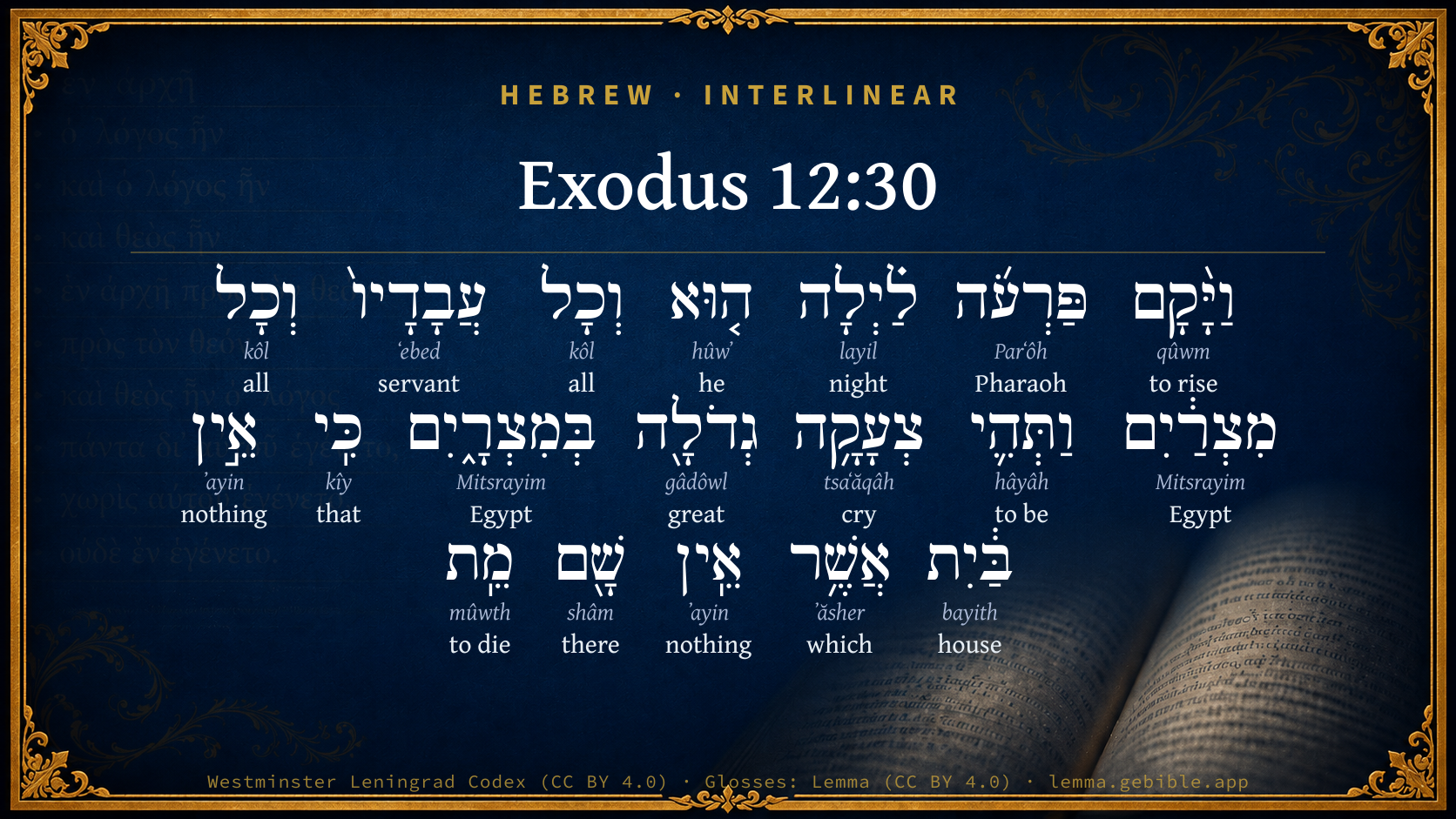
  1. וַיָּ֨קָם qûwm H6965 “and · to rise” Conjunction + Verb, Qal, Sequential Imperfect, 3rd Person, Masculine, Singular
  2. פַּרְעֹ֜ה Parʻôh H6547 “Pharaoh” Noun, Proper
  3. לַ֗יְלָה layil H3915 “night” Noun, Common, Masculine, Singular, Absolute
  4. ה֤וּא hûwʼ H1931 “he” Pronoun, Personal, 3rd Person, Masculine, Singular
  5. וְכָל kôl H3605 “and · all of” Conjunction + Noun, Common, Masculine, Singular, Construct
  6. עֲבָדָיו֙ ʻebed H5650 “servants · his” Noun, Common, Masculine, Plural, Construct + Suffix, Personal, 3rd Person, Masculine, Singular
  7. וְכָל kôl H3605 “and · all of” Conjunction + Noun, Common, Masculine, Singular, Construct
  8. מִצְרַ֔יִם Mitsrayim H4714 “Egypt” Noun, Proper
  9. וַתְּהִ֛י hâyâh H1961 “and · to be” Conjunction + Verb, Qal, Sequential Imperfect, 3rd Person, Feminine, Singular
  10. גְדֹלָ֖ה gâdôwl H1419 “great” Adjective, Adjective, Feminine, Singular, Absolute
  11. בְּמִצְרָ֑יִם Mitsrayim H4714 “in/at · Egypt” Preposition + Noun, Proper
  12. כִּֽי kîy H3588 “that” Conjunction
  13. אֵ֣ין ʼayin H369 “nothing” Particle, Negative
  14. בַּ֔יִת bayith H1004 “house” Noun, Common, Masculine, Singular, Absolute
  15. אֲשֶׁ֥ר ʼăsher H834 “which” Particle, Relative
  16. אֵֽין ʼayin H369 “nothing” Particle, Negative
  17. שָׁ֖ם shâm H8033 “there” Adverb
  18. מֵֽת mûwth H4191 “dying” Verb, Qal, Participle Active, Masculine, Singular, Absolute

About this verse

These counts appear in no published source. They are computed here, from the morphology-tagged text and Lemma’s own curated glosses. What Lemma adds →

19
words
16
distinct lemmas
Pentateuch
section

Notable vocabulary

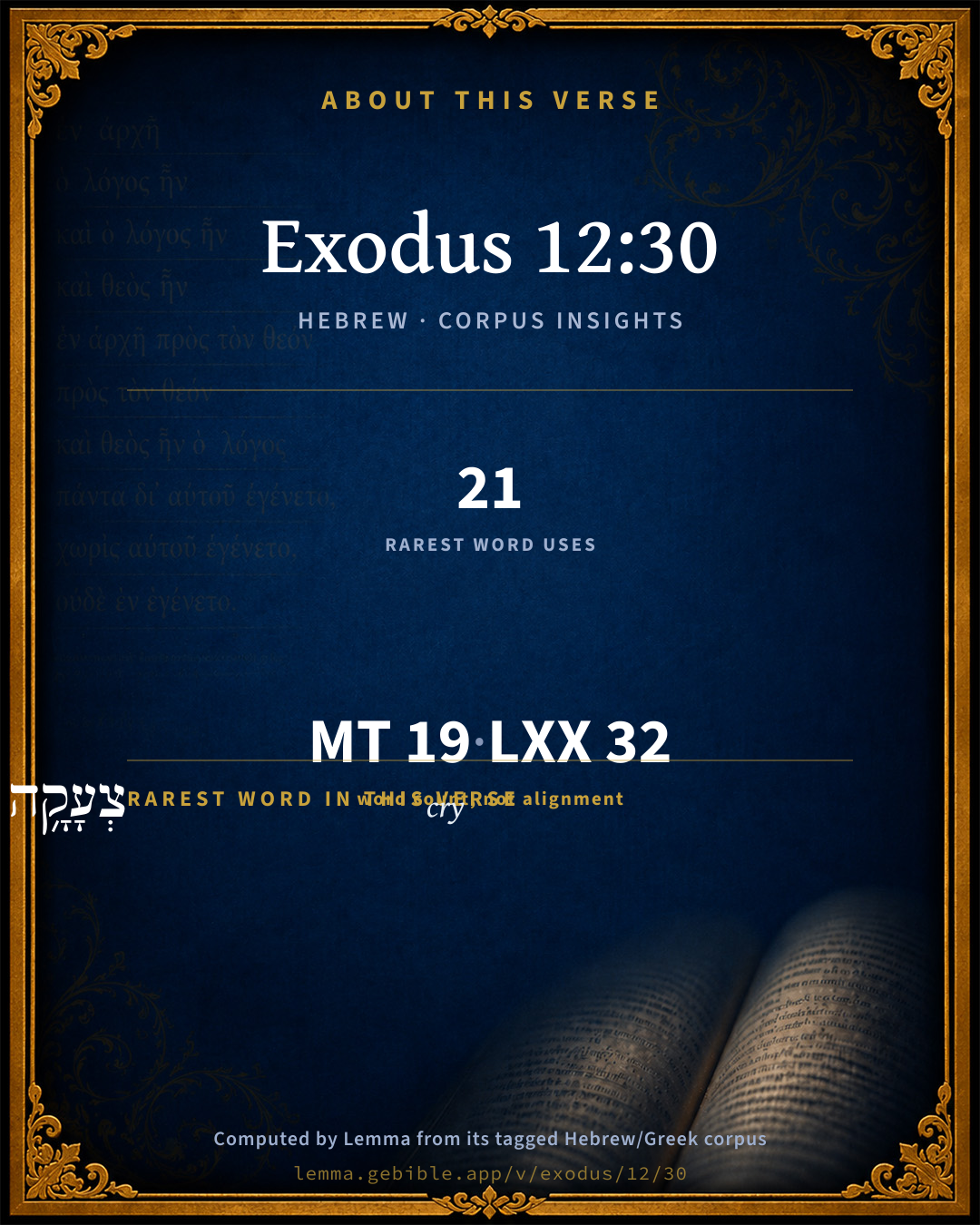
The rarest word here is צְעָקָ֥ה cry H6818 — appearing just 21 times in the whole Hebrew Bible.

Shared distinctive vocabulary

צְעָקָ֥ה cry H6818 occurs in 20 verses of the Hebrew Bible. Also found in:

Grammatical profile

  • 3 verbs
  • 9 nouns
  • 1 adjective
  • 1 pronoun
  • 1 conjunction
  • 1 adverb
  • 3 particles

Verb forms

  • וַיָּ֨קָם Qal · Sequential Imperfect
  • וַתְּהִ֛י Qal · Sequential Imperfect
  • מֵֽת Qal · Participle Active

Repetition

Words recur within this verse — often emphatic in Hebrew:

  • וְכָל all H3605 ×2
  • מִצְרַ֔יִם Egypt H4714 ×2
  • אֵ֣ין nothing H369 ×2

Hebrew & Septuagint length

In English translation the verse runs 35 words from the Hebrew and 38 from the Septuagint (LXX English) — closely comparable.

A rough comparison of the two English renderings, which tokenize alike — not a word-level alignment.

Word counts can differ between the Hebrew and the Greek without any difference in meaning — e.g. the Hebrew direct-object marker אֵת has no separate Greek word, and Greek often adds the article ὁ.

In the original languages it is 19 Hebrew tokens and 32 Greek tokens — but the two are counted differently (Hebrew bundles its prefixes and suffixes into one token; the Greek is in lemma form), so that isn’t a like-for-like length.

Cross-references

5

Topical passages linked to Exodus 12:30 in the Treasury of Scripture Knowledge — connected by theme and wording, ordered by reader-vote popularity; previews shown in the World English Bible.

  • Exodus 11:6 There shall be a great cry throughout all the land of Egypt, such as there has not been, nor shall be any more.
  • Amos 5:17 In all vineyards there will be wailing; For I will pass through the midst of you," says Yahweh.
  • Proverbs 21:13 Whoever stops his ears at the cry of the poor, He will also cry out, but shall not be heard.
  • Matthew 25:6 But at midnight there was a cry, 'Behold! The bridegroom is coming! Come out to meet him!'
  • James 2:13 For judgment is without mercy to him who has shown no mercy. Mercy triumphs over judgment.

Cross-references courtesy of OpenBible.info (CC BY 4.0).

Hebrew and Greek witnesses Masoretic Hebrew ↔ Greek Septuagint

The same verse in the two great witnesses to the Old Testament, shown verse-for-verse.

These are two independent witnesses, not word-aligned to each other, and the Septuagint is shown in lemma (dictionary) form.

Hebrew Exodus 12:30 Masoretic · Westminster Leningrad Codex

וַיָּ֨קָם פַּרְעֹ֜ה לַ֗יְלָה ה֤וּא וְכָל עֲבָדָיו֙ וְכָל מִצְרַ֔יִם וַתְּהִ֛י צְעָקָ֥ה גְדֹלָ֖ה בְּמִצְרָ֑יִם כִּֽי אֵ֣ין בַּ֔יִת אֲשֶׁ֥ר אֵֽין שָׁ֖ם מֵֽת

Pharaoh rose up in the night, he, and all his servants, and all the Egyptians; and there was a great cry in Egypt, for there was not a house where there was not one dead.

World English Bible · Public Domain

Greek LXX Exodus 12:30 Septuagint · lemma form

καί ἀναἵστημι φαραώ νύξ καί πᾶς ὁ θεράπων αὐτός καί πᾶς ὁ αἰγύπτιος καί γίγνομαι κραυγή μέγας ἐν πᾶς γῆ αἴγυπτος οὐ γάρ εἰμί οἰκία ἐν ὅς οὐ εἰμί ἐν αὐτός θνήσκω

And Pharao rose up by night, and his servants, and all the Egyptians; and there was a great cry in all the land of Egypt, for there was not a house in which there was not one dead.

LXX2012 (modern English Septuagint) · Public Domain

Hebrew: Westminster Leningrad Codex (CC BY 4.0). Greek: Septuagint (public domain); English from LXX2012 (modern English Septuagint) (Public Domain). How the Septuagint differs from the Hebrew →

Targum (Aramaic paraphrase)

2

The Targum is the ancient Jewish Aramaic paraphrase of the Hebrew Scriptures — an interpretive translation, not the Hebrew text itself. Onkelos (literal) and Pseudo-Jonathan (expansive) render the Torah, and Jonathan the Prophets. Coverage is partial: where no permissively-licensed English translation exists for a verse, only the Aramaic is shown. This is verse-level text, not a word-by-word alignment to the Hebrew.

  1. Targum Onkelos Torah (Genesis–Deuteronomy)
    וְקָם פַּרְעֹה לֵילְיָא הוּא וְכָל עַבְדוֹהִי וְכָל מִצְרַיִם וַהֲוַת צְוַחְתָּא רַבְּתָא בְּמִצְרָיִם אֲרֵי לֵית בֵּיתָא דִי לֵית הֲוָה בֵהּ תַּמָן מֵתָא:

    (no public-domain English translation for this verse)

    Targum Onkelos — Aramaic: “Onkelos Genesis” (public domain); “Onkelos Exodus” (public domain); “Onkelos Leviticus” (public domain); “Onkelos Numbers” (public domain); “Onkelos Deuteronomy” (public domain). English: “Sefaria Community Translation” (CC0 1.0 (public-domain dedication)); “J.W. Etheridge. The Targums of Onkelos and Jonathan Ben Uzziel on the Pentateuch. London: Longmans, Green, 1862” (public domain). Text via Sefaria.

  2. Targum Pseudo-Jonathan Torah (Genesis–Deuteronomy)
    וְקָם פַּרְעה בְּלֵילְיָא הוּא וְכָל שְׁאָר עַבְדוֹי וְכָל שְׁאָר מִצְרָאֵי וַהֲוָה צְוַוחְתָּא רַבְּתָא אֲרוּם לָא הֲוָה תַּמָּן בֵּיתָא דְמִצְרָאֵי דְלָא הֲוָה תַמָּן בְּכוֹר מָאִית

    And Pharoh rose up in that night, and all the rest of his servants, and all the rest of the Mizraee; and there was a great cry, because there was no house of the Mizraee where the firstborn was not dead.

    Targum Pseudo-Jonathan — Aramaic: “Targum Jonathan on Genesis” (public domain); “Targum Jonathan on Exodus” (public domain); “Targum Jonathan on Leviticus” (public domain); “Targum Jonathan on Numbers” (public domain); “Targum Jonathan on Deuteronomy” (public domain). English: “The Targum of Jonathan ben Uzziel, trans. J. W. Etheridge, London, 1862” (public domain). Text via Sefaria.

Commentary

Notes on Exodus 12:30 from classic Christian and Jewish commentators (each source and its license shown beneath its notes). The classic Christian expositions comment on the surrounding passage and are grouped to its opening verse, so a note may address several verses; the Jewish commentaries on the Tanakh (Rashi and others) are per-verse, so they appear only where the commentator wrote on this verse.

Lemma curates 59 commentaries, every one of them public domain or Creative Commons licensed, each selected and text-cleaned for this edition rather than reprinted as found. About our sources →

Trapp's Complete Commentary

John Trapp

Exo 12:30 And Pharaoh rose up in the night, he, and all his servants, and all the Egyptians; and there was a great cry in Egypt; for [there was] not a house where [there was] not one dead.

Ver. 30. For there was not a house.] Neither is there a house amongst us, hardly, where not one but many are "dead in trespasses and sins." Our land even stinks again with such, as Egypt did with the frogs.

John Trapp, A Commentary or Exposition upon All the Books of the Old and New Testament (1647–1656) — public domain. Text from a community e-Sword module.

Rashi

Rabbi Shlomo Yitzchaki (Rashi)

ויקם פרעה AND PHARAOH AROSE from his bed,

לילה AT NIGHT and not, as is the way of kings, at three hours in the day (9 o’clock in the morning) (Mekhilta; cf. Berakhot 9b).

הוא HE, first — and afterwards עבדיו HIS SERVANTS — this informs us that he went round to the houses of his servants and made them get up (Mekhilta).

כי אין בית אשר אין שם מת FOR THERE WAS NOT A HOUSE WHERE THERE WAS NOT ONE DEAD — If there was a firstborn there, he died: if there was no firstborn there, then the chief person in the house died because the chief person in the house is called בכור, as it is said, (Psalms 89:28) “I also will appoint him to be a בכור, [the highest of the kings of the earth]” (Mekhilta DeRashbi 12:30; cf. Rashi on 4:22; Pesachim Rabbah, Midr. Vajosha). Another explanation is: the Egyptian women were unfaithful to their husbands and bore children from young men, unmarried, and thus they (the Egyptian men) had many firstborn sons sometimes there were five to one woman, each being the firstborn to his own father (thus there might well be no house in which there was not a firstborn) (cf. Mekhilta).

Rashi on the Tanakh — English translations: “The Judaica Press complete Tanach with Rashi, translated by A. J. Rosenberg” (CC BY 4.0); “Pentateuch with Rashi's commentary by M. Rosenbaum and A.M. Silbermann, 1929-1934” (public domain); “The Metsudah Tanach series, Lakewood, N.J” (CC BY 4.0); and “The Book of Joshua, Metsudah Publications, 1997” (CC BY 4.0). Text via Sefaria.

Geneva Bible (1599)

Geneva Bible translators

Of those houses, wherein any firstborn was, either of men or beasts.

Geneva Bible (1599) marginal notes — public domain. Text via Bolls.life.

Jamieson, Fausset & Brown

Robert Jamieson, A. R. Fausset & David Brown

there was not a house where there was not one dead--Perhaps this statement is not to be taken absolutely. The Scriptures frequently use the words "all," "none," in a comparative sense--and so in this case. There would be many a house in which there would be no child, and many in which the first-born might be already dead. What is to be understood is, that almost every house in Egypt had a death in it.

Jamieson, Fausset & Brown — Commentary Critical and Explanatory on the Whole Bible (1871) — public domain (CC PDM 1.0). Text via the HelloAO Bible API.

Adam Clarke's Commentary

Verse 30. There was a great cry] No people in the universe were more remarkable for their mournings than the Egyptians, especially in matters of religion; they whipped, beat, tore themselves, and howled in all the excess of grief. When a relative died, the people left the house, ran into the streets, and howled in the most lamentable and frantic manner. See Diod. Sicul., lib. i., and Herod., lib. ii., c. 85, 86. And this latter author happening to be in Egypt on one of their solemnities, saw myriads of people whipping and beating themselves in this manner, lib. ii., c. 60; and see Mr. Bryant on the Plagues of Egypt, where many examples are given, p. 162, c. How dreadful then must the scene of horror and distress appear when there was not one house or family in Egypt where there was not one dead and according to their custom, all the family running out into the streets bewailing this calamity!

Adam Clarke's Commentary on the Bible (1810–1826) — public domain. Text from a community e-Sword/MySword module.

Ellicott's Commentary for English Readers

(30) A great cry.—See the comment on Exo_11:6. The combination of public calamity, private grief, and shocked religious fanaticism might well produce a cry “such as there was none like it, neither shall be like it any more” (Exo_11:6).

Not a house where there was not one dead. This cannot have been literally true. In half the families a daughter would have “opened the womb;” in others, the firstborn son would have been absent, or dead previously. To judge Scripture fairly, we must make allowance for the hyperbole of Oriental thought and expression, which causes the substitution of universal terms for general ones, and the absence of qualifying clauses. The meaning is that in the great majority of houses there was one dead. This may, well have been so, if we include the dependants and the animals. Pet animals—dogs, cats, gazelles, and monkeys—abounded in Egyptian homes.

A Bible Commentary for English Readers, edited by Charles John Ellicott (1878–1897) — public domain. Text from a community e-Sword module.

The Cambridge Bible for Schools and Colleges

gen. ed. J. J. S. Perowne

30. a great cry in Egypt] cf. Exo_11:6 (J).

The tenth plague, like the preceding ones, has also its connexion with the natural conditions of the country. Malignant epidemics are of not unfrequent occurrence in Egypt; and Di. quotes from Kn. (see also DB. iii. 892b) numerous references to travellers and others, who state that they usually break out in spring, and are often worse at the time of the Ḥamsîn wind (see on Exo_10:23; and cf. Lane, Mod. Eg.5 i. 2); they are also sometimes accompanied by very great mortality. But, as Di. continues, ‘the plague here, by its momentary suddenness, as also by its carrying off as its victims exclusively the first-born of the Egyptians, bears a wholly supernatural character. This particular form of the tradition (Sage) evidently first arose partly through the influence of the Isr. spring-offering of the Passover, partly through that of the Isr. custom of dedicating the first-born, which together brought into the tradition the sparing of the houses and first-born of the Israelites, and transformed the Egyptians who perished in the plague into first-born’ (Di. on v. 29, slightly abridged). Cf. pp. 410, 412.

The Cambridge Bible for Schools and Colleges (gen. ed. J. J. S. Perowne; Cambridge University Press, 1878–1918) — public domain. Text from a community e-Sword module.

John Gill's Exposition

Also take your flocks and your herds, as ye have said,.... Which they had insisted upon should go with them, but he had refused, but now he is willing they should go with them:

and be gone; out of his city and country in all haste:

and bless me also; or pray for me, as the Targum of Onkelos; pray the Lord to bestow a blessing upon me also, as I have done well by you in suffering you to depart with your whole families, flocks, and herds. The Targum of Jonathan is,"I desire nothing else of you, only pray for me, that I die not;''and so Jarchi. As he found his firstborn, and the heir to his crown and kingdom, was dead, he might justly fear it would be his case next, and perhaps very soon; and therefore desires their prayers for him, that his life might be spared.

John Gill's Exposition of the Whole Bible (1746–1763) — public domain (CC PDM 1.0). Text via the HelloAO Bible API.

Haydock's Catholic Bible Commentary

Pharao, who it seems was not the eldest son. Where the first-born of a family had a son, both were consigned to destruction. (Menochius)

George Leo Haydock (1774–1849), Haydock's Catholic Family Bible and Commentary, 1859 edition — public domain. Excludes Psalms (Douay-Rheims chapter numbering differs from Protestant) and Deuterocanonical books (Catholic canon only).

Matthew Poole's English Annotations

Not a house, to wit, of those houses which had any first-born in them, for in divers families there might be no first-born. And such restrictions of the universal particles are frequently understood.

Matthew Poole's English Annotations on the Holy Bible (1683–1685) — public domain. Text from a community e-Sword/MySword module.

The Pulpit Commentary

And Pharaoh rose up in the night, and all his servants. This general disturbance differentiates the present visitations from that which came upon the host of Sennacherib. (2Ki_19:35) Then, the calamity came with such silence and secrecy, that the deaths were not suspected until men rose to go about their various tasks in the morning Now, every household seems to have been aroused from its sleep in the night. We must suppose sharp and painful illness, terminating after a few hours in death. The disaster itself may have been one from which Egypt often suffers in the spring of the year (Kalisch); but its attacking all the firstborn and no others, and no Israelites, as well as its announcement, plainly showed it to be miraculous. There was a great cry. See the comment on Exo_11:6. For there was not a house where there was not one dead. This is perhaps a slight hyperbole. There would be many families in which there was no son; and some houses might contain no male who had opened the womb. It is always to be borne in mind, that the language of Scripture especially where exciting and tragical events are narrated is poetical, or at the least highly rhetorical.

The Pulpit Commentary (1880–1919), ed. H.D.M. Spence-Jones & Joseph S. Exell — public domain. Text from a community e-Sword module.

Ramban (Nachmanides)

Rabbi Moshe ben Nachman (Ramban / Nachmanides)

FOR THERE WAS NOT A HOUSE WHERE THERE WAS NOT ONE DEAD. Rashi comments: “If there was a firstborn there, he died; if there was no firstborn there, the chief person in the house died because he is called b’chor (firstborn), as it is said, I also will appoint him firstborn. Another interpretation: The Egyptian women led dissolute lives under their husbands and bore children from unmarried young men. Thus they had many firstborn sons, sometimes [as many as] five to one woman, each one being the firstborn to his own father.”In line with the plain meaning of Scripture, the firstborn that died in Egypt were the firstborn of their mothers, and this is why He sanctified in their place all the firstborn, whatsoever openeth the womb among the children of Israel, both of man and of beast. The firstborn of Pharaoh that sat on his throne was the firstborn to his mother. And such indeed is the custom among kings that the reigning mistress be a virgin, something like it is said in the case of Ahasuerus. But in accordance with the opinion of our Rabbis [who say that the firstborn of a father also died], we shall explain that in Egypt, He smote all their firstborn. That is to say, the firstborn of the father, since he is the first-fruit of his strength, and the firstborn of the mother, since he opened the womb, and also the chief person in the house. Yet it was His desire to sanctify in Israel in their place only the firstborn of the mother, because that is a matter more known and of open knowledge. In cattle, only the firstborn of the mother is known at all, and therefore He chose from among all of them only [the firstborn of the mother]. A sort of proof for this [statement of the Rabbis that the firstborn of the father was also smitten] is the verse: And He smote all the firstborn in Egypt, the first-fruits of their strength in the tents of Ham, for such an expression, [i.e., the first-fruits of his strength], is said only of a male.

Ramban (Nachmanides) on the Tanakh — English translation: “Commentary on the Torah by Ramban (Nachmanides). Translated and annotated by Charles B. Chavel. New York, Shilo Pub. House, 1971-1976” (CC BY 4.0). Text via Sefaria.

Lesson kit

Teaching starters — assembled from the data on this page, not authored interpretation. Every prompt links to the verse data it draws on. Edit before teaching.

Exodus, in the Pentateuch, opens this verse with 19 words (16 distinct Hebrew lemmas). Its most distinctive word is tsaʻăqâh (“cry”). A historical commentator’s framing appears above. Read the whole chapter for the surrounding context.

Discussion questions

  1. What does “cry” (tsaʻăqâh) contribute to the verse as a whole?
  2. Genesis 18:21 shares the word «cry» with this verse. How do the two illuminate each other?
  3. “all” occurs 2× in this one verse. What is the effect of the repetition?
  4. These translations render this verse differently. What is at stake in choosing one wording over another?
  5. The verb «וַיָּ֨קָם» is Qal Sequential Imperfect. How does its form color the action?
  6. Reading how Trapp's Complete Commentary and Rashi read this verse, where do the two commentators agree and where do they part?

Things to notice

Reading settings

Reading text

Shown beneath each verse's original-language words.

Old Testament
Old Testament edition

Read the OT as the Masoretic Hebrew (MT) or the Greek Septuagint (LXX).

English shown for the Greek Septuagint (in the Hebrew ↔ Greek comparison).

Comparing translations? Open the Compare panel on any verse page to stack up to four side by side.