Deuteronomy 32:38

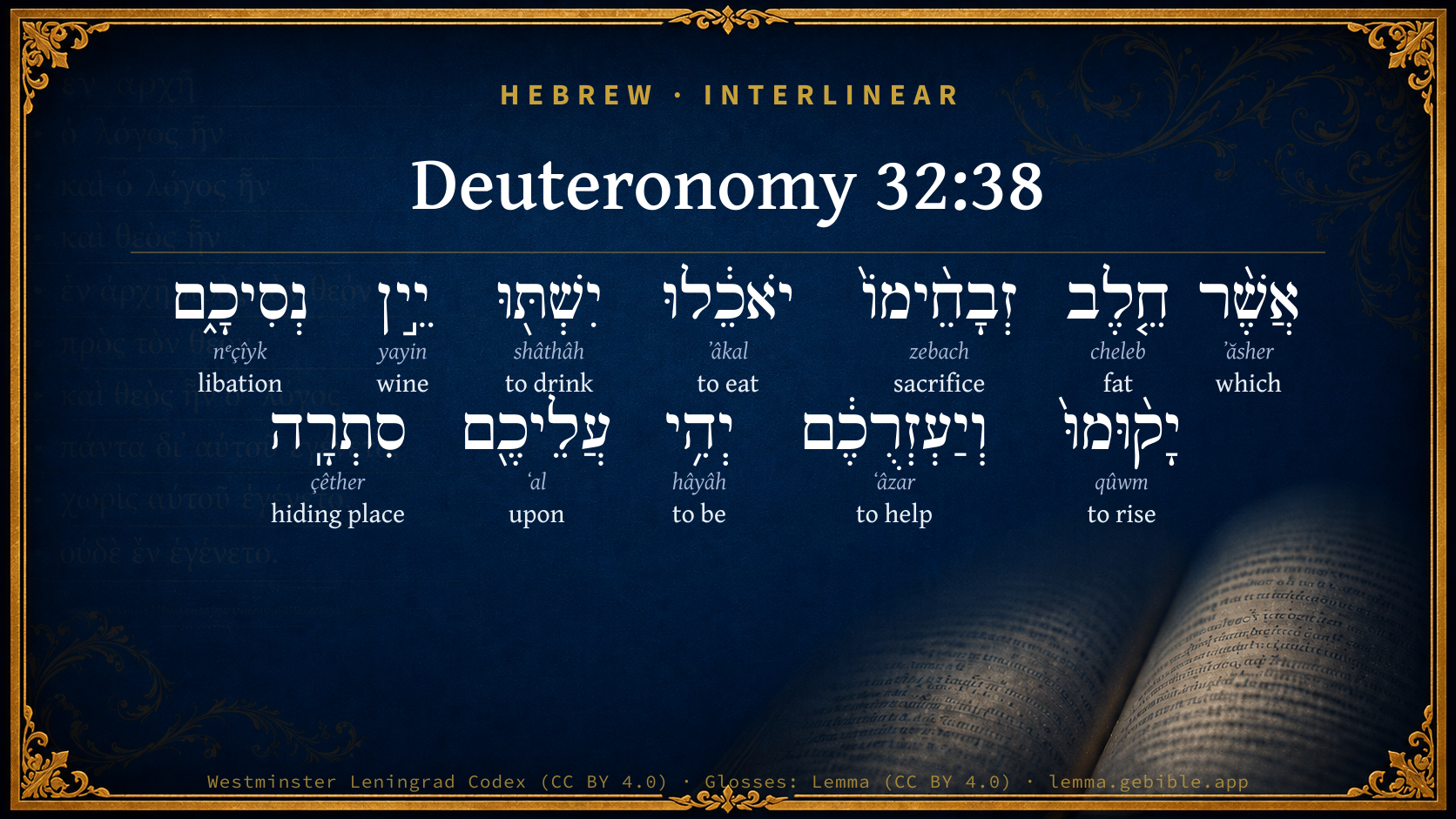
Hebrew (Westminster Leningrad Codex) Deuteronomy 32:38 appears in the Hebrew Old Testament. The text above is from the Westminster Leningrad Codex. Each word links to its Strong’s number, a concise gloss, and parsing drawn from the Open Scriptures Hebrew Bible morphology. Click any word for its full Brown-Driver-Briggs (BDB) entry.
Download image
Cite this verse

Deuteronomy 32:38 (World English Bible). Public Domain. Lemma interlinear Bible study tool, https://lemma.gebible.app/v/deuteronomy/32/38.

Show BibTeX & RIS
BibTeX
RIS
English Translation
Which ate the fat of their sacrifices, And drank the wine of their drink-offering? Let them rise up and help you, Let them be your protection.
World English Bible · Public Domain
Highlights
  • 1 first appearance in the Hebrew Bible
Full analysis ↓
Download a study sheet

One document with this verse’s original text, its word-by-word gloss line, the meaning frame, cross-references with their text, attributed commentary, and full source and license credits — printable, and it pastes into notes with its structure intact.

This verse Autodidact and up

Study sheet (.html) Plain text (.txt)

A passage Seminary Student

Up to 50 verses in one chapter. A passage sheet keeps up to 6 commentary sources and 12 cross-references per verse, in the order this page ranks them, and says so on the sheet whenever that leaves anything out. Ask for a single verse and you get the Autodidact verse sheet above.

Everything on this page stays free to read, with no account — the sheet is a download of what is already on screen, not access to it.

Want to remove ads? Support Godless Engineer
Compare translations 3

The same verse in 3 English versions, stacked beneath the original-language interlinear above. Click any original word for its lexicon entry.

Each is an independent rendering of the whole verse — the interlinear is not word-aligned to these translations.

Highlighted words mark where these versions differ — a whole-verse word diff, not a word-by-word alignment.

  • World English Bible Public Domain
    Which ate the fat of their sacrifices, And drank the wine of their drink-offering? Let them rise up and help you, Let them be your protection.
  • King James Version Public Domain
    Which did eat the fat of their sacrifices, and drank the wine of their drink offerings? let them rise up and help you, and be your protection.
  • unfoldingWord Literal Text CC BY-SA 4.0
    who ate the fat of their sacrifices, drank the wine of their libations? Let them rise up and help you; let them be a shelter over you. ts\*

unfoldingWord Literal Text — © unfoldingWord, licensed CC BY-SA 4.0. Word-aligned USFM3 via Door43 (git.door43.org/unfoldingWord/en_ult).

Versions to compare (up to 4)

3 of 4 selected

Show all 18 translations

Every available English version of this verse, each an independent rendering of the whole verse.

  • World English Bible Public Domain
    Which ate the fat of their sacrifices, And drank the wine of their drink-offering? Let them rise up and help you, Let them be your protection.
  • Berean Standard Bible Public Domain
    which ate the fat of their sacrifices and drank the wine of their drink offerings? Let them rise up and help you; let them give you shelter!
  • Majority Standard Bible Public Domain
    which ate the fat of their sacrifices and drank the wine of their drink offerings? Let them rise up and help you; let them give you shelter!
  • King James Version Public Domain
    Which did eat the fat of their sacrifices, and drank the wine of their drink offerings? let them rise up and help you, and be your protection.
  • American Standard Version (1901) Public Domain
    Which did eat the fat of their sacrifices, `And' drank the wine of their drink-offering? Let them rise up and help you, Let them be your protection.
  • Revised Version (1885) Public Domain
    Which did eat the fat of their sacrifices, And drank the wine of their drink offering? Let them rise up and help you, Let them be your protection.
  • Geneva Bible (1599) Public Domain
    Which did eate the fat of their sacrifices, and did drinke the wine of their drinke offring? let them rise vp, and help you: let him be your refuge.
  • Douay-Rheims (1899) Public Domain
    Of whose victims they ate the fat, and drank the wine of their drink offerings: let them arise and help you, and protect you in your distress.
  • Young's Literal Translation Public Domain
    Which the fat of their sacrifices do eat, They drink the wine of their libation! Let them arise and help you, Let it be for you a hiding-place!
  • Literal Standard Version CC BY-SA 4.0
    Who eat the fat of their sacrifices, || [And] drink the wine of their drink-offering? Let them arise and help you, || Let it be a hiding place for you!
  • Unlocked Literal Bible CC BY-SA 4.0
    The gods who ate the fat of their sacrifices and drank the wine of their drink offerings? Let them rise up and help you; let them be your protection.
  • unfoldingWord Literal Text CC BY-SA 4.0
    who ate the fat of their sacrifices, drank the wine of their libations? Let them rise up and help you; let them be a shelter over you. ts\*
  • Darby Bible Public Domain
    Who ate the fat of their sacrifices, [And] drank the wine of their drink-offering? Let them rise up and help you, That there may be a protection over you.
  • World Messianic Bible Public Domain
    which ate the fat of their sacrifices, and drank the wine of their drink offering? Let them rise up and help you! Let them be your protection.
  • Webster's Bible Public Domain
    Which ate the fat of their sacrifices, and drank the wine of their drink-offerings? let them rise up and help you, and be your protection.
  • Free Bible Version CC BY-SA 4.0
    Who ate the fat of your sacrifices and drank the wine of your drink offerings? Have them come and help you; have them come and protect you!
  • Bible in Basic English Public Domain
    Who took the fat of their offerings, and the wine of their drink offering? Let them now come to your help, let them be your salvation.
  • JPS Tanakh (1917) Public Domain
    Who did eat the fat of their sacrifices, and drank the wine of their drink-offering? let him rise up and help you, let him be your protection.

Literal Standard Version (2020), Covenant Press — licensed CC BY-SA 4.0. Text via the HelloAO Bible API (eBible.org). Unlocked Literal Bible (unfoldingWord) — licensed CC BY-SA 4.0. Text via the HelloAO Bible API (eBible.org). unfoldingWord Literal Text — © unfoldingWord, licensed CC BY-SA 4.0. Word-aligned USFM3 via Door43 (git.door43.org/unfoldingWord/en_ult). Free Bible Version, Dr. Jonathan Gallagher — licensed CC BY-SA 4.0. Text via the HelloAO Bible API (eBible.org).

Word by word

More ways to search: Search by grammar → Find every occurrence → Compare this word →

Practice this passage: Drill this verse → Learn its vocabulary →

נְסִיכָ֑ם
nᵉçîyk
H5257
“libation · their”
Noun, Common, Masculine, Singular, Construct + Suffix, Personal, 3rd Person, Masculine, Plural
Part of Speech
Noun
Type
Common
Gender
Masculine
Number
Singular
State
Construct
Full BDB Definition

Origin: from H5258

TWOT: 1375b , 1377a

poured out, libation, molten image, one anointed - libation, drink-offering - molten image - prince, anointed one
  1. אֲשֶׁ֨ר ʼăsher H834 “which” Particle, Relative
  2. חֵ֤לֶב cheleb H2459 “fat of” Noun, Common, Masculine, Singular, Construct
  3. זְבָחֵ֨ימוֹ֙ zebach H2077 “sacrifices · their” Noun, Common, Masculine, Plural, Construct + Suffix, Personal, 3rd Person, Masculine, Plural
  4. יֹאכֵ֔לוּ ʼâkal H398 “to eat” Verb, Qal, Imperfect, 3rd Person, Masculine, Plural
  5. יִשְׁתּ֖וּ shâthâh H8354 “to drink” Verb, Qal, Imperfect, 3rd Person, Masculine, Plural
  6. יֵ֣ין yayin H3196 “wine of” Noun, Common, Masculine, Singular, Construct
  7. יָק֨וּמוּ֙ qûwm H6965 “to rise” Verb, Qal, Imperfect, 3rd Person, Masculine, Plural
  8. וְיַעְזְרֻכֶ֔ם ʻâzar H5826 “and · to help · you” Conjunction + Verb, Qal, Imperfect, 3rd Person, Masculine, Plural + Suffix, Personal, 2nd Person, Masculine, Plural
  9. יְהִ֥י hâyâh H1961 “to be” Verb, Qal, Jussive, 3rd Person, Masculine, Singular
  10. עֲלֵיכֶ֖ם ʻal H5921 “upon · you” Preposition + Suffix, Personal, 2nd Person, Masculine, Plural
  11. סִתְרָֽה çêther H5643 “hiding place” Noun, Common, Feminine, Singular, Absolute

About this verse

These counts appear in no published source. They are computed here, from the morphology-tagged text and Lemma’s own curated glosses. What Lemma adds →

12
words
12
distinct lemmas
Pentateuch
section

Notable vocabulary

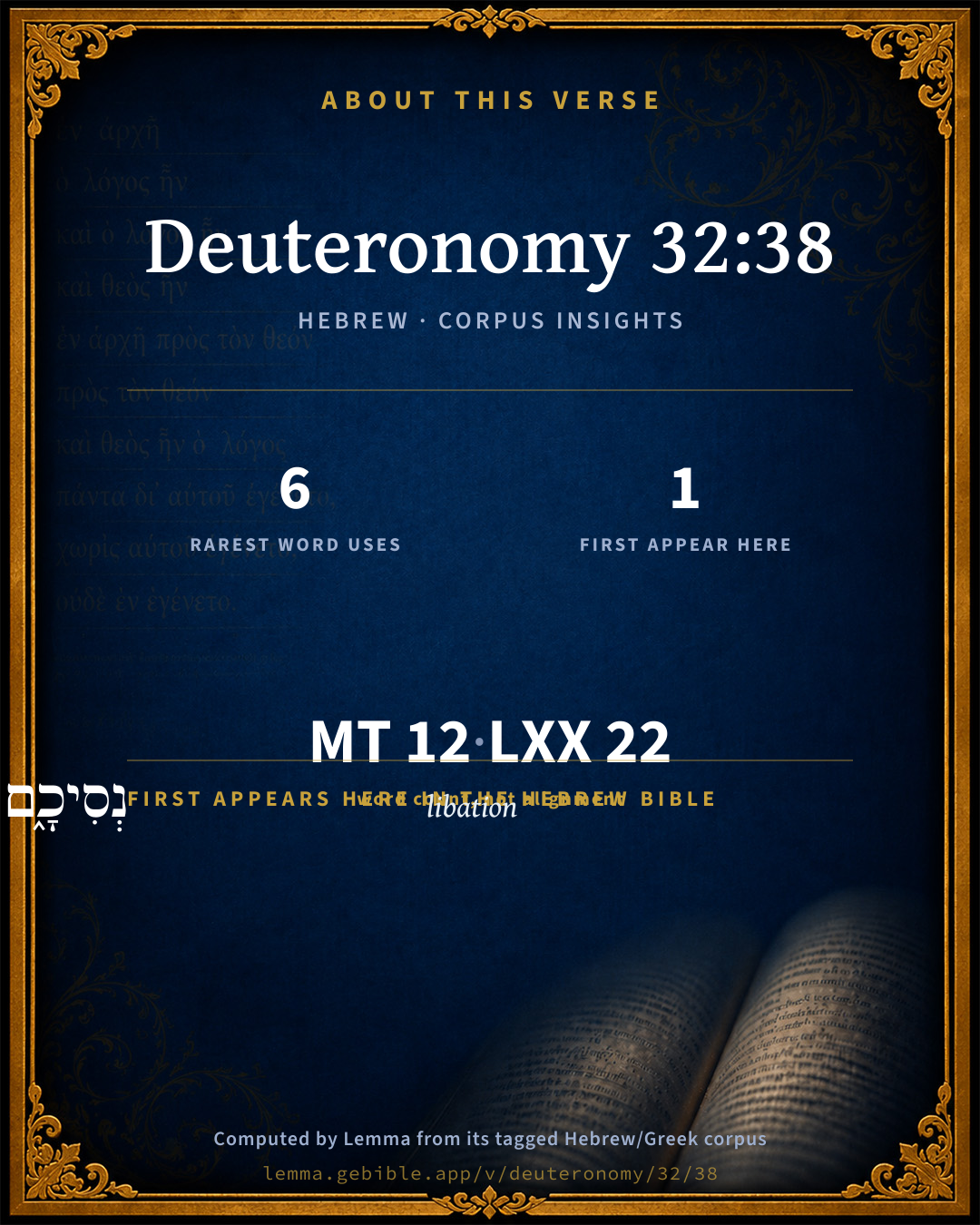
The rarest word here is נְסִיכָ֑ם libation H5257 — appearing just 6 times in the whole Hebrew Bible.

First appearance in Scripture

This word makes its first canonical appearance in the Hebrew Bible here:

  • נְסִיכָ֑ם libation H5257

Shared distinctive vocabulary

נְסִיכָ֑ם libation H5257 occurs in 6 verses of the Hebrew Bible. Also found in:

Grammatical profile

  • 5 verbs
  • 5 nouns
  • 1 preposition
  • 1 particle

Verb forms

  • יֹאכֵ֔לוּ Qal · Imperfect
  • יִשְׁתּ֖וּ Qal · Imperfect
  • יָק֨וּמוּ֙ Qal · Imperfect
  • וְיַעְזְרֻכֶ֔ם Qal · Imperfect
  • יְהִ֥י Qal · Jussive

Hebrew & Septuagint length

In English translation the verse runs 26 words from the Hebrew and 25 from the Septuagint (LXX English) — closely comparable.

A rough comparison of the two English renderings, which tokenize alike — not a word-level alignment.

Word counts can differ between the Hebrew and the Greek without any difference in meaning — e.g. the Hebrew direct-object marker אֵת has no separate Greek word, and Greek often adds the article ὁ.

In the original languages it is 12 Hebrew tokens and 22 Greek tokens — but the two are counted differently (Hebrew bundles its prefixes and suffixes into one token; the Greek is in lemma form), so that isn’t a like-for-like length.

Cross-references

6

Topical passages linked to Deuteronomy 32:38 in the Treasury of Scripture Knowledge — connected by theme and wording, ordered by reader-vote popularity; previews shown in the World English Bible.

  • Leviticus 21:21 no man of the seed of Aaron the priest, who has a blemish, shall come near to offer the offerings of Yahweh made by fire. Since has a blemish, he shall not come near to offer the bread of his God.
  • Judges 10:14 Go and cry to the gods which you have chosen; let them save you in the time of your distress.
  • Psalms 50:13 Will I eat the flesh of bulls, Or drink the blood of goats?
  • Ezekiel 16:18–19 and you took your embroidered garments, and covered them, and did set my oil and my incense before them.
  • Hosea 2:8 For she did not know that I gave her the grain, the new wine, and the oil, And multiplied to her silver and gold, which they used for Baal.
  • Zephaniah 2:11 Yahweh will be awesome to them, for he will famish all the gods of the land. Men will worship him, everyone from his place, even all the shores of the nations.

Cross-references courtesy of OpenBible.info (CC BY 4.0).

Hebrew and Greek witnesses Masoretic Hebrew ↔ Greek Septuagint

The same verse in the two great witnesses to the Old Testament, shown verse-for-verse.

These are two independent witnesses, not word-aligned to each other, and the Septuagint is shown in lemma (dictionary) form.

Hebrew Deuteronomy 32:38 Masoretic · Westminster Leningrad Codex

אֲשֶׁ֨ר חֵ֤לֶב זְבָחֵ֨ימוֹ֙ יֹאכֵ֔לוּ יִשְׁתּ֖וּ יֵ֣ין נְסִיכָ֑ם יָק֨וּמוּ֙ וְיַעְזְרֻכֶ֔ם יְהִ֥י עֲלֵיכֶ֖ם סִתְרָֽה

Which ate the fat of their sacrifices, And drank the wine of their drink-offering? Let them rise up and help you, Let them be your protection.

World English Bible · Public Domain

Greek LXX Deuteronomy 32:38 Septuagint · lemma form

ὅς ὁ στέαρ ὁ θυσία αὐτός ἐσθίω καί πίνω ὁ οἶνος ὁ σπονδή αὐτός ἀναἵστημι καί βοηθέω σύ καί γίγνομαι σύ σκεπαστής

the fat of whose sacrifices you⌃ ate, and you⌃ drank the wine of their drink-offerings? let them arise and help you, and be your protectors.

LXX2012 (modern English Septuagint) · Public Domain

On this verse, The Cambridge Bible for Schools and Colleges discusses the Septuagint’s reading. Read the note in Commentary ↓

Hebrew: Westminster Leningrad Codex (CC BY 4.0). Greek: Septuagint (public domain); English from LXX2012 (modern English Septuagint) (Public Domain). How the Septuagint differs from the Hebrew →

Targum (Aramaic paraphrase)

2

The Targum is the ancient Jewish Aramaic paraphrase of the Hebrew Scriptures — an interpretive translation, not the Hebrew text itself. Onkelos (literal) and Pseudo-Jonathan (expansive) render the Torah, and Jonathan the Prophets. Coverage is partial: where no permissively-licensed English translation exists for a verse, only the Aramaic is shown. This is verse-level text, not a word-by-word alignment to the Hebrew.

  1. Targum Onkelos Torah (Genesis–Deuteronomy)
    דִי תְרַב נִכְסָתְהוֹן הֲווֹ אָכְלִין שָׁתָן חֲמַר נִסְכֵּיהוֹן יְקוּמוּן כְּעַן וִיסַעֲדוּנְכוֹן יְהוֹן עֲלֵיכוֹן מָגֵן

    (no public-domain English translation for this verse)

    Targum Onkelos — Aramaic: “Onkelos Genesis” (public domain); “Onkelos Exodus” (public domain); “Onkelos Leviticus” (public domain); “Onkelos Numbers” (public domain); “Onkelos Deuteronomy” (public domain). English: “Sefaria Community Translation” (CC0 1.0 (public-domain dedication)); “J.W. Etheridge. The Targums of Onkelos and Jonathan Ben Uzziel on the Pentateuch. London: Longmans, Green, 1862” (public domain). Text via Sefaria.

  2. Targum Pseudo-Jonathan Torah (Genesis–Deuteronomy)
    דִתְרֵיב נִכְסַתְהוֹן הֲווֹן אָכְלִין שָׁתָן חֲמַר נִיסוּכֵיהוֹן יְקוּמוּן כְּדוֹן וִיסַעֲדוּנְכוֹן יְהֵי עֲלֵיכוֹן מֵגִין בְּמֵימְרֵיהּ

    who ate the fat of their sacrifices, and drank the wine of their libations? Let Him now rise up and help you, let Him shield you by His Word.

    Targum Pseudo-Jonathan — Aramaic: “Targum Jonathan on Genesis” (public domain); “Targum Jonathan on Exodus” (public domain); “Targum Jonathan on Leviticus” (public domain); “Targum Jonathan on Numbers” (public domain); “Targum Jonathan on Deuteronomy” (public domain). English: “The Targum of Jonathan ben Uzziel, trans. J. W. Etheridge, London, 1862” (public domain). Text via Sefaria.

Commentary

Notes on Deuteronomy 32:38 from classic Christian and Jewish commentators (each source and its license shown beneath its notes). The classic Christian expositions comment on the surrounding passage and are grouped to its opening verse, so a note may address several verses; the Jewish commentaries on the Tanakh (Rashi and others) are per-verse, so they appear only where the commentator wrote on this verse.

Lemma curates 59 commentaries, every one of them public domain or Creative Commons licensed, each selected and text-cleaned for this edition rather than reprinted as found. About our sources →

Trapp's Complete Commentary

John Trapp

Deu 32:38 Which did eat the fat of their sacrifices, [and] drank the wine of their drink offerings? let them rise up and help you, [and] be your protection.

Ver. 38. Which did eat.] Put them to a great deal of charge, but for no profit.

John Trapp, A Commentary or Exposition upon All the Books of the Old and New Testament (1647–1656) — public domain. Text from a community e-Sword module.

Tyndale Open Study Notes

Tyndale Open Resources

32:38 ate the fat . . . drank the wine: Most polytheistic religious systems that practice sacrifice include the notion that the gods find nourishment in the sacrifices made to them. Israel fell victim to this superstitious belief for a time before the Lord graciously taught them otherwise and restored them to himself (32:36).

Tyndale Open Study Notes — © Tyndale Open Resources, licensed CC BY-SA 4.0. Text via the HelloAO Bible API.

The Cambridge Bible for Schools and Colleges

gen. ed. J. J. S. Perowne

38. Let them be a covert above you] So LXX, etc.; Heb. let it.

The Cambridge Bible for Schools and Colleges (gen. ed. J. J. S. Perowne; Cambridge University Press, 1878–1918) — public domain. Text from a community e-Sword module.

John Gill's Exposition

See now that I, even I, am he,.... Which words are directed to the people of God in their low estate, to look to Christ, and expect deliverance and salvation from him; or to their enemies that insult them, to the despisers, to look, and wonder, and perish, as they will, when the witnesses slain by them shall arise, and go up to heaven in their sight, Rev 11:11; they are spoken by the Word and Son of God, to whom the Father has committed all judgment, and who will now rise up and execute it; so the Targum of Jonathan,"when the Word of the Lord shall reveal himself to redeem his people, he will say to all people, see now, &c.''and who will declare himself to be the great Jehovah, the self-existent Being, the eternal and immutable I AM; for this phrase is expressive of his existence, eternity, immutability, and sovereignty; and which the above Targum paraphrases thus,"see now that I am he that have been, and am, and I am he that shall be,''which, as it is a deciphering the word "Jehovah", is what is applied to Christ, Rev 1:8. The repeating the word "I", as it may denote the strong affection of the speaker, and the certainty of what he would do, so it may have respect to both sorts of persons the words are directed to, and to the several sorts of things to be done, hereafter related; signifying that it is the same I, that does the one, does also the other, kills and makes alive, &c.

and there is no god with me; this the Redeemer and Saviour says elsewhere, Isa 44:6; see Deu 32:12; there is but one God, and Christ the Word, with the Father and the Spirit, are that one God, Jo1 5:7; and there is no other with him; he is the true God, in opposition to all factitious and fictitious gods; he is not a made god, nor a god by office, nor by name and title only, but by nature the one, true, only, and living God; and so it may be most truly believed of him, that he is able to do, and will do, what he next says:

I kill, and I make alive; I wound, and I heal: Christ is the sovereign disposer of life and death, of sickness and health, in a temporal sense; and in a spiritual sense he wounds and kills, by the law in the hand of his Spirit; and he heals and makes alive by his Gospel, as it is accompanied by his Spirit and grace also: this is by some referred to the resurrection from the dead, which will be by Christ the resurrection and the life, the earnest, exemplar, and efficient cause of it; so the Targum of Jerusalem,"I am he that kills the living in this world, and quickens the dead in the world to come:''but it refers to another resurrection previous to that, namely, the reviving of the witnesses after they have been slain three days; who, as they will be killed in a civil sense, in the same sense they will be quickened by the Spirit of life from Christ; that is, they will be raised from that very low estate into which they will be brought, into a glorious one, signified by their ascending up into heaven; which will be done by Christ when he takes to himself his great power, and reigns; then as he suffered his witnesses and people to be wounded and killed, he will make them alive, and heal them, and restore comforts and happiness to them, see Rev 11:11,

neither is there any that can deliver out of my hand; for, at the same time that he saves his people, he will take their enemies into his hands, out of which there will be no escape; at this time seven thousand names of men, or men of name, will be slain; see Gill on Rev 11:13.

John Gill's Exposition of the Whole Bible (1746–1763) — public domain (CC PDM 1.0). Text via the HelloAO Bible API.

Haydock's Catholic Bible Commentary

Wine. Hence the Jews abhor the wine of Christians, whom they consider as the greatest enemies of God. The pagans were accustomed to make libations to their idols, even in their ordinary repasts. (Calmet) --- The fat was always sacred to God, Leviticus iii. 17. (Menochius)

George Leo Haydock (1774–1849), Haydock's Catholic Family Bible and Commentary, 1859 edition — public domain. Excludes Psalms (Douay-Rheims chapter numbering differs from Protestant) and Deuterocanonical books (Catholic canon only).

Matthew Poole's English Annotations

i.e. To whom you offered sacrifices and oblations after the manner of the Gentiles. See Exo 34:13; Psa 106:28; 1Co 10:20.

Let them help you, if they can do it. Compare Jdg 10:14; Jer 2:28.

Matthew Poole's English Annotations on the Holy Bible (1683–1685) — public domain. Text from a community e-Sword/MySword module.

Whedon's Commentary on the Bible

Daniel D. Whedon

38. Let them rise up — Comp. Jer_2:28 : “But where are thy gods that thou hast made thee? Let them arise, if they can save thee in the time of the trouble.” Men need divine protection. It is natural for them to look to those they have worshipped for help.

Daniel D. Whedon (gen. ed.), Commentary on the Old and New Testaments (1874–1909) — public domain. Text from a community e-Sword module.

John Wesley's Explanatory Notes

Which did eat - That is, to whom you offered sacrifices and oblations after the manner of the Gentiles. Help you - If they can.

John Wesley, Explanatory Notes Upon the Whole Bible (1754–1765) — public domain. Text via the GEBible commentary corpus.

Rashi

Rabbi Shlomo Yitzchaki (Rashi)

אשר חלב זבחימו THE FAT OF WHOSE SACRIFICES THEY, i.e. these gods — used to eat, which they offered to them, and which used to drink יין נסיכם THE WINE OF THEIR DRINK OFFERING.

יהי עליכם סתרה LET IT BE YOUR PROTECTION — i.e., let that rock (v. 37) be a refuge and shelter to you.

Rashi on the Tanakh — English translations: “The Judaica Press complete Tanach with Rashi, translated by A. J. Rosenberg” (CC BY 4.0); “Pentateuch with Rashi's commentary by M. Rosenbaum and A.M. Silbermann, 1929-1934” (public domain); “The Metsudah Tanach series, Lakewood, N.J” (CC BY 4.0); and “The Book of Joshua, Metsudah Publications, 1997” (CC BY 4.0). Text via Sefaria.

Ramban (Nachmanides)

Rabbi Moshe ben Nachman (Ramban / Nachmanides)

WHO ‘YOCHEILU’ (DID EAT) THE FAT OF THEIR SACRIFICES — for Israel was more constant in the service of offerings and drink-offerings than any other nation to its gods. He mentions the plural: ‘yocheilu’ (‘they’ did eat), ‘yishthu’ (‘they’ did drink), and their ‘gods’ which are in the plural [although referring to G-d Who is One] because according to the nations [whose words He is now citing] there are many deities. Therefore He turns [to Israel] and says, See now all My people, that I, even I, am He, One, and there is no god with Me to assist Me, and there is no one to oppose Me, to deliver out of My hand or object to My doing whatever I wish — to kill, to wound, to make alive and to heal.

Ramban (Nachmanides) on the Tanakh — English translation: “Commentary on the Torah by Ramban (Nachmanides). Translated and annotated by Charles B. Chavel. New York, Shilo Pub. House, 1971-1976” (CC BY 4.0). Text via Sefaria.

Lesson kit

Teaching starters — assembled from the data on this page, not authored interpretation. Every prompt links to the verse data it draws on. Edit before teaching.

Deuteronomy, in the Pentateuch, opens this verse with 12 words (12 distinct Hebrew lemmas). Its most distinctive word is nᵉçîyk (“libation”). A historical commentator’s framing appears above. Read the whole chapter for the surrounding context.

Discussion questions

  1. The word nᵉçîyk carries the sense “libation.” How does it shape the verse?
  2. This is the first place “libation” appears in Scripture (first appears here). What does its debut here establish?
  3. How does Joshua 13:21, which shares the word «libation», read alongside this verse?
  4. These translations render this verse differently; the difference is in the English rendering, not the original. What questions does that raise?
  5. «יֹאכֵ֔לוּ» is a Qal Imperfect verb. How does that grammatical form shape the action described?
  6. Compare how Trapp's Complete Commentary and Tyndale Open Study Notes read this verse. Where do they agree or differ?

Things to notice

Reading settings

Reading text

Shown beneath each verse's original-language words.

Old Testament
Old Testament edition

Read the OT as the Masoretic Hebrew (MT) or the Greek Septuagint (LXX).

English shown for the Greek Septuagint (in the Hebrew ↔ Greek comparison).

Comparing translations? Open the Compare panel on any verse page to stack up to four side by side.