
Job 1:3

Hebrew (Westminster Leningrad Codex) Job 1:3 appears in the Hebrew Old Testament. The text above is from the Westminster Leningrad Codex. Each word links to its Strong’s number, a concise gloss, and parsing drawn from the Open Scriptures Hebrew Bible morphology. Click any word for its full Brown-Driver-Briggs (BDB) entry.
Download image
Cite this verse

Job 1:3 (World English Bible). Public Domain. Lemma interlinear Bible study tool, https://lemma.gebible.app/v/job/1/3.

Show BibTeX & RIS
BibTeX
RIS
English Translation
His possessions also were seven thousand sheep, three thousand camels, five hundred yoke of oxen, five hundred she-donkeys, and a very great household; so that this man was the greatest of all the children of the east.
World English Bible · Public Domain
Download a study sheet

One document with this verse’s original text, its word-by-word gloss line, the meaning frame, cross-references with their text, attributed commentary, and full source and license credits — printable, and it pastes into notes with its structure intact.

This verse Autodidact and up

Study sheet (.html) Plain text (.txt)

A passage Seminary Student

Up to 50 verses in one chapter. A passage sheet keeps up to 6 commentary sources and 12 cross-references per verse, in the order this page ranks them, and says so on the sheet whenever that leaves anything out. Ask for a single verse and you get the Autodidact verse sheet above.

Everything on this page stays free to read, with no account — the sheet is a download of what is already on screen, not access to it.

Want to remove ads? Support Godless Engineer
Compare translations 3

The same verse in 3 English versions, stacked beneath the original-language interlinear above. Click any original word for its lexicon entry.

Each is an independent rendering of the whole verse — the interlinear is not word-aligned to these translations.

Highlighted words mark where these versions differ — a whole-verse word diff, not a word-by-word alignment.

  • World English Bible Public Domain
    His possessions also were seven thousand sheep, three thousand camels, five hundred yoke of oxen, five hundred she-donkeys, and a very great household; so that this man was the greatest of all the children of the east.
  • King James Version Public Domain
    His substance also was seven thousand sheep, and three thousand camels, and five hundred yoke of oxen, and five hundred she asses, and a very great household; so that this man was the greatest of all the men of the east.
  • unfoldingWord Literal Text CC BY-SA 4.0
    And his stock was 7,000 sheep and 3,000 camels and 500 pairs of oxen and 500 donkeys and a very large retinue. And that man was greater than all the sons of the East.

unfoldingWord Literal Text — © unfoldingWord, licensed CC BY-SA 4.0. Word-aligned USFM3 via Door43 (git.door43.org/unfoldingWord/en_ult).

Versions to compare (up to 4)

3 of 4 selected

Show all 18 translations

Every available English version of this verse, each an independent rendering of the whole verse.

  • World English Bible Public Domain
    His possessions also were seven thousand sheep, three thousand camels, five hundred yoke of oxen, five hundred she-donkeys, and a very great household; so that this man was the greatest of all the children of the east.
  • Berean Standard Bible Public Domain
    and he owned 7,000 sheep, 3,000 camels, 500 yoke of oxen, 500 female donkeys, and a very large number of servants. Job was the greatest man of all the people of the East.
  • Majority Standard Bible Public Domain
    and he owned 7,000 sheep, 3,000 camels, 500 yoke of oxen, 500 female donkeys, and a very large number of servants. Job was the greatest man of all the people of the East.
  • King James Version Public Domain
    His substance also was seven thousand sheep, and three thousand camels, and five hundred yoke of oxen, and five hundred she asses, and a very great household; so that this man was the greatest of all the men of the east.
  • American Standard Version (1901) Public Domain
    His substance also was seven thousand sheep, and three thousand camels, and five hundred yoke of oxen, and five hundred she-asses, and a very great household; so that this man was the greatest of all the children of the east.
  • Revised Version (1885) Public Domain
    His substance also was seven thousand sheep, and three thousand camels, and five hundred yoke of oxen, and five hundred she-asses, and a very great household; so that this man was the greatest of all the children of the east.
  • Geneva Bible (1599) Public Domain
    His substance also was seuen thousande sheepe, and three thousand camels, and fiue hundreth yoke of oxen, and fiue hundreth shee asses, and his family was very great, so that this man was the greatest of all the men of the East.
  • Douay-Rheims (1899) Public Domain
    And his possession was seven thousand sheep, and three thousand camels, and five hundred yoke of oxen, and five hundred she asses, and a family exceeding great: and this man was great among all the people of the east.
  • Young's Literal Translation Public Domain
    and his substance is seven thousand sheep, and three thousand camels, and five hundred pairs of oxen, and five hundred she-asses, and a service very abundant; and that man is greater than any of the sons of the east.
  • Literal Standard Version CC BY-SA 4.0
    and his substance is seven thousand sheep, and three thousand camels, and five hundred pairs of oxen, and five hundred female donkeys, and a very abundant service; and that man is greater than any of the sons of the east.
  • Unlocked Literal Bible CC BY-SA 4.0
    He possessed seven thousand sheep, three thousand camels, five hundred pairs of oxen, and five hundred donkeys and a great many servants. He was the man who was the greatest of all the people of the East.
  • unfoldingWord Literal Text CC BY-SA 4.0
    And his stock was 7,000 sheep and 3,000 camels and 500 pairs of oxen and 500 donkeys and a very large retinue. And that man was greater than all the sons of the East.
  • Darby Bible Public Domain
    And his substance was seven thousand sheep, and three thousand camels, and five hundred yoke of oxen, and five hundred she-asses, and very many servants; and this man was greater than all the children of the east.
  • World Messianic Bible Public Domain
    His possessions also were seven thousand sheep, three thousand camels, five hundred yoke of oxen, five hundred female donkeys, and a very great household; so that this man was the greatest of all the children of the east.
  • Webster's Bible Public Domain
    His substance also was seven thousand sheep, and three thousand camels, and five hundred yoke of oxen, and five hundred she-asses, and a very great household; so that this man was the greatest of all the men of the east.
  • Free Bible Version CC BY-SA 4.0
    He owned seven thousand sheep, three thousand camels, five hundred teams of oxen, and five hundred female donkeys, as well as many servants. He was more wealthy than anyone else in the East.
  • Bible in Basic English Public Domain
    And of cattle he had seven thousand sheep and goats, and three thousand camels, and a thousand oxen, and five hundred she-asses, and a very great number of servants. And the man was greater than any of the sons of the east.
  • JPS Tanakh (1917) Public Domain
    His possessions also were seven thousand sheep, and three thousand camels, and five hundred yoke of oxen, and five hundred she-asses, and a very great household; so that this man was the greatest of all the children of the east.

Literal Standard Version (2020), Covenant Press — licensed CC BY-SA 4.0. Text via the HelloAO Bible API (eBible.org). Unlocked Literal Bible (unfoldingWord) — licensed CC BY-SA 4.0. Text via the HelloAO Bible API (eBible.org). unfoldingWord Literal Text — © unfoldingWord, licensed CC BY-SA 4.0. Word-aligned USFM3 via Door43 (git.door43.org/unfoldingWord/en_ult). Free Bible Version, Dr. Jonathan Gallagher — licensed CC BY-SA 4.0. Text via the HelloAO Bible API (eBible.org).

Word by word

More ways to search: Search by grammar → Find every occurrence → Compare this word →

Practice this passage: Drill this verse → Learn its vocabulary →

וַעֲבֻדָּ֖ה
ʻăbuddâh
H5657
“and · service”
Conjunction + Noun, Common, Feminine, Singular, Absolute
Part of Speech
Conjunction + Noun
Type
Common
Gender
Feminine
Number
Singular
State
Absolute
Full BDB Definition

Origin: pass part of H5647

TWOT: 1553d

service, household servants
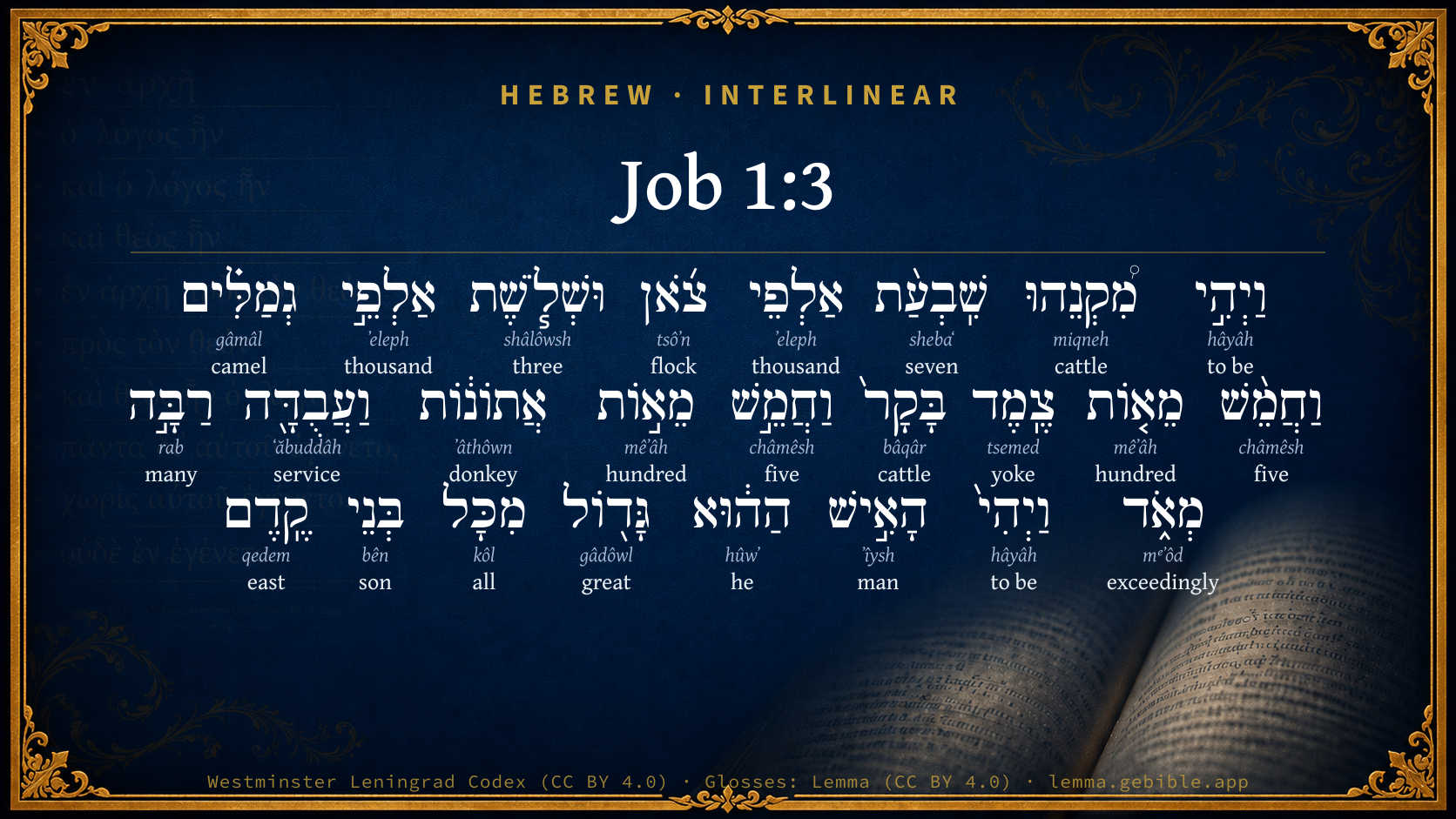
  1. וַיְהִ֣י hâyâh H1961 “and · to be” Conjunction + Verb, Qal, Sequential Imperfect, 3rd Person, Masculine, Singular
  2. מִ֠קְנֵהוּ miqneh H4735 “cattle · his” Noun, Common, Masculine, Singular, Construct + Suffix, Personal, 3rd Person, Masculine, Singular
  3. שִֽׁבְעַ֨ת shebaʻ H7651 “seven” Adjective, Cardinal number, Masculine, Singular, Construct
  4. אַלְפֵי ʼeleph H505 “thousand” Adjective, Cardinal number, Both, Plural, Construct
  5. צֹ֜אן tsôʼn H6629 “flock” Noun, Common, Both, Singular, Absolute
  6. וּשְׁלֹ֧שֶׁת shâlôwsh H7969 “and · three” Conjunction + Adjective, Cardinal number, Masculine, Singular, Construct
  7. אַלְפֵ֣י ʼeleph H505 “thousand” Adjective, Cardinal number, Both, Plural, Construct
  8. גְמַלִּ֗ים gâmâl H1581 “camels” Noun, Common, Masculine, Plural, Absolute
  9. וַחֲמֵ֨שׁ châmêsh H2568 “and · five” Conjunction + Adjective, Cardinal number, Feminine, Singular, Absolute
  10. מֵא֤וֹת mêʼâh H3967 “hundred” Adjective, Cardinal number, Both, Plural, Absolute
  11. צֶֽמֶד tsemed H6776 “yoke of” Noun, Common, Masculine, Singular, Construct
  12. בָּקָר֙ bâqâr H1241 “cattle” Noun, Common, Both, Singular, Absolute
  13. וַחֲמֵ֣שׁ châmêsh H2568 “and · five” Conjunction + Adjective, Cardinal number, Feminine, Singular, Absolute
  14. מֵא֣וֹת mêʼâh H3967 “hundred” Adjective, Cardinal number, Both, Plural, Absolute
  15. אֲתוֹנ֔וֹת ʼâthôwn H860 “donkeys” Noun, Common, Feminine, Plural, Absolute
  16. רַבָּ֣ה rab H7227 “many” Adjective, Adjective, Feminine, Singular, Absolute
  17. מְאֹ֑ד mᵉʼôd H3966 “exceedingly” Adverb
  18. וַיְהִי֙ hâyâh H1961 “and · to be” Conjunction + Verb, Qal, Sequential Imperfect, 3rd Person, Masculine, Singular
  19. הָאִ֣ישׁ ʼîysh H376 “the · man” Particle, Definite Article + Noun, Common, Masculine, Singular, Absolute
  20. הַה֔וּא hûwʼ H1931 “the · he” Particle, Definite Article + Pronoun, Personal, 3rd Person, Masculine, Singular
  21. גָּד֖וֹל gâdôwl H1419 “great” Adjective, Adjective, Masculine, Singular, Absolute
  22. מִכָּל kôl H3605 “from · all of” Preposition + Noun, Common, Masculine, Singular, Construct
  23. בְּנֵי bên H1121 “sons of” Noun, Common, Masculine, Plural, Construct
  24. קֶֽדֶם qedem H6924 “east” Noun, Common, Masculine, Singular, Absolute

About this verse

These counts appear in no published source. They are computed here, from the morphology-tagged text and Lemma’s own curated glosses. What Lemma adds →

25
words
21
distinct lemmas
Wisdom
section

Notable vocabulary

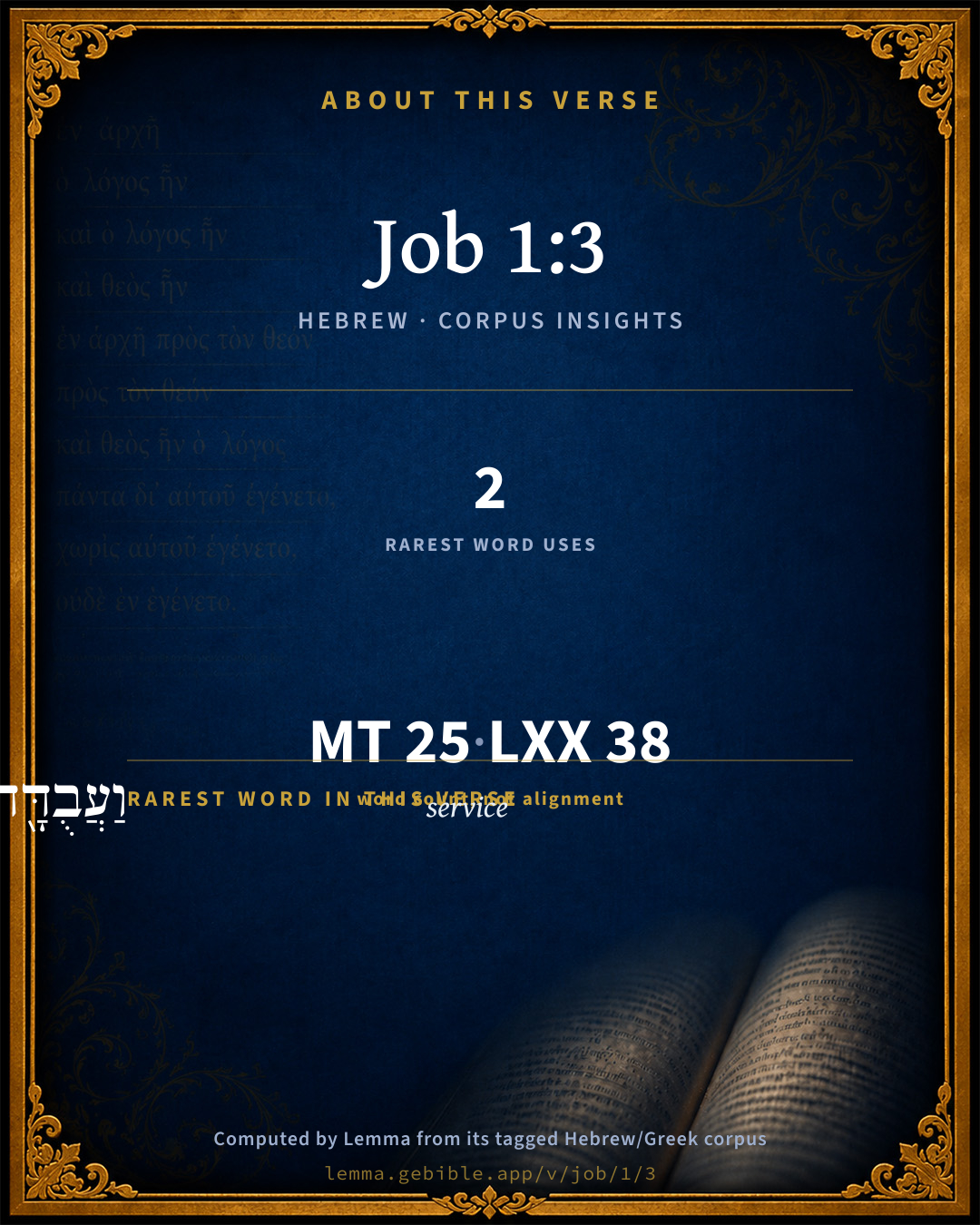
The rarest word here is וַעֲבֻדָּ֖ה service H5657 — appearing just 2 times in the whole Hebrew Bible.

Shared distinctive vocabulary

וַעֲבֻדָּ֖ה service H5657 occurs in 2 verses of the Hebrew Bible. Also found in:

Grammatical profile

  • 2 verbs
  • 11 nouns
  • 10 adjectives
  • 1 pronoun
  • 1 adverb

Verb forms

  • וַיְהִ֣י Qal · Sequential Imperfect
  • וַיְהִי֙ Qal · Sequential Imperfect

Repetition

Words recur within this verse — often emphatic in Hebrew:

  • וַיְהִ֣י to be H1961 ×2
  • אַלְפֵי thousand H505 ×2
  • וַחֲמֵ֨שׁ five H2568 ×2
  • מֵא֤וֹת hundred H3967 ×2

Hebrew & Septuagint length

In English translation the verse runs 37 words from the Hebrew and 48 from the Septuagint (LXX English) — closely comparable.

A rough comparison of the two English renderings, which tokenize alike — not a word-level alignment.

Word counts can differ between the Hebrew and the Greek without any difference in meaning — e.g. the Hebrew direct-object marker אֵת has no separate Greek word, and Greek often adds the article ὁ.

In the original languages it is 25 Hebrew tokens and 38 Greek tokens — but the two are counted differently (Hebrew bundles its prefixes and suffixes into one token; the Greek is in lemma form), so that isn’t a like-for-like length.

Cross-references

21

Topical passages linked to Job 1:3 in the Treasury of Scripture Knowledge — connected by theme and wording, ordered by reader-vote popularity; previews shown in the World English Bible.

  • Job 29:25 I chose out their way, and sat as chief. I lived as a king in the army, As one who comforts the mourners.
  • Job 42:12 So Yahweh blessed the latter end of Job more than his beginning. He had fourteen thousand sheep, six thousand camels, one thousand yoke of oxen, and a thousand female donkeys.
  • Judges 6:3 So it was, when Israel had sown, that the Midianites came up, and the Amalekites, and the children of the east; they came up against them;
  • Numbers 23:7 He took up his parable, and said, From Aram has Balak brought me, The king of Moab from the mountains of the East: Come, curse me Jacob, Come, defy Israel.
  • 1 Kings 4:30 Solomon's wisdom excelled the wisdom of all the children of the east, and all the wisdom of Egypt.
  • Proverbs 10:22 Yahweh's blessing brings wealth, And he adds no trouble to it.
  • Genesis 12:16 He dealt well with Abram for her sake. He had sheep, and oxen, and male donkeys, and men-servants, and maid-servants, and female donkeys, and camels.
  • Genesis 12:5 Abram took Sarai his wife, Lot his brother's son, all their substance that they had gathered, and the souls who they had gotten in Haran; and they went forth to go into the land of Canaan. Into the land of Canaan they came.
  • Job 29:9–10 The princes refrained from talking, And laid their hand on their mouth;
  • Genesis 13:6 The land was not able to bear them, that they might live together: for their substance was great, so that they could not live together.
  • Genesis 29:1 Then Jacob went on his journey, and came to the land of the children of the east.
  • Genesis 25:6 but to the sons of the concubines who Abraham had, Abraham gave gifts. He sent them away from Isaac his son, while he yet lived, eastward, to the east country.
  • Genesis 34:23 Won't their cattle and their substance and all their animals be ours? Only let us give our consent to them, and they will dwell with us."
  • Numbers 31:32–34 Now the prey, over and above the booty which the men of war took, was six hundred seventy-five thousand sheep,
  • Judges 6:5 For they came up with their cattle and their tents; they came in as locusts for multitude; both they and their camels were without number: and they came into the land to destroy it.
  • 1 Samuel 25:2 There was a man in Maon, whose possessions were in Carmel; and the man was very great, and he had three thousand sheep, and a thousand goats: and he was shearing his sheep in Carmel.
  • 2 Kings 3:4 Now Mesha king of Moab was a sheep-master; and he rendered to the king of Israel the wool of one hundred thousand lambs, and of one hundred thousand rams.
  • 2 Chronicles 26:10 He built towers in the wilderness, and hewed out many cisterns, for he had much cattle; in the lowland also, and in the plain: [and he had] farmers and vineyard keepers in the mountains and in the fruitful fields; for he loved farming.
  • 2 Chronicles 32:29 Moreover he provided him cities, and possessions of flocks and herds in abundance; for God had given him very much substance.
  • Judges 7:12 The Midianites and the Amalekites and all the children of the east lay along in the valley like locusts for multitude; and their camels were without number, as the sand which is on the sea-shore for multitude.
  • Judges 8:10 Now Zebah and Zalmunna were in Karkor, and their hosts with them, about fifteen thousand men, all who were left of all the host of the children of the east; for there fell one hundred twenty thousand men who drew sword.

Cross-references courtesy of OpenBible.info (CC BY 4.0).

Hebrew and Greek witnesses Masoretic Hebrew ↔ Greek Septuagint

The same verse in the two great witnesses to the Old Testament, shown verse-for-verse.

These are two independent witnesses, not word-aligned to each other, and the Septuagint is shown in lemma (dictionary) form.

Hebrew Job 1:3 Masoretic · Westminster Leningrad Codex

וַיְהִ֣י מִ֠קְנֵהוּ שִֽׁבְעַ֨ת אַלְפֵי צֹ֜אן וּשְׁלֹ֧שֶׁת אַלְפֵ֣י גְמַלִּ֗ים וַחֲמֵ֨שׁ מֵא֤וֹת צֶֽמֶד בָּקָר֙ וַחֲמֵ֣שׁ מֵא֣וֹת אֲתוֹנ֔וֹת וַעֲבֻדָּ֖ה רַבָּ֣ה מְאֹ֑ד וַיְהִי֙ הָאִ֣ישׁ הַה֔וּא גָּד֖וֹל מִכָּל בְּנֵי קֶֽדֶם

His possessions also were seven thousand sheep, three thousand camels, five hundred yoke of oxen, five hundred she-donkeys, and a very great household; so that this man was the greatest of all the children of the east.

World English Bible · Public Domain

Greek LXX Job 1:3 Septuagint · lemma form

καί εἰμί ὁ κτῆνος αὐτός πρόβατον ἑπτακισχίλιοι κάμηλος τρισχίλιοι ζεῦγος βοῦς πεντακόσιοι ὄνος θῆλυς νομάς πεντακόσιοι καί ὑπηρεσία πολύς σφόδρα καί ἔργον μέγας εἰμί αὐτός ἐπί ὁ γῆ καί εἰμί ὁ ἄνθρωπος ἐκεῖνος εὐγενής ὁ ἀπό ἥλιος ἀνατολή

And his cattle consisted of seven thousand sheep, three thousand camels, five hundred yoke of oxen, five hundred she-asses in the pastures, and a very great household, and he had a great husbandry on the earth; and that man was most noble of the men of the east.

LXX2012 (modern English Septuagint) · Public Domain

On this verse, John Gill's Exposition discusses the Septuagint’s reading. Read the note in Commentary ↓

Hebrew: Westminster Leningrad Codex (CC BY 4.0). Greek: Septuagint (public domain); English from LXX2012 (modern English Septuagint) (Public Domain). How the Septuagint differs from the Hebrew →

Commentary

Notes on Job 1:3 from classic Christian and Jewish commentators (each source and its license shown beneath its notes). The classic Christian expositions comment on the surrounding passage and are grouped to its opening verse, so a note may address several verses; the Jewish commentaries on the Tanakh (Rashi and others) are per-verse, so they appear only where the commentator wrote on this verse.

Lemma curates 59 commentaries, every one of them public domain or Creative Commons licensed, each selected and text-cleaned for this edition rather than reprinted as found. About our sources →

Trapp's Complete Commentary

John Trapp

Job 1:3 His substance also was seven thousand sheep, and three thousand camels, and five hundred yoke of oxen, and five hundred she asses, and a very great household; so that this man was the greatest of all the men of the east.

Ver. 3. His substance also] Heb. His possession or acquisition, that stock and store which he had gotten, and was rightly possessed of, consisting very much in cattle, great and small ( Possessio maxime pecuaria. Nomen dictum est ab acquirendo, Merc.), his possessions were mostly in sheep. His name was said from acquiring. for money in was not then in so great request as now, when it is become the monarch, and bears the mastery, Regina pecunia, Queen of money, as he saith; In precio precium nunc est, saith another. We read not of Job’s gold, silver, tapestry, rich furniture (saith Origen), and other accoutrements, now much used and valued, but not so of old. Heretofore in this island of ours (saith Hollingshed) in a good farmer’s house it was rare to find four pieces of pewter; and it was accounted a great matter that a farmer could show five shillings or a noble together in silver; and if the goodman of the house had a mattress or flock bed, and a sack of chaff to rest his head on, he thought himself as well lodged as the lord of the town, &c. Hollingshed further saith, that some old men he knew who told of such times in England, no longer ago.

Was seven thousand sheep] He had most of that most profitable creature, good both ad esum and ad usum; for eating and using; therefore also in sacrifices was no creature so frequently offered.

And three thousand camels, and five hundred yoke of oxen] sc. To carry his servants and his baggage, to export and import commodities; for

Nec vero terrae ferre omnes omnia possunt.

And truly, the lands are not able to bear all his possessions.

And five hundred she asses] To plough his ground with, for great men were anciently much addicted to husbandry (as Uzziah, 2Ch 26:10), which Socrates called Amaltheae cornu, the horn of plenty; and the Romans reckoned, that grain was with them never so cheap as when men were fetched from the plough tail to govern the Commonwealth, quasi gauderet terra laureato vomere, et aratro triumphali (Plin.). But now the case is otherwise, as Beza upon this text complaineth; that husbandry and shepherdy are left for the basest and simplest men, and for such as all others might prey upon. And this bringeth into my mind, saith he, that which once I saw painted in a table, where the nobleman had this posy, By my sword I defend you all; the clergyman, By my prayers I preserve you all; the countryman, I feed you all, lastly, the lawyer, I devour you all. Pellican noteth here, that Job had no horses, because he lived lovingly with his neighbours, not warring upon any: the horse is a warlike creature, prepared for the day of battle. But Beza noteth, that in that country they had little use of horses, as using camels to bear burdens, and asses to ride on. See Jdg 5:10; Jdg 10:4.

And a very great household] Great store of servants he had about him, and himself was the greatest, according to that of the Greek poet (wherewith Luther was so taken, that he translated it in certain rhythms),

Eις εστι δουλος οικιας ο δεσποτης.

Some render it, He had very much husbandry; others, He had great doings in the world; the more was his trouble (it is not the great cage that maketh the bird sing; and abroad, she singeth not on the ground, but when got in the air, or on the top of trees; so is it with the saints), and the greater was his praise, that he could handle his thorns and not prick his fingers; have so much to do with the world, and yet not grow worldly-minded.

Difficile est opibus non tradere mores,

Et cum tot Croesos viceris, esse Numam.

It is difficult is not to surrender morals for wealth, and when so many Croesos’ excel, to be a Numa. (Second king of Rome who reformed their society and religion.)

So that this man was the greatest, &c.] A king; some say, the first king of Edom, but that’s uncertain; he might be a private man, and yet a very rich man; such as was Pythias, who was once able to entertain Xerxes and his two millions of men for three days, and yet died a beggar, and was famished. He was impoverished by his own folly and prodigality; but Job, by the immediate hand and good pleasure of God, for his trial, and for exercise of his patience. This commendeth unto us Job’s constancy and magnanimity, which is so much the more wonderful, by how much this change was not only not self acquired, but altogether unexpected; his sun went down suddenly, at high noon; and when he doubted least he was made a mirror of misfortune; as if God and men, heaven and earth, were set against him. In him it appeared that mortality was but the stage of mutability, and that,

Omnia sunt hominum tenui pendentia filo;

Et subito casu, quae valuere, ruunt.

All things of men are hanging down on a feeble string; and suddenly overthrown, which to value is their ruin.

John Trapp, A Commentary or Exposition upon All the Books of the Old and New Testament (1647–1656) — public domain. Text from a community e-Sword module.

Joseph Benson's Commentary

Job 1:3. His substance also was seven thousand sheep — Namely, seven thousand small cattle, whether sheep or goats, in opposition to the larger cattle next mentioned. And three thousand camels — Camels in these parts were very numerous, as is manifest from Jdg 7:12; 1Ch 5:21, and the testimonies of Aristotle and Pliny; and very useful, both for carrying burdens in those hot and dry countries, being able to endure thirst much better than other creatures, and for service in war. And five hundred she-asses — Which were preferred before he-asses, as serving for the same uses of carrying burdens, riding on, and different kinds of labour; and likewise for breeding and giving milk: but he-asses also may perhaps be included in the expression, the denomination being, as usual, taken from the greater part, which were she-asses. This man was the greatest of all the men of the East — Hebrew, magnus præ omnibus filiis Orientis, great in comparison, in respect, or before all the children of the East. Grotius and others have observed, that the phraseology here used is an argument that the book must have been written by some Israelite, or inhabitant of the land of Canaan, Job’s country lying eastward from thence, and it being usual with the Hebrews to call Arabia the East. The expression probably only means that he was the greatest, or one of the greatest, that lived in those parts; such general expressions being commonly understood with such limitations. The account of his piety and prosperity comes before the account of his afflictions, to show that neither of these will secure us from the common, no, nor from the uncommon calamities of human life.

Joseph Benson's Commentary on the Old and New Testaments (1811–1818) — public domain. Text from a community e-Sword module.

Geneva Bible (1599)

Geneva Bible translators

Hebrew, children.

His children and riches are declared, to commend his virtue in his prosperity and his patience, and constancy, when God had taken them from him.

Meaning, the Arabians, Chaldeans, Idumeans, etc.

Geneva Bible (1599) marginal notes — public domain. Text via Bolls.life.

Jamieson, Fausset & Brown

Robert Jamieson, A. R. Fausset & David Brown

she-asses--prized on account of their milk, and for riding (Jdg 5:10). Houses and lands are not mentioned among the emir's wealth, as nomadic tribes dwell in movable tents and live chiefly by pasture, the right to the soil not being appropriated by individuals. The "five hundred yoke of oxen" imply, however, that Job tilled the soil. He seems also to have had a dwelling in a town, in which respect he differed from the patriarchs. Camels are well called "ships of the desert," especially valuable for caravans, as being able to lay in a store of water that suffices them for days, and to sustain life on a very few thistles or thorns.

household-- (Gen 26:14). The other rendering which the Hebrew admits, "husbandry," is not so probable.

men of the east--denoting in Scripture those living east of Palestine; as the people of North Arabia-Deserta (Jdg 6:3; Eze 25:4).

Jamieson, Fausset & Brown — Commentary Critical and Explanatory on the Whole Bible (1871) — public domain (CC PDM 1.0). Text via the HelloAO Bible API.

Adam Clarke's Commentary

Verse 3. His substance also was seven thousand sheep] A thousand, says the Chaldee, for each of his sons. Three thousand camels: a thousand for each of his daughters. Five hundred yoke of oxen for himself. And five hundred she-asses for his wife. Thus the Targum divides the substance of this eminent man.

A very great household] עבדה רבה מאד abuddah rabbah meod, "a very great estate.' The word עבדה abuddah refers chiefly to husbandry, including all manner of labour in the field, with cattle, and every description of servants.

The greatest of all the men of the East.] He was more eminent than any other person in that region in wisdom, wealth, and piety. He was the chief emir of that district.

Adam Clarke's Commentary on the Bible (1810–1826) — public domain. Text from a community e-Sword/MySword module.

Ellicott's Commentary for English Readers

(3) The men of the east.—This term is indefinite with regard to the three districts above mentioned, and might include them all. The Arabs still call the Hauran, or the district east of Jordan, the land of Job. It is said to be a lovely and fertile region, fulfilling the conditions of the poem.

A Bible Commentary for English Readers, edited by Charles John Ellicott (1878–1897) — public domain. Text from a community e-Sword module.

John Gill's Exposition

His substance also was seven thousand sheep,.... For which he must have a large pasturage to feed them on, as well as these would produce much wool for clothing, and flesh for food; this part of his substance or possessions is mentioned first, as being the largest, and most useful and profitable:

and three thousand camels; creatures fit to carry burdens, and travel with, and were greatly valued on that account, especially in the deserts of Arabia, near to which Job lived; and that not only because they were strong for this purpose, but because they could endure much thirst and want of water for a long time; See Gill on Lev 11:4, it seems by this that Job carried on a commerce, and traded in distant parts, whither he sent the produce of his lands and cattle, and trafficked with them: these camels might not only be he, but she camels also, according to the Septuagint version, which might be kept for breeding, and for their milk: Aristotle observes (z), some of the inhabitants of the upper Asia used to have camels, to the number of 3000, the exact number here mentioned; and by the number of these creatures the Arabians estimated their riches and possessions (a); and so sheep are by the Greeks called as it is thought, from the Arabic word "mala", to be rich (b); the riches of other people, and of particular persons, as of Geryon, Atlas, and Polyphemus, are represented as chiefly consisting of their flocks, and also of their herds (c), as follows:

and five hundred yoke of oxen; to plough his land with, of which he must have a large quantity to employ such a number in, see Kg1 19:19

and five hundred she asses; which must be chiefly for their milk; and no doubt but he had a considerable number of he asses also, though not mentioned, which, as well as the others, were used to ride on, and also to plough with, in those countries; it may be rendered only asses as by some, and so may include both: Aristaeus, Philo, and Polyhistor (d) give the same account of Job's substance in the several articles as here:

and a very great household: this must be understood of his servants only, since his children are before taken notice of; and the same phrase is rendered "great store of servants", Gen 26:14 and in the margin, "husbandry" or "tillage", large fields and farms; and the sense comes to much the same, whether it is taken the one way or the other; if great store of servants, he must have large farms and many fields to employ them in; and if a large husbandry, and much ground for tillage, he must have many servants to manure and cultivate them: now these several articles are mentioned, because, in those times and countries, as has been observed, the substance of men chiefly lay in them, and according to them they were reckoned more or less rich; not but that they had gold and silver also, as Abraham had, Gen 13:1, and so had Job, Job 31:24, but these were the principal things:

so that this man was the greatest of all the men of the east; that lived in Arabia, Chaldea, and other eastern countries; that is, he was a man of the greatest wealth and riches, and of the greatest power and authority, and was had in the greatest honour and esteem: now these temporal blessings are observed, to show that grace and earthly riches are compatible, that they may, and sometimes do, meet in the same person; as also to point at the goodness of God, in bestowing such blessings on this good man, thereby fulfilling the promise made to godliness and godly men, which respects this life, and that which is to come; and they are mentioned chiefly for the sake of the loss of these things after related, whereby the greatness of his loss and of his afflictions would be the more easily perceived, and his patience in bearing them appear the more illustrious; for by how much the greater was his substance, by so much the greater were his losses and trials, and the more remarkable his patience under them.

(z) Hist. Animal. l. 9. c. 50. (a) Leo African. Descript. Africae, l. 9. p. 745. (b) Hinckelman. Praefat. ad Alkoran. (c) Vid. Homer. Odyss. 14. ver. 100, &c. Virgil. Aeneid. l. 7. ver. 537. Justin e Trogo, l. 44. c. 4. Theocrit. Idyll. 11. ver. 34. Ovid. Metamorph. l. 4. Fab. 17. & l. 13. Fab. 8. (d) Apud Euseb. Evangel. Praepar. l. 9. c. 25. p. 430.

John Gill's Exposition of the Whole Bible (1746–1763) — public domain (CC PDM 1.0). Text via the HelloAO Bible API.

Albert Barnes' Notes on the Bible

His substance - Margin, or “cattle.” The word used here מקנה mı̂qneh is derived from קנה qânâh, to gain or acquire, to buy or purchase, and properly means anything acquired or purchased - property, possessions, riches. The wealth of nomadic tribes, however, consisted mostly in flocks and herds, and hence the word in the Scripture signifies, almost exclusively, property in cattle. The word, says Gesenius, is used “strictly” to denote sheep, goats, and neat cattle, excluding beasts of burden (compare Greek κτῆνος ktēnos, herd, used here by the Septuagint), though sometimes the word includes asses and camels, as in this place.

Seven thousand sheep - In this verse we have a description of the wealth of an Arab ruler or chief, similar to that of those who are at this day called “Emirs.” Indeed the whole description in the book is that which is applicable to the chief of a tribe. The possessions referred to in this verse would constitute no inconsiderable wealth anywhere, and particularly in the nomadic tribes of the East. Land is not mentioned as a part of this wealth; for among nomadic tribes living by pasturage, the right to the soil in fee simple is not claimed by individuals, the right of pasturage or a temporary possession being all that is needed. For the same reason, and from the fact that their circumstances require them to live in movable tents, houses are not mentioned as a part; of the wealth of this Emir. To understand this book, as well as most of the books of the Old Testament, it is necessary for us to lay aside our notions of living, and transfer ourselves in imagination to the very dissimilar customs of the East. The Chaldee has made a very singular explanation of this verse, which must be regarded as the work of fancy, but which shows the character of that version: “And his possessions were seven thousand sheep - a thousand for each of his sons; and three thousand camels - a thousand for each of his daughters; and five hundred yoke of oxen - for himself; and five hundred she-asses - for his wife.”

And three thousand camels - Camels are well-known beasts of burden, extensively used still in Arabia. The Arabs employed these animals anciently in war, in their caravans, and for food. They are not unfrequently called “ships of the desert,” particularly valuable in arid plains because they go many days without water. They carry from three to five hundred pounds, in proportion to the distance which they have to travel. Providence has adapted the camel with wonderful wisdom to sandy deserts, and in all ages the camel must be an invaluable possession there. The driest thistle and the barest thorn is all the food that he requires, and this he eats while advancing on his journey without stopping or causing a moment’s delay. As it is his lot to cross immense deserts where no water is found, and where no dews fall, he is endowed with the power of laying in a store of water that will suffice him for days - Bruce says for thirty days.

To effect this, nature has provided large reservoirs or stomachs within him, where the water is kept pure, and from which he draws at pleasure as from a fountain. No other animal is endowed with this power, and were it not for this, it would be wholly impracticable to cross those immense plains of sand. The Arabians, the Persians, and others, eat the flesh of camels, and it is served up at the best tables in the country. One of the ancient Arab poets, whose hospitality grew into a proverb, is reported to have killed yearly, in a certain month, ten camels every day for the entertainment of his friends. In regard to the hardihood of camels, and their ability to live on the coarsest fare, Burckhardt has stated a fact which may furnish an illustration. In a journey which he made from the country south of the Dead Sea to Egypt, he says, “During the whole of this journey, the camels had no other provender than the withered shrubs of the desert, my dromedary excepted, to which I gave a few handfuls of barley each evening.” Trav. in Syria, p. 451; compare Bruce’s Travels, vol. iv. p. 596; Niebuhr, Reise-beschreibung nach Arabien, 1 Band, s. 215; Sandys, p. 138; Harmer’s Obs. 4:415, ed. Lond. 1808, 8vo; and Rob. Cal.

And five hundred yoke of oxen - The fact that Job had so many oxen implies that he devoted himself to the cultivation of the soil as well as to keeping flocks and herds; compare Job 1:14. So large a number of oxen would constitute wealth anywhere.

And five hundred she-asses - Bryant remarks (Observations, p. 61) that a great part of the wealth of the inhabitants of the East often consisted of she-asses, the males being few and not held in equal estimation. She-asses are early mentioned as having been in common use to ride on; Num 22:25; Jdg 5:10. 2Ki 4:24 (Hebrew). One reason why the ass was chosen in preference to the horse, was that it subsisted on so much less than that animal, there being no animal except the camel that could be so easily kept as the ass. She-asses were also regarded as the most valuable, because, in traversing the deserts of the country they would furnish travelers with milk. It is remarkable that “cows” are not mentioned expressly in this enumeration of the articles of Job’s wealth, though “butter” is referred to by him subsequently as having been abundant in his family, Job 29:6. It is possible, however, that “cows” were included as a part of the “five hundred yoke of בקר bâqâr.” here rendered “oxen;” but which would be quite as appropriately rendered “cattle.” The word is in the common gender, and is derived from בקר bâqar, in Arabic to cleave, to divide, to lay open, and hence, to plow, to cleave the soil. It denotes properly the animals used in plowing; and it is well known that cows are employed as well as oxen for this purpose in the East; see Jdg 14:18; Hos 4:10; compare Deu 32:14, where the word בקר bâqâr is used to denote a cow - “milk of kine,” Gen 33:13 (Hebrew).

And a very great household - Margin, “husbandry.” The Hebrew word here (עבדה ‛ăbûddâh)ambiguous. - It may denote service rendered, that is, work, or the servants who performed it; compare Gen 26:14, margin. The Septuagint renders it ὑπηρεσία hupēresia, Aquila δουλεία douleia, and Symmachus, οἰκετία oiketia; all denoting “service,” or “servitude,” or that which pertained to the domestic service of a family. The word refers doubtless to those who had charge of his camels, his cattle, and of his husbandry; see Job 1:15. It is not implied by the word here used, nor by that in Job 1:15, that they were “slaves.” They may have been, but there is nothing to indicate this in the narrative. The Septuagint adds to this, as if explanatory of it, “and his works were great in the land.”

So that this man was the greatest - Was possessed of the most wealth, and was held in the highest honor.

Of all the men of the East - Margin as in Hebrew “sons.” The sons of the East denote those who lived in the East. The word “East” קדם qedem is commonly employed in the Scriptures to denote the country which lies east of Palestine. For the places intended here, see the Introduction, Section 2, (3). It is of course impossible to estimate with accuracy the exact amount of the value of the property of Job. Compared with many persons in modern times, indeed, his possessions would not be regarded as constituting very great riches. The Editor of the Pictorial Bible supposes that on a fair estimate his property might be considered as worth from thirty to forty thousand pounds sterling - equivalent to some 200,000 (circa 1880’s). In this estimate the camel is reckoned as worth about 45.00 dollars, the oxen as worth about five dollars, and the sheep at a little more than one dollar, which it is said are about the average prices now in Western Asia. Prices, however, fluctuate much from one age to another; but at the present day such possessions would be regarded as constituting great wealth in Arabia. The value of the property of Job may be estimated from this fact, that he had almost half as many camels as constituted the wealth of a Persian king in more modern times.

Chardin says, “as the king of Persia in the year 1676 was in Mesandera, the Tartars fell upon the camels of the king and took away three thousand of them which was to him a great loss, for he had only seven thousand.” - Rosenmuller, Morgenland, “in loc.” The condition of Job we are to regard as that of a rich Arabic Emir, and his mode of life as between the nomadic pastoral life, and the settled manner of living in communities like ours. He was a princely shepherd, and yet he was devoted to the cultivation of the soil. It does not appear, however, that he claimed the right of the soil in “fee simple,” nor is his condition inconsistent with the supposition that his residence in any place was regarded as temporary, and that all his property might be easily removed. “He belonged to that condition of life which fluctuated between that of the wandering shepherd, and that of a people settled in towns. That he resided, or had a residence, in a town is obvious; but his flocks and herds evidently pastured in the deserts, between which and the town his own time was probably divided. He differed from the Hebrew patriarchs chiefly in this, that he did not so much wander about “without any certain dwelling place.”

This mixed condition of life, which is still frequently exhibited in Western Asia, will, we apprehend, account sufficiently for the diversified character of the allusions and pictures which the book contains - to the pastoral life and the scenes and products of the wilderness; to the scenes and circumstances of agriculture; to the arts and sciences of settled life and of advancing civilization.” - Pict. Bib. It may serve somewhat to illustrate the different ideas in regard to what constituted wealth in different countries, to compare this statement respecting Job with a remark of Virgil respecting an inhabitant of ancient Italy, whom he calls the most wealthy among the Ausonian farmers:

Seniorque Galaesua.

Dum paci medium se offert; justissimus unus

Qui fuit, Ausoniisque olim ditissimus arvis:

Quinque greges illi balantum. quina redibant

Armenta, et terram centurn vertebat aratris.

Aeneid 7:535-539.

Among the rest, the rich Galaesus lies;

A good old man, while peace he preached in vain,

Amid the madness of the unruly train:

Five herds, five bleating flocks his pasture filled,

His lands a hundred yoke of oxen tilted.

Dryden

Albert Barnes' Notes on the Bible (1834–1885) — public domain. Text from a community e-Sword/MySword module.

Haydock's Catholic Bible Commentary

Sheep. Hebrew including "goats," which are equally valuable in that country for milk. --- Camels. These animals were used for riding in those barren sands, where they can travel for four days without water; and that which is muddy is best for them. --- East, in the desert Arabia. Septuagint add at the end of the book, that Job was king; and he seems to have been independent, (Calmet) and to have had other kings who acknowledged his authority. (Pineda) (Chap. xxix. 7., &c.) --- Each city had its own king in the days of Abraham and of Josue. Job, or Jobab, resided at Denaba, Genesis xxxvi. 32. (Calmet)

George Leo Haydock (1774–1849), Haydock's Catholic Family Bible and Commentary, 1859 edition — public domain. Excludes Psalms (Douay-Rheims chapter numbering differs from Protestant) and Deuterocanonical books (Catholic canon only).

Matthew Poole's English Annotations

Camels in these parts were very numerous, as is manifest from Jdg 7:12; 1Ch 5:21, and from the plain testimonies of Aristotle and Pliny, and very useful, and proper both for carrying of burdens in these hot and dry countries, as being able to endure thirst much better than other creatures, and for service in war.

She-asses were preferred before he-asses, as serving for the same uses as they did, and for breeding and milk also; but he-asses also may be included in this expression, which is of the feminine gender, because the greatest part of them (from which the denomination is usually taken) were she-asses.

The greatest, i.e. one of the richest.

Of all the men of the east, to wit, that lived in those parts; such general expressions being commonly understood with such limitations.

Matthew Poole's English Annotations on the Holy Bible (1683–1685) — public domain. Text from a community e-Sword/MySword module.

Whedon's Commentary on the Bible

Daniel D. Whedon

3. His substance — Sir G. Wilkinson gives a plate, taken from a tomb at the pyramids, illustrative of the possessions of a wealthy Egyptian proprietor, who probably lived four thousand years ago. In the schedule appears a flock of four thousand two hundred and eight sheep, and about the same number of oxen and asses as in our text, but no camels. The statement of the stock of Abraham, (Gen_12:16,) during his short stay in Egypt, presented sheep, oxen, asses of both sexes, and camels. He and Job were both of a country where camels were needed. It is to be remarked that in the inventories of all these extensive proprietors no horses or mules are mentioned — an incidental indication of the remote antiquity in which Job must have lived. Kitto (Bible Illustrations) estimates the value of his live stock to have been not far from forty thousand pounds, and that this did not constitute one half of his entire possessions. Money, too, was then of vastly greater relative value than now. His wealth was that of a prince. A sheik or emir, worth five or six thousand pounds, would at the present day be regarded as a very rich man.

Three thousand camels — Of the camel the Arabs say: “Job’s beast is a miracle of God’s mercy.”

The word itself, hamala, as found in the Arabic, a cognate language, indicates the mission of his life to be a beast of burden. The quaint old traveler Sandys calls him the ship of Arabia — his seas being the deserts. In his life he is indispensable, for without him the vast deserts of the East would be impassable; and in his death the Arab, says Scetzen, “turns every part to account.” As the make of the ship tells of the sea, so the make of the camel points to the desert; and the one no more indicates the mind of man than does the other the forethought and goodness of God. Burckhardt (Notes) says of the Bedawin residing on the frontiers of Yemen: “The father of a family is said to be poor among them if he possesses only forty camels — the usual stock in a family is from one to two hundred.”

She asses — The sex is mentioned, not on account of the milk they give, which the Semitic tribes do not drink, but because of their value as breeders. The price of the male, however, in Syria is now three times that of the female, (Wetzstein.) A peculiar breed is implied in the original, אתון, the possession of which imported riches or dignity. The Targum thus distributes the live stock: A thousand sheep to each son, a thousand camels to each daughter, and the asses to the wife.

The men of the east — Literally, sons of the East. By the bene Kedem, “sons of the East,” is meant, according to Rosenmuller and Winer, the miscellaneous tribes (especially the Arabian) inhabiting the regions between Egypt and the Euphrates. The word “Saracen” is Arabic for “men of the East,” Orientals.

3. The close and tender relationship of God, as Jehovah, to Israel, will help us to a proper conception of the word. It not only embraced all the moral attributes of God, but those relationships which among men are most endearing — those of father, husband, and Saviour. Deu_32:6; Psa_103:13; Isa_54:5; Isa_60:16; Hos_2:16. According to Havernick, “it denoted the essence of the Godhead in its concrete relation to mankind, the revelation of the living God himself, which is as much unique as its object is unique.” It is, then, not without the deepest reason that Job passes by the olden divine names of power, El, Eloah, Elohim, Shaddai, and in the unshaken affection of the soul addresses God as Jehovah. His stricken heart seeks the heart of God. His appeal rises in sublimity as we contemplate him spontaneously, and at once, casting himself upon the eternal God (Jehovah) who is the Saviour and life of the soul. Upon the very issue that the adversary had made — that Job, stripped of his possessions, would renounce God — faith strikes its key-note of triumph. He blesses God, but not according to the Satanic form of blessing. The jubilant cry of Job is a remarkable and unconscious rejoinder to the dark insinuation that he served God for what he could get. The withdrawing of the goods or blessings of life is one of the modes God takes to remind us that all we have belongs to him. “Just as in some places on one day in the year the way or path is closed in order to remind the public that they pass by sufferance and not by right, in order that no lapse of time may establish ‘adverse possession,’ so does God give warning to us.” — F.W. ROBERTSON, Ser. 2:65. etc.

Daniel D. Whedon (gen. ed.), Commentary on the Old and New Testaments (1874–1909) — public domain. Text from a community e-Sword module.

The Pulpit Commentary

His substance also; literally, his acquisition (from hnq, acquirere), but used of wealth generally. Seven thousand sheep, and three thousand camels, and five hundred yoke of oxen, and five hundred she-asses . Note, first of all, the absence of horses or mules from this list an indication of high antiquity. Horses were not known in Egypt till the time of the shepherd-kings (about B.C. 1900-1650), who introduced them from Asia. None are given to Abraham by the Pharaoh contemporary with him. (Gen_12:16) We hear of none as possessed by the patriarchs in Palestine; and, on the whole, it is not probable that they had been known in Western Asia very long before their introduction into Egypt. They are natives of Central Asia, where they are still found wild, and passed gradually by exportation to the more southern regions, Armenia, Asia Minor, Syria, Palestine, Arabia. Note, secondly, that the items of Job"s wealth accord with those of Abraham"s. (Gen_12:16) Thirdly, note that Job"s wealth in cattle is not beyond credibility. An Egyptian lord of the time of the fourth dynasty relates that he possessed above 1000 oxen and cows, 974 sheep, 2, 235 goals, and 760 asses (Rawlinson"s "Egypt," vol. 2. p. 88). Further, the proportion of the camels is noticeable, and implies a residence on the borders of the desert (see the comment on ver. 1). and a very great household ; literally, and a very great service, or retinue of servants. Oriental emirs and sheikhs consider it necessary for their dignity to maintain a number of attendants and retainers (except, perhaps, in feudal times) quite unknown to the West. Abraham had three hundred and eighteen trained servants, born in his house. (Gen_14:14) Egyptian households were "full of domestics," comprising attendants of all kinds grooms, artisans, clerks, musicians, messengers, and the like. A sheikh, situated as Job was, would also require a certain number of guards, while for his cattle he would need a large body of shepherds, ox-herds, and the like (see Birch"s "Egypt from the Earliest Times," p. 44). So that this man was the greatest of all the men of the east. The Beney Kedem, or "men of the east," literally, sons of the east, seems to include the entire population between Palestine and the Euphrates. (Gen_29:1 Jud_1:6:3 7:12 8:10 Isa_11:14 Jer_49:28, etc.) Many tribes of Arabs are similarly designated at the present day, e.g. the Beni Harb, the Beni Suhr, the Bani Naim, the Bani Lain, etc. It would seem that the Phoenicians must have called themselves Beni Kedem when they settled in Greece, since the Greeks knew them as "Cadmeisns," and made them descendants of a mythic "Cadreus" (Herod., 5:57-59). The name "Saracens" is to some extent analogous, since it means "Men of the morning.

Wealth and piety.

I THEIR COMMON CHARACTERISTICS.

1. God"s gifts; and therefore to be received with thankfulness.

2. Man"s ornaments; and therefore to be borne humbly.

3. A Christian"s talents; and therefore to be used with fidelity.

II THEIR RECIPROCAL RELATIONS.

1. Wealth and piety are not necessarily incompatible.

2. Wealth and piety are often mutually destructive.

3. Wealth and piety may prove reciprocally helpful

III THEIR COMPARATIVE EXCELLENCES.

1. Piety may be obtained by all; wealth can be secured only by a few.

2. Piety is useful to all; wealth is injurious to some.

3. Piety will abide with all; wealth can remain with none.

LESSONS.

1. They that have piety can do without wealth.

2. They that have wealth cannot do without piety.

The Pulpit Commentary (1880–1919), ed. H.D.M. Spence-Jones & Joseph S. Exell — public domain. Text from a community e-Sword module.

John Wesley's Explanatory Notes

Camels - Camels in these parts were very numerous, and very useful, both for carrying burdens in these hot and dry countries, as being able to endure thirst much better than other creatures, and for service in war. Asses - He-asses also may be included in this expression, because the greatest part of them (from which the denomination is usually taken) were she asses. The greatest - That lived in those parts. The account of his piety and prosperity comes before the account of his afflictions, to shew that neither of these will secure us from the common, no, nor from the uncommon calamities of human life.

John Wesley, Explanatory Notes Upon the Whole Bible (1754–1765) — public domain. Text via the GEBible commentary corpus.

Rashi

Rabbi Shlomo Yitzchaki (Rashi)

seven thousand sheep He counted the largest number first.

greater than all the children of the East Than the generation of the division, as it is written (Gen. 11:2): “And it came to pass as they migrated from the east.” But concerning Abraham, it is not so, for concerning Abraham, it is written הגדול, the greatest, as it is stated (Josh. 14:15): “And the name of Hebron before was Kirjath-Arba; he was the greatest man among the “Anakim.” It should have said אדם גדול, a great man. Why did he write האדם הגדול, the greatest man? By this, Scripture hinted that he was a great man who passed ten tests. Therefore, his title is written with two “heys”, the numerical value of which is ten. Job, however, described by the word גדול, greater, passed only one [test], as it is stated: sincere and upright, etc., that out of that entire generation, he was not apprehended for that iniquity.

Rashi on the Tanakh — English translations: “The Judaica Press complete Tanach with Rashi, translated by A. J. Rosenberg” (CC BY 4.0); “Pentateuch with Rashi's commentary by M. Rosenbaum and A.M. Silbermann, 1929-1934” (public domain); “The Metsudah Tanach series, Lakewood, N.J” (CC BY 4.0); and “The Book of Joshua, Metsudah Publications, 1997” (CC BY 4.0). Text via Sefaria.

Lesson kit

Teaching starters — assembled from the data on this page, not authored interpretation. Every prompt links to the verse data it draws on. Edit before teaching.

Job, in the Wisdom, opens this verse with 25 words (21 distinct Hebrew lemmas). Its most distinctive word is ʻăbuddâh (“service”). A historical commentator’s framing appears above. Read the whole chapter for the surrounding context.

Discussion questions

  1. The word ʻăbuddâh carries the sense “service.” How does it shape the verse?
  2. How does Genesis 26:14, which shares the word «service», read alongside this verse?
  3. What does the repetition of “to be” (2× in this one verse) do in this verse?
  4. These translations render this verse differently. What is at stake in choosing one wording over another?
  5. «וַיְהִ֣י» is a Qal Sequential Imperfect verb. How does that grammatical form shape the action described?
  6. Compare how Trapp's Complete Commentary and Joseph Benson's Commentary read this verse. Where do they agree or differ?

Things to notice

Reading settings

Reading text

Shown beneath each verse's original-language words.

Old Testament
Old Testament edition

Read the OT as the Masoretic Hebrew (MT) or the Greek Septuagint (LXX).

English shown for the Greek Septuagint (in the Hebrew ↔ Greek comparison).

Comparing translations? Open the Compare panel on any verse page to stack up to four side by side.