
1 Chronicles 28:12

Hebrew (Westminster Leningrad Codex) 1 Chronicles 28:12 appears in the Hebrew Old Testament. The text above is from the Westminster Leningrad Codex. Each word links to its Strong’s number, a concise gloss, and parsing drawn from the Open Scriptures Hebrew Bible morphology. Click any word for its full Brown-Driver-Briggs (BDB) entry.
Download image
Cite this verse

1 Chronicles 28:12 (World English Bible). Public Domain. Lemma interlinear Bible study tool, https://lemma.gebible.app/v/1-chronicles/28/12.

Show BibTeX & RIS
BibTeX
RIS
English Translation
and the pattern of all that he had by the Spirit, for the courts of the house of Yahweh, and for all the surrounding rooms, for the treasuries of the house of God, and for the treasuries of the dedicated things;
World English Bible · Public Domain
Download a study sheet

One document with this verse’s original text, its word-by-word gloss line, the meaning frame, cross-references with their text, attributed commentary, and full source and license credits — printable, and it pastes into notes with its structure intact.

This verse Autodidact and up

Study sheet (.html) Plain text (.txt)

A passage Seminary Student

Up to 50 verses in one chapter. A passage sheet keeps up to 6 commentary sources and 12 cross-references per verse, in the order this page ranks them, and says so on the sheet whenever that leaves anything out. Ask for a single verse and you get the Autodidact verse sheet above.

Everything on this page stays free to read, with no account — the sheet is a download of what is already on screen, not access to it.

Want to remove ads? Support Godless Engineer
Compare translations 3

The same verse in 3 English versions, stacked beneath the original-language interlinear above. Click any original word for its lexicon entry.

Each is an independent rendering of the whole verse — the interlinear is not word-aligned to these translations.

Highlighted words mark where these versions differ — a whole-verse word diff, not a word-by-word alignment.

  • World English Bible Public Domain
    and the pattern of all that he had by the Spirit, for the courts of the house of Yahweh, and for all the surrounding rooms, for the treasuries of the house of God, and for the treasuries of the dedicated things;
  • King James Version Public Domain
    And the pattern of all that he had by the spirit, of the courts of the house of the LORD, and of all the chambers round about, of the treasuries of the house of God, and of the treasuries of the dedicated things:
  • unfoldingWord Literal Text CC BY-SA 4.0
    and the plan of all that was with him by the Spirit for the courts of the house of Yahweh and for all of the chambers around, for the treasuries of the house of God and for the treasuries of the holy

unfoldingWord Literal Text — © unfoldingWord, licensed CC BY-SA 4.0. Word-aligned USFM3 via Door43 (git.door43.org/unfoldingWord/en_ult).

Versions to compare (up to 4)

3 of 4 selected

Show all 18 translations

Every available English version of this verse, each an independent rendering of the whole verse.

  • World English Bible Public Domain
    and the pattern of all that he had by the Spirit, for the courts of the house of Yahweh, and for all the surrounding rooms, for the treasuries of the house of God, and for the treasuries of the dedicated things;
  • Berean Standard Bible Public Domain
    The plans contained everything David had in mind for the courts of the house of the LORD, for all the surrounding rooms, for the treasuries of the house of God and of the dedicated things,
  • Majority Standard Bible Public Domain
    The plans contained everything David had in mind for the courts of the house of the LORD, for all the surrounding rooms, for the treasuries of the house of God and of the dedicated things,
  • King James Version Public Domain
    And the pattern of all that he had by the spirit, of the courts of the house of the LORD, and of all the chambers round about, of the treasuries of the house of God, and of the treasuries of the dedicated things:
  • American Standard Version (1901) Public Domain
    and the pattern of all that he had by the Spirit, for the courts of the house of Jehovah, and for all the chambers round about, for the treasuries of the house of God, and for the treasuries of the dedicated things;
  • Revised Version (1885) Public Domain
    and the pattern of all that he had by the spirit, for the courts of the house of the LORD, and for all the chambers round about, for the treasuries of the house of God, and for the treasuries of the dedicated things:
  • Geneva Bible (1599) Public Domain
    And the paterne of all that he had in his minde for the courtes of the house of the Lord, and for all the chambers round about, for the treasures of the house of God, and for the treasures of the dedicate things,
  • Douay-Rheims (1899) Public Domain
    As also of all the courts, which he had in his thought, and of the chambers round about, for the treasures of the house of the Lord, and for the treasures of the consecrated things,
  • Young's Literal Translation Public Domain
    and the pattern of all that hath been by the Spirit with him, for the courts of the house of Jehovah, and for all the chambers round about, for the treasures of the house of God, and for the treasures of the things sacrificed;
  • Literal Standard Version CC BY-SA 4.0
    and the pattern of all that has been with him by the Spirit, for the courts of the house of YHWH, and for all the surrounding chambers, for the treasures of the house of God, and for the treasures of the things sacrificed;
  • Unlocked Literal Bible CC BY-SA 4.0
    He gave him the plans he had drawn for the courtyards of Yahweh's house, all the surrounding rooms, the storerooms in God's house, and the treasuries for the things that belong to Yahweh.
  • unfoldingWord Literal Text CC BY-SA 4.0
    and the plan of all that was with him by the Spirit for the courts of the house of Yahweh and for all of the chambers around, for the treasuries of the house of God and for the treasuries of the holy
  • Darby Bible Public Domain
    and the pattern of all that he had by the Spirit, of the courts of the house of Jehovah, and of all the chambers round about, for the treasuries of the house of God, and for the treasuries of the dedicated things;
  • World Messianic Bible Public Domain
    and the plans of all that he had by the Spirit, for the courts of the LORD’s house, for all the surrounding rooms, for the treasuries of God’s house, and for the treasuries of the dedicated things;
  • Webster's Bible Public Domain
    And the pattern of all that he had by the spirit, of the courts of the house of the LORD, and of all the chambers around, of the treasuries of the house of God, and of the treasuries of the dedicated things:
  • Free Bible Version CC BY-SA 4.0
    He also gave him everything he had planned for the courts of the house of the Lord, for all the surrounding rooms, for the treasuries of the house of God and of those things that had been dedicated.
  • Bible in Basic English Public Domain
    And the design of all he had in his heart for the outer squares of the house of the Lord, and for the rooms all round it, and for the store-houses of the house of the Lord, and for the store-houses for the holy things;
  • JPS Tanakh (1917) Public Domain
    and the pattern of all that he had by the spirit, for the courts of the house of the LORD, and for all the chambers round about, for the treasuries of the house of God, and for the treasuries of the hallowed things;

Literal Standard Version (2020), Covenant Press — licensed CC BY-SA 4.0. Text via the HelloAO Bible API (eBible.org). Unlocked Literal Bible (unfoldingWord) — licensed CC BY-SA 4.0. Text via the HelloAO Bible API (eBible.org). unfoldingWord Literal Text — © unfoldingWord, licensed CC BY-SA 4.0. Word-aligned USFM3 via Door43 (git.door43.org/unfoldingWord/en_ult). Free Bible Version, Dr. Jonathan Gallagher — licensed CC BY-SA 4.0. Text via the HelloAO Bible API (eBible.org).

Word by word

More ways to search: Search by grammar → Find every occurrence → Compare this word →

Practice this passage: Drill this verse → Learn its vocabulary →

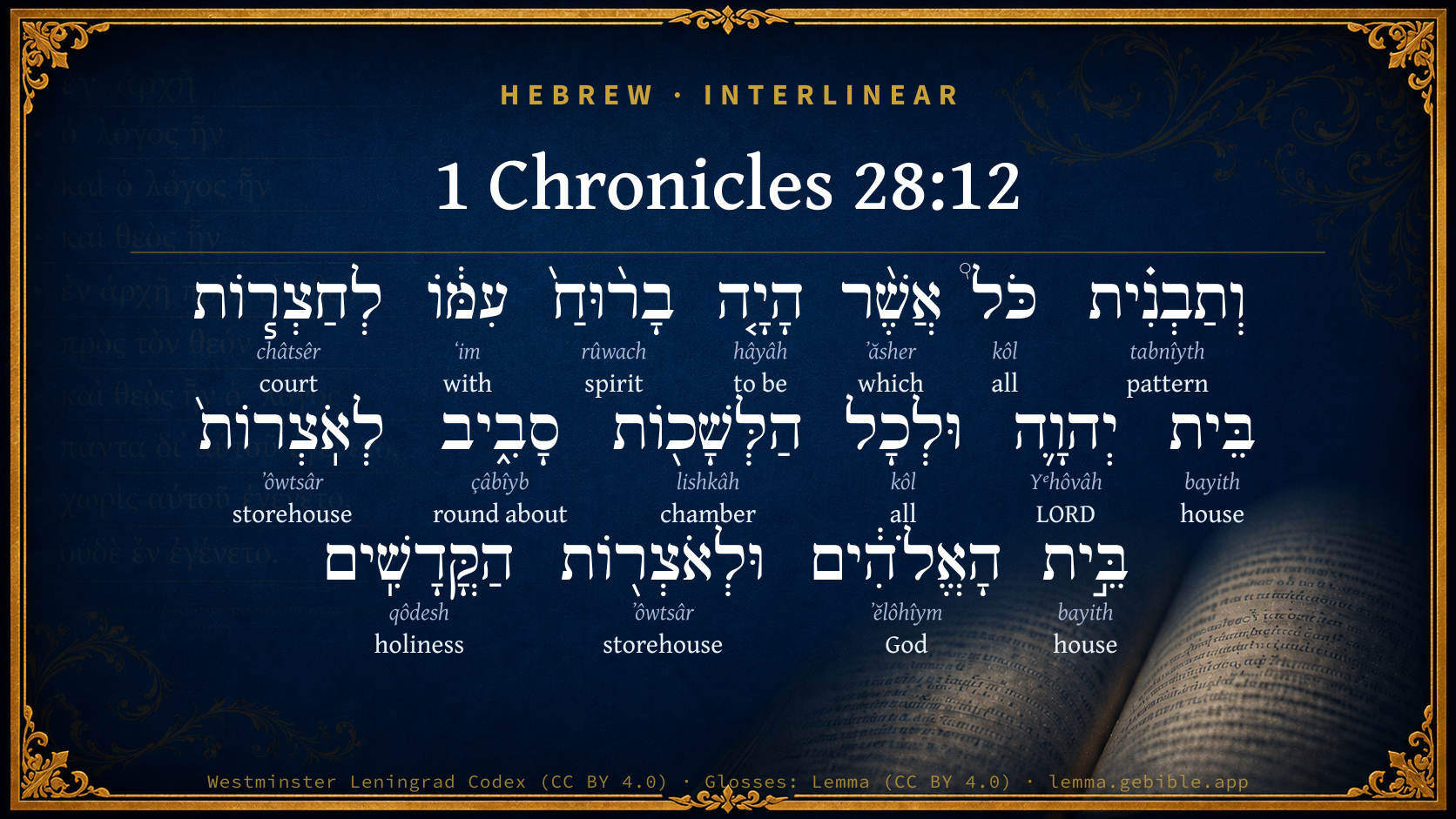
וְתַבְנִ֗ית
tabnîyth
H8403
“and · pattern of”
Conjunction + Noun, Common, Feminine, Singular, Construct
Part of Speech
Conjunction + Noun
Type
Common
Gender
Feminine
Number
Singular
State
Construct
Full BDB Definition

Origin: from H1129

TWOT: 255d

pattern, plan, form, construction, figure - construction, structure - meaning dubious - pattern - figure, image (of idols)
  1. כֹּל֩ kôl H3605 “all” Noun, Common, Masculine, Singular, Absolute
  2. אֲשֶׁ֨ר ʼăsher H834 “which” Particle, Relative
  3. הָיָ֤ה hâyâh H1961 “to be” Verb, Qal, Perfect, 3rd Person, Masculine, Singular
  4. בָר֨וּחַ֙ rûwach H7307 “in/at the · spirit” Preposition, Determined + Noun, Common, Both, Singular, Absolute
  5. עִמּ֔וֹ ʻim H5973 “with · him” Preposition + Suffix, Personal, 3rd Person, Masculine, Singular
  6. לְחַצְר֧וֹת châtsêr H2691 “to/for · courts of” Preposition + Noun, Common, Both, Plural, Construct
  7. בֵּית bayith H1004 “house of” Noun, Common, Masculine, Singular, Construct
  8. יְהוָ֛ה Yᵉhôvâh H3068 “LORD” Noun, Proper
  9. וּלְכָל kôl H3605 “and · to/for · all of” Conjunction + Preposition + Noun, Common, Masculine, Singular, Construct
  10. הַלְּשָׁכ֖וֹת lishkâh H3957 “the · chambers” Particle, Definite Article + Noun, Common, Feminine, Plural, Absolute
  11. סָבִ֑יב çâbîyb H5439 “round about” Noun, Common, Both, Singular, Absolute
  12. לְאֹֽצְרוֹת֙ ʼôwtsâr H214 “to/for · storehouses of” Preposition + Noun, Common, Masculine, Plural, Construct
  13. בֵּ֣ית bayith H1004 “house of” Noun, Common, Masculine, Singular, Construct
  14. הָאֱלֹהִ֔ים ʼĕlôhîym H430 “the · God(s)” Particle, Definite Article + Noun, Common, Masculine, Plural, Absolute
  15. וּלְאֹצְר֖וֹת ʼôwtsâr H214 “and · to/for · storehouses of” Conjunction + Preposition + Noun, Common, Masculine, Plural, Construct
  16. הַקֳּדָשִֽׁים qôdesh H6944 “the · holy things” Particle, Definite Article + Noun, Common, Masculine, Plural, Absolute

About this verse

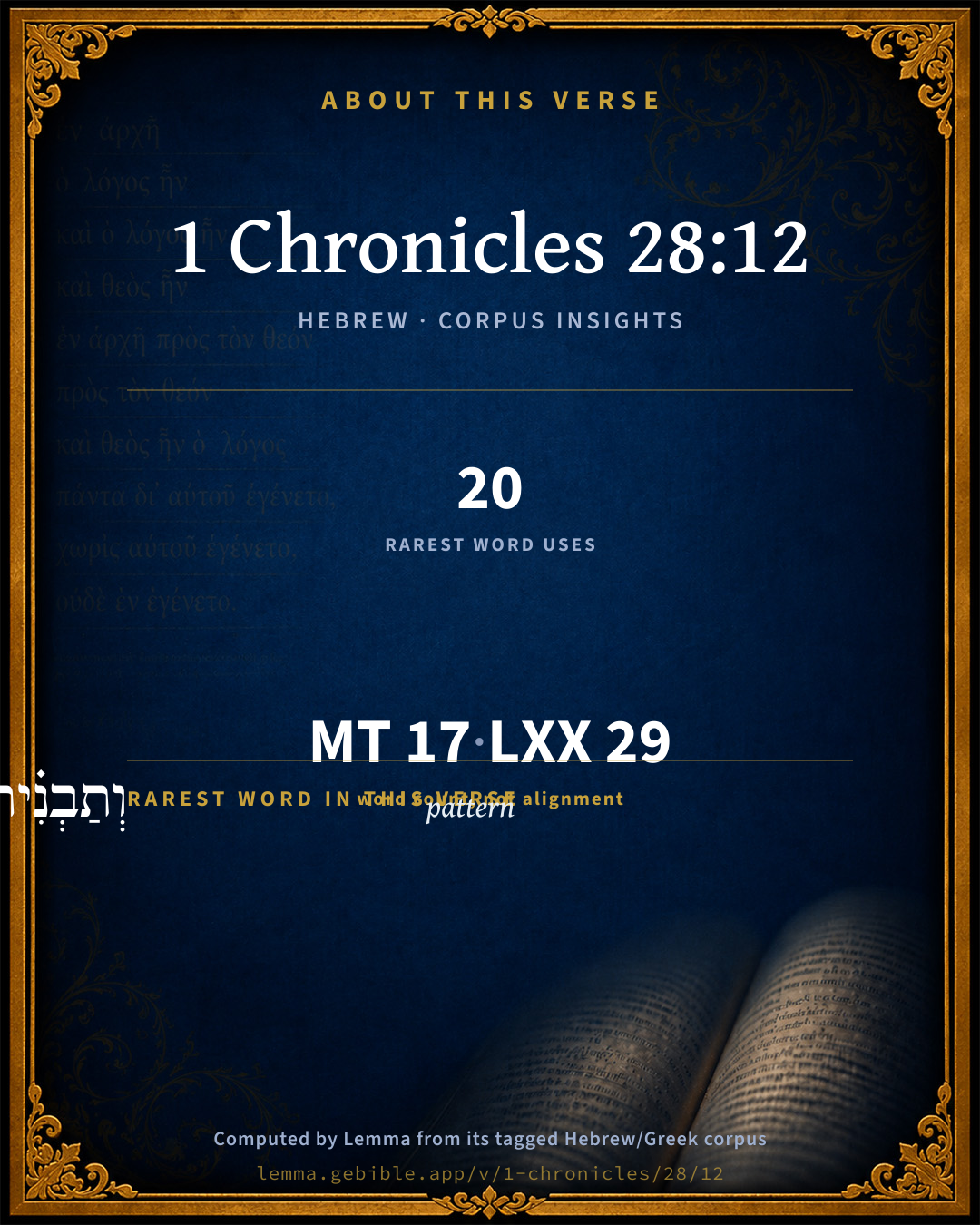
These counts appear in no published source. They are computed here, from the morphology-tagged text and Lemma’s own curated glosses. What Lemma adds →

17
words
14
distinct lemmas
Historical
section

Notable vocabulary

The rarest word here is וְתַבְנִ֗ית pattern H8403 — appearing just 20 times in the whole Hebrew Bible.

Shared distinctive vocabulary

וְתַבְנִ֗ית pattern H8403 occurs in 17 verses of the Hebrew Bible. Also found in:

Grammatical profile

  • 1 verb
  • 14 nouns
  • 1 preposition
  • 1 particle

Verb forms

  • הָיָ֤ה Qal · Perfect

Repetition

Words recur within this verse — often emphatic in Hebrew:

  • כֹּל֩ all H3605 ×2
  • בֵּית house H1004 ×2
  • לְאֹֽצְרוֹת֙ storehouse H214 ×2

Hebrew & Septuagint length

In English translation the verse runs 41 words from the Hebrew and 48 from the Septuagint (LXX English) — closely comparable.

A rough comparison of the two English renderings, which tokenize alike — not a word-level alignment.

Word counts can differ between the Hebrew and the Greek without any difference in meaning — e.g. the Hebrew direct-object marker אֵת has no separate Greek word, and Greek often adds the article ὁ.

In the original languages it is 17 Hebrew tokens and 29 Greek tokens — but the two are counted differently (Hebrew bundles its prefixes and suffixes into one token; the Greek is in lemma form), so that isn’t a like-for-like length.

Cross-references

10

Topical passages linked to 1 Chronicles 28:12 in the Treasury of Scripture Knowledge — connected by theme and wording, ordered by reader-vote popularity; previews shown in the World English Bible.

  • 1 Chronicles 26:20 Of the Levites, Ahijah was over the treasures of the house of God, and over the treasures of the dedicated things.
  • Exodus 25:40 See that you make them after their pattern, which has been shown to you on the mountain.
  • Exodus 31:2 "Behold, I have called by name Bezalel the son of Uri, the son of Hur, of the tribe of Judah:
  • 1 Kings 14:26 and he took away the treasures of the house of Yahweh, and the treasures of the king's house; he even took away all: and he took away all the shields of gold which Solomon had made.
  • 1 Kings 15:15 He brought into the house of Yahweh the things that his father had dedicated, and the things that himself had dedicated, silver, and gold, and vessels.
  • 1 Kings 15:18 Then Asa took all the silver and the gold that were left in the treasures of the house of Yahweh, and the treasures of the king's house, and delivered them into the hand of his servants; and king Asa sent them to Ben Hadad, the son of Tabrimmon, the son of Hezion, king of Syria, who lived at Damascus, saying,
  • 2 Kings 16:8 Ahaz took the silver and gold that was found in the house of Yahweh, and in the treasures of the king's house, and sent it for a present to the king of Assyria.
  • 2 Kings 18:15 Hezekiah gave [him] all the silver that was found in the house of Yahweh, and in the treasures of the king's house.
  • 1 Chronicles 26:26–28 This Shelomoth and his brothers were over all the treasures of the dedicated things, which David the king, and the heads of the fathers' [houses], the captains over thousands and hundreds, and the captains of the host, had dedicated.
  • Hebrews 8:5 who serve a copy and shadow of the heavenly things, even as Moses was warned by God when he was about to make the tabernacle, for he said, "See, you shall make everything according to the pattern that was shown to you on the mountain."

Cross-references courtesy of OpenBible.info (CC BY 4.0).

Hebrew and Greek witnesses Masoretic Hebrew ↔ Greek Septuagint

The same verse in the two great witnesses to the Old Testament, shown verse-for-verse.

These are two independent witnesses, not word-aligned to each other, and the Septuagint is shown in lemma (dictionary) form.

Hebrew 1 Chronicles 28:12 Masoretic · Westminster Leningrad Codex

וְתַבְנִ֗ית כֹּל֩ אֲשֶׁ֨ר הָיָ֤ה בָר֨וּחַ֙ עִמּ֔וֹ לְחַצְר֧וֹת בֵּית יְהוָ֛ה וּלְכָל הַלְּשָׁכ֖וֹת סָבִ֑יב לְאֹֽצְרוֹת֙ בֵּ֣ית הָאֱלֹהִ֔ים וּלְאֹצְר֖וֹת הַקֳּדָשִֽׁים

and the pattern of all that he had by the Spirit, for the courts of the house of Yahweh, and for all the surrounding rooms, for the treasuries of the house of God, and for the treasuries of the dedicated things;

World English Bible · Public Domain

Greek LXX 1 Chronicles 28:12 Septuagint · lemma form

καί ὁ παράδειγμα ὅς ἔχω ἐν πνεῦμα αὐτός ὁ αὐλός οἶκος κύριος καί πᾶς ὁ παστοφόριον ὁ κύκλος ὁ εἰς ὁ ἀποθήκη οἶκος κύριος καί ὁ ἀποθήκη ὁ ἅγιος

and the plan which he had in his mind of the courts of the house of the Lord, and of all the chambers round about, designed for the treasuries of the house of God, and of the treasuries of the holy things, and of the chambers for resting:

LXX2012 (modern English Septuagint) · Public Domain

Hebrew: Westminster Leningrad Codex (CC BY 4.0). Greek: Septuagint (public domain); English from LXX2012 (modern English Septuagint) (Public Domain). How the Septuagint differs from the Hebrew →

Commentary

Notes on 1 Chronicles 28:12 from classic Christian and Jewish commentators (each source and its license shown beneath its notes). The classic Christian expositions comment on the surrounding passage and are grouped to its opening verse, so a note may address several verses; the Jewish commentaries on the Tanakh (Rashi and others) are per-verse, so they appear only where the commentator wrote on this verse.

Lemma curates 59 commentaries, every one of them public domain or Creative Commons licensed, each selected and text-cleaned for this edition rather than reprinted as found. About our sources →

Joseph Benson's Commentary

1Ch 28:12. The pattern of all he had by the Spirit — By the Spirit of God, as is evident from 1Ch 28:19. All the particulars of the tabernacle built by Moses were suggested to him by God’s Spirit, and it is not credible that God would use less care and exactness in the building of this far more glorious and durable work. All this, it seems, was given him in writing, probably by the ministry of an angel. The temple was to be a sacred thing, a type of Christ, of his church, and of heaven. Therefore it was not to be contrived by man’s invention, but to be framed by divine institution. So Christ the true temple, the church, the gospel temple, and heaven, the everlasting temple, are all framed according to the divine counsels, and the plan laid before the world began. It is supposed, the tabernacle of Moses, with all its utensils, being wanted no more, was laid up here.

Joseph Benson's Commentary on the Old and New Testaments (1811–1818) — public domain. Text from a community e-Sword module.

Geneva Bible (1599)

Geneva Bible translators

Hebrew, that were in his spirit with him.

Geneva Bible (1599) marginal notes — public domain. Text via Bolls.life.

Jamieson, Fausset & Brown

Robert Jamieson, A. R. Fausset & David Brown

the pattern of all that he had by the spirit--rather, "with him in spirit"; that is, was floating in his mind.

Jamieson, Fausset & Brown — Commentary Critical and Explanatory on the Whole Bible (1871) — public domain (CC PDM 1.0). Text via the HelloAO Bible API.

Adam Clarke's Commentary

Verse 12. All that he had by the Spirit] "By the Spirit of prophecy that was with him." - T.

Adam Clarke's Commentary on the Bible (1810–1826) — public domain. Text from a community e-Sword/MySword module.

Ellicott's Commentary for English Readers

(12) And the pattern of all that he had by the spirit.—Rather, the pattern of all that was (or had come to be) in the spirit with him: i.e., had come into his mind; the whole design as it lay in his mind. (Comp. the phrase in 1Ch_28:2 : “with my heart it was to build.” See 1Ch_28:19, which attributes the design of the Temple to Divine inspiration.)

Of the courts.—For the courts.

The chambers.—The cells (lĕshâkhôth). (Comp. 1Ch_23:28.)

The treasuries.—For the treasures (1Ch_26:20, and Notes).

A Bible Commentary for English Readers, edited by Charles John Ellicott (1878–1897) — public domain. Text from a community e-Sword module.

The Cambridge Bible for Schools and Colleges

gen. ed. J. J. S. Perowne

12. that he had by the spirit] i.e. that had come to him by revelation and rested with him waiting for realisation. R.V. marg., that he had in his spirit, a less likely translation.

of the courts] The last verse dealt with the Temple itself; this one with the courts and detached buildings.

chambers] Cp. 1Ch_9:26, note.

the treasuries] The same Hebrew word as in 1Ch_26:20 (treasures, A.V.); Neh_13:12; Neh_13:15. See note on 1Ch_28:11.

dedicate things] 1Ch_26:26-28; 2Ch_15:18.

The Cambridge Bible for Schools and Colleges (gen. ed. J. J. S. Perowne; Cambridge University Press, 1878–1918) — public domain. Text from a community e-Sword module.

John Gill's Exposition

By the Spirit of God, who gave him the whole form of the temple, and all things relative to it; just as God showed to Moses the pattern of the tabernacle in the mount; the Targum is, by the spirit of prophecy that was with him. The Jews suppose that Samuel the prophet was first made acquainted with it, and he made it known to David:

of the courts of the house of the Lord: the outward court, the court of the priests, &c.

and of all the chambers round about: see Kg1 6:5.

of the treasuries of the house of God, and of the treasuries of the dedicated things; of the difference of which, see Ch1 26:20.

John Gill's Exposition of the Whole Bible (1746–1763) — public domain (CC PDM 1.0). Text via the HelloAO Bible API.

Albert Barnes' Notes on the Bible

The pattern ... - literally, “the pattern of all that was with him in the spirit;” perhaps to be paraphrased, “the form of all that floated before his mind.” It seems to be David’s spirit, not God’s Spirit, that is here spoken of.

Albert Barnes' Notes on the Bible (1834–1885) — public domain. Text from a community e-Sword/MySword module.

Matthew Poole's English Annotations

And the pattern of all, for even the pattern of all; for this clause belongs both to the foregoing and the following particulars.

By the spirit; by the Spirit of God, as is evident from 1Ch 27:19. For seeing all the particulars of the tabernacle built by Moses were suggested to him by God’s Spirit, by which even the workmen were inspired, Exo 25:40; 31:3, it is not credible that God would use less care and exactness in the building of this far more glorious and durable work.

Of all the chambers, & c.; all which were within the courts, or adjoining to them, as the other chambers, 1Ch 27:11, were adjoined to the house.

Matthew Poole's English Annotations on the Holy Bible (1683–1685) — public domain. Text from a community e-Sword/MySword module.

Whedon's Commentary on the Bible

Daniel D. Whedon

12. The pattern of all that he had by the Spirit — Rather, of all that was in spirit with him; that is, of all that was pictured or conceived in his own mind. The words do not warrant the explanation, all that was shown him by the Holy Spirit.

Daniel D. Whedon (gen. ed.), Commentary on the Old and New Testaments (1874–1909) — public domain. Text from a community e-Sword module.

The Pulpit Commentary

Bertheau, Keil, and some others regard the spirit here spoken of as referring to the spirit and mind of David, and Bertheau goes so far as to translate, or paraphrase, "the pattern of all that floated before his mind." Such manifest stress has been laid upon the two facts that the patterns were of God"s giving, and that they were now in such form that they could be given over into the hands of Solomon that such an interpretation seems inadmissible. Rather translate, And the pattern of all which was by the spirit with him. For the courts of the house of the Lord, see 1Ki_6:36; 2Ch_4:9. The chambers round about; bybis twOkvLh. (1Ch_23:28) There seems no necessity to suppose that these chambers were separate from the building. For the treasuries, the correct translation is the treasures. (1Ch_26:20)

Vers. 12, 19.

Divine inspiration the guide of human work.

These verses amount to a very real and very interesting assertion of Divine inspiration. The "things that float before the mind," to use Bertheau"s words, without his meaning in them, may none the less be the fruit of inspiration. But beside and in addition to the mind"s ordinary command of its own gifts, in addition to the exercise of reason, to the aids of the accumulations of experience, and of even some touch of foresight, which belong by nature to all, and which attach to some in a very high degree by training and by purity of mind, the Divine Spirit gives as he lists special impulses and sure guidance, an unusual discernment and unerring correctness of deliverance, and truth absolute betimes. The leading instance and type of such inspiration is to be found, no doubt, in those impulses and that Divine superintending and Divine informing of certain men"s minds in the essential matter of spiritual truth, which by many an instalment and through a very long stretch of ages secured for us at last the grand total we now call our Bible. This may be called the inspiration of word or of truth; while that exercise of inspiration which the present passage leads us to notice might rather be designated the inspiration of work. There is, of course, nothing manifest to distinguish these in their nature, for the same gracious Spirit, the same mighty and heavenly Force, is in either case at work. But there are important and grateful thoughts suggested to us in the fact that the quickening, informing, revealing Spirit comes to our aid not only in the deepest and highest things that can touch soul, but in the literal works of our hands. Let us notice

I THE SPIRIT DOES NOT DISDAIN TO CO-OPERATE WITH MEN, IN SUGGESTING, SHAPING, AND COMPLETING THAT WHICH IS TO BE MADE BY THEIR HANDS, AND TO AFFECT THEM THOUGH THE MINISTRY OF THE SENSES. Though the inevitable and just inference in our own minds herein is of the condescension of the Spirit, yet we need not pass over the consideration, that this is in keeping with an analogy that we might expect would be observed. As St. Paul teaches us forcibly, in the first chapter of his Epistle to the Romans, that they are to be adjudged worthy of the severest condemnation who refuse to learn the invisible things of God himself from his works visible in creation, so the Spirit would nourish in our outer works right methods of approaching the Being who must all the while be "worshipped in spirit and in truth.

II THE SPIRIT PUTS HONOUR ON THE EXPRESSION ON THE PART OF MAN OF HIS WORSHIP AND SERVICE OF GOD, EVEN IN THE OUTER REQUISITES OF THEM. That which has cost nothing of money, of skill, of thought, of care, is not what is to be offered to God. It would not be offered to those we loved or respected among our fellow-creatures, and yet less should it be offered to him.

III THE SPIRIT HONOURS IN PARTICULAR THE EXACTITUDE AND PERFECTION IN ITS KIND OF WHAT IS GIVEN TO GOD. The sacrifice must he the young and the pure and the blemishless. And a similar principle must be observed throughout our service of God. But how often, how grossly, how notoriously, how self-deceivingly, is this plain principle disregarded by multitudes of professing Christians! To God is given last; to God the least; to God that which is too poor to keep or to give elsewhere.

IV THE SPIRIT RECOGNIZES AND SUGGESTS OUR NEED OF PATTERNS. The Lord"s Prayer was one kind of pattern; the sermon on the mount was another kind of pattern; the sacred cross was another illustrious pattern; the directions given to the twelve disciples and again to the seventy, on their first missionary journeys, were a pattern; the Israelites were a pattern; John, Peter, and Paul were each respectively a pattern. And for the first solid temple that informed and intelligent worship of God ever reared, the Spirit gave the pattern, and pattern after pattern for details.

V STILL THE SPIRIT GIVES BUT THE PATTERN, He does not supersede our active exertions, our best exertions, nor permits us to reckon on even his proxy. But he does wait to lead, offer to show and to teach , and above all in this particular way the way of imparting principles of right action, of holy action, of beautiful action.

VI THE SPIRIT GAVE THE TEMPLE MODEL, WHICH IN VERY DEED SPOKE PRINCIPLE IN EVERYTHING THAT MIGHT SOUND MOST LIKE DETAIL, BECAUSE THAT TEMPLE WAS ITSELF THE TYPE OF GOD"S CHURCH ON EARTH. No exclusive sanctity belonged to it. It and its lineal successors were to lie level with the ground. But its seed was to be as the stars of heaven, or as the sand upon the shore. "Neither in this mountain, nor yet at Jerusalem," meant no doom, no curse, no disparagement of the temple. Those words of Jesus spoke the charter of God"s Church, as a growing, an ever-growing, and a prevailing reality in the world. Literally innumerable have been already the copies after that type. And they have yet to be manifold more. The building itself was emphatically not an ordinary building, nor a mere building. The thought of it in David"s heart was not indigenous to that heart, nor was the execution of it to be liable to be dangerously ascribed either to his architecture, or his sons, or to that of the combined professional talent of the nation, or of all nations. No, it is unique. It has virtue in it. It, in the person of its successor, justifies Jesus" admiration, and a share of his tears. It breathes and moves ubiquitously, and has life in it. And it was because it was necessary that it should have these endowments, that though David thought and gave and prepared, and a nation now banded as one man consented and gave and wrought enthusiastically, yet the Architect was God the Spirit.

The pattern of the Spirit.

We sometimes make a great mistake in neglecting to remark the presence and operation of God in the ordinary and secular affairs of life. The Hebrews were in this respect in advance of us; they justly attributed all wise and good works to that Spirit from whom all wisdom and goodness proceed. Thus the workers in the construction of the tabernacle are expressly said to have received from the Spirit of God the knowledge and skill they needed to fulfil their undertaking, and in the passage before us David is represented as having received by inspiration from Heaven the plans upon which his son was to erect the temple of Jehovah.

I THE PLAN OF EVERY GREAT AND GOOD WORK IS FROM GOD. That is, so far as it is good and great. There is human ignorance and human folly discernible in many noble enterprises; but the impulse of piety or benevolence to which they owe their being is from above. This is so either, as probably in the case before us, from a direct inspiration, or, as is usually the case, in a more ordinary manner. The inspiration of the Almighty giveth man understanding; and every high and holy purpose, every inspiriting truth and influence, should be traced up to the Giver of every good gift and every perfect gift.

II SUCH PLANS SHOULD THEN BE FORMED WITH REVERENCE AND WITH PRAYER. If we would have the Spirit"s guidance, we must ourselves be "filled with the Spirit;" we must seek his teaching in humility and docility of heart.

III SUCH PLANS SHOULD BE CARRIED OUT WITH EARNESTNESS, AND WITH A LOWLY DEPENDENCE UPON THE GRACE AND AID OF GOD. In these respects the kings of Israel, who were concerned in the erection of the temple, stand before us as a bright example. It is only as all our works are "begun, continued, and ended" in God, that we can justly hope for blessing and prosperity. T.

The Pulpit Commentary (1880–1919), ed. H.D.M. Spence-Jones & Joseph S. Exell — public domain. Text from a community e-Sword module.

John Wesley's Explanatory Notes

By the spirit - All the particulars of the tabernacle built by Moses were suggested to him by God's spirit, and it is not credible that God would use less care and exactness in the building of this far more glorious and durable work. All this, it seems, was given him in writing, probably by the ministry of an angel. The temple was to be a sacred thing, a type of Christ, of his church, and of heaven. Therefore it was not to be contrived by man's invention, but to be framed by divine institution. So Christ, the true temple, the church, the gospel-temple, and heaven, the everlasting temple, are all framed according to the divine counsels, and the plan laid before the world began. It is supposed, the tabernacle of Moses, with all its utensils, being wanted no more, was laid up here.

John Wesley, Explanatory Notes Upon the Whole Bible (1754–1765) — public domain. Text via the GEBible commentary corpus.

Keil & Delitzsch

C. F. Keil & F. Delitzsch

By the Spirit of God, who gave him the whole form of the temple, and all things relative to it; just as God showed to Moses the pattern of the tabernacle in the mount; the Targum is, by the spirit of prophecy that was with him. The Jews suppose that Samuel the prophet was first made acquainted with it, and he made it known to David:

of the courts of the house of the Lord: the outward court, the court of the priests, &c.

and of all the chambers round about: see Kg1 6:5.

of the treasuries of the house of God, and of the treasuries of the dedicated things; of the difference of which, see Ch1 26:20.

Keil & Delitzsch — Biblical Commentary on the Old Testament (1861–1891) — public domain (CC PDM 1.0). Text via the HelloAO Bible API. (Old Testament only.)

Rashi

Rabbi Shlomo Yitzchaki (Rashi)

that he had by the spirit As Samuel the Seer showed him, as it is written (above 9:22): “... whom David and Samuel established permanently.” Our Rabbis said (Zeb. 54b) (I Sam. 19:22): “... and he asked and said, ‘Where are Samuel and David?’ And one said, ‘Behold at Naioth in Ramah.’” They were engaged in the building of the world. That refers to the Temple. And he taught him at that time what a faithful student cannot learn in many years. (Mid. Sam. 22:4)

round about, of the treasuries of the House of God and of the treasuries of the hallowed things but he does not explain which of the hallowed things that David and the chiefs of the fathers’ houses hallowed [he is referring to]; and at that time they were appointed over it until they would build the Temple, but these treasuries were always in existence as long as the Temple existed.

Rashi on the Tanakh — English translations: “The Judaica Press complete Tanach with Rashi, translated by A. J. Rosenberg” (CC BY 4.0); “Pentateuch with Rashi's commentary by M. Rosenbaum and A.M. Silbermann, 1929-1934” (public domain); “The Metsudah Tanach series, Lakewood, N.J” (CC BY 4.0); and “The Book of Joshua, Metsudah Publications, 1997” (CC BY 4.0). Text via Sefaria.

Lesson kit

Teaching starters — assembled from the data on this page, not authored interpretation. Every prompt links to the verse data it draws on. Edit before teaching.

1 Chronicles, in the Historical, opens this verse with 17 words (14 distinct Hebrew lemmas). Its most distinctive word is tabnîyth (“pattern”). A historical commentator’s framing appears above. Read the whole chapter for the surrounding context.

Discussion questions

  1. How does “pattern” (tabnîyth) shape what this verse is saying?
  2. Exodus 25:9 shares the word «pattern» with this verse. How do the two illuminate each other?
  3. “all” occurs 2× in this one verse. What is the effect of the repetition?
  4. These translations render this verse differently; the difference is in the English rendering, not the original. What questions does that raise?
  5. The verb «הָיָ֤ה» is Qal Perfect. How does its form color the action?
  6. Reading how Joseph Benson's Commentary and Geneva Bible (1599) read this verse, where do the two commentators agree and where do they part?

Things to notice

Reading settings

Reading text

Shown beneath each verse's original-language words.

Old Testament
Old Testament edition

Read the OT as the Masoretic Hebrew (MT) or the Greek Septuagint (LXX).

English shown for the Greek Septuagint (in the Hebrew ↔ Greek comparison).

Comparing translations? Open the Compare panel on any verse page to stack up to four side by side.