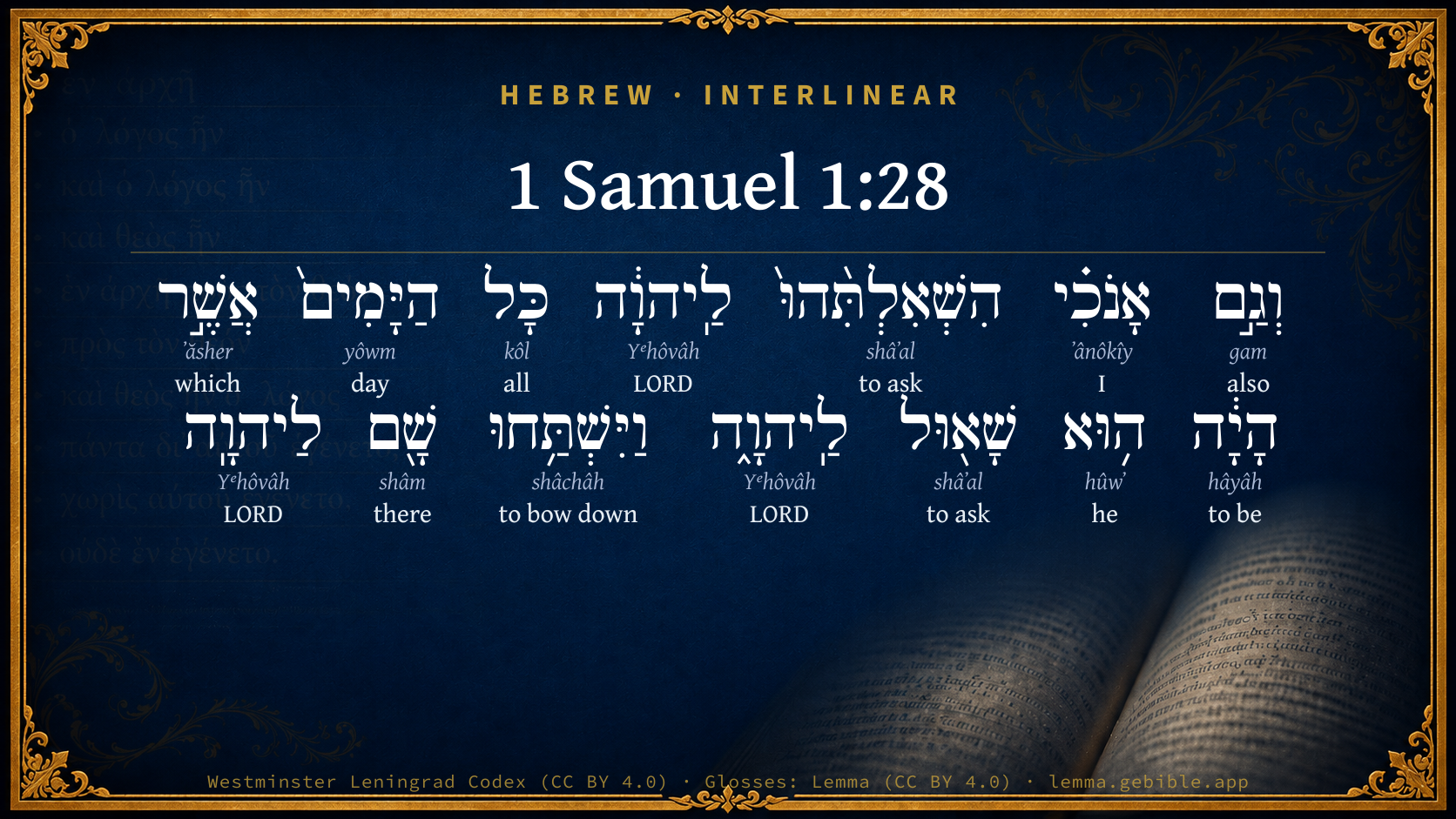
1 Samuel 1:28

Hebrew (Westminster Leningrad Codex) 1 Samuel 1:28 appears in the Hebrew Old Testament. The text above is from the Westminster Leningrad Codex. Each word links to its Strong’s number, a concise gloss, and parsing drawn from the Open Scriptures Hebrew Bible morphology. Click any word for its full Brown-Driver-Briggs (BDB) entry.
Download image
Cite this verse

1 Samuel 1:28 (World English Bible). Public Domain. Lemma interlinear Bible study tool, https://lemma.gebible.app/v/1-samuel/1/28.

Show BibTeX & RIS
BibTeX
RIS
English Translation
therefore also I have granted him to Yahweh; as long as he lives he is granted to Yahweh. He worshiped Yahweh there.
World English Bible · Public Domain
Download a study sheet

One document with this verse’s original text, its word-by-word gloss line, the meaning frame, cross-references with their text, attributed commentary, and full source and license credits — printable, and it pastes into notes with its structure intact.

This verse Autodidact and up

Study sheet (.html) Plain text (.txt)

A passage Seminary Student

Up to 50 verses in one chapter. A passage sheet keeps up to 6 commentary sources and 12 cross-references per verse, in the order this page ranks them, and says so on the sheet whenever that leaves anything out. Ask for a single verse and you get the Autodidact verse sheet above.

Everything on this page stays free to read, with no account — the sheet is a download of what is already on screen, not access to it.

Want to remove ads? Support Godless Engineer
Compare translations 3

The same verse in 3 English versions, stacked beneath the original-language interlinear above. Click any original word for its lexicon entry.

Each is an independent rendering of the whole verse — the interlinear is not word-aligned to these translations.

Highlighted words mark where these versions differ — a whole-verse word diff, not a word-by-word alignment.

  • World English Bible Public Domain
    therefore also I have granted him to Yahweh; as long as he lives he is granted to Yahweh. He worshiped Yahweh there.
  • King James Version Public Domain
    Therefore also I have lent him to the LORD; as long as he liveth he shall be lent to the LORD. And he worshipped the LORD there.
  • unfoldingWord Literal Text CC BY-SA 4.0
    And also I have granted him to Yahweh; all of the days that he is, he granted to Yahweh.” And he worshiped Yahweh there.

unfoldingWord Literal Text — © unfoldingWord, licensed CC BY-SA 4.0. Word-aligned USFM3 via Door43 (git.door43.org/unfoldingWord/en_ult).

Versions to compare (up to 4)

3 of 4 selected

Show all 18 translations

Every available English version of this verse, each an independent rendering of the whole verse.

  • World English Bible Public Domain
    therefore also I have granted him to Yahweh; as long as he lives he is granted to Yahweh. He worshiped Yahweh there.
  • Berean Standard Bible Public Domain
    I now dedicate the boy to the LORD. For as long as he lives, he is dedicated to the LORD.” So they worshiped the LORD there.
  • Majority Standard Bible Public Domain
    I now dedicate the boy to the LORD. For as long as he lives, he is dedicated to the LORD.” So they worshiped the LORD there.
  • King James Version Public Domain
    Therefore also I have lent him to the LORD; as long as he liveth he shall be lent to the LORD. And he worshipped the LORD there.
  • American Standard Version (1901) Public Domain
    therefore also I have granted him to Jehovah; as long as he liveth he is granted to Jehovah. And he worshipped Jehovah there.
  • Revised Version (1885) Public Domain
    wherefore I also have granted him to the LORD; as long as he liveth he is granted to the LORD. And he worshipped the LORD there.
  • Geneva Bible (1599) Public Domain
    Therefore also I haue giuen him vnto the Lord: as long as he liueth hee shalbe giuen vnto the Lord: and he worshipped the Lord there.
  • Douay-Rheims (1899) Public Domain
    Therefore I also have lent him to the Lord all the days of his life, he shall be lent to the Lord. And they adored the Lord there. And Anna prayed, and said:
  • Young's Literal Translation Public Domain
    and also I have caused him to be asked for Jehovah, all the days that he hath lived -- he is asked for Jehovah;' and he boweth himself there before Jehovah.
  • Literal Standard Version CC BY-SA 4.0
    and I also have called him to YHWH, all the days that he has lived—he is called to YHWH”; and he bows himself there before YHWH.
  • Unlocked Literal Bible CC BY-SA 4.0
    I have given him to Yahweh, as long as he lives he is lent to Yahweh.” Then he worshiped Yahweh there.
  • unfoldingWord Literal Text CC BY-SA 4.0
    And also I have granted him to Yahweh; all of the days that he is, he granted to Yahweh.” And he worshiped Yahweh there.
  • Darby Bible Public Domain
    And also I have lent him to Jehovah: all the days that he lives, he is lent to Jehovah. And he worshipped Jehovah there.
  • World Messianic Bible Public Domain
    Therefore I have also given him to the LORD. As long as he lives he is given to the LORD.” He worshiped the LORD there.
  • Webster's Bible Public Domain
    Therefore also I have lent him to the LORD; as long as he liveth he shall be lent to the LORD. And he worshiped the LORD there.
  • Free Bible Version CC BY-SA 4.0
    now I'm giving him to the Lord. As long as he lives he will be dedicated to the Lord.” And he worshiped the Lord there.
  • Bible in Basic English Public Domain
    So I have given him to the Lord; for all his life he is the Lord's. Then he gave the Lord worship there.
  • JPS Tanakh (1917) Public Domain
    therefore I also have lent him to the LORD; as long as he liveth he is lent to the LORD.' And he worshipped the LORD there.

Literal Standard Version (2020), Covenant Press — licensed CC BY-SA 4.0. Text via the HelloAO Bible API (eBible.org). Unlocked Literal Bible (unfoldingWord) — licensed CC BY-SA 4.0. Text via the HelloAO Bible API (eBible.org). unfoldingWord Literal Text — © unfoldingWord, licensed CC BY-SA 4.0. Word-aligned USFM3 via Door43 (git.door43.org/unfoldingWord/en_ult). Free Bible Version, Dr. Jonathan Gallagher — licensed CC BY-SA 4.0. Text via the HelloAO Bible API (eBible.org).

Word by word

More ways to search: Search by grammar → Find every occurrence → Compare this word →

Practice this passage: Drill this verse → Learn its vocabulary →

וַיִּשְׁתַּ֥חוּ
shâchâh
H7812
“and · to bow down”
Conjunction + Verb, Hithpael, Sequential Imperfect, 3rd Person, Masculine, Singular
Part of Speech
Conjunction + Verb
Stem
Hithpael
Form
Sequential Imperfect
Person
3rd Person
Gender
Masculine
Number
Singular
Full BDB Definition

Origin: a primitive root

TWOT: 2360

to bow down - (Qal) to bow down - (Hiphil) to depress (figuratively) - (Hithpael) - to bow down, prostrate oneself - before superior in homage - before God in worship - before false gods - before angel
  1. וְגַ֣ם gam H1571 “and · also” Conjunction + Particle, Accusative
  2. אָנֹכִ֗י ʼânôkîy H595 “I” Pronoun, Personal, 1st Person, Common, Singular
  3. הִשְׁאִלְתִּ֨הוּ֙ shâʼal H7592 “to ask · him” Verb, Hiphil, Perfect, 1st Person, Common, Singular + Suffix, Personal, 3rd Person, Masculine, Singular
  4. לַֽיהוָ֔ה Yᵉhôvâh H3068 “to/for · LORD” Preposition + Noun, Proper
  5. כָּל kôl H3605 “all of” Noun, Common, Masculine, Singular, Construct
  6. הַיָּמִים֙ yôwm H3117 “the · days” Particle, Definite Article + Noun, Common, Masculine, Plural, Absolute
  7. אֲשֶׁ֣ר ʼăsher H834 “which” Particle, Relative
  8. הָיָ֔ה hâyâh H1961 “to be” Verb, Qal, Perfect, 3rd Person, Masculine, Singular
  9. ה֥וּא hûwʼ H1931 “he” Pronoun, Personal, 3rd Person, Masculine, Singular
  10. שָׁא֖וּל shâʼal H7592 “asked” Verb, Qal, Participle Passive, Masculine, Singular, Absolute
  11. לַֽיהוָ֑ה Yᵉhôvâh H3068 “to/for · LORD” Preposition + Noun, Proper
  12. שָׁ֖ם shâm H8033 “there” Adverb
  13. לַיהוָֽה Yᵉhôvâh H3068 “to/for · LORD” Preposition + Noun, Proper

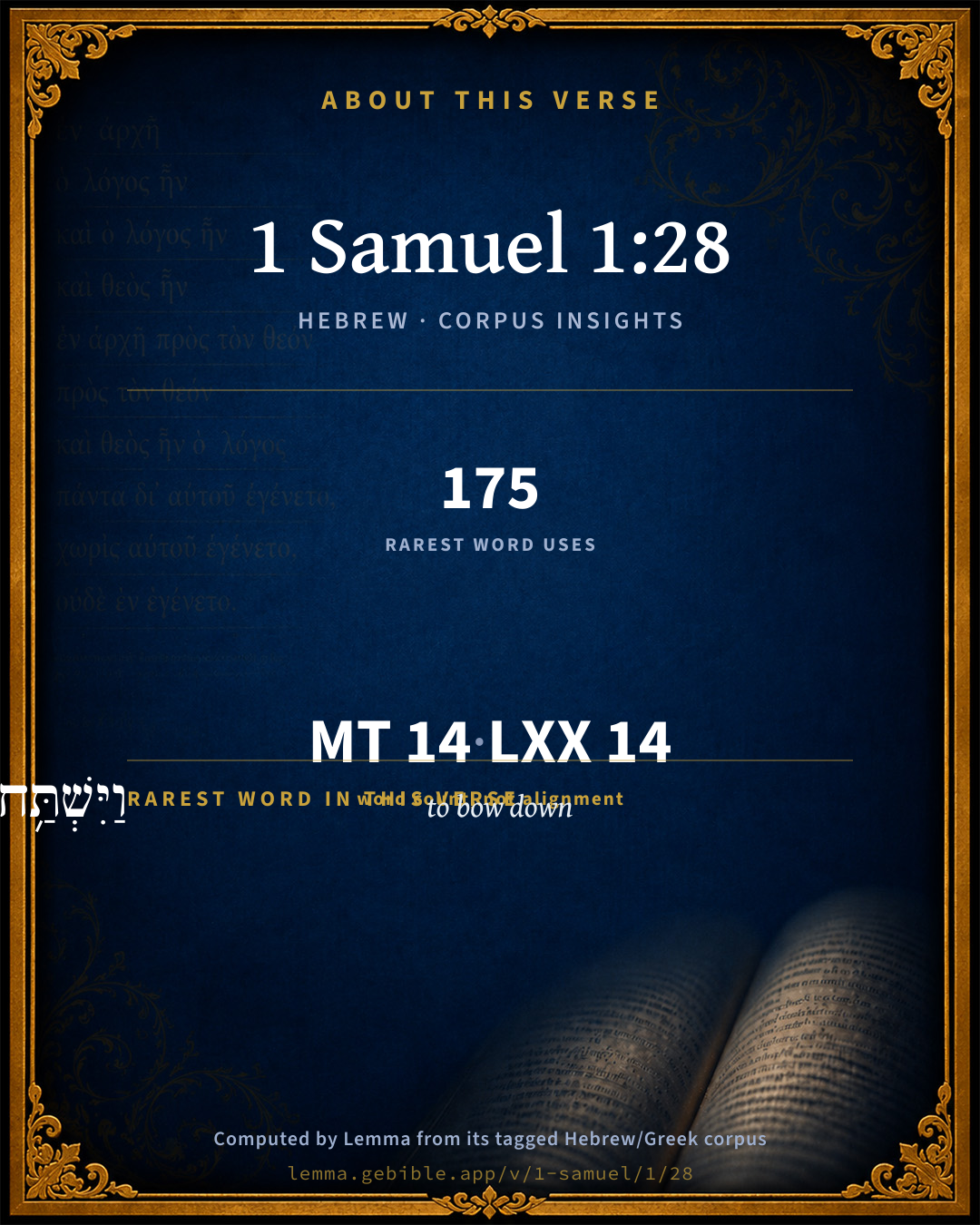
About this verse

These counts appear in no published source. They are computed here, from the morphology-tagged text and Lemma’s own curated glosses. What Lemma adds →

14
words
11
distinct lemmas
Historical
section

Grammatical profile

  • 4 verbs
  • 5 nouns
  • 2 pronouns
  • 1 adverb
  • 2 particles

Verb forms

  • הִשְׁאִלְתִּ֨הוּ֙ Hiphil · Perfect
  • הָיָ֔ה Qal · Perfect
  • שָׁא֖וּל Qal · Participle Passive
  • וַיִּשְׁתַּ֥חוּ Hithpael · Sequential Imperfect

Repetition

Words recur within this verse — often emphatic in Hebrew:

  • לַֽיהוָ֔ה LORD H3068 ×3
  • הִשְׁאִלְתִּ֨הוּ֙ to ask H7592 ×2

Hebrew & Septuagint length

In English translation the verse runs 22 words from the Hebrew and 21 from the Septuagint (LXX English) — closely comparable.

A rough comparison of the two English renderings, which tokenize alike — not a word-level alignment.

Word counts can differ between the Hebrew and the Greek without any difference in meaning — e.g. the Hebrew direct-object marker אֵת has no separate Greek word, and Greek often adds the article ὁ.

In the original languages it is 14 Hebrew tokens and 14 Greek tokens — but the two are counted differently (Hebrew bundles its prefixes and suffixes into one token; the Greek is in lemma form), so that isn’t a like-for-like length.

Cross-references

5

Topical passages linked to 1 Samuel 1:28 in the Treasury of Scripture Knowledge — connected by theme and wording, ordered by reader-vote popularity; previews shown in the World English Bible.

  • Genesis 24:26 The man bowed his head, and worshiped Yahweh.
  • Genesis 24:52 It happened that when Abraham's servant heard their words, he bowed himself down to the earth to Yahweh.
  • 1 Samuel 1:11 She vowed a vow, and said, Yahweh of hosts, if you will indeed look on the affliction of your handmaid, and remember me, and not forget your handmaid, but will give to your handmaid a man-child, then I will give him to Yahweh all the days of his life, and there shall no razor come on his head.
  • 2 Timothy 3:15 From infancy, you have known the sacred writings which are able to make you wise for salvation through faith, which is in Christ Jesus.
  • Genesis 24:48 I bowed my head, and worshiped Yahweh, and blessed Yahweh, the God of my master Abraham, who had led me in the right way to take my master's brother's daughter for his son.

Cross-references courtesy of OpenBible.info (CC BY 4.0).

Hebrew and Greek witnesses Masoretic Hebrew ↔ Greek Septuagint

The same verse in the two great witnesses to the Old Testament, shown verse-for-verse.

These are two independent witnesses, not word-aligned to each other, and the Septuagint is shown in lemma (dictionary) form.

Hebrew 1 Samuel 1:28 Masoretic · Westminster Leningrad Codex

וְגַ֣ם אָנֹכִ֗י הִשְׁאִלְתִּ֨הוּ֙ לַֽיהוָ֔ה כָּל הַיָּמִים֙ אֲשֶׁ֣ר הָיָ֔ה ה֥וּא שָׁא֖וּל לַֽיהוָ֑ה וַיִּשְׁתַּ֥חוּ שָׁ֖ם לַיהוָֽה

therefore also I have granted him to Yahweh; as long as he lives he is granted to Yahweh. He worshiped Yahweh there.

World English Bible · Public Domain

Greek LXX 1 Samuel 1:28 Septuagint · lemma form

καΐἐγώ κιχράω αὐτός ὁ κύριος πᾶς ὁ ἡμέρα ὅς ζάω αὐτός χρῆσις ὁ κύριος

And I lend him to the Lord all his days that he lives, a loan to the Lord: and she said,

LXX2012 (modern English Septuagint) · Public Domain

On this verse, Adam Clarke's Commentary discusses the Septuagint’s reading. Read the note in Commentary ↓

Hebrew: Westminster Leningrad Codex (CC BY 4.0). Greek: Septuagint (public domain); English from LXX2012 (modern English Septuagint) (Public Domain). How the Septuagint differs from the Hebrew →

Targum (Aramaic paraphrase)

1

The Targum is the ancient Jewish Aramaic paraphrase of the Hebrew Scriptures — an interpretive translation, not the Hebrew text itself. Onkelos (literal) and Pseudo-Jonathan (expansive) render the Torah, and Jonathan the Prophets. Coverage is partial: where no permissively-licensed English translation exists for a verse, only the Aramaic is shown. This is verse-level text, not a word-by-word alignment to the Hebrew.

  1. Targum Jonathan Prophets (Joshua–Malachi)
    וְאַף אֲנָא מְסַרְתֵּיהּ דִיהֵי מְשַׁמֵשׁ קֳדָם יְיָ כָּל יוֹמַיָא דְהוּא קַיָם הוּא מְשַׁמֵשׁ קֳדָם יְיָ וּסְגִיד תַּמָן קֳדָם יְיָ:

    (no public-domain English translation for this verse)

    Targum Jonathan — Aramaic: “Mikraot Gedolot” (public domain). English: “Sefaria Community Translation” (CC0 1.0 (public-domain dedication)); “London "Chaldee Paraphrase," 1871” (public domain). Text via Sefaria.

Commentary

Notes on 1 Samuel 1:28 from classic Christian and Jewish commentators (each source and its license shown beneath its notes). The classic Christian expositions comment on the surrounding passage and are grouped to its opening verse, so a note may address several verses; the Jewish commentaries on the Tanakh (Rashi and others) are per-verse, so they appear only where the commentator wrote on this verse.

Lemma curates 59 commentaries, every one of them public domain or Creative Commons licensed, each selected and text-cleaned for this edition rather than reprinted as found. About our sources →

Adam Clarke's Commentary

Verse 28. Therefore also I have lent him to the Lord] There is here a continual reference to her vow, and to the words which she used in making that vow.

The word Samuel, as we have already seen, is a contraction of the words שאול מאל Shaul meEl, that is, asked or lent of God; for his mother said, 1Sa 1:27, The Lord hath given me my petition, which שאלתי SHAALTI, I ASKED of him. In 1Sa 1:28 she says: הוא ששול ליהוה hu SHAUL layhouah, he shall be LENT unto the Lord: here we find the verb is the same; and it is remarked by grammarians that שאל shaal, he asked, making in the participle pahul שאול shaul, ASKED, in the conjugation hiphil signifies to lend; therefore, says his mother, 1Sa 1:28, השאלתיהו ליהוה HISHILTIHU layhovah, I have LENT him to the Lord. This twofold meaning of the Hebrew root is not only followed by our translators, but also by the Vulgate, Septuagint, and Syriac.

And he worshipped the Lord there.] Instead of וישתחו vaiyishtachu, HE worshipped, וישתחוו vaiyishtachavu, and THEY worshipped, is the reading of six of Kennicott's and De Rossi's MSS., of some copies of the Septuagint, and of the Vulgate, Syriac, and Arabic.

This and the following chapter are connected in most copies of the Septuagint and Vulgate thus: And Anna worshipped, and said, My soul is strengthened in the Lord, c. It is very likely that the whole passage, from the beginning of ver. 26 to the end of ver. 10 of the ensuing chapter, contains the words of Hannah alone and that even the clause, He worshipped the Lord there, should be, And she worshipped the Lord there, and prayed, and said, &c. Indeed this latter clause is wanting in the Polyglot Septuagint, as I have stated above.

Adam Clarke's Commentary on the Bible (1810–1826) — public domain. Text from a community e-Sword/MySword module.

Trapp's Complete Commentary

John Trapp

1Sa 1:28 Therefore also I have lent him to the LORD; as long as he liveth he shall be lent to the LORD. And he worshipped the LORD there.

Ver. 28. Therefore also I have lent him.] Or, Returned him whom I have obtained by petition unto the Lord. So did Hunter the martyr’s mother: {a} and Mr Bradford begged of his mother to do the like. {b} The stork is said to leave one of her young ones where she hatcheth.

{a} Act. and Mon., 1397.

{b} Ibid., 1504.

John Trapp, A Commentary or Exposition upon All the Books of the Old and New Testament (1647–1656) — public domain. Text from a community e-Sword module.

The Biblical Illustrator

Joseph S. Exell

1Sa_1:28

I have lent him to the Lord.

Samuel, the Child-Christian

There is no child explicable apart from his parentage. The foundations of one generation are in all respects laid in the antecedent generation. In an important sense the boy begins to live when his father begins to live. The child is the parent continued down into a new generation. And so Scripture biography, much of it, begins with a statement and exposition of parentage. You remember how it was with Jesus, with John the Baptist, and now with Samuel. Science today lays large stress on heredity. Revelation emphasised heredity long before science was born. Francillon says that the lives of the mothers of great men form an important branch of biographical literature. The author of the old Hebrew chapter quietly asserts the same fact by going about to narrate to us Samuel by first acquainting us with his mother. There are numerous intimations in Scripture that in the bequest of spiritual legacies the law of heritage works with peculiar constancy and vigour. The promise is unto you and to your children. And that occurs as a frequent and favourite thought, I will establish my covenant with Isaac for an everlasting covenant, and with his seed after him. And this principle is wrought into the structure of the whole Jewish record. It is as though God held parent and child in one individual compact of grace, parental faith throwing itself forward upon the child, and working in and for the child vicariously; the faith of the parent becoming in time the childs faith, just as by a physical law the features of the father and mother reappear in time in the childs face, in growing distinctness. Of Elkanah, Samuels father, little notice is taken. A single remark of his indicates the mutual loyalty and confidences of husband and wife, and along the course of the first chapter is shown his faithful observance of religious obligations. But Samuel was preeminently his mothers boy, as boys are apt to be. It was his mother that prayed for him; his mother that took him to Shiloh with the bullocks, the flour, and the wine; his mother that offered him in consecration. Appreciating the quality of the parentage, then, we have laid for us a basis of just expectancy touching the quality of the offspring. We must just mention Samuels early connection with the church and the sanctuary. I suppose that this, too, had its strengthening and educating effect. It was just in the midst of the sanctuary that the Lords presence became manifest in him, and that the Divine voice shouted clearly and intelligibly in his ears. We may gather from the fact that there is great virtue in early and affectionate association with the church, and in earnest participation in things that concern the church. But great as is the supplementary service which the church can render the child, the home is at once his physical birthplace and his proper spiritual birth place. It is a Spanish proverb that an ounce of mother is worth a pound of clergy. The home is the first church, the hearthstone the first altar, and the father and mother the first priests. And so the more home there is in the home, the more readily and completely does it fulfil its offices as a child church. And the home, for the same reason, is the childs proper Sunday school. It is not quite evident how Christian parents can ever farm out their children to the spiritual nurture of strangers. (C. H. Parkhurst, D. D.)

A mothers formative influence on the characters of her children

Who can hear the name of St. Augustine--that shining light, twice on the point of being extinguished, but snatched by turns from sin and heresy, to glorify the true and living God down to the latest posterity. Who can think of his name without joining with him in recognising, in his two-fold deliverance--next to the hand of God--the influence of the tender, humble, patient Monica? Theodoret, Basil the Great, Emmilia, Chrysostom, and many of those who have walked in their ways, had each their Monica; and were each proofs of the power of a mothers prayers. In later times we read of Bishop Hall, Philip Henry, and his son Matthew, Hooker, Payson, Doddridge, the Wesleys, and of many other bright stars still shining in the churches, who have had pious mothers, and who have confessed to the power of a mothers influence. John Newton learned to pray at his mothers knee; and such was the influence of her life upon his mind (and, be it remembered, that she was called to her heavenly home before her son John was eight years of age), that in after years, when at sea, and in the midst of many dangers, his agonising prayer often was, my mothers god, Thou God of Mercy, have mercy on me! The prayer was heard, and from that time the name of John Newton has been a name honoured in the churches, and he will remain yet for ages as a burning and a shining light. It was through Newton that Thomas Scott, the commentator, was led to Christ, and Wilberforce, the champion of the freedom of the slave, and the author of that Practical View of Christianity, which brought Leigh Richmond into the ministry of Christ. And who shall now go further in attempting to estimate the probable influence of one pious mother? (Footsteps of Truth.)

Vows fulfilled

Hannahs fulfilment of her vow was to be an ample, prompt, honourable fulfilment. Many a one who makes vows or resolutions under the pressure and pinch of distress immediately begins to pare them down when the pinch is removed, like the merchant in the storm who vowed a hecatomb to Jupiter, then reduced the hecatomb to a single bullock, the bullock to a sheep, the sheep to a few dates; but even these he ate on the way to the altar, laying on it only the stones. Not one jot would Hannah abate of the full sweep and compass of her vow. (W. G. Blaikie, D. D.)

The connection between God and children to be cultivated

Do not treat lightly, O parents, the connection between God and your children! Cherish the thought that they are Gods gifts, Gods heritage to you, committed by Him to you to bring up, but not apart from Him, not in separation from those holy influences which He alone can impart, and which He is willing to impart. What a cruel thing it is to cut this early connection between them and God, and send them drifting through the world like a ship with a forsaken rudder, that flaps hither and thither with every current of the sea. (W. G. Blaikie, D. D.)

The dedication of Samuel

In those rude times which long preceded the birth of science in our country, when there was no appliance of steam to wear vessels off the dangers of a lee shore, nor lights shone forth on sunken reef or rocky headland to guide them through the gloom of night, one of the royal family of Scotland was in imminent hazard of shipwreck. After every effort had been made, but made in vain, to wear off shore, he vowed a vow that it God would interpose to deliver them from death, he would build and endow a chapel, as an acknowledgment of Gods gracious interposition and an expression of his own gratitude. They were saved. And, though a Papist, a better man than many Protestants who forget, in the day of returned health or prosperity, the vows and resolutions formed in an hour of trouble, he fulfilled his promise. In the erection of Maison Dieu Chapel (in Brechin, Forfar), for so it is called, David, Earl of Huntingdon, paid his vow. Associated though it be with popish superstitions, it sprang from higher motives than either ecclesiastical pride or sectarian rivalry; and humble as these ruins are now, they form a venerable and interesting memorial of the simple faith, and devout piety, that ever and anon, like the blaze of a brilliant meteor, lighted up the long night of the dark ages of the Church. Such dedications and vows as those to which that chapel owed its existence, have fallen into too great disuse. The devout, but too much neglected, practice which these famous saints observed, Hannah also recommends to our imitation. It was in the performance of such a vow that she returned to the house of God, not empty handed; but to earn, if I may say so, the high encomium pronounced on her of whom our Lord said, She hath given all she had. In that child of prayer, her only son, the boy whom she leads lovingly by the hand, Hannah presented to God a gift more beautiful and costly, more precious far, than Jacobs tithe of corn and cattle, or Davids richest spoils of war. A blessed contrast to another woman, the unhappy partner of Ananias guilt and also of his doom, who, pretending, while a part was withheld, that the whole price had been given, lied to the Holy Ghost, Hannah, in going to perform her vow, like a martyr marching to the stake, walks in her integrity. Hannahs case was peculiar. She might, repenting of her vow, have kept back not a part of the price, but the whole; nor thereby laid herself open to challenge or censure; to the taunts of Peninnah, her enemy, or of anyone else. When she vowed that if God would give her a son, he should be the Lords, Eli saw her lips move; but no more--and hearing nothing took her for a drunken woman. Only God and she herself knew what these lips had said. That was enough for Hannah. It should be so for us. Thou God seest me, should place us in circumstances of greater restraint than broad daylight, the public street, the eyes of a theatre of spectators; even so it was a sufficient reason for Hannah performing her vow that God had heard the words of her noiseless lips, and that the vow, though a secret to others, was none to Him. It is to the honour of Hannahs sex that the only two offerings on which Jesus, He who offered himself for her and us on the cross, ever bestowed the meed of His applause, were both made by women. The one was a widow. Poor, and meanly clad, in her offering as much as in her dress, she presented a remarkable contrast to many who, sweeping into the house of God, attired in all the gaieties of changing fashions, give a wide berth to the plate at the door, or drop into the offertory, without a blush of shame, the merest, meanest pittance. Though but two mites, hers was a munificent gift, being her little all. The other woman, praised by Him whom all heaven praises, was one--strange as it will appear to such as have not reflected on the blessed truth, that a fallen is not necessarily a lost woman--from whose touch decency and decorum shrinks. As the phrase went, she was a sinner. Lying, where all have need, and the purest love, to lie, at Jesus feet, she washes them with a flood of tears; and, taking an alabaster box of precious ointment, pours its fragrance on the feet that for her, and us, were ire be nailed on Calvary. Beside these women Hannah deserves a place. In her dedication of Samuel, in giving him up who was the light of her eyes and the joy of her home, she parted for Gods sake and his service with the costliest, the most prized and precious, thing in her possession. Before turning the dedication of Samuel to a practical use, let me observe, that though we may have to wait for the reward and recompense in heaven, Hannah had not so long to wait. She says of Samuel, I have lent him to the Lord; and God paid her good interest for the loan. Ages before the great words were uttered by the lips of Jesus, she proved the truth of His saying, Whosoever will save his life shall lose it, and whosoever will lose his life for my sake shall find it. There is that scattereth, says the wise man, and yet increaseth; and there is that withholdeth more than is meet, but it tendeth to poverty. The liberal soul shall be made fat. Such was Hannahs experience. She gave away one child, and God paid her back with five; and promptly too. To turn the dedication of Samuel to a seasonable and important use, let me ask why so few parents now follow Hannahs example? why so few either dedicate themselves, or are dedicated by others to the Christian ministry? When other professions are overstocked, why is it that almost all the churches, both in this country and in America, are complaining of a hack of candidates for the sacred office, and especially of such as possess not only the piety, but the talents and culture which it requires? Why should not our Christian youth come forward to embrace this noblest, though meanwhile poorest, of all professions? Some years ago, leaving titles, estates, luxurious mansions, kind fathers, mothers, sisters, brothers, and blooming brides, many threw themselves on the shores of the Black Sea, to face frost and famine, pestilence and iron showers of death, under the walls of Sebastopol! And shall piety blush before patriotism? Shall Jesus Christ call in vain for less costly sacrifices--either of money or of men? Let those whom Providence has enriched, some with silver and some with sons, remember the touching question one wrote beneath a figure of our Lord stretched bleeding on the cross, This Thou hast done for me, what shall I do for Thee? (T. Guthrie, D. D.)

.

The Biblical Illustrator, edited by Joseph S. Exell (c. 1880s–1900s) — public domain. Text from a community e-Sword module.

Joseph Benson's Commentary

1Sa 1:28. Therefore I have lent him to the Lord — But not with a purpose to require him again. Whatever we give to the Lord may, upon this account, be said to be lent to him, because, though we may not recall it, yet he will certainly repay it to our unspeakable advantage. As long as he liveth he shall be lent to the Lord — Or, as the words may be properly translated, All the days that he shall be desired for the Lord; that is, as long as God shall think fit to employ him in his own house: which was till he made him a judge, 1Sa 7:15. Then he was no longer fixed at Shiloh, but went about the country, to Beth-el, and Gilgal, and Mizpeh; afterward he settled at his own house in Ramah, as we read there, 1Sa 1:17. Still, however, he was wholly the Lord’s and lived entirely to him, employing all his powers of body and mind in his service. And he worshipped the Lord there — Not Eli, but young Samuel, who is spoken of in this and the foregoing verse, and who was capable of worshipping the Lord in some sort, at least with external worship. The Vulgate, Syriac, and Arabic, however, translate the words: And they worshipped the Lord.

Joseph Benson's Commentary on the Old and New Testaments (1811–1818) — public domain. Text from a community e-Sword module.

Geneva Bible (1599)

Geneva Bible translators

Hebrew, lent.

Meaning, Eli gave thanks to God for her.

Geneva Bible (1599) marginal notes — public domain. Text via Bolls.life.

Ellicott's Commentary for English Readers

(28) I have lent him to the Lord.—The rendering of the Hebrew here, “I have lent,” and in Exo_12:36, is false. The translation should run: “Therefore I also make him one asked of the Lord; all the days that he liveth he is asked of the Lord.” The sense is: “The Lord gave him to me, and now I have returned him whom I obtained by prayer to the Lord, as one asked or demanded.”

And he worshipped the Lord there.—“He,” that is, the boy Samuel: thus putting his own child-seal to his mother’s gift of himself to God.

A Bible Commentary for English Readers, edited by Charles John Ellicott (1878–1897) — public domain. Text from a community e-Sword module.

The Cambridge Bible for Schools and Colleges

gen. ed. J. J. S. Perowne

28. therefore also, &c.] Render, And I on my part have given him to Jehovah as long as he liveth: because he was one asked for Jehovah. The exact translation of the Heb. is doubtful, and the remarkable play upon words in it is lost in translation. But the general sense is clear: ‘Jehovah gave me the child, and I restore him in accordance with my vow.’ The word translated lend occurs elsewhere only in Exo_12:36, where it means give rather than lend. A loan may be reclaimed at the will of the lender. Hannah’s surrender of Samuel was complete. See 1Sa_1:11 and ch. 1Sa_2:20.

he worshipped] Who? Not Samuel, who was too young: but Elkanah, as head of the household, worshipped, while Hannah poured out her heart in the hymn which immediately follows. The Sept. however omits the words, and the Vulg. reads “And they worshipped the Lord there.”

The Cambridge Bible for Schools and Colleges (gen. ed. J. J. S. Perowne; Cambridge University Press, 1878–1918) — public domain. Text from a community e-Sword module.

John Gill's Exposition

Therefore also I have lent him to the Lord,.... To be employed in his service, not for a few days, months, or years, but for his whole life. The Targum is,"I have delivered him, that he may minister before the Lord;''as she had received him front him as an answer of prayer, she gave him up to him again according to her vow: as long as he liveth he shall be lent unto the Lord, or as the Targum,"all the days that he lives he shall be ministering before the Lord;''

or "all the days he shall be asked" (or "required") by or for the Lord (e); that is, he shall be lent unto him, and serve him as long as it is desired:

and he worshipped the Lord there; in the tabernacle at the same time; either Elkanah, who with Hannah brought the child to Eli, and now gave thanks to God for giving them the child, and prayed unto him that he might be received into the service of the sanctuary; or else Eli, to whom the child was brought for admittance, who when he heard that Hannah's request was granted, which he had entreated also might be or had declared it would be, bowed his head, and gave thanks to God for it; or rather the child Samuel, as he was taught and trained up, bowed himself before the Lord, and worshipped him in the tabernacle as soon as he was brought into it, though a child; for he only is spoken of in this and the preceding verse; and by some interpreters (f) the name Samuel is supplied; the Vulgate Latin, Syriac, and Arabic versions, read in the plural number, "and they worshipped the Lord there": that is, Elkanah and his wife; so Mr. Weemse (g) translates and interprets it.

(e) "Quamdiu" h. e. "expetitus aut requisitur", Peter Martyr; "quoties a Jehova postulatur", Piscator. (f) Junius & Tremellius, Piscator. (g) Observat. Nat. c. 18. p. 77.

Next: 1 Samuel Chapter 2

John Gill's Exposition of the Whole Bible (1746–1763) — public domain (CC PDM 1.0). Text via the HelloAO Bible API.

Haydock's Catholic Bible Commentary

Lent. This is equivalent to giving entirely. Anna presents her son to the Lord, to serve in his tabernacle as long as God shall think proper. He dispensed with his personal attendance, when he appointed him judge, chap. vii. 15. (Calmet) --- As much as depended on Samuel’s mother, he was consecrated for ever. But he was at liberty to ratify the vow if he pleased. (Menochius) --- The expression, lent, seems to reserve the dominion of the thing, which Anna had entirely given up, so that we might translate the Hebrew, "Therefore I have him simply as one lent....he is a thing lent, which belongs to the Lord." (Calmet) --- They. Hebrew, "he worshipped the Lord there." Grabe found not these words in the Alexandrian copy, which by comparison of this chapter with the the Vatican edition, appears, to be more accurate. Both omit this sentence: but it is found in the Aldine edition of the Septuagint Proleg., chap. iv. The Targum adds, "and she prayed in the spirit of prophecy, and said." (Haydock)

George Leo Haydock (1774–1849), Haydock's Catholic Family Bible and Commentary, 1859 edition — public domain. Excludes Psalms (Douay-Rheims chapter numbering differs from Protestant) and Deuterocanonical books (Catholic canon only).

Matthew Poole's English Annotations

I have lent him to the Lord, or, given him, &c., i.e. do now give or offer him; for she did not lend him for a time, with a purpose or right to require him again. The words may be rendered thus, And I also asked him, or made myself to ask him. (a usual Hebraism,) for the Lord, i.e. I prayed for this child, not only for myself, and to take away my reproach, but especially that I might have a child to serve and devote to the Lord. And so the following words,

as long as he liveth, are not to be joined with this foregoing clause, but with those which come next after them; and that whole clause may be thus rendered, as a consequent upon the former: And, or therefore all the days in which he is, or shall be, he is or shall be lent or given to the Lord; or, as one begged for the Lord, and for his service, and therefore justly given to him.

He shall be lent, or rendered, or used as one given in my prayer; for this was the condition of my prayer, that he should be the Lord’s.

He worshipped; not Eli, who is not mentioned but 1Sa 1:25, and then only passively, not as speaking or doing any thing; nor Elkanah, of whom here is no mention; but young Samuel, who is the subject spoken of in this and the foregoing verse, and who was capable of worshipping God in some sort, at least with external adoration; of which see See Poole on "1Sa 1:22". And so the particle

there is emphatical, signifying that hereby he entered himself into the worship and service of God in that place, to which he was devoted by his parents, and now did devote himself.

Matthew Poole's English Annotations on the Holy Bible (1683–1685) — public domain. Text from a community e-Sword/MySword module.

Whedon's Commentary on the Bible

Daniel D. Whedon

28. Lent him to the Lord — It is hardly proper to translate the word שׁאל, to ask, in any of its forms by lend. It is used in the Hiphil form only here and Exo_12:36, and in that form means to cause to ask. So the passage in Exodus 12 should be rendered, “And Jehovah gave the people favour in the eyes of the Egyptians, and they (the Egyptians) caused them (the Israelites) to ask.” That is, the great favour which the Israelites received from the Egyptians disposed the former to ask of the latter such things as they desired of them; and so anxious were the Egyptians to hasten the departure of the Hebrews that they willingly presented them all they asked, even to the spoiling of themselves. Compare Exo_3:22. Accordingly we would translate this verse, And I also cause him to ask of Jehovah all the days which he shall live; he is the asked of Jehovah. To cause him to ask of Jehovah is the same as causing him to be in constant intercourse and favour with him, and this was to be Samuel’s lot and destiny. Comp. note on 1Sa_1:20, and 1Sa_3:21.

He worshipped the Lord there — The reference of he is obscure, leaving it doubtful whether Elkanah or Samuel is meant. They worshipped, that is, Elkanah and his wife, is the reading of some of the Hebrew MSS. and the Septuagint, Vulgate, Syriac and Arabic versions, and is much to be preferred.

Daniel D. Whedon (gen. ed.), Commentary on the Old and New Testaments (1874–1909) — public domain. Text from a community e-Sword module.

The Pulpit Commentary

I have lent him. The word lent spoils the meaning: Hannah really in these two verses uses the same verb four times, though in different conjugations, and the same sense must be maintained throughout. Her words are, "For this child I prayed, and Jehovah hath given me my asking which I asked of him: and I also have given back what was asked to Jehovah; as long as he liveth he is asked for Jehovah." The conjugation translated to give back what was asked literally means to make to ask, and so to give or lend anything asked. The sense here requires the restoration by Hannah of what she had prayed for, (comp. Exo_12:35, Exo_12:36) but which she had asked not for herself, but that she might devote it to Jehovah"s service. At the end of ver. 28 the sing. "he worshipped" is rendered in the pl. by all the versions except the Sept., which omits it. But he, i.e. Elkanah, includes all his household, and it may be correctly translated in the pl., because the sense so requires, without altering the reading of the Hebrew. In the sing. it puts an unnecessary difficulty in the way of the ordinary reader.

The Pulpit Commentary (1880–1919), ed. H.D.M. Spence-Jones & Joseph S. Exell — public domain. Text from a community e-Sword module.

John Wesley's Explanatory Notes

Lent him - But not with a purpose to require him again. Whatever we give to God, may upon this account be said to be lent to him, that tho' we may not recall it, yet he will certainly repay it, to our unspeakable advantage. He worshipped - Not Eli, but young Samuel, who is spoken of in this and the foregoing verse, and who was capable of worshipping God in some sort, at least with external adoration.

John Wesley, Explanatory Notes Upon the Whole Bible (1754–1765) — public domain. Text via the GEBible commentary corpus.

Rashi

Rabbi Shlomo Yitzchaki (Rashi)

And I have dedicated him to Adonoy. Just as a person who lends a utensil to his master, or lends him his son to serve him.

He is dedicated. Enpruntez in Old French, i.e., you have no right to punish him, for the Holy one, Blessed is He, has become his borrower; because I have lent [Shmuel] to Him, He must return him to me.

He then prostrated himself. Shmuel. Others say, Elkonoh.

Rashi on the Tanakh — English translations: “The Judaica Press complete Tanach with Rashi, translated by A. J. Rosenberg” (CC BY 4.0); “Pentateuch with Rashi's commentary by M. Rosenbaum and A.M. Silbermann, 1929-1934” (public domain); “The Metsudah Tanach series, Lakewood, N.J” (CC BY 4.0); and “The Book of Joshua, Metsudah Publications, 1997” (CC BY 4.0). Text via Sefaria.

Radak

Rabbi David Kimhi (Radak)

I lent him: I returned the loan to Him that He gave me. And Yonatan translated it [in the Targum] as, "I gave him over, that he should serve before the Lord."

That he was (lived): It is like, that he would be. And there are many [cases] like this.

He is lent (shaul): It is like, given - meaning to say, he who was lent is now truly given to the Lord. And there is a homiletical teaching about it: At that time, the holy spirit blossomed in her, and she said, "All the time that Shmuel is alive, Saul is alive." And that is [the meaning of] that which it is written, "shaul to the Lord."

And he bowed down: Elkanah, like someone getting permission to leave the House of the Lord. Or the explanation of, "And he bowed down," is Shmuel - even though he was only two years old, they taught him to bow down to the Lord.

Radak on the Tanakh — English translations: “Sefaria Community Translation” (CC0 1.0 (public-domain dedication)); “Eliyahu Munk, HaChut Hameshulash” (CC BY 4.0); “Rabbi Mike Feuer, Jerusalem Anthology” (CC BY 4.0); and “R. David Kimhi on the first book of Psalms, Translated by R.G. Finch, London, 1919” (public domain). Text via Sefaria.

Lesson kit

Teaching starters — assembled from the data on this page, not authored interpretation. Every prompt links to the verse data it draws on. Edit before teaching.

1 Samuel, in the Historical, opens this verse with 14 words (11 distinct Hebrew lemmas). Its most distinctive word is shâchâh (“to bow down”). A historical commentator’s framing appears above. Read the whole chapter for the surrounding context.

Discussion questions

  1. What does “to bow down” (shâchâh) contribute to the verse as a whole?
  2. How does Genesis 24:26, which shares this passage’s theme, read alongside this verse?
  3. What does the repetition of “LORD” (3× in this one verse) do in this verse?
  4. These translations render this verse differently. What is at stake in choosing one wording over another?
  5. «הִשְׁאִלְתִּ֨הוּ֙» is a Hiphil Perfect verb. How does that grammatical form shape the action described?
  6. Compare how Adam Clarke's Commentary and Trapp's Complete Commentary read this verse. Where do they agree or differ?

Things to notice

Reading settings

Reading text

Shown beneath each verse's original-language words.

Old Testament
Old Testament edition

Read the OT as the Masoretic Hebrew (MT) or the Greek Septuagint (LXX).

English shown for the Greek Septuagint (in the Hebrew ↔ Greek comparison).

Comparing translations? Open the Compare panel on any verse page to stack up to four side by side.