
2 Chronicles 13:15

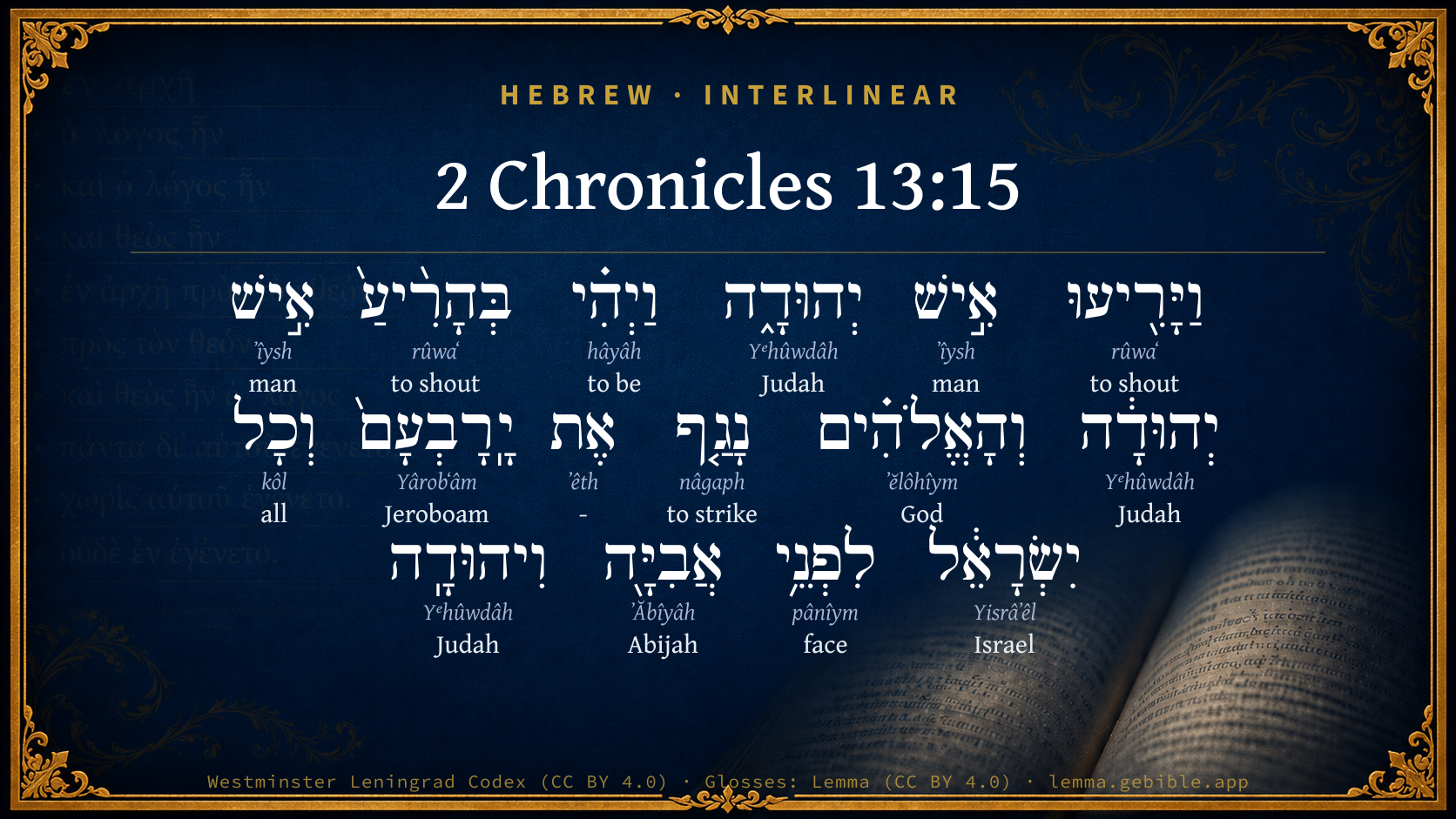
Hebrew (Westminster Leningrad Codex) 2 Chronicles 13:15 appears in the Hebrew Old Testament. The text above is from the Westminster Leningrad Codex. Each word links to its Strong’s number, a concise gloss, and parsing drawn from the Open Scriptures Hebrew Bible morphology. Click any word for its full Brown-Driver-Briggs (BDB) entry.
Download image
Cite this verse

2 Chronicles 13:15 (World English Bible). Public Domain. Lemma interlinear Bible study tool, https://lemma.gebible.app/v/2-chronicles/13/15.

Show BibTeX & RIS
BibTeX
RIS
English Translation
Then the men of Judah gave a shout: and as the men of Judah shouted, it happened, that God struck Jeroboam and all Israel before Abijah and Judah.
World English Bible · Public Domain
Download a study sheet

One document with this verse’s original text, its word-by-word gloss line, the meaning frame, cross-references with their text, attributed commentary, and full source and license credits — printable, and it pastes into notes with its structure intact.

This verse Autodidact and up

Study sheet (.html) Plain text (.txt)

A passage Seminary Student

Up to 50 verses in one chapter. A passage sheet keeps up to 6 commentary sources and 12 cross-references per verse, in the order this page ranks them, and says so on the sheet whenever that leaves anything out. Ask for a single verse and you get the Autodidact verse sheet above.

Everything on this page stays free to read, with no account — the sheet is a download of what is already on screen, not access to it.

Want to remove ads? Support Godless Engineer
Compare translations 3

The same verse in 3 English versions, stacked beneath the original-language interlinear above. Click any original word for its lexicon entry.

Each is an independent rendering of the whole verse — the interlinear is not word-aligned to these translations.

Highlighted words mark where these versions differ — a whole-verse word diff, not a word-by-word alignment.

  • World English Bible Public Domain
    Then the men of Judah gave a shout: and as the men of Judah shouted, it happened, that God struck Jeroboam and all Israel before Abijah and Judah.
  • King James Version Public Domain
    Then the men of Judah gave a shout: and as the men of Judah shouted, it came to pass, that God smote Jeroboam and all Israel before Abijah and Judah.
  • unfoldingWord Literal Text CC BY-SA 4.0
    And the men of Judah raised a shout; and it happened when the men of Judah raised a shout, then God struck Jeroboam and all Israel before Abijah and Judah.

unfoldingWord Literal Text — © unfoldingWord, licensed CC BY-SA 4.0. Word-aligned USFM3 via Door43 (git.door43.org/unfoldingWord/en_ult).

Versions to compare (up to 4)

3 of 4 selected

Show all 18 translations

Every available English version of this verse, each an independent rendering of the whole verse.

  • World English Bible Public Domain
    Then the men of Judah gave a shout: and as the men of Judah shouted, it happened, that God struck Jeroboam and all Israel before Abijah and Judah.
  • Berean Standard Bible Public Domain
    and the men of Judah raised the battle cry. And when they raised the cry, God routed Jeroboam and all Israel before Abijah and Judah.
  • Majority Standard Bible Public Domain
    and the men of Judah raised the battle cry. And when they raised the cry, God routed Jeroboam and all Israel before Abijah and Judah.
  • King James Version Public Domain
    Then the men of Judah gave a shout: and as the men of Judah shouted, it came to pass, that God smote Jeroboam and all Israel before Abijah and Judah.
  • American Standard Version (1901) Public Domain
    Then the men of Judah gave a shout: and as the men of Judah shouted, it came to pass, that God smote Jeroboam and all Israel before Abijah and Judah.
  • Revised Version (1885) Public Domain
    Then the men of Judah gave a shout: and as the men of Judah shouted, it came to pass, that God smote Jeroboam and all Israel before Abijah and Judah.
  • Geneva Bible (1599) Public Domain
    And the men of Iudah gaue a shoute: and euen as the men of Iudah shouted, God smote Ieroboam and also Israel before Abiiah and Iudah.
  • Douay-Rheims (1899) Public Domain
    And all the men of Juda shouted: and behold when they shouted, God terrified Jeroboam, and all Israel that stood against Abia and Juda.
  • Young's Literal Translation Public Domain
    and the men of Judah shout -- and it cometh to pass, at the shouting of the men of Judah, that God hath smitten Jeroboam, and all Israel, before Abijah and Judah.
  • Literal Standard Version CC BY-SA 4.0
    and the men of Judah shout; and it comes to pass, at the shouting of the men of Judah, that God has struck Jeroboam and all Israel before Abijah and Judah.
  • Unlocked Literal Bible CC BY-SA 4.0
    Then the men of Judah gave a shout; as they shouted, it came about that God struck Jeroboam and all Israel before Abijah and Judah.
  • unfoldingWord Literal Text CC BY-SA 4.0
    And the men of Judah raised a shout; and it happened when the men of Judah raised a shout, then God struck Jeroboam and all Israel before Abijah and Judah.
  • Darby Bible Public Domain
    And the men of Judah gave a shout; and as the men of Judah shouted, it came to pass that God smote Jeroboam and all Israel before Abijah and Judah.
  • World Messianic Bible Public Domain
    Then the men of Judah gave a shout. As the men of Judah shouted, God struck Jeroboam and all Israel before Abijah and Judah.
  • Webster's Bible Public Domain
    Then the men of Judah gave a shout: and as the men of Judah shouted, it came to pass, that God smote Jeroboam and all Israel before Abijah and Judah.
  • Free Bible Version CC BY-SA 4.0
    and the men of Judah gave a loud shout. When they shouted, God struck Jeroboam and all Israel in front of Abijah and Judah.
  • Bible in Basic English Public Domain
    And the men of Judah gave a loud cry; and at their cry, God put fear into Jeroboam and all Israel before Abijah and Judah.
  • JPS Tanakh (1917) Public Domain
    Then the men of Judah gave a shout; and as the men of Judah shouted, it came to pass, that God smote Jeroboam and all Israel before Abijah and Judah.

Literal Standard Version (2020), Covenant Press — licensed CC BY-SA 4.0. Text via the HelloAO Bible API (eBible.org). Unlocked Literal Bible (unfoldingWord) — licensed CC BY-SA 4.0. Text via the HelloAO Bible API (eBible.org). unfoldingWord Literal Text — © unfoldingWord, licensed CC BY-SA 4.0. Word-aligned USFM3 via Door43 (git.door43.org/unfoldingWord/en_ult). Free Bible Version, Dr. Jonathan Gallagher — licensed CC BY-SA 4.0. Text via the HelloAO Bible API (eBible.org).

Word by word

More ways to search: Search by grammar → Find every occurrence → Compare this word →

Practice this passage: Drill this verse → Learn its vocabulary →

אֲבִיָּ֖ה
ʼĂbîyâh
H29
“Abijah”
Noun, Proper
Part of Speech
Noun
Type
Proper
Full BDB Definition

Origin: from H1 and H3050

TWOT: None

Abia or Abiah or Abijah = "Jehovah is (my) father" - king of Judah, son and successor of Rehoboam - second son of Samuel - son of Jeroboam the first, king of Israel - son of Becher, a Benjamite - head of a priestly house (one of the 24 Levite groups) - head of a priestly house (after the exile) - wife of Hezron - mother of Hezekiah (compare H21 )
  1. וַיָּרִ֖יעוּ rûwaʻ H7321 “and · to shout” Conjunction + Verb, Hiphil, Sequential Imperfect, 3rd Person, Masculine, Plural
  2. אִ֣ישׁ ʼîysh H376 “man of” Noun, Common, Masculine, Singular, Construct
  3. יְהוּדָ֑ה Yᵉhûwdâh H3063 “Judah” Noun, Proper
  4. וַיְהִ֗י hâyâh H1961 “and · to be” Conjunction + Verb, Qal, Sequential Imperfect, 3rd Person, Masculine, Singular
  5. בְּהָרִ֨יעַ֙ rûwaʻ H7321 “in/at · to shout” Preposition + Verb, Hiphil, Infinitive Construct
  6. אִ֣ישׁ ʼîysh H376 “man of” Noun, Common, Masculine, Singular, Construct
  7. יְהוּדָ֔ה Yᵉhûwdâh H3063 “Judah” Noun, Proper
  8. וְהָאֱלֹהִ֗ים ʼĕlôhîym H430 “and · the · God(s)” Conjunction + Particle, Definite Article + Noun, Common, Masculine, Plural, Absolute
  9. נָגַ֤ף nâgaph H5062 “to strike” Verb, Qal, Perfect, 3rd Person, Masculine, Singular
  10. אֶת ʼêth H853 “-” Particle, Direct Object
  11. יָֽרָבְעָם֙ Yârobʻâm H3379 “Jeroboam” Noun, Proper
  12. וְכָל kôl H3605 “and · all of” Conjunction + Noun, Common, Masculine, Singular, Construct
  13. יִשְׂרָאֵ֔ל Yisrâʼêl H3478 “Israel” Noun, Proper
  14. לִפְנֵ֥י pânîym H6440 “to/for · face(s) of” Preposition + Noun, Common, Both, Plural, Construct
  15. וִיהוּדָֽה Yᵉhûwdâh H3063 “and · Judah” Conjunction + Noun, Proper

About this verse

These counts appear in no published source. They are computed here, from the morphology-tagged text and Lemma’s own curated glosses. What Lemma adds →

16
words
12
distinct lemmas
Historical
section

Notable vocabulary

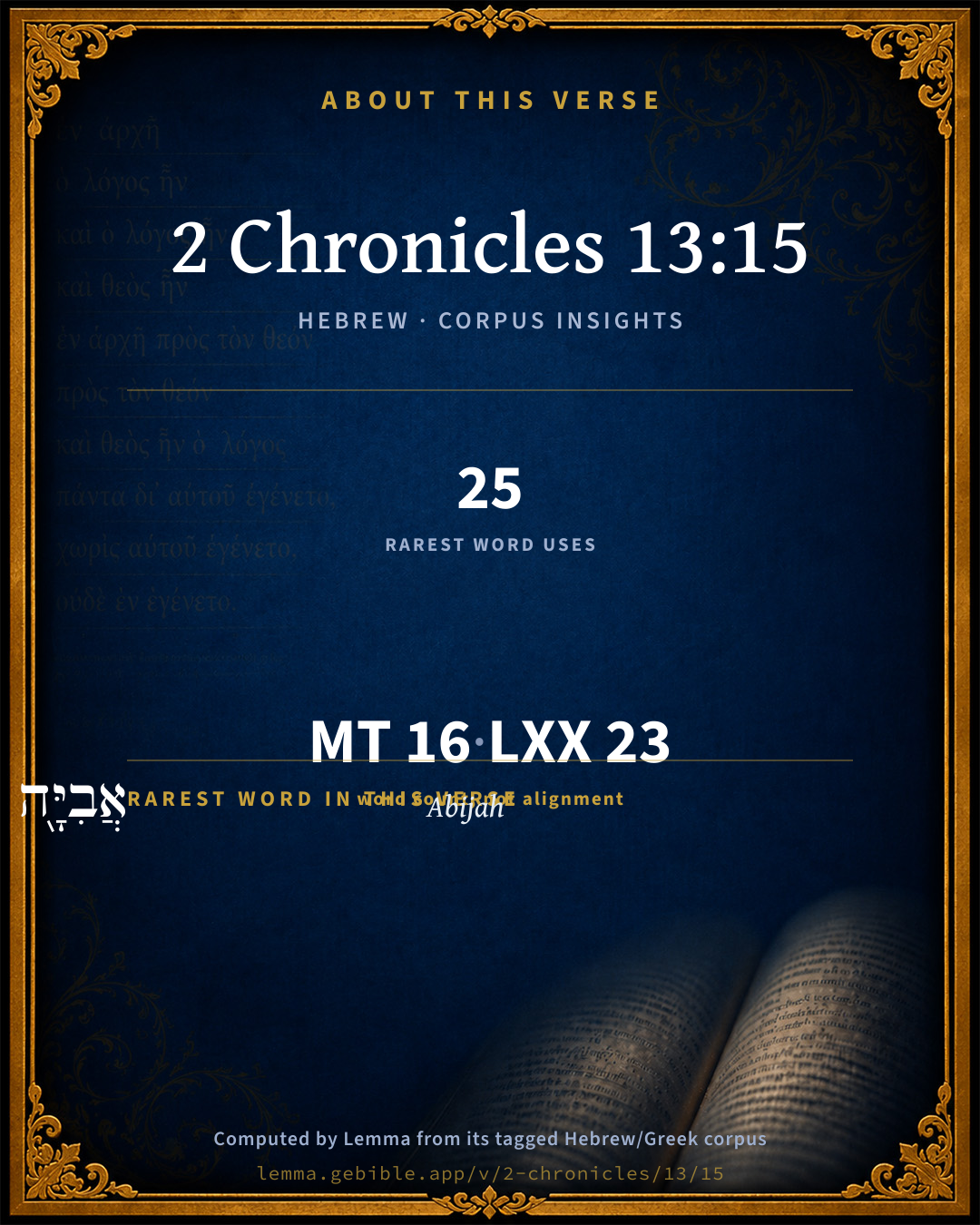
The rarest word here is אֲבִיָּ֖ה Abijah H29 — appearing just 25 times in the whole Hebrew Bible.

Shared distinctive vocabulary

אֲבִיָּ֖ה Abijah H29 occurs in 25 verses of the Hebrew Bible. Also found in:

Grammatical profile

  • 4 verbs
  • 11 nouns
  • 1 particle

Verb forms

  • וַיָּרִ֖יעוּ Hiphil · Sequential Imperfect
  • וַיְהִ֗י Qal · Sequential Imperfect
  • בְּהָרִ֨יעַ֙ Hiphil · Infinitive Construct
  • נָגַ֤ף Qal · Perfect

Repetition

Words recur within this verse — often emphatic in Hebrew:

  • יְהוּדָ֑ה Judah H3063 ×3
  • וַיָּרִ֖יעוּ to shout H7321 ×2
  • אִ֣ישׁ man H376 ×2

Hebrew & Septuagint length

In English translation the verse runs 28 words from the Hebrew and 28 from the Septuagint (LXX English) — the same length.

A rough comparison of the two English renderings, which tokenize alike — not a word-level alignment.

Word counts can differ between the Hebrew and the Greek without any difference in meaning — e.g. the Hebrew direct-object marker אֵת has no separate Greek word, and Greek often adds the article ὁ.

In the original languages it is 16 Hebrew tokens and 23 Greek tokens — but the two are counted differently (Hebrew bundles its prefixes and suffixes into one token; the Greek is in lemma form), so that isn’t a like-for-like length.

Cross-references

13

Topical passages linked to 2 Chronicles 13:15 in the Treasury of Scripture Knowledge — connected by theme and wording, ordered by reader-vote popularity; previews shown in the World English Bible.

  • 2 Chronicles 14:12 So Yahweh struck the Ethiopians before Asa, and before Judah; and the Ethiopians fled.
  • Numbers 32:4 the land which Yahweh struck before the congregation of Israel, is a land for cattle; and your servants have cattle.
  • Joshua 6:16 It happened at the seventh time, when the priests blew the trumpets, Joshua said to the people, Shout; for Yahweh has given you the city.
  • Joshua 6:20 So the people shouted, and [the priests] blew the trumpets; and it happened, when the people heard the sound of the trumpet, that the people shouted with a great shout, and the wall fell down flat, so that the people went up into the city, every man straight before him, and they took the city.
  • Joshua 11:8 Yahweh delivered them into the hand of Israel, and they struck them, and chased them to great Sidon, and to Misrephoth Maim, and to the valley of Mizpeh eastward; and they struck them, until they left them none remaining.
  • Judges 4:15 Yahweh confused Sisera, and all his chariots, and all his host, with the edge of the sword before Barak; and Sisera alighted from his chariot, and fled away on his feet.
  • Judges 7:18–22 When I blow the trumpet, I and all who are with me, then blow you the trumpets also on every side of all the camp, and say, For Yahweh and for Gideon.
  • 2 Kings 5:1 Now Naaman, captain of the host of the king of Syria, was a great man with his master, and honorable, because by him Yahweh had given victory to Syria: he was also a mighty man of valor, [but he was] a leper.
  • 2 Chronicles 20:21 When he had taken counsel with the people, he appointed those who should sing to Yahweh, and give praise in holy array, as they went out before the army, and say, Give thanks to Yahweh; for his loving kindness endures forever.
  • Psalms 47:1 Oh clap your hands, all you nations. Shout to God with the voice of triumph!
  • Psalms 47:5 God has gone up with a shout, Yahweh with the sound of a trumpet.
  • Psalms 118:4–7 Now let those who fear Yahweh say That his loving kindness endures forever.
  • Isaiah 37:36 The angel of Yahweh went forth, and struck in the camp of the Assyrians one hundred and eighty-five thousand; and when men arose early in the morning, behold, these were all dead bodies.

Cross-references courtesy of OpenBible.info (CC BY 4.0).

Hebrew and Greek witnesses Masoretic Hebrew ↔ Greek Septuagint

The same verse in the two great witnesses to the Old Testament, shown verse-for-verse.

These are two independent witnesses, not word-aligned to each other, and the Septuagint is shown in lemma (dictionary) form.

Hebrew 2 Chronicles 13:15 Masoretic · Westminster Leningrad Codex

וַיָּרִ֖יעוּ אִ֣ישׁ יְהוּדָ֑ה וַיְהִ֗י בְּהָרִ֨יעַ֙ אִ֣ישׁ יְהוּדָ֔ה וְהָאֱלֹהִ֗ים נָגַ֤ף אֶת יָֽרָבְעָם֙ וְכָל יִשְׂרָאֵ֔ל לִפְנֵ֥י אֲבִיָּ֖ה וִיהוּדָֽה

Then the men of Judah gave a shout: and as the men of Judah shouted, it happened, that God struck Jeroboam and all Israel before Abijah and Judah.

World English Bible · Public Domain

Greek LXX 2 Chronicles 13:15 Septuagint · lemma form

καί βοάω ἀνήρ ἰουδά καί γίγνομαι ἐν ὁ βοάω ἀνήρ ἰουδά καί κύριος πατάσσω ὁ ιεροβοαμ καί ὁ ἰσραήλ ἐναντίον αβια καί ἰουδά

And the men of Juda shouted: and it came to pass, when the men of Juda shouted, that the Lord struck Jeroboam and Israel before Abia and Juda.

LXX2012 (modern English Septuagint) · Public Domain

On this verse, Haydock's Catholic Bible Commentary discusses the Septuagint’s reading. Read the note in Commentary ↓

Hebrew: Westminster Leningrad Codex (CC BY 4.0). Greek: Septuagint (public domain); English from LXX2012 (modern English Septuagint) (Public Domain). How the Septuagint differs from the Hebrew →

Commentary

Notes on 2 Chronicles 13:15 from classic Christian and Jewish commentators (each source and its license shown beneath its notes). The classic Christian expositions comment on the surrounding passage and are grouped to its opening verse, so a note may address several verses; the Jewish commentaries on the Tanakh (Rashi and others) are per-verse, so they appear only where the commentator wrote on this verse.

Lemma curates 59 commentaries, every one of them public domain or Creative Commons licensed, each selected and text-cleaned for this edition rather than reprinted as found. About our sources →

Trapp's Complete Commentary

John Trapp

2Ch 13:15 Then the men of Judah gave a shout: and as the men of Judah shouted, it came to pass, that God smote Jeroboam and all Israel before Abijah and Judah.

Ver. 15. Then the men of Judah gave a shout.] Initio pugnae, de more antiquorum. Together with their loud outcries - first for fear perhaps, afterwards to affright their enemies - prayers went up to God. And see the happy effect thereof.

God smote Jeroboam.] With a panic terror, with furies in his own conscience, and with some grievous disease, whereof, Nabal-like, at length he died. {2Ch 13:20}

John Trapp, A Commentary or Exposition upon All the Books of the Old and New Testament (1647–1656) — public domain. Text from a community e-Sword module.

Joseph Benson's Commentary

2Ch 13:15. Then the men of Judah gave a shout — In confidence of victory, the priests animating them by sounding the trumpets, and giving them assurance of God’s presence with them. To the cry of prayer they added the shout of faith, and so became more than conquerors. God smote Jeroboam and all Israel — He struck him and his army with such terror and amazement, that, it appears, they could not strike a stroke, but fled with the greatest precipitation imaginable, and the conquerors gave no quarter; so that they put to the sword five hundred thousand chosen men; more (it is said) than ever we read of in any history to have been killed in one battle. But the battle was the Lord’s; who would thus chastise the idolatry of Israel, and own the house of David. But see the sad effects of division! It was the blood of Israelites which was thus shed like water by Israelites, while the heathen, their neighbours, to whom the name of Israel had formerly been a terror, cried, Aha, so would we have it.

Joseph Benson's Commentary on the Old and New Testaments (1811–1818) — public domain. Text from a community e-Sword module.

Geneva Bible (1599)

Geneva Bible translators

Or, gave him the overthrow.

Geneva Bible (1599) marginal notes — public domain. Text via Bolls.life.

Ellicott's Commentary for English Readers

(15) Then the men of Judah gave a shout.—The same verb (hâria‘) occurred in 2Ch_13:12, in the sense of sounding an alarm with the “trumpets of alarm” (t’rû‘ah.) Here our version gives the right sense. Immediately after the priests had blown a blast upon the trumpets, the warriors raised a shout or war- cry. (Comp. Jdg_7:18-20).

God smote Jeroboam and all Israel before Abijah and Judah.—The wild panic which seized the host of Israel, when they heard the shout of their foes, is thus forcibly described. The same phrase is used in Jdg_20:35, and again by the chronicler (2Ch_14:12). (Comp. the Vulg., “perterruit Deus Jeroboam et omnem Israel.” Syriac, “the Lord routed,” &c.)

A Bible Commentary for English Readers, edited by Charles John Ellicott (1878–1897) — public domain. Text from a community e-Sword module.

The Cambridge Bible for Schools and Colleges

gen. ed. J. J. S. Perowne

15. gave a shout] This shout had the character of a religions function; cp. Jos_6:10; Jos_6:16, where the same Heb. word is used.

God smote Jeroboam] Cp. 2Ch_14:12.

The Cambridge Bible for Schools and Colleges (gen. ed. J. J. S. Perowne; Cambridge University Press, 1878–1918) — public domain. Text from a community e-Sword module.

John Gill's Exposition

And the children of Israel fled before Judah,.... Were in such a fright and consternation, that they could not stand their ground, or engage at all; but took to flight immediately:

and God delivered them into their hand; to be taken and slain by them.

John Gill's Exposition of the Whole Bible (1746–1763) — public domain (CC PDM 1.0). Text via the HelloAO Bible API.

Haydock's Catholic Bible Commentary

CHAPTER XIII.

Terrified. Septuagint, "struck;" God caused the victory to declare in favour of those who were only half the number. (Haydock)

George Leo Haydock (1774–1849), Haydock's Catholic Family Bible and Commentary, 1859 edition — public domain. Excludes Psalms (Douay-Rheims chapter numbering differs from Protestant) and Deuterocanonical books (Catholic canon only).

Matthew Poole's English Annotations

By strengthening the hearts and hands of the men of Judah, and taking away the spirits and power of their enemies; and, it may be, by some extraordinary assistance.

Matthew Poole's English Annotations on the Holy Bible (1683–1685) — public domain. Text from a community e-Sword/MySword module.

John Wesley's Explanatory Notes

Gave a shout - It is unspeakable comfort, that no stratagem or ambush can cut off our communication with heaven. To the cry of prayer they added the shout of faith, and so became more than conquerors.

John Wesley, Explanatory Notes Upon the Whole Bible (1754–1765) — public domain. Text via the GEBible commentary corpus.

Lesson kit

Teaching starters — assembled from the data on this page, not authored interpretation. Every prompt links to the verse data it draws on. Edit before teaching.

2 Chronicles, in the Historical, opens this verse with 16 words (12 distinct Hebrew lemmas). Its most distinctive word is ʼĂbîyâh (“Abijah”). A historical commentator’s framing appears above. Read the whole chapter for the surrounding context.

Discussion questions

  1. How does “Abijah” (ʼĂbîyâh) shape what this verse is saying?
  2. 1 Samuel 8:2 shares the word «Abijah» with this verse. How do the two illuminate each other?
  3. “Judah” occurs 3× in this one verse. What is the effect of the repetition?
  4. These translations render this verse differently; the difference is in the English rendering, not the original. What questions does that raise?
  5. The verb «וַיָּרִ֖יעוּ» is Hiphil Sequential Imperfect. How does its form color the action?
  6. Reading how Trapp's Complete Commentary and Joseph Benson's Commentary read this verse, where do the two commentators agree and where do they part?

Things to notice

Reading settings

Reading text

Shown beneath each verse's original-language words.

Old Testament
Old Testament edition

Read the OT as the Masoretic Hebrew (MT) or the Greek Septuagint (LXX).

English shown for the Greek Septuagint (in the Hebrew ↔ Greek comparison).

Comparing translations? Open the Compare panel on any verse page to stack up to four side by side.