Nehemiah 4:12

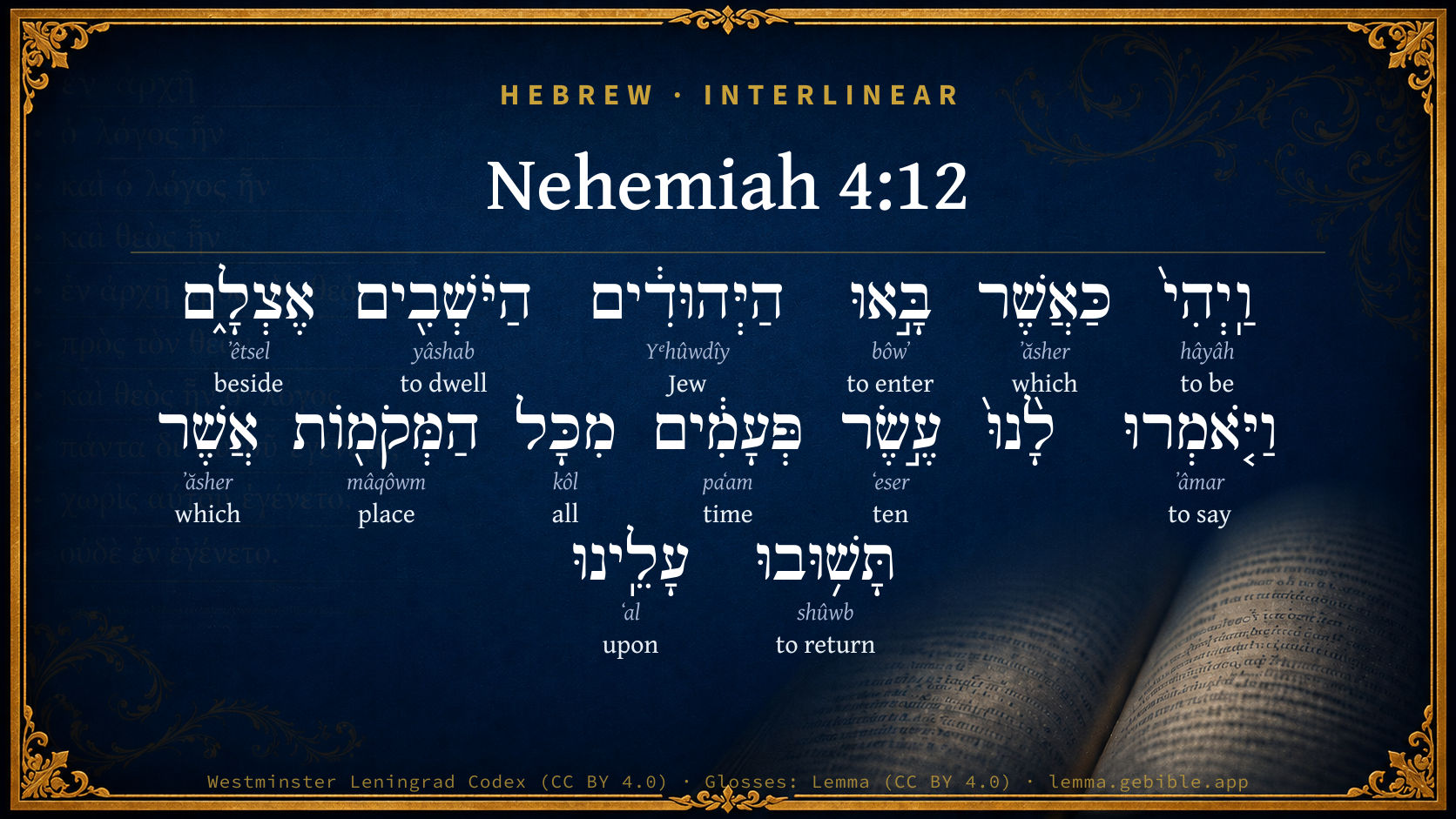
Hebrew (Westminster Leningrad Codex) Nehemiah 4:12 appears in the Hebrew Old Testament. The text above is from the Westminster Leningrad Codex. Each word links to its Strong’s number, a concise gloss, and parsing drawn from the Open Scriptures Hebrew Bible morphology. Click any word for its full Brown-Driver-Briggs (BDB) entry.
Download image
Cite this verse

Nehemiah 4:12 (World English Bible). Public Domain. Lemma interlinear Bible study tool, https://lemma.gebible.app/v/nehemiah/4/12.

Show BibTeX & RIS
BibTeX
RIS
English Translation
It happened that when the Jews who lived by them came, they said to us ten times from all places, You must return to us.
World English Bible · Public Domain
Download a study sheet

One document with this verse’s original text, its word-by-word gloss line, the meaning frame, cross-references with their text, attributed commentary, and full source and license credits — printable, and it pastes into notes with its structure intact.

This verse Autodidact and up

Study sheet (.html) Plain text (.txt)

A passage Seminary Student

Up to 50 verses in one chapter. A passage sheet keeps up to 6 commentary sources and 12 cross-references per verse, in the order this page ranks them, and says so on the sheet whenever that leaves anything out. Ask for a single verse and you get the Autodidact verse sheet above.

Everything on this page stays free to read, with no account — the sheet is a download of what is already on screen, not access to it.

Want to remove ads? Support Godless Engineer
Compare translations 3

The same verse in 3 English versions, stacked beneath the original-language interlinear above. Click any original word for its lexicon entry.

Each is an independent rendering of the whole verse — the interlinear is not word-aligned to these translations.

Highlighted words mark where these versions differ — a whole-verse word diff, not a word-by-word alignment.

  • World English Bible Public Domain
    It happened that when the Jews who lived by them came, they said to us ten times from all places, You must return to us.
  • King James Version Public Domain
    And it came to pass, that when the Jews which dwelt by them came, they said unto us ten times, From all places whence ye shall return unto us they will be upon you.
  • unfoldingWord Literal Text CC BY-SA 4.0
    And it happened that, when the Jews dwelling beside them came, they said to us ten times, “From all the places where you turn, they are on us!”

unfoldingWord Literal Text — © unfoldingWord, licensed CC BY-SA 4.0. Word-aligned USFM3 via Door43 (git.door43.org/unfoldingWord/en_ult).

Versions to compare (up to 4)

3 of 4 selected

Show all 18 translations

Every available English version of this verse, each an independent rendering of the whole verse.

  • World English Bible Public Domain
    It happened that when the Jews who lived by them came, they said to us ten times from all places, You must return to us.
  • Berean Standard Bible Public Domain
    At that time the Jews who lived nearby came and told us ten times over, “Wherever you turn, they will attack us.”
  • Majority Standard Bible Public Domain
    At that time the Jews who lived nearby came and told us ten times over, “Wherever you turn, they will attack us.”
  • King James Version Public Domain
    And it came to pass, that when the Jews which dwelt by them came, they said unto us ten times, From all places whence ye shall return unto us they will be upon you.
  • American Standard Version (1901) Public Domain
    And it came to pass that, when the Jews that dwelt by them came, they said unto us ten times from all places, Ye must return unto us.
  • Revised Version (1885) Public Domain
    And it came to pass that, when the Jews which dwelt by them came, they said unto us ten times from all places, Ye must return unto us.
  • Geneva Bible (1599) Public Domain
    But when the Iewes (which dwelt beside them) came, they told vs ten times, From all places whence ye shall returne, they wil be vpon vs.
  • Douay-Rheims (1899) Public Domain
    And it came to pass, that when the Jews that dwelt by them came and told us ten times, out of all the places from whence they came to us,
  • Young's Literal Translation Public Domain
    And it cometh to pass, when the Jews have come who are dwelling near them, that they say to us ten times from all the places whither ye return -- `they are' against us.
  • Literal Standard Version CC BY-SA 4.0
    And it comes to pass, when the Jews have come who are dwelling near them, that they say to us ten times from all the places to where you return—[they are] against us.
  • Unlocked Literal Bible CC BY-SA 4.0
    At that time the Jews who lived near them came from all directions and spoke to us ten times, warning us about the schemes they were making against us.
  • unfoldingWord Literal Text CC BY-SA 4.0
    And it happened that, when the Jews dwelling beside them came, they said to us ten times, “From all the places where you turn, they are on us!”
  • Darby Bible Public Domain
    And it came to pass that when the Jews that dwelt by them came and told us so ten times, from all the places whence they returned to us,
  • World Messianic Bible Public Domain
    When the Jews who lived by them came, they said to us ten times from all places, “Wherever you turn, they will attack us.”
  • Webster's Bible Public Domain
    And it came to pass, that when the Jews who dwelt by them came, they said to us ten times, From all places whence ye shall return to us they will be upon you.
  • Free Bible Version CC BY-SA 4.0
    The Jews who lived close by came and told us over and over again, “They're going to attack us from all directions!”
  • Bible in Basic English Public Domain
    And it came about that when the Jews who were living near them came, they said to us ten times, From all directions they are coming against us.
  • JPS Tanakh (1917) Public Domain
    (4-6) And it came to pass that, when the Jews that dwelt by them came, they said unto us ten times: 'Ye must return unto us from all places.'

Literal Standard Version (2020), Covenant Press — licensed CC BY-SA 4.0. Text via the HelloAO Bible API (eBible.org). Unlocked Literal Bible (unfoldingWord) — licensed CC BY-SA 4.0. Text via the HelloAO Bible API (eBible.org). unfoldingWord Literal Text — © unfoldingWord, licensed CC BY-SA 4.0. Word-aligned USFM3 via Door43 (git.door43.org/unfoldingWord/en_ult). Free Bible Version, Dr. Jonathan Gallagher — licensed CC BY-SA 4.0. Text via the HelloAO Bible API (eBible.org).

Word by word

More ways to search: Search by grammar → Find every occurrence → Compare this word →

Practice this passage: Drill this verse → Learn its vocabulary →

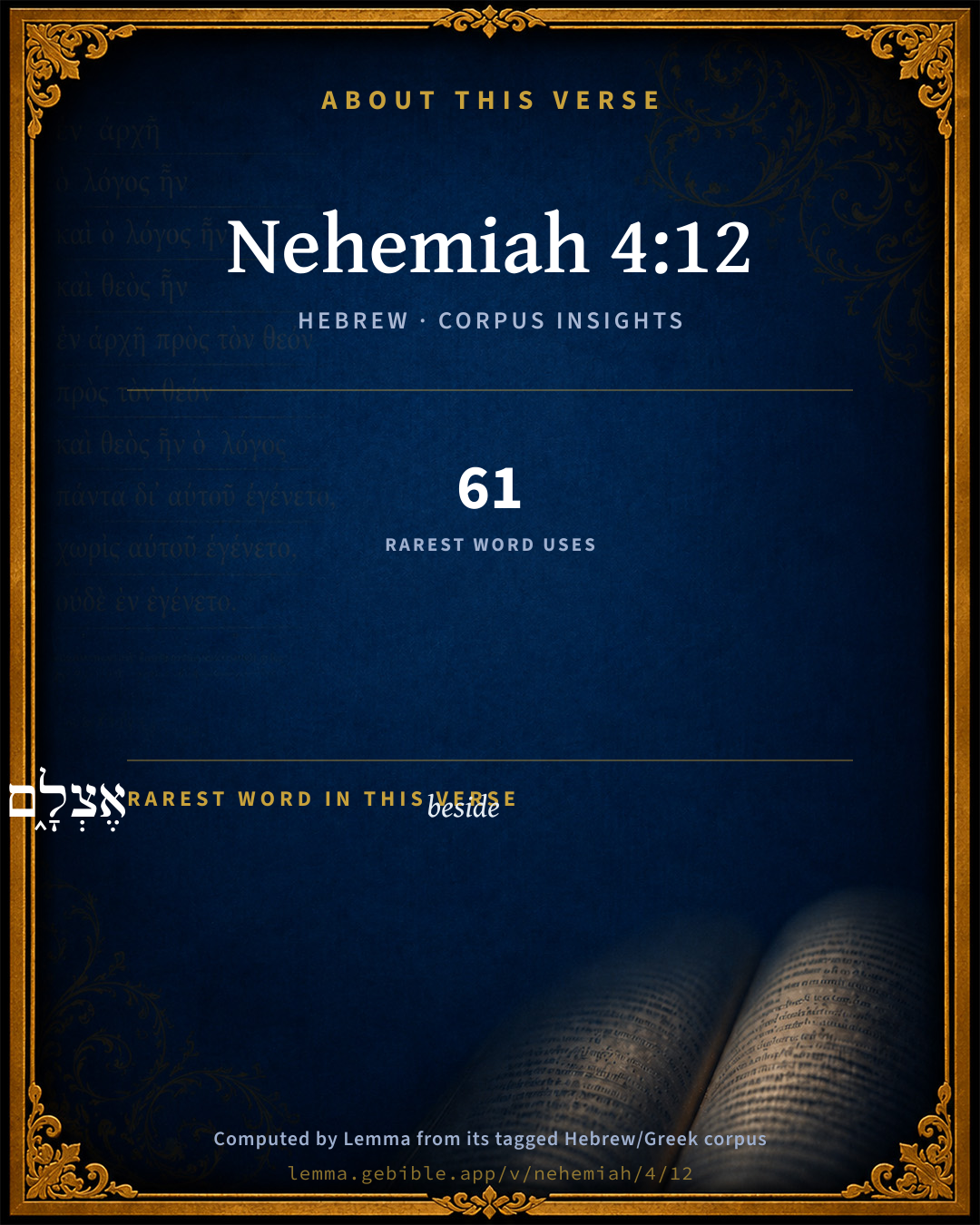
אֶצְלָ֑ם
ʼêtsel
H681
“beside · them”
Preposition + Suffix, Personal, 3rd Person, Masculine, Plural
Part of Speech
Preposition
Full BDB Definition

Origin: from H680 (in the sense of joining)

TWOT: 153a

beside, by, near, nearness, joining, proximity - (BDB) (substantive) - conjunction, proximity - beside, in proximity, contiguous to, from beside
  1. וַֽיְהִי֙ hâyâh H1961 “and · to be” Conjunction + Verb, Qal, Sequential Imperfect, 3rd Person, Masculine, Singular
  2. כַּאֲשֶׁר ʼăsher H834 “like/as · which” Preposition + Particle, Relative
  3. בָּ֣אוּ bôwʼ H935 “to enter” Verb, Qal, Perfect, 3rd Person, Common, Plural
  4. הַיְּהוּדִ֔ים Yᵉhûwdîy H3064 “the · Jews” Particle, Definite Article + Noun, Gentilic, Masculine, Plural, Absolute
  5. הַיֹּשְׁבִ֖ים yâshab H3427 “the · dwelling” Particle, Definite Article + Verb, Qal, Participle Active, Masculine, Plural, Absolute
  6. וַיֹּ֤אמְרוּ ʼâmar H559 “and · to say” Conjunction + Verb, Qal, Sequential Imperfect, 3rd Person, Masculine, Plural
  7. עֶ֣שֶׂר ʻeser H6235 “ten” Adjective, Cardinal number, Feminine, Singular, Absolute
  8. פְּעָמִ֔ים paʻam H6471 “times” Noun, Common, Feminine, Plural, Absolute
  9. מִכָּל kôl H3605 “from · all of” Preposition + Noun, Common, Masculine, Singular, Construct
  10. הַמְּקֹמ֖וֹת mâqôwm H4725 “the · places” Particle, Definite Article + Noun, Common, Masculine, Plural, Absolute
  11. אֲשֶׁר ʼăsher H834 “which” Particle, Relative
  12. תָּשׁ֥וּבוּ shûwb H7725 “to return” Verb, Qal, Imperfect, 2nd Person, Masculine, Plural
  13. עָלֵֽינוּ ʻal H5921 “upon · us” Preposition + Suffix, Personal, 1st Person, Common, Plural

About this verse

These counts appear in no published source. They are computed here, from the morphology-tagged text and Lemma’s own curated glosses. What Lemma adds →

15
words
13
distinct lemmas
Historical
section

Grammatical profile

  • 5 verbs
  • 4 nouns
  • 1 adjective
  • 3 prepositions
  • 2 particles

Verb forms

  • וַֽיְהִי֙ Qal · Sequential Imperfect
  • בָּ֣אוּ Qal · Perfect
  • הַיֹּשְׁבִ֖ים Qal · Participle Active
  • וַיֹּ֤אמְרוּ Qal · Sequential Imperfect
  • תָּשׁ֥וּבוּ Qal · Imperfect

Repetition

A word recurs within this verse — often emphatic in Hebrew:

  • כַּאֲשֶׁר which H834 ×2

Cross-references

4

Topical passages linked to Nehemiah 4:12 in the Treasury of Scripture Knowledge — connected by theme and wording, ordered by reader-vote popularity; previews shown in the World English Bible.

  • Genesis 31:7 Your father has deceived me, and changed my wages ten times, but God didn't allow him to hurt me.
  • Genesis 31:41 These twenty years have I been in your house. I served you fourteen years for your two daughters, and six years for your flock, and you have changed my wages ten times.
  • Numbers 14:22 because all those men who have seen my glory, and my signs, which I worked in Egypt and in the wilderness, yet have tempted me these ten times, and have not listened to my voice;
  • Job 19:3 You have reproached me ten times. You aren't ashamed that you attack me.

Cross-references courtesy of OpenBible.info (CC BY 4.0).

Hebrew and Greek witnesses Masoretic Hebrew ↔ Greek Septuagint

The same verse in the two great witnesses to the Old Testament, shown verse-for-verse.

These are two independent witnesses, not word-aligned to each other, and the Septuagint is shown in lemma (dictionary) form.

Hebrew Nehemiah 4:12 Masoretic · Westminster Leningrad Codex

וַֽיְהִי֙ כַּאֲשֶׁר בָּ֣אוּ הַיְּהוּדִ֔ים הַיֹּשְׁבִ֖ים אֶצְלָ֑ם וַיֹּ֤אמְרוּ לָ֨נוּ֙ עֶ֣שֶׂר פְּעָמִ֔ים מִכָּל הַמְּקֹמ֖וֹת אֲשֶׁר תָּשׁ֥וּבוּ עָלֵֽינוּ

It happened that when the Jews who lived by them came, they said to us ten times from all places, You must return to us.

World English Bible · Public Domain

Greek LXX Structure differs

The Septuagint has no separate book of Nehemiah. Its Greek text is the second half of Esdras B (2 Esdras), chapters 11–23; Ezra is the first half (1–10).

A verse-for-verse comparison isn’t shown here because the chapters and verses don’t line up. Switch to the LXX edition with the MT / LXX toggle above to read the Greek directly.

On this verse, Adam Clarke's Commentary discusses the Septuagint’s reading. Read the note in Commentary ↓

Hebrew: Westminster Leningrad Codex (CC BY 4.0). Greek: Septuagint (public domain); English from a public-domain English Septuagint. How the Septuagint differs from the Hebrew →

Commentary

Notes on Nehemiah 4:12 from classic Christian and Jewish commentators (each source and its license shown beneath its notes). The classic Christian expositions comment on the surrounding passage and are grouped to its opening verse, so a note may address several verses; the Jewish commentaries on the Tanakh (Rashi and others) are per-verse, so they appear only where the commentator wrote on this verse.

Lemma curates 59 commentaries, every one of them public domain or Creative Commons licensed, each selected and text-cleaned for this edition rather than reprinted as found. About our sources →

Trapp's Complete Commentary

John Trapp

Neh 4:12 And it came to pass, that when the Jews which dwelt by them came, they said unto us ten times, From all places whence ye shall return unto us [they will be upon you].

Ver. 12. And it came to pass, that when the Jews which dwelt by them came] Their brethren from abroad gave the workmen intelligence; and this was a friendly office; for praemonitus praemunitus, premonition is the best means of prevention. It is the property of a brother, though at other times not so kind, yet in affliction and extremity to find nature working in him, and to do his best. See Pro 17:17. {See Trapp on "Pro 17:17"}

They said unto us ten times] i.e. Oftentimes, Gen 31:41 Num 14:22. The Lord knoweth how to deliver his, as he did David from Saul, Peter from the Jews, Act 12:7-12, Paul from those conspirators, Act 23:12-23, and this sinful nation oft from the blood thirsty Papists. Masses were said in Rome for the good success of the Catholic design (the gunpowder plot); but no prayers in England, for our deliverance: and yet they were defeated ( Sorex sue periit indicio), and we delivered. Admirable mercy.

From all places whence ye shall return, &c.] Some read it thus, And it came to pass, when the Jews which dwelt beside them, came and told us of their practices ten times out of all places, whence they came unto us, I set in the low places, &c. And here, I cannot tell, saith one, whether these intelligencers be worthy more praise or condemnation. It was their duty to have come home, stood in storms, and help to build Jerusalem. But God, which turneth our intelligence and foolishness to the setting forth of his wisdom and goodness, gave them a good will and boldness to further that building as they might. Thus God useth the service of all men and creatures to the comfort of his people.

John Trapp, A Commentary or Exposition upon All the Books of the Old and New Testament (1647–1656) — public domain. Text from a community e-Sword module.

Joseph Benson's Commentary

Neh 4:12. And the Jews which dwelt by them — Who were neighbours to that people; or dwelt among them, as the words may be rendered, whereby they became acquainted with their counsels. They said unto us ten times — That is, they came and informed us very often, for ten times, in Scripture, signifies a great many times. From all places whence ye shall return unto us, &c. — That is, they will attack you by all the ways by which we can come to you, or you to us, or wherever there is any communication between you and us; therefore take care to keep watches on every side. Hence it appears, that though those Jews, who dwelt near or among the Samaritans, had not zeal enough to induce them to come to Jerusalem to help their brethren in building the wall; yet, having discovered the enemies’ design, they had so much honesty, and affection to the cause, as to give intelligence of it: nay, that their information might be the more credited, they came themselves to make them acquainted with it, repeating it many times, as men in earnest, and under a concern to have it believed.

Joseph Benson's Commentary on the Old and New Testaments (1811–1818) — public domain. Text from a community e-Sword module.

Tyndale Open Study Notes

Tyndale Open Resources

4:12 They will come from all directions and attack us! Jews from the surrounding areas might have been exhorting the people working in Jerusalem to return to their villages to avoid being killed in an attack.

Tyndale Open Study Notes — © Tyndale Open Resources, licensed CC BY-SA 4.0. Text via the HelloAO Bible API.

Geneva Bible (1599)

Geneva Bible translators

They which brought the tidings, said thus, When you leave your work, and go either to eat or to rest, your enemies will assail you.

That is, oftentimes.

Geneva Bible (1599) marginal notes — public domain. Text via Bolls.life.

Adam Clarke's Commentary

Verse 12. From all places whence ye shall return unto us] This verse is extremely difficult. Our translators have supplied the words, they will be upon you, which have nothing correspondent in the Hebrew. The Septuagint have given a good sense, Αναβαινουσιν εκ παντων των τοπων εφ' ἡμας, They come up from all places against us. The sense appears to be this: the Jews which dwelt among the Samaritans, &c., came often to Nehemiah from all quarters, where they sojourned, and told him the designs of his enemies against him: therefore, he set people with their swords, spears, and bows, to defend the walls. It is probable that instead of תשובו tashubu, "ye shall return," we should read חשבו chashebu, "they designed or meditated." This word is very similar to the other, and makes the sense very clear. "The Jews who dwelt among them told us frequently, from all places, what they designed against us." For this reading Houbigant, Michaelis and Dathé contend. But this various reading is not found in any MS., and is not countenanced by any of the versions. See Ne 4:15.

Adam Clarke's Commentary on the Bible (1810–1826) — public domain. Text from a community e-Sword/MySword module.

Ellicott's Commentary for English Readers

(12) From all places.—The neighbouring Jews in their terror said by repeated messages “from all places ‘Ye shall return to us,’ “: that is, for our protection.

A Bible Commentary for English Readers, edited by Charles John Ellicott (1878–1897) — public domain. Text from a community e-Sword module.

The Cambridge Bible for Schools and Colleges

gen. ed. J. J. S. Perowne

12. The translation of the last clause of this verse presents a great difficulty, and leaves us doubtful with what intention the Jews here spoken of addressed their countrymen.

The verse stands in very loose connexion with the two previous verses. It represents a fresh complication in the difficult position which confronted Nehemiah. To discontent within, and the schemes of the foe without, is added the panic of the Jews in the outlying districts.

the Jews which dwelt by them] By this expression are apparently intended the Jewish dwellers in towns and districts adjacent to the territory of the Samaritans, Ammonites, Arabians and Philistines, who had sent contingents to assist in the rebuilding of the walls—e.g. Jericho, Tekoah, Gibeon, Mizpah, Zanoah (chap. Neh_3:2; Neh_3:5; Neh_3:7; Neh_3:13). ‘by them,’ comp. Neh_5:3.

they said unto us ten times] i.e. again and again, as often as occasion offered—cf. Gen_31:41, ‘Thou hast changed my wages ten times.’

From all places whence ye shall return unto us they will be upon you] R.V. from all places, Ye must return unto us, marg. ‘Or, From all places whence ye shall return they will be upon us’. The Authorised Version is here unintelligible.

(1) The R.V. text is a literal translation, with the exception of the omission of the relative before ‘Ye must return.’ This however may be explained as an instance of the relative in late Hebrew idiom prefixed to the ‘Oratio Recta,’ like ὅτι in late Greek. ‘From all places’ refers to the scattered Jewish communities. The foes of Jerusalem were on every side; the fears of the Jewish frontier-towns on every side were increased by the growing hostility of the neighbouring peoples. The words of their petition to Nehemiah and his companions may be explained in one of two ways.

(a) They express apprehension on their own account and for their own homes. Deprived of the able-bodied men who had been sent to work at the walls on Jerusalem, these little towns and villages could not hope to defend themselves against the gathering foe. Wherefore they address themselves through the leaders to their fellow-townsmen sojourning in Jerusalem, ‘Ye must return unto us.’

(b) They are alarmed for the safety of their fellow-townsmen. They see the combination of foes against Jerusalem and regard her overthrow as certain. They entreat their own friends and relatives to return home in time to save their lives.

Of these alternatives (a) is much to be preferred.

(2) The R.V. marg. ‘From all places whence ye shall return they will be upon us.’ This rendering is perfectly literal, but it seems impossible to find a satisfactory meaning for ‘whence ye shall return.’ The interpretation ‘On every side, as soon as you leave a place, the enemy occupy it and attack us,’ gives a fair sense, but is hardly applicable to the circumstances. The Jews had no moving forces in the field.

(3) Another rendering which is supplied by the reading of the 3rd pers. for the 2nd pers. plur. is found in the Versions, LXX., Vulg., and Peshitto Syriac. The 3rd pers. plur. then refers to the enemy; and the translation will run, ‘And they told it us ten times from all the places where the enemy went to and fro against us.’ (LXX. ἀναβαίνουσιν … ἐφʼ ἡμᾶς. Vulg. venerant ad nos). But the alteration of the text has the appearance of a correction to make the passage easier; and the renderings ‘told,’ instead of ‘said,’ ‘went to and fro,’ instead of ‘return,’ introduce fresh difficulties.

The Cambridge Bible for Schools and Colleges (gen. ed. J. J. S. Perowne; Cambridge University Press, 1878–1918) — public domain. Text from a community e-Sword module.

John Gill's Exposition

Near Samaria, Arabia, and Ashdod, and had intelligence of their designs:

came, they said to us ten times; that is, they came to them at Jerusalem, and often told them, as this phrase "ten times" signifies; see Gill on Gen 31:7,

from all places whence ye shall return unto us: they will be upon you, come which way you will, so that ye are in the utmost danger: or "from all places"; where you are repairing and rebuilding:

return to us; that ye may enjoy peace and prosperity with us under Sanballat, &c. and escape the wrath and fury you are now exposed to; or "from all places we come, that ye may return to us"; so De Dieu; these Jews, though they pretended to be friends, to their brethren, yet seemed to be in friendship with their enemies, and sought to discourage them, and weaken their minds, and cause them to cease building.

John Gill's Exposition of the Whole Bible (1746–1763) — public domain (CC PDM 1.0). Text via the HelloAO Bible API.

Albert Barnes' Notes on the Bible

Ten times - i. e. repeatedly.

From all places ... - Better as in the margin. The Jews who dwelt on the Samaritan border, came to Jerusalem and tried to withdraw their contingents of workmen from the work, representing to them the impending danger, and saying, “You must return to your homes, and so escape it.”

Albert Barnes' Notes on the Bible (1834–1885) — public domain. Text from a community e-Sword/MySword module.

Haydock's Catholic Bible Commentary

Ten times, frequently. (Menochius) --- Places, among the Cuthites. --- Whence they. Protestants, "ye return unto us, they will be upon you." Hebrew, the second person is put for the third, which occurs in the Septuagint, &c., though they refer it to the enemy. "They come up from all places against us." (Haydock) --- De Dieu would translate, "return to us," cultivate the friendship of Sanaballat; or "return home," and leave off this work. The sense of the Vulgate is the most easy, and the best. (Calmet)

George Leo Haydock (1774–1849), Haydock's Catholic Family Bible and Commentary, 1859 edition — public domain. Excludes Psalms (Douay-Rheims chapter numbering differs from Protestant) and Deuterocanonical books (Catholic canon only).

Matthew Poole's English Annotations

Which dwelt by them, or, among them; whereby they came to the knowledge of their counsels.

Ten times, i.e. very often. A certain number for an uncertain.

They will be upon you, i.e. they will invade you every way, by which we can come to you, or you to us; and therefore do you keep watches on every side. But these words may be otherwise rendered thus, On all parts where you shall be quiet, or at rest, (i.e. secure; for the Hebrew schub signifies not only to return, but also to be quiet, or at ease, as Hebricians know,) they will be upon us, i.e. upon our people, and city Jerusalem, where you are. And they rather say upon us than upon you, to manifest their affection to them, and conjunction with them, and that they looked upon themselves as members of the same body and church with them, and took what was designed or done against them, as if it were against themselves, and therefore gave them this friendly notice. Or the place may be rendered thus, They told this (to wit, the enemy’s intentions) to us ten times, coming from all places where they dwelt, or rested, (Heb. you rested; the second person being put for the third, as it is both in the Hebrew language, as Gen 10:19,30; Ge 25:18, and in the Hebrew text, Psa 22:9, and in other languages and authors; of which see my Latin Synopsis upon Gen 10:19; and that it is so here we have the consent of the LXX. and Arabic, and of some modern and accurate interpreters, who render it by a verb of the third person,) about us; whence they came purposely to inform and warn us. Or thus, They told this to us ten times from all places whence they did return to us: which phrase of returning to us, i.e. to Jerusalem, suits very well with those persons who came up with their brethren from Babylon to Jerusalem, and went thence into several parts of the country to dwell where they thought meet, and returned now, and at other times, as they had occasion, to their brethren at Jerusalem.

Matthew Poole's English Annotations on the Holy Bible (1683–1685) — public domain. Text from a community e-Sword/MySword module.

Whedon's Commentary on the Bible

Daniel D. Whedon

12. Jews which dwelt by them — That is, Jews who dwelt among the Samaritans and other enemies, and by that means found out their evil designs.

Said unto us ten times — Thereby showing their intense anxiety. The expression is equivalent to a great many times, or again and again.

From all places whence ye shall return unto us — Something seems to have fallen out of the text here. The words supplied by our translators, they will be upon you, do not fully clear up the obscurity, nor suit the previous words, whence ye shall return. Bertheau literally translates the Hebrew thus: — From all places that ye return to us; and explains it as the request of the kinsmen and friends of those builders whose homes were in places some distance from Jerusalem, (like the men of Jericho, Tekoa, and Gibeon, Neh_3:2; Neh_3:5; Neh_3:7,) to tarry no longer in danger at Jerusalem, but return to them. This, too, is the natural meaning of the marginal reading, that from all places ye must return to us. We take this to be the true meaning. The Jews who dwelt at a distance from Jerusalem were anxious to have their friends and kinsmen there return to their homes and families. Interpreters have too generally assumed that these words contained the information which the Jews from a distance brought to the rulers at Jerusalem; whereas, they are rather a request of those Jews for their relatives to leave the imperilled city, and thus escape the threatening danger. Exactly how the rulers at Jerusalem were informed of their enemies’ designs is not said, but, doubtless, it came through those Jews who dwelt among the enemy.

Daniel D. Whedon (gen. ed.), Commentary on the Old and New Testaments (1874–1909) — public domain. Text from a community e-Sword module.

The Pulpit Commentary

If the text is sound, it can only mean that the Jews who dwelt in the outlying towns, in the neighbourhood of Ammon, Samaria, Ashdod, etc., came repeatedly to Jerusalem, and tried to draw off their contingents, saying to them, "You must return to us." But it is suspected that there is a corruption of the original words of Nehemiah, and that what he wrote was, that these Jews came repeatedly to Jerusalem and warned him of the enemy"s designs. (So Ewald, Houbigant, Dathe, A. Clarke, and others.)

The Pulpit Commentary (1880–1919), ed. H.D.M. Spence-Jones & Joseph S. Exell — public domain. Text from a community e-Sword module.

John Wesley's Explanatory Notes

By them - Or, among them: whereby they came to the knowledge of their counsels. Tho' these had not zeal enough to help in the work, yet they had some concern for their brethren. Ten tribes - Very often, a certain number for an uncertain. Be upon you - They will invade you every way, by which we can come to you, or you to us; therefore keep watches on every side.

John Wesley, Explanatory Notes Upon the Whole Bible (1754–1765) — public domain. Text via the GEBible commentary corpus.

Keil & Delitzsch

C. F. Keil & F. Delitzsch

When, therefore, the Jews who dwelt near them, i.e., in the neighbourhood of the adversaries, and heard their words, came to Jerusalem, "and said to us ten times (i.e., again and again), that from all places ye must return to us, then I placed," etc. Jews came from all places to Jerusalem, and summoned those who were building there to return home, for adversaries were surrounding the community on all sides: Sanballat and the Samaritans on the north, the Ammonites on the east, the Arabians on the south, and the Philistines (Ashdodites) on the west. אשׁר before תּשׁוּבוּ introduces their address, instead of כּי; being thus used, e.g., before longer speeches, Sa1 15:20; Sa2 1:4; and for כּי generally, throughout the later books, in conformity to Aramaean usage. "Return to us" (על שׁוּב, as in Ch2 30:9, for אל שׁוּב), said the Jews who came from all quarters to Jerusalem to their fellow-townsmen, who from Jericho, Gibeon, and Tekoa (comp. Neh 3:2-3, Neh 3:5, Neh 3:7) were working on the wall of Jerusalem. These words express their fear lest those who were left at home, especially the defenceless women, children, and aged men, should be left without protection against the attacks of enemies, if their able-bodied men remained any longer in Jerusalem to take part in the building of the wall.

Neh 4:13

Neh 4:7 is hardly intelligible. We translate it: Then I placed at the lowest places behind the wall, at the dried-up places, I (even) placed the people, after their families, with their swords, their spears, and their bows. למּקום מתּחתּיּות is a stronger expression for למּקום מתּחת when used to indicate position, and מן points out the direction. The sense is: at the lowest places from behind the wall. בּצּחחים gives the nature of the places where the people were placed with arms. צחיח and צחיחה mean a dry or bare place exposed to the heat of the sun: bare, uncovered, or empty places, perhaps bare hills, whence approaching foes might be discerned at a distance. The second ואעמיד is but a reiteration of the verb, for the sake of combining it with its object, from which the ואעמיד at the beginning of the verse was too far removed by the circumstantial description of the locality.

(Note: Bertheau considers the text corrupt, regarding the word מתּחתּיּות as the object of אעמיד, and alters it into מחשׁבות or חשּׁבנות, engines for hurling missiles (Ch2 26:15), or into מטחיּות (a word of this own invention), instruments for hurling. But not only is this conjecture critically inadmissible, it also offers no appropriate sense. The lxx reads the text as we do, and merely renders בצחחיים conjecturally by ἐν τοῖς σκεπεινοῖς. Besides, it is not easy to see how חשׁבנות could have arisen from a false reading of מתחתיות; and it should be remembered that מחשׁבות does not mean a machine for hurling, while מטחתייות is a mere fabrication. To this must be added, that such machines are indeed placed upon the walls of a fortress to hurl down stones and projectiles upon assaulting foes, and not behind the walls, where they could only be used to demolish the walls, and so facilitate the taking of the town by the enemy.)

Keil & Delitzsch — Biblical Commentary on the Old Testament (1861–1891) — public domain (CC PDM 1.0). Text via the HelloAO Bible API. (Old Testament only.)

unfoldingWord translationNotes

Door43 World Missions Community

from all directions

This represents many directions. The word "all" is an exaggeration for represents "many." AT: "from many directions" (See: Hyperbole and Generalization)

spoke to us ten times

Here the number 10 is used to represent "many." AT: "spoke to us many times" (See: Metonymy)

in the exposed areas

"in the vulnerable areas"

I positioned each family

This refers to several people from each family, this likely does not include the women and children. AT: "I positioned people from each family" (See: Synecdoche)

Call to mind the Lord

the phrase "call to mind" means to remember. AT: "Remember the Lord" (See: Idiom)

translationWords

life

family

sword

spear

bow and arrow

rule

fear

call

mind

Lord Yahweh

awe

unfoldingWord translationNotes — © Distant Shores Media and the Door43 World Missions Community, licensed CC BY-SA 4.0. Source: git.door43.org/Door43/en_tn.

Rashi

Rabbi Shlomo Yitzchaki (Rashi)

And the builders How were they building? They were all girded, each one with his sword on his waist, and thus did they build.

beside me He was always beside me.

Rashi on the Tanakh — English translations: “The Judaica Press complete Tanach with Rashi, translated by A. J. Rosenberg” (CC BY 4.0); “Pentateuch with Rashi's commentary by M. Rosenbaum and A.M. Silbermann, 1929-1934” (public domain); “The Metsudah Tanach series, Lakewood, N.J” (CC BY 4.0); and “The Book of Joshua, Metsudah Publications, 1997” (CC BY 4.0). Text via Sefaria.

Lesson kit

Teaching starters — assembled from the data on this page, not authored interpretation. Every prompt links to the verse data it draws on. Edit before teaching.

Nehemiah, in the Historical, opens this verse with 15 words (13 distinct Hebrew lemmas). Its most distinctive word is ʼêtsel (“beside”). A historical commentator’s framing appears above. Read the whole chapter for the surrounding context.

Discussion questions

  1. How does “beside” (ʼêtsel) shape what this verse is saying?
  2. Genesis 31:7 shares this passage’s theme. How do the two illuminate each other?
  3. “which” occurs 2× in this one verse. What is the effect of the repetition?
  4. The translations on this page render this verse differently — a whole-verse word diff, not a word-by-word alignment. What might account for the different wordings?
  5. The verb «וַֽיְהִי֙» is Qal Sequential Imperfect. How does its form color the action?
  6. Reading how Trapp's Complete Commentary and Joseph Benson's Commentary read this verse, where do the two commentators agree and where do they part?

Things to notice

Reading settings

Reading text

Shown beneath each verse's original-language words.

Old Testament
Old Testament edition

Read the OT as the Masoretic Hebrew (MT) or the Greek Septuagint (LXX).

English shown for the Greek Septuagint (in the Hebrew ↔ Greek comparison).

Comparing translations? Open the Compare panel on any verse page to stack up to four side by side.