
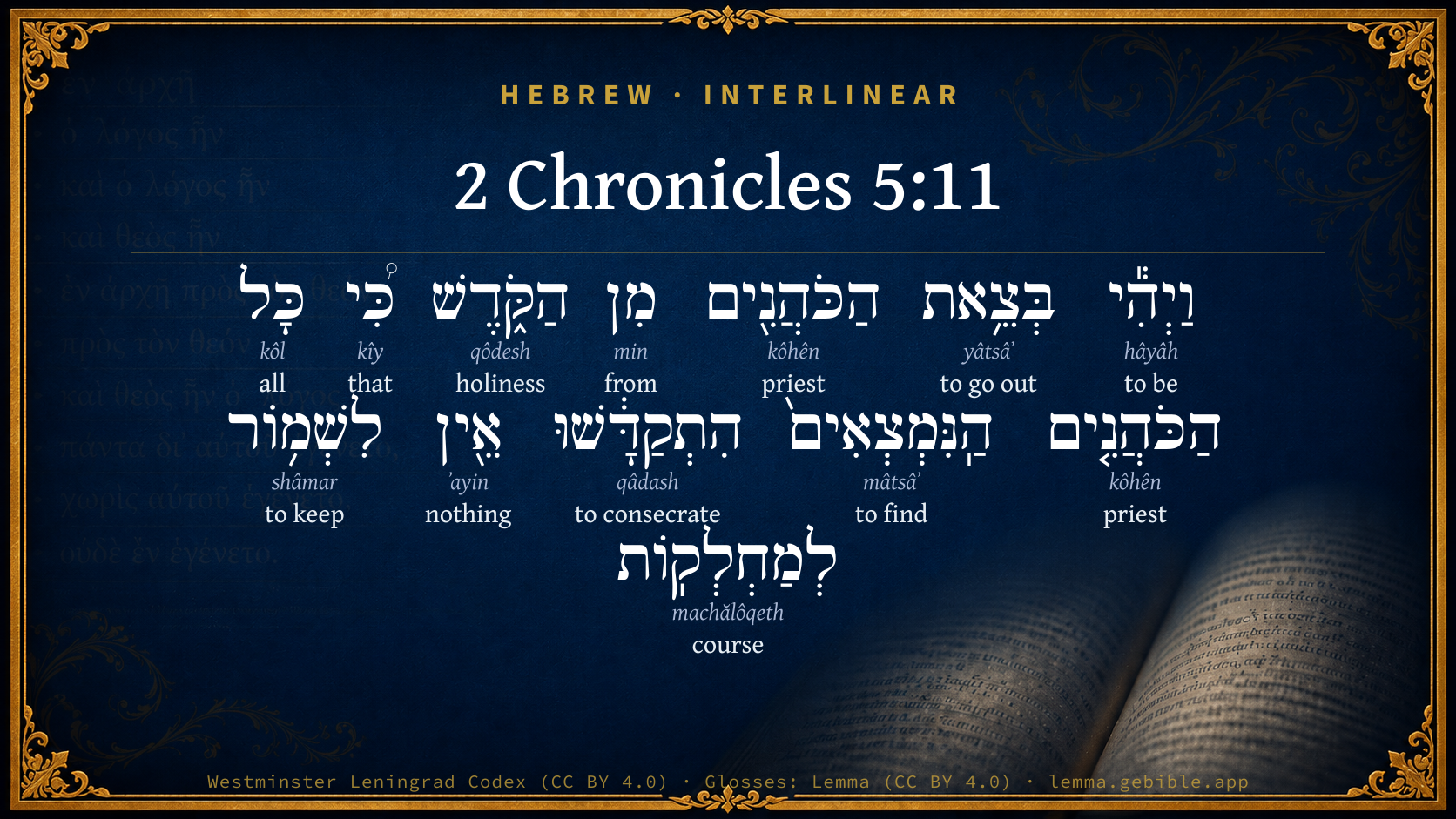
2 Chronicles 5:11

Hebrew (Westminster Leningrad Codex) 2 Chronicles 5:11 appears in the Hebrew Old Testament. The text above is from the Westminster Leningrad Codex. Each word links to its Strong’s number, a concise gloss, and parsing drawn from the Open Scriptures Hebrew Bible morphology. Click any word for its full Brown-Driver-Briggs (BDB) entry.
Download image
Cite this verse

2 Chronicles 5:11 (World English Bible). Public Domain. Lemma interlinear Bible study tool, https://lemma.gebible.app/v/2-chronicles/5/11.

Show BibTeX & RIS
BibTeX
RIS
English Translation
It happened, when the priests were come out of the holy place, (for all the priests who were present had sanctified themselves, and did not keep their divisions;
World English Bible · Public Domain
Download a study sheet

One document with this verse’s original text, its word-by-word gloss line, the meaning frame, cross-references with their text, attributed commentary, and full source and license credits — printable, and it pastes into notes with its structure intact.

This verse Autodidact and up

Study sheet (.html) Plain text (.txt)

A passage Seminary Student

Up to 50 verses in one chapter. A passage sheet keeps up to 6 commentary sources and 12 cross-references per verse, in the order this page ranks them, and says so on the sheet whenever that leaves anything out. Ask for a single verse and you get the Autodidact verse sheet above.

Everything on this page stays free to read, with no account — the sheet is a download of what is already on screen, not access to it.

Want to remove ads? Support Godless Engineer
Compare translations 3

The same verse in 3 English versions, stacked beneath the original-language interlinear above. Click any original word for its lexicon entry.

Each is an independent rendering of the whole verse — the interlinear is not word-aligned to these translations.

Highlighted words mark where these versions differ — a whole-verse word diff, not a word-by-word alignment.

  • World English Bible Public Domain
    It happened, when the priests were come out of the holy place, (for all the priests who were present had sanctified themselves, and did not keep their divisions;
  • King James Version Public Domain
    And it came to pass, when the priests were come out of the holy place: (for all the priests that were present were sanctified, and did not then wait by course:
  • unfoldingWord Literal Text CC BY-SA 4.0
    And it happened in the going out of the priests from the holy place that all the priests who were found consecrated themselves; there was no keeping to the divisions.

unfoldingWord Literal Text — © unfoldingWord, licensed CC BY-SA 4.0. Word-aligned USFM3 via Door43 (git.door43.org/unfoldingWord/en_ult).

Versions to compare (up to 4)

3 of 4 selected

Show all 18 translations

Every available English version of this verse, each an independent rendering of the whole verse.

  • World English Bible Public Domain
    It happened, when the priests were come out of the holy place, (for all the priests who were present had sanctified themselves, and did not keep their divisions;
  • Berean Standard Bible Public Domain
    Now all the priests who were present had consecrated themselves regardless of their divisions. And when the priests came out of the Holy Place,
  • Majority Standard Bible Public Domain
    Now all the priests who were present had consecrated themselves regardless of their divisions. And when the priests came out of the Holy Place,
  • King James Version Public Domain
    And it came to pass, when the priests were come out of the holy place: (for all the priests that were present were sanctified, and did not then wait by course:
  • American Standard Version (1901) Public Domain
    And it came to pass, when the priests were come out of the holy place, (for all the priests that were present had sanctified themselves, and did not keep their courses;
  • Revised Version (1885) Public Domain
    And it came to pass, when the priests were come out of the holy place, (for all the priests that were present had sanctified themselves, and did not keep their courses;
  • Geneva Bible (1599) Public Domain
    And when the Priestes were come out of the Sanctuarie (for all the Priests that were present, were sanctified and did not waite by course.
  • Douay-Rheims (1899) Public Domain
    Now when the priests were come out of the sanctuary, (for all the priests that could be found there, mere sanctified: and as yet at that time the courses and orders of the ministries were not divided among them,)
  • Young's Literal Translation Public Domain
    And it cometh to pass, in the going out of the priests from the sanctuary -- for all the priests who are present have sanctified themselves, there is none to watch by courses,
  • Literal Standard Version CC BY-SA 4.0
    And it comes to pass, in the going out of the priests from the holy place—for all the priests who are present have sanctified themselves, there is none to watch by divisions,
  • Unlocked Literal Bible CC BY-SA 4.0
    It came about that the priests came out of the holy place. All the priests who were present had consecrated themselves to Yahweh, not ordering themselves according to their divisions.
  • unfoldingWord Literal Text CC BY-SA 4.0
    And it happened in the going out of the priests from the holy place that all the priests who were found consecrated themselves; there was no keeping to the divisions.
  • Darby Bible Public Domain
    And it came to pass when the priests were come out of the holy place (for all the priests that were present were hallowed without observing the courses;
  • World Messianic Bible Public Domain
    When the priests had come out of the holy place (for all the priests who were present had sanctified themselves, and didn’t keep their divisions;
  • Webster's Bible Public Domain
    And it came to pass, when the priests had come out of the holy place: (for all the priests that were present were sanctified, and did not then wait by course:
  • Free Bible Version CC BY-SA 4.0
    Then the priests came out of the Holy Place. All the priests who were there had purified themselves, whatever their division.
  • Bible in Basic English Public Domain
    Now when the priests had come out of the holy place, (for all the priests who were present had made themselves holy, not keeping to their divisions;
  • JPS Tanakh (1917) Public Domain
    And it came to pass, when the priests were come out of the holy place — for all the priests that were present had sanctified themselves, and did not keep their courses;

Literal Standard Version (2020), Covenant Press — licensed CC BY-SA 4.0. Text via the HelloAO Bible API (eBible.org). Unlocked Literal Bible (unfoldingWord) — licensed CC BY-SA 4.0. Text via the HelloAO Bible API (eBible.org). unfoldingWord Literal Text — © unfoldingWord, licensed CC BY-SA 4.0. Word-aligned USFM3 via Door43 (git.door43.org/unfoldingWord/en_ult). Free Bible Version, Dr. Jonathan Gallagher — licensed CC BY-SA 4.0. Text via the HelloAO Bible API (eBible.org).

Word by word

More ways to search: Search by grammar → Find every occurrence → Compare this word →

Practice this passage: Drill this verse → Learn its vocabulary →

לְמַחְלְקֽוֹת
machălôqeth
H4256
“to/for · courses”
Preposition + Noun, Common, Feminine, Plural, Absolute
Part of Speech
Preposition + Noun
Type
Common
Gender
Feminine
Number
Plural
State
Absolute
Full BDB Definition

Origin: from H2505

TWOT: 669d

division, course, class, share, allotment - division, part - division, class, course - of priests, Levites (technical term of organisation)
  1. וַיְהִ֕י hâyâh H1961 “and · to be” Conjunction + Verb, Qal, Sequential Imperfect, 3rd Person, Masculine, Singular
  2. בְּצֵ֥את yâtsâʼ H3318 “in/at · to go out” Preposition + Verb, Qal, Infinitive Construct
  3. הַכֹּהֲנִ֖ים kôhên H3548 “the · priests” Particle, Definite Article + Noun, Common, Masculine, Plural, Absolute
  4. מִן min H4480 “from” Preposition
  5. הַקֹּ֑דֶשׁ qôdesh H6944 “the · holiness” Particle, Definite Article + Noun, Common, Masculine, Singular, Absolute
  6. כִּ֠י kîy H3588 “that” Conjunction
  7. כָּל kôl H3605 “all of” Noun, Common, Masculine, Singular, Construct
  8. הַכֹּהֲנִ֤ים kôhên H3548 “the · priests” Particle, Definite Article + Noun, Common, Masculine, Plural, Absolute
  9. הַֽנִּמְצְאִים֙ mâtsâʼ H4672 “the · finding” Particle, Definite Article + Verb, Niphal, Participle Active, Masculine, Plural, Absolute
  10. הִתְקַדָּ֔שׁוּ qâdash H6942 “to consecrate” Verb, Hithpael, Perfect, 3rd Person, Common, Plural
  11. אֵ֖ין ʼayin H369 “nothing” Particle, Negative
  12. לִשְׁמ֥וֹר shâmar H8104 “to keep” Preposition + Verb, Qal, Infinitive Construct

About this verse

These counts appear in no published source. They are computed here, from the morphology-tagged text and Lemma’s own curated glosses. What Lemma adds →

13
words
12
distinct lemmas
Historical
section

Shared distinctive vocabulary

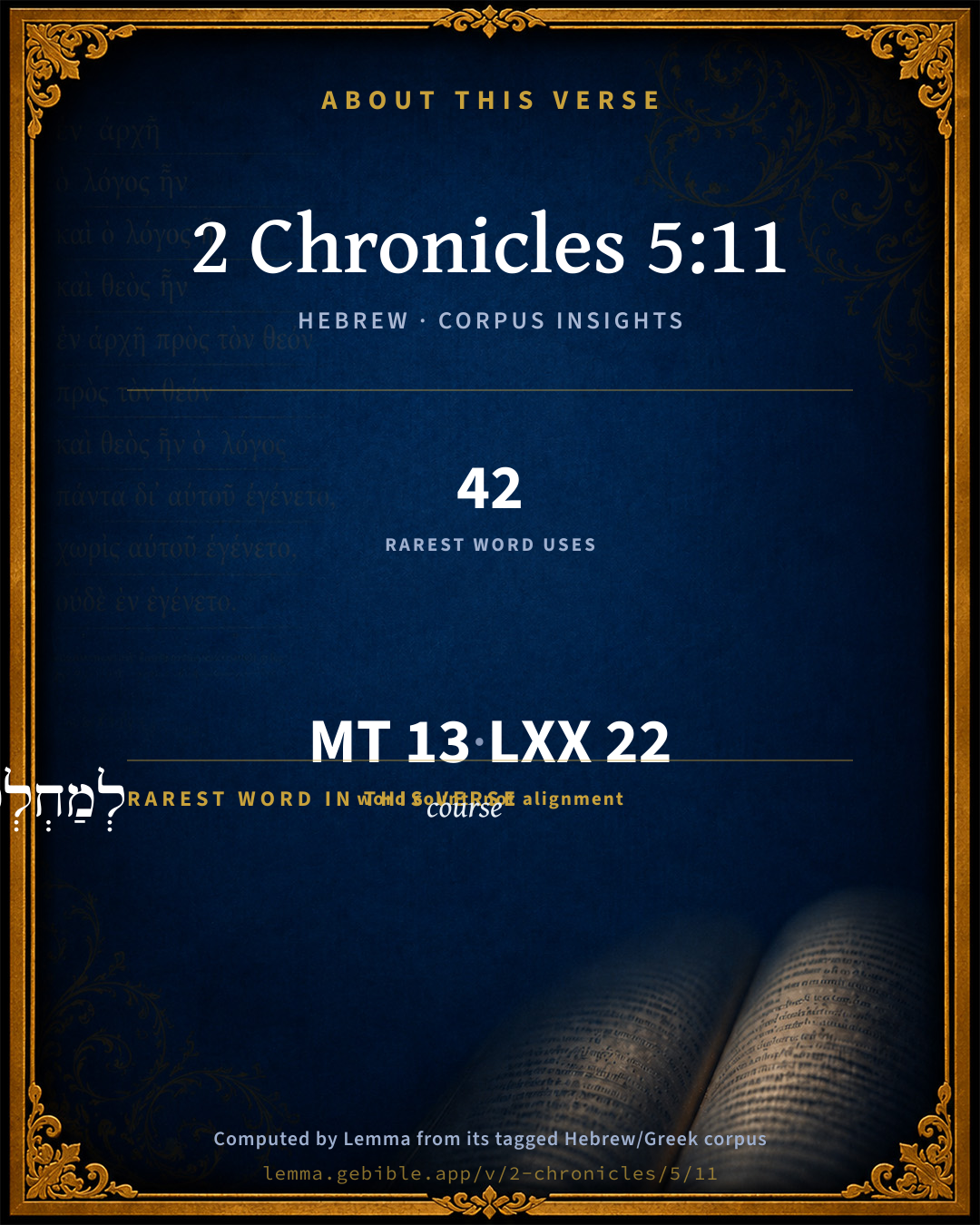
לְמַחְלְקֽוֹת course H4256 occurs in 36 verses of the Hebrew Bible. Also found in:

Grammatical profile

  • 5 verbs
  • 5 nouns
  • 1 preposition
  • 1 conjunction
  • 1 particle

Verb forms

  • וַיְהִ֕י Qal · Sequential Imperfect
  • בְּצֵ֥את Qal · Infinitive Construct
  • הַֽנִּמְצְאִים֙ Niphal · Participle Active
  • הִתְקַדָּ֔שׁוּ Hithpael · Perfect
  • לִשְׁמ֥וֹר Qal · Infinitive Construct

Repetition

A word recurs within this verse — often emphatic in Hebrew:

  • הַכֹּהֲנִ֖ים priest H3548 ×2

Hebrew & Septuagint length

In English translation the verse runs 28 words from the Hebrew and 33 from the Septuagint (LXX English) — closely comparable.

A rough comparison of the two English renderings, which tokenize alike — not a word-level alignment.

Word counts can differ between the Hebrew and the Greek without any difference in meaning — e.g. the Hebrew direct-object marker אֵת has no separate Greek word, and Greek often adds the article ὁ.

In the original languages it is 13 Hebrew tokens and 22 Greek tokens — but the two are counted differently (Hebrew bundles its prefixes and suffixes into one token; the Greek is in lemma form), so that isn’t a like-for-like length.

Cross-references

10

Topical passages linked to 2 Chronicles 5:11 in the Treasury of Scripture Knowledge — connected by theme and wording, ordered by reader-vote popularity; previews shown in the World English Bible.

  • 2 Chronicles 29:5 and said to them, Hear me, you Levites; now sanctify yourselves, and sanctify the house of Yahweh, the God of your fathers, and carry forth the filthiness out of the holy place.
  • 2 Chronicles 30:17–20 For there were many in the assembly who had not sanctified themselves: therefore the Levites had the charge of killing the Passovers for everyone who was not clean, to sanctify them to Yahweh.
  • 2 Chronicles 35:4 Prepare yourselves after your fathers' houses by your divisions, according to the writing of David king of Israel, and according to the writing of Solomon his son.
  • Job 1:5 It was so, when the days of their feasting had run their course, that Job sent and sanctified them, and rose up early in the morning, and offered burnt offerings according to the number of them all. For Job said, "It may be that my sons have sinned, and renounced God in their hearts." Thus did Job continually.
  • Exodus 19:10 Yahweh said to Moses, "Go to the people, and sanctify them today and tomorrow, and let them wash their garments,
  • Exodus 19:14–15 Moses went down from the mountain to the people, and sanctified the people; and they washed their clothes.
  • 1 Chronicles 24:1–31 Thes were the divisions of the sons of Aaron. The sons of Aaron: Nadab and Abihu, Eleazar and Ithamar.
  • 2 Chronicles 29:15 They gathered their brothers, and sanctified themselves, and went in, according to the commandment of the king by the words of Yahweh, to cleanse the house of Yahweh.
  • 2 Chronicles 29:34 But the priests were too few, so that they could not flay all the burnt offerings: therefore their brothers the Levites helped them, until the work was ended, and until the priests had sanctified themselves; for the Levites were more upright in heart to sanctify themselves than the priests.
  • 2 Chronicles 30:15 Then they killed the Passover on the fourteenth [day] of the second month: and the priests and the Levites were ashamed, and sanctified themselves, and brought burnt offerings into the house of Yahweh.

Cross-references courtesy of OpenBible.info (CC BY 4.0).

Hebrew and Greek witnesses Masoretic Hebrew ↔ Greek Septuagint

The same verse in the two great witnesses to the Old Testament, shown verse-for-verse.

These are two independent witnesses, not word-aligned to each other, and the Septuagint is shown in lemma (dictionary) form.

Hebrew 2 Chronicles 5:11 Masoretic · Westminster Leningrad Codex

וַיְהִ֕י בְּצֵ֥את הַכֹּהֲנִ֖ים מִן הַקֹּ֑דֶשׁ כִּ֠י כָּל הַכֹּהֲנִ֤ים הַֽנִּמְצְאִים֙ הִתְקַדָּ֔שׁוּ אֵ֖ין לִשְׁמ֥וֹר לְמַחְלְקֽוֹת

It happened, when the priests were come out of the holy place, (for all the priests who were present had sanctified themselves, and did not keep their divisions;

World English Bible · Public Domain

Greek LXX 2 Chronicles 5:11 Septuagint · lemma form

καί γίγνομαι ἐν ὁ ἐκἔρχομαι ὁ ἱερεύς ἐκ ὁ ἅγιος ὅτι πᾶς ὁ ἱερεύς ὁ εὑρίσκω ἁγιάζω οὐ εἰμί διατάσσω κατά ἐφημερία

And it came to pass, when the priests when out of the holy place, (for all the priests that were found were sanctified, they were not then arranged according to their daily course,)

LXX2012 (modern English Septuagint) · Public Domain

On this verse, Haydock's Catholic Bible Commentary discusses the Septuagint’s reading. Read the note in Commentary ↓

Hebrew: Westminster Leningrad Codex (CC BY 4.0). Greek: Septuagint (public domain); English from LXX2012 (modern English Septuagint) (Public Domain). How the Septuagint differs from the Hebrew →

Commentary

Notes on 2 Chronicles 5:11 from classic Christian and Jewish commentators (each source and its license shown beneath its notes). The classic Christian expositions comment on the surrounding passage and are grouped to its opening verse, so a note may address several verses; the Jewish commentaries on the Tanakh (Rashi and others) are per-verse, so they appear only where the commentator wrote on this verse.

Lemma curates 59 commentaries, every one of them public domain or Creative Commons licensed, each selected and text-cleaned for this edition rather than reprinted as found. About our sources →

Matthew Henry's Commentary

Solomon, and the elders of Israel, had done what they could to grace the solemnity of the introduction of the ark; but God, by testifying his acceptance of what they did, put the greatest honour upon it. The cloud of glory that filled the house beautified it more than all the gold with which it was overlaid or the precious stones with which it was garnished; and yet that was no glory in comparison with the glory of the gospel dispensation, Co2 3:8-10. Observe,

I. How God took possession of the temple: He filled it with a cloud, Ch2 5:13. 1. Thus he signified his acceptance of this temple to be the same to him that the tabernacle of Moses was, and assured them that he would be the same in it; for it was by a cloud that he made his public entry into that, Exo 40:34. 2. Thus he considered the weakness and infirmity of those to whom he manifested himself, who could not bear the dazzling lustre of the divine light: it would have overpowered them; he therefore spread his cloud upon it, Job 26:9. Christ revealed things unto his disciples as they were able to bear them, and in parables, which wrapped up divine things as in a cloud. 3. Thus he would affect all that worshipped in his courts with holy reverence and fear. Christ's disciples were afraid when they entered into a cloud, Luk 9:34. 4. Thus he would intimate the darkness of that dispensation, by reason of which they could not stedfastly look to the end of those things which were now abolished, Co2 3:13.

II. When he took possession of it. 1. When the priests had come out of the holy place, Ch2 5:11. This is the way of giving possession. All must come out, that the rightful owner may come in. Would we have God dwell in our hearts? We must leave room for him; let every thing else give way. We are here told that upon this occasion the whole family of the priests attended, and not any one particular course: All the priests that were present were sanctified (Ch2 5:11), because there was work enough for them all, when such a multitude of sacrifices were to be offered, and because it was fit that they should all be eye-witnesses of this solemnity and receive the impressions of it. 2. When the singers and musicians praised God, then the house was filled with a cloud. This is very observable; it was not when they offered sacrifices, but when they sang the praises of God, that God gave them this token of his favour; for the sacrifice of praise pleaseth the Lord better than that of an ox or bullock, Psa 69:31. All the singers and musicians were employed, those of all the three families; and, to complete the concert, 120 priests, with their trumpets, joined with them, all standing at the east end of the altar, on that side of the court which lay outmost towards the people, Ch2 5:12. And, when this part of the service began, the glory of God appeared. Observe, (1.) It was when they were unanimous, when they were as one, to make one sound. The Holy God descended on the apostles when they met with one accord, Act 2:1-4. Where unity is the Lord commands the blessing. (2.) It was when they were lively and hearty, and lifted up their voice to praise the Lord. Then we serve God acceptably when we are fervent in spirit serving him. (3.) It was when they were, in their praises, celebrating the everlasting mercy and goodness of God. As there is one saying oftener repeated in scripture than this, his mercy endureth for ever (twenty-six times in one psalm, Ps. 136, and often elsewhere), so there is none more signally owned from heaven; for it was not the expression of some rapturous flights that the priests were singing when the glory of God appeared, but this plain song, He is good, and his mercy endureth for ever. God's goodness is his glory, and he is pleased when we give him the glory of it.

III. What was the effect of it. The priests themselves could not stand to minister, by reason of the cloud (Ch2 5:14), which, as it was an evidence that the law made men priests that had infirmity, so (as bishop Patrick observes) it was a plain intimation that the Levitical priesthood should cease, and stand no longer to minister, when the Messiah should come, in whom the fulness of the godhead should dwell bodily. In him the glory of God dwelt among us, but covered with a cloud. The Word was made flesh; and when he comes to his temple, like a refiner's fire, who may abide the day of his coming? And who shall stand when he appeareth? Mal 3:1, Mal 3:2.

Matthew Henry's Commentary on the Whole Bible (1708–1710) — public domain (CC PDM 1.0). Text via the HelloAO Bible API.

Trapp's Complete Commentary

John Trapp

2Ch 5:11 And it came to pass, when the priests were come out of the holy [place]: (for all the priests [that were] present were sanctified, [and] did not [then] wait by course:

Ver. 11. And did not then wait by course.] Because the work was extraordinary.

John Trapp, A Commentary or Exposition upon All the Books of the Old and New Testament (1647–1656) — public domain. Text from a community e-Sword module.

Keil & Delitzsch

C. F. Keil & F. Delitzsch

Ch2 5:11-13 describe the part which the priests and Levitical singers and musicians took in the solemn act of transferring the ark to the temple-a matter entirely passed over in the narrative in Kg1 8:11, which confines itself to the main transaction. The mention of the priests gives occasion for the remark, Ch2 5:11, "for all the priests present had sanctified themselves, but the courses were not to be observed," i.e., the courses of the priests (1 Chron 24) could not be observed. The festival was so great, that not merely the course appointed to perform the service of that week, but also all the courses had sanctified themselves and co-operated in the celebration. In reference to the construction לשׁמור אין, cf. Ew. 321, b.

Ch2 5:12

All the Levitic singers and musicians were also engaged in it, to make the festival glorious by song and instrumental music: "and the Levites, the singers, all of them, Asaph, Heman, and Jeduthun, and their sons and brethren, clad in byssus, with cymbals, psalteries, and harps, stood eastward from the altar, and with them priests to 120, blowing trumpets." The ל before כּלּם and the following noun is the introductory ל: "as regards." On the form מחצררים, see on Ch1 15:24; on these singers and musicians, their clothing, and their instruments, see on Ch1 15:17-28 and Ch2 25:1-8.

Ch2 5:13

Ch2 5:13 runs thus literally: "And it came to pass, as one, regarding the trumpeters and the singers, that they sang with one voice to praise and thank Jahve." The meaning is: and the trumpeters and singers, together as one man, sang with one voice to praise. כּאחד is placed first for emphasis; stress is laid upon the subject, the trumpeters and singers, by the introductory ל; and היה is construed with the following infinitive (להשׁמיע): it was to sound, to cause to hear, for they were causing to hear, where ל c. infin. is connected with היה, as the participle is elsewhere, to describe the circumstances; cf. Ew. 237. But in order to express very strongly the idea of the unisono of the trumpet-sound, and the singing accompanied by the harp-playing, which lies in כּאחד, אחד קול is added to להשׁמיע. By וגו קול וּכהרים all that was to be said of the song and music is drawn together in the form of a protasis, to which is joined מלא והבּית, the apodosis both of this latter and also of the protasis which was interrupted by the parenthesis in Ch2 5:11 : "When the priests went forth from the holy place, for...(Ch2 5:11), and when they lifted up the voice with trumpets and with cymbals, and the (other) instruments of song, and with the praise of Jahve, that He is good, that His mercy endureth for ever (cf. Ch1 16:34), then was the house filled with the cloud of the house of Jahve." The absence of the article before ענן requires us thus to connect the יהוה בּית at the close of the verse with ענן (stat. constr.), since the indefinite ענן (without the article) is not at all suitable here; for it is not any cloud which is here spoken of, but that which overshadowed the glory of the Lord in the most holy place.

Keil & Delitzsch — Biblical Commentary on the Old Testament (1861–1891) — public domain (CC PDM 1.0). Text via the HelloAO Bible API. (Old Testament only.)

Tyndale Open Study Notes

Tyndale Open Resources

5:11-14 The Chronicler complements the dedication of the Temple with a detailed description of a great celebration. He names the three specific orders of singers and all their kinsmen. The 120 . . . trumpeters apparently included five priests from each of the 24 divisions (1 Chr 24:3-19). The sanctified priests, their standard apparel of fine linen robes, the musical instruments, the singers, and the trumpeters were all correctly positioned. When the priests exited, the musicians raised their song, and the cloud of the glorious presence of the Lord filled the Temple.

Tyndale Open Study Notes — © Tyndale Open Resources, licensed CC BY-SA 4.0. Text via the HelloAO Bible API.

Geneva Bible (1599)

Geneva Bible translators

Were prepared to serve the Lord.

Geneva Bible (1599) marginal notes — public domain. Text via Bolls.life.

Jamieson, Fausset & Brown

Robert Jamieson, A. R. Fausset & David Brown

all the priests that were present . . . did not then wait by course--The rotation system of weekly service introduced by David was intended for the ordinary duties of the priesthood; on extraordinary occasions, or when more than wonted solemnity attached to them, the priests attended in a body.

Jamieson, Fausset & Brown — Commentary Critical and Explanatory on the Whole Bible (1871) — public domain (CC PDM 1.0). Text via the HelloAO Bible API.

Adam Clarke's Commentary

Verse 11. When the priests were come out] After having carried the ark into the holy of holies, before the sacred service had commenced.

Adam Clarke's Commentary on the Bible (1810–1826) — public domain. Text from a community e-Sword/MySword module.

Ellicott's Commentary for English Readers

(11) For all the priests.—From this point to “for his mercy endureth for ever,” 2Ch_5:13, the narrative is peculiar to the chronicler. He has characteristically inserted between the two halves of the short verse (1Ki_8:10) a long parenthesis, dwelling upon the Levitical ministrations.

That were present.—That could be found. So Vulg. (Comp. 2Ki_19:4.)

Were sanctified.—Had sanctified (or purified) themselves, for the purpose of taking part in the ceremony (1Ch_15:12).

And did not then wait by course.—They had not to observe courses (1 Chronicles 24). Not merely the class of priests then on duty, but all the classes indiscriminately took part in the solemnity.

A Bible Commentary for English Readers, edited by Charles John Ellicott (1878–1897) — public domain. Text from a community e-Sword module.

The Cambridge Bible for Schools and Colleges

gen. ed. J. J. S. Perowne

11–14 (= 1Ki_8:10-11). The Descent of the Glory of the Lord

11. out of the holy place] The priests could remain neither in the Holy of Holies where they had deposited the ark, nor even in the holy place, but were driven altogether out of the Temple building into the Temple court (cp. 2Ch_5:14).

and did not then wait by course] R.V. and did not keep their courses. Cp. 1Ch_24:1-19.

The Cambridge Bible for Schools and Colleges (gen. ed. J. J. S. Perowne; Cambridge University Press, 1878–1918) — public domain. Text from a community e-Sword module.

Haydock's Catholic Bible Commentary

Sanctified; free from all legal impediments to offer sacrifice. (Haydock) --- Divided. Hebrew, "observed." (Tirinus) --- Protestants, "and they did not then wait by course," which was the case also with the singers, &c., on this solemn occasion; as the number regulated by David for each week, would not have been sufficient. (Haydock) --- The regulation had not yet been reduced to practice. (Menochius) (Calmet) --- As yet (Du Hamel) at that time, is omitted (Haydock) by the Septuagint (Du Hamel) and Hebrew.

George Leo Haydock (1774–1849), Haydock's Catholic Family Bible and Commentary, 1859 edition — public domain. Excludes Psalms (Douay-Rheims chapter numbering differs from Protestant) and Deuterocanonical books (Catholic canon only).

Matthew Poole's English Annotations

According to David’s appointment, 1Ch 24; 1Ch 25, which was only for the ordinary service; but in extraordinary solemnities, such as this eminently was they all came together.

Matthew Poole's English Annotations on the Holy Bible (1683–1685) — public domain. Text from a community e-Sword/MySword module.

The Pulpit Commentary

The parallel (1Ki_8:10) shows the first half of this verse and the last sentence of ver. 13 to make its tenth verse. All between these two is special to the present passage and to Chronicles. All the priests not by course; i.e. all of all the courses, twenty-four in number, instead of only the one course on daily duty at the time. (1Ch_23:6-32 1Ch_24:1-31) Present; or, found more literally; that is to say, all who were not for one cause or another out of reach (1Ch_29:17; Ezr_8:25) The Hebrew word is the familiar

The Pulpit Commentary (1880–1919), ed. H.D.M. Spence-Jones & Joseph S. Exell — public domain. Text from a community e-Sword module.

John Wesley's Explanatory Notes

By course - According to David's appointment, 1 Chron. xxiv, 1-31, xxv, 1-22, which was only for the ordinary service, but in extraordinary solemnities, such as this, they all came together.

John Wesley, Explanatory Notes Upon the Whole Bible (1754–1765) — public domain. Text via the GEBible commentary corpus.

Kretzmann's Popular Commentary

Paul E. Kretzmann

The Glory of the Lord in the Temple

v. 11. And it came to pass, when the priests were come out of the Holy Place; (for all the priests that were present were sanctified and did not then wait by course; on account of the greatness of the festival and the unusual number of sacrifices all the priests were required, and so they all, without regard to any courses, were sanctified for the work;

v. 12. also the Levites which were the singers, all of them of Asaph, of Heman, of Jeduthun, in the companies as fixed by the order of David, 1Ch 25:1, with their sons and their brethren, being arrayed in white linen, having cymbals and psalteries and harps, stood at the east end of the altar, near the entrance to the Court of the Priests, and with them an hundred and twenty priests sounding with trumpets, Cf 1Ch 15:17-28;)

v. 13. it came even to pass, as the trumpeters and singers were as one, voices and instruments rising in one wonderful sound of rejoicing, to make one sound to be heard in praising and thanking the Lord. And when they lifted up their voice with the trumpets and cymbals and instruments of music and praised the Lord, saying, For He is good, for His mercy endureth forever, that then, when this climax in the celebration was reached, the house was filled with a cloud, even the house of the Lord, the entire Sanctuary,

v. 14. so that the priests could not stand to minister by reason of the cloud, this being the well-known light cloud (shechinah) dwelling in the Tabernacle since the time of Moses; for the glory of the Lord, manifesting His gracious presence in this wonderful cloud, had filled the house of God. In the New Testament we have a much more wonderful manifestation of the gracious presence of God, since the eternal Word was made flesh and dwelt among men, revealing to them His glory, a glory as of the Only-begotten of the Father, full of grace and truth.

Paul E. Kretzmann, Popular Commentary of the Bible (1921–1924) — public domain. Text from a community e-Sword module.

unfoldingWord translationNotes

Door43 World Missions Community

It came about that

This phrase is used here to mark an important event in the story. If your language has a way of doing this, you could consider using it here.

Asaph, Heman, Jeduthun

These are names of men. (See: How to Translate Names)

sons and brothers

"sons and other relatives"

cymbals

two thin, round metal plates that are hit together to make a loud sound (See: Translate Unknowns)

120 priests

"one hundred and twenty priests" (See: Numbers)

translationWords

priest

consecrate

brother

harp

lute

altar

trumpet

unfoldingWord translationNotes — © Distant Shores Media and the Door43 World Missions Community, licensed CC BY-SA 4.0. Source: git.door43.org/Door43/en_tn.

Rashi

Rabbi Shlomo Yitzchaki (Rashi)

And it came to pass when the priests left the Holy He should have immediately written, “and the House became full of the cloud of the House of the Lord,” but he interrupted in between, and so in I Kings (8:10): “And it came to pass, when the priests came out of the Holy, and the cloud filled the House of the Lord.”

for all the priests that were present had sanctified themselves for this thing.

not taking heed of the divisions The twenty-four of the Levites and the twenty-four of the priests, but all those present sanctified themselves.

Rashi on the Tanakh — English translations: “The Judaica Press complete Tanach with Rashi, translated by A. J. Rosenberg” (CC BY 4.0); “Pentateuch with Rashi's commentary by M. Rosenbaum and A.M. Silbermann, 1929-1934” (public domain); “The Metsudah Tanach series, Lakewood, N.J” (CC BY 4.0); and “The Book of Joshua, Metsudah Publications, 1997” (CC BY 4.0). Text via Sefaria.

Lesson kit

Teaching starters — assembled from the data on this page, not authored interpretation. Every prompt links to the verse data it draws on. Edit before teaching.

2 Chronicles, in the Historical, opens this verse with 13 words (12 distinct Hebrew lemmas). Its most distinctive word is machălôqeth (“course”). A historical commentator’s framing appears above. Read the whole chapter for the surrounding context.

Discussion questions

  1. The word machălôqeth carries the sense “course.” How does it shape the verse?
  2. How does Joshua 11:23, which shares the word «course», read alongside this verse?
  3. What does the repetition of “priest” (2× in this one verse) do in this verse?
  4. The translations on this page render this verse differently — a whole-verse word diff, not a word-by-word alignment. What might account for the different wordings?
  5. «וַיְהִ֕י» is a Qal Sequential Imperfect verb. How does that grammatical form shape the action described?
  6. Compare how Matthew Henry's Commentary and Trapp's Complete Commentary read this verse. Where do they agree or differ?

Things to notice

Reading settings

Reading text

Shown beneath each verse's original-language words.

Old Testament
Old Testament edition

Read the OT as the Masoretic Hebrew (MT) or the Greek Septuagint (LXX).

English shown for the Greek Septuagint (in the Hebrew ↔ Greek comparison).

Comparing translations? Open the Compare panel on any verse page to stack up to four side by side.