
Deuteronomy 23:13

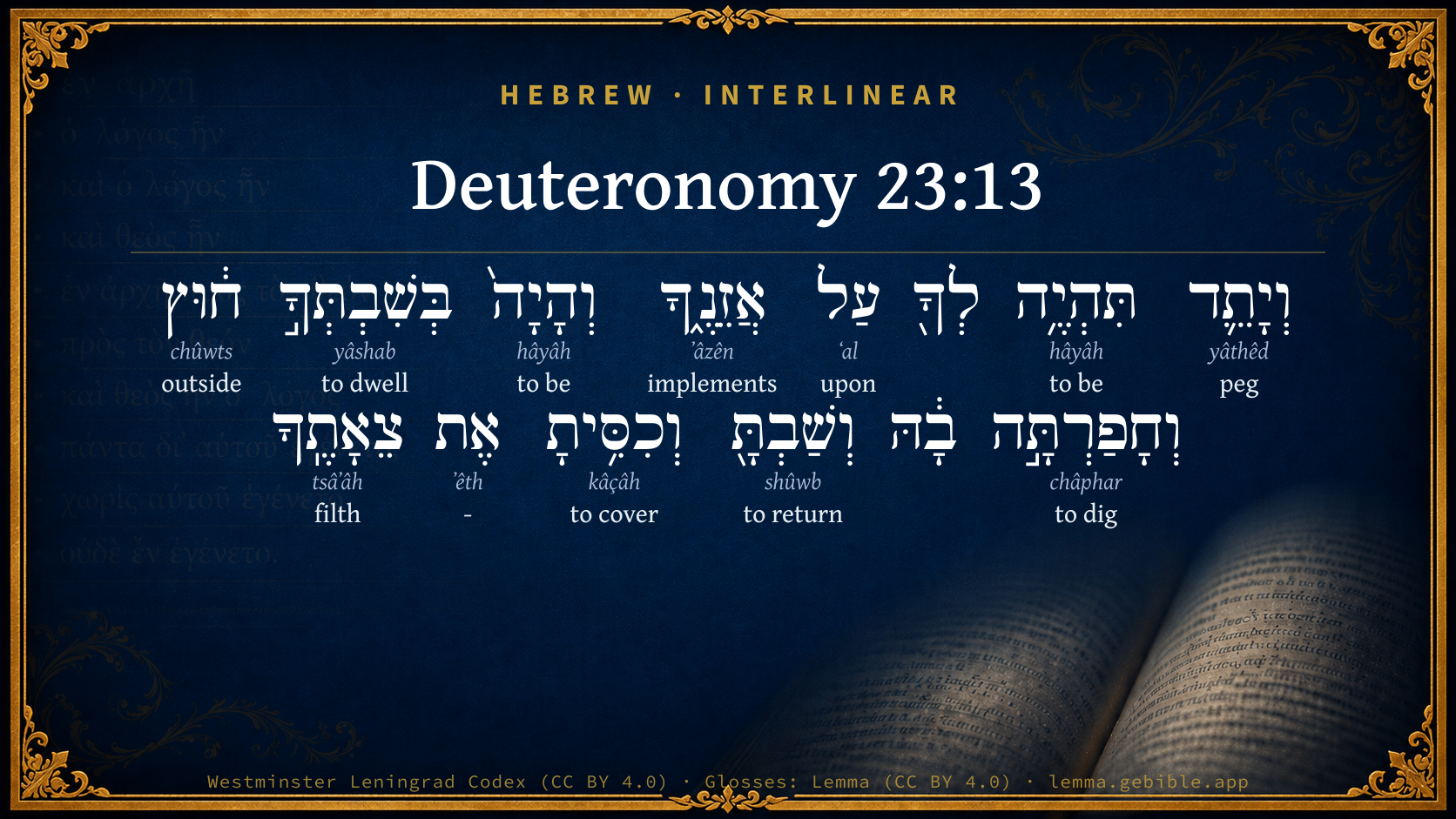
Hebrew (Westminster Leningrad Codex) Deuteronomy 23:13 appears in the Hebrew Old Testament. The text above is from the Westminster Leningrad Codex. Each word links to its Strong’s number, a concise gloss, and parsing drawn from the Open Scriptures Hebrew Bible morphology. Click any word for its full Brown-Driver-Briggs (BDB) entry.
Download image
Cite this verse

Deuteronomy 23:13 (World English Bible). Public Domain. Lemma interlinear Bible study tool, https://lemma.gebible.app/v/deuteronomy/23/13.

Show BibTeX & RIS
BibTeX
RIS
English Translation
and you shall have a paddle among your weapons; and it shall be, when you sit down abroad, you shall dig therewith, and shall turn back and cover that which comes from you:
World English Bible · Public Domain
Highlights
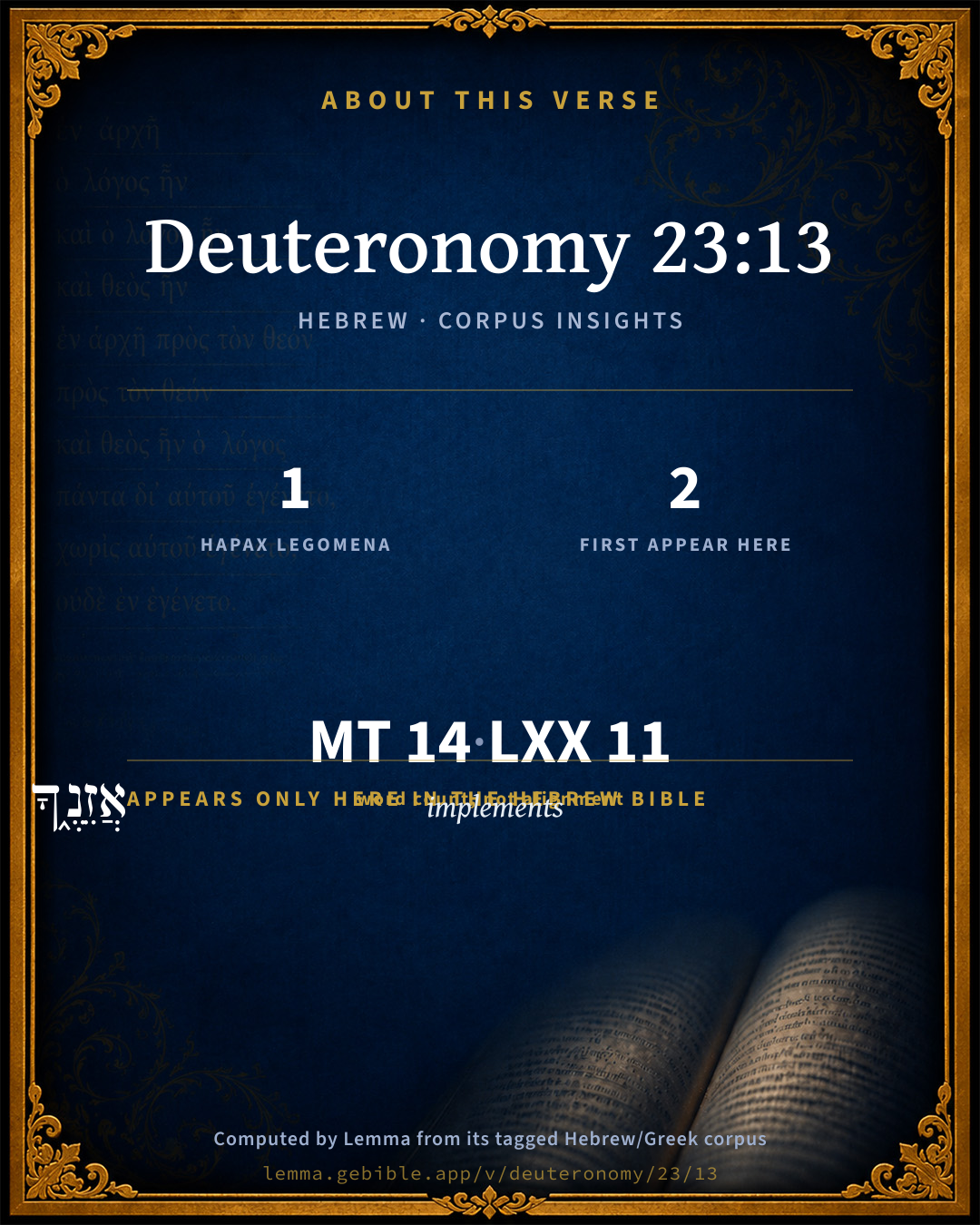
  • 1 hapax legomenon — only here in the Hebrew Bible
  • 2 first appearances in the Hebrew Bible
Full analysis ↓
Download a study sheet

One document with this verse’s original text, its word-by-word gloss line, the meaning frame, cross-references with their text, attributed commentary, and full source and license credits — printable, and it pastes into notes with its structure intact.

This verse Autodidact and up

Study sheet (.html) Plain text (.txt)

A passage Seminary Student

Up to 50 verses in one chapter. A passage sheet keeps up to 6 commentary sources and 12 cross-references per verse, in the order this page ranks them, and says so on the sheet whenever that leaves anything out. Ask for a single verse and you get the Autodidact verse sheet above.

Everything on this page stays free to read, with no account — the sheet is a download of what is already on screen, not access to it.

Want to remove ads? Support Godless Engineer
Compare translations 3

The same verse in 3 English versions, stacked beneath the original-language interlinear above. Click any original word for its lexicon entry.

Each is an independent rendering of the whole verse — the interlinear is not word-aligned to these translations.

Highlighted words mark where these versions differ — a whole-verse word diff, not a word-by-word alignment.

  • World English Bible Public Domain
    and you shall have a paddle among your weapons; and it shall be, when you sit down abroad, you shall dig therewith, and shall turn back and cover that which comes from you:
  • King James Version Public Domain
    And thou shalt have a paddle upon thy weapon; and it shall be, when thou wilt ease thyself abroad, thou shalt dig therewith, and shalt turn back and cover that which cometh from thee:
  • unfoldingWord Literal Text CC BY-SA 4.0
    and you shall have a spade among your tools, and it happens when you are sitting yourself out, then you shall dig with it and put back and cover up your excrement.

unfoldingWord Literal Text — © unfoldingWord, licensed CC BY-SA 4.0. Word-aligned USFM3 via Door43 (git.door43.org/unfoldingWord/en_ult).

Versions to compare (up to 4)

3 of 4 selected

Show all 18 translations

Every available English version of this verse, each an independent rendering of the whole verse.

  • World English Bible Public Domain
    and you shall have a paddle among your weapons; and it shall be, when you sit down abroad, you shall dig therewith, and shall turn back and cover that which comes from you:
  • Berean Standard Bible Public Domain
    And you must have a digging tool in your equipment so that when you relieve yourself you can dig a hole and cover up your excrement.
  • Majority Standard Bible Public Domain
    And you must have a digging tool in your equipment so that when you relieve yourself you can dig a hole and cover up your excrement.
  • King James Version Public Domain
    And thou shalt have a paddle upon thy weapon; and it shall be, when thou wilt ease thyself abroad, thou shalt dig therewith, and shalt turn back and cover that which cometh from thee:
  • American Standard Version (1901) Public Domain
    and thou shalt have a paddle among thy weapons; and it shall be, when thou sittest down abroad, thou shalt dig therewith, and shalt turn back and cover that which cometh from thee:
  • Revised Version (1885) Public Domain
    and thou shalt have a paddle among thy weapons; and it shall be, when thou sittest down abroad, thou shalt dig therewith, and shalt turn back and cover that which cometh from thee:
  • Geneva Bible (1599) Public Domain
    And thou shalt haue a paddle among thy weapons, and when thou wouldest sit downe without, thou shalt shalt digge therewith, and returning thou shalt couer thine excrements.
  • Douay-Rheims (1899) Public Domain
    Carrying a paddle at thy girdle. And when thou sittest down, thou shalt dig round about, and with the earth that is dug up thou shalt cover
  • Young's Literal Translation Public Domain
    and a nail thou hast on thy staff, and it hath been, in thy sitting without, that thou hast digged with it, and turned back, and covered thy filth;
  • Literal Standard Version CC BY-SA 4.0
    and you have a peg on your staff, and it has been, in your sitting outside, that you have dug with it, and turned back, and covered your filth.
  • Unlocked Literal Bible CC BY-SA 4.0
    and you will have something among your tools to dig with; when you squat down to relieve yourself, you must dig with it and then put back the earth and cover up what has come out from you.
  • unfoldingWord Literal Text CC BY-SA 4.0
    and you shall have a spade among your tools, and it happens when you are sitting yourself out, then you shall dig with it and put back and cover up your excrement.
  • Darby Bible Public Domain
    And thou shalt have a shovel amongst thy weapons, and it shall be, when thou sittest down abroad, thou shalt dig therewith, and shalt turn back and cover that which is come from thee.
  • World Messianic Bible Public Domain
    You shall have a trowel among your weapons. It shall be, when you relieve yourself, you shall dig with it, and shall turn back and cover your excrement;
  • Webster's Bible Public Domain
    And thou shalt have a paddle upon thy weapon: and it shall be when thou wilt ease thyself abroad, thou shalt dig with it, and shalt turn back, and cover that which cometh from thee:
  • Free Bible Version CC BY-SA 4.0
    You need to have a spade as part of your equipment so that you can dig a hole, and then when you're finished you can cover up your excrement.
  • Bible in Basic English Public Domain
    And have among your arms a spade; and when you have been to that place, let that which comes from you be covered up with earth:
  • JPS Tanakh (1917) Public Domain
    (23-14) And thou shalt have a paddle among thy weapons; and it shall be, when thou sittest down abroad, thou shalt dig therewith, and shalt turn back and cover that which cometh from thee.

Literal Standard Version (2020), Covenant Press — licensed CC BY-SA 4.0. Text via the HelloAO Bible API (eBible.org). Unlocked Literal Bible (unfoldingWord) — licensed CC BY-SA 4.0. Text via the HelloAO Bible API (eBible.org). unfoldingWord Literal Text — © unfoldingWord, licensed CC BY-SA 4.0. Word-aligned USFM3 via Door43 (git.door43.org/unfoldingWord/en_ult). Free Bible Version, Dr. Jonathan Gallagher — licensed CC BY-SA 4.0. Text via the HelloAO Bible API (eBible.org).

Word by word

More ways to search: Search by grammar → Find every occurrence → Compare this word →

Practice this passage: Drill this verse → Learn its vocabulary →

אֲזֵנֶ֑ךָ
ʼâzên
H240
“implements · your”
Noun, Common, Masculine, Singular, Construct + Suffix, Personal, 2nd Person, Masculine, Singular
Part of Speech
Noun
Type
Common
Gender
Masculine
Number
Singular
State
Construct
Full BDB Definition

Origin: from H238

TWOT: 57b

tools, implements, weapons
  1. וְיָתֵ֛ד yâthêd H3489 “and · peg” Conjunction + Noun, Common, Feminine, Singular, Absolute
  2. תִּהְיֶ֥ה hâyâh H1961 “to be” Verb, Qal, Imperfect, 3rd Person, Feminine, Singular
  3. עַל ʻal H5921 “upon” Preposition
  4. וְהָיָה֙ hâyâh H1961 “and · to be” Conjunction + Verb, Qal, Sequential Perfect, 3rd Person, Masculine, Singular
  5. בְּשִׁבְתְּךָ֣ yâshab H3427 “in/at · to dwell · you” Preposition + Verb, Qal, Infinitive Construct + Suffix, Personal, 2nd Person, Masculine, Singular
  6. ח֔וּץ chûwts H2351 “outside” Noun, Common, Masculine, Singular, Absolute
  7. וְחָפַרְתָּ֣ה châphar H2658 “and · to dig” Conjunction + Verb, Qal, Sequential Perfect, 2nd Person, Masculine, Singular
  8. וְשַׁבְתָּ֖ shûwb H7725 “and · to return” Conjunction + Verb, Qal, Sequential Perfect, 2nd Person, Masculine, Singular
  9. וְכִסִּ֥יתָ kâçâh H3680 “and · to cover” Conjunction + Verb, Piel, Sequential Perfect, 2nd Person, Masculine, Singular
  10. אֶת ʼêth H853 “-” Particle, Direct Object
  11. צֵאָתֶֽךָ tsâʼâh H6627 “filth · your” Noun, Common, Feminine, Singular, Construct + Suffix, Personal, 2nd Person, Masculine, Singular

About this verse

These counts appear in no published source. They are computed here, from the morphology-tagged text and Lemma’s own curated glosses. What Lemma adds →

14
words
11
distinct lemmas
Pentateuch
section

Notable vocabulary

1 hapax legomenon — a word that appears only here in the entire Hebrew Bible:

  • אֲזֵנֶ֑ךָ implements H240

First appearance in Scripture

These words make their first canonical appearance in the Hebrew Bible here:

  • אֲזֵנֶ֑ךָ implements H240
  • צֵאָתֶֽךָ filth H6627

Shared distinctive vocabulary

צֵאָתֶֽךָ filth H6627 occurs in 2 verses of the Hebrew Bible. Also found in:

Grammatical profile

  • 6 verbs
  • 4 nouns
  • 3 prepositions
  • 1 particle

Verb forms

  • תִּהְיֶ֥ה Qal · Imperfect
  • וְהָיָה֙ Qal · Sequential Perfect
  • בְּשִׁבְתְּךָ֣ Qal · Infinitive Construct
  • וְחָפַרְתָּ֣ה Qal · Sequential Perfect
  • וְשַׁבְתָּ֖ Qal · Sequential Perfect
  • וְכִסִּ֥יתָ Piel · Sequential Perfect

Repetition

A word recurs within this verse — often emphatic in Hebrew:

  • תִּהְיֶ֥ה to be H1961 ×2

Hebrew & Septuagint length

In English translation the verse runs 33 words from the Hebrew and 37 from the Septuagint (LXX English) — closely comparable.

A rough comparison of the two English renderings, which tokenize alike — not a word-level alignment.

Word counts can differ between the Hebrew and the Greek without any difference in meaning — e.g. the Hebrew direct-object marker אֵת has no separate Greek word, and Greek often adds the article ὁ.

In the original languages it is 14 Hebrew tokens and 11 Greek tokens — but the two are counted differently (Hebrew bundles its prefixes and suffixes into one token; the Greek is in lemma form), so that isn’t a like-for-like length.

Cross-references

1

Topical passages linked to Deuteronomy 23:13 in the Treasury of Scripture Knowledge — connected by theme and wording, ordered by reader-vote popularity; previews shown in the World English Bible.

  • Ezekiel 24:6–8 Therefore thus says the Lord Yahweh: Woe to the bloody city, to the caldron whose rust is therein, and whose rust is not gone out of it! take out of it piece after piece; No lot is fallen on it.

Cross-references courtesy of OpenBible.info (CC BY 4.0).

Hebrew and Greek witnesses Masoretic Hebrew ↔ Greek Septuagint

The same verse in the two great witnesses to the Old Testament, shown verse-for-verse.

These are two independent witnesses, not word-aligned to each other, and the Septuagint is shown in lemma (dictionary) form.

Hebrew Deuteronomy 23:13 Masoretic · Westminster Leningrad Codex

וְיָתֵ֛ד תִּהְיֶ֥ה לְךָ֖ עַל אֲזֵנֶ֑ךָ וְהָיָה֙ בְּשִׁבְתְּךָ֣ ח֔וּץ וְחָפַרְתָּ֣ה בָ֔הּ וְשַׁבְתָּ֖ וְכִסִּ֥יתָ אֶת צֵאָתֶֽךָ

and you shall have a paddle among your weapons; and it shall be, when you sit down abroad, you shall dig therewith, and shall turn back and cover that which comes from you:

World English Bible · Public Domain

Greek LXX Deuteronomy 23:13 Septuagint · lemma form

καί τόπος εἰμί σύ ἔξω ὁ παρεμβολή καί ἐκἔρχομαι ἐκεῖ ἔξω

and you shall have a trowel on your girdle; and it shall come to pass when you would relieve yourself abroad, that you shall dig with it, and shall bring back the earth and cover your nuisance.

LXX2012 (modern English Septuagint) · Public Domain

On this verse, Haydock's Catholic Bible Commentary discusses the Septuagint’s reading. Read the note in Commentary ↓

Hebrew: Westminster Leningrad Codex (CC BY 4.0). Greek: Septuagint (public domain); English from LXX2012 (modern English Septuagint) (Public Domain). How the Septuagint differs from the Hebrew →

Targum (Aramaic paraphrase)

2

The Targum is the ancient Jewish Aramaic paraphrase of the Hebrew Scriptures — an interpretive translation, not the Hebrew text itself. Onkelos (literal) and Pseudo-Jonathan (expansive) render the Torah, and Jonathan the Prophets. Coverage is partial: where no permissively-licensed English translation exists for a verse, only the Aramaic is shown. This is verse-level text, not a word-by-word alignment to the Hebrew.

  1. Targum Onkelos Torah (Genesis–Deuteronomy)
    וַאֲתַר מְתַקֵן יְהֵי לָךְ מִבָּרָא לְמַשְׁרִיתָא וְתִפּוֹק תַּמָן לְבָרָא

    (no public-domain English translation for this verse)

    Targum Onkelos — Aramaic: “Onkelos Genesis” (public domain); “Onkelos Exodus” (public domain); “Onkelos Leviticus” (public domain); “Onkelos Numbers” (public domain); “Onkelos Deuteronomy” (public domain). English: “Sefaria Community Translation” (CC0 1.0 (public-domain dedication)); “J.W. Etheridge. The Targums of Onkelos and Jonathan Ben Uzziel on the Pentateuch. London: Longmans, Green, 1862” (public domain). Text via Sefaria.

  2. Targum Pseudo-Jonathan Torah (Genesis–Deuteronomy)
    וְאָתַר מְזַמֵּן יֶהֱוֵי לָךְ מִבָּרָא לְמַשְׁרִיתָא וּתְשׁוּד תַּמָן מוֹי דְרִגְלָךְ

    Let a place be prepared for thee without the camp where thou mayest shed the water of thy feet,

    Targum Pseudo-Jonathan — Aramaic: “Targum Jonathan on Genesis” (public domain); “Targum Jonathan on Exodus” (public domain); “Targum Jonathan on Leviticus” (public domain); “Targum Jonathan on Numbers” (public domain); “Targum Jonathan on Deuteronomy” (public domain). English: “The Targum of Jonathan ben Uzziel, trans. J. W. Etheridge, London, 1862” (public domain). Text via Sefaria.

Commentary

Notes on Deuteronomy 23:13 from classic Christian and Jewish commentators (each source and its license shown beneath its notes). The classic Christian expositions comment on the surrounding passage and are grouped to its opening verse, so a note may address several verses; the Jewish commentaries on the Tanakh (Rashi and others) are per-verse, so they appear only where the commentator wrote on this verse.

Lemma curates 59 commentaries, every one of them public domain or Creative Commons licensed, each selected and text-cleaned for this edition rather than reprinted as found. About our sources →

Trapp's Complete Commentary

John Trapp

Deu 23:13 And thou shalt have a paddle upon thy weapon; and it shall be, when thou wilt ease thyself abroad, thou shalt dig therewith, and shalt turn back and cover that which cometh from thee:

Ver. 13. Thy God walketh in the midst of thy camp.] Where he is both van and rear. {Isa 52:12}

And to give up thine enemies.] Hence the Philistines were so frighted at the sight of the ark. "Let us flee from the face of Israel, for the Lord fighteth for them," said those Egyptians. {Exo 14:25}

That he see no unclean thing.] Hereby God taught his people holy conversation, that they should keep themselves from their iniquity, as David did {Psa 18:23} - that is, from such sins as either by their constitution, calling, company, or custom, they are most prone to.

John Trapp, A Commentary or Exposition upon All the Books of the Old and New Testament (1647–1656) — public domain. Text from a community e-Sword module.

Joseph Benson's Commentary

Deu 23:13. Cover — To prevent the annoyance of ourselves or others; to preserve and exercise modesty; and principally that by such outward rites they might be inured to the greater reverence of the Divine Majesty, and the greater caution to avoid all real and moral uncleanness.

Joseph Benson's Commentary on the Old and New Testaments (1811–1818) — public domain. Text from a community e-Sword module.

Tyndale Open Study Notes

Tyndale Open Resources

23:13 It would be disgusting and shameful to have an open latrine outside the camp, let alone within it.

Tyndale Open Study Notes — © Tyndale Open Resources, licensed CC BY-SA 4.0. Text via the HelloAO Bible API.

Geneva Bible (1599)

Geneva Bible translators

Meaning hereby that his people should be pure both in body and soul.

Geneva Bible (1599) marginal notes — public domain. Text via Bolls.life.

John Gill's Exposition

And thou shalt have a paddle upon thy weapon,.... A nail or spike, some kind of instrument to make a hole in the ground with, which was fastened to the sword upon their loins; which was to be instead of a spade or mattock to dig with:

and it shall be, when thou shall ease thyself abroad; without the camp, in the place appointed for that use, whenever nature required such an action to be performed:

thou shall dig therewith; with, the paddle, an hole in the earth: the Essenes used, according to Josephus, to make it a foot deep with a spade or mattock, and to everyone that was newly admitted among them, a little pickaxe was given for that purpose (r):

and shalt turn back; having eased nature:

and cover that which cometh from thee; their dung, with the earth they dug out of the hole they made. This law was made to preserve modesty and decency becoming men, and not act like brute beasts, as well as cleanliness in the camp, and, the health of themselves and their fellow soldiers; and that, they might not be offensive to the smell, as well as pernicious to the health of one another; and especially for a reason that follows in Deu 23:14; so Maimonides (s) says, the intention of this law is especially cleanliness, and to avoid nastiness, filthiness, and impurities of every kind, that men might not be like the brute animals.

(r) De Bello Jud. l. 2. c. 8. sect. 9. (s) Moreh Nevochim, par. 3. c. 41.

John Gill's Exposition of the Whole Bible (1746–1763) — public domain (CC PDM 1.0). Text via the HelloAO Bible API.

Haydock's Catholic Bible Commentary

Girdle. Hebrew azon, means "a balance," as the Hebrews generally carried weights, &c., about them, chap. xxv. 13. Moderns translate, "a paddle upon thy weapon," But the Septuagint seem to have read ezor, "a girdle," (Calmet) which is more intelligible, as the Jews were accustomed to carry the necessary utensils, money, &c., not in their pockets, as we do, but in a bag, which they fixed to their girdles, or belts. All the Jews who dwelt in the camp, were bound to have a paddle, for the purpose here mentioned. (Haydock) --- Josephus (Jewish Wars ii. 7,) observes, that the Essenians always made use of one, with which they made a hole a foot deep, and covered it with their robes, that nothing indecent might be exposed to view. (Haydock) --- The Turks still follow the same custom, when they are encamped. (Busbec, ep. iii.) (Calmet)

George Leo Haydock (1774–1849), Haydock's Catholic Family Bible and Commentary, 1859 edition — public domain. Excludes Psalms (Douay-Rheims chapter numbering differs from Protestant) and Deuterocanonical books (Catholic canon only).

Matthew Poole's English Annotations

A paddle; the nature of which may be known from the use, which here follows.

Cover that which cometh from thee; partly, to prevent the annoyance of ourselves or others; partly, to preserve and exercise modesty and natural honesty; and principally, that by such outward rites they might be inured to the greater reverence of the Divine Majesty, and the greater caution to avoid all real and moral uncleanness, especially now when it was most necessary so to do.

Matthew Poole's English Annotations on the Holy Bible (1683–1685) — public domain. Text from a community e-Sword/MySword module.

The Pulpit Commentary

A paddle upon thy weapon; rather, a small spade (the word properly means a pin or nail) among thy furniture, or, according to another reading among thy implements or accoutrements; they were to carry with them along with their implements of war a tool for digging in the earth.

The Pulpit Commentary (1880–1919), ed. H.D.M. Spence-Jones & Joseph S. Exell — public domain. Text from a community e-Sword module.

John Wesley's Explanatory Notes

Cover - To prevent the annoyance of ourselves or others; to preserve and exercise modesty and natural honesty; and principally that by such outward rites they might be innured to the greater reverence of the Divine Majesty, and the greater caution to avoid all real and moral uncleanness.

John Wesley, Explanatory Notes Upon the Whole Bible (1754–1765) — public domain. Text via the GEBible commentary corpus.

Rashi

Rabbi Shlomo Yitzchaki (Rashi)

ויד תהיה לך THOU SHALT HAVE A יד [WITHOUT THE CAMP] — Understand the word יד as the Targum does: ואתר (and you shall have a place). Similar is, (Numbers 2:17) “Each man at his place (ידו)” (Sifrei Devarim 257:1).

מחוץ למחנה WITHOUT THE CAMP — i.e. outside the area enclosed by the clouds of glory.

Rashi on the Tanakh — English translations: “The Judaica Press complete Tanach with Rashi, translated by A. J. Rosenberg” (CC BY 4.0); “Pentateuch with Rashi's commentary by M. Rosenbaum and A.M. Silbermann, 1929-1934” (public domain); “The Metsudah Tanach series, Lakewood, N.J” (CC BY 4.0); and “The Book of Joshua, Metsudah Publications, 1997” (CC BY 4.0). Text via Sefaria.

Lesson kit

Teaching starters — assembled from the data on this page, not authored interpretation. Every prompt links to the verse data it draws on. Edit before teaching.

Deuteronomy, in the Pentateuch, opens this verse with 14 words (11 distinct Hebrew lemmas). Its most distinctive word is ʼâzên (“implements”). A historical commentator’s framing appears above. Read the whole chapter for the surrounding context.

Discussion questions

  1. What does “implements” (ʼâzên) contribute to the verse as a whole?
  2. This verse holds 1 word here found nowhere else in the Hebrew Bible. What might the rare word draw attention to?
  3. 2 words here appear for the first time in Scripture. What is being introduced at this debut?
  4. Ezekiel 4:12 shares the word «filth» with this verse. How do the two illuminate each other?
  5. “to be” occurs 2× in this one verse. What is the effect of the repetition?
  6. The translations on this page render this verse differently — a whole-verse word diff, not a word-by-word alignment. What might account for the different wordings?
  7. The verb «תִּהְיֶ֥ה» is Qal Imperfect. How does its form color the action?
  8. Reading how Trapp's Complete Commentary and Joseph Benson's Commentary read this verse, where do the two commentators agree and where do they part?

Things to notice

  • 1 word in this verse appears nowhere else in the Hebrew Bible.
  • 2 words make their first canonical appearance in Scripture here.
  • This verse counts 14 Hebrew ↔ 11 Greek words.
  • These translations choose different wording for 26 words in this verse.
  • “to be” occurs 2× in this single verse.

Reading settings

Reading text

Shown beneath each verse's original-language words.

Old Testament
Old Testament edition

Read the OT as the Masoretic Hebrew (MT) or the Greek Septuagint (LXX).

English shown for the Greek Septuagint (in the Hebrew ↔ Greek comparison).

Comparing translations? Open the Compare panel on any verse page to stack up to four side by side.