
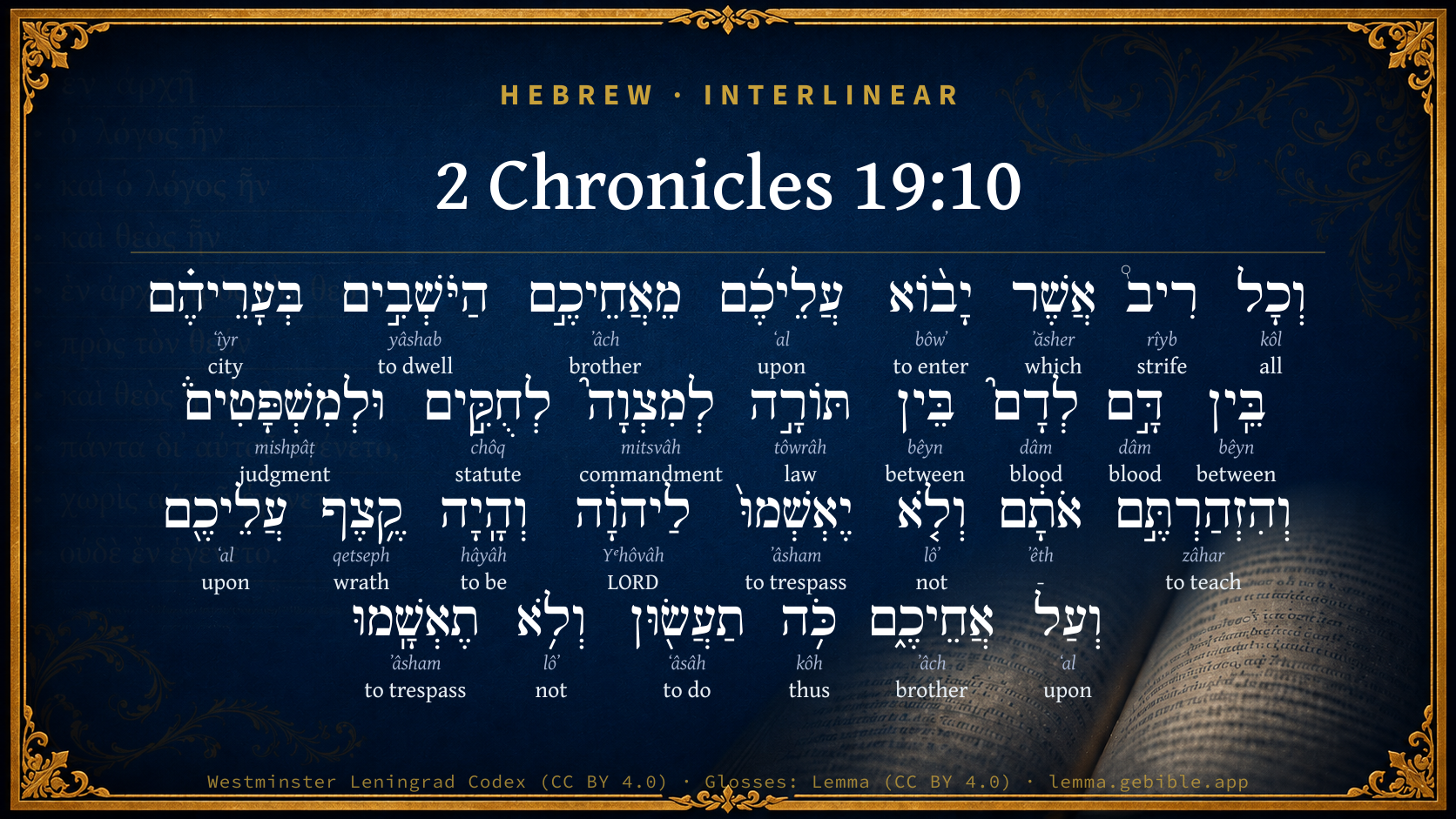
2 Chronicles 19:10

Hebrew (Westminster Leningrad Codex) 2 Chronicles 19:10 appears in the Hebrew Old Testament. The text above is from the Westminster Leningrad Codex. Each word links to its Strong’s number, a concise gloss, and parsing drawn from the Open Scriptures Hebrew Bible morphology. Click any word for its full Brown-Driver-Briggs (BDB) entry.
Download image
Cite this verse

2 Chronicles 19:10 (World English Bible). Public Domain. Lemma interlinear Bible study tool, https://lemma.gebible.app/v/2-chronicles/19/10.

Show BibTeX & RIS
BibTeX
RIS
English Translation
Whenever any controversy shall come to you from your brothers who dwell in their cities, between blood and blood, between law and commandment, statutes and ordinances, you shall warn them, that they not be guilty towards Yahweh, and so wrath come on you and on your brothers: this do, and you shall not be guilty.
World English Bible · Public Domain
Download a study sheet

One document with this verse’s original text, its word-by-word gloss line, the meaning frame, cross-references with their text, attributed commentary, and full source and license credits — printable, and it pastes into notes with its structure intact.

This verse Autodidact and up

Study sheet (.html) Plain text (.txt)

A passage Seminary Student

Up to 50 verses in one chapter. A passage sheet keeps up to 6 commentary sources and 12 cross-references per verse, in the order this page ranks them, and says so on the sheet whenever that leaves anything out. Ask for a single verse and you get the Autodidact verse sheet above.

Everything on this page stays free to read, with no account — the sheet is a download of what is already on screen, not access to it.

Want to remove ads? Support Godless Engineer
Compare translations 3

The same verse in 3 English versions, stacked beneath the original-language interlinear above. Click any original word for its lexicon entry.

Each is an independent rendering of the whole verse — the interlinear is not word-aligned to these translations.

Highlighted words mark where these versions differ — a whole-verse word diff, not a word-by-word alignment.

  • World English Bible Public Domain
    Whenever any controversy shall come to you from your brothers who dwell in their cities, between blood and blood, between law and commandment, statutes and ordinances, you shall warn them, that they not be guilty towards Yahweh, and so wrath come on you and on your brothers: this do, and you shall not be guilty.
  • King James Version Public Domain
    And what cause soever shall come to you of your brethren that dwell in your cities, between blood and blood, between law and commandment, statutes and judgments, ye shall even warn them that they trespass not against the LORD, and so wrath come upon you, and upon your brethren: this do, and ye shall not trespass.
  • unfoldingWord Literal Text CC BY-SA 4.0
    And any dispute that comes to you all from your brothers, the ones dwelling in their cities, between blood to blood, between law to command, to statutes, and to judgments, and you all must caution them, so they will not be guilty to Yahweh, and there will be wrath on you all and on your brothers. Thus you will do, and you all will not be guilty.

unfoldingWord Literal Text — © unfoldingWord, licensed CC BY-SA 4.0. Word-aligned USFM3 via Door43 (git.door43.org/unfoldingWord/en_ult).

Versions to compare (up to 4)

3 of 4 selected

Show all 18 translations

Every available English version of this verse, each an independent rendering of the whole verse.

  • World English Bible Public Domain
    Whenever any controversy shall come to you from your brothers who dwell in their cities, between blood and blood, between law and commandment, statutes and ordinances, you shall warn them, that they not be guilty towards Yahweh, and so wrath come on you and on your brothers: this do, and you shall not be guilty.
  • Berean Standard Bible Public Domain
    For every dispute that comes before you from your brothers who dwell in their cities—whether it regards bloodshed or some other violation of law, commandments, statutes, or ordinances—you are to warn them, so that they will not incur guilt before the LORD and wrath will not come upon you and your brothers. Do this, and you will not incur guilt.
  • Majority Standard Bible Public Domain
    For every dispute that comes before you from your brothers who dwell in their cities—whether it regards bloodshed or some other violation of law, commandments, statutes, or ordinances—you are to warn them, so that they will not incur guilt before the LORD and wrath will not come upon you and your brothers. Do this, and you will not incur guilt.
  • King James Version Public Domain
    And what cause soever shall come to you of your brethren that dwell in your cities, between blood and blood, between law and commandment, statutes and judgments, ye shall even warn them that they trespass not against the LORD, and so wrath come upon you, and upon your brethren: this do, and ye shall not trespass.
  • American Standard Version (1901) Public Domain
    And whensoever any controversy shall come to you from your brethren that dwell in their cities, between blood and blood, between law and commandment, statutes and ordinances, ye shall warn them, that they be not guilty towards Jehovah, and so wrath come upon you and upon your brethren: this do, and ye shall not be guilty.
  • Revised Version (1885) Public Domain
    And whensoever any controversy shall come to you from your brethren that dwell in their cities, between blood and blood, between law and commandment, statutes and judgments, ye shall warn them, that they be not guilty towards the LORD, and so wrath come upon you and upon your brethren: this do, and ye shall not be guilty.
  • Geneva Bible (1599) Public Domain
    And in euery cause that shall come to you of your brethren that dwel in their cities, betweene blood and blood, betweene law and precept, statutes and iudgements, ye shall iudge them, and admonish them that they trespasse not against the Lord, that wrath come not vpon you and vpon your brethren. This shall ye do and trespasse not.
  • Douay-Rheims (1899) Public Domain
    Every cause that shall come to you of your brethren, that dwell in their cities, between kindred and kindred, wheresoever there is question concerning the law, the commandment, the ceremonies, the justifications: shew it them, that they may not sin against the Lord, and that wrath may not come upon you and your brethren: and so doing you shall not sin.
  • Young's Literal Translation Public Domain
    and any strife that cometh in unto you of your brethren who are dwelling in their cities, between blood and blood, between law and command, statutes, and judgments, then ye have warned them and they become not guilty before Jehovah, and wrath hath not been on you and on your brethren; thus do ye do, and ye are not guilty.
  • Literal Standard Version CC BY-SA 4.0
    and any strife that comes to you of your brothers who are dwelling in their cities, between blood and blood, between law and command, statutes, and judgments, then you have warned them and they do not become guilty before YHWH, and wrath has not been on you and on your brothers; thus do you do, and you are not guilty.
  • Unlocked Literal Bible CC BY-SA 4.0
    Whenever any dispute comes to you from your brothers who live in their cities, whether concerning bloodshed, whether about laws and commands, statutes or decrees, you must warn them, so they do not become guilty before Yahweh, or anger will come toward you and toward your brothers. You shall do this and you will not be guilty.
  • unfoldingWord Literal Text CC BY-SA 4.0
    And any dispute that comes to you all from your brothers, the ones dwelling in their cities, between blood to blood, between law to command, to statutes, and to judgments, and you all must caution them, so they will not be guilty to Yahweh, and there will be wrath on you all and on your brothers. Thus you will do, and you all will not be guilty.
  • Darby Bible Public Domain
    And what cause soever comes to you of your brethren that dwell in their cities, between blood and blood, between law and commandment, statutes and ordinances, ye shall even warn them that they trespass not against Jehovah, and so wrath come upon you and upon your brethren: this do and ye shall not trespass.
  • World Messianic Bible Public Domain
    Whenever any controversy comes to you from your brothers who dwell in their cities, between blood and blood, between law and commandment, statutes and ordinances, you must warn them, that they not be guilty toward the LORD, and so wrath come on you and on your brothers. Do this, and you will not be guilty.
  • Webster's Bible Public Domain
    And whatever cause shall come to you of your brethren that dwell in their cities, between blood and blood, between law and commandment, statutes and judgments, ye shall even warn them that they trespass not against the LORD, and so wrath come upon you, and upon your brethren: this do, and ye shall not trespass.
  • Free Bible Version CC BY-SA 4.0
    In every case that comes before you from your people living in other towns, whether it involves murder or violations of the law, commandments, statutes, or judgments, you are to warn them not to offend the Lord so that punishment does not come upon you and your people. If you do this you will not be held guilty.
  • Bible in Basic English Public Domain
    And if any cause comes before you from your brothers living in their towns, where the death punishment is in question, or where there are questions of law or order, or rules or decisions, make them take care that they are not in the wrong before the Lord, so that wrath may not come on you and on your brothers; do this and you yourselves will not be in the wrong.
  • JPS Tanakh (1917) Public Domain
    And whensoever any controversy shall come to you from your brethren that dwell in their cities, between blood and blood, between law and commandment, statutes and ordinances, ye shall warn them, that they be not guilty towards the LORD, and so wrath come upon you and upon your brethren; thus shall ye do, and ye shall not be guilty.

Literal Standard Version (2020), Covenant Press — licensed CC BY-SA 4.0. Text via the HelloAO Bible API (eBible.org). Unlocked Literal Bible (unfoldingWord) — licensed CC BY-SA 4.0. Text via the HelloAO Bible API (eBible.org). unfoldingWord Literal Text — © unfoldingWord, licensed CC BY-SA 4.0. Word-aligned USFM3 via Door43 (git.door43.org/unfoldingWord/en_ult). Free Bible Version, Dr. Jonathan Gallagher — licensed CC BY-SA 4.0. Text via the HelloAO Bible API (eBible.org).

Word by word

More ways to search: Search by grammar → Find every occurrence → Compare this word →

Practice this passage: Drill this verse → Learn its vocabulary →

וְהִזְהַרְתֶּ֣ם
zâhar
H2094
“and · to teach”
Conjunction + Verb, Hiphil, Sequential Perfect, 2nd Person, Masculine, Plural
Part of Speech
Conjunction + Verb
Stem
Hiphil
Form
Sequential Perfect
Person
2nd Person
Gender
Masculine
Number
Plural
Full BDB Definition

Origin: a primitive root

TWOT: 531 , 532

to admonish, warn, teach, shine, send out light, be light, be shining - (Niphal) to be taught, be admonished - (Hiphil) - to teach, warn - to shine, send out light (figuratively)
  1. וְכָל kôl H3605 “and · all of” Conjunction + Noun, Common, Masculine, Singular, Construct
  2. רִיב֩ rîyb H7379 “strife” Noun, Common, Both, Singular, Absolute
  3. אֲשֶׁר ʼăsher H834 “which” Particle, Relative
  4. יָב֨וֹא bôwʼ H935 “to enter” Verb, Qal, Imperfect, 3rd Person, Masculine, Singular
  5. עֲלֵיכֶ֜ם ʻal H5921 “upon · you” Preposition + Suffix, Personal, 2nd Person, Masculine, Plural
  6. מֵאֲחֵיכֶ֣ם ʼâch H251 “from · brothers · your” Preposition + Noun, Common, Masculine, Plural, Construct + Suffix, Personal, 2nd Person, Masculine, Plural
  7. הַיֹּשְׁבִ֣ים yâshab H3427 “the · dwelling” Particle, Definite Article + Verb, Qal, Participle Active, Masculine, Plural, Absolute
  8. בְּעָרֵיהֶ֗ם ʻîyr H5892 “in/at · cities · their” Preposition + Noun, Common, Feminine, Plural, Construct + Suffix, Personal, 3rd Person, Masculine, Plural
  9. בֵּֽין bêyn H996 “between” Preposition
  10. דָּ֣ם dâm H1818 “blood” Noun, Common, Masculine, Singular, Absolute
  11. לְדָם֮ dâm H1818 “to/for · blood” Preposition + Noun, Common, Masculine, Singular, Absolute
  12. בֵּין bêyn H996 “between” Preposition
  13. תּוֹרָ֣ה tôwrâh H8451 “law” Noun, Common, Feminine, Singular, Absolute
  14. לְמִצְוָה֮ mitsvâh H4687 “to/for · commandment” Preposition + Noun, Common, Feminine, Singular, Absolute
  15. לְחֻקִּ֣ים chôq H2706 “to/for · statutes” Preposition + Noun, Common, Masculine, Plural, Absolute
  16. וּלְמִשְׁפָּטִים֒ mishpâṭ H4941 “and · to/for · judgments” Conjunction + Preposition + Noun, Common, Masculine, Plural, Absolute
  17. אֹתָ֔ם ʼêth H853 “- · them” Particle, Direct Object + Suffix, Personal, 3rd Person, Masculine, Plural
  18. וְלֹ֤א lôʼ H3808 “and · not” Conjunction + Particle, Negative
  19. יֶאְשְׁמוּ֙ ʼâsham H816 “to trespass” Verb, Qal, Imperfect, 3rd Person, Masculine, Plural
  20. לַיהוָ֔ה Yᵉhôvâh H3068 “to/for · LORD” Preposition + Noun, Proper
  21. וְהָֽיָה hâyâh H1961 “and · to be” Conjunction + Verb, Qal, Perfect, 3rd Person, Masculine, Singular
  22. קֶ֥צֶף qetseph H7110 “wrath” Noun, Common, Masculine, Singular, Absolute
  23. עֲלֵיכֶ֖ם ʻal H5921 “upon · you” Preposition + Suffix, Personal, 2nd Person, Masculine, Plural
  24. וְעַל ʻal H5921 “and · upon” Conjunction + Preposition
  25. אֲחֵיכֶ֑ם ʼâch H251 “brothers · your” Noun, Common, Masculine, Plural, Construct + Suffix, Personal, 2nd Person, Masculine, Plural
  26. כֹּ֥ה kôh H3541 “thus” Adverb
  27. תַעֲשׂ֖וּן ʻâsâh H6213 “to do” Verb, Qal, Imperfect, 2nd Person, Masculine, Plural + Suffix, n
  28. וְלֹ֥א lôʼ H3808 “and · not” Conjunction + Particle, Negative
  29. תֶאְשָֽׁמוּ ʼâsham H816 “to trespass” Verb, Qal, Imperfect, 2nd Person, Masculine, Plural

About this verse

These counts appear in no published source. They are computed here, from the morphology-tagged text and Lemma’s own curated glosses. What Lemma adds →

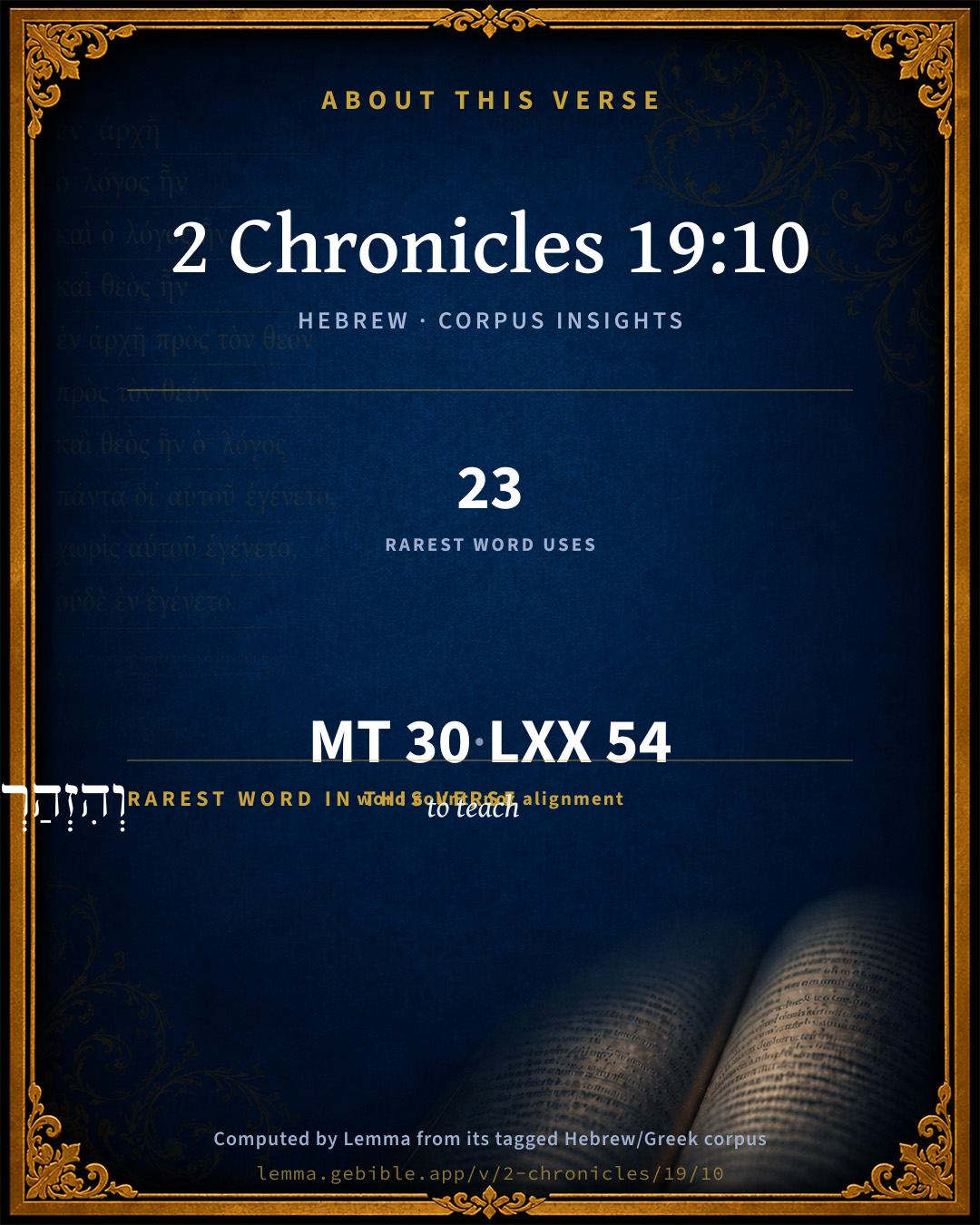
30
words
23
distinct lemmas
Historical
section

Notable vocabulary

The rarest word here is וְהִזְהַרְתֶּ֣ם to teach H2094 — appearing just 23 times in the whole Hebrew Bible.

Shared distinctive vocabulary

וְהִזְהַרְתֶּ֣ם to teach H2094 occurs in 19 verses of the Hebrew Bible. Also found in:

Grammatical profile

  • 7 verbs
  • 13 nouns
  • 5 prepositions
  • 1 adverb
  • 4 particles

Verb forms

  • יָב֨וֹא Qal · Imperfect
  • הַיֹּשְׁבִ֣ים Qal · Participle Active
  • וְהִזְהַרְתֶּ֣ם Hiphil · Sequential Perfect
  • יֶאְשְׁמוּ֙ Qal · Imperfect
  • וְהָֽיָה Qal · Perfect
  • תַעֲשׂ֖וּן Qal · Imperfect
  • תֶאְשָֽׁמוּ Qal · Imperfect

Repetition

Words recur within this verse — often emphatic in Hebrew:

  • עֲלֵיכֶ֜ם upon H5921 ×3
  • מֵאֲחֵיכֶ֣ם brother H251 ×2
  • בֵּֽין between H996 ×2
  • דָּ֣ם blood H1818 ×2
  • יֶאְשְׁמוּ֙ to trespass H816 ×2
  • וְלֹ֤א not H3808 ×2

Hebrew & Septuagint length

In English translation the verse runs 55 words from the Hebrew and 66 from the Septuagint (LXX English) — closely comparable.

A rough comparison of the two English renderings, which tokenize alike — not a word-level alignment.

Word counts can differ between the Hebrew and the Greek without any difference in meaning — e.g. the Hebrew direct-object marker אֵת has no separate Greek word, and Greek often adds the article ὁ.

In the original languages it is 30 Hebrew tokens and 54 Greek tokens — but the two are counted differently (Hebrew bundles its prefixes and suffixes into one token; the Greek is in lemma form), so that isn’t a like-for-like length.

Cross-references

8

Topical passages linked to 2 Chronicles 19:10 in the Treasury of Scripture Knowledge — connected by theme and wording, ordered by reader-vote popularity; previews shown in the World English Bible.

  • Deuteronomy 17:8–13 If there arise a matter too hard for you in judgment, between blood and blood, between plea and plea, and between stroke and stroke, being matters of controversy within your gates; then shall you arise, and go up to the place which Yahweh your God shall choose;
  • Numbers 16:46 Moses said to Aaron, Take your censer, and put fire therein from off the altar, and lay incense thereon, and carry it quickly to the congregation, and make atonement for them: for there is wrath gone out from Yahweh; the plague is begun.
  • Joshua 22:18–20 that you must turn away this day from following Yahweh? and it will be, seeing you rebel today against Yahweh, that tomorrow he will be angry with the whole congregation of Israel.
  • 2 Chronicles 19:2 Jehu the son of Hanani the seer went out to meet him, and said to king Jehoshaphat, Should you help the wicked, and love those who hate Yahweh? for this thing wrath is on you from before Yahweh.
  • Ezekiel 3:18–21 When I tell the wicked, You shall surely die; and you give him no warning, nor speak to warn the wicked from his wicked way, to save his life; the same wicked man shall die in his iniquity; but his blood will I require at your hand.
  • Ezekiel 33:6 But if the watchman sees the sword come, and doesn't blow the trumpet, and the people aren't warned, and the sword comes, and take any person from among them; he is taken away in his iniquity, but his blood will I require at the watchman's hand.
  • Acts 20:31 Therefore watch, remembering that for a period of three years I didn't cease to admonish everyone night and day with tears.
  • 1 Thessalonians 5:14 We exhort you, brothers, admonish the disorderly, encourage the fainthearted, support the weak, be patient toward all.

Cross-references courtesy of OpenBible.info (CC BY 4.0).

Hebrew and Greek witnesses Masoretic Hebrew ↔ Greek Septuagint

The same verse in the two great witnesses to the Old Testament, shown verse-for-verse.

These are two independent witnesses, not word-aligned to each other, and the Septuagint is shown in lemma (dictionary) form.

Hebrew 2 Chronicles 19:10 Masoretic · Westminster Leningrad Codex

וְכָל רִיב֩ אֲשֶׁר יָב֨וֹא עֲלֵיכֶ֜ם מֵאֲחֵיכֶ֣ם הַיֹּשְׁבִ֣ים בְּעָרֵיהֶ֗ם בֵּֽין דָּ֣ם לְדָם֮ בֵּין תּוֹרָ֣ה לְמִצְוָה֮ לְחֻקִּ֣ים וּלְמִשְׁפָּטִים֒ וְהִזְהַרְתֶּ֣ם אֹתָ֔ם וְלֹ֤א יֶאְשְׁמוּ֙ לַיהוָ֔ה וְהָֽיָה קֶ֥צֶף עֲלֵיכֶ֖ם וְעַל אֲחֵיכֶ֑ם כֹּ֥ה תַעֲשׂ֖וּן וְלֹ֥א תֶאְשָֽׁמוּ

Whenever any controversy shall come to you from your brothers who dwell in their cities, between blood and blood, between law and commandment, statutes and ordinances, you shall warn them, that they not be guilty towards Yahweh, and so wrath come on you and on your brothers: this do, and you shall not be guilty.

World English Bible · Public Domain

Greek LXX 2 Chronicles 19:10 Septuagint · lemma form

πᾶς ἀνήρ κρίσις ὁ ἔρχομαι ἐπί σύ ὁ ἀδελφός σύ ὁ καταοἰκέω ἐν ὁ πόλις αὐτός ἀνά μέσος αἷμα αἷμα καί ἀνά μέσος πρόσταγμα καί ἐντολή καί δικαίωμα καί κρίμα καί διαστέλλω αὐτός καί οὐ ἁμαρτάνω ὁ κύριος καί οὐ εἰμί ἐπί σύ ὀργή καί ἐπί ὁ ἀδελφός σύ οὕτως ποιέω καί οὐ ἁμαρτάνω

Whatsoever man of your brethren that dwell in their cities shall bring the cause that comes before you, between blood and blood, and between precept and commandment, and ordinances and judgments, you⌃ shall even decide for them; so they shall not sin against the Lord, and there shall not be wrath upon you, and upon your brethren: thus you⌃ shall do, and you⌃ shall not sin.

LXX2012 (modern English Septuagint) · Public Domain

Hebrew: Westminster Leningrad Codex (CC BY 4.0). Greek: Septuagint (public domain); English from LXX2012 (modern English Septuagint) (Public Domain). How the Septuagint differs from the Hebrew →

Commentary

Notes on 2 Chronicles 19:10 from classic Christian and Jewish commentators (each source and its license shown beneath its notes). The classic Christian expositions comment on the surrounding passage and are grouped to its opening verse, so a note may address several verses; the Jewish commentaries on the Tanakh (Rashi and others) are per-verse, so they appear only where the commentator wrote on this verse.

Lemma curates 59 commentaries, every one of them public domain or Creative Commons licensed, each selected and text-cleaned for this edition rather than reprinted as found. About our sources →

Trapp's Complete Commentary

John Trapp

2Ch 19:10 And what cause soever shall come to you of your brethren that dwell in their cities, between blood and blood, between law and commandment, statutes and judgments, ye shall even warn them that they trespass not against the LORD, and [so] wrath come upon you, and upon your brethren: this do, and ye shall not trespass.

Ver. 10. Of your brethren,] q.d., They are your brethren by race, place, and grace; therefore see that right be done them; else your father will be angry.

Between blood and blood.] Between an innocent and one culpable of death: as also between murders, whether wilful or casual.

Between law and commandments, &c.] To find out the true sense of the law, when it is pleaded by both parties; and to resolve the seeming ambiguities and contradictions: for not the letter but the mind of the law is law; and this you must fish out.

That they trespass not against the Lord.] By misinterpreting the law; making it a nose of wax; writhing it from the right sense.

John Trapp, A Commentary or Exposition upon All the Books of the Old and New Testament (1647–1656) — public domain. Text from a community e-Sword module.

Joseph Benson's Commentary

2Ch 19:10. Between blood and blood — Between the blood of the person slain, and the blood of the manslayer. See the note on Deu 17:8. All the cities of refuge, except Hebron, now belonged to the kingdom of Israel, so that the manslayer now usually fled to the courts of the temple, or the horns of the altar; and therefore the trial of these was reserved for the court at Jerusalem. Between law and commandment, &c. — When any debates shall arise about the meaning of any of God’s laws. Ye shall even warn them — Ye shall not only give a righteous sentence for what is past, but ye shall admonish the offender, and others, to take better heed for the future. This do, and ye shall not trespass — Thus you shall not bring guilt and wrath upon yourselves and others, which otherwise you certainly would do.

Joseph Benson's Commentary on the Old and New Testaments (1811–1818) — public domain. Text from a community e-Sword module.

Geneva Bible (1599)

Geneva Bible translators

Meaning, that God would punish them most sharply, if they would not execute justice aright.

That is, to try whether the murder was done at unawares, or else on set purpose, Num. 35:11; Deut. 4:41.

Geneva Bible (1599) marginal notes — public domain. Text via Bolls.life.

Adam Clarke's Commentary

Verse 10. Between blood and blood] Cases of man-slaughter or accidental murder, or cases of consanguinity, the settlement of inheritance, family claims, &c.

Between law and commandment] Whatsoever concerns the moral precepts, rites, and ceremonies, of the law, or whatsoever belongs to civil affairs.

Adam Clarke's Commentary on the Bible (1810–1826) — public domain. Text from a community e-Sword/MySword module.

Ellicott's Commentary for English Readers

(10) And.—To wit.

Cause.—Rîbh, “controversy” (2Ch_19:8).

Shall come to you.—i.e., be referred to you as the Supreme Court of Appeal.

Of.—From your brethren—i.e., not your judicial brethren, but your fellow-countrymen.

That dwell in their cities.—In the various country towns, as opposed to the capital.

Between blood and blood.—See Deu_17:8. Questions growing out of cases of homicide—e.g., whether a given crime were murder or manslaughter.

Between law and commandment, statutes and judgments.—That is, questions about the interpretation and application of the different legal rules and principles. The phrase “commandment, statutes, and judgments,” is a sort of summary of the various kinds of law.

Ye shall even warn them that they trespass not.—Then ye shall instruct them, in order that, &.100

Warn.—Teach (Exo_18:20) them the true sense and bearing of the law in the particular case.

Trespass.—Incur guilt; by giving false judgment.

And so wrath (2Ch_19:2) . . . brethren.—The miscarriage of justice would involve not only the immediate agents, but the whole people, in guilt and its penal consequences.

This do . . . trespass.—Thus shall ye do (2Ch_19:9), that ye may not incur guilt.

A Bible Commentary for English Readers, edited by Charles John Ellicott (1878–1897) — public domain. Text from a community e-Sword module.

The Cambridge Bible for Schools and Colleges

gen. ed. J. J. S. Perowne

10. And what cause soever shall come to you of your brethren] R.V. And whensoever any controversy shall come to you from your brethren.

between blood and blood] To decide between one kind of blood-shedding and another, i.e. between manslaughter and murder. Deu_17:8.

between law and commandment] To decide what particular ordinance applies to a particular case.

ye shall even warn them] R.V. ye shall warn them. Cp. Eze_3:17-21.

that they trespass not against] R.V. that they be not guilty towards. Cp. Isa_24:6 (“found guilty” R.V.).

wrath] Heb. qeçeph; see note on 2Ch_19:2.

ye shall not trespass] R.V. ye stall not be guilty.

The Cambridge Bible for Schools and Colleges (gen. ed. J. J. S. Perowne; Cambridge University Press, 1878–1918) — public domain. Text from a community e-Sword module.

John Gill's Exposition

And, behold, Amariah the chief priest is over you in all matters of the Lord,.... He being high priest, presided in this court in all things sacred, or which respected the worship of God; and was present to give his advice, and direct in the determination of all such matters that should come before them, according to the laws and statutes provided in such cases; though it may be he was only a common priest that was chief over them, or the president of this court:

and Zebadiah the son of Ishmael, the ruler of the house of Judah; the prince of the tribe of Judah:

for all the king's matters; such as related to civil government, and which were not so clearly determined by positive laws:

also the Levites shall be officers before you; to execute the sentences that should be passed by them:

deal courageously; fear not the faces of any, but judge righteously and faithfully:

and the Lord shall be with the good; with good men that do good, to bestow all needful good upon them, to protect and defend them; the Targum is,"the Word of the Lord shall be for your help, who is good.''

Next: 2 Chronicles Chapter 20

John Gill's Exposition of the Whole Bible (1746–1763) — public domain (CC PDM 1.0). Text via the HelloAO Bible API.

Albert Barnes' Notes on the Bible

The Jews who “dwelt in the cities,” if dissatisfied with the decision given by the provincial judges, might therefore remove the cause to Jerusalem, as to a court of appeal.

Albert Barnes' Notes on the Bible (1834–1885) — public domain. Text from a community e-Sword/MySword module.

Haydock's Catholic Bible Commentary

Cities. He addressed the judges of the capital, to whom appeals might be made. C. M. --- Kindred, with respect to inheritances and matrimonial cases. Heb. "blood," or murder, whither casual or wilful.

George Leo Haydock (1774–1849), Haydock's Catholic Family Bible and Commentary, 1859 edition — public domain. Excludes Psalms (Douay-Rheims chapter numbering differs from Protestant) and Deuterocanonical books (Catholic canon only).

Matthew Poole's English Annotations

Between blood and blood; of which See Poole "Deu 17:8".

Between law and commandment, statutes and judgments; when any debates or differences shall arise about the meaning of any of God’s laws, one party possibly putting this, and the other a quite differing sense upon the same place, or one alleging one place, and the offer another place, which may seem to clash with it.

Ye shall even warn them that they trespass not against the Lord; ye shall not only give a righteous sentence for what is past, but ye shall admonish the offender, and others, to take better heed to themselves and their ways for the future.

This do, and ye shall not trespass; so you shall not bring guilt and wrath upon yourselves and others, which otherwise you will certainly do.

Matthew Poole's English Annotations on the Holy Bible (1683–1685) — public domain. Text from a community e-Sword/MySword module.

Whedon's Commentary on the Bible

Daniel D. Whedon

10. Between law and commandment, statutes and judgments — “That is, in cases where the matter concerns the interpretation and application of the law, and its individual commands, statutes, and judgments, to particular crimes; wherever, in short, there is any doubt by what particular provision of the law the case in hand should be decided.” — Keil.

Daniel D. Whedon (gen. ed.), Commentary on the Old and New Testaments (1874–1909) — public domain. Text from a community e-Sword module.

The Pulpit Commentary

Come of your brethren in their cities. These words confirm our foregoing note, and point to the appeal character of the Jerusalem court. Note also the clear connection of the verse with Deu_17:8, Deu_17:10, Deu_17:11; Exo_21:12-27. Law commandment, statutes judgments. It might sometimes need to be shown how the particular commandment flowed from main and essential law; and the written statute is easily distinguishable from those judgments, which were more like "judge-made" law. Ye shall not trespass; Revised Version, more correctly, ye shall not be guilty.

The Pulpit Commentary (1880–1919), ed. H.D.M. Spence-Jones & Joseph S. Exell — public domain. Text from a community e-Sword module.

John Wesley's Explanatory Notes

Blood - This refers to Deut. xvii, 8, between the blood of the person slain, and the blood of the man-slayer. All the cities of refuge, except Hebron, now belonged to the kingdom of Israel, so that the man-slayer now usually fled to the courts of the temple, or the horns of the altar. And therefore the trial of these, was reserved for the court at Jerusalem. Law, &c. - When any debates shall arise about the meaning of any of God's laws. Warn - Ye shall not only give a righteous sentence for what is past, but ye shall admonish the offender, and others, to take better heed for the future.

John Wesley, Explanatory Notes Upon the Whole Bible (1754–1765) — public domain. Text via the GEBible commentary corpus.

unfoldingWord translationNotes

Door43 World Missions Community

Connecting Statement:

Jehoshaphat continues to instruct some of the Levites and the priests, and some of the heads of the ancestral houses of Israel, who he appointed to be judges.

General Information:

The words "you" and "your" in this verse refers to those persons Jehoshaphat appointed to be judges.

Whenever any dispute comes to you from your brothers who live in their cities

This can be stated in active form. AT: "Whenever your brothers who live in their cities bring you a dispute" (See: Active or Passive)

from your brothers

Here "brothers" is a general reference to fellow Israelites.

bloodshed

Here the killing of people is spoken of as shedding their blood, where "blood" represents their lives. AT: "the killing of people" or "murder" (See: Metonymy)

anger will come toward you and toward your brothers

The abstract noun "anger" can be expressed as the adjective "angry." This can be stated in active form. AT: "God will be angry with you and your brothers" (See: Abstract Nouns and Active or Passive)

translationWords

brother

bloodshed

law, laws

command

statute

decree

guilt

unfoldingWord translationNotes — © Distant Shores Media and the Door43 World Missions Community, licensed CC BY-SA 4.0. Source: git.door43.org/Door43/en_tn.

Rashi

Rabbi Shlomo Yitzchaki (Rashi)

between blood[shed] and blood[shed] between the bloodshed of an unintentional murder and an intentional one.

you shall admonish them your brethren.

and there be wrath upon you and upon your brethren Therefore so shall you do You shall admonish your brethren.

and you will not be guilty In any case, you [will not be guilty], for if you accept the admonition, there will be no wrath upon you, and there will also be no guilt upon you in anything since you performed the duty which was incumbent upon you to perform.

Rashi on the Tanakh — English translations: “The Judaica Press complete Tanach with Rashi, translated by A. J. Rosenberg” (CC BY 4.0); “Pentateuch with Rashi's commentary by M. Rosenbaum and A.M. Silbermann, 1929-1934” (public domain); “The Metsudah Tanach series, Lakewood, N.J” (CC BY 4.0); and “The Book of Joshua, Metsudah Publications, 1997” (CC BY 4.0). Text via Sefaria.

Lesson kit

Teaching starters — assembled from the data on this page, not authored interpretation. Every prompt links to the verse data it draws on. Edit before teaching.

2 Chronicles, in the Historical, opens this verse with 30 words (23 distinct Hebrew lemmas). Its most distinctive word is zâhar (“to teach”). A historical commentator’s framing appears above. Read the whole chapter for the surrounding context.

Discussion questions

  1. What does “to teach” (zâhar) contribute to the verse as a whole?
  2. How does Exodus 18:20, which shares the word «to teach», read alongside this verse?
  3. What does the repetition of “upon” (3× in this one verse) do in this verse?
  4. These translations render this verse differently. What is at stake in choosing one wording over another?
  5. «יָב֨וֹא» is a Qal Imperfect verb. How does that grammatical form shape the action described?
  6. Compare how Trapp's Complete Commentary and Joseph Benson's Commentary read this verse. Where do they agree or differ?

Things to notice

Reading settings

Reading text

Shown beneath each verse's original-language words.

Old Testament
Old Testament edition

Read the OT as the Masoretic Hebrew (MT) or the Greek Septuagint (LXX).

English shown for the Greek Septuagint (in the Hebrew ↔ Greek comparison).

Comparing translations? Open the Compare panel on any verse page to stack up to four side by side.