
Nehemiah 5:13

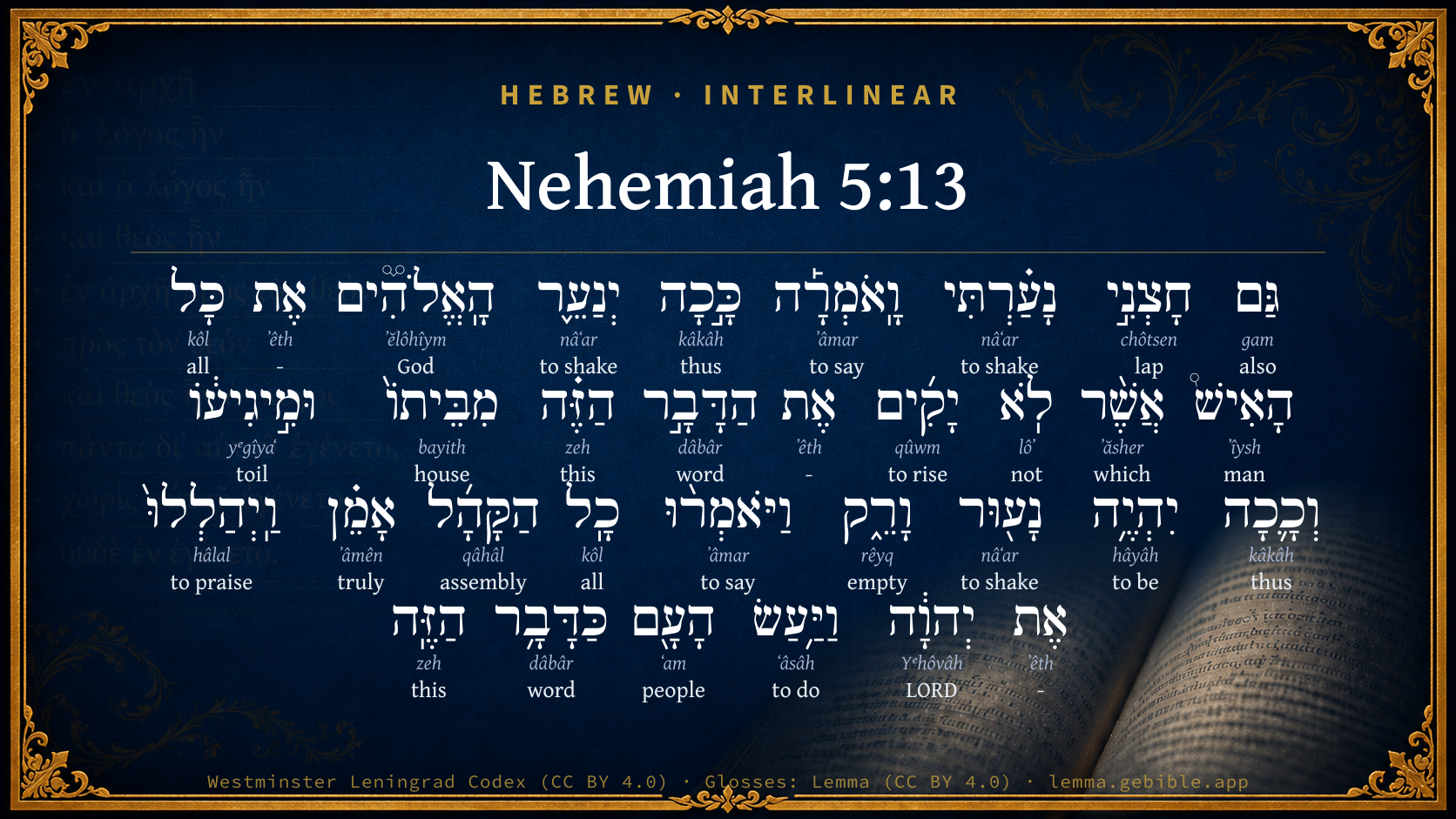
Hebrew (Westminster Leningrad Codex) Nehemiah 5:13 appears in the Hebrew Old Testament. The text above is from the Westminster Leningrad Codex. Each word links to its Strong’s number, a concise gloss, and parsing drawn from the Open Scriptures Hebrew Bible morphology. Click any word for its full Brown-Driver-Briggs (BDB) entry.
Download image
Cite this verse

Nehemiah 5:13 (World English Bible). Public Domain. Lemma interlinear Bible study tool, https://lemma.gebible.app/v/nehemiah/5/13.

Show BibTeX & RIS
BibTeX
RIS
English Translation
Also I shook out my lap, and said, So God shake out every man from his house, and from his labor, that doesn't perform this promise; even thus be he shaken out, and emptied. All the assembly said, Amen, and praised Yahweh. The people did according to this promise.
World English Bible · Public Domain
Highlights
  • 1 first appearance in the Hebrew Bible
Full analysis ↓
Download a study sheet

One document with this verse’s original text, its word-by-word gloss line, the meaning frame, cross-references with their text, attributed commentary, and full source and license credits — printable, and it pastes into notes with its structure intact.

This verse Autodidact and up

Study sheet (.html) Plain text (.txt)

A passage Seminary Student

Up to 50 verses in one chapter. A passage sheet keeps up to 6 commentary sources and 12 cross-references per verse, in the order this page ranks them, and says so on the sheet whenever that leaves anything out. Ask for a single verse and you get the Autodidact verse sheet above.

Everything on this page stays free to read, with no account — the sheet is a download of what is already on screen, not access to it.

Want to remove ads? Support Godless Engineer
Compare translations 3

The same verse in 3 English versions, stacked beneath the original-language interlinear above. Click any original word for its lexicon entry.

Each is an independent rendering of the whole verse — the interlinear is not word-aligned to these translations.

Highlighted words mark where these versions differ — a whole-verse word diff, not a word-by-word alignment.

  • World English Bible Public Domain
    Also I shook out my lap, and said, So God shake out every man from his house, and from his labor, that doesn't perform this promise; even thus be he shaken out, and emptied. All the assembly said, Amen, and praised Yahweh. The people did according to this promise.
  • King James Version Public Domain
    Also I shook my lap, and said, So God shake out every man from his house, and from his labour, that performeth not this promise, even thus be he shaken out, and emptied. And all the congregation said, Amen, and praised the LORD. And the people did according to this promise.
  • unfoldingWord Literal Text CC BY-SA 4.0
    Also, I shook out my bosom, and I said, “Thus may God shake out from his house and from his labor every man who does not cause this word to stand. And thus may he be shaken out and emptied.” And all the assembly said, “Amen!” And they praised Yahweh, and the people did according to this word.

unfoldingWord Literal Text — © unfoldingWord, licensed CC BY-SA 4.0. Word-aligned USFM3 via Door43 (git.door43.org/unfoldingWord/en_ult).

Versions to compare (up to 4)

3 of 4 selected

Show all 18 translations

Every available English version of this verse, each an independent rendering of the whole verse.

  • World English Bible Public Domain
    Also I shook out my lap, and said, So God shake out every man from his house, and from his labor, that doesn't perform this promise; even thus be he shaken out, and emptied. All the assembly said, Amen, and praised Yahweh. The people did according to this promise.
  • Berean Standard Bible Public Domain
    I also shook out the folds of my robe and said, “May God likewise shake out of His house and possession every man who does not keep this promise. May such a man be shaken out and have nothing!” The whole assembly said, “Amen,” and they praised the LORD. And the people did as they had promised.
  • Majority Standard Bible Public Domain
    I also shook out the folds of my robe and said, “May God likewise shake out of his house and possessions every man who does not keep this promise. May such a man be shaken out and have nothing!” The whole assembly said, “Amen,” and they praised the LORD. And the people did as they had promised.
  • King James Version Public Domain
    Also I shook my lap, and said, So God shake out every man from his house, and from his labour, that performeth not this promise, even thus be he shaken out, and emptied. And all the congregation said, Amen, and praised the LORD. And the people did according to this promise.
  • American Standard Version (1901) Public Domain
    Also I shook out my lap, and said, So God shake out every man from his house, and from his labor, that performeth not this promise; even thus be he shaken out, and emptied. And all the assembly said, Amen, and praised Jehovah. And the people did according to this promise.
  • Revised Version (1885) Public Domain
    Also I shook out my lap, and said, So God shake out every man from his house, and from his labour, that performeth not this promise; even thus be he shaken out, and emptied. And all the congregation said, Amen, and praised the LORD. And the people did according to this promise.
  • Geneva Bible (1599) Public Domain
    So I shooke my lappe, and said, So let God shake out euery man that wil not perfourme this promise from his house, and from his labour: euen thus let him be shaken out, and emptied. And all the Cogregation said, Amen, and praised the Lord: and the people did according to this promise.
  • Douay-Rheims (1899) Public Domain
    Moreover I shook my lap, and said: So may God shake every man that shall not accomplish this word, out of his house, and out of his labours, thus may he be shaken out, and become empty. And all the multitude said: Amen. And they praised God. And the people did according to what was said.
  • Young's Literal Translation Public Domain
    also, my lap I have shaken, and I say, `Thus doth God shake out every man, who doth not perform this thing, from his house, and from his labour; yea, thus is he shaken out and empty;' and all the assembly say, `Amen,' and praise Jehovah; and the people do according to this thing.
  • Literal Standard Version CC BY-SA 4.0
    also, I have shaken my lap, and I say, “Thus God shakes out every man from his house and from his labor who does not perform this thing; indeed, thus is he shaken out and empty”; and all the assembly says, “Amen,” and praises YHWH; and the people do according to this thing.
  • Unlocked Literal Bible CC BY-SA 4.0
    I shook out the fold of my robe and said, “So may God shake out of his house and possessions every man who does not keep his promise. So may he be shaken out and emptied.” All the assembly said, “Amen,” and they praised Yahweh and the people did as they had promised.
  • unfoldingWord Literal Text CC BY-SA 4.0
    Also, I shook out my bosom, and I said, “Thus may God shake out from his house and from his labor every man who does not cause this word to stand. And thus may he be shaken out and emptied.” And all the assembly said, “Amen!” And they praised Yahweh, and the people did according to this word.
  • Darby Bible Public Domain
    Also I shook my lap, and said, So God shake out every man from his house and from his earnings, that performeth not this promise: even thus be he shaken out and emptied! And all the congregation said, Amen! And they praised Jehovah. And the people did according to this promise.
  • World Messianic Bible Public Domain
    Also I shook out my lap, and said, “So may God shake out every man from his house, and from his labor, that doesn’t perform this promise; even may he be shaken out and emptied like this.” All the assembly said, “Amen,” and praised the LORD. The people did according to this promise.
  • Webster's Bible Public Domain
    Also I shook my lap, and said, So God shake out every man from his house, and from his labor, that performeth not this promise, even thus be he shaken out, and emptied. And all the congregation said, Amen, and praised the LORD. And the people did according to this promise.
  • Free Bible Version CC BY-SA 4.0
    I shook out the folds of my robe and said, “This is how my God will shake you out of your homes and out of your possessions if you don't keep your promise! If you don't, you'll be shaken out and end up with nothing!” Everyone there said, “Amen,” and praised the Lord. The people did what they'd promised.
  • Bible in Basic English Public Domain
    And shaking out the folds of my robe, I said, So may God send out from his house and his work every man who does not keep this agreement; even so let him be sent out and made as nothing. And all the meeting of the people said, So be it, and gave praise to the Lord. And the people did as they had said.
  • JPS Tanakh (1917) Public Domain
    Also I shook out my lap, and said: 'So God shake out every man from his house, and from his labour, that performeth not this promise; even thus be he shaken out, and emptied.' And all the congregation said: 'Amen', and praised the LORD. And the people did according to this promise.

Literal Standard Version (2020), Covenant Press — licensed CC BY-SA 4.0. Text via the HelloAO Bible API (eBible.org). Unlocked Literal Bible (unfoldingWord) — licensed CC BY-SA 4.0. Text via the HelloAO Bible API (eBible.org). unfoldingWord Literal Text — © unfoldingWord, licensed CC BY-SA 4.0. Word-aligned USFM3 via Door43 (git.door43.org/unfoldingWord/en_ult). Free Bible Version, Dr. Jonathan Gallagher — licensed CC BY-SA 4.0. Text via the HelloAO Bible API (eBible.org).

Word by word

More ways to search: Search by grammar → Find every occurrence → Compare this word →

Practice this passage: Drill this verse → Learn its vocabulary →

חָצְנִ֣י
chôtsen
H2684
“lap · my”
Noun, Common, Masculine, Singular, Construct + Suffix, Personal, 1st Person, Common, Singular
Part of Speech
Noun
Type
Common
Gender
Masculine
Number
Singular
State
Construct
Full BDB Definition

Origin: a collateral form of H2683 , and meaning the same

TWOT: 720b

bosom, lap
  1. גַּם gam H1571 “also” Particle, Accusative
  2. נָעַ֗רְתִּי nâʻar H5287 “to shake” Verb, Qal, Perfect, 1st Person, Common, Singular
  3. וָֽאֹמְרָ֡ה ʼâmar H559 “and · to say” Conjunction + Verb, Qal, Sequential Imperfect, 1st Person, Common, Singular + Suffix, h
  4. כָּ֣כָה kâkâh H3602 “thus” Adverb
  5. יְנַעֵ֪ר nâʻar H5287 “to shake” Verb, Piel, Imperfect, 3rd Person, Masculine, Singular
  6. הָֽאֱלֹהִ֟ים ʼĕlôhîym H430 “the · God(s)” Particle, Definite Article + Noun, Common, Masculine, Plural, Absolute
  7. אֶת ʼêth H853 “-” Particle, Direct Object
  8. כָּל kôl H3605 “all of” Noun, Common, Masculine, Singular, Construct
  9. הָאִישׁ֩ ʼîysh H376 “the · man” Particle, Definite Article + Noun, Common, Masculine, Singular, Absolute
  10. אֲשֶׁ֨ר ʼăsher H834 “which” Particle, Relative
  11. לֹֽא lôʼ H3808 “not” Particle, Negative
  12. יָקִ֜ים qûwm H6965 “to rise” Verb, Hiphil, Imperfect, 3rd Person, Masculine, Singular
  13. אֶת ʼêth H853 “-” Particle, Direct Object
  14. הַדָּבָ֣ר dâbâr H1697 “the · word” Particle, Definite Article + Noun, Common, Masculine, Singular, Absolute
  15. הַזֶּ֗ה zeh H2088 “the · this” Particle, Definite Article + Pronoun, Demonstrative, Masculine, Singular
  16. מִבֵּיתוֹ֙ bayith H1004 “from · house · his” Preposition + Noun, Common, Masculine, Singular, Construct + Suffix, Personal, 3rd Person, Masculine, Singular
  17. וּמִ֣יגִיע֔וֹ yᵉgîyaʻ H3018 “and · from · toil · his” Conjunction + Preposition + Noun, Common, Masculine, Singular, Construct + Suffix, Personal, 3rd Person, Masculine, Singular
  18. וְכָ֛כָה kâkâh H3602 “and · thus” Conjunction + Adverb
  19. יִהְיֶ֥ה hâyâh H1961 “to be” Verb, Qal, Imperfect, 3rd Person, Masculine, Singular
  20. נָע֖וּר nâʻar H5287 “shaken” Verb, Qal, Participle Passive, Masculine, Singular, Absolute
  21. וָרֵ֑ק rêyq H7386 “and · empty” Conjunction + Adjective, Adjective, Masculine, Singular, Absolute
  22. וַיֹּאמְר֨וּ ʼâmar H559 “and · to say” Conjunction + Verb, Qal, Sequential Imperfect, 3rd Person, Masculine, Plural
  23. כָֽל kôl H3605 “all of” Noun, Common, Masculine, Singular, Construct
  24. הַקָּהָ֜ל qâhâl H6951 “the · assembly” Particle, Definite Article + Noun, Common, Masculine, Singular, Absolute
  25. אָמֵ֗ן ʼâmên H543 “truly” Adverb
  26. וַֽיְהַלְלוּ֙ hâlal H1984 “and · to praise” Conjunction + Verb, Piel, Sequential Imperfect, 3rd Person, Masculine, Plural
  27. אֶת ʼêth H853 “-” Particle, Direct Object
  28. יְהוָ֔ה Yᵉhôvâh H3068 “LORD” Noun, Proper
  29. וַיַּ֥עַשׂ ʻâsâh H6213 “and · to do” Conjunction + Verb, Qal, Sequential Imperfect, 3rd Person, Masculine, Singular
  30. הָעָ֖ם ʻam H5971 “the · people” Particle, Definite Article + Noun, Common, Masculine, Singular, Absolute
  31. כַּדָּבָ֥ר dâbâr H1697 “like/as the · word” Preposition, Determined + Noun, Common, Masculine, Singular, Absolute
  32. הַזֶּֽה zeh H2088 “the · this” Particle, Definite Article + Pronoun, Demonstrative, Masculine, Singular

About this verse

These counts appear in no published source. They are computed here, from the morphology-tagged text and Lemma’s own curated glosses. What Lemma adds →

33
words
24
distinct lemmas
Historical
section

Notable vocabulary

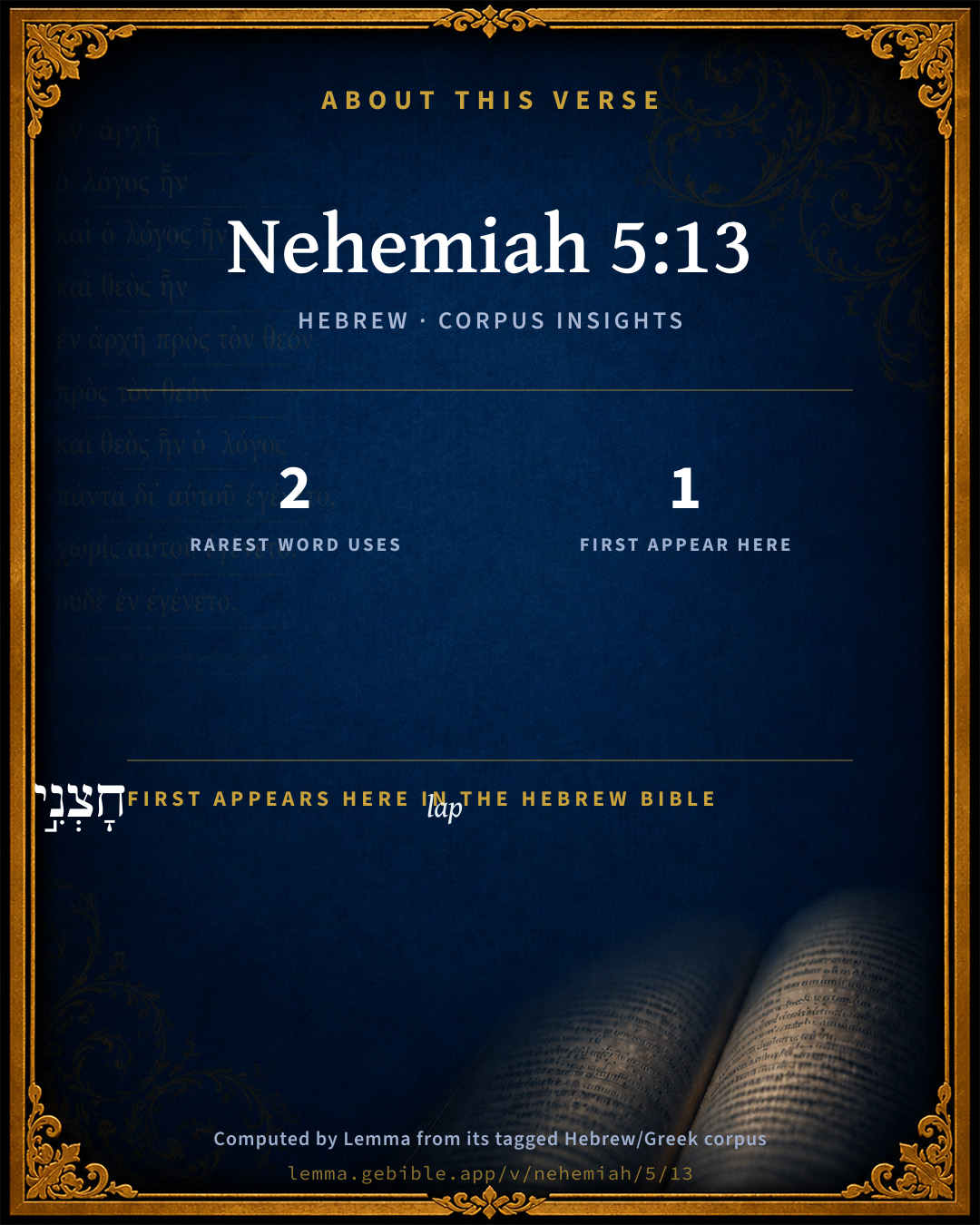
The rarest word here is חָצְנִ֣י lap H2684 — appearing just 2 times in the whole Hebrew Bible.

First appearance in Scripture

This word makes its first canonical appearance in the Hebrew Bible here:

  • חָצְנִ֣י lap H2684

Shared distinctive vocabulary

חָצְנִ֣י lap H2684 occurs in 2 verses of the Hebrew Bible. Also found in:

Grammatical profile

  • 9 verbs
  • 12 nouns
  • 1 adjective
  • 2 pronouns
  • 3 adverbs
  • 6 particles

Verb forms

  • נָעַ֗רְתִּי Qal · Perfect
  • וָֽאֹמְרָ֡ה Qal · Sequential Imperfect
  • יְנַעֵ֪ר Piel · Imperfect
  • יָקִ֜ים Hiphil · Imperfect
  • יִהְיֶ֥ה Qal · Imperfect
  • נָע֖וּר Qal · Participle Passive
  • וַיֹּאמְר֨וּ Qal · Sequential Imperfect
  • וַֽיְהַלְלוּ֙ Piel · Sequential Imperfect
  • וַיַּ֥עַשׂ Qal · Sequential Imperfect

Repetition

Words recur within this verse — often emphatic in Hebrew:

  • נָעַ֗רְתִּי to shake H5287 ×3
  • וָֽאֹמְרָ֡ה to say H559 ×2
  • כָּ֣כָה thus H3602 ×2
  • כָּל all H3605 ×2
  • הַדָּבָ֣ר word H1697 ×2
  • הַזֶּ֗ה this H2088 ×2

Cross-references

15

Topical passages linked to Nehemiah 5:13 in the Treasury of Scripture Knowledge — connected by theme and wording, ordered by reader-vote popularity; previews shown in the World English Bible.

  • Acts 18:6 When they opposed him and blasphemed, he shook out his clothing and said to them, "Your blood be on your own heads! I am clean. From now on, I will go to the Gentiles!"
  • 1 Chronicles 16:36 Blessed be Yahweh, the God of Israel, From everlasting even to everlasting. All the people said, Amen, and praised Yahweh.
  • Zechariah 5:3–4 Then he said to me, "This is the curse that goes out over the surface of the whole land; for everyone who steals shall be cut off according to it on the one side; and everyone who swears falsely shall be cut off according to it on the other side.
  • Matthew 10:14 Whoever doesn't receive you, nor hear your words, as you go out of that house or that city, shake off the dust from your feet.
  • Numbers 5:22 and this water that brings a curse will go into your bowels, and make your body swell, and your thigh fall away.' The woman shall say, 'Amen, Amen.'
  • Deuteronomy 27:14–26 The Levites shall answer, and tell all the men of Israel with a loud voice,
  • 1 Samuel 15:28 Samuel said to him, Yahweh has torn the kingdom of Israel from you this day, and has given it to a neighbor of yours who is better than you.
  • 1 Kings 11:29–31 It happened at that time, when Jeroboam went out of Jerusalem, that the prophet Ahijah the Shilonite found him in the way; now [Ahijah] had clad himself with a new garment; and they two were alone in the field.
  • 2 Kings 23:3 The king stood by the pillar, and made a covenant before Yahweh, to walk after Yahweh, and to keep his commandments, and his testimonies, and his statutes, with all [his] heart, and all [his] soul, to confirm the words of this covenant that were written in this book: and all the people stood to the covenant.
  • Nehemiah 8:6 and Ezra blessed Yahweh, the great God. All the people answered, Amen, Amen, with the lifting up of their hands: and they bowed their heads, and worshiped Yahweh with their faces to the ground.
  • Psalms 50:14 Offer to God the sacrifice of thanksgiving. Pay your vows to the Most High.
  • Psalms 76:11 Make vows to Yahweh your God, and fulfill them! Let all of his neighbors bring presents to him who is to be feared.
  • Psalms 119:106 I have sworn, and have confirmed it, That I will obey your righteous ordinances.
  • Ecclesiastes 5:5 It is better that you should not vow, than that you should vow and not pay.
  • Acts 13:51 But they shook off the dust of their feet against them, and came to Iconium.

Cross-references courtesy of OpenBible.info (CC BY 4.0).

Hebrew and Greek witnesses Masoretic Hebrew ↔ Greek Septuagint

The same verse in the two great witnesses to the Old Testament, shown verse-for-verse.

These are two independent witnesses, not word-aligned to each other, and the Septuagint is shown in lemma (dictionary) form.

Hebrew Nehemiah 5:13 Masoretic · Westminster Leningrad Codex

גַּם חָצְנִ֣י נָעַ֗רְתִּי וָֽאֹמְרָ֡ה כָּ֣כָה יְנַעֵ֪ר הָֽאֱלֹהִ֟ים אֶת כָּל הָאִישׁ֩ אֲשֶׁ֨ר לֹֽא יָקִ֜ים אֶת הַדָּבָ֣ר הַזֶּ֗ה מִבֵּיתוֹ֙ וּמִ֣יגִיע֔וֹ וְכָ֛כָה יִהְיֶ֥ה נָע֖וּר וָרֵ֑ק וַיֹּאמְר֨וּ כָֽל הַקָּהָ֜ל אָמֵ֗ן וַֽיְהַלְלוּ֙ אֶת יְהוָ֔ה וַיַּ֥עַשׂ הָעָ֖ם כַּדָּבָ֥ר הַזֶּֽה

Also I shook out my lap, and said, So God shake out every man from his house, and from his labor, that doesn't perform this promise; even thus be he shaken out, and emptied. All the assembly said, Amen, and praised Yahweh. The people did according to this promise.

World English Bible · Public Domain

Greek LXX Structure differs

The Septuagint has no separate book of Nehemiah. Its Greek text is the second half of Esdras B (2 Esdras), chapters 11–23; Ezra is the first half (1–10).

A verse-for-verse comparison isn’t shown here because the chapters and verses don’t line up. Switch to the LXX edition with the MT / LXX toggle above to read the Greek directly.

On this verse, The Cambridge Bible for Schools and Colleges discusses the Septuagint’s reading. Read the note in Commentary ↓

Hebrew: Westminster Leningrad Codex (CC BY 4.0). Greek: Septuagint (public domain); English from a public-domain English Septuagint. How the Septuagint differs from the Hebrew →

Commentary

Notes on Nehemiah 5:13 from classic Christian and Jewish commentators (each source and its license shown beneath its notes). The classic Christian expositions comment on the surrounding passage and are grouped to its opening verse, so a note may address several verses; the Jewish commentaries on the Tanakh (Rashi and others) are per-verse, so they appear only where the commentator wrote on this verse.

Lemma curates 59 commentaries, every one of them public domain or Creative Commons licensed, each selected and text-cleaned for this edition rather than reprinted as found. About our sources →

Trapp's Complete Commentary

John Trapp

Neh 5:13 Also I shook my lap, and said, So God shake out every man from his house, and from his labour, that performeth not this promise, even thus be he shaken out, and emptied. And all the congregation said, Amen, and praised the LORD. And the people did according to this promise.

Ver. 13. Also I shook my lap] By this rite (running into their senses) this holy man runs with terrors into the eyes and hearts of all that should perfidiously forswear themselves, by a direful denunciation of divine vengeance, in all lawful oaths there is an imprecation, though it be not always expressed, Gen 14:23; Heb. iii.

So God cast out every man from his house] See Zec 5:4-5, with the note.

And from his labour] i.e. From his laying up (the fruit of his labour), his lands and estate, got by a diligent hand. The Hebrew word signifieth labour even to lassitude and fainting.

And all the congregation said, Amen] In token of hearty assent and assurance.

And praised the Lord] There was a general joy, and many a humble, cheerful, and thankful heart lifted up to God for sin so redressed, and poor people relieved.

And the people did according to this promise] This was real thankfulness. It is not the fumbling out of a few good words (as, God, I thank thee, praised be God, &c.) that will pass. Thanksdoing is the proof of thanksgiving; and the good life of the thankful is the life of thankfulness. "Offer unto God thanksgiving, and pay thy vows unto the Most High," Psa 50:14.

John Trapp, A Commentary or Exposition upon All the Books of the Old and New Testament (1647–1656) — public domain. Text from a community e-Sword module.

Joseph Benson's Commentary

Neh 5:13. Also I shook my lap — The extreme parts of my garment, which I first folded together, and then shook it and scattered it asunder. This was one form of swearing then in use. So God shake every man from his house, &c. — Thus he represented, by an external sign, as the manner of the prophets often was, how God would cast them out of their possessions, and of the fruit of their labours, who did not observe this oath. And all the congregation said, Amen! — God so influenced the people’s hearts, that even they who had been guilty of taking usury consented to this imprecation, and wished this mischief to themselves, if they did not do as he required. And praised the Lord — So far were they from promising with regret, that they promised and even took an oath to do as he desired, with all possible expressions of joy and gladness, and with thankfulness to God for giving them such a good governor, and inclining them to submit to him.

Joseph Benson's Commentary on the Old and New Testaments (1811–1818) — public domain. Text from a community e-Sword module.

Adam Clarke's Commentary

Verse 13. Also I shook my lap] This was a significant action frequent among the Hebrews; and something of the same nature was practised among other nations. "When the Roman ambassadors entered the senate of Carthage, they had their toga gathered up in their bosom. They said, We carry here peace and war; you may have which you will. The senate answered, You may give which you please. They then shook their toga, and said, We bring you war. To which all the senate answered, We cheerfully accept it." See Livy. lib. xxi., cap. 18; and see Calmet.

Adam Clarke's Commentary on the Bible (1810–1826) — public domain. Text from a community e-Sword/MySword module.

Ellicott's Commentary for English Readers

(13) Shook my lap.—This symbolical act imprecated on every man who broke this covenant an appropriate penalty: that he be emptied of all his possessions, even as the fold of Nehemiah’s garment was emptied. And it is observable that the iniquity thus stopped is not referred to in the subsequent covenant (Nehemiah 10), nor is it one of the offences which the governor found on his second return (Nehemiah 13).

A Bible Commentary for English Readers, edited by Charles John Ellicott (1878–1897) — public domain. Text from a community e-Sword module.

The Cambridge Bible for Schools and Colleges

gen. ed. J. J. S. Perowne

13. Also I shook my lap] R.V. Also I shook out my lap. (LXX. ἀναβολήν. Vulg. ‘sinum’.) The word here rendered ‘lap’ only occurs elsewhere in the O. T. in Isa_49:22, R.V. ‘bosom,’ A.V. ‘arms.’ Nehemiah here employs a symbolical gesture, suiting his action to his metaphor. He pressed tightly to his body the loose fold of his mantle, so that it hung like a bag or wallet against him; then with a vehement motion of both hands he suddenly stretched it out and shook it in the sight of all the people, so that anything which it might have before concealed would have been jerked violently from him. Even so, he says, may God cast forth from His protection and love, in home and work, the man who fails to abide by the compact. Cf. Job_38:13, ‘That it might take hold of the ends of the earth, and the wicked be shaken out of it.’ Isa_24:1. The gesture was rhetorical. It would impress itself upon the audience, and emphasize the speaker’s words. For instances of symbolical action comp. 1Ki_11:30; 1Ki_20:35-43; 1Ki_22:11; Jer_13:1-14; Jer_18:1-12; Jer_19:1-13; Mat_27:24; Act_18:6.

that performeth not this promise] Lit. ‘that fulfilleth or establisheth not this word.’ The same phrase in the original as Deu_27:26, ‘Cursed be he that confirmeth not the words of this law to do them.’

from his house, and from his labour] This conjunction of words sounds proverbial, but does not occur elsewhere in the O. T. ‘His labour’ does not mean so much ‘his means of occupation’—the modern idea—as ‘the exercise and even the fruits of his industry.’ The word used is that found in the expression ‘the labour of the hands,’ Gen_31:42; Job_10:3; Psa_128:2; Hag_1:11. Cf. Deu_28:33, ‘The fruit of thy ground, and all thy labours, shall a nation which thou knowest not eat up.’

promise, even thus] R.V. promise; even thus.

all the congregation said, Amen, and praised the Lord] The people said ‘Amen,’ ratifying the curse of Nehemiah and the condition of the contract: they praised the Lord, because the poor had been succoured and the division of the people healed. The ‘Amen,’ as the people’s assent to the ruler’s proposition, occurs again Neh_8:6. Cf. 1Ki_1:36; 1Ch_16:36, and Deu_27:15.

And the people did, &c.] If we may press the distinction between the two words employed, ‘the people’ in the mass carried into execution the resolutions of ‘the congregation,’ that had approved Nehemiah’s measures.

The Cambridge Bible for Schools and Colleges (gen. ed. J. J. S. Perowne; Cambridge University Press, 1878–1918) — public domain. Text from a community e-Sword module.

John Gill's Exposition

Moreover, from the time that I was appointed to be their governor in the land of Judah,.... That is, by the king of Persia, which was not done when he was first sent into Judea; but very probably when he had finished the wall in fifty two days, he returned to Persia, and gave the king an account of his success, and how things stood in those parts, when he judged it necessary to send him again in the character of a governor, and which was still within the same year, as follows: from the twentieth year, even unto the thirty second year of Artaxerxes, that is, twelve years; see Neh 13:6.

I and my brethren have not eaten the bread of the governor; which was fit and proper for him, and used to be given him; neither he, nor those that assisted him in the government, the principal men he brought along with him, and put into posts and places under him.

John Gill's Exposition of the Whole Bible (1746–1763) — public domain (CC PDM 1.0). Text via the HelloAO Bible API.

Albert Barnes' Notes on the Bible

I shook my lap - Compare the marginal references. By “lap” is meant a fold in the bosom of the dress, capable of serving as a pocket. Compare Isa 49:22 margin.

Albert Barnes' Notes on the Bible (1834–1885) — public domain. Text from a community e-Sword/MySword module.

Haydock's Catholic Bible Commentary

Lap, or skirt of my robes. (Tirinus) --- Such figurative actions were very common. Thus a Roman ambassador at Carthage, folding up his garment, said he brought peace or war. (Livy xxi. 18.) (Calmet) --- Said. Behold how easily was that effected at Jerusalem, which the Romans could never perfectly bring about, after the most violent riots! (Tirinus)

George Leo Haydock (1774–1849), Haydock's Catholic Family Bible and Commentary, 1859 edition — public domain. Excludes Psalms (Douay-Rheims chapter numbering differs from Protestant) and Deuterocanonical books (Catholic canon only).

Matthew Poole's English Annotations

I shook my lap, i.e. the lap or extreme parts of my garment, which I first folded together, and then shook it, and scattered it asunder. This was a form of swearing then in use.

From his labour, i.e. from enjoying what he hath got by his labour.

Matthew Poole's English Annotations on the Holy Bible (1683–1685) — public domain. Text from a community e-Sword/MySword module.

Whedon's Commentary on the Bible

Daniel D. Whedon

13. Shook my lap — Or, shook my bosom; that is, the bosom of my garment. This was a symbolical act to designate, as Nehemiah immediately explains, the casting out from the covenant people those who performeth not this promise. The person using this sign gathered up his garment in his bosom, intimating that there was the seat of confidence and trust, and then, shaking it out, he represented the utter casting off and disowning of any that would violate such a solemn pledge.

The people did — They kept their promise by restoring all they had taken from their brethren.

Daniel D. Whedon (gen. ed.), Commentary on the Old and New Testaments (1874–1909) — public domain. Text from a community e-Sword module.

The Pulpit Commentary

Also I shook my lap. Even the taking of the oath did not seem sufficient to the prudent governor. He would strengthen the oath by a malediction, and a malediction accompanied by a symbolical act, to render it the more impressive. Among the nations of antiquity few things were so much dreaded as falling under a curse. The maledictions of Deu_28:16-44 were the supreme sanction which Moses devised for the Law, whereof he was the promulgator. Curses protected the tombs and inscriptions of the Assyrian and Persian kings, the contracts of the Babylonians, and the treaties of most nations. Nehemiah"s curse is an unusual one, but very clear and intelligible. He prays that whosoever departs from his promise given may be cast forth a homeless wanderer, emptied of all his possessions, as empty as the fold in his own dress, which he first gathers into a sort of bag or pocket, and then throws from him and so empties out. To this the assembly responded by a hearty "Amen," and then praised the Lord for the happy ending of the whole affair; in which they piously traced the directing and over-ruling hand of God, "restraining the fierceness of men," and "turning it to his praise". (Psa_76:10 Prayer-Book version)

Promise-keeping.

"And the people did according to this promise." Nehemiah wrote this, we may be sure, with peculiar satisfaction. It would be well if the history of all promises of amendment, etc. could be thus concluded. But it is far otherwise. Men often "say and do not." Even vows made to God in secret or before the Church, and with solemnities resembling those recorded here, are, alas, often broken. In view of such failures it may be profitable for those who are contemplating a solemn profession of religion to consider how they may best Secure that they shall fulfil their vows.

I BY CARE IN MAKING THEM.

1. With right understanding of their import.

2. With deep conviction of the truths and duties to which they relate.

3. With due deliberation. Not hastily, under the influence of passing emotion, but carefully considering what they involve, and counting the cost of keeping them.

4. Of free and hearty choice. Not merely because of pressing solicitations from others.

5. In dependence on the grace of the Holy Spirit. With consciousness of weakness, and humble reliance on God and prayer to him.

II BY FREQUENT REMEMBRANCE AND RENEWAL OF THEM. "O my soul, thou hast said unto the Lord, Thou art my Lord." "Thy vows are upon me, O God." "I have sworn, and I will perform it, that I will keep thy righteous judgments." Such exercises are especially suitable:

1. In anticipating and celebrating the Lord"s Supper.

2. When assailed by powerful temptations.

3. When called to difficult duties. Such as, though requiring toil and self-denial, are involved in our professed consecration to God.

III BY CONSTANT WATCHFULNESS AND PRAYER. In conclusion, notice

1. The blessedness of those who do according to their promises to God. He will fulfil his promises to them.

2. The guilt of unfulfilled promises.

3. The comfort, under the sense of partial failure, which arises from the Divine compassion and readiness to forgive. "For in many things we offend all." But our God knows and values sincere purpose and endeavour. He knows also our weakness. He accepts imperfect service, and forgives the imperfections of his true-hearted servants.

4. Obligation to piety and holiness is independent of our promises. These recognise obligations, do not create them. Those who "make no profession" must not, therefore, console themselves as if they were guiltless.

The Pulpit Commentary (1880–1919), ed. H.D.M. Spence-Jones & Joseph S. Exell — public domain. Text from a community e-Sword module.

John Wesley's Explanatory Notes

My lap - The extreme parts of my garment, which I first folded together, and then shook it and scattered it asunder. This was a form of swearing then in use.

John Wesley, Explanatory Notes Upon the Whole Bible (1754–1765) — public domain. Text via the GEBible commentary corpus.

Rashi

Rabbi Shlomo Yitzchaki (Rashi)

I also shook out my garment Heb. חָצְנִי, I also shook out my garment. חָצְנִי is like (Isa. 49: 22): “...and they shall bring your sons on the skirt of their garments (בְּחֹצֶן).”

my garment is escrol(l)e in Old French, I shook out, like (ibid. 52:2): “Shake yourself (הִתְנַעֲרִי) from the dust.”

So shall...shake out So shall the Holy One, blessed be He, shake out from the world and from their property those who do not relinquish their debts.

shake out and empty without property.

Rashi on the Tanakh — English translations: “The Judaica Press complete Tanach with Rashi, translated by A. J. Rosenberg” (CC BY 4.0); “Pentateuch with Rashi's commentary by M. Rosenbaum and A.M. Silbermann, 1929-1934” (public domain); “The Metsudah Tanach series, Lakewood, N.J” (CC BY 4.0); and “The Book of Joshua, Metsudah Publications, 1997” (CC BY 4.0). Text via Sefaria.

Lesson kit

Teaching starters — assembled from the data on this page, not authored interpretation. Every prompt links to the verse data it draws on. Edit before teaching.

Nehemiah, in the Historical, opens this verse with 33 words (24 distinct Hebrew lemmas). Its most distinctive word is chôtsen (“lap”). A historical commentator’s framing appears above. Read the whole chapter for the surrounding context.

Discussion questions

  1. What does “lap” (chôtsen) contribute to the verse as a whole?
  2. The word “lap” first appears here in Scripture. What is being introduced at this debut?
  3. Isaiah 49:22 shares the word «lap» with this verse. How do the two illuminate each other?
  4. “to shake” occurs 3× in this one verse. What is the effect of the repetition?
  5. These translations render this verse differently. What is at stake in choosing one wording over another?
  6. The verb «נָעַ֗רְתִּי» is Qal Perfect. How does its form color the action?
  7. Reading how Trapp's Complete Commentary and Joseph Benson's Commentary read this verse, where do the two commentators agree and where do they part?

Things to notice

  • 1 word makes its first canonical appearance in Scripture here.
  • These translations choose different wording for 19 words in this verse.
  • “to shake” occurs 3× in this single verse.
  • 24 distinct Hebrew lemmas span 33 words in this verse.

Reading settings

Reading text

Shown beneath each verse's original-language words.

Old Testament
Old Testament edition

Read the OT as the Masoretic Hebrew (MT) or the Greek Septuagint (LXX).

English shown for the Greek Septuagint (in the Hebrew ↔ Greek comparison).

Comparing translations? Open the Compare panel on any verse page to stack up to four side by side.