
Genesis 38:7

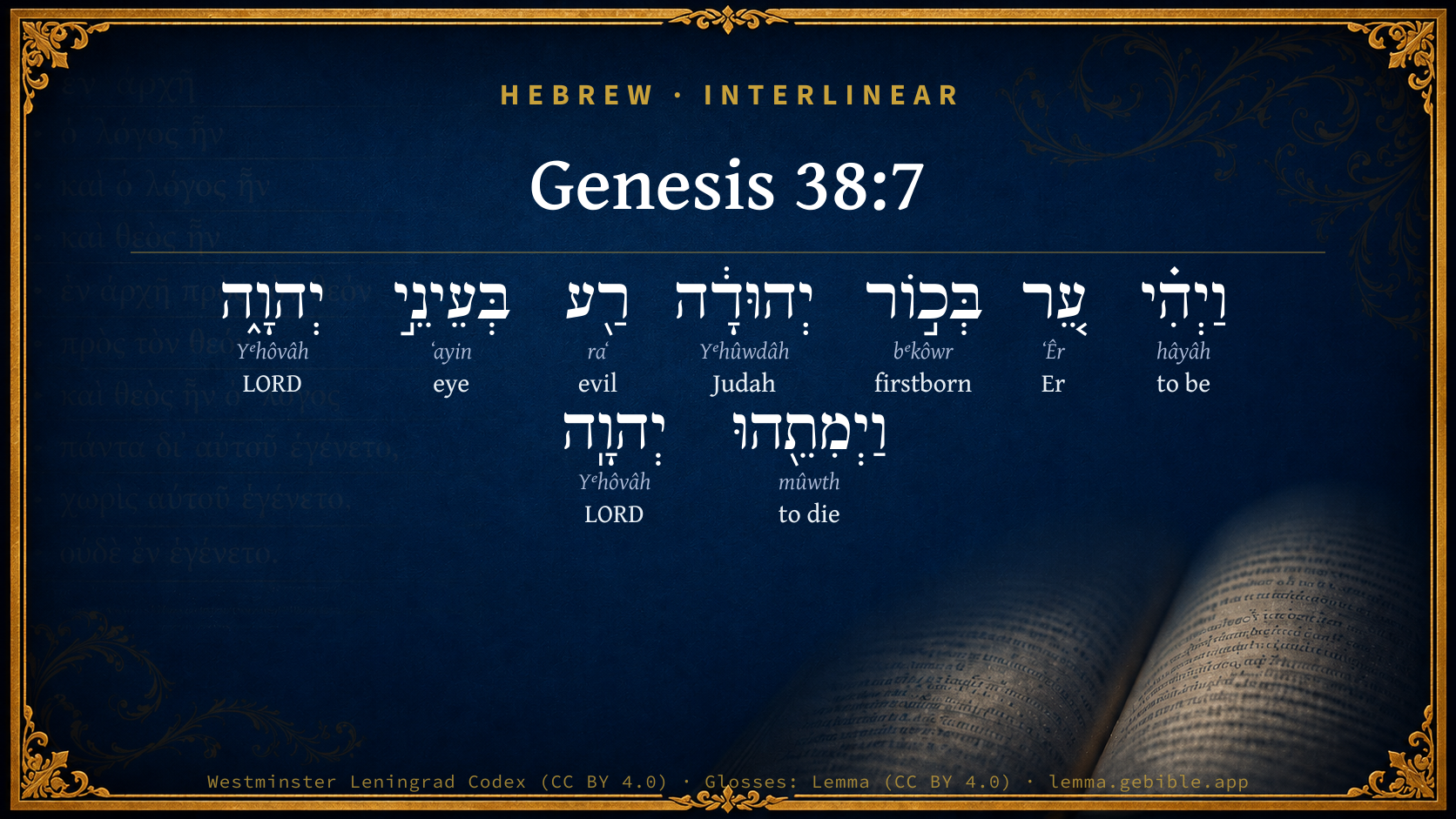
Hebrew (Westminster Leningrad Codex) Genesis 38:7 appears in the Hebrew Old Testament. The text above is from the Westminster Leningrad Codex. Each word links to its Strong’s number, a concise gloss, and parsing drawn from the Open Scriptures Hebrew Bible morphology. Click any word for its full Brown-Driver-Briggs (BDB) entry.
Download image
Cite this verse

Genesis 38:7 (World English Bible). Public Domain. Lemma interlinear Bible study tool, https://lemma.gebible.app/v/genesis/38/7.

Show BibTeX & RIS
BibTeX
RIS
English Translation
Er, Judah's firstborn, was wicked in the sight of Yahweh. Yahweh killed him.
World English Bible · Public Domain
Download a study sheet

One document with this verse’s original text, its word-by-word gloss line, the meaning frame, cross-references with their text, attributed commentary, and full source and license credits — printable, and it pastes into notes with its structure intact.

This verse Autodidact and up

Study sheet (.html) Plain text (.txt)

A passage Seminary Student

Up to 50 verses in one chapter. A passage sheet keeps up to 6 commentary sources and 12 cross-references per verse, in the order this page ranks them, and says so on the sheet whenever that leaves anything out. Ask for a single verse and you get the Autodidact verse sheet above.

Everything on this page stays free to read, with no account — the sheet is a download of what is already on screen, not access to it.

Want to remove ads? Support Godless Engineer
Compare translations 3

The same verse in 3 English versions, stacked beneath the original-language interlinear above. Click any original word for its lexicon entry.

Each is an independent rendering of the whole verse — the interlinear is not word-aligned to these translations.

Highlighted words mark where these versions differ — a whole-verse word diff, not a word-by-word alignment.

  • World English Bible Public Domain
    Er, Judah's firstborn, was wicked in the sight of Yahweh. Yahweh killed him.
  • King James Version Public Domain
    And Er, Judah's firstborn, was wicked in the sight of the LORD; and the LORD slew him.
  • unfoldingWord Literal Text CC BY-SA 4.0
    But Er, the firstborn of Judah, was evil in the eyes of Yahweh, so Yahweh killed him.

unfoldingWord Literal Text — © unfoldingWord, licensed CC BY-SA 4.0. Word-aligned USFM3 via Door43 (git.door43.org/unfoldingWord/en_ult).

Versions to compare (up to 4)

3 of 4 selected

Show all 18 translations

Every available English version of this verse, each an independent rendering of the whole verse.

  • World English Bible Public Domain
    Er, Judah's firstborn, was wicked in the sight of Yahweh. Yahweh killed him.
  • Berean Standard Bible Public Domain
    But Er, Judah’s firstborn, was wicked in the sight of the LORD; so the LORD put him to death.
  • Majority Standard Bible Public Domain
    But Er, Judah’s firstborn, was wicked in the sight of the LORD; so the LORD put him to death.
  • King James Version Public Domain
    And Er, Judah's firstborn, was wicked in the sight of the LORD; and the LORD slew him.
  • American Standard Version (1901) Public Domain
    And Er, Judah's first-born, was wicked in the sight of Jehovah. And Jehovah slew him.
  • Revised Version (1885) Public Domain
    And Er, Judah’s firstborn, was wicked in the sight of the LORD; and the LORD slew him.
  • Geneva Bible (1599) Public Domain
    Now Er the first borne of Iudah was wicked in the sight of the Lord: therefore the Lord slewe him.
  • Douay-Rheims (1899) Public Domain
    And Her, the firstborn of Juda, was wicked in the sight of the Lord: and was slain by him.
  • Young's Literal Translation Public Domain
    and Er, Judah's first-born, is evil in the eyes of Jehovah, and Jehovah doth put him to death.
  • Literal Standard Version CC BY-SA 4.0
    and Er, Judah’s firstborn, is evil in the eyes of YHWH, and YHWH puts him to death.
  • Unlocked Literal Bible CC BY-SA 4.0
    Er, Judah's firstborn, was wicked in the sight of Yahweh. Yahweh killed him.
  • unfoldingWord Literal Text CC BY-SA 4.0
    But Er, the firstborn of Judah, was evil in the eyes of Yahweh, so Yahweh killed him.
  • Darby Bible Public Domain
    And Er, Judah's firstborn, was wicked in the sight of Jehovah, and Jehovah slew him.
  • World Messianic Bible Public Domain
    Er, Judah’s firstborn, was wicked in the LORD’s sight. So the LORD killed him.
  • Webster's Bible Public Domain
    And Er, Judah's first-born, was wicked in the sight of the LORD; and the LORD slew him.
  • Free Bible Version CC BY-SA 4.0
    But Er did what was evil in the Lord's sight, so the Lord put him to death.
  • Bible in Basic English Public Domain
    Now Er, Judah's first son, did evil in the eyes of the Lord, so that he put him to death.
  • JPS Tanakh (1917) Public Domain
    And Er, Judah's first-born, was wicked in the sight of the LORD; and the LORD slew him.

Literal Standard Version (2020), Covenant Press — licensed CC BY-SA 4.0. Text via the HelloAO Bible API (eBible.org). Unlocked Literal Bible (unfoldingWord) — licensed CC BY-SA 4.0. Text via the HelloAO Bible API (eBible.org). unfoldingWord Literal Text — © unfoldingWord, licensed CC BY-SA 4.0. Word-aligned USFM3 via Door43 (git.door43.org/unfoldingWord/en_ult). Free Bible Version, Dr. Jonathan Gallagher — licensed CC BY-SA 4.0. Text via the HelloAO Bible API (eBible.org).

Word by word

More ways to search: Search by grammar → Find every occurrence → Compare this word →

Practice this passage: Drill this verse → Learn its vocabulary →

About this verse

These counts appear in no published source. They are computed here, from the morphology-tagged text and Lemma’s own curated glosses. What Lemma adds →

9
words
8
distinct lemmas
Pentateuch
section

Notable vocabulary

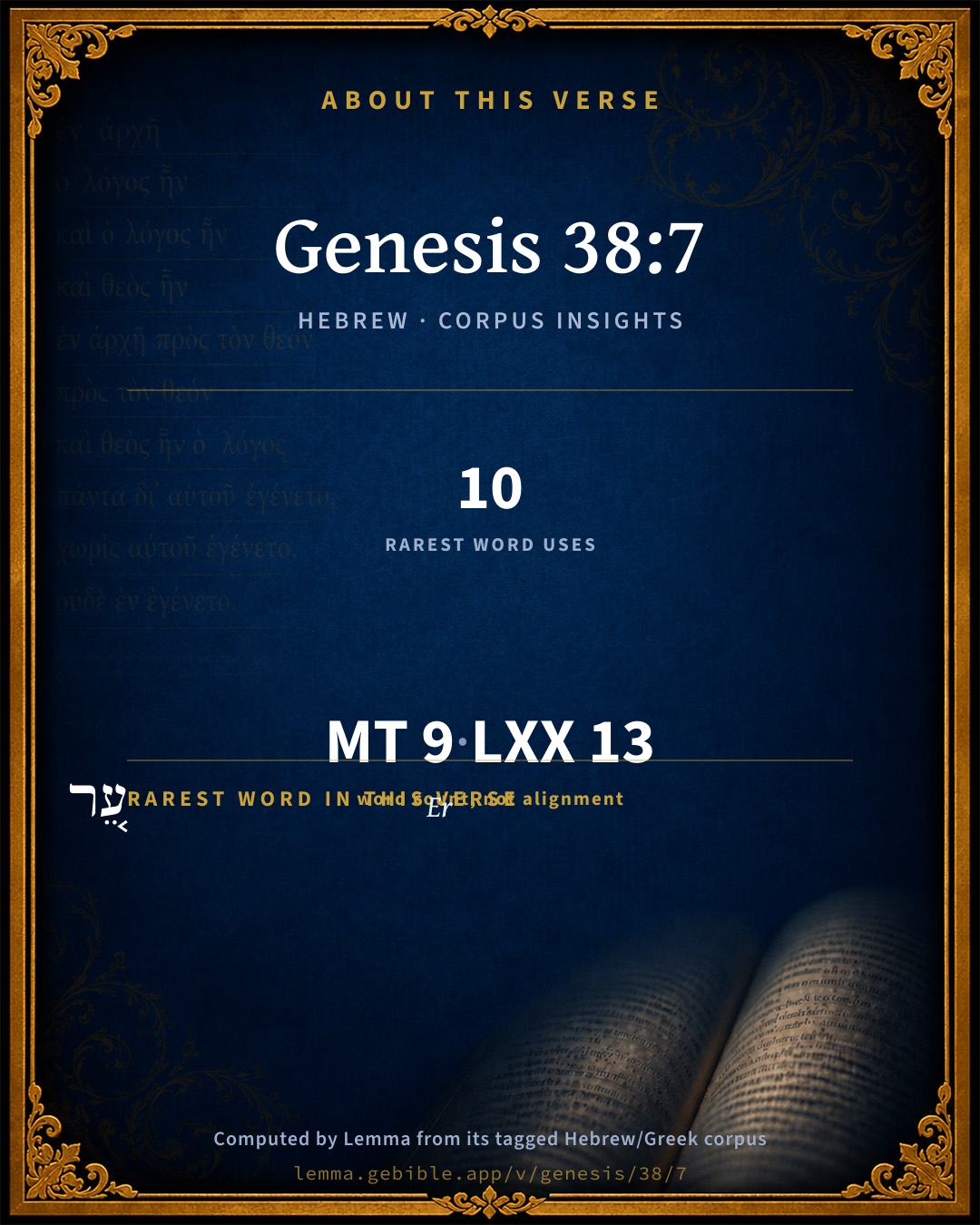
The rarest word here is עֵ֚ר Er H6147 — appearing just 10 times in the whole Hebrew Bible.

Shared distinctive vocabulary

עֵ֚ר Er H6147 occurs in 7 verses of the Hebrew Bible. Also found in:

Grammatical profile

  • 2 verbs
  • 6 nouns
  • 1 adjective

Verb forms

  • וַיְהִ֗י Qal · Sequential Imperfect
  • וַיְמִתֵ֖הוּ Hiphil · Sequential Imperfect

Repetition

A word recurs within this verse — often emphatic in Hebrew:

  • יְהוָ֑ה LORD H3068 ×2

Hebrew & Septuagint length

In English translation the verse runs 13 words from the Hebrew and 15 from the Septuagint (LXX English) — closely comparable.

A rough comparison of the two English renderings, which tokenize alike — not a word-level alignment.

Word counts can differ between the Hebrew and the Greek without any difference in meaning — e.g. the Hebrew direct-object marker אֵת has no separate Greek word, and Greek often adds the article ὁ.

In the original languages it is 9 Hebrew tokens and 13 Greek tokens — but the two are counted differently (Hebrew bundles its prefixes and suffixes into one token; the Greek is in lemma form), so that isn’t a like-for-like length.

Cross-references

6

Topical passages linked to Genesis 38:7 in the Treasury of Scripture Knowledge — connected by theme and wording, ordered by reader-vote popularity; previews shown in the World English Bible.

  • 1 Chronicles 2:3 The sons of Judah: Er, and Onan, and Shelah; which three were born to him of Shua's daughter the Canaanitess. Er, Judah's firstborn, was wicked in the sight of Yahweh; and he killed him.
  • Genesis 46:12 The sons of Judah: Er, Onan, Shelah, Perez, and Zerah; but Er and Onan died in the land of Canaan. The sons of Perez were Hezron and Hamul.
  • Numbers 26:19 The sons of Judah: Er and Onan; and Er and Onan died in the land of Canaan.
  • Genesis 13:13 Now the men of Sodom were exceedingly wicked and sinners against Yahweh.
  • Genesis 19:13 for we will destroy this place, because the cry of them is grown great before Yahweh. Yahweh has sent us to destroy it."
  • Psalms 55:23 But you, God, will bring them down into the pit of destruction. Bloodthirsty and deceitful men shall not live out half their days, But I will trust in you.

Cross-references courtesy of OpenBible.info (CC BY 4.0).

Hebrew and Greek witnesses Masoretic Hebrew ↔ Greek Septuagint

The same verse in the two great witnesses to the Old Testament, shown verse-for-verse.

These are two independent witnesses, not word-aligned to each other, and the Septuagint is shown in lemma (dictionary) form.

Hebrew Genesis 38:7 Masoretic · Westminster Leningrad Codex

וַיְהִ֗י עֵ֚ר בְּכ֣וֹר יְהוּדָ֔ה רַ֖ע בְּעֵינֵ֣י יְהוָ֑ה וַיְמִתֵ֖הוּ יְהוָֽה

Er, Judah's firstborn, was wicked in the sight of Yahweh. Yahweh killed him.

World English Bible · Public Domain

Greek LXX Genesis 38:7 Septuagint · lemma form

γίγνομαι δέ ηρ πρωτότοκος ιουδα πονηρός ἐναντίον κύριος καί ἀποκτείνω αὐτός ὁ θεός

And Er, the firstborn of Judas, was wicked before the Lord; and God killed him.

LXX2012 (modern English Septuagint) · Public Domain

Hebrew: Westminster Leningrad Codex (CC BY 4.0). Greek: Septuagint (public domain); English from LXX2012 (modern English Septuagint) (Public Domain). How the Septuagint differs from the Hebrew →

Targum (Aramaic paraphrase)

2

The Targum is the ancient Jewish Aramaic paraphrase of the Hebrew Scriptures — an interpretive translation, not the Hebrew text itself. Onkelos (literal) and Pseudo-Jonathan (expansive) render the Torah, and Jonathan the Prophets. Coverage is partial: where no permissively-licensed English translation exists for a verse, only the Aramaic is shown. This is verse-level text, not a word-by-word alignment to the Hebrew.

  1. Targum Onkelos Torah (Genesis–Deuteronomy)
    וַהֲוָה עֵר בּוּכְרָא דִיהוּדָה בִּישׁ קֳדָם יְיָ וַאֲמִיתֵהּ יְיָ

    (no public-domain English translation for this verse)

    Targum Onkelos — Aramaic: “Onkelos Genesis” (public domain); “Onkelos Exodus” (public domain); “Onkelos Leviticus” (public domain); “Onkelos Numbers” (public domain); “Onkelos Deuteronomy” (public domain). English: “Sefaria Community Translation” (CC0 1.0 (public-domain dedication)); “J.W. Etheridge. The Targums of Onkelos and Jonathan Ben Uzziel on the Pentateuch. London: Longmans, Green, 1862” (public domain). Text via Sefaria.

  2. Targum Pseudo-Jonathan Torah (Genesis–Deuteronomy)
    וַהֲוָה עֵר בּוּכְרָא דִיהוּדָה בִּישׁ קֳדָם יְיָ עַל דְלָא הֲוָה יָהִיב זַרְעֵיהּ לְאִנְתְּתֵיהּ וּתְקֵיף רוּגְזָא דַיְיָ עֲלֵיהּ וְקַטְלֵיהּ יְיָ

    But Er the firstborn of Jehuda was evil before the Lord because he had not given his seed unto his wife, and the anger of the Lord prevailed against him, and the Lord slew him.

    Targum Pseudo-Jonathan — Aramaic: “Targum Jonathan on Genesis” (public domain); “Targum Jonathan on Exodus” (public domain); “Targum Jonathan on Leviticus” (public domain); “Targum Jonathan on Numbers” (public domain); “Targum Jonathan on Deuteronomy” (public domain). English: “The Targum of Jonathan ben Uzziel, trans. J. W. Etheridge, London, 1862” (public domain). Text via Sefaria.

Commentary

Notes on Genesis 38:7 from classic Christian and Jewish commentators (each source and its license shown beneath its notes). The classic Christian expositions comment on the surrounding passage and are grouped to its opening verse, so a note may address several verses; the Jewish commentaries on the Tanakh (Rashi and others) are per-verse, so they appear only where the commentator wrote on this verse.

Lemma curates 59 commentaries, every one of them public domain or Creative Commons licensed, each selected and text-cleaned for this edition rather than reprinted as found. About our sources →

Trapp's Complete Commentary

John Trapp

Gen 38:7 And Er, Judah’s firstborn, was wicked in the sight of the LORD; and the LORD slew him.

Ver. 7. Wicked in the sight of the Lord.] A Sodomite, say the Hebrews; but this is hard to say. {a} As an evildoer, he was soon cut off. {Psa 37:9} God would not have such to be his son Christ’s progenitor. Too wicked he was to live: you may know him to be the son of a Canaanitess. Partus sequitur ventrem.

{a} In Heb., videtur esse allusio seu inversio nominis. ער erat רע: q.d., Er erat vigil perversus.

John Trapp, A Commentary or Exposition upon All the Books of the Old and New Testament (1647–1656) — public domain. Text from a community e-Sword module.

Joseph Benson's Commentary

Gen 38:7-8. Er was wicked in the sight of the Lord — That is, in defiance of God, and his law. And the Lord slew him — Cut him off by an untimely death, before he had any children by Tamar. As long life among the Jews was generally reckoned a blessing from God; so an untimely death was accounted a punishment. The next brother, Onan, was, according to the ancient usage, married to the widow, to preserve the name of his deceased brother that died childless. This custom of marrying the brother’s widow was afterward made one of the laws of Moses, Deu 25:5. Onan, though he consented to marry the widow, yet, to the great abuse of his own body, and of the wife he had married, and to the dishonour of the memory of his brother that was gone, refused to raise up seed unto his brother. And this story seems to be recorded by the Holy Ghost purposely to condemn, not only his malignant and envious disposition with respect to his deceased brother, but also and especially that vile pollution of his body of which he was guilty. For, observe, The thing which he did displeased the Lord, and brought upon him the Lord’s vengeance. And it is to be feared that thousands, especially of single persons, still displease the Lord in a similar way, and destroy their own bodies and souls. All such sins, at the same time that they dishonour the body, evidence the power of vile affections, and are not only condemned in the Scriptures, but by the light of nature, and were held even by the heathen moralists to be peculiarly criminal, and by the Jewish doctors to be a degree of murder. See Universal History.

Joseph Benson's Commentary on the Old and New Testaments (1811–1818) — public domain. Text from a community e-Sword module.

Tyndale Open Study Notes

Tyndale Open Resources

38:7-10 In this story, the Lord is mentioned as the sovereign judge who took the lives of Judah’s evil sons.

38:7 That Er was a wicked man is not surprising, since his mother was a Canaanite and his father a wayward Israelite.

Tyndale Open Study Notes — © Tyndale Open Resources, licensed CC BY-SA 4.0. Text via the HelloAO Bible API.

Adam Clarke's Commentary

Verse 7. Er-was wicked in the sight of the Lord] What this wickedness consisted in we are not told; but the phrase sight of the Lord being added, proves that it was some very great evil. It is worthy of remark that the Hebrew word used to express Er's wickedness is his own name, the letters reversed. Er ער wicked, רע ra. As if the inspired writer had said, "Er was altogether wicked, a completely abandoned character."

Adam Clarke's Commentary on the Bible (1810–1826) — public domain. Text from a community e-Sword/MySword module.

John Calvin's Commentaries

7. And the Lord slew him. We know that long life is reckoned among the gifts of God; and justly: for since it is by no means a despicable honor that we are created after the image of God, the longer any one lives in the world, and daily experiences God’s care over him, it is certain that he is the more bountifully dealt with by the Lord. Even amidst the many miseries with which life is filled, this divine goodness still shines forth, that God invites us to himself, and exercises us in the knowledge of himself; while at the same time he adorns us with such dignity, that he subjects to our authority whatever is in the world. Wherefore it is no wonder that God, as an act of kindness, prolongs the life of man. Whence it follows, that when the wicked are taken away by a premature death, a punishment for their wickedness is inflicted upon them: for it is as if the Lord should pronounce judgment from heaven, that they are unworthy to be sustained by the earth, unworthy to enjoy the common light of heaven. Let us therefore learn, as long as God keeps us in the world, to meditate on his benefits, to the end that every one may the more cheerfully endeavor to give praise to God for the life received from him. And although, at the present day also, sudden death is to be reckoned among the scourges of God; since that doctrine is always true,

“Bloody and deceitful men shall not live out half their days,” (Psalm 55:23;)

yet God executed this judgment more fully under the law, when the knowledge of a future life was comparatively obscure; for now, since the resurrection is clearly manifested to us in Christ, it is not right that death should be so greatly dreaded. And this difference between us and the ancient people of God is elsewhere noted. Nevertheless, it can never be laid down as a general rule, that they who had a long life were thereby proved to be pleasing and acceptable to the Lord, whereas God has sometimes lengthened the life of reprobates, in aggravation of their punishment. We know that Cain survived his brother Abel many centuries. But as God does not always, and to all persons, cause his temporal benefits manifestly to flow in a perpetual and equable course; so neither, on the other hand, does he always execute temporal punishments by the same rule. It is enough that, as far as the present life is concerned, certain examples of punishments and rewards are set before us. Moreover, as the miseries of the present life, which spring from the corruption of nature, do not extinguish the first and special grace of God; so, on the other hand, death, which is in itself the curse of God, is so far from doing any injury, that it tends, by a supernatural remedy, to the salvation of the elect. Especially now, from the time that the first-fruits of the resurrection in Christ have been offered, the condition of those who are quickly taken out of life is in no way deteriorated; because Christ himself is gain both for life and death. But the vengeance of God was so clear and remarkable in the death of Er, that the earth might plainly appear to have been purged as from its filthiness.

John Calvin's Commentaries (1540-1563) — public domain. Text from the Calvin Translation Society English edition (1840s-50s) via the Christian Classics Ethereal Library (ccel.org). Calvin's coverage is partial (roughly two-thirds of the Bible); uncommented books and verses are honest gaps, never fabricated. The 19th-century editor's footnotes and remarks are omitted so the notes are faithfully Calvin's own voice.

John Gill's Exposition

And Judah said unto Onan,.... Some time after his brother's death:

go in unto thy brother's wife, and marry her; Moses here uses a word not common for marriage, but which was peculiar to the marrying of a brother's wife according to a law given in his time: it appears to have been a custom before, and which the patriarch might be directed to by the Lord, in such a case when a brother died, and left no issue, for the sake of multiplication of seed, according to the divine promise, and which in the time of Moses passed into a law, see Deu 25:5,

and raise up seed unto thy brother; that might bear his name, and enjoy his inheritance. For this law or custom was partly political, to continue the paternal inheritance in the family, and partly typical, to direct to Christ the firstborn among many brethren, Rom 8:29, who in all things was to have the preeminence, Col 1:18; and this was not taken from the Canaanites, among whom Judah now was, but from the ancient patriarchs, which they had no doubt from divine revelation, and was taught in the school of Shem, and handed down from father to son; for as to this being a law among the Egyptians in later times, and which continued to the days of Zeno Augustus (q), it is most likely they took it from the Jews.

(q) Justinian. Cod l. 5. tit. 6. leg. 8.

John Gill's Exposition of the Whole Bible (1746–1763) — public domain (CC PDM 1.0). Text via the HelloAO Bible API.

Haydock's Catholic Bible Commentary

Wicked; without shame or remorse, sinning against nature, in order, if we may believe the Jews, that the beauty of his wife might not be impaired by having children. Onan was actuated by envy. (Menochius)

George Leo Haydock (1774–1849), Haydock's Catholic Family Bible and Commentary, 1859 edition — public domain. Excludes Psalms (Douay-Rheims chapter numbering differs from Protestant) and Deuterocanonical books (Catholic canon only).

Matthew Poole's English Annotations

Wicked in the sight of the Lord, i.e. notoriously wicked. Compare Gen 10:9; 13:13.

The Lord slew him, in some extraordinary and remarkable manner, as Gen 38:10.

Matthew Poole's English Annotations on the Holy Bible (1683–1685) — public domain. Text from a community e-Sword/MySword module.

Whedon's Commentary on the Bible

Daniel D. Whedon

7. Er… was wicked — In what particular forms he showed his wickedness we are not told; but being the son of a Canaanitish woman, he probably imbibed, in his earliest years, the spirit of Canaanitish idolatry and vice, which was ever an abomination to Jehovah.

The Lord slew him — Some sudden or fearful death that was recognised as a judgment stroke.

Daniel D. Whedon (gen. ed.), Commentary on the Old and New Testaments (1874–1909) — public domain. Text from a community e-Sword module.

The Pulpit Commentary

And Er, Judah"s firstborn, was wicked in the sight of the Lord. The connection between Er"s name (re) and Er"s character (r) is noticeable. The special form which his wickedness assumed is not stated; but the accompanying phrase suggests that, as in the case of the Sodomites, (Gen_13:13 Gen_19:5) it was some unnatural abomination. And the Lord slew him literally, caused him to die; not necessarily by direct visitation; perhaps simply by allowing him to reap the fruits of his youthful indulgence in premature and childless death, which yet was so rapid and so evidently entailed by his evil courses as immediately to suggest the punitive hand of God.

The Pulpit Commentary (1880–1919), ed. H.D.M. Spence-Jones & Joseph S. Exell — public domain. Text from a community e-Sword module.

John Wesley's Explanatory Notes

And Er was wicked in the sight of the Lord - That is, in defiance of God and his law. And what came of it? Why God cut him off presently, The Lord slew him. The next brother Onan was, according to the ancient usage, married to the widow, to preserve the name of his deceased brother that died childless. This custom of marrying the brother's widow was afterward made one of the laws of Moses, Deut. xxv, 5. Onan, though he consented to marry the widow, yet to the great abuse of his own body, of the wife he had married, and the memory of his brother that was gone, he refused to raise up seed unto his brother. Those sins that dishonour the body are very displeasing to God, and the evidence of vile actions. Observe, the thing which he did displeased the Lord - And it is to be feared, thousands, especially of single persons, by this very thing, still displeased the Lord, and destroy their own souls.

John Wesley, Explanatory Notes Upon the Whole Bible (1754–1765) — public domain. Text via the GEBible commentary corpus.

Rashi

Rabbi Shlomo Yitzchaki (Rashi)

רע בעיני ה' WAS WICKED IN THE EYES OF THE LORD — like the wickedness of Onan, and committing the same sin. This must have been the case because of Onan it is said, (v. 10) “And the Lord slew him also — Onan’s death was for a similar reason as Er’s death. Why did Er commit this sin? So that she should not bear children and her beauty thereby become impaired (Yevamot 34b).

Rashi on the Tanakh — English translations: “The Judaica Press complete Tanach with Rashi, translated by A. J. Rosenberg” (CC BY 4.0); “Pentateuch with Rashi's commentary by M. Rosenbaum and A.M. Silbermann, 1929-1934” (public domain); “The Metsudah Tanach series, Lakewood, N.J” (CC BY 4.0); and “The Book of Joshua, Metsudah Publications, 1997” (CC BY 4.0). Text via Sefaria.

Ramban (Nachmanides)

Rabbi Moshe ben Nachman (Ramban / Nachmanides)

AND ER, JUDAH’s FIRSTBORN, WAS WICKED IN THE SIGHT OF THE ETERNAL. Scripture does not specify the nature of his wickedness as it did in the case of his brother. Instead, it simply states that he died for his own sin. It informs us that this was not by way of punishment of Judah for his role in the sale of Joseph, since the saving of Joseph’s life by Judah compensated for his role in the sale. There was no case of death of a child in the house of the patriarchs except this one who was wicked in the sight of the Eternal, since the race of the righteous is blessed. This is why Jacob mourned many days for his son Joseph, and he refused to comfort himself, for he considered this to be a great punishment to himself, quite apart from his love for him.

Ramban (Nachmanides) on the Tanakh — English translation: “Commentary on the Torah by Ramban (Nachmanides). Translated and annotated by Charles B. Chavel. New York, Shilo Pub. House, 1971-1976” (CC BY 4.0). Text via Sefaria.

Radak

Rabbi David Kimhi (Radak)

'רע בעיני ה, the addition of the words “in the eyes of G’d,” is needed, seeing that no one else was aware of Er’s sin, something committed in the privacy of the bedroom. Our sages in Yevamot 34 said that the reason why Er ejaculated outside his wife’s vagina was in order for her to retain her beauty and not become pregnant.

Radak on the Tanakh — English translations: “Sefaria Community Translation” (CC0 1.0 (public-domain dedication)); “Eliyahu Munk, HaChut Hameshulash” (CC BY 4.0); “Rabbi Mike Feuer, Jerusalem Anthology” (CC BY 4.0); and “R. David Kimhi on the first book of Psalms, Translated by R.G. Finch, London, 1919” (public domain). Text via Sefaria.

Lesson kit

Teaching starters — assembled from the data on this page, not authored interpretation. Every prompt links to the verse data it draws on. Edit before teaching.

Genesis, in the Pentateuch, opens this verse with 9 words (8 distinct Hebrew lemmas). Its most distinctive word is ʻÊr (“Er”). A historical commentator’s framing appears above. Read the whole chapter for the surrounding context.

Discussion questions

  1. What does “Er” (ʻÊr) contribute to the verse as a whole?
  2. Genesis 38:3 shares the word «Er» with this verse. How do the two illuminate each other?
  3. “LORD” occurs 2× in this one verse. What is the effect of the repetition?
  4. The translations on this page render this verse differently — a whole-verse word diff, not a word-by-word alignment. What might account for the different wordings?
  5. The verb «וַיְהִ֗י» is Qal Sequential Imperfect. How does its form color the action?
  6. Reading how Trapp's Complete Commentary and Joseph Benson's Commentary read this verse, where do the two commentators agree and where do they part?

Things to notice

Reading settings

Reading text

Shown beneath each verse's original-language words.

Old Testament
Old Testament edition

Read the OT as the Masoretic Hebrew (MT) or the Greek Septuagint (LXX).

English shown for the Greek Septuagint (in the Hebrew ↔ Greek comparison).

Comparing translations? Open the Compare panel on any verse page to stack up to four side by side.