Ezekiel 21:23

Hebrew (Westminster Leningrad Codex) Ezekiel 21:23 appears in the Hebrew Old Testament. The text above is from the Westminster Leningrad Codex. Each word links to its Strong’s number, a concise gloss, and parsing drawn from the Open Scriptures Hebrew Bible morphology. Click any word for its full Brown-Driver-Briggs (BDB) entry.
Download image
Cite this verse

Ezekiel 21:23 (World English Bible). Public Domain. Lemma interlinear Bible study tool, https://lemma.gebible.app/v/ezekiel/21/23.

Show BibTeX & RIS
BibTeX
RIS
English Translation
It shall be to them as a false divination in their sight, who have sworn oaths to them; but he brings iniquity to memory, that they may be taken.
World English Bible · Public Domain
Download a study sheet

One document with this verse’s original text, its word-by-word gloss line, the meaning frame, cross-references with their text, attributed commentary, and full source and license credits — printable, and it pastes into notes with its structure intact.

This verse Autodidact and up

Study sheet (.html) Plain text (.txt)

A passage Seminary Student

Up to 50 verses in one chapter. A passage sheet keeps up to 6 commentary sources and 12 cross-references per verse, in the order this page ranks them, and says so on the sheet whenever that leaves anything out. Ask for a single verse and you get the Autodidact verse sheet above.

Everything on this page stays free to read, with no account — the sheet is a download of what is already on screen, not access to it.

Want to remove ads? Support Godless Engineer
Compare translations 3

The same verse in 3 English versions, stacked beneath the original-language interlinear above. Click any original word for its lexicon entry.

Each is an independent rendering of the whole verse — the interlinear is not word-aligned to these translations.

Highlighted words mark where these versions differ — a whole-verse word diff, not a word-by-word alignment.

  • World English Bible Public Domain
    It shall be to them as a false divination in their sight, who have sworn oaths to them; but he brings iniquity to memory, that they may be taken.
  • King James Version Public Domain
    And it shall be unto them as a false divination in their sight, to them that have sworn oaths: but he will call to remembrance the iniquity, that they may be taken.
  • unfoldingWord Literal Text CC BY-SA 4.0
    It will seem to be a useless omen in the eyes of the ones in Jerusalem, those who had sworn an oath to the Babylonians! But the king will accuse them of violating their treaty in order to besiege them!

unfoldingWord Literal Text — © unfoldingWord, licensed CC BY-SA 4.0. Word-aligned USFM3 via Door43 (git.door43.org/unfoldingWord/en_ult).

Versions to compare (up to 4)

3 of 4 selected

Show all 18 translations

Every available English version of this verse, each an independent rendering of the whole verse.

  • World English Bible Public Domain
    It shall be to them as a false divination in their sight, who have sworn oaths to them; but he brings iniquity to memory, that they may be taken.
  • Berean Standard Bible Public Domain
    It will seem like a false omen to the eyes of those who have sworn allegiance to him, but it will draw attention to their guilt and take them captive.
  • Majority Standard Bible Public Domain
    It will seem like a false omen to the eyes of those who have sworn allegiance to him, but it will draw attention to their guilt and take them captive.
  • King James Version Public Domain
    And it shall be unto them as a false divination in their sight, to them that have sworn oaths: but he will call to remembrance the iniquity, that they may be taken.
  • American Standard Version (1901) Public Domain
    And it shall be unto them as a false divination in their sight, who have sworn oaths unto them; but he bringeth iniquity to remembrance, that they may be taken.
  • Revised Version (1885) Public Domain
    And it shall be unto them as a vain divination in their sight, which have sworn oaths unto them: but he bringeth iniquity to remembrance, that they may be taken.
  • Geneva Bible (1599) Public Domain
    And it shalbe vnto them as a false diuination in their sight for the othes made vnto them: but hee will call to remembrance their iniquitie, to the intent they should be taken.
  • Douay-Rheims (1899) Public Domain
    And he shall be in their eyes as one consulting the oracle in vain, and imitating the leisure of sabbaths: but he will call to remembrance the iniquity that they may be taken.
  • Young's Literal Translation Public Domain
    And it hath been to them as a false divination in their eyes, Who have sworn oaths to them, And he is causing iniquity to be remembered to be caught.
  • Literal Standard Version CC BY-SA 4.0
    And it has been to them as a false divination in their eyes, || Who have sworn oaths to them, || But he is causing iniquity to be remembered [so they] are caught.
  • Unlocked Literal Bible CC BY-SA 4.0
    It will seem to be a useless omen in the eyes of the ones in Jerusalem, those who had sworn an oath to the Babylonians! But the king will accuse them of violating their treaty in order to besiege them!
  • unfoldingWord Literal Text CC BY-SA 4.0
    It will seem to be a useless omen in the eyes of the ones in Jerusalem, those who had sworn an oath to the Babylonians! But the king will accuse them of violating their treaty in order to besiege them!
  • Darby Bible Public Domain
    And this shall be a false divination in their sight, for them that have sworn oaths; but he will call to remembrance the iniquity, that they may be taken.
  • World Messianic Bible Public Domain
    It will be to them as a false divination in their sight, who have sworn oaths to them; but he brings iniquity to memory, that they may be taken.
  • Webster's Bible Public Domain
    And it shall be to them as a false divination in their sight, to them that have sworn oaths: but he will call to remembrance the iniquity, that they may be taken.
  • Free Bible Version CC BY-SA 4.0
    To those who have sworn to be loyal to Nebuchadnezzar this will look like a false sign, but it will reveal their guilt and they will be taken prisoner.
  • Bible in Basic English Public Domain
    And this answer given by secret arts will seem false to those who have given their oaths and have let them be broken: but he will keep the memory of evil-doing so that they may be taken.
  • JPS Tanakh (1917) Public Domain
    (21-28) And it shall be unto them as a false divination in their sight, who have weeks upon weeks! but it bringeth iniquity to remembrance, that they may be taken.

Literal Standard Version (2020), Covenant Press — licensed CC BY-SA 4.0. Text via the HelloAO Bible API (eBible.org). Unlocked Literal Bible (unfoldingWord) — licensed CC BY-SA 4.0. Text via the HelloAO Bible API (eBible.org). unfoldingWord Literal Text — © unfoldingWord, licensed CC BY-SA 4.0. Word-aligned USFM3 via Door43 (git.door43.org/unfoldingWord/en_ult). Free Bible Version, Dr. Jonathan Gallagher — licensed CC BY-SA 4.0. Text via the HelloAO Bible API (eBible.org).

Word by word

More ways to search: Search by grammar → Find every occurrence → Compare this word →

Practice this passage: Drill this verse → Learn its vocabulary →

כקסום
qâçam
H7080
“like/as · to divine”
Preposition + Verb, Qal, Infinitive Construct
Part of Speech
Preposition + Verb
Stem
Qal
Form
Infinitive Construct
Full BDB Definition

Origin: a primitive root

TWOT: 2044

(Qal) to practice divination, divine - of diviners of the nations, Balaam - of false prophets of Israel - prohibited
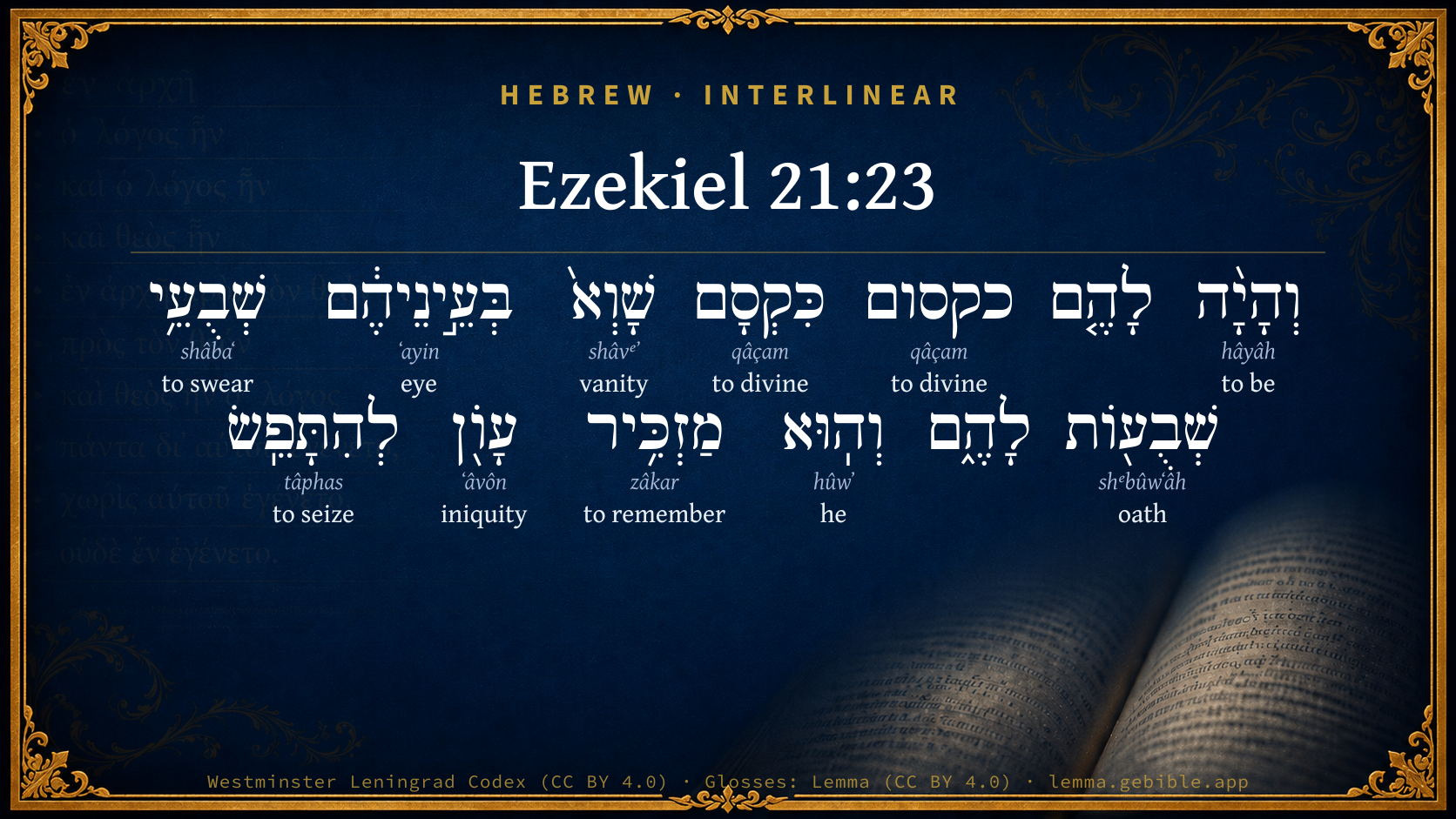
  1. וְהָיָ֨ה hâyâh H1961 “and · to be” Conjunction + Verb, Qal, Sequential Perfect, 3rd Person, Masculine, Singular
  2. כִּקְסָם qâçam H7080 “like/as · divination of” Preposition + Noun, Common, Masculine, Singular, Construct
  3. שָׁוְא֙ shâvᵉʼ H7723 “vanity” Noun, Common, Masculine, Singular, Absolute
  4. בְּעֵ֣ינֵיהֶ֔ם ʻayin H5869 “in/at · eyes · their” Preposition + Noun, Common, Both, Dual, Construct + Suffix, Personal, 3rd Person, Masculine, Plural
  5. שְׁבֻעֵ֥י shâbaʻ H7650 “those who have sworn of” Noun, Common, Feminine, Plural, Construct
  6. שְׁבֻע֖וֹת shᵉbûwʻâh H7621 “oaths” Noun, Common, Feminine, Plural, Absolute
  7. וְהֽוּא hûwʼ H1931 “and · he” Conjunction + Pronoun, Personal, 3rd Person, Masculine, Singular
  8. מַזְכִּ֥יר zâkar H2142 “remembering” Verb, Hiphil, Participle Active, Masculine, Singular, Absolute
  9. עָוֺ֖ן ʻâvôn H5771 “iniquity” Noun, Common, Both, Singular, Absolute
  10. לְהִתָּפֵֽשׂ tâphas H8610 “to seize” Preposition + Verb, Niphal, Infinitive Construct

About this verse

These counts appear in no published source. They are computed here, from the morphology-tagged text and Lemma’s own curated glosses. What Lemma adds →

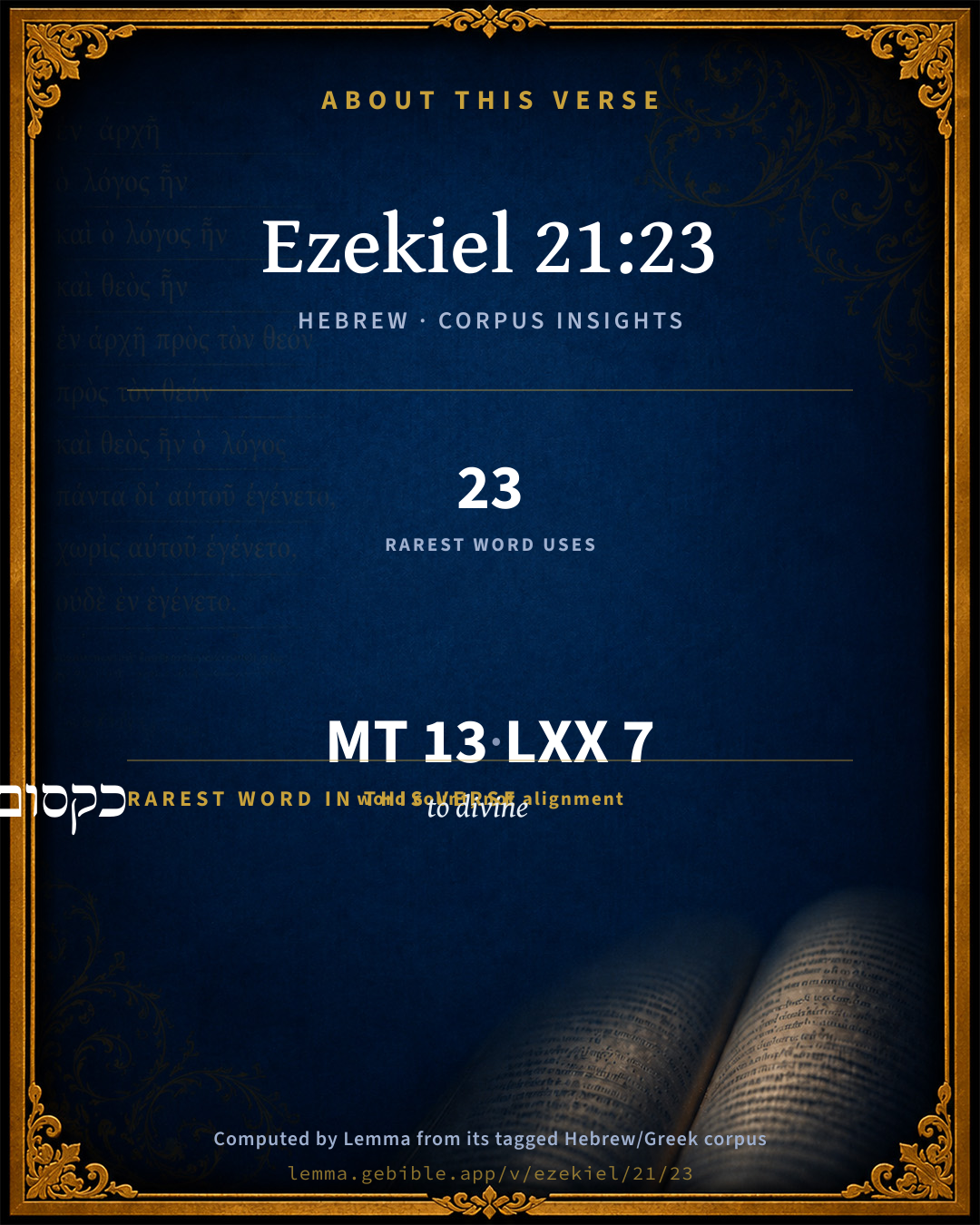
13
words
10
distinct lemmas
Prophets
section

Notable vocabulary

The rarest word here is כקסום to divine H7080 — appearing just 23 times in the whole Hebrew Bible.

Shared distinctive vocabulary

כקסום to divine H7080 occurs in 20 verses of the Hebrew Bible. Also found in:

Grammatical profile

  • 4 verbs
  • 6 nouns
  • 1 pronoun
  • 2 prepositions

Verb forms

  • וְהָיָ֨ה Qal · Sequential Perfect
  • כקסום Qal · Infinitive Construct
  • מַזְכִּ֥יר Hiphil · Participle Active
  • לְהִתָּפֵֽשׂ Niphal · Infinitive Construct

Repetition

A word recurs within this verse — often emphatic in Hebrew:

  • כקסום to divine H7080 ×2

Hebrew & Septuagint length

In English translation the verse runs 29 words from the Hebrew and 24 from the Septuagint (LXX English) — closely comparable.

A rough comparison of the two English renderings, which tokenize alike — not a word-level alignment.

Word counts can differ between the Hebrew and the Greek without any difference in meaning — e.g. the Hebrew direct-object marker אֵת has no separate Greek word, and Greek often adds the article ὁ.

In the original languages it is 13 Hebrew tokens and 7 Greek tokens — but the two are counted differently (Hebrew bundles its prefixes and suffixes into one token; the Greek is in lemma form), so that isn’t a like-for-like length.

Cross-references

12

Topical passages linked to Ezekiel 21:23 in the Treasury of Scripture Knowledge — connected by theme and wording, ordered by reader-vote popularity; previews shown in the World English Bible.

  • Numbers 5:15 then the man shall bring his wife to the priest, and shall bring her offering for her: the tenth part of an ephah of barley meal. He shall pour no oil on it, nor put frankincense on it, for it is a meal offering of jealousy, a meal offering of memorial, bringing iniquity to memory.
  • Ezekiel 21:24 Therefore thus says the Lord Yahweh: Because you have made your iniquity to be remembered, in that your transgressions are uncovered, so that in all your doings your sins do appear; because you have come to memory, you shall be taken with the hand.
  • Ezekiel 29:16 It shall be no more the confidence of the house of Israel, bringing iniquity to memory, when they turn to look after them: and they shall know that I am the Lord Yahweh.
  • 1 Kings 17:18 She said to Elijah, What have I to do with you, you man of God? You have come to me to bring my sin to memory, and to kill my son!
  • 2 Kings 24:20–25:7 For through the anger of Yahweh did it happen in Jerusalem and Judah, until he had cast them out from his presence. Zedekiah rebelled against the king of Babylon.
  • 2 Chronicles 36:13 He also rebelled against king Nebuchadnezzar, who had made him swear by God: but he stiffened his neck, and hardened his heart against turning to Yahweh, the God of Israel.
  • Isaiah 28:14–15 Why hear the word of Yahweh, you scoffers, that rule this people that is in Jerusalem:
  • Jeremiah 52:3–11 For through the anger of Yahweh did it happen in Jerusalem and Judah, until he had cast them out from his presence. Zedekiah rebelled against the king of Babylon.
  • Ezekiel 11:3 who say, [The time] is not near to build houses: this [city] is the caldron, and we are the flesh.
  • Ezekiel 12:22 Son of man, what is this proverb that you have in the land of Israel, saying, The days are prolonged, and every vision fails?
  • Ezekiel 17:13–19 and he took of the seed royal, and made a covenant with him; he also brought him under an oath, and took away the mighty of the land;
  • Revelation 16:19 The great city was divided into three parts, and the cities of the nations fell. Babylon the great was remembered in the sight of God, to give to her the cup of the wine of the fierceness of his wrath.

Cross-references courtesy of OpenBible.info (CC BY 4.0).

Hebrew and Greek witnesses Masoretic Hebrew ↔ Greek Septuagint

The same verse in the two great witnesses to the Old Testament, shown verse-for-verse.

These are two independent witnesses, not word-aligned to each other, and the Septuagint is shown in lemma (dictionary) form.

Hebrew Ezekiel 21:23 Masoretic · Westminster Leningrad Codex

וְהָיָ֨ה לָהֶ֤ם כקסום כִּקְסָם שָׁוְא֙ בְּעֵ֣ינֵיהֶ֔ם שְׁבֻעֵ֥י שְׁבֻע֖וֹת לָהֶ֑ם וְהֽוּא מַזְכִּ֥יר עָוֺ֖ן לְהִתָּפֵֽשׂ

It shall be to them as a false divination in their sight, who have sworn oaths to them; but he brings iniquity to memory, that they may be taken.

World English Bible · Public Domain

Greek LXX Ezekiel 21:23 Septuagint · lemma form

καί γίγνομαι λόγος κύριος πρός ἐγώ λέγω

And he was to them as one using divination before them, and he himself recounting his iniquities, that they might be borne in mind.

LXX2012 (modern English Septuagint) · Public Domain

On this verse, Keil & Delitzsch discusses the Septuagint’s reading. Read the note in Commentary ↓

Hebrew: Westminster Leningrad Codex (CC BY 4.0). Greek: Septuagint (public domain); English from LXX2012 (modern English Septuagint) (Public Domain). How the Septuagint differs from the Hebrew →

Targum (Aramaic paraphrase)

1

The Targum is the ancient Jewish Aramaic paraphrase of the Hebrew Scriptures — an interpretive translation, not the Hebrew text itself. Onkelos (literal) and Pseudo-Jonathan (expansive) render the Torah, and Jonathan the Prophets. Coverage is partial: where no permissively-licensed English translation exists for a verse, only the Aramaic is shown. This is verse-level text, not a word-by-word alignment to the Hebrew.

  1. Targum Jonathan Prophets (Joshua–Malachi)
    וַהֲוָה פִּתְגָם נְבוּאָה מִן קֳדָם יְיָ עִמִי לְמֵימָר:

    (no public-domain English translation for this verse)

    Targum Jonathan — Aramaic: “Mikraot Gedolot” (public domain). English: “Sefaria Community Translation” (CC0 1.0 (public-domain dedication)); “London "Chaldee Paraphrase," 1871” (public domain). Text via Sefaria.

Commentary

Notes on Ezekiel 21:23 from classic Christian and Jewish commentators (each source and its license shown beneath its notes). The classic Christian expositions comment on the surrounding passage and are grouped to its opening verse, so a note may address several verses; the Jewish commentaries on the Tanakh (Rashi and others) are per-verse, so they appear only where the commentator wrote on this verse.

Lemma curates 59 commentaries, every one of them public domain or Creative Commons licensed, each selected and text-cleaned for this edition rather than reprinted as found. About our sources →

Trapp's Complete Commentary

John Trapp

Eze 21:23 And it shall be unto them as a false divination in their sight, to them that have sworn oaths: but he will call to remembrance the iniquity, that they may be taken.

Ver. 23. And it shall be to them as a false divination.] The Jews shall believe nothing, till wrath comes upon them to the utmost. They shall laugh at Nebuchadnezzar’s fopperies, and think thee, O Ezekiel, to be little wiser than him; ludificabuntur te, adeoque teipsum, divinationis nefariae, quam de Nebuchadnetzare praedicas, incusabunt; { a} but they shall rue this their madness.

To them that have sworn oaths.] But cared not at all to keep them. Lingua iuravi, mens iniurata est. The swore with their mouths but not from the heart. {b}

But he will call to remembrance the iniquity.] The perfidy and perjury which they make nothing of. They that harden themselves in any one sin, put God in mind, as it were, of the rest, which he had seemed to have forgotten. {c}

{a} Jun.

{b} Medea.

{c} Iusiurandum tanquam mantile adhibent quo novae noxae quotidie extergeantur. - Pacuvius.

John Trapp, A Commentary or Exposition upon All the Books of the Old and New Testament (1647–1656) — public domain. Text from a community e-Sword module.

Joseph Benson's Commentary

Eze 21:23-24. And it shall be as a false divination to them that have sworn oaths — That is, the Jews, when they shall hear of it, shall deride and despise it as a vain, lying divination, and so shall consider themselves as being unconcerned in it; and that though they have sworn homage to the king of Babylon, and afterward perfidiously broken their covenant with him. But he will call to remembrance the iniquity, that they may be taken — Nebuchadnezzar will remember Zedekiah’s breach of his oath, and all his and his people’s treacheries, and will avenge himself by taking the city, and making him and his subjects prisoners of war. The form of expression seems to imply that the king of Babylon had had it chiefly in his mind to go against Rabbath; but the divinations all signifying that he should go against Jerusalem, caused him to reflect on the perfidious behaviour of the Jewish nation toward him, and so determined him to take the way to Jerusalem, in order severely to punish the inhabitants of it. Because ye have made your iniquity to be remembered — Not by yourselves, that it might be repented of, but by me, that it might be punished: because by your open and manifest continuance in your former sinful courses against me, and rebellions against the king of Babylon, you cause both me and him to call your iniquitous conduct to mind, and punish you for it: ye shall be taken by the hand — As birds or beasts, entangled in the net, are easily taken with the hand, so shall you be taken in the easiest manner, and fall into the hands of the king of Babylon, whose anger you have justly provoked.

Joseph Benson's Commentary on the Old and New Testaments (1811–1818) — public domain. Text from a community e-Sword module.

The Preacher's Complete Homiletical Commentary

Joseph S. Exell (gen. ed.)

EXEGETICAL NOTES.—Eze_21:23-27. Though this announcement of God’s judgments will appear to the people of Judea as a deceptive divination, yet it will surely come to pass. The prophet, however, sees beyond all these evils the hope of redemption. The Messiah is promised, who is to be the founder and restorer of perfect right on earth (Eze_21:27). See also, Psalms 62; Isa_9:6; Isa_42:1; Jer_23:5; Jer_33:17.

Eze_21:23 “And it shall be unto them as a false divination in their sight, to them that have sworn oaths, but He will call to remembrance the iniquity, that they may be taken.” “Though the Jews were prone themselves to believe in divination, yet they affect to despise it when it tells against them. The second ‘to them’ may be understood to refer to the Jews, as they had come under solemn engagements to be subject to the Babylonians, but those engagements they had violated; and for this, as well as their other sins, they were now to be punished. The oaths were those the Jews had taken to the King of Babylon. ‘He will call to remembrance,’ refers to Nebuchadnezzar, to whom the Jews had proved faithless, and who now should recall to their mind the crime of perjury, of which they had been guilty.”—(Henderson).

Eze_21:24. “So that in all your doings your sins do appear.” They dragged their old sins into light again by the new enormities which they committed. Their rebellion against God is here spoken of as “your iniquity,” “transgressions,” “sins.” These words are the same as those mentioned in connection with the offerings on the day of Atonement, when “a remembrance was made of sins” (Leviticus 16; Heb_10:3). Then the people confessed their sins and were forgiven; but now they refuse to acknowledge their guilt (Eze_18:2), and so their sin is “discovered,” it stands over for punishment.

Eze_21:25. “And thou, profane wicked prince of Israel.” Zedekiah is pointed out by name as the prince whose wickedness had desecrated his character as the Lord’s anointed. “When iniquity shall have an end.” Heb., In the time of final iniquity. Their iniquity was now full, when justice can no longer stay her hand (Gen_15:16). It was the treachery of Zedekiah towards Nebuchadnezzar that brought their national affairs to the crisis, to the time of judgment. In the person of that wicked prince the temporal sovereignty of David’s house received a wound from which it never recovered. He brought complete destruction upon the Jewish state.

Eze_21:26.“Remove the diadem.” More accurately, “the mitre.” Besides this passage, the word is found only in Exodus 28, 29, 39; Leviticus 8, 16; and it is always used of the High Priest’s mitre. “The crown” The regal crown. This word occurs in the books of Samuel, Kings, and Chronicles, but only in the history of David’s conquest of Rabbah (2Sa_12:30); 1Ch_20:2).“Ideally regarded, the king bears, as the representative of the whole people, along with the crown, the head band, or priestly cap. The two are closely connected. The crown without the band is an empty show. The forgiveness of sins, which was secured by the mediation of the high priest, whose dignity was overthrown with the fall of the sanctuary forms the foundation of all the royal blessings of God. In the Messiah, in whom the kingdom attained to its full reality, a real union of the kingly and priestly offices is to take place (Zechariah 6), which were practically divided under the Old Testament on account of human weakness.”—(Hengstenberg). “This shall not be the same.” (Heb.) This is not this. The meaning is that there shall be a complete revolution in the existing state of things. By a sad reversal, the hallowed nation is unholy; the mitre which had written on it, “Holiness to the Lord,” is profaned, the regal crown disgraced by such wickedness is laid in the dust. All things, hitherto sacred, have now become unreal, and must be swept away by “a righteous judgment.” Exalt him that is low, and abase him that is high.” “In a general overthrow the low is exalted even by the fact that it becomes like the high, who are involved in the same downfall. The people have in their procedure turned the lowest into the highest, and in just retribution the same takes place in their experience. All is levelled.”—(Hengstenberg).“This is not to be taken as the enunciation of a general truth, but it is to be understood specifically of the Messiah and of Zedekiah. There is a direct reference to the Messiah in the following verse. The two are here placed in the strongest contrast:—the root out of the dry ground (Isa_53:2), whom the prophet sees in the future, and the haughty monarch immediately present to his view upon the royal Jewish throne. The commands given in this verse are a strong mode of declaring prophetically that the things should be done.”—(Henderson).

Eze_21:27. “I will overturn, overturn, overturn it” (Heb.) An overthrow, overthrow, overthrow, will I make it. The threefold repetition is intensive, conveying the idea that there shall be overthrow upon overthrow. “And it shall be no more.” The words can be rendered, even this is no more. The kingdom, though constituted by God Himself, should perish, as though it had never been. “Until He come, whose right it is; and I will give it Him.” There is an evident reference here to Gen_49:10. Judah’s royalty is taken away, but not for ever. His inherent dignity persists through all the wreck of his fortunes and hopes, until it is assumed by the Messiah, who has both the right and the power to rule. The outward royalty and priesthood must pass away, but the true King of Israel is coming, who is also a “Priest upon His throne.” (Zec_6:13; Act_3:14; Heb_7:26; Zec_9:9). “Nowhere is there rest, nowhere security, all things are in a state of flux, till the coming of the Great Restorer and Prince of Peace. He to whom this right belongs, and to whom God will give it, is the Messiah, of whom the prophets from the times of David onwards have prophesied as the founder and restorer of purest right on earth (Psalms 72; Isa_9:6; Isa_42:1; Jer_23:5; Jer_33:17).”—(Keil). “It is not expressly said what was to be given Him, and should stand waiting for its proper possessor till He should come; but the context forbids us to understand anything less than what was taken away—the things represented by the priestly mitre and the royal crown. The true priestly dignity, and the proper regal glory, were to be gone for a time into abeyance; some partial, temporary and fluctuating possession of them might be regained, but nothing more; the adequate and permanent realization was only to be found in the person of Messiah, because in Him alone was there to be a fitting representation of the Divine righteousness. It is true that there was something like a restoration of the standing and honour of the presthood after the return from the Babylonian exile; and if the ideas currently entertained upon the subject were correct, there might appear in that a failure of the prophecy. But there was no right restoration of the priestly, any more than of the regal dignity at the time specified; it was but a shadow of the original glory. For there was no longer the distinctive prerogative of the Urim and Thummim, nor the ark of the covenant, nor the glory over-shadowing the mercy-seat; all was in a depressed and mutilated condition, and even that subject to many interferences from the encroachments of foreign powers. So much only was given, both in respect to the priesthood and the kingdom, as to show that the Lord had not forsaken His people, and to serve as a pledge of the coming glory. But it was to the still prospective, rather than the present state of things, that the eye of faith was still directed to look for the proper restoration. And lest any should expect otherwise, the prophet Zechariah, after the return from Babylon, took up the matter, as it were, where Ezekiel had left it, and intimated in the plainest manner, that what was then accomplished was scarcely worth taking into account; it was, at the most, but doing in a figure what could only find its real accomplishment in the person and work of Messiah (Zec_6:14). Thus the mitre and the crown were both to meet in Him, and the temple in its noblest verse be built and the glory be obtained, such as became the Lord’s Anointed to possess. Meanwhile, all was but preparatory and imperfect.”—(Fairbairn).

HOMILETICS

(Eze_21:27.)

The word “overturn” is trebled, to show not only the certainty and evidence of the thing but the gradation and continuance of it; for the kingdom of Judah by certain degrees fell from its height. After that Zedekiah was deposed, there was no crown nor king more in Judah. After the captivity there were no kings, but governors, captains, rulers; after them the high priests had the power, in whose hands it continued, even to Hyrcanus, who usurping kingly authority was miserably stain—Herod, a stranger, succeeding. “Until He come whose right it is.” The crown shall neither fit, nor be fastened to any head, till He come that hath the right to it; and that is neither Nebuchadnezzar nor Zerubbabel; nor Aristobulus, Alexander, or Hyrcanus, who assumed kingly dignity to themselves, in time of the Maccabees; but Christ the Messiah, who is the true Heir and Successor of David, when He comes, shall raise up the kingdom of Judah, being miserably afflicted, destitute, and lost to the eye of the world; He changing it into a spiritual kingdom, shall restore it to a higher glory than ever it had. The crown here was reserved and laid up for the Lord Christ, who was born King of the Jews (Mat_2:2); to whom the angel told Mary that the Lord should give the throne of His father David, and that He should reign over the house of Jacob for ever (Luk_1:32-33). Nathaniel called Him “the King of Israel” (Joh_1:40). The Father hath appointed Christ to be king of Israel, gave Him power (Isa_9:6; Mic_5:2). Christ claimed to be such Himself (Joh_5:22). “And I will give it Him.” Christ, when He comes, shall not be kept off from His rights. Though He come in a mean and low way, yet He shall be king and reign.

I. The Lord doth lay the glory of crowns and sceptres in the dust when He pleases. “I will overturn.” There is no crown so sure to any mortal’s head, no kingdom so stable, but the Lord can pluck away the crown, shake the kingdom to pieces, throw out the possessors, and dispossess their heirs. Sometimes the Lord doth suddenly overturn empires and kingdoms (Dan_5:30-31); sometimes He proceeds gradually as with the kingdoms of Israel and Judah. “I will be unto Ephraim as a moth, and to the house of Judah as rottenness. A moth eats up a garment by degrees, now it makes one hole in it, and anon another; so rottenness enters by degrees into a tree, first into one branch, then another, after into the body and root. So God, by degrees, wasted and consumed these kingdoms. Be it suddenly or gradually, He overturns them when He pleases. He breaks the slaves of the wicked, and the sceptres of the rulers (Isa_14:5).

II. When God overturns crowns and kingdoms He keeps those in such a condition while he pleases. “And it shall be no more, until He come, whose right it is.” This was near 500 years; for from Zedekiah’s deposal to the birth of Christ were 492 years, which was a long season for His crown and kingdom to lie in darkness, and a desolate condition. Hosea told us long since that the children of Israel should “abide many days without a king and without a prince” (Hos_3:4). The kingdom of Israel was overturned by the hand of God above a hundred years before the kingdom of Judah, and lies overturned to this day; and so hath been above two thousand years in a sad, dark, distressed condition. Their sins were great, which caused the Lord to overturn them, and He lets them lie under the punishment of their iniquity many years. When kingdoms are down, many may strive to lift them up to their former dignity, but it cannot be till the Lord’s time come.

III. The Lord Christ; the promised Messiah, was the true King of Judah, and Prince of Zion. “Until He comes whose right it is, and I will give it Him.” The Father had appointed Him to be King, given Him the kingdom, and made it known long before His coming in the flesh. He was the Shiloh, the Prosperer, unto whom the gathering of the people should be; He gathered Jews and Gentiles together. He was spoken of as the “Star of Jacob,” and the “Sceptre” who “should rise out of Israel” (Num_24:17). In many other places of Scripture, the kingdom of Christ, His right thereunto, and the Father’s donation thereof unto Him are spoken of. The people’s hearts were towards Him, and they would have made Him a king (Joh_6:15). However He appeared to the world, the Apostles beheld glory and majesty in Him (Joh_1:14; 2Pe_1:16); and Pilate wrote over His head, “This is Jesus, the King of the Jews” (Mat_27:37). Christ was born a king, died a king, He lives and reigns at this day King of Zion, and of all saints (Rev_15:3).

IV. The wisdom and goodness of the Lord towards His people, that when He tells them of the severest judgment, He mingles some mercy. Though He threatens their Church and State for a long time, yet He tells them of the coming of Christ who should be their king, wear the crown, and raise up the kingdom again. This was a great mercy, in the depth of misery; if they lost an earthly kingdom, they should have a spiritual one; if they lost a profane and temporal king, they should have a king of righteousness, an eternal king. It is the method of the Lord, when He is bringing in dreadful judgments upon His people, that have provoked Him bitterly, to lay in something that may support and comfort those who have served Him faithfully (Amo_9:8-11). Here is goodness with severity.

V. That how contrary soever God’s actings appear, yet He will make good His promises. The Lord had promised to set up His son Christ to be King in Zion, the hill of His holiness (Psa_2:6); that the Government should be upon His shoulder (Isa_9:6); that He would “cause a Branch of righteousness to grow up unto David, and He shall execute judgment and righteousness in the land (Jer_33:15). What likelihood was there that these things should be, when the Lord overturns the land, plucks up all by the roots, and lays all in a dead condition, and that for many days and years? They might have thought and said, Surely, this death of the crown, of Church and State, will be the death of all those and other promises; but it was not so. Though a sentence of death was upon the land, upon the Jews, yet the living God kept life in the promises, He remembered them, and said, I will give it to Him, He shall have this land, the kingdom and the crown, He shall sit upon Zion, reign and execute judgment. The actings of God sometimes are such, that to man’s apprehensions they will make void the promises of God. In Psa_77:7-8; saith Asaph, “Will the Lord cast off for ever? And will He be favourable no more? Is His mercy clean gone for ever? Doth His promise fail for evermore? God’s hand was heavy upon him, his soul was greatly afflicted so that he questioned the truth of God’s promises, and was ready to despair. But what saith he in the tenth verse, “This was my infirmity.” There was no infirmity in God; He had not forgotten His promise, it was not out of His sight, though out of Asaph’s. Man’s faith may fail him sometimes, but God’s faithfulness never fails Him (Psa_89:33). God’s operations may have an aspect that way; the devil’s temptations and our unbelieving hearts may not only make us think so, but persuade us it is so; whereas it cannot be so, for the Lord will not suffer it, He will not make a lie in His truth or faithfulness; so the Hebrew is: He is Truth, and not one of His promises can fail. This must afford strong consolation unto all that are under any promise of God.—Greenhill.

(Eze_21:18-27.)

JERUSALEM’S FALL AND RISING

The prophet announces the fall of the temporal sovereignty of David’s house in the person of Zedekiah. He declares his message as the word of the Lord, “Exalt him that is low, and abase him that is high” (Eze_21:26). This may be considered as the principle upon which God acts in His government of mankind throughout all ages. When the mother of our Lord thought of the honour which had been bestowed upon her, that one so obscure and lowly should be chosen to bring forth the Saviour of the world, she broke forth into a song of praise, saying, “He hath put down the mighty from their seats, and exalted them of low degree” (Luk_1:52). Christ taught the general principle, “Everyone that exalteth himself shall be abased, and he that humbleth himself shall be exalted” (Luk_17:14). Even the great French sceptic, Bayle, says of these words, that they contain “the abridgment of all human history.” Such is the law of God’s kingdom. Jerusalem is to fall, but in due time to be raised to a better and nobler condition. Her true King will come unto her in the person of the Messiah. Her fall is to be unto rising (Eze_21:27).

I. Jerusalem’s fall.

1. It is portrayed by an enigmatic representation. The event is now near and the prophet is bidden to portray the judgments which are to fall upon Jerusalem. He draws a symbolic sketch of the siege of the city, representing the advance of Nebuchadnezzar towards it from his own country. The King of Babylon is seen standing on the highway, at a point from which two roads diverge, one leading to Jerusalem, the other to Rabbah. Which road shall he take? He determines his course by augury in three of its branches, employing divination by arrows, by images, and by the appearance of the entrails of a newly killed sacrifice. The omens all point to Jerusalem as the first object of attack. Thus Providence so ordered it that judgment must begin at the house of God.

2. The threat of it is received with irreverent credulity. When the Jews hear that the King of Babylon is advancing against Jerusalem they make light of it. They say that the king has been misled by a false divination (Eze_21:23). They forget that they themselves were deluded by vain divinations and lying prophets (Eze_21:29; Exo_13:6-7; Exo_22:28). They despise augury when it is against themselves. In their infatuation they cannot read the signs of the times, nor see that their judgment is nigh at hand. They readily take refuge in any interpretation of events which can lend some support to their vain hope. They are blind to the sad facts of their own spiritual condition, which must inevitably draw these judgments upon them. They have the worst omens against them, their iniquities, transgressions, sins (Eze_21:24); and, more particularly, their treason and perjury (Eze_21:23). And all this was “discovered” sin, it affected the social and political life of the nation; it appeared before the eyes of all men (Eze_21:24).

3. The instrument which was to bring it about was chosen of God. The human instrument who was to compass the fall of Jerusalem was the King of Babylon, who, in this instance, was God’s servant for judgment. Though an heathen king, and one who consulted augury, he was truly an instrument in the hands of God for the correction of His people and for working out His purposes towards mankind. God can guide even men’s appeals to chance, and overrule them for His own purpose (Pro_16:33). The Magi, who were worshippers of the hosts of heaven, and who thought that they could read in them the destinies of nations, were yet led to Christ by a star. Apart from all his consultation of omens, the King of Babylon had justice on his side. He was truly a chosen vessel to accomplish God’s righteous will concerning Jerusalem.

4. The blame must be charged upon the Jews themselves. “Because ye have made your iniquity to be remembered” (Eze_21:24). The King of Babylon must not be charged with their disasters, nor his resorting to divination, but to their own treason and perjury they must impute the blame. It was not their father’s sins but their own that brought destruction upon them.

5. Judgment was inevitable. “Jerusalem the defenced” (Eze_21:20) must fall. The measure of her iniquity was full. Justice could forbear no longer. In Zedekiah the iniquity of the nation culminated. (Eze_21:25). In him the sovereignty of David’s house came to an end.

II. Jerusalem’s rising. In one man Jerusalem fell, but a greater Man shall restore it. The sovereignty of David’s house came to an end in Zedekiah, but not for ever. Jerusalem has a future. She shall rise from her ruins in a far more glorious form than that in which she was lost, even as the “Jerusalem which is above, the mother of us all” (Gal_4:26).

1. The rising is to come through the Messiah. It is not by a doctrine, or a truth, but by a person that God will deliver His people. Zedekiah represented the nation in its fall; Christ in its rising. The Messiah is the rightful sovereign of men (Eze_21:27). He is the true priest, and the true king. All others are but shadows of Him. He alone has the supreme right and power. Among the Israelites the offices of priest and king were jealously separated; but in Christ they can be united with perfect safety, for He is both holy and just.

2. The deliverance through the Messiah only comes after the complete wreck of the nation’s fortunes. “I will overturn, overturn, overturn it; and it shall be no more” (Eze_21:24). This complete destruction issued in that fulness of time in which the Son of Man should come. The Messiah appeared upon the wreck of the world’s hopes. Judah’s royalty had long been laid in the dust, Greece had long ago fallen, and Rome was fast sinking into decay, when God sent His Son to redeem the world. Men were permitted to make the sad experiment of trying to live without God, in order that they might learn their need of a Redeemer who was the “Desire of all nations.”

The Preacher's Complete Homiletical Commentary (gen. ed. Joseph S. Exell; Funk & Wagnalls, c. 1892) — public domain (pre-1929). A full-Bible homiletical/sermon-outline anthology covering 65 of 66 books (2 John is absent from the source module). Text from a community e-Sword module.

Keil & Delitzsch

C. F. Keil & F. Delitzsch

This announcement will appear to the Judaeans, indeed, to be a deceptive divination, but nevertheless it will be verified. - Eze 21:23. And it is like deceptive divination in their eyes; sacred oaths are theirs (lit., to them); but he brings the iniquity to remembrance, that they may be taken. Eze 21:24. Therefore thus saith the Lord Jehovah, Because ye bring your iniquity to remembrance, in that your offences are made manifest, so that your sins appear in all your deeds, because ye are remembered ye shall be taken with the hand. Eze 21:25. And thou pierced one, sinner, prince of Israel, whose day is come at the time of the final transgression, Eze 21:26. Thus saith the Lord Jehovah, The turban will be removed, the crown taken off. This is not this; the low will be lifted up, and the lofty lowered. Eze 21:27. Overthrown, overthrown, overthrown will I make it; even this shall not be, till He cometh, to whom is the right, to Him do I give it. - In Eze 21:23 (28), להם, which is more precisely defined by בּעיניהם, refers to the Israelites, i.e., the Judaeans. This also applies to the following להם, which cannot possibly be taken as referring to a different subject, say, for example, the Chaldeans. It is evident, therefore, that it is impossible to sustain the rendering given in Gesenius' Thesaurus (s.v.) to the obscure words שׁבעי שׁבעות, viz., qui juramenta jurarunt eis (sc., Chaldaeis), which Maurer has modified and expounded thus: "they will not fear these auguries; they will swear oaths to them (the Chaldeans), that is to say, according to their usual custom, these truce-breakers will take fresh oaths, hoping that the Chaldeans will be conciliated thereby." Moreover, the thought itself is an unsuitable one, inasmuch as "the defiant attitude of confidence with which they looked such awfully threatening danger in the face must have had some other ground than a reliance upon false oaths and Chaldean credulity" (Hvernick). The common explanation, which Rosenmller and Kliefoth uphold, is, "because the Chaldeans are sworn allies, sworn confederates of theirs;" or as Kliefoth explains it, "on account of the oath of fealty or vassalage sworn by Zedekiah to Nebuchadnezzar, they have sworn confederates in the Chaldeans, and relying upon this, they are confident that they have no hostile attack to fear from them." But this is altogether untenable, not only because it is perfectly arbitrary to supply "the Chaldeans," but still more for the reason adduced by Maurer. "How," he justly asks, "could the Judaeans despise these auguries because the Chaldeans were bound to them by an oath when they themselves had broken faith? When a treaty has been violated by one party, is not the other released from his oath?" We therefore adopt the same explanation as Hvernick: "oaths of oaths are theirs (to them), i.e., the most sacred oaths are (made) to them, namely, by God." They rely upon that which God has solemnly sworn to them, without considering upon what this promise was conditional, namely, upon a faithful observance on their part of the commandments of God. For the fact itself, compare Eze 20:42, and such passages as Psa 105:9., etc. The form שׁבעי by the side of שׁבעות may be explained in a very simple way from the relation of the construct state, i.e., from the endeavour to secure an obvious form for the construct state, and cannot in any case furnish a well-founded argument against the correctness of our explanation. As Ezekiel uses נפשׁים for נפשׁות in Eze 13:20, he may also have formed שׁבעים (שׁבעי) by the side of שׁבעות. - As they rely upon the promises of God without reflecting upon their own breach of covenant, God will bring their sin to remembrance through His judgment. והוּא is Jehovah, upon whose oaths they rely. עון must not be restricted to Zedekiah's breach of covenant, since Eze 21:24 clearly shows that it is the wrong-doing of Judah generally. להתּפשׂ in Eze 21:24 (29) is also to be understood of the whole nation, which is to be taken and punished by the king of Babylon. For Eze 21:24 (29) introduces the reason for the statement made in the last clause of Eze 21:23 (28). God must put the people in remembrance of their iniquity by inflicting punishment, because they have called it to remembrance by sins committed without any shame, and thereby have, so to speak, compelled God to remember them, and to cause the sinners to be grasped by the hand of the slayer. הזכּיר עון is used in Eze 21:24 (29) in a different sense from Eze 21:23 (28), and is therefore explained by 'בּהגּלות. בּכּף, which is indefinite in itself, points back to יד הורג in Eze 21:11 (16), and receives from that its more exact definition.

With Eze 21:25 the address turns to the chief sinner, the godless King Zedekiah, who was bringing the judgment of destruction upon the kingdom by his faithless breach of oath. The words חלל, רשׁע, and 'נשׂיא ישׂ are asyndeta, co-ordinate to one another. חלל does not mean profane or infamous (βέβηλε, lxx), but simply pierced, slain. This meaning is to be retained here. This is demanded not only by the fixed usage of the language, but also by the relation in which חלל stands both to Eze 21:14 and to חללי רשׁעים in Eze 21:29 (34). It is true that Zedekiah was not pierced by the sword either at that time or afterwards, but was simply blinded and led in captivity to Babylon, where he died. But all that follows from this is, that חלל is used here in a figurative sense, given up to the sword, i.e., to death; and Zedekiah is so designated for the purpose of announcing in a more energetic manner the certainty of his fate. The selection of the term חלל is the more natural, because throughout the whole prophecy the description of the judgment takes its character from the figure of the sword of Jehovah. As God does not literally wield a sword, so חלל is no proof of actual slaying with the sword. יומו .dro, his day, is the day of his destruction (cf. Sa1 26:10), or of the judgment upon him. The time of the final transgression is not the time when the transgression reaches its end, i.e., its completion, but the time when the wickedness brings the end, i.e., destruction (cf. Eze 35:5, and for קץ in this sense, Eze 7:2-3). The fact that the end, the destruction, is come, i.e., is close at hand, is announced in Eze 21:26 to the prince, and in his person to the whole nation. If we understand the connection in this way, which is naturally suggested by Eze 21:25, we get rid of the objection, which led Kliefoth to question the fact that it is the king who is addressed in Eze 21:25, and to take the words as collective, "ye slaughtered sinners, princes of Israel," and to understand them as referring to the entire body of rulers, including the priests, - an explanation that is completely upset by the words נשׂיא... אתּה (thou...prince), which are so entirely opposed to the collective view. Again, the remark that "what follows in Eze 21:26, viz., the statement to be made to the נשׂיא, has really nothing to do with him, since the sweeping away of the priesthood did not affect Zedekiah personally" (Kliefoth), is neither correct nor conclusive. For Eze 21:26 contains an announcement not only of the abrogation of the priesthood, but also of the destruction of the kingdom, which did affect Zedekiah both directly and personally. Moreover, we must not isolate the king addressed, even as an individual, from the position which he occupied, or, at any rate, which he ought to have occupied as a theocratic monarch, so as to be able to say that the abrogation of the priesthood did not affect him. The priesthood was one of the fundamental pillars of the theocracy, the removal of which would necessarily be followed by the collapse of the divine state, and therefore by the destruction of the monarchy. Hence it is that the abolition of the priesthood is mentioned first. The infinitives absolute (not imperatives) הסיר and הרים are selected for the purpose of expressing the truth in the most emphatic manner; and the verbs are synonymous. הרים, to lift up, i.e., not to elevate, but to take away, to abolish, as in Isa 57:14; Dan 8:11. מצנפת does not mean the royal diadem, like צניף in Isa 62:3, but the tiara of the high priest, as it does in every instance in the Pentateuch, from which Ezekiel has taken the word. העטרה, the king's crown. The diadem of the priest and the regal crown are the insignia of the offices of high priest and king; and consequently their removal is the abolition of both high-priesthood and monarchy. These words contain the sentence of death upon the theocracy, of which the Aaronic priesthood and the Davidic monarchy constituted the foundations.

They predict not merely a temporary, but a complete abolition of both offices and dignities; and their fulfilment took place when the kingdom of Judah was destroyed by the king of Babylon. The earthly sovereignty of the house of David was not restored again after the captivity; and the high-priesthood of the restoration, like the second temple, was only a shadowy outline of the glory and essential features of the high-priesthood of Aaron. As the ark with the Shechinah, or the gracious presence of God, was wanting in the temple of Zerubbabel; so were the Urim and Thummim wanting to the high-priesthood, and these were the only means by which the high priest could really carry out the mediation between the Lord and the people. זאת לא זאת .el (this is not this) does not refer to the tiara (mitre) and crown. זאת is neuter, and therefore construed with the masculine היה. This (mitre and crown) will not be this (היה is prophetic), i.e., it will not continue, it will be all over with it (Hvernick, Maurer, and Kliefoth). To this there is appended the further thought, that a general inversion of things will take place. This is the meaning of the words - the low will be lifted up, and the lofty lowered. הגבּהּ and השׁפּיל are infinitives, and are chosen in the same sense as in the first hemistich. The form השּׁפלה, with ה without the tone, is masculine; the ־ה probably serving merely to give greater fulness to the form, and to make it correspond more nearly to הגּבהּ.

(Note: Hitzig has given a most preposterous exposition of this verse. Taking the words הסיר and הרים as antithetical, in the sense of removing ad exalting or sustaining in an exalted position, and regarding the clauses as questions signifying, "Shall the high-priesthood be abolished, and the real dignity, on the contrary, remain untouched?" he finds the answer to these questions in the words זאת לא (this, not this). They contain, in his opinion, as affirmation of the former and a negation of the latter. But he does not tell us how זאת לא זאת without a verb can possibly mean, "the former (the abrogation of the high-priesthood) will take place, but the latter (the exaltation of the monarchy) will not occur." And, finally, the last clause, "the low shall be lifted up," etc., is said to contain simply a watchword, which is not for the time being to be followed by any result. Such trifling needs no refutation. We simply observe, therefore, that there is no ground for the assertion, that הרים without מן cannot possibly signify to abolish.)

This general thought is expressed still more definitely in Eze 21:27. עוּה, which is repeated twice to give greater emphasis to the thought, is a noun derived from עוּה, inversion, overthrow; and the suffix in אשׂימנּהּ points back to זאת in Eze 21:26 (31). This, the existing state, the high-priesthood and the monarch, will I make into destruction, or utterly overthrow. But the following זאת cannot also refer to the tiara and crown, as Kliefoth supposes, on account of the גּם which precedes it. This shows that זאת relates to the thing last mentioned. Even this, the overthrow, shall have no durability; or, as Tanch. has correctly expressed it, neque haec conditio erit durabilis. The following עד־בּא attaches itself not so much to this last clause as to the main thought: overthrow upon overthrow will ensue. The thought is this: "nowhere is there rest, nowhere security; all things are in a state of flux till the coming of the great Restorer and Prince of peace" (Hengstenberg). It is generally acknowledged that the words עד־בּא אשׁר־לו המּשׁפּט contain an allusion to Gen 49:10, עד כּי; and it is only by a false interpretation of the preceding clauses, wrung from the words by an arbitrary alteration of the text, that Hitzig is able to set this connection aside. At the same time, אשׁר־לו המּשׁפּט is of course not to be taken as a philological explanation of the word שׁילה, but is simply a theological interpretation of the patriarchal prophecy, with direct reference to the predicted destruction of the existing relations in consequence of the ungodliness and unrighteousness of the leaders of the theocracy up to that time. המּשׁפּט is not the rightful claim to the mitre and crown, but right in an objective sense, as belonging to God (Deu 1:17), and entrusted by God to the earthly government as His representative. He then, to whom this right belongs, and to whom God will give it, is the Messiah, of whom the prophets from the time of David onwards have prophesied as the founder and restorer of perfect right on earth (cf. Ps 72; Isa 9:6; Isa 42:1; Jer 23:5; Jer 33:17). The suffix attached to נתתּיו is not a dative, but an accusative, referring to משׁפּט (cf. Psa 72:1). There was no necessity to mention the person again to whom God would give the right, as He had already been designated in the previous expression אשׁר לו.

Keil & Delitzsch — Biblical Commentary on the Old Testament (1861–1891) — public domain (CC PDM 1.0). Text via the HelloAO Bible API. (Old Testament only.)

Tyndale Open Study Notes

Tyndale Open Resources

21:23-24 A treaty with the Babylonians would not save the people of Jerusalem because they had been unfaithful to the terms of that treaty. The king of Babylon would remind the people of their rebellion by publicly demonstrating that rebellion against a covenant overlord had consequences. If this was true of rebellion against their Babylonian master, how much more when they rebelled against the Lord?

Tyndale Open Study Notes — © Tyndale Open Resources, licensed CC BY-SA 4.0. Text via the HelloAO Bible API.

Geneva Bible (1599)

Geneva Bible translators

That is, Nebuchadnezzar will remember the rebellion of Zedekiah, and so come upon them.

Because there was a league between the Jews, and the Babylonians, they of Jerusalem shall think nothing less than that this thing should come to pass.

Geneva Bible (1599) marginal notes — public domain. Text via Bolls.life.

Jamieson, Fausset & Brown

Robert Jamieson, A. R. Fausset & David Brown

Unto the Jews, though credulous of divinations when in their favor, Nebuchadnezzar's divination "shall be (seen) as false." This gives the reason which makes the Jews fancy themselves safe from the Chaldeans, namely, that they "have sworn" to the latter "oaths" of allegiance, forgetting that they had violated them (Eze 17:13, Eze 17:15-16, Eze 17:18).

but he, &c.--Nebuchadnezzar will remember in consulting his idols that he swore to Zedekiah by them, but that Zedekiah broke the league [GROTIUS]. Rather, God will remember against them (Rev 16:19) their violating their oath sworn by the true God, whereas Nebuchadnezzar kept his oath sworn by a false god; Eze 21:24 confirms this.

Jamieson, Fausset & Brown — Commentary Critical and Explanatory on the Whole Bible (1871) — public domain (CC PDM 1.0). Text via the HelloAO Bible API.

Adam Clarke's Commentary

Verse 23. To them that have sworn oaths] To Zedekiah and his ministers, who had bound themselves by the oath of the Lord to be faithful to the Chaldeans, and to pay them the promised tribute. The oaths may refer, farther, to the alliances formed with the Egyptians, Ammonites, and others. They will not believe that Nebuchadnezzar shall suceeed against them, while they expect the powerful assistance of the Egyptians.

Adam Clarke's Commentary on the Bible (1810–1826) — public domain. Text from a community e-Sword/MySword module.

Ellicott's Commentary for English Readers

(23) As a false divination in their sight.—The divination of the Babylonians seemed false to the Jews, primarily, because they were determined not to believe it; yet, doubtless, there was mingled with this a secret consciousness of the worthlessness of the idolatries which they themselves practised, and a consequent readiness to cast them aside when opposed to their wishes.

To them that have sworn oaths.—These words have been very variously interpreted, but the simplest meaning seems the best; the resolution of Nebuchadnezzar to attack Jerusalem seemed impossible to the Jews, because they were his vassals, and under oaths of fidelity to him. They must have been conscious of their own violation of those oaths, and yet have persuaded themselves that their intrigues with Egypt were not known to Nebuchadnezzar, and that therefore he would not attack them.

But he will call to remembrance the iniquity.—The pronoun is here understood by many as referring to the Lord, and “iniquity” as expressing the general sinfulness of the people. It is better to refer the pronoun to Nebuchadnezzar, who will call to remembrance and punish the violation of their oaths to him. It is constantly to be remembered that Zedekiah was placed upon the throne by him under a solemn oath of fidelity to himself (2Ch_36:10; 2Ch_36:13; Jer_52:3; Eze_17:15; Eze_17:18, &c).

A Bible Commentary for English Readers, edited by Charles John Ellicott (1878–1897) — public domain. Text from a community e-Sword module.

The Cambridge Bible for Schools and Colleges

gen. ed. J. J. S. Perowne

23. to them … sworn oaths] The words are obscure and wanting in LXX., and possibly are not original. Whether a gloss or no their purpose appears to be to explain why Israel considered this divination of the king’s to be false, i.e. believed that he would not besiege or at least capture Jerusalem. The natural sense is: they have those who have sworn oaths (to them), i.e. allies, viz, the Egyptians, &c., who will frustrate and falsify Nebuchadnezzar’s divination. Others: inasmuch as they (Israel) have sworn oaths to them (the Chaldeans). The construction is unnatural, and the sense without relevancy, because Israel had just broken its oath, a thing which Neb. came up to punish (ch. 17). Others still would change the pointing: they have weeks of weeks, i.e. weeks upon weeks—abundance of time to prepare for the siege, a sense feeble in the extreme.

he will call to remembrance] Or, calleth. The subject is most naturally Nebuchadnezzar, whose presence is an accusation before God of the king and people because of their breaking their allegiance to him (cf. ch. 17). The consequence of this accusation or bringing guilt to remembrance is that they shall be taken, i.e. captured, the city and people, by the foe. It is certainly possible that the clause “sworn oaths” may have been thrown in to explain this idea.

The Cambridge Bible for Schools and Colleges (gen. ed. J. J. S. Perowne; Cambridge University Press, 1878–1918) — public domain. Text from a community e-Sword module.

John Gill's Exposition

And thou, profane wicked prince of Israel,.... Meaning Zedekiah, the then reigning prince; who is so called, because he had profaned or violated the oath and covenant he made with the king of Babylon, as well as because of other sins he was guilty of; and his being a prince of Israel was an aggravation of his crimes: now, though it is "not fit" in common, or for ordinary persons, "to say to a king thou art wicked, and to princes ye are ungodly", Job 34:18, yet a prophet from the Lord, and in his name, may say so; and he ought, when he has a commission from God for it:

whose day is come; the time of his downfall and ruin; and so the Targum,

"whose day of destruction is come:''

when iniquity shall have an end; a stop put to the torrent of it, both in the king and his subjects; they not having the opportunity and means of sinning in captivity as before; or when the measure of iniquity is filled up, then comes punishment; or when the punishment of iniquity shall be completed. So the Targum,

"the time of the recompence of his sins.''

John Gill's Exposition of the Whole Bible (1746–1763) — public domain (CC PDM 1.0). Text via the HelloAO Bible API.

Haydock's Catholic Bible Commentary

Vain. They shall think that Nabuchodonosor is wasting his time. --- Sabbaths. Hebrew, "they have people who swear to them;" false prophets, or the Egyptians, on whom they depend. Septuagint, "and counting the weeks," like Aman, Esther iii. 7. --- Iniquity, or perfidy of Sedecias, chap. xvii. 15. (Calmet)

George Leo Haydock (1774–1849), Haydock's Catholic Family Bible and Commentary, 1859 edition — public domain. Excludes Psalms (Douay-Rheims chapter numbering differs from Protestant) and Deuterocanonical books (Catholic canon only).

Matthew Poole's English Annotations

Unto them; the Jews, who shall either not believe that Nebuchadnezzar did so consult, or else that it is a vain, false, and lying divination, which will delude him that believes it, but never hurt them who deride it.

Them that have sworn oaths; Zedekiah, his princes, and nobles, who swore allegiance to the king of Babylon first, and afterward conspired with Egypt, and by new and contrary oaths perjured themselves, provoked as well as dishonoured God, and enraged Nebuchadnezzar to revenge their perfidiousness; these perjured persons will contemn all predictions of the prophet, and all the preparations of the king of Babylon. But Nebuchadnezzar will think on, and thoroughly weigh, and impart also to his council, as the ground of his war, the great wickedness of their perjury and rebellion; that both Zedekiah, and the Jews with him, may be subdued, taken captives, and the kingdom overthrown, the city burnt, and they sent into Babylon.

Matthew Poole's English Annotations on the Holy Bible (1683–1685) — public domain. Text from a community e-Sword/MySword module.

Whedon's Commentary on the Bible

Daniel D. Whedon

23. To them that have sworn oaths — Rather, to them who have received oaths (Keil). The meaning is obscure, but seems to be that although the Hebrews call this a “false divination” because of the oath of help which they have received from Egypt (Eze_17:18) or possibly from God (Eze_20:42), yet it will prove a true omen and Israel’s sins shall be openly exposed and openly punished. (See Eze_29:16.)

Daniel D. Whedon (gen. ed.), Commentary on the Old and New Testaments (1874–1909) — public domain. Text from a community e-Sword module.

The Pulpit Commentary

The whole verse is obscure, and has been very variously interpreted. I follow the translation of the Revised Version, and explain it by inserting words which are needed to bring out its meaning: It (what Nebuchadnezzar has done) shall be as a vain divination in their sight (sc. in that of the men of Jerusalem), which have sworn unto them (sc. have taken oaths of fealty to the Chaldeans, and are ready to take them again), but he (Nebuchadnezzar) brings iniquity to remembrance. The fact represented is that when the people of Jerusalem heard of the divination at the parting of the ways, they still lulled themselves in a false security. They and Zedekiah had sworn obedience, and that oath would protect them. "Not so," rejoins the prophet; "the Chaldean king knows how those oaths have been kept." The LXX omits all reference to "oaths." The Vulgate. taking the word for "oath" in its ether sense of "sabbath," gives the curious rendering, Eritque quasi consulens frustra oraculum in eorum oculis, et sabbatorum otium imitans. In spite of the reports that reached them, the men of Jerusalem thought themselves as safe as if the Chaldean king were keeping a sabbath day. Ewald partly follows the Vulgate, and renders, They believe they have weeks on weeks, i.e. will not believe that the danger is close at hand. Keil and Havernick: Oaths of oaths are theirs; i.e. they count on the oath of Jehovah, on his promises of protection, but he (Jehovah) brings iniquity to remembrance. That they may be taken; i.e. be seized by the invader and either slain or made prisoners

The Pulpit Commentary (1880–1919), ed. H.D.M. Spence-Jones & Joseph S. Exell — public domain. Text from a community e-Sword module.

John Wesley's Explanatory Notes

Them - The Jews. That have sworn - Zedekiah, his princes, and nobles, who swore allegiance to the king of Babylon, these perjured persons will contemn all predictions of the prophet. He - Nebuchadnezzar. The iniquity - The wickedness of their perjury and rebellion. They - Zedekiah, and the Jews with him

John Wesley, Explanatory Notes Upon the Whole Bible (1754–1765) — public domain. Text via the GEBible commentary corpus.

Lesson kit

Teaching starters — assembled from the data on this page, not authored interpretation. Every prompt links to the verse data it draws on. Edit before teaching.

Ezekiel, in the Prophets, opens this verse with 13 words (10 distinct Hebrew lemmas). Its most distinctive word is qâçam (“to divine”). A historical commentator’s framing appears above. Read the whole chapter for the surrounding context.

Discussion questions

  1. What does “to divine” (qâçam) contribute to the verse as a whole?
  2. How does Deuteronomy 18:10, which shares the word «to divine», read alongside this verse?
  3. What does the repetition of “to divine” (2× in this one verse) do in this verse?
  4. The translations on this page render this verse differently — a whole-verse word diff, not a word-by-word alignment. What might account for the different wordings?
  5. «וְהָיָ֨ה» is a Qal Sequential Perfect verb. How does that grammatical form shape the action described?
  6. Compare how Trapp's Complete Commentary and Joseph Benson's Commentary read this verse. Where do they agree or differ?

Things to notice

Reading settings

Reading text

Shown beneath each verse's original-language words.

Old Testament
Old Testament edition

Read the OT as the Masoretic Hebrew (MT) or the Greek Septuagint (LXX).

English shown for the Greek Septuagint (in the Hebrew ↔ Greek comparison).

Comparing translations? Open the Compare panel on any verse page to stack up to four side by side.