
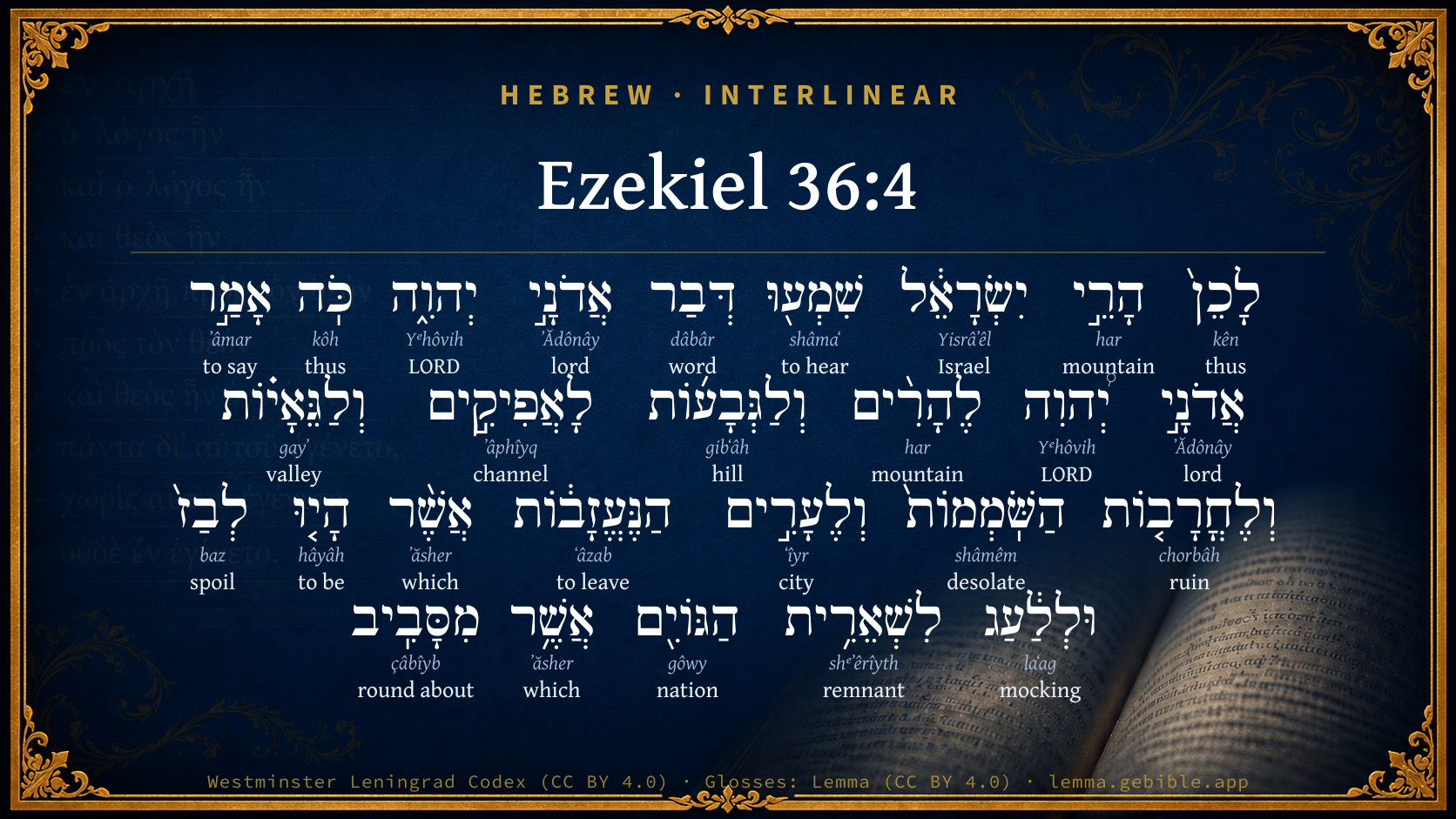
Ezekiel 36:4

Hebrew (Westminster Leningrad Codex) Ezekiel 36:4 appears in the Hebrew Old Testament. The text above is from the Westminster Leningrad Codex. Each word links to its Strong’s number, a concise gloss, and parsing drawn from the Open Scriptures Hebrew Bible morphology. Click any word for its full Brown-Driver-Briggs (BDB) entry.
Download image
Cite this verse

Ezekiel 36:4 (World English Bible). Public Domain. Lemma interlinear Bible study tool, https://lemma.gebible.app/v/ezekiel/36/4.

Show BibTeX & RIS
BibTeX
RIS
English Translation
therefore, you mountains of Israel, hear the word of the Lord Yahweh: Thus says the Lord Yahweh to the mountains and to the hills, to the watercourses and to the valleys, to the desolate wastes and to the cities that are forsaken, which are become a prey and derision to the residue of the nations that are round about;
World English Bible · Public Domain
Download a study sheet

One document with this verse’s original text, its word-by-word gloss line, the meaning frame, cross-references with their text, attributed commentary, and full source and license credits — printable, and it pastes into notes with its structure intact.

This verse Autodidact and up

Study sheet (.html) Plain text (.txt)

A passage Seminary Student

Up to 50 verses in one chapter. A passage sheet keeps up to 6 commentary sources and 12 cross-references per verse, in the order this page ranks them, and says so on the sheet whenever that leaves anything out. Ask for a single verse and you get the Autodidact verse sheet above.

Everything on this page stays free to read, with no account — the sheet is a download of what is already on screen, not access to it.

Want to remove ads? Support Godless Engineer
Compare translations 3

The same verse in 3 English versions, stacked beneath the original-language interlinear above. Click any original word for its lexicon entry.

Each is an independent rendering of the whole verse — the interlinear is not word-aligned to these translations.

Highlighted words mark where these versions differ — a whole-verse word diff, not a word-by-word alignment.

  • World English Bible Public Domain
    therefore, you mountains of Israel, hear the word of the Lord Yahweh: Thus says the Lord Yahweh to the mountains and to the hills, to the watercourses and to the valleys, to the desolate wastes and to the cities that are forsaken, which are become a prey and derision to the residue of the nations that are round about;
  • King James Version Public Domain
    Therefore, ye mountains of Israel, hear the word of the Lord GOD; Thus saith the Lord GOD to the mountains, and to the hills, to the rivers, and to the valleys, to the desolate wastes, and to the cities that are forsaken, which became a prey and derision to the residue of the heathen that are round about;
  • unfoldingWord Literal Text CC BY-SA 4.0
    Therefore, mountains of Israel, listen to the word of the Lord Yahweh: The Lord Yahweh says this to the mountains and the high hills, to the streambeds and valleys, to the uninhabited desolations and the forsaken cities that have become plunder and a subject of mocking for the other nations that surround them—

unfoldingWord Literal Text — © unfoldingWord, licensed CC BY-SA 4.0. Word-aligned USFM3 via Door43 (git.door43.org/unfoldingWord/en_ult).

Versions to compare (up to 4)

3 of 4 selected

Show all 18 translations

Every available English version of this verse, each an independent rendering of the whole verse.

  • World English Bible Public Domain
    therefore, you mountains of Israel, hear the word of the Lord Yahweh: Thus says the Lord Yahweh to the mountains and to the hills, to the watercourses and to the valleys, to the desolate wastes and to the cities that are forsaken, which are become a prey and derision to the residue of the nations that are round about;
  • Berean Standard Bible Public Domain
    therefore, O mountains of Israel, hear the word of the Lord GOD. This is what the Lord GOD says to the mountains and hills, to the ravines and valleys, to the desolate ruins and abandoned cities, which have become a spoil and a mockery to the rest of the nations around you.
  • Majority Standard Bible Public Domain
    therefore, O mountains of Israel, hear the word of the Lord GOD. This is what the Lord GOD says to the mountains and hills, to the ravines and valleys, to the desolate ruins and abandoned cities, which have become a spoil and a mockery to the rest of the nations around you.
  • King James Version Public Domain
    Therefore, ye mountains of Israel, hear the word of the Lord GOD; Thus saith the Lord GOD to the mountains, and to the hills, to the rivers, and to the valleys, to the desolate wastes, and to the cities that are forsaken, which became a prey and derision to the residue of the heathen that are round about;
  • American Standard Version (1901) Public Domain
    therefore, ye mountains of Israel, hear the word of the Lord Jehovah: Thus saith the Lord Jehovah to the mountains and to the hills, to the watercourses and to the valleys, to the desolate wastes and to the cities that are forsaken, which are become a prey and derision to the residue of the nations that are round about;
  • Revised Version (1885) Public Domain
    therefore, ye mountains of Israel, hear the word of the Lord GOD; Thus saith the Lord GOD to the mountains and to the hills, to the watercourses and to the valleys, to the desolate wastes and to the cities that are forsaken, which are become a prey and derision to the residue of the nations that are round about:
  • Geneva Bible (1599) Public Domain
    Therefore ye mountaines of Israel, heare the worde of the Lord God, Thus sayth the Lord God to the mountaines and to the hilles, to the riuers, and to the valleys, and to the waste, and desolate places, and to the cities that are forsaken: which are spoyled and had in derision of the residue of the heathen that are round about.
  • Douay-Rheims (1899) Public Domain
    Therefore, ye mountains of Israel, hear the word of the Lord God: Thus saith the Lord God to the mountains, and to the hills, to the brooks, and to the valleys, and to desolate places, and ruinous walls, and to the cities that are forsaken, that are spoiled, and derided by the rest of the nations round about.
  • Young's Literal Translation Public Domain
    Therefore, O mountains of Israel, Hear a word of the Lord Jehovah: Thus said the Lord Jehovah, to mountains, and to hills, To streams, and to valleys, And to wastes that `are' desolate, And to cities that are forsaken, That have been for a prey, And for a scorn, to the remnant of the nations who `are' round about.
  • Literal Standard Version CC BY-SA 4.0
    Therefore, O mountains of Israel, || Hear a word of Lord YHWH! Thus said Lord YHWH, to mountains, and to hills, || To streams, and to valleys, || And to ruins that [are] desolate, || And to cities that are forsaken, || That have been for a prey, || And for a scorn, to the remnant of the surrounding nations,
  • Unlocked Literal Bible CC BY-SA 4.0
    Therefore, mountains of Israel, listen to the word of the Lord Yahweh: The Lord Yahweh says this to the mountains and the high hills, to the streambeds and valleys, to the uninhabited desolations and the forsaken cities that have become plunder and a subject of mocking for the other nations that surround them—
  • unfoldingWord Literal Text CC BY-SA 4.0
    Therefore, mountains of Israel, listen to the word of the Lord Yahweh: The Lord Yahweh says this to the mountains and the high hills, to the streambeds and valleys, to the uninhabited desolations and the forsaken cities that have become plunder and a subject of mocking for the other nations that surround them—
  • Darby Bible Public Domain
    therefore, ye mountains of Israel, hear the word of the Lord Jehovah. Thus saith the Lord Jehovah to the mountains and to the hills, to the water-courses and to the valleys, to the desolate wastes and to the cities that are forsaken, which are become a prey and a derision to the remnant of the nations that are round about,
  • World Messianic Bible Public Domain
    therefore, you mountains of Israel, hear the word of the Lord GOD: The Lord GOD says to the mountains and to the hills, to the watercourses and to the valleys, to the desolate wastes and to the cities that are forsaken, which have become a prey and derision to the residue of the nations that are all around;
  • Webster's Bible Public Domain
    Therefore, ye mountains of Israel, hear the word of the Lord GOD; Thus saith the Lord GOD to the mountains, and to the hills, to the rivers, and to the valleys, to the desolate wastes, and to the cities that are forsaken, which became a prey and derision to the residue of the heathen that are around;
  • Free Bible Version CC BY-SA 4.0
    So now, mountains of Israel, listen to the message from the Lord God. This is what the Lord God says to the mountains and hills, to the ravines and valleys, to the deserted ruins and abandoned towns, that the other nations around you have looted and mocked.
  • Bible in Basic English Public Domain
    For this reason, you mountains of Israel, give ear to the word of the Lord; this is what the Lord has said to the mountains and to the hills, to the streams and to the valleys, to the unpeopled wastes and to the towns where no one is living, from which the goods have been taken and which have been put to shame by the rest of the nations who are round about:
  • JPS Tanakh (1917) Public Domain
    therefore, ye mountains of Israel, hear the word of the Lord GOD: Thus saith the Lord GOD to the mountains and to the hills, to the streams and to the valleys, to the desolate wastes and to the cities that are forsaken, which are become a prey and derision to the residue of the nations that are round about;

Literal Standard Version (2020), Covenant Press — licensed CC BY-SA 4.0. Text via the HelloAO Bible API (eBible.org). Unlocked Literal Bible (unfoldingWord) — licensed CC BY-SA 4.0. Text via the HelloAO Bible API (eBible.org). unfoldingWord Literal Text — © unfoldingWord, licensed CC BY-SA 4.0. Word-aligned USFM3 via Door43 (git.door43.org/unfoldingWord/en_ult). Free Bible Version, Dr. Jonathan Gallagher — licensed CC BY-SA 4.0. Text via the HelloAO Bible API (eBible.org).

Word by word

More ways to search: Search by grammar → Find every occurrence → Compare this word →

Practice this passage: Drill this verse → Learn its vocabulary →

הַשֹּֽׁמְמוֹת֙
shâmêm
H8076
“the · desolate”
Particle, Definite Article + Verb, Qal, Participle Active, Feminine, Plural, Absolute
Part of Speech
Particle + Verb
Stem
Qal
Form
Participle Active
Gender
Feminine
Number
Plural
State
Absolute
Full BDB Definition

Origin: from H8074

TWOT: 2409a

devastated, deserted, desolate
  1. לָכֵן֙ kên H3651 “to/for · thus” Preposition + Adverb
  2. הָרֵ֣י har H2022 “mountains of” Noun, Common, Masculine, Plural, Construct
  3. יִשְׂרָאֵ֔ל Yisrâʼêl H3478 “Israel” Noun, Proper
  4. שִׁמְע֖וּ shâmaʻ H8085 “hear” Verb, Qal, Imperative, 2nd Person, Masculine, Plural
  5. דְּבַר dâbâr H1697 “word of” Noun, Common, Masculine, Singular, Construct
  6. אֲדֹנָ֣י ʼĂdônây H136 “Lord · my” Noun, Common, Masculine, Plural, Construct + Suffix, Personal, 1st Person, Common, Singular
  7. יְהוִ֑ה Yᵉhôvih H3069 “LORD” Noun, Proper
  8. כֹּֽה kôh H3541 “thus” Adverb
  9. אָמַ֣ר ʼâmar H559 “to say” Verb, Qal, Perfect, 3rd Person, Masculine, Singular
  10. אֲדֹנָ֣י ʼĂdônây H136 “Lord · my” Noun, Common, Masculine, Plural, Construct + Suffix, Personal, 1st Person, Common, Singular
  11. יְ֠הוִה Yᵉhôvih H3069 “LORD” Noun, Proper
  12. לֶהָרִ֨ים har H2022 “to/for the · mountains” Preposition, Determined + Noun, Common, Masculine, Plural, Absolute
  13. וְלַגְּבָע֜וֹת gibʻâh H1389 “and · to/for the · hills” Conjunction + Preposition, Determined + Noun, Common, Feminine, Plural, Absolute
  14. לָאֲפִיקִ֣ים ʼâphîyq H650 “to/for the · channels” Preposition, Determined + Noun, Common, Masculine, Plural, Absolute
  15. וְלַגֵּאָי֗וֹת gayʼ H1516 “and · to/for the · valleys” Conjunction + Preposition, Determined + Noun, Common, Both, Plural, Absolute
  16. וְלֶחֳרָב֤וֹת chorbâh H2723 “and · to/for the · ruins” Conjunction + Preposition, Determined + Noun, Common, Feminine, Plural, Absolute
  17. וְלֶעָרִ֣ים ʻîyr H5892 “and · to/for the · cities” Conjunction + Preposition, Determined + Noun, Common, Feminine, Plural, Absolute
  18. הַנֶּעֱזָב֔וֹת ʻâzab H5800 “the · left” Particle, Definite Article + Verb, Niphal, Participle Passive, Feminine, Plural, Absolute
  19. אֲשֶׁ֨ר ʼăsher H834 “which” Particle, Relative
  20. הָי֤וּ hâyâh H1961 “to be” Verb, Qal, Perfect, 3rd Person, Common, Plural
  21. לְבַז֙ baz H957 “to/for · spoil” Preposition + Noun, Common, Masculine, Singular, Absolute
  22. וּלְלַ֔עַג laʻag H3933 “and · to/for · mocking” Conjunction + Preposition + Noun, Common, Masculine, Singular, Absolute
  23. לִשְׁאֵרִ֥ית shᵉʼêrîyth H7611 “to/for · remnant of” Preposition + Noun, Common, Feminine, Singular, Construct
  24. הַגּוֹיִ֖ם gôwy H1471 “the · nations” Particle, Definite Article + Noun, Common, Masculine, Plural, Absolute
  25. אֲשֶׁ֥ר ʼăsher H834 “which” Particle, Relative
  26. מִסָּבִֽיב çâbîyb H5439 “from · round about” Preposition + Noun, Common, Both, Singular, Absolute

About this verse

These counts appear in no published source. They are computed here, from the morphology-tagged text and Lemma’s own curated glosses. What Lemma adds →

27
words
23
distinct lemmas
Prophets
section

Notable vocabulary

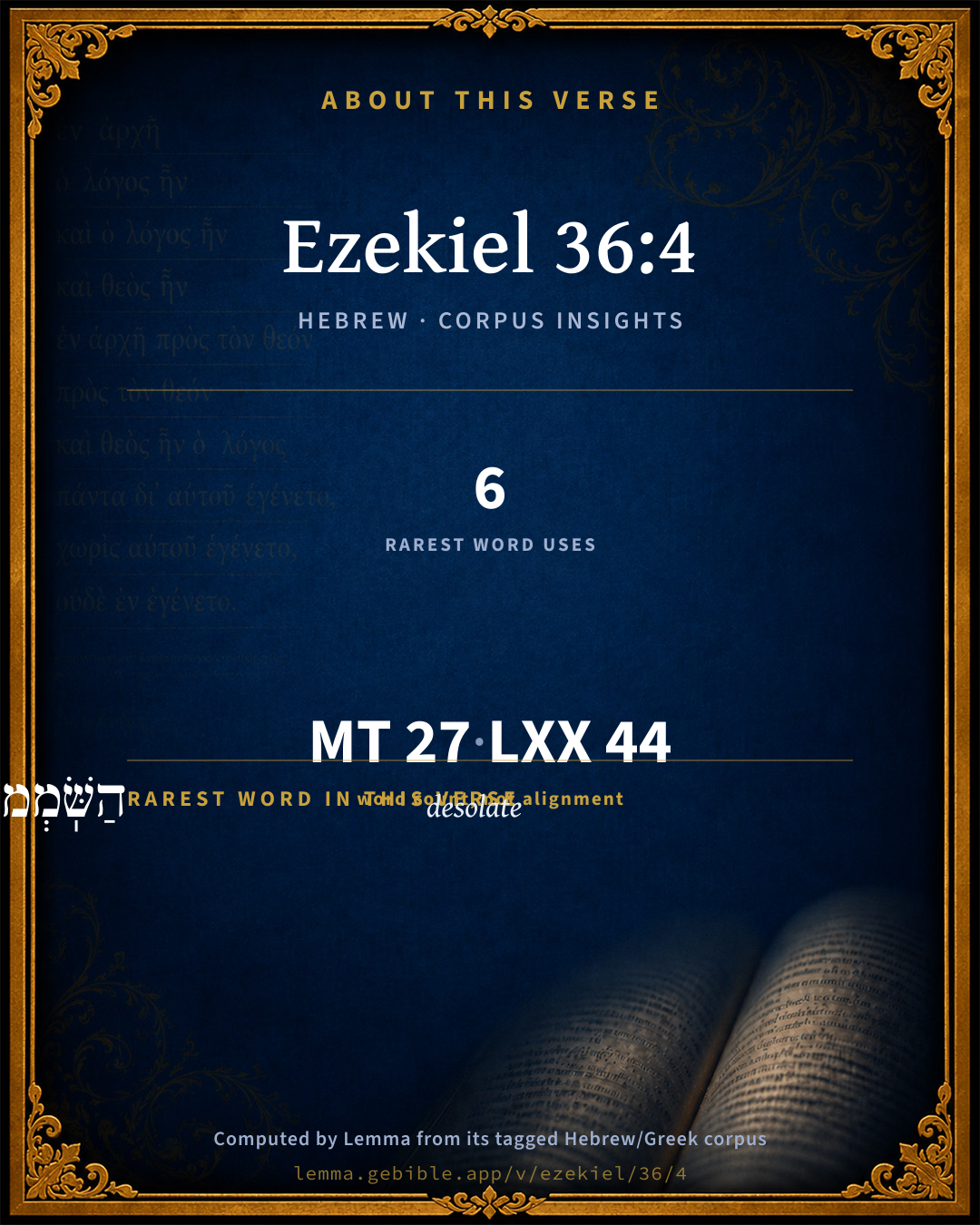
The rarest word here is הַשֹּֽׁמְמוֹת֙ desolate H8076 — appearing just 6 times in the whole Hebrew Bible.

Shared distinctive vocabulary

הַשֹּֽׁמְמוֹת֙ desolate H8076 occurs in 6 verses of the Hebrew Bible. Also found in:

Grammatical profile

  • 5 verbs
  • 18 nouns
  • 2 adverbs
  • 2 particles

Verb forms

  • שִׁמְע֖וּ Qal · Imperative
  • אָמַ֣ר Qal · Perfect
  • הַשֹּֽׁמְמוֹת֙ Qal · Participle Active
  • הַנֶּעֱזָב֔וֹת Niphal · Participle Passive
  • הָי֤וּ Qal · Perfect

Repetition

Words recur within this verse — often emphatic in Hebrew:

  • הָרֵ֣י mountain H2022 ×2
  • אֲדֹנָ֣י lord H136 ×2
  • יְהוִ֑ה LORD H3069 ×2
  • אֲשֶׁ֨ר which H834 ×2

Hebrew & Septuagint length

In English translation the verse runs 59 words from the Hebrew and 65 from the Septuagint (LXX English) — closely comparable.

A rough comparison of the two English renderings, which tokenize alike — not a word-level alignment.

Word counts can differ between the Hebrew and the Greek without any difference in meaning — e.g. the Hebrew direct-object marker אֵת has no separate Greek word, and Greek often adds the article ὁ.

In the original languages it is 27 Hebrew tokens and 44 Greek tokens — but the two are counted differently (Hebrew bundles its prefixes and suffixes into one token; the Greek is in lemma form), so that isn’t a like-for-like length.

Cross-references

14

Topical passages linked to Ezekiel 36:4 in the Treasury of Scripture Knowledge — connected by theme and wording, ordered by reader-vote popularity; previews shown in the World English Bible.

  • Deuteronomy 11:11 but the land, where you go over to possess it, is a land of hills and valleys, [and] drinks water of the rain of the sky,
  • Ezekiel 34:28 They shall no more be a prey to the nations, neither shall the animals of the earth devour them; but they shall dwell securely, and none shall make them afraid.
  • Psalms 79:4 We have become a reproach to our neighbors, A scoffing and derision to those who are around us.
  • Ezekiel 36:1 You, son of man, prophesy to the mountains of Israel, and say, You mountains of Israel, hear the word of Yahweh.
  • Ezekiel 36:6 Therefore prophesy concerning the land of Israel, and tell the mountains and to the hills, to the watercourses and to the valleys, Thus says the Lord Yahweh: Behold, I have spoken in my jealousy and in my wrath, because you have borne the shame of the nations:
  • 2 Chronicles 36:17–21 Therefore he brought on them the king of the Chaldeans, who killed their young men with the sword in the house of their sanctuary, and had no compassion on young man or virgin, old man or gray-headed: he gave them all into his hand.
  • Isaiah 6:11 Then I said, "Lord, how long?" He answered, "Until cities are waste without inhabitant, And houses without man, And the land becomes utterly waste,
  • Isaiah 24:1–12 Behold, Yahweh makes the earth empty, and makes it waste, and turns it upside down, and scatters abroad the inhabitants of it.
  • Isaiah 64:10–11 Your holy cities are become a wilderness, Zion is become a wilderness, Jerusalem a desolation.
  • Jeremiah 25:9–13 behold, I will send and take all the families of the north, says Yahweh, and [I will send] to Nebuchadrezzar the king of Babylon, my servant, and will bring them against this land, and against the inhabitants of it, and against all these nations round about; and I will utterly destroy them, and make them an astonishment, and a hissing, and perpetual desolations.
  • Jeremiah 29:10 For thus says Yahweh, After seventy years are accomplished for Babylon, I will visit you, and perform my good word toward you, in causing you to return to this place.
  • Ezekiel 6:3 and say, You mountains of Israel, hear the word of the Lord Yahweh: Thus says the Lord Yahweh to the mountains and to the hills, to the watercourses and to the valleys: Behold, I, even I, will bring a sword on you, and I will destroy your high places.
  • Ezekiel 6:14 I will stretch out my hand on them, and make the land desolate and waste, from the wilderness toward Diblah, throughout all their habitations: and they shall know that I am Yahweh.
  • Ezekiel 36:33–35 Thus says the Lord Yahweh: In the day that I cleanse you from all your iniquities, I will cause the cities to be inhabited, and the waste places shall be built.

Cross-references courtesy of OpenBible.info (CC BY 4.0).

Hebrew and Greek witnesses Masoretic Hebrew ↔ Greek Septuagint

The same verse in the two great witnesses to the Old Testament, shown verse-for-verse.

These are two independent witnesses, not word-aligned to each other, and the Septuagint is shown in lemma (dictionary) form.

Hebrew Ezekiel 36:4 Masoretic · Westminster Leningrad Codex

לָכֵן֙ הָרֵ֣י יִשְׂרָאֵ֔ל שִׁמְע֖וּ דְּבַר אֲדֹנָ֣י יְהוִ֑ה כֹּֽה אָמַ֣ר אֲדֹנָ֣י יְ֠הוִה לֶהָרִ֨ים וְלַגְּבָע֜וֹת לָאֲפִיקִ֣ים וְלַגֵּאָי֗וֹת וְלֶחֳרָב֤וֹת הַשֹּֽׁמְמוֹת֙ וְלֶעָרִ֣ים הַנֶּעֱזָב֔וֹת אֲשֶׁ֨ר הָי֤וּ לְבַז֙ וּלְלַ֔עַג לִשְׁאֵרִ֥ית הַגּוֹיִ֖ם אֲשֶׁ֥ר מִסָּבִֽיב

therefore, you mountains of Israel, hear the word of the Lord Yahweh: Thus says the Lord Yahweh to the mountains and to the hills, to the watercourses and to the valleys, to the desolate wastes and to the cities that are forsaken, which are become a prey and derision to the residue of the nations that are round about;

World English Bible · Public Domain

Greek LXX Ezekiel 36:4 Septuagint · lemma form

διά οὗτος ὄρος ἰσραήλ ἀκούω λόγος κύριος ὅδε λέγω κύριος ὁ ὄρος καί ὁ βουνός καί ὁ φάραγξ καί ὁ χειμάρρους καί ὁ ἐκἐρημόω καί ἀπο ἀναἵζω καί ὁ πόλις ὁ ἐν καταλείπω ὅς γίγνομαι εἰς προνομή καί εἰς καταπάτημα ὁ καταλείπω ἔθνος περικύκλῳ

therefore, you⌃ mountains of Israel, hear the word of the Lord; Thus says the Lord to the mountains, and to the hills, and to the streams, and to the valleys, and to the places that have been made desolate and destroyed, and to the cities that have been deserted, and have become a spoil and a trampling to the nations that were left round about;

LXX2012 (modern English Septuagint) · Public Domain

Hebrew: Westminster Leningrad Codex (CC BY 4.0). Greek: Septuagint (public domain); English from LXX2012 (modern English Septuagint) (Public Domain). How the Septuagint differs from the Hebrew →

Targum (Aramaic paraphrase)

1

The Targum is the ancient Jewish Aramaic paraphrase of the Hebrew Scriptures — an interpretive translation, not the Hebrew text itself. Onkelos (literal) and Pseudo-Jonathan (expansive) render the Torah, and Jonathan the Prophets. Coverage is partial: where no permissively-licensed English translation exists for a verse, only the Aramaic is shown. This is verse-level text, not a word-by-word alignment to the Hebrew.

  1. Targum Jonathan Prophets (Joshua–Malachi)
    בְּכֵן טוּרֵי יִשְׂרָאֵל קַבִּילוּ פִּתְגָמָא דַייָ אֱלֹהִים כִּדְנַן אֲמַר יְיָ אֱלֹהִים לְטוּרַיָא וּלְרָמָתָא לְפַצִידַיָא וּלְחֵילַיָא וּלְחֶרְבָתָא צַדְיָתָא וּלְקִרְוַיָא שְׁבִיקָתָא דַהֲוָאָה לְחוֹךְ וּלְלָעָב לִשְׁאָרָא דְעַמְמַיָא דְמִסְחוֹר סְחוֹר:

    (no public-domain English translation for this verse)

    Targum Jonathan — Aramaic: “Mikraot Gedolot” (public domain). English: “Sefaria Community Translation” (CC0 1.0 (public-domain dedication)); “London "Chaldee Paraphrase," 1871” (public domain). Text via Sefaria.

Commentary

Notes on Ezekiel 36:4 from classic Christian and Jewish commentators (each source and its license shown beneath its notes). The classic Christian expositions comment on the surrounding passage and are grouped to its opening verse, so a note may address several verses; the Jewish commentaries on the Tanakh (Rashi and others) are per-verse, so they appear only where the commentator wrote on this verse.

Lemma curates 59 commentaries, every one of them public domain or Creative Commons licensed, each selected and text-cleaned for this edition rather than reprinted as found. About our sources →

Trapp's Complete Commentary

John Trapp

Eze 36:4 Therefore, ye mountains of Israel, hear the word of the Lord GOD; Thus saith the Lord GOD to the mountains, and to the hills, to the rivers, and to the valleys, to the desolate wastes, and to the cities that are forsaken, which became a prey and derision to the residue of the heathen that [are] round about;

Ver. 4. Therefore thus saith the Lord God to the mountains.] For men there were hardly any left, or not very fit to be dealt with. See Eze 36:1.

Which became a prey.] To those man eaters, {Eze 36:3} qui diruerunt et devoraverunt, who did eat up God’s people as they ate bread, {Psa 14:4} making themselves merry with their misery.

John Trapp, A Commentary or Exposition upon All the Books of the Old and New Testament (1647–1656) — public domain. Text from a community e-Sword module.

Jamieson, Fausset & Brown

Robert Jamieson, A. R. Fausset & David Brown

Inanimate creatures are addressed, to imply that the creature also, as it were, groans for deliverance from the bondage of corruption into the glorious liberty of the children of God (Rom 8:19-21) [POLANUS]. The completeness of the renewed blessedness of all parts of the land is implied.

derision-- (Psa 79:4).

Jamieson, Fausset & Brown — Commentary Critical and Explanatory on the Whole Bible (1871) — public domain (CC PDM 1.0). Text via the HelloAO Bible API.

Adam Clarke's Commentary

Verse 4. Therefore - thus saith the Lord God to the mountains, c.] They shall neither possess mountain nor valley, hill nor dale, fountain nor river for though in my justice I made you desolate, yet they shall not profit by your disasters. See Eze 36:5-7.

Adam Clarke's Commentary on the Bible (1810–1826) — public domain. Text from a community e-Sword/MySword module.

John Gill's Exposition

Therefore, ye mountains of Israel, hear the word of the Lord,.... As in Eze 36:1, here repeated to raise and quicken their attention to what was about to be said to them:

thus saith the Lord God to the mountains, and to the hills, to the rivers, and to the valleys, to the desolate wastes, and to the cities that are forsaken; before only the mountains are spoken to, though the whole land was included; here the several particulars are given, which describe the whole, and which suffered in the calamity, and the inhabitants that dwelt in them or near them; who only can be supposed to hear the word of the Lord, though places are only mentioned, because of the great depopulation of them:

which became a prey and derision to the residue of the Heathen that are round about; to the Tyrians, Philistines, Edomites, Ammonites, and Moabites; who mocked the Jews, rejoicing at their destruction by the king of Babylon, and seized upon as a prey to themselves what he left: or these are the residue of the Heathens round about Judea; who remained after the judgments threatened were executed on the above nations, foretold in chapters twenty five and twenty six, see Eze 36:36.

John Gill's Exposition of the Whole Bible (1746–1763) — public domain (CC PDM 1.0). Text via the HelloAO Bible API.

Matthew Poole's English Annotations

To the hills: now is added a particular of hills, valleys, &c., whereas before only the mountains were mentioned, but by them the whole land was understood; and to assure them thereof, all parts are here particularly mentioned: all that the enemy wasted shall be repaired, all that he took away shall be restored in kind, and those he derided shall be vindicated; their estates repaired, cities rebuilt and filled, their credit and honour cleared and vindicated. Their deliverance should be complete and full.

Matthew Poole's English Annotations on the Holy Bible (1683–1685) — public domain. Text from a community e-Sword/MySword module.

The Pulpit Commentary

The rivers (or, channels, bottoms, dales) were the watercourses, wadies, or ravines through which mountain streams flowed, as in Eze_35:8; and the residue of the heathen were the surrounding nations that had mocked Israel in her degradation, and were then profiting by her fall. (comp. Psa_79:4)

The Pulpit Commentary (1880–1919), ed. H.D.M. Spence-Jones & Joseph S. Exell — public domain. Text from a community e-Sword module.

unfoldingWord translationNotes

Door43 World Missions Community

General Information:

This continues the message that Yahweh tells Ezekiel to speak to the mountains of Israel. The message is for all of the people of Israel.

General Information:

It may be helpful to use a verse bridge here, as the UDB does, to arrange the text in a more logical order. (See: Verse Bridges)

listen to the word of the Lord Yahweh

"listen to the message of the Lord Yahweh"

the uninhabited desolations

The abstract noun "desolations" can be stated as "desolate cities." AT: "the desolate cities which have no people living in them" (See: Abstract Nouns)

the forsaken cities

This can be stated in active form. AT: "the cities that people have left behind" (See: Active or Passive)

that have become plunder

"that enemies have stolen from"

a subject of mocking for the other nations that surround them

"that the other, surrounding nations mock"

in the fire of my fury

This speaks of Yahweh's fury as if it were a fire. Yahweh loves Israel very much, so he becomes jealous and angry when other nations mock it. AT: "because of my intense jealousy" or "because of my very strong anger" (See: Metaphor)

against Edom and all

"and against all of Edom"

had both joy in their heart and disdain in their spirit, as they seized my land

Here "heart" and "spirit" represent a person's inner being. The ideas of having joy and disdain can be expressed with the verbs "rejoiced" and "despised." AT: "who despised the people of Israel and rejoiced while they took my land" (See: Metonymy)

Behold!

The word "Behold" here adds emphasis to what follows. AT: "Indeed!"

In my fury and in my anger

The words "fury" and "anger" mean basically the same thing. Together they emphasize the intensity of his anger. AT: "Because I am extremely angry" (See: Doublet)

you have borne the insults of nations

"other nations have insulted you" or "other nations have mocked you"

translationWords

desolate

forsake

mock

nation

fire

Edom

joy

heart

spirit

seize

anger

declare

unfoldingWord translationNotes — © Distant Shores Media and the Door43 World Missions Community, licensed CC BY-SA 4.0. Source: git.door43.org/Door43/en_tn.

Lesson kit

Teaching starters — assembled from the data on this page, not authored interpretation. Every prompt links to the verse data it draws on. Edit before teaching.

Ezekiel, in the Prophets, opens this verse with 27 words (23 distinct Hebrew lemmas). Its most distinctive word is shâmêm (“desolate”). A historical commentator’s framing appears above. Read the whole chapter for the surrounding context.

Discussion questions

  1. How does “desolate” (shâmêm) shape what this verse is saying?
  2. 2 Samuel 13:20 shares the word «desolate» with this verse. How do the two illuminate each other?
  3. “mountain” occurs 2× in this one verse. What is the effect of the repetition?
  4. The translations on this page render this verse differently — a whole-verse word diff, not a word-by-word alignment. What might account for the different wordings?
  5. The verb «שִׁמְע֖וּ» is Qal Imperative. How does its form color the action?
  6. Reading how Trapp's Complete Commentary and Jamieson, Fausset & Brown read this verse, where do the two commentators agree and where do they part?

Things to notice

Reading settings

Reading text

Shown beneath each verse's original-language words.

Old Testament
Old Testament edition

Read the OT as the Masoretic Hebrew (MT) or the Greek Septuagint (LXX).

English shown for the Greek Septuagint (in the Hebrew ↔ Greek comparison).

Comparing translations? Open the Compare panel on any verse page to stack up to four side by side.