Nehemiah 6:19

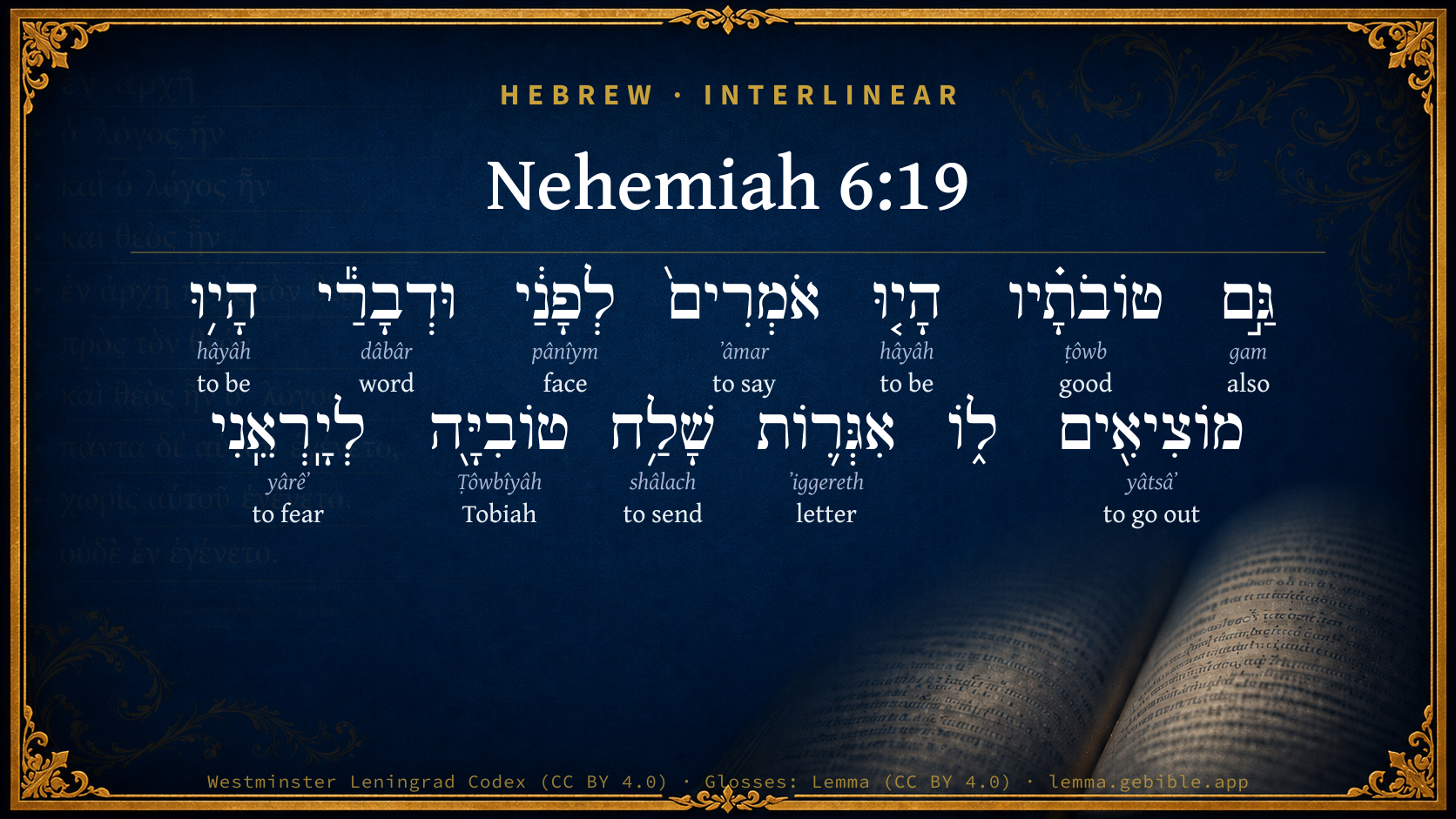
Hebrew (Westminster Leningrad Codex) Nehemiah 6:19 appears in the Hebrew Old Testament. The text above is from the Westminster Leningrad Codex. Each word links to its Strong’s number, a concise gloss, and parsing drawn from the Open Scriptures Hebrew Bible morphology. Click any word for its full Brown-Driver-Briggs (BDB) entry.
Download image
Cite this verse

Nehemiah 6:19 (World English Bible). Public Domain. Lemma interlinear Bible study tool, https://lemma.gebible.app/v/nehemiah/6/19.

Show BibTeX & RIS
BibTeX
RIS
English Translation
Also they spoke of his good deeds before me, and reported my words to him. Tobiah sent letters to put me in fear.
World English Bible · Public Domain
Download a study sheet

One document with this verse’s original text, its word-by-word gloss line, the meaning frame, cross-references with their text, attributed commentary, and full source and license credits — printable, and it pastes into notes with its structure intact.

This verse Autodidact and up

Study sheet (.html) Plain text (.txt)

A passage Seminary Student

Up to 50 verses in one chapter. A passage sheet keeps up to 6 commentary sources and 12 cross-references per verse, in the order this page ranks them, and says so on the sheet whenever that leaves anything out. Ask for a single verse and you get the Autodidact verse sheet above.

Everything on this page stays free to read, with no account — the sheet is a download of what is already on screen, not access to it.

Want to remove ads? Support Godless Engineer
Compare translations 3

The same verse in 3 English versions, stacked beneath the original-language interlinear above. Click any original word for its lexicon entry.

Each is an independent rendering of the whole verse — the interlinear is not word-aligned to these translations.

Highlighted words mark where these versions differ — a whole-verse word diff, not a word-by-word alignment.

  • World English Bible Public Domain
    Also they spoke of his good deeds before me, and reported my words to him. Tobiah sent letters to put me in fear.
  • King James Version Public Domain
    Also they reported his good deeds before me, and uttered my words to him. And Tobiah sent letters to put me in fear.
  • unfoldingWord Literal Text CC BY-SA 4.0
    Also, they were saying his good deeds before my face, and they were taking out my words to him. Tobiah sent letters to frighten me.

unfoldingWord Literal Text — © unfoldingWord, licensed CC BY-SA 4.0. Word-aligned USFM3 via Door43 (git.door43.org/unfoldingWord/en_ult).

Versions to compare (up to 4)

3 of 4 selected

Show all 18 translations

Every available English version of this verse, each an independent rendering of the whole verse.

  • World English Bible Public Domain
    Also they spoke of his good deeds before me, and reported my words to him. Tobiah sent letters to put me in fear.
  • Berean Standard Bible Public Domain
    Moreover, these nobles kept reporting to me Tobiah’s good deeds, and they relayed my words to him. And Tobiah sent letters to intimidate me.
  • Majority Standard Bible Public Domain
    Moreover, these nobles kept reporting to me Tobiah’s good deeds, and they relayed my words to him. And Tobiah sent letters to intimidate me.
  • King James Version Public Domain
    Also they reported his good deeds before me, and uttered my words to him. And Tobiah sent letters to put me in fear.
  • American Standard Version (1901) Public Domain
    Also they spake of his good deeds before me, and reported my words to him. `And' Tobiah sent letters to put me in fear.
  • Revised Version (1885) Public Domain
    Also they spake of his good deeds before me, and reported my words to him. And Tobiah sent letters to put me in fear.
  • Geneva Bible (1599) Public Domain
    Yea, they spake in his praise before me, and tolde him my wordes, and Tobiah sent letters to put me in feare.
  • Douay-Rheims (1899) Public Domain
    And they praised him also before me, and they related my words to him: And Tobias sent letters to put me in fear.
  • Young's Literal Translation Public Domain
    also, his good deeds they have been saying before me, and my words they have been taking out to him; letters hath Tobiah sent to make me afraid.
  • Literal Standard Version CC BY-SA 4.0
    also, they have been speaking of his good deeds before me, and they have been taking my words out to him; Tobiah has sent letters to make me afraid.
  • Unlocked Literal Bible CC BY-SA 4.0
    They also spoke to me about his good deeds and reported my words back to him. Letters were sent to me from Tobiah to frighten me.
  • unfoldingWord Literal Text CC BY-SA 4.0
    Also, they were saying his good deeds before my face, and they were taking out my words to him. Tobiah sent letters to frighten me.
  • Darby Bible Public Domain
    Also they spoke of his good deeds before me, and reported my words to him. [And] Tobijah sent letters to put me in fear.
  • World Messianic Bible Public Domain
    Also they spoke of his good deeds before me, and reported my words to him. Tobiah sent letters to put me in fear.
  • Webster's Bible Public Domain
    Also they reported his good deeds before me, and uttered my words to him. And Tobiah sent letters to put me in fear.
  • Free Bible Version CC BY-SA 4.0
    They kept on telling me all the good things Tobiah was doing, and they reported to him what I said. Tobiah also sent letters to try and scare me.
  • Bible in Basic English Public Domain
    And they said much before me of the good he had done, and gave him accounts of my words. And Tobiah sent letters with the purpose of causing me fear.
  • JPS Tanakh (1917) Public Domain
    Also they spoke of his good deeds before me, and reported my words to him. And Tobiah sent letters to put me in fear.

Literal Standard Version (2020), Covenant Press — licensed CC BY-SA 4.0. Text via the HelloAO Bible API (eBible.org). Unlocked Literal Bible (unfoldingWord) — licensed CC BY-SA 4.0. Text via the HelloAO Bible API (eBible.org). unfoldingWord Literal Text — © unfoldingWord, licensed CC BY-SA 4.0. Word-aligned USFM3 via Door43 (git.door43.org/unfoldingWord/en_ult). Free Bible Version, Dr. Jonathan Gallagher — licensed CC BY-SA 4.0. Text via the HelloAO Bible API (eBible.org).

Word by word

More ways to search: Search by grammar → Find every occurrence → Compare this word →

Practice this passage: Drill this verse → Learn its vocabulary →

אִגְּר֛וֹת
ʼiggereth
H107
“letters”
Noun, Common, Feminine, Plural, Absolute
Part of Speech
Noun
Type
Common
Gender
Feminine
Number
Plural
State
Absolute
Full BDB Definition

Origin: from H104

TWOT: 23b

letter, missive
  1. גַּ֣ם gam H1571 “also” Particle, Accusative
  2. טוֹבֹתָ֗יו ṭôwb H2896 “good · his” Adjective, Adjective, Feminine, Plural, Construct + Suffix, Personal, 3rd Person, Masculine, Singular
  3. הָי֤וּ hâyâh H1961 “to be” Verb, Qal, Perfect, 3rd Person, Common, Plural
  4. אֹמְרִים֙ ʼâmar H559 “saying” Verb, Qal, Participle Active, Masculine, Plural, Absolute
  5. לְפָנַ֔י pânîym H6440 “to/for · face(s) · my” Preposition + Noun, Common, Both, Plural, Construct + Suffix, Personal, 1st Person, Common, Singular
  6. וּדְבָרַ֕י dâbâr H1697 “and · words · my” Conjunction + Noun, Common, Masculine, Plural, Construct + Suffix, Personal, 1st Person, Common, Singular
  7. הָי֥וּ hâyâh H1961 “to be” Verb, Qal, Perfect, 3rd Person, Common, Plural
  8. מוֹצִיאִ֖ים yâtsâʼ H3318 “going out” Verb, Hiphil, Participle Active, Masculine, Plural, Absolute
  9. שָׁלַ֥ח shâlach H7971 “to send” Verb, Qal, Perfect, 3rd Person, Masculine, Singular
  10. טוֹבִיָּ֖ה Ṭôwbîyâh H2900 “Tobiah” Noun, Proper
  11. לְיָֽרְאֵֽנִי yârêʼ H3372 “to fear · me” Preposition + Verb, Piel, Infinitive Construct + Suffix, Personal, 1st Person, Common, Singular

About this verse

These counts appear in no published source. They are computed here, from the morphology-tagged text and Lemma’s own curated glosses. What Lemma adds →

13
words
11
distinct lemmas
Historical
section

Notable vocabulary

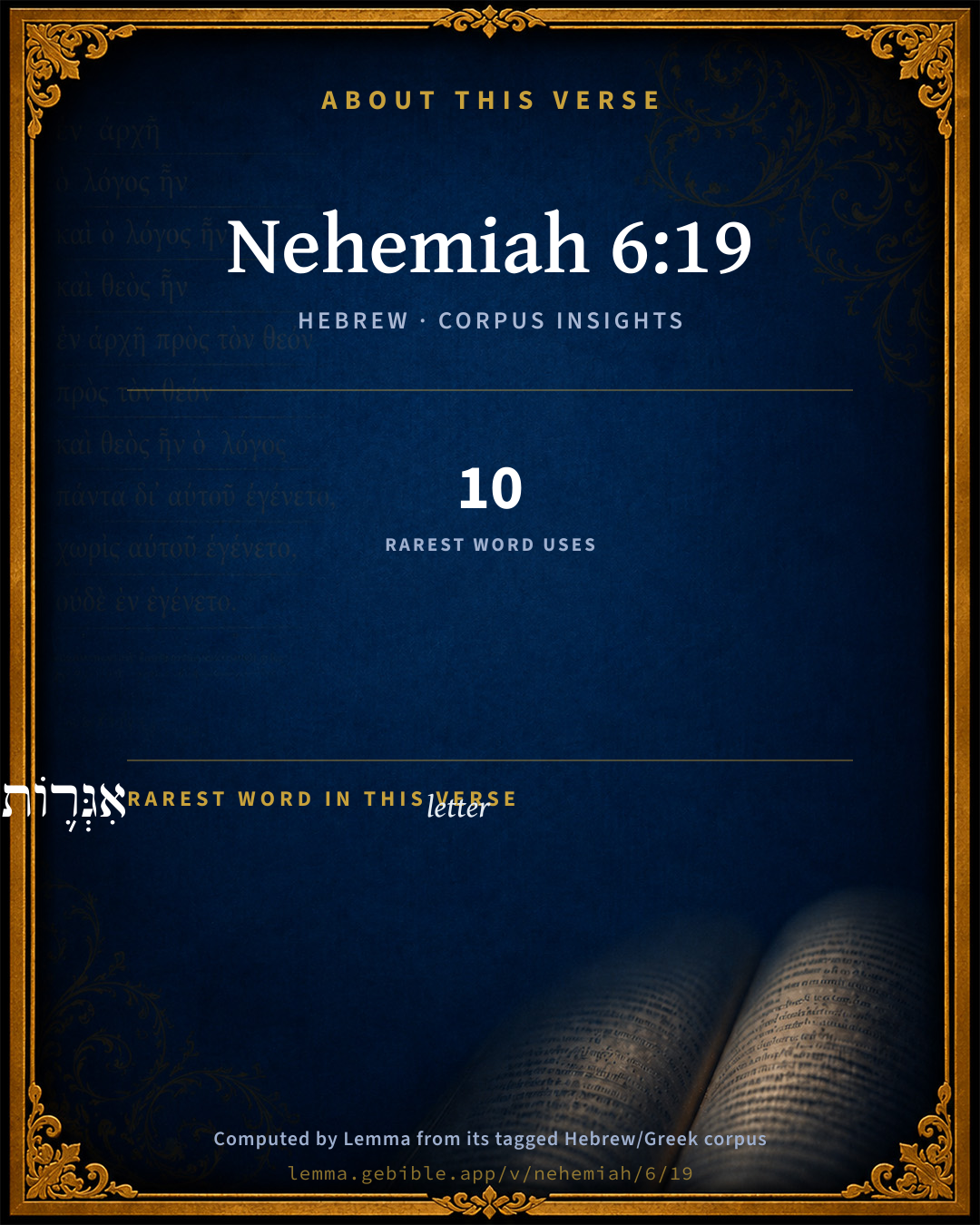
The rarest word here is אִגְּר֛וֹת letter H107 — appearing just 10 times in the whole Hebrew Bible.

Shared distinctive vocabulary

אִגְּר֛וֹת letter H107 occurs in 10 verses of the Hebrew Bible. Also found in:

Grammatical profile

  • 6 verbs
  • 4 nouns
  • 1 adjective
  • 1 preposition
  • 1 particle

Verb forms

  • הָי֤וּ Qal · Perfect
  • אֹמְרִים֙ Qal · Participle Active
  • הָי֥וּ Qal · Perfect
  • מוֹצִיאִ֖ים Hiphil · Participle Active
  • שָׁלַ֥ח Qal · Perfect
  • לְיָֽרְאֵֽנִי Piel · Infinitive Construct

Repetition

A word recurs within this verse — often emphatic in Hebrew:

  • הָי֤וּ to be H1961 ×2

Cross-references

8

Topical passages linked to Nehemiah 6:19 in the Treasury of Scripture Knowledge — connected by theme and wording, ordered by reader-vote popularity; previews shown in the World English Bible.

  • Nehemiah 6:9 For they all would have made us afraid, saying, Their hands shall be weakened from the work, that it not be done. But now, [God], strengthen you my hands.
  • Nehemiah 6:13 For this cause was he hired, that I should be afraid, and do so, and sin, and that they might have matter for an evil report, that they might reproach me.
  • Proverbs 28:4 Those who forsake the law praise the wicked; But those who keep the law contend with them.
  • Isaiah 37:10–14 Thus shall you speak to Hezekiah king of Judah, saying, Don't let your God in whom you trust deceive you, saying, Jerusalem shall not be given into the hand of the king of Assyria.
  • John 7:7 The world can't hate you, but it hates me, because I testify about it, that its works are evil.
  • John 15:19 If you were of the world, the world would love its own. But because you are not of the world, since I chose you out of the world, therefore the world hates you.
  • Acts 4:18–21 They called them, and charged them not to speak at all nor teach in the name of Jesus.
  • 1 John 4:5 They are of the world. Therefore they speak of the world, and the world hears them.

Cross-references courtesy of OpenBible.info (CC BY 4.0).

Hebrew and Greek witnesses Masoretic Hebrew ↔ Greek Septuagint

The same verse in the two great witnesses to the Old Testament, shown verse-for-verse.

These are two independent witnesses, not word-aligned to each other, and the Septuagint is shown in lemma (dictionary) form.

Hebrew Nehemiah 6:19 Masoretic · Westminster Leningrad Codex

גַּ֣ם טוֹבֹתָ֗יו הָי֤וּ אֹמְרִים֙ לְפָנַ֔י וּדְבָרַ֕י הָי֥וּ מוֹצִיאִ֖ים ל֑וֹ אִגְּר֛וֹת שָׁלַ֥ח טוֹבִיָּ֖ה לְיָֽרְאֵֽנִי

Also they spoke of his good deeds before me, and reported my words to him. Tobiah sent letters to put me in fear.

World English Bible · Public Domain

Greek LXX Structure differs

The Septuagint has no separate book of Nehemiah. Its Greek text is the second half of Esdras B (2 Esdras), chapters 11–23; Ezra is the first half (1–10).

A verse-for-verse comparison isn’t shown here because the chapters and verses don’t line up. Switch to the LXX edition with the MT / LXX toggle above to read the Greek directly.

Hebrew: Westminster Leningrad Codex (CC BY 4.0). Greek: Septuagint (public domain); English from a public-domain English Septuagint. How the Septuagint differs from the Hebrew →

Commentary

Notes on Nehemiah 6:19 from classic Christian and Jewish commentators (each source and its license shown beneath its notes). The classic Christian expositions comment on the surrounding passage and are grouped to its opening verse, so a note may address several verses; the Jewish commentaries on the Tanakh (Rashi and others) are per-verse, so they appear only where the commentator wrote on this verse.

Lemma curates 59 commentaries, every one of them public domain or Creative Commons licensed, each selected and text-cleaned for this edition rather than reprinted as found. About our sources →

Trapp's Complete Commentary

John Trapp

Neh 6:19 Also they reported his good deeds before me, and uttered my words to him. [And] Tobiah sent letters to put me in fear.

Ver. 19. Also they reported his good deeds before me] Heb. His goodness, as if he had been another Phocion, who was surnamed the Good. But this was but in their opinion only, who had little enough goodness, and skill to judge it. Or if there were any good in him, yet Sunt bona mista malis and of him might be said, as once of Sfortz, duke of Milan, that he was a very monster, made up and compact of virtue and vice (Folieta Galeazo).

John Trapp, A Commentary or Exposition upon All the Books of the Old and New Testament (1647–1656) — public domain. Text from a community e-Sword module.

The Biblical Illustrator

Joseph S. Exell

Neh_6:19

Also they reported his good deeds before me.

The bad men praised

I. Bad men do get praised.

1. Sometimes this praise is real.

2. Sometimes this praise is mistaken.

3. Sometimes this praise is fictitious altogether.

II. Bad men are anxious for praise.

1. In this there is a sentence of condemnation.

2. In this there is an indirect homage to virtue.

III. Bad men are not hidden by the praise of the world.

1. Good men detect.

2. God detects.

Application:

1. Do not be discouraged by this misdirected praise.

2. Do not be deceived into any lowering of the standard of righteousness. (Homiletic Commentary.)

.

The Biblical Illustrator, edited by Joseph S. Exell (c. 1880s–1900s) — public domain. Text from a community e-Sword module.

Joseph Benson's Commentary

Neh 6:19. Also, they reported his good deeds before me — To such a degree of impudence were they arrived, that they highly commended Tobiah as a very worthy man in the presence of Nehemiah, who knew so much of his wickedness. And uttered my words to him — Informed him of all I spake or did. We learn from the contents of this chapter, that pious people, especially those who labour for the glory of God, are exposed to many troubles and oppositions, not only from their declared enemies, who attack them with open force, or by craft and calumny, but also from those whom they look upon as their brethren. It appears also from the wise, steady, and pious conduct of Nehemiah, that those who labour for the public good ought never to be staggered by the threats and slanders of the wicked, because, with the blessing of God, who watches over them, they will happily overcome all opposition.

Joseph Benson's Commentary on the Old and New Testaments (1811–1818) — public domain. Text from a community e-Sword module.

Ellicott's Commentary for English Readers

(19) Reported his good deeds.—Besides the correspondence thus carried on. these nobles strove to exalt the character of Tobiah to tne governor, while they made the enemy acquainted with all that went on. This intelligence enabled him to write the disquieting letters which Nehemiah says he was in the habit of receiving.

A Bible Commentary for English Readers, edited by Charles John Ellicott (1878–1897) — public domain. Text from a community e-Sword module.

The Cambridge Bible for Schools and Colleges

gen. ed. J. J. S. Perowne

19. reported … uttered] R.V. spoke of … reported. The Hebrew gives the idea of continuous action. They endeavoured to convince Nehemiah that Tobiah’s professions of goodwill were sincere. Perhaps too they spoke of the generous way in which he distributed money among the Jews. On the other hand they communicated to Tobiah all that Nehemiah said and did, with the view of supplying him with material for charges against Nehemiah to be made before the Persian king, or for slanders to the Jewish people. The word for ‘His good deeds,’ or ‘virtues,’ (tôbôthâv) is perhaps a play on the name ‘Tobiah.’

Tobiah … in fear] i.e. letters like that of Sanballat quoted above (Neh_6:5-8).

The Cambridge Bible for Schools and Colleges (gen. ed. J. J. S. Perowne; Cambridge University Press, 1878–1918) — public domain. Text from a community e-Sword module.

John Gill's Exposition

Also they reported his good deeds before me,.... Recommended him as a very worthy man, deserving of respect and notice by Nehemiah, and to be taken into his friendship, and admitted to conversation with him, whose counsel and advice might be of service:

and uttered my words to him; reported both what he said and did; for the word used signifies both words and actions:

and Tobiah sent letters to put me in fear; perceiving, by the intelligence of his friends, that Nehemiah would have nothing to say to him, nor to do with him, he threatened him.

Next: Nehemiah Chapter 7

John Gill's Exposition of the Whole Bible (1746–1763) — public domain (CC PDM 1.0). Text via the HelloAO Bible API.

Haydock's Catholic Bible Commentary

CHAPTER VI.

George Leo Haydock (1774–1849), Haydock's Catholic Family Bible and Commentary, 1859 edition — public domain. Excludes Psalms (Douay-Rheims chapter numbering differs from Protestant) and Deuterocanonical books (Catholic canon only).

Whedon's Commentary on the Bible

Daniel D. Whedon

19. They reported his good deeds before me — Seeking to allay suspicions, and to show that Tobiah was not so bad a man as Nehemiah thought. They kept repeating his praises, and mentioning what they esteemed his noble deeds. But at the same time they uttered, or conveyed and reported, Nehemiah’s words to him, and thus acted the despicable part of traitors.

Sent letters to put me in fear — Just as Sanballat had done. Neh_6:5. But all their machinations came to naught, for the work was of God. Neh_6:16.

Daniel D. Whedon (gen. ed.), Commentary on the Old and New Testaments (1874–1909) — public domain. Text from a community e-Sword module.

The Pulpit Commentary

Also they reported his good deeds, etc. Rather, "they even reported they went so far as to speak to me of his good actions, perhaps representing the bribes which he dispensed (ver. 12) as given from charitable motives. And they uttered my words, or "communicated my affairs, to him. They made him acquainted with all my proceedings.

The Pulpit Commentary (1880–1919), ed. H.D.M. Spence-Jones & Joseph S. Exell — public domain. Text from a community e-Sword module.

Rashi

Rabbi Shlomo Yitzchaki (Rashi)

also of his good qualities His confederates and his kinsmen would speak of them before me.

his good qualities Heb. טוֹבֹתְָיו ses proezes, in Old French, his gallant exploits.

they divulged to him to tell Tobiah.

Tobiah sent letters He constantly sent letters to frighten me so that we would not build the wall.

Rashi on the Tanakh — English translations: “The Judaica Press complete Tanach with Rashi, translated by A. J. Rosenberg” (CC BY 4.0); “Pentateuch with Rashi's commentary by M. Rosenbaum and A.M. Silbermann, 1929-1934” (public domain); “The Metsudah Tanach series, Lakewood, N.J” (CC BY 4.0); and “The Book of Joshua, Metsudah Publications, 1997” (CC BY 4.0). Text via Sefaria.

Lesson kit

Teaching starters — assembled from the data on this page, not authored interpretation. Every prompt links to the verse data it draws on. Edit before teaching.

Nehemiah, in the Historical, opens this verse with 13 words (11 distinct Hebrew lemmas). Its most distinctive word is ʼiggereth (“letter”). A historical commentator’s framing appears above. Read the whole chapter for the surrounding context.

Discussion questions

  1. How does “letter” (ʼiggereth) shape what this verse is saying?
  2. How does 2 Chronicles 30:1, which shares the word «letter», read alongside this verse?
  3. What does the repetition of “to be” (2× in this one verse) do in this verse?
  4. These translations render this verse differently. What is at stake in choosing one wording over another?
  5. «הָי֤וּ» is a Qal Perfect verb. How does that grammatical form shape the action described?
  6. Compare how Trapp's Complete Commentary and The Biblical Illustrator read this verse. Where do they agree or differ?

Things to notice

Reading settings

Reading text

Shown beneath each verse's original-language words.

Old Testament
Old Testament edition

Read the OT as the Masoretic Hebrew (MT) or the Greek Septuagint (LXX).

English shown for the Greek Septuagint (in the Hebrew ↔ Greek comparison).

Comparing translations? Open the Compare panel on any verse page to stack up to four side by side.