
Deuteronomy 21:16

Hebrew (Westminster Leningrad Codex) Deuteronomy 21:16 appears in the Hebrew Old Testament. The text above is from the Westminster Leningrad Codex. Each word links to its Strong’s number, a concise gloss, and parsing drawn from the Open Scriptures Hebrew Bible morphology. Click any word for its full Brown-Driver-Briggs (BDB) entry.
Download image
Cite this verse

Deuteronomy 21:16 (World English Bible). Public Domain. Lemma interlinear Bible study tool, https://lemma.gebible.app/v/deuteronomy/21/16.

Show BibTeX & RIS
BibTeX
RIS
English Translation
then it shall be, in the day that he causes his sons to inherit that which he has, that he may not make the son of the beloved the firstborn before the son of the hated, who is the firstborn:
World English Bible · Public Domain
Download a study sheet

One document with this verse’s original text, its word-by-word gloss line, the meaning frame, cross-references with their text, attributed commentary, and full source and license credits — printable, and it pastes into notes with its structure intact.

This verse Autodidact and up

Study sheet (.html) Plain text (.txt)

A passage Seminary Student

Up to 50 verses in one chapter. A passage sheet keeps up to 6 commentary sources and 12 cross-references per verse, in the order this page ranks them, and says so on the sheet whenever that leaves anything out. Ask for a single verse and you get the Autodidact verse sheet above.

Everything on this page stays free to read, with no account — the sheet is a download of what is already on screen, not access to it.

Want to remove ads? Support Godless Engineer
Compare translations 3

The same verse in 3 English versions, stacked beneath the original-language interlinear above. Click any original word for its lexicon entry.

Each is an independent rendering of the whole verse — the interlinear is not word-aligned to these translations.

Highlighted words mark where these versions differ — a whole-verse word diff, not a word-by-word alignment.

  • World English Bible Public Domain
    then it shall be, in the day that he causes his sons to inherit that which he has, that he may not make the son of the beloved the firstborn before the son of the hated, who is the firstborn:
  • King James Version Public Domain
    Then it shall be, when he maketh his sons to inherit that which he hath, that he may not make the son of the beloved firstborn before the son of the hated, which is indeed the firstborn:
  • unfoldingWord Literal Text CC BY-SA 4.0
    then it will be, on the day he causes his sons to inherit what he has, he shall not the son of the beloved as the firstborn upon the face of the son of the hated, the firstborn.

unfoldingWord Literal Text — © unfoldingWord, licensed CC BY-SA 4.0. Word-aligned USFM3 via Door43 (git.door43.org/unfoldingWord/en_ult).

Versions to compare (up to 4)

3 of 4 selected

Show all 18 translations

Every available English version of this verse, each an independent rendering of the whole verse.

  • World English Bible Public Domain
    then it shall be, in the day that he causes his sons to inherit that which he has, that he may not make the son of the beloved the firstborn before the son of the hated, who is the firstborn:
  • Berean Standard Bible Public Domain
    when that man assigns his inheritance to his sons he must not appoint the son of the beloved wife as the firstborn over the son of the unloved wife.
  • Majority Standard Bible Public Domain
    when that man assigns his inheritance to his sons he must not appoint the son of the beloved wife as the firstborn over the son of the unloved wife.
  • King James Version Public Domain
    Then it shall be, when he maketh his sons to inherit that which he hath, that he may not make the son of the beloved firstborn before the son of the hated, which is indeed the firstborn:
  • American Standard Version (1901) Public Domain
    then it shall be, in the day that he causeth his sons to inherit that which he hath, that he may not make the son of the beloved the first-born before the son of the hated, who is the first-born:
  • Revised Version (1885) Public Domain
    then it shall be, in the day that he causeth his sons to inherit that which he hath, that he may not make the son of the beloved the firstborn before the son of the hated, which is the firstborn:
  • Geneva Bible (1599) Public Domain
    Then when the time commeth, that hee appointeth his sonnes to be heires of that which he hath, he may not make the sonne of the beloued first borne before the sonne of the hated, which is the first borne:
  • Douay-Rheims (1899) Public Domain
    And he meaneth to divide his substance among his sons: he may not make the son of the beloved the firstborn, and prefer him before the son of the hated.
  • Young's Literal Translation Public Domain
    then it hath been, in the day of his causing his sons to inherit that which he hath, he is not able to declare first-born the son of the loved one, in the face of the son of the hated one -- the first-born.
  • Literal Standard Version CC BY-SA 4.0
    then it has been, in the day of his causing his sons to inherit that which he has, he is not able to declare firstborn the son of the loved one, in the face of the son of the hated one—the firstborn.
  • Unlocked Literal Bible CC BY-SA 4.0
    then on the day that the man causes his sons to inherit what he possesses, he may not make the son of the beloved wife the firstborn before the son of the hated wife, the son who is actually the firstborn.
  • unfoldingWord Literal Text CC BY-SA 4.0
    then it will be, on the day he causes his sons to inherit what he has, he shall not the son of the beloved as the firstborn upon the face of the son of the hated, the firstborn.
  • Darby Bible Public Domain
    then it shall be, in the day that he maketh his sons to inherit what he hath, that he may not make the son of the beloved firstborn before the son of the hated, who is the firstborn;
  • World Messianic Bible Public Domain
    then it shall be, in the day that he causes his sons to inherit that which he has, that he may not give the son of the beloved the rights of the firstborn before the son of the hated, who is the firstborn;
  • Webster's Bible Public Domain
    Then it shall be, when he maketh his sons to inherit that which he hath, that he may not prefer the son of the beloved first-born, before the son of the hated, which is indeed the first-born:
  • Free Bible Version CC BY-SA 4.0
    when the time comes for the man to decide what each son will inherit from him, he must not prefer the son of the wife he loves and treat him as the firstborn instead of the son of the wife he doesn't love.
  • Bible in Basic English Public Domain
    Then when he gives his property to his sons for their heritage, he is not to put the son of his loved one in the place of the first son, the son of the hated wife:
  • JPS Tanakh (1917) Public Domain
    then it shall be, in the day that he causeth his sons to inherit that which he hath, that he may not make the son of the beloved the first-born before the son of the hated, who is the first-born;

Literal Standard Version (2020), Covenant Press — licensed CC BY-SA 4.0. Text via the HelloAO Bible API (eBible.org). Unlocked Literal Bible (unfoldingWord) — licensed CC BY-SA 4.0. Text via the HelloAO Bible API (eBible.org). unfoldingWord Literal Text — © unfoldingWord, licensed CC BY-SA 4.0. Word-aligned USFM3 via Door43 (git.door43.org/unfoldingWord/en_ult). Free Bible Version, Dr. Jonathan Gallagher — licensed CC BY-SA 4.0. Text via the HelloAO Bible API (eBible.org).

Word by word

More ways to search: Search by grammar → Find every occurrence → Compare this word →

Practice this passage: Drill this verse → Learn its vocabulary →

לְבַכֵּר֙
bâkar
H1069
“to be firstborn”
Preposition + Verb, Piel, Infinitive Construct
Part of Speech
Preposition + Verb
Stem
Piel
Form
Infinitive Construct
Full BDB Definition

Origin: a primitive root

TWOT: 244

to be born first - (Piel) - to bear early, new fruit - to give the right of the firstborn - to make as firstborn - to constitute as firstborn - (Pual) - to be born a firstling - to be made a firstling - (Hiphil) one bearing her first child
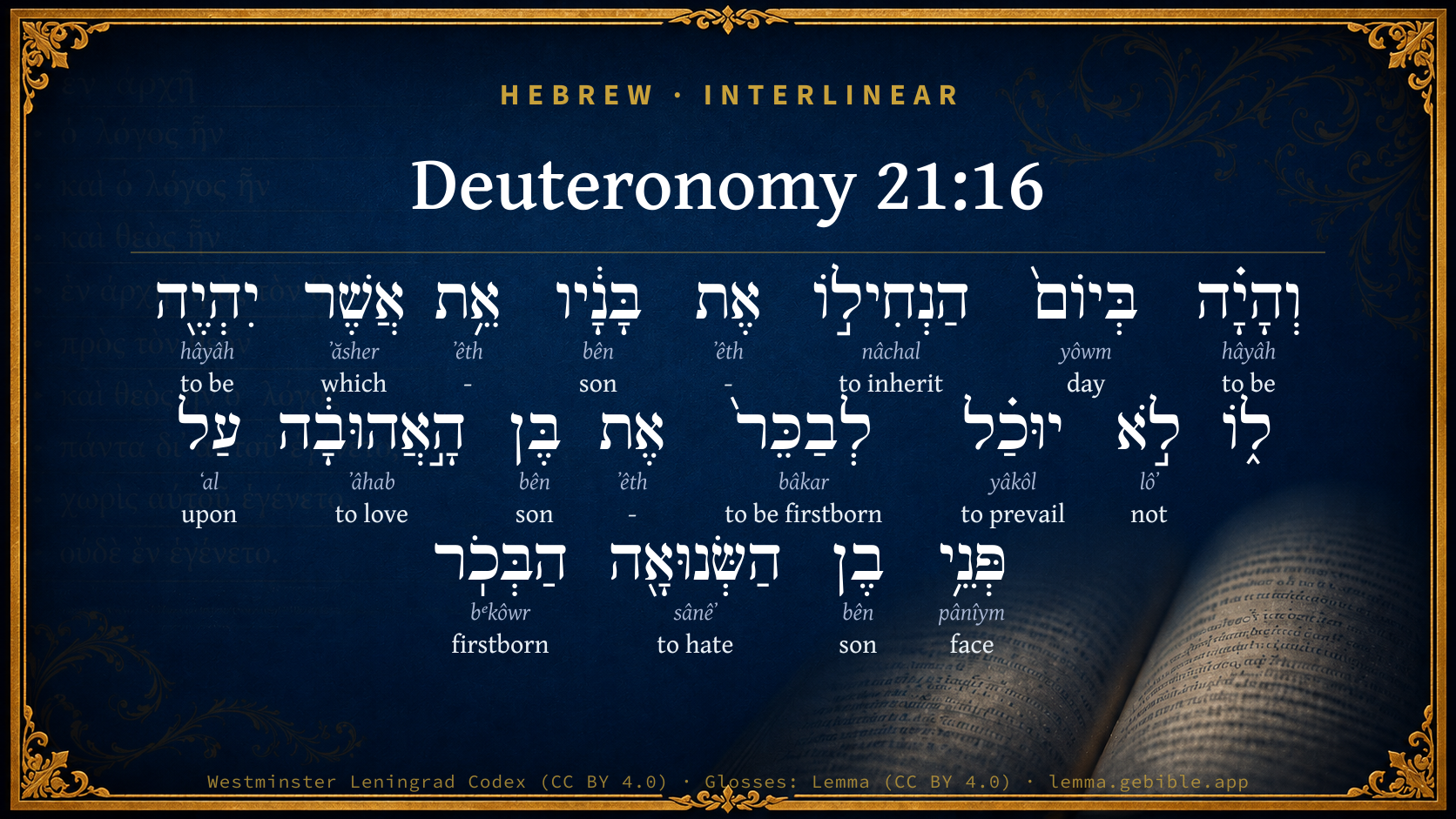
  1. וְהָיָ֗ה hâyâh H1961 “and · to be” Conjunction + Verb, Qal, Sequential Perfect, 3rd Person, Masculine, Singular
  2. בְּיוֹם֙ yôwm H3117 “in/at · day of” Preposition + Noun, Common, Masculine, Singular, Construct
  3. הַנְחִיל֣וֹ nâchal H5157 “to inherit · him” Verb, Hiphil, Infinitive Construct + Suffix, Personal, 3rd Person, Masculine, Singular
  4. אֶת ʼêth H853 “-” Particle, Direct Object
  5. בָּנָ֔יו bên H1121 “sons · his” Noun, Common, Masculine, Plural, Construct + Suffix, Personal, 3rd Person, Masculine, Singular
  6. אֵ֥ת ʼêth H853 “-” Particle, Direct Object
  7. אֲשֶׁר ʼăsher H834 “which” Particle, Relative
  8. יִהְיֶ֖ה hâyâh H1961 “to be” Verb, Qal, Imperfect, 3rd Person, Masculine, Singular
  9. לֹ֣א lôʼ H3808 “not” Particle, Negative
  10. יוּכַ֗ל yâkôl H3201 “to prevail” Verb, Qal, Imperfect, 3rd Person, Masculine, Singular
  11. אֶת ʼêth H853 “-” Particle, Direct Object
  12. בֶּן bên H1121 “son of” Noun, Common, Masculine, Singular, Construct
  13. הָ֣אֲהוּבָ֔ה ʼâhab H157 “the · loved” Particle, Definite Article + Verb, Qal, Participle Passive, Feminine, Singular, Absolute
  14. עַל ʻal H5921 “upon” Preposition
  15. פְּנֵ֥י pânîym H6440 “face(s) of” Noun, Common, Both, Plural, Construct
  16. בֶן bên H1121 “son of” Noun, Common, Masculine, Singular, Construct
  17. הַשְּׂנוּאָ֖ה sânêʼ H8130 “the · hated” Particle, Definite Article + Verb, Qal, Participle Passive, Feminine, Singular, Absolute
  18. הַבְּכֹֽר bᵉkôwr H1060 “the · firstborn” Particle, Definite Article + Noun, Common, Masculine, Singular, Absolute

About this verse

These counts appear in no published source. They are computed here, from the morphology-tagged text and Lemma’s own curated glosses. What Lemma adds →

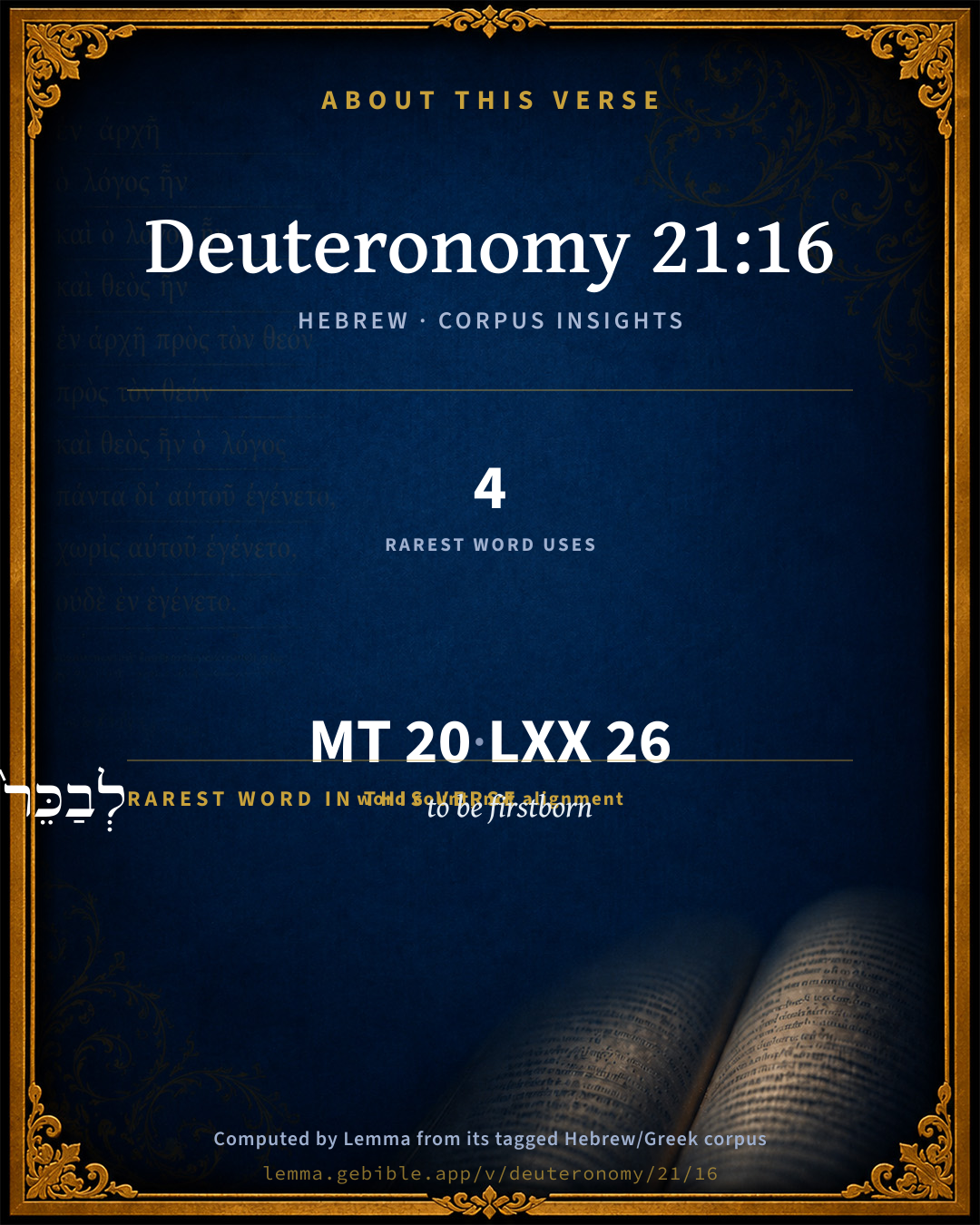
20
words
14
distinct lemmas
Pentateuch
section

Notable vocabulary

The rarest word here is לְבַכֵּר֙ to be firstborn H1069 — appearing just 4 times in the whole Hebrew Bible.

Shared distinctive vocabulary

לְבַכֵּר֙ to be firstborn H1069 occurs in 4 verses of the Hebrew Bible. Also found in:

Grammatical profile

  • 7 verbs
  • 6 nouns
  • 2 prepositions
  • 5 particles

Verb forms

  • וְהָיָ֗ה Qal · Sequential Perfect
  • הַנְחִיל֣וֹ Hiphil · Infinitive Construct
  • יִהְיֶ֖ה Qal · Imperfect
  • יוּכַ֗ל Qal · Imperfect
  • לְבַכֵּר֙ Piel · Infinitive Construct
  • הָ֣אֲהוּבָ֔ה Qal · Participle Passive
  • הַשְּׂנוּאָ֖ה Qal · Participle Passive

Repetition

Words recur within this verse — often emphatic in Hebrew:

  • בָּנָ֔יו son H1121 ×3
  • וְהָיָ֗ה to be H1961 ×2

Hebrew & Septuagint length

In English translation the verse runs 40 words from the Hebrew and 46 from the Septuagint (LXX English) — closely comparable.

A rough comparison of the two English renderings, which tokenize alike — not a word-level alignment.

Word counts can differ between the Hebrew and the Greek without any difference in meaning — e.g. the Hebrew direct-object marker אֵת has no separate Greek word, and Greek often adds the article ὁ.

In the original languages it is 20 Hebrew tokens and 26 Greek tokens — but the two are counted differently (Hebrew bundles its prefixes and suffixes into one token; the Greek is in lemma form), so that isn’t a like-for-like length.

Cross-references

7

Topical passages linked to Deuteronomy 21:16 in the Treasury of Scripture Knowledge — connected by theme and wording, ordered by reader-vote popularity; previews shown in the World English Bible.

  • 1 Chronicles 5:2 For Judah prevailed above his brothers, and of him came the prince; but the birthright was Joseph's:)
  • 1 Chronicles 26:10 Also Hosah, of the children of Merari, had sons: Shimri the chief, (for though he was not the firstborn, yet his father made him chief),
  • 2 Chronicles 21:3 Their father gave them great gifts, of silver, and of gold, and of precious things, with fortified cities in Judah: but the kingdom gave he to Jehoram, because he was the firstborn.
  • Romans 8:29 For whom he foreknew, he also predestined to be conformed to the image of his Son, that he might be the firstborn among many brothers.
  • Philippians 4:8 Finally, brothers, whatever things are true, whatever things are honorable, whatever things are just, whatever things are pure, whatever things are lovely, whatever things are of good report; if there is any virtue, and if there is any praise, think about these things.
  • Hebrews 12:16–17 lest there be any sexually immoral person, or profane person, as Esau, who sold his birthright for one meal.
  • 2 Chronicles 11:19–22 and she bore him sons: Jeush, and Shemariah, and Zaham.

Cross-references courtesy of OpenBible.info (CC BY 4.0).

Hebrew and Greek witnesses Masoretic Hebrew ↔ Greek Septuagint

The same verse in the two great witnesses to the Old Testament, shown verse-for-verse.

These are two independent witnesses, not word-aligned to each other, and the Septuagint is shown in lemma (dictionary) form.

Hebrew Deuteronomy 21:16 Masoretic · Westminster Leningrad Codex

וְהָיָ֗ה בְּיוֹם֙ הַנְחִיל֣וֹ אֶת בָּנָ֔יו אֵ֥ת אֲשֶׁר יִהְיֶ֖ה ל֑וֹ לֹ֣א יוּכַ֗ל לְבַכֵּר֙ אֶת בֶּן הָ֣אֲהוּבָ֔ה עַל פְּנֵ֥י בֶן הַשְּׂנוּאָ֖ה הַבְּכֹֽר

then it shall be, in the day that he causes his sons to inherit that which he has, that he may not make the son of the beloved the firstborn before the son of the hated, who is the firstborn:

World English Bible · Public Domain

Greek LXX Deuteronomy 21:16 Septuagint · lemma form

καί εἰμί ὅς ἄν ἡμέρα κατακληροδοτέω ὁ υἱός αὐτός ὁ ὑποἄρχω αὐτός οὐ δύναμαι πρωτοτοκεύω ὁ υἱός ὁ ἀγαπάω ὑπερὁράω ὁ υἱός ὁ μισέω ὁ πρωτότοκος

then it shall be that whenever he shall divide by inheritance his goods to his sons, he shall not be able to give the right of the firstborn to the son of the loved one, having overlooked the son of the hated, which is the firstborn.

LXX2012 (modern English Septuagint) · Public Domain

Hebrew: Westminster Leningrad Codex (CC BY 4.0). Greek: Septuagint (public domain); English from LXX2012 (modern English Septuagint) (Public Domain). How the Septuagint differs from the Hebrew →

Targum (Aramaic paraphrase)

2

The Targum is the ancient Jewish Aramaic paraphrase of the Hebrew Scriptures — an interpretive translation, not the Hebrew text itself. Onkelos (literal) and Pseudo-Jonathan (expansive) render the Torah, and Jonathan the Prophets. Coverage is partial: where no permissively-licensed English translation exists for a verse, only the Aramaic is shown. This is verse-level text, not a word-by-word alignment to the Hebrew.

  1. Targum Onkelos Torah (Genesis–Deuteronomy)
    וִיהֵי בְּיוֹמָא דְיַחְסֵן לִבְנוֹהִי יָת דִי יְהֵי לֵהּ לֵית לֵהּ רְשׁוּ לְבַכָּרָא יָת בַּר רְחֶמְתָּא עַל אַפֵּי בַר שְׂנִיאֲתָא בּוּכְרָא

    (no public-domain English translation for this verse)

    Targum Onkelos — Aramaic: “Onkelos Genesis” (public domain); “Onkelos Exodus” (public domain); “Onkelos Leviticus” (public domain); “Onkelos Numbers” (public domain); “Onkelos Deuteronomy” (public domain). English: “Sefaria Community Translation” (CC0 1.0 (public-domain dedication)); “J.W. Etheridge. The Targums of Onkelos and Jonathan Ben Uzziel on the Pentateuch. London: Longmans, Green, 1862” (public domain). Text via Sefaria.

  2. Targum Pseudo-Jonathan Torah (Genesis–Deuteronomy)
    וִיהֵי בְּיוֹם אַחֲסִינְתֵּיהּ יַת בְּנוֹי יַת נִיכְסִין דִּיהֵי לֵיהּ לֵית לֵיהּ רְשׁוּ לְמִתַּן חוּלַק בְּכוֹרוֹתָא לְבַר רְחוּמְתָּא עַל אַנְפֵּי בִּיר סְנֵיתָא דְהוּא בּוּכְרָא

    it shall be in the day that he deviseth to his sons the inheritance of the wealth that may be his, he shall not be allowed to give the birthright portion to the son of the beloved, over the head of the son of the hated wife, to whom the birthright belongs;

    Targum Pseudo-Jonathan — Aramaic: “Targum Jonathan on Genesis” (public domain); “Targum Jonathan on Exodus” (public domain); “Targum Jonathan on Leviticus” (public domain); “Targum Jonathan on Numbers” (public domain); “Targum Jonathan on Deuteronomy” (public domain). English: “The Targum of Jonathan ben Uzziel, trans. J. W. Etheridge, London, 1862” (public domain). Text via Sefaria.

Commentary

Notes on Deuteronomy 21:16 from classic Christian and Jewish commentators (each source and its license shown beneath its notes). The classic Christian expositions comment on the surrounding passage and are grouped to its opening verse, so a note may address several verses; the Jewish commentaries on the Tanakh (Rashi and others) are per-verse, so they appear only where the commentator wrote on this verse.

Lemma curates 59 commentaries, every one of them public domain or Creative Commons licensed, each selected and text-cleaned for this edition rather than reprinted as found. About our sources →

Geneva Bible (1599)

Geneva Bible translators

Or, while the son of the hated liveth.

Geneva Bible (1599) marginal notes — public domain. Text via Bolls.life.

The Cambridge Bible for Schools and Colleges

gen. ed. J. J. S. Perowne

16. in the day that he causeth his sons to inherit] When he makes his will, Gen_24:36; Gen_25:5; cp. 2Sa_17:23, 2Ki_20:1.

before] in preference to (see on Deu_5:7), R.V. margin is improbable.

The Cambridge Bible for Schools and Colleges (gen. ed. J. J. S. Perowne; Cambridge University Press, 1878–1918) — public domain. Text from a community e-Sword module.

John Gill's Exposition

Then it shall be, when he maketh his sons to inherit that which he hath,.... By a will in writing, or byword of mouth, or by a deed of gift, actually bestowing his goods upon them, and dividing among them what he is for the present possessed of; see Luk 15:12,

that he may not make the son of the beloved firstborn before the son of the hated, which is indeed the firstborn; that is, when such is the case, that the son of his wife he has the least value for is really his firstborn, he may not, through favour and affection to the wife he loves better, prefer her son, and declare him to be the firstborn, by devising to him or bestowing on him the double portion of his goods; for so to do would not be right, or agreeably to the will and law of God; for though previous to this law the birthright was given to Joseph, the eldest son of Rachel, the most beloved wife of Jacob, before Reuben who was the son of Leah, less beloved by him, and was in fact his firstborn; yet this was owing to the sin of Reuben, and by the appointment of God; see Gen 49:3.

John Gill's Exposition of the Whole Bible (1746–1763) — public domain (CC PDM 1.0). Text via the HelloAO Bible API.

Haydock's Catholic Bible Commentary

Hated, or less loved. (Haydock) --- The inheritance goes to the first-born independently of the father’s disposition, in order to prevent the disturbances which would otherwise have taken place in families, where the different wives would have been continually endeavouring to get their respective children preferred before the rest. David, indeed, assigned the throne to Solomon, to the exclusion of Adonias; but this was done by the command of God, 3 Kings i. 17. The regulation of Jacob, in favour of Joseph, was made prior to this law. The Jewish doctors inform us that a father cannot disinherit any of his lawful heirs, except the judges ratify his sentence, while he is in health. But if he be dangerously ill, his verbal declaration will suffice, provided he appoint some one whom the law does not reject. For if he were to make a Gentile his heir, the will would be null. The testament must be made in the day time, for which they cite Ecclesiasticus xxxiii. 24. They say likewise that a father may, while living, give his effects to whom he pleases, and by this means disinherit his children; or he may give the succession to one of them, who is then considered as a tutor of the rest, and is bound to maintain them with necessaries till the year of jubilee, when each may claim his respective share. (Selden, Succes. c. xxiv.) But all these regulations seem to contradict the law. (Calmet)

George Leo Haydock (1774–1849), Haydock's Catholic Family Bible and Commentary, 1859 edition — public domain. Excludes Psalms (Douay-Rheims chapter numbering differs from Protestant) and Deuterocanonical books (Catholic canon only).

Matthew Poole's English Annotations

He may not; it is not lawful, because contrary to the rights and law of nature.

Before the son, or, before the face of the son, i.e. in his lifetime, as this phrase is understood, Gen 11:28; 16:12; 25:18. And when this phrase is rendered before another, it signifies only in the presence of another, but never notes the preference of one person to another, which the Hebrews express in another manner. And this may be added to intimate, that if the eldest son were dead, and had left a child, the father was free to give the right of his first-born unto his second son, rather than to the child of the eldest. Or this phrase may be an aggravation of the fact, whereby his father did in a manner spit in his face, and fasten a reproach upon him in his very sight and presence.

Matthew Poole's English Annotations on the Holy Bible (1683–1685) — public domain. Text from a community e-Sword/MySword module.

The Pulpit Commentary

He may not make; literally, is not able to make; i.e. is legally incapable of making.

The Pulpit Commentary (1880–1919), ed. H.D.M. Spence-Jones & Joseph S. Exell — public domain. Text from a community e-Sword module.

Ramban (Nachmanides)

Rabbi Moshe ben Nachman (Ramban / Nachmanides)

LO YUCHAL’ [literally: “he could not” but rendered: HE MAY NOT] DECLARE THE SON OF THE BELOVED FIRSTBORN. This is an admonition against doing so. Likewise are all such verses as: ‘Lo thuchal’ (thou mayest not) eat within thy gates etc.; ‘lo thuchal’ (thou mayest not) put a foreigner over thee., 17:15. And in all these cases, Onkelos translates “you have no right” [which proves that the verse before us, too, constitutes an admonition], and the purport of these expressions is, “you could not allow yourself the possibility of doing so,” emphasizing the importance of the admonitions. Similarly, But he shall acknowledge the firstborn, the son of the hated, by giving him a double portion constitutes a positive commandment that he bequeath a double portion to the firstborn. Thus he who equalizes the firstborn with his brothers [i.e., he assigns him a share equal to theirs] violates both a negative commandment and a positive commandment, even though his words are not legally valid. He surely violates both [commandments] if, knowing he [the son of the hated one] is the firstborn, and did not wish to make it known that he is the firstborn and claimed that he is an ordinary son and caused him to inherit like any one of his sons. Now, these are newly-declared commandments. And from that which Scripture states [he may not declare the son of the beloved firstborn] in the face of the firstborn, the son of the hated it would appear to me that this commandment and this law are binding only during the lifetime of the firstborn. But, if the firstborn died during the life of his father, even though he [the deceased son] inherits his share as the firstborn in the grave and bequeathes it by law to his children, yet if the father wished [to deviate] and said, “My sons shall inherit such-and-such of my belongings, and the children of my [late] son, the firstborn, shall take such-and-such of my belongings,” his instructions are valid just as they would be valid in a case where there is no firstborn son. Similarly, the father would not be violating this negative commandment if he did not acknowledge the firstborn son only after his death, for I have never found the expression ‘al pnei’ (in the face of) except with reference to the living, such as: ‘al pnei’ (in the presence of) Aaron their father; ‘al pnei’ (in the presence of) his father Terah, and similarly all such expressions. [Therefore, in this case, since it states that the father may not do it ‘al pnei’ the firstborn of the hated, it follows that the prohibition is binding only during the lifetime of the firstborn and that the father had acknowledged him as such.].

Ramban (Nachmanides) on the Tanakh — English translation: “Commentary on the Torah by Ramban (Nachmanides). Translated and annotated by Charles B. Chavel. New York, Shilo Pub. House, 1971-1976” (CC BY 4.0). Text via Sefaria.

Sforno

Rabbi Ovadia Sforno

He may not prefer the son of the loved one. The birthright of the eldest son may not be transferred due to love or hatred for one or another of his wives. However, if the father transfers the birthright due to the wicked behavior of the son, then he acts appropriately. As our Sages have said: If the son does not act in a proper manner, a father who disinherits him will be remembered for good (Bava Basra 133b). This is what Yaakov did, as the verse states, “Because he defiled his father's couch, his birthright was given to the sons of Joseph the son of Yisroel” (I Divrei HaYomim 5:1).

Sforno on the Tanakh — English translation: “Yalkut, Sifsei Chachomim Chumash, Metsudah Publications, 2009” (CC BY 4.0). Text via Sefaria.

Lesson kit

Teaching starters — assembled from the data on this page, not authored interpretation. Every prompt links to the verse data it draws on. Edit before teaching.

Deuteronomy, in the Pentateuch, opens this verse with 20 words (14 distinct Hebrew lemmas). Its most distinctive word is bâkar (“to be firstborn”). A historical commentator’s framing appears above. Read the whole chapter for the surrounding context.

Discussion questions

  1. What does “to be firstborn” (bâkar) contribute to the verse as a whole?
  2. How does Leviticus 27:26, which shares the word «to be firstborn», read alongside this verse?
  3. What does the repetition of “son” (3× in this one verse) do in this verse?
  4. These translations render this verse differently. What is at stake in choosing one wording over another?
  5. «וְהָיָ֗ה» is a Qal Sequential Perfect verb. How does that grammatical form shape the action described?
  6. Compare how Geneva Bible (1599) and The Cambridge Bible for Schools and Colleges read this verse. Where do they agree or differ?

Things to notice

Reading settings

Reading text

Shown beneath each verse's original-language words.

Old Testament
Old Testament edition

Read the OT as the Masoretic Hebrew (MT) or the Greek Septuagint (LXX).

English shown for the Greek Septuagint (in the Hebrew ↔ Greek comparison).

Comparing translations? Open the Compare panel on any verse page to stack up to four side by side.