
2 Chronicles 13:2

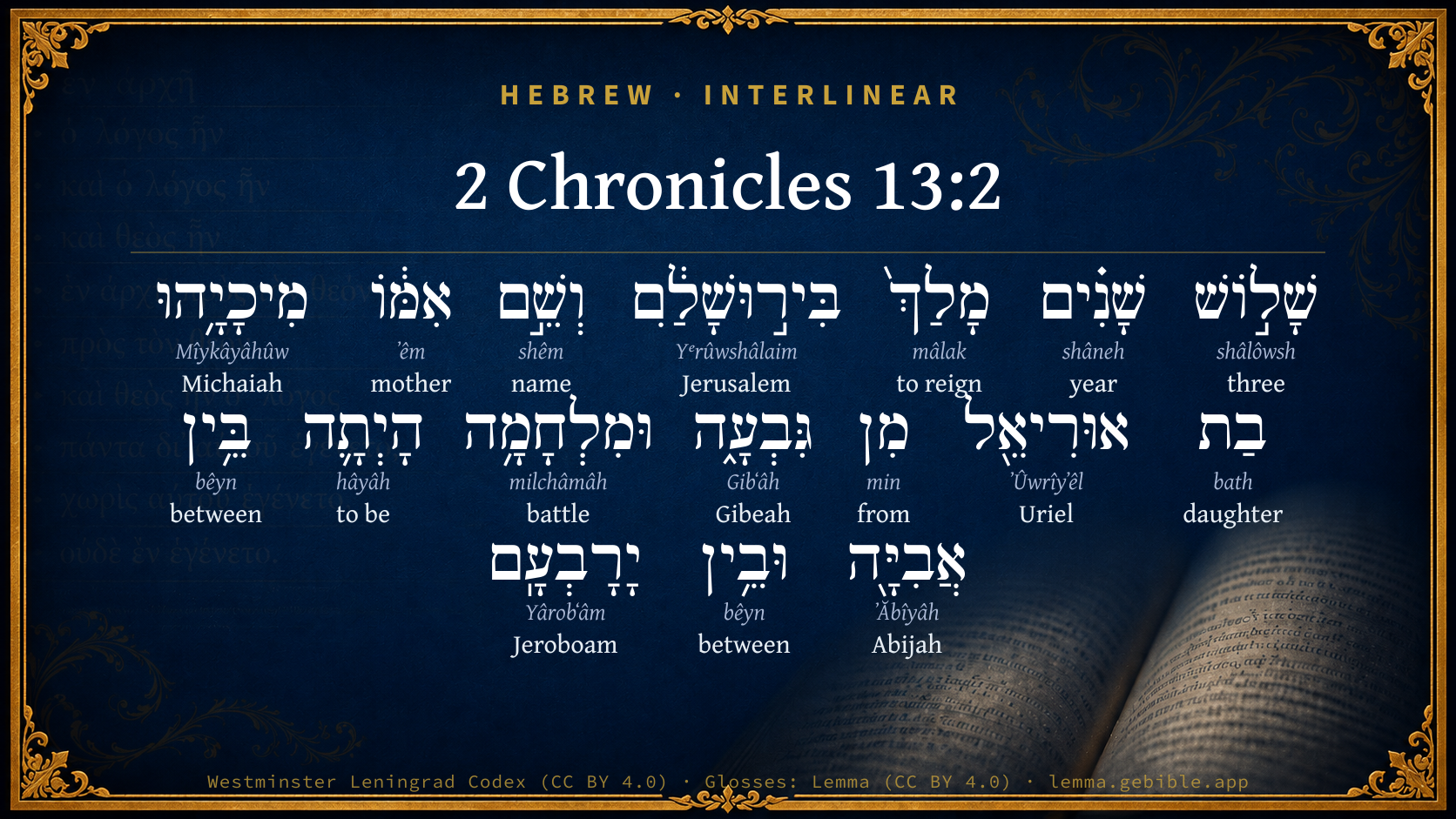
Hebrew (Westminster Leningrad Codex) 2 Chronicles 13:2 appears in the Hebrew Old Testament. The text above is from the Westminster Leningrad Codex. Each word links to its Strong’s number, a concise gloss, and parsing drawn from the Open Scriptures Hebrew Bible morphology. Click any word for its full Brown-Driver-Briggs (BDB) entry.
Download image
Cite this verse

2 Chronicles 13:2 (World English Bible). Public Domain. Lemma interlinear Bible study tool, https://lemma.gebible.app/v/2-chronicles/13/2.

Show BibTeX & RIS
BibTeX
RIS
English Translation
Three years reigned he in Jerusalem: and his mother's name was Micaiah the daughter of Uriel of Gibeah. There was war between Abijah and Jeroboam.
World English Bible · Public Domain
Highlights
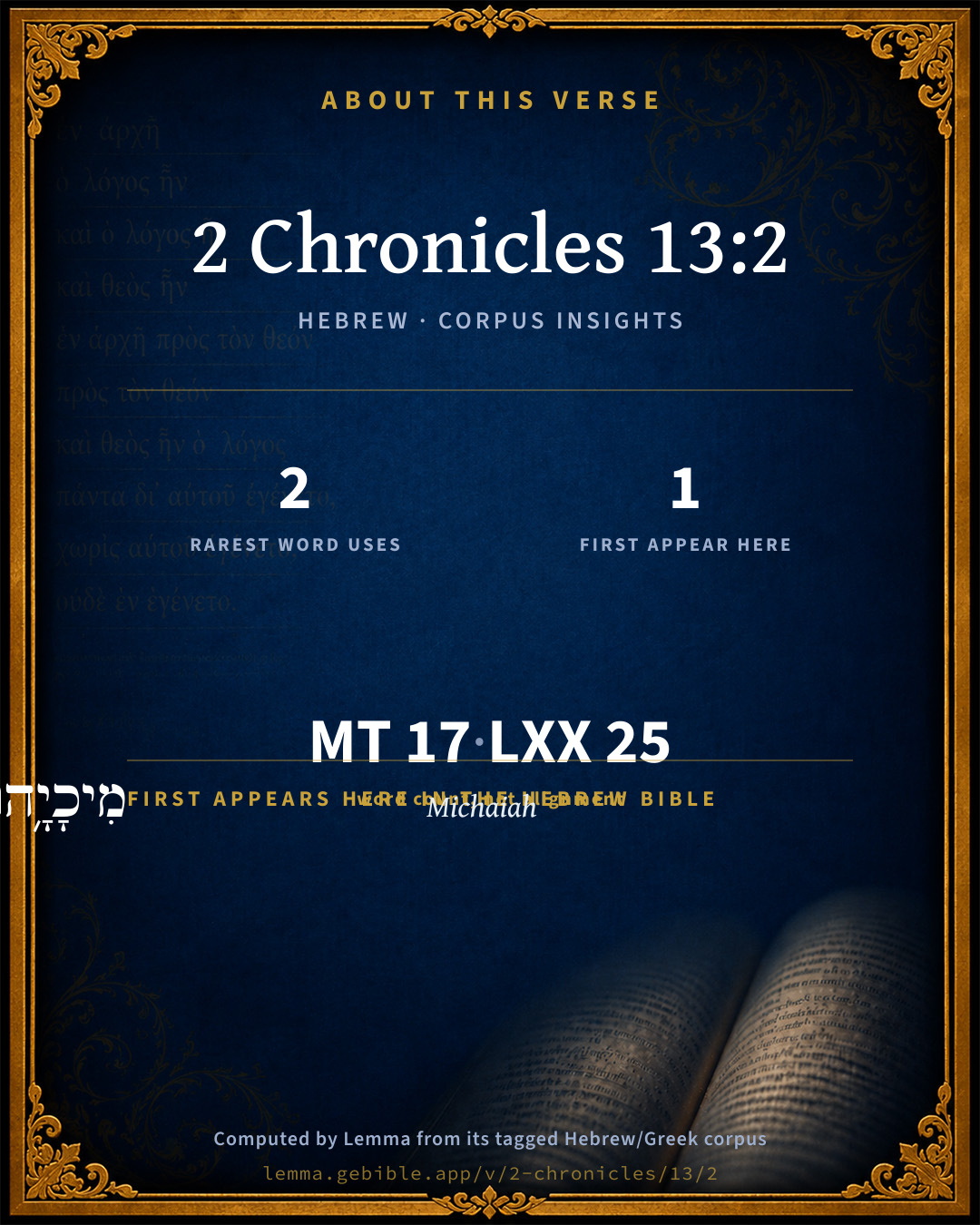
  • 1 first appearance in the Hebrew Bible
Full analysis ↓
Download a study sheet

One document with this verse’s original text, its word-by-word gloss line, the meaning frame, cross-references with their text, attributed commentary, and full source and license credits — printable, and it pastes into notes with its structure intact.

This verse Autodidact and up

Study sheet (.html) Plain text (.txt)

A passage Seminary Student

Up to 50 verses in one chapter. A passage sheet keeps up to 6 commentary sources and 12 cross-references per verse, in the order this page ranks them, and says so on the sheet whenever that leaves anything out. Ask for a single verse and you get the Autodidact verse sheet above.

Everything on this page stays free to read, with no account — the sheet is a download of what is already on screen, not access to it.

Want to remove ads? Support Godless Engineer
Compare translations 3

The same verse in 3 English versions, stacked beneath the original-language interlinear above. Click any original word for its lexicon entry.

Each is an independent rendering of the whole verse — the interlinear is not word-aligned to these translations.

Highlighted words mark where these versions differ — a whole-verse word diff, not a word-by-word alignment.

  • World English Bible Public Domain
    Three years reigned he in Jerusalem: and his mother's name was Micaiah the daughter of Uriel of Gibeah. There was war between Abijah and Jeroboam.
  • King James Version Public Domain
    He reigned three years in Jerusalem. His mother's name also was Michaiah the daughter of Uriel of Gibeah. And there was war between Abijah and Jeroboam.
  • unfoldingWord Literal Text CC BY-SA 4.0
    Three years he reigned in Jerusalem. And the name of his mother, Macaiah, the daughter of Uriel from Gibeah. And war was between Abijah and between Jeroboam.

unfoldingWord Literal Text — © unfoldingWord, licensed CC BY-SA 4.0. Word-aligned USFM3 via Door43 (git.door43.org/unfoldingWord/en_ult).

Versions to compare (up to 4)

3 of 4 selected

Show all 18 translations

Every available English version of this verse, each an independent rendering of the whole verse.

  • World English Bible Public Domain
    Three years reigned he in Jerusalem: and his mother's name was Micaiah the daughter of Uriel of Gibeah. There was war between Abijah and Jeroboam.
  • Berean Standard Bible Public Domain
    and he reigned in Jerusalem three years. His mother’s name was Micaiah daughter of Uriel; she was from Gibeah. And there was war between Abijah and Jeroboam.
  • Majority Standard Bible Public Domain
    and he reigned in Jerusalem three years. His mother’s name was Micaiah daughter of Uriel; she was from Gibeah. And there was war between Abijah and Jeroboam.
  • King James Version Public Domain
    He reigned three years in Jerusalem. His mother's name also was Michaiah the daughter of Uriel of Gibeah. And there was war between Abijah and Jeroboam.
  • American Standard Version (1901) Public Domain
    Three years reigned he in Jerusalem: and his mother's name was Micaiah the daughter of Uriel of Gibeah. And there was war between Abijah and Jeroboam.
  • Revised Version (1885) Public Domain
    Three years reigned he in Jerusalem: and his mother’s name was Micaiah the daughter of Uriel of Gibeah. And there was war between Abijah and Jeroboam.
  • Geneva Bible (1599) Public Domain
    He reigned three yere in Ierusalem: (his mothers name also was Michaiah the daughter of Vriel of Gibea) and there was warre betweene Abiiah and Ieroboam.
  • Douay-Rheims (1899) Public Domain
    Three years he reigned in Jerusalem, and his mother's name was Michaia, the daughter of Uriel of Gabaa: and there was war between Abia and Jeroboam.
  • Young's Literal Translation Public Domain
    three years he hath reigned in Jerusalem, (and the name of his mother `is' Michaiah daughter of Uriel, from Gibeah,) and war hath been between Abijah and Jeroboam.
  • Literal Standard Version CC BY-SA 4.0
    he has reigned three years in Jerusalem (and the name of his mother [is] Michaiah daughter of Uriel, from Gibeah), and there has been war between Abijah and Jeroboam.
  • Unlocked Literal Bible CC BY-SA 4.0
    He ruled for three years in Jerusalem; his mother's name was Macaiah, the daughter of Uriel of Gibeah. There was war between Abijah and Jeroboam.
  • unfoldingWord Literal Text CC BY-SA 4.0
    Three years he reigned in Jerusalem. And the name of his mother, Macaiah, the daughter of Uriel from Gibeah. And war was between Abijah and between Jeroboam.
  • Darby Bible Public Domain
    He reigned three years in Jerusalem; and his mother's name was Michaiah, the daughter of Uriel of Gibeah. And there was war between Abijah and Jeroboam.
  • World Messianic Bible Public Domain
    He reigned three years in Jerusalem. His mother’s name was Micaiah the daughter of Uriel of Gibeah. There was war between Abijah and Jeroboam.
  • Webster's Bible Public Domain
    He reigned three years in Jerusalem. His mother's name also was Michaiah the daughter of Uriel of Gibeah. And there was war between Abijah and Jeroboam.
  • Free Bible Version CC BY-SA 4.0
    He reigned in Jerusalem for three years. His mother's name was Micaiah, daughter of Uriel—she was from Gibeah. Abijah and Jeroboam were at war.
  • Bible in Basic English Public Domain
    He was king in Jerusalem for three years; his mother's name was Maacah, the daughter of Uriel of Gibeah. And there was war between Abijah and Jeroboam.
  • JPS Tanakh (1917) Public Domain
    Three years reigned he in Jerusalem; and his mother's name was Micaiah the daughter of Uriel of Gibeah. And there was war between Abijah and Jeroboam.

Literal Standard Version (2020), Covenant Press — licensed CC BY-SA 4.0. Text via the HelloAO Bible API (eBible.org). Unlocked Literal Bible (unfoldingWord) — licensed CC BY-SA 4.0. Text via the HelloAO Bible API (eBible.org). unfoldingWord Literal Text — © unfoldingWord, licensed CC BY-SA 4.0. Word-aligned USFM3 via Door43 (git.door43.org/unfoldingWord/en_ult). Free Bible Version, Dr. Jonathan Gallagher — licensed CC BY-SA 4.0. Text via the HelloAO Bible API (eBible.org).

Word by word

More ways to search: Search by grammar → Find every occurrence → Compare this word →

Practice this passage: Drill this verse → Learn its vocabulary →

מִיכָיָ֥הוּ
Mîykâyâhûw
H4322
“Michaiah”
Noun, Proper
Part of Speech
Noun
Type
Proper
Full BDB Definition

Origin: for H4320

TWOT: None

Michaiah = "who is like God" - one of the princes of Jehoshaphat whom he sent to teach the law of Jehovah in the cities of Judah - daughter of Uriel of Gibeah, wife of king Rehoboam of Judah, and mother of king Abijah of Judah
  1. שָׁל֣וֹשׁ shâlôwsh H7969 “three” Adjective, Cardinal number, Feminine, Singular, Absolute
  2. שָׁנִ֗ים shâneh H8141 “years” Noun, Common, Feminine, Plural, Absolute
  3. מָלַךְ֙ mâlak H4427 “to reign” Verb, Qal, Perfect, 3rd Person, Masculine, Singular
  4. בִּיר֣וּשָׁלִַ֔ם Yᵉrûwshâlaim H3389 “in/at · Jerusalem” Preposition + Noun, Proper
  5. וְשֵׁ֣ם shêm H8034 “and · name of” Conjunction + Noun, Common, Masculine, Singular, Construct
  6. אִמּ֔וֹ ʼêm H517 “mother · his” Noun, Common, Feminine, Singular, Construct + Suffix, Personal, 3rd Person, Masculine, Singular
  7. בַת bath H1323 “daughter of” Noun, Common, Feminine, Singular, Construct
  8. אוּרִיאֵ֖ל ʼÛwrîyʼêl H222 “Uriel” Noun, Proper
  9. מִן min H4480 “from” Preposition
  10. גִּבְעָ֑ה Gibʻâh H1390 “Gibeah” Noun, Proper
  11. וּמִלְחָמָ֥ה milchâmâh H4421 “and · battle” Conjunction + Noun, Common, Feminine, Singular, Absolute
  12. הָיְתָ֛ה hâyâh H1961 “to be” Verb, Qal, Perfect, 3rd Person, Feminine, Singular
  13. בֵּ֥ין bêyn H996 “between” Preposition
  14. אֲבִיָּ֖ה ʼĂbîyâh H29 “Abijah” Noun, Proper
  15. וּבֵ֥ין bêyn H996 “and · between” Conjunction + Preposition
  16. יָרָבְעָֽם Yârobʻâm H3379 “Jeroboam” Noun, Proper

About this verse

These counts appear in no published source. They are computed here, from the morphology-tagged text and Lemma’s own curated glosses. What Lemma adds →

17
words
16
distinct lemmas
Historical
section

Notable vocabulary

The rarest word here is מִיכָיָ֥הוּ Michaiah H4322 — appearing just 2 times in the whole Hebrew Bible.

First appearance in Scripture

This word makes its first canonical appearance in the Hebrew Bible here:

  • מִיכָיָ֥הוּ Michaiah H4322

Shared distinctive vocabulary

מִיכָיָ֥הוּ Michaiah H4322 occurs in 2 verses of the Hebrew Bible. Also found in:

Grammatical profile

  • 2 verbs
  • 11 nouns
  • 1 adjective
  • 3 prepositions

Verb forms

  • מָלַךְ֙ Qal · Perfect
  • הָיְתָ֛ה Qal · Perfect

Repetition

A word recurs within this verse — often emphatic in Hebrew:

  • בֵּ֥ין between H996 ×2

Hebrew & Septuagint length

In English translation the verse runs 25 words from the Hebrew and 25 from the Septuagint (LXX English) — the same length.

A rough comparison of the two English renderings, which tokenize alike — not a word-level alignment.

Word counts can differ between the Hebrew and the Greek without any difference in meaning — e.g. the Hebrew direct-object marker אֵת has no separate Greek word, and Greek often adds the article ὁ.

In the original languages it is 17 Hebrew tokens and 25 Greek tokens — but the two are counted differently (Hebrew bundles its prefixes and suffixes into one token; the Greek is in lemma form), so that isn’t a like-for-like length.

Cross-references

7

Topical passages linked to 2 Chronicles 13:2 in the Treasury of Scripture Knowledge — connected by theme and wording, ordered by reader-vote popularity; previews shown in the World English Bible.

  • 2 Chronicles 11:20 After her he took Maacah the daughter of Absalom; and she bore him Abijah, and Attai, and Ziza, and Shelomith.
  • 1 Kings 15:6–7 Now there was war between Rehoboam and Jeroboam all the days of his life.
  • Joshua 18:28 and Zelah, Eleph, and the Jebusite (the same is Jerusalem), Gibeath, [and] Kiriath; fourteen cities with their villages. This is the inheritance of the children of Benjamin according to their families.
  • Judges 19:14 So they passed on and went their way; and the sun went down on them near to Gibeah, which belongs to Benjamin.
  • Judges 19:16 Behold, there came an old man from his work out of the field at even: now the man was of the hill-country of Ephraim, and he sojourned in Gibeah; but the men of the place were Benjamites.
  • 1 Samuel 10:26 Saul also went to his house to Gibeah; and there went with him the host, whose hearts God had touched.
  • 1 Kings 15:2 Three years reigned he in Jerusalem: and his mother's name was Maacah the daughter of Abishalom.

Cross-references courtesy of OpenBible.info (CC BY 4.0).

Hebrew and Greek witnesses Masoretic Hebrew ↔ Greek Septuagint

The same verse in the two great witnesses to the Old Testament, shown verse-for-verse.

These are two independent witnesses, not word-aligned to each other, and the Septuagint is shown in lemma (dictionary) form.

Hebrew 2 Chronicles 13:2 Masoretic · Westminster Leningrad Codex

שָׁל֣וֹשׁ שָׁנִ֗ים מָלַךְ֙ בִּיר֣וּשָׁלִַ֔ם וְשֵׁ֣ם אִמּ֔וֹ מִיכָיָ֥הוּ בַת אוּרִיאֵ֖ל מִן גִּבְעָ֑ה וּמִלְחָמָ֥ה הָיְתָ֛ה בֵּ֥ין אֲבִיָּ֖ה וּבֵ֥ין יָרָבְעָֽם

Three years reigned he in Jerusalem: and his mother's name was Micaiah the daughter of Uriel of Gibeah. There was war between Abijah and Jeroboam.

World English Bible · Public Domain

Greek LXX 2 Chronicles 13:2 Septuagint · lemma form

ἔτος τρεῖς βασιλεύω ἐν ἰερουσαλήμ καί ὄνομα ὁ μήτηρ αὐτός μααχα θυγάτηρ ουριηλ ἀπό γαβαων καί πόλεμος εἰμί ἀνά μέσος αβια καί ἀνά μέσος ιεροβοαμ

He reigned three years in Jerusalem. And his mother's name was Maacha, daughter of Uriel of Gabaon. And there was war between Abia and Jeroboam.

LXX2012 (modern English Septuagint) · Public Domain

On this verse, Ellicott's Commentary for English Readers discusses the Septuagint’s reading. Read the note in Commentary ↓

Hebrew: Westminster Leningrad Codex (CC BY 4.0). Greek: Septuagint (public domain); English from LXX2012 (modern English Septuagint) (Public Domain). How the Septuagint differs from the Hebrew →

Commentary

Notes on 2 Chronicles 13:2 from classic Christian and Jewish commentators (each source and its license shown beneath its notes). The classic Christian expositions comment on the surrounding passage and are grouped to its opening verse, so a note may address several verses; the Jewish commentaries on the Tanakh (Rashi and others) are per-verse, so they appear only where the commentator wrote on this verse.

Lemma curates 59 commentaries, every one of them public domain or Creative Commons licensed, each selected and text-cleaned for this edition rather than reprinted as found. About our sources →

Trapp's Complete Commentary

John Trapp

2Ch 13:2 He reigned three years in Jerusalem. His mother’s name also [was] Michaiah the daughter of Uriel of Gibeah. And there was war between Abijah and Jeroboam.

Ver. 2. His mother’s name was Michaiah.] Alias Maachah. See on 2Ch 11:21-22.

And there was war between Abijah and Jeroboam.] Like as there had been between Rehoboam and Jeroboam. So the dissension betwixt England and Scotland, which consumed more Christian blood, wrought more spoil and destruction, and continued longer, than ever quarrel we read of did between any two people in the world.

John Trapp, A Commentary or Exposition upon All the Books of the Old and New Testament (1647–1656) — public domain. Text from a community e-Sword module.

Joseph Benson's Commentary

2Ch 13:2. His mother’s name was Michaiah, the daughter of Uriel —

Called Maachah, the daughter of Absalom, 1Ki 15:2. She might be daughter to one, and grand-daughter to the other: or the proper and natural daughter of the one, and the other’s daughter by adoption.

Joseph Benson's Commentary on the Old and New Testaments (1811–1818) — public domain. Text from a community e-Sword module.

Tyndale Open Study Notes

Tyndale Open Resources

13:2-3 The ongoing conflict between Rehoboam and Jeroboam (see 12:15) carried into the reign of Abijah. Abijah might have been attempting to reunite north and south, as is suggested by his speech (13:5-12). The large numbers of soldiers on each side correspond approximately to David’s census (2 Sam 24:9); Israel’s double number of soldiers magnifies God’s intervention on behalf of Judah (2 Chr 13:14-19).

Tyndale Open Study Notes — © Tyndale Open Resources, licensed CC BY-SA 4.0. Text via the HelloAO Bible API.

Geneva Bible (1599)

Geneva Bible translators

Or, Maachah, 1 Kings 15:2.

Called also Abishalom, for Abishalom was her grandfather, 1 Kings 15:2.

Geneva Bible (1599) marginal notes — public domain. Text via Bolls.life.

Adam Clarke's Commentary

Verse 2. His mother's name - was Michaiah] See on 2Ch 11:20.

Adam Clarke's Commentary on the Bible (1810–1826) — public domain. Text from a community e-Sword/MySword module.

Ellicott's Commentary for English Readers

(2) His mother’s name also was Michaiah the daughter of Uriel of Gibeah.—Kings reads for the names “Maachah the daughter of Abishalom”; and as the chronicler has himself already designated Abijah as son of Maachah, daughter of Absalom (2Ch_11:20-22), there can be no doubt that this is correct, and that “Michaiah,” which is elsewhere a man’s name, is a corruption of Maachah. This is confirmed by the LXX., Syriac, and Arabic, which read Maachah. As we have already stated (2Ch_11:20), Maachah was granddaughter to Absalom, being a daughter of Tamar the only daughter of Absalom. Uriel of Gibeah, then, must have been the husband of Tamar. (See on 2Ch_15:16. Uriel of Gibeah is otherwise unknown.)

And there was war between Abijah and Jeroboam.—Now war had arisen. See 1Ki_15:6. “Now war had prevailed [same verb] between Abijam [common Hebrew text incorrectly has Rehoboam] and Jeroboam all the days of his life.” The chronicler modifies the sense by omitting the concluding phrase, and then proceeds to give a striking account of a campaign in which Abijah totally defeated his rival (2Ch_13:3-20); of all which we find not a word in Kings.

A Bible Commentary for English Readers, edited by Charles John Ellicott (1878–1897) — public domain. Text from a community e-Sword module.

The Cambridge Bible for Schools and Colleges

gen. ed. J. J. S. Perowne

2. Michaiah] Read with LXX., Maacah; cp. note on 2Ch_11:20.

The Cambridge Bible for Schools and Colleges (gen. ed. J. J. S. Perowne; Cambridge University Press, 1878–1918) — public domain. Text from a community e-Sword module.

John Gill's Exposition

And Abijah set the battle in array, with an army of valiant man of war, even four hundred thousand chosen men,.... Collected such an army of select men, led them into his enemy's country, and set them in order of battle:

and Jeroboam also set the battle in array against him, with eight hundred thousand chosen men, being mighty men of valour; double the number of Abijah s army, he having ten tribes to collect out of, and Abijah but two.

John Gill's Exposition of the Whole Bible (1746–1763) — public domain (CC PDM 1.0). Text via the HelloAO Bible API.

Albert Barnes' Notes on the Bible

See the 1Ki 15:2 note.

Albert Barnes' Notes on the Bible (1834–1885) — public domain. Text from a community e-Sword/MySword module.

Haydock's Catholic Bible Commentary

Michaia, alias Maacha. Her father had also two names; viz., Absalom or Abessalom, and Uriel. (Challoner) --- Many had two names. (Tirinus) --- Of Gabaa, may refer to the women.

George Leo Haydock (1774–1849), Haydock's Catholic Family Bible and Commentary, 1859 edition — public domain. Excludes Psalms (Douay-Rheims chapter numbering differs from Protestant) and Deuterocanonical books (Catholic canon only).

Matthew Poole's English Annotations

Michaiah the daughter of Uriel, called Maachah the daughter of Absalom, 1Ki 15:2. She might be daughter to one, and granddaughter to the other; or the proper and natural daughter of the, one, and the other’s by adoption, of which there are instances in Scripture; or the same person might be called Uriel and Absalom: see 1Ki 15:2.

Matthew Poole's English Annotations on the Holy Bible (1683–1685) — public domain. Text from a community e-Sword/MySword module.

Whedon's Commentary on the Bible

Daniel D. Whedon

2. Michaiah — Probably a copyist’s error for Maachah.

Daughter of Uriel — And granddaughter of Absalom. 1Ki_15:2, note.

Daniel D. Whedon (gen. ed.), Commentary on the Old and New Testaments (1874–1909) — public domain. Text from a community e-Sword module.

The Pulpit Commentary

Michaiah the daughter of Uriel of Gibeah. As before noted, (2Ch_11:20) and as in the parallel, (1Ki_15:2) this name is one with "Maachah, daughter of Absalom" (parallel, Abishalom). The different alphabetic characters may be attributed to error, and that error the error of transcription merely. As in our note, (2Ch_11:20) the word "daughter," as in many similar cases, stands for granddaughter. Thus the father of Maachah was Uriel of Gibeah, and her mother Tamar, daughter of Absalom. Josephus ("Ant.," 8:10. proffers us this connecting link of explanation. On the other hand, Rabbi Joseph"s Targum on Chronicles says that Uriel means Absalom, but was a name used to avoid the use of Absalom. We have no clue as to which out of many Gibeahs is here intended. The Hebrew word (j; bgi) signifies a hill with round top, and hence would easily give name to many places. The following are the chief places of the name (as classified by Dr. Smith"s "Bible Dictionary," 1:689-691):

1. Gibeah in the mountain district of Judah (Jos_15:57; 1Ch_2:49)

2. Gibeath among the towns of Benjamin. (Jos_18:28)

3. The Gibeah (1Sa_7:1; 2Sa_6:3, 2Sa_6:4)

4. Gibeah of Benjamin, (Jud_1:19:, 20) between Bethlehem andJerusalem. This should strictly be quoted either as "Gibeah belonging to Benjamin," or "Geba (bG) of Benjamin". (see also 1Sa 13:, 1Sa_13:14; 2Sa_23:29; 1Ch_11:31; Hos_5:8 Hos_9:9 Hos_10:9)

5. Gibeah of Saul (1Sa_10:26 1Sa_15:34; 2Sa_21:6) Josephus ("Bell, Jud:," 5:2. states what helps to the identifying of the place as the modern Tuleil-el-ful, about thirty stadia from Jerusalem. (see Isa_10:28-32) The Gibeah of 1Sa_22:6 1Sa_23:19 1Sa_26:1, is this Gibeah of Saul.

6. Gibeah in the field. (Jud_1:20:31) Lastly, our Authorized Version gives us seven other Gibeahs, only translating this word, e g. The hill of the foreskins"; (Jos_5:3) "The hill of Phinehas"; (Jos_24:33) The hill of Moreh"; (Jud_1:7:1) The hill of God"; (1Sa_10:5) The hill of Haehilah"; (1Sa_23:19 1Sa_26:1) The hill of Ammah"; (2Sa_2:24) The hill Gareb". (Jer_31:39)

The Pulpit Commentary (1880–1919), ed. H.D.M. Spence-Jones & Joseph S. Exell — public domain. Text from a community e-Sword module.

Scofield Reference Notes

C. I. Scofield

Michaiah

Probably a grandchild of Absalom, called Abishalom, Cf. 2Ch 11:20; 1Ki 15:2.

The Scofield Reference Bible (1917 edition), notes by C. I. Scofield — public domain. Text from a community e-Sword module.

Rashi

Rabbi Shlomo Yitzchaki (Rashi)

Three years he reigned in Jerusalem and no more, as is proven in I Kings (15:9): “And in the twentieth year of Jeroboam, king of Israel, Asa reigned over Judah.” We find that he did not reign even three whole years.

Micaiah the daughter of Uriel And above (11:20), he calls her by a different name, Maacah the daughter of Absalom, and in I Kings (15:10), it is likewise written “Maacah the daughter of Absalom.” Micaiah the daughter of Uriel was her [real] name, and here he calls her thus because this is the genealogical record of Judah. In Kings, which is the book of the kings of Israel and Judah, he calls her by her nickname, Maacah the daughter of Absalom. Now, for this reason, they nicknamed her Maacah, rather than call her by her real name, Micaiah, (and the name of her father was Uriel Abishalom). She was called by the name of her daughter-in-law, who was a valiant woman, a heroic woman, as it is written (below 15:16): “And also Maacah the mother of King Asa he removed from being queen,” and in honor of her daughter-in-law, they called the mother-in-law by the daughter-in-law’s name. So it is explained in Yerushalmi (unknown). Now this tradition is in the name of Rabbi Eliezer, and he told me this in the name of his father, and so I found in his father’s commentary: Wherever a “vav” is added to the name of a woman, this is to her praise, like Athaliah (below 22: 12): “and Athaliah reigned over the land,” for she was a valiant woman; similarly Jecaliah (ibid. 26:3) and Jecaliahu (II Kings 15:2), because she was a heroic woman, for Amaziah her husband fled to Lachish and was there fifteen years until he died, and she judged the people all those fifteen years, and later, when he died, they crowned his son Uzziah after him at the age of sixteen.

Rashi on the Tanakh — English translations: “The Judaica Press complete Tanach with Rashi, translated by A. J. Rosenberg” (CC BY 4.0); “Pentateuch with Rashi's commentary by M. Rosenbaum and A.M. Silbermann, 1929-1934” (public domain); “The Metsudah Tanach series, Lakewood, N.J” (CC BY 4.0); and “The Book of Joshua, Metsudah Publications, 1997” (CC BY 4.0). Text via Sefaria.

Lesson kit

Teaching starters — assembled from the data on this page, not authored interpretation. Every prompt links to the verse data it draws on. Edit before teaching.

2 Chronicles, in the Historical, opens this verse with 17 words (16 distinct Hebrew lemmas). Its most distinctive word is Mîykâyâhûw (“Michaiah”). A historical commentator’s framing appears above. Read the whole chapter for the surrounding context.

Discussion questions

  1. What does “Michaiah” (Mîykâyâhûw) contribute to the verse as a whole?
  2. The word “Michaiah” first appears here in Scripture. What is being introduced at this debut?
  3. 2 Chronicles 17:7 shares the word «Michaiah» with this verse. How do the two illuminate each other?
  4. “between” occurs 2× in this one verse. What is the effect of the repetition?
  5. These translations render this verse differently. What is at stake in choosing one wording over another?
  6. The verb «מָלַךְ֙» is Qal Perfect. How does its form color the action?
  7. Reading how Trapp's Complete Commentary and Joseph Benson's Commentary read this verse, where do the two commentators agree and where do they part?

Things to notice

Reading settings

Reading text

Shown beneath each verse's original-language words.

Old Testament
Old Testament edition

Read the OT as the Masoretic Hebrew (MT) or the Greek Septuagint (LXX).

English shown for the Greek Septuagint (in the Hebrew ↔ Greek comparison).

Comparing translations? Open the Compare panel on any verse page to stack up to four side by side.