
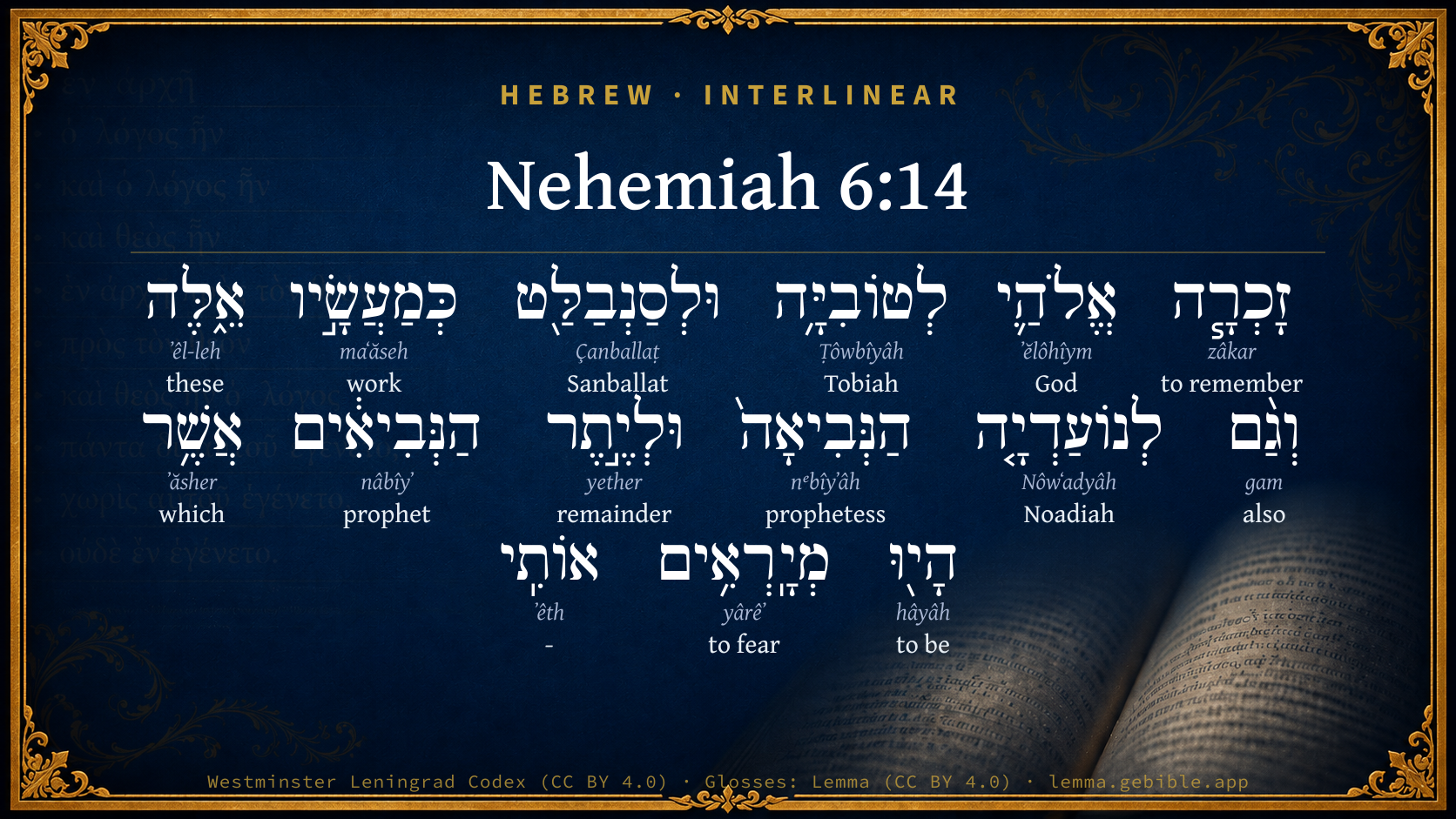
Nehemiah 6:14

Hebrew (Westminster Leningrad Codex) Nehemiah 6:14 appears in the Hebrew Old Testament. The text above is from the Westminster Leningrad Codex. Each word links to its Strong’s number, a concise gloss, and parsing drawn from the Open Scriptures Hebrew Bible morphology. Click any word for its full Brown-Driver-Briggs (BDB) entry.
Download image
Cite this verse

Nehemiah 6:14 (World English Bible). Public Domain. Lemma interlinear Bible study tool, https://lemma.gebible.app/v/nehemiah/6/14.

Show BibTeX & RIS
BibTeX
RIS
English Translation
Remember, my God, Tobiah and Sanballat according to these their works, and also the prophetess Noadiah, and the rest of the prophets, that would have put me in fear.
World English Bible · Public Domain
Download a study sheet

One document with this verse’s original text, its word-by-word gloss line, the meaning frame, cross-references with their text, attributed commentary, and full source and license credits — printable, and it pastes into notes with its structure intact.

This verse Autodidact and up

Study sheet (.html) Plain text (.txt)

A passage Seminary Student

Up to 50 verses in one chapter. A passage sheet keeps up to 6 commentary sources and 12 cross-references per verse, in the order this page ranks them, and says so on the sheet whenever that leaves anything out. Ask for a single verse and you get the Autodidact verse sheet above.

Everything on this page stays free to read, with no account — the sheet is a download of what is already on screen, not access to it.

Want to remove ads? Support Godless Engineer
Compare translations 3

The same verse in 3 English versions, stacked beneath the original-language interlinear above. Click any original word for its lexicon entry.

Each is an independent rendering of the whole verse — the interlinear is not word-aligned to these translations.

Highlighted words mark where these versions differ — a whole-verse word diff, not a word-by-word alignment.

  • World English Bible Public Domain
    Remember, my God, Tobiah and Sanballat according to these their works, and also the prophetess Noadiah, and the rest of the prophets, that would have put me in fear.
  • King James Version Public Domain
    My God, think thou upon Tobiah and Sanballat according to these their works, and on the prophetess Noadiah, and the rest of the prophets, that would have put me in fear.
  • unfoldingWord Literal Text CC BY-SA 4.0
    My God, remember Tobiah, and Sanballat according to these deeds of his, and also Noadiah the prophetess, and the rest of the prophets who are frightening me.

unfoldingWord Literal Text — © unfoldingWord, licensed CC BY-SA 4.0. Word-aligned USFM3 via Door43 (git.door43.org/unfoldingWord/en_ult).

Versions to compare (up to 4)

3 of 4 selected

Show all 18 translations

Every available English version of this verse, each an independent rendering of the whole verse.

  • World English Bible Public Domain
    Remember, my God, Tobiah and Sanballat according to these their works, and also the prophetess Noadiah, and the rest of the prophets, that would have put me in fear.
  • Berean Standard Bible Public Domain
    O my God, remember Tobiah and Sanballat for what they have done, and also Noadiah the prophetess and the other prophets who tried to intimidate me.
  • Majority Standard Bible Public Domain
    O my God, remember Tobiah and Sanballat for what they have done, and also Noadiah the prophetess and the other prophets who tried to intimidate me.
  • King James Version Public Domain
    My God, think thou upon Tobiah and Sanballat according to these their works, and on the prophetess Noadiah, and the rest of the prophets, that would have put me in fear.
  • American Standard Version (1901) Public Domain
    Remember, O my God, Tobiah and Sanballat according to these their works, and also the prophetess Noadiah, and the rest of the prophets, that would have put me in fear.
  • Revised Version (1885) Public Domain
    Remember, O my God, Tobiah and Sanballat according to these their works, and also the prophetess Noadiah, and the rest of the prophets, that would have put me in fear.
  • Geneva Bible (1599) Public Domain
    My God, remember thou Tobiah, and Sanballat according vnto these their workes, and Noadiah the Prophetesse also, and the rest of the Prophets that would haue put me in feare.
  • Douay-Rheims (1899) Public Domain
    Remember me, O Lord, for Tobias and Sanaballat, according to their works of this kind: and Noadias the prophet, and the rest of the prophets that would have put me in fear.
  • Young's Literal Translation Public Domain
    Be mindful, O my God, of Tobiah, and of Sanballat, according to these his works, and also, of Noadiah the prophetess, and of the rest of the prophets who have been making me afraid.
  • Literal Standard Version CC BY-SA 4.0
    Be mindful, O my God, of Tobiah, and of Sanballat, according to these his works, and also, of Noadiah the prophetess, and of the rest of the prophets who have been making me afraid.
  • Unlocked Literal Bible CC BY-SA 4.0
    Call to mind Tobiah and Sanballat, my God, and all that they did. Also call to mind the prophetess Noadiah and the rest of the prophets who tried to make me be afraid.
  • unfoldingWord Literal Text CC BY-SA 4.0
    My God, remember Tobiah, and Sanballat according to these deeds of his, and also Noadiah the prophetess, and the rest of the prophets who are frightening me.
  • Darby Bible Public Domain
    My God, remember Tobijah and Sanballat according to these their works, and also the prophetess Noadiah, and the rest of the prophets who would have put me in fear.
  • World Messianic Bible Public Domain
    “Remember, my God, Tobiah and Sanballat according to these their works, and also the prophetess Noadiah and the rest of the prophets that would have put me in fear.”
  • Webster's Bible Public Domain
    My God, think thou upon Tobiah and Sanballat according to these their works, and on the prophetess Noadiah, and the rest of the prophets, that would have put me in fear.
  • Free Bible Version CC BY-SA 4.0
    My God, remember Tobiah and Sanballat for doing this, and Noadiah the prophetess and the other prophets too who tried to frighten me.
  • Bible in Basic English Public Domain
    Keep in mind, O my God, Tobiah and Sanballat and what they did, and Noadiah, the woman prophet, and the rest of the prophets whose purpose was to put fear into me.
  • JPS Tanakh (1917) Public Domain
    Remember, O my God, Tobiah and Sanballat according to these their works, and also the prophetess Noadiah, and the rest of the prophets, that would have me put in fear.

Literal Standard Version (2020), Covenant Press — licensed CC BY-SA 4.0. Text via the HelloAO Bible API (eBible.org). Unlocked Literal Bible (unfoldingWord) — licensed CC BY-SA 4.0. Text via the HelloAO Bible API (eBible.org). unfoldingWord Literal Text — © unfoldingWord, licensed CC BY-SA 4.0. Word-aligned USFM3 via Door43 (git.door43.org/unfoldingWord/en_ult). Free Bible Version, Dr. Jonathan Gallagher — licensed CC BY-SA 4.0. Text via the HelloAO Bible API (eBible.org).

Word by word

More ways to search: Search by grammar → Find every occurrence → Compare this word →

Practice this passage: Drill this verse → Learn its vocabulary →

לְנוֹעַדְיָ֤ה
Nôwʻadyâh
H5129
“to/for · Noadiah”
Preposition + Noun, Proper
Part of Speech
Preposition + Noun
Type
Proper
Full BDB Definition

Origin: from H3259 and H3050

TWOT: None

Noadiah = "meeting with Jehovah" - a Levite, son of Binnui, who weighed the vessels of gold and silver belonging to the temple which were brought back from Babylon (noun proper masculine) - a prophetess who joined Sanballat and Tobiah in their attempt to intimidate Nehemiah (noun proper feminine)
  1. זָכְרָ֧ה zâkar H2142 “remember” Verb, Qal, Imperative, 2nd Person, Masculine, Singular + Suffix, h
  2. אֱלֹהַ֛י ʼĕlôhîym H430 “God(s) · my” Noun, Common, Masculine, Plural, Construct + Suffix, Personal, 1st Person, Common, Singular
  3. לְטוֹבִיָּ֥ה Ṭôwbîyâh H2900 “to/for · Tobiah” Preposition + Noun, Proper
  4. וּלְסַנְבַלַּ֖ט Çanballaṭ H5571 “and · to/for · Sanballat” Conjunction + Preposition + Noun, Proper
  5. כְּמַעֲשָׂ֣יו maʻăseh H4639 “like/as · works · his” Preposition + Noun, Common, Masculine, Plural, Construct + Suffix, Personal, 3rd Person, Masculine, Singular
  6. אֵ֑לֶּה ʼêl-leh H428 “these” Pronoun, Demonstrative, Common, Plural
  7. וְגַ֨ם gam H1571 “and · also” Conjunction + Particle, Accusative
  8. הַנְּבִיאָה֙ nᵉbîyʼâh H5031 “the · prophetess” Particle, Definite Article + Noun, Common, Feminine, Singular, Absolute
  9. וּלְיֶ֣תֶר yether H3499 “and · to/for · remainder of” Conjunction + Preposition + Noun, Common, Masculine, Singular, Construct
  10. הַנְּבִיאִ֔ים nâbîyʼ H5030 “the · prophets” Particle, Definite Article + Noun, Common, Masculine, Plural, Absolute
  11. אֲשֶׁ֥ר ʼăsher H834 “which” Particle, Relative
  12. הָי֖וּ hâyâh H1961 “to be” Verb, Qal, Perfect, 3rd Person, Common, Plural
  13. מְיָֽרְאִ֥ים yârêʼ H3372 “fearing” Verb, Piel, Participle Active, Masculine, Plural, Absolute
  14. אוֹתִֽי ʼêth H853 “- · me” Particle, Direct Object + Suffix, Personal, 1st Person, Common, Singular

About this verse

These counts appear in no published source. They are computed here, from the morphology-tagged text and Lemma’s own curated glosses. What Lemma adds →

15
words
15
distinct lemmas
Historical
section

Notable vocabulary

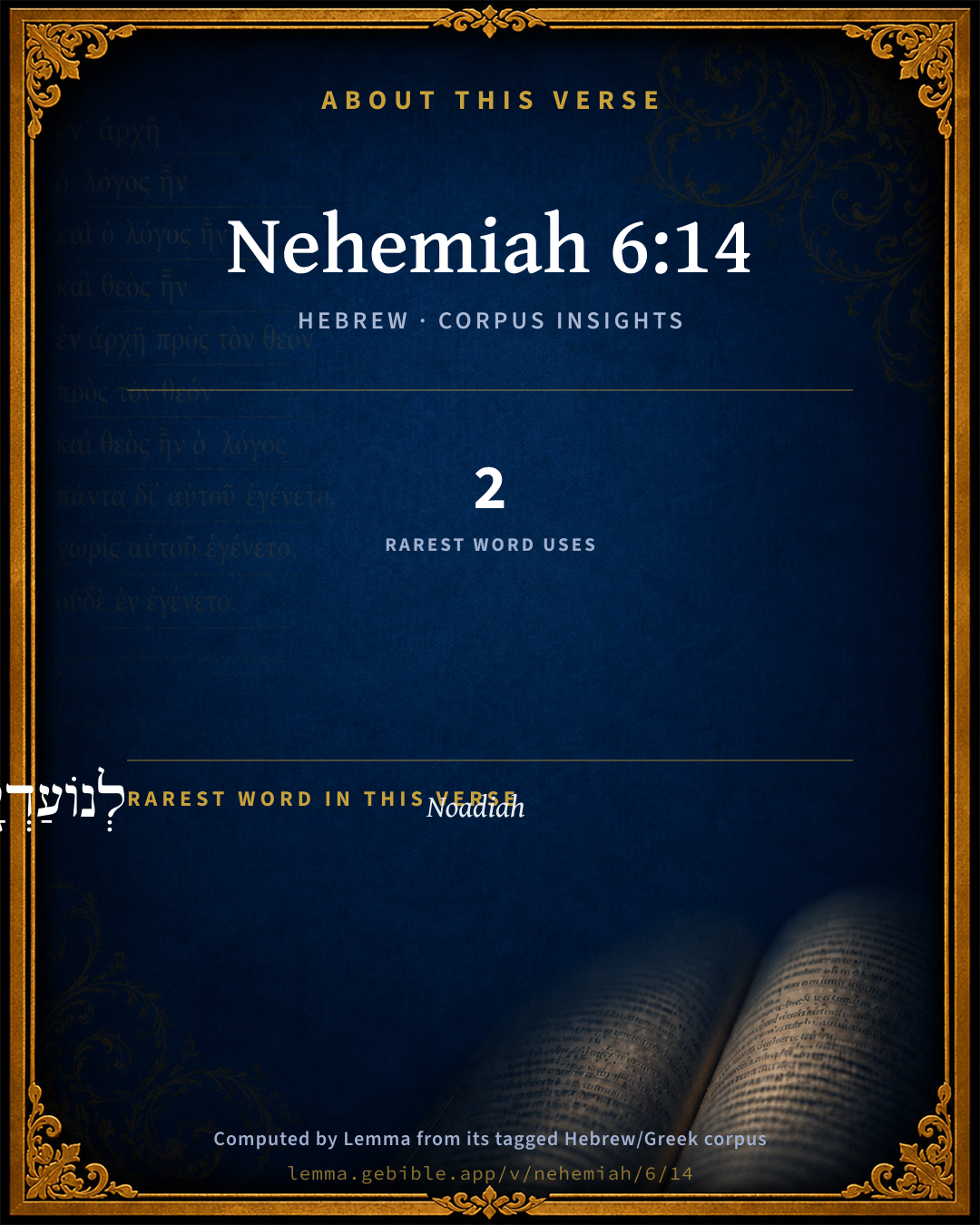
The rarest word here is לְנוֹעַדְיָ֤ה Noadiah H5129 — appearing just 2 times in the whole Hebrew Bible.

Shared distinctive vocabulary

לְנוֹעַדְיָ֤ה Noadiah H5129 occurs in 2 verses of the Hebrew Bible. Also found in:

Grammatical profile

  • 3 verbs
  • 8 nouns
  • 1 pronoun
  • 3 particles

Verb forms

  • זָכְרָ֧ה Qal · Imperative
  • הָי֖וּ Qal · Perfect
  • מְיָֽרְאִ֥ים Piel · Participle Active

Cross-references

24

Topical passages linked to Nehemiah 6:14 in the Treasury of Scripture Knowledge — connected by theme and wording, ordered by reader-vote popularity; previews shown in the World English Bible.

  • Nehemiah 13:29 Remember them, my God, because they have defiled the priesthood, and the covenant of the priesthood, and of the Levites.
  • 2 Timothy 4:14–15 Alexander, the coppersmith, did much evil to me. The Lord will repay him according to his works,
  • 1 Kings 22:22–24 Yahweh said to him, 'How?' He said, 'I will go forth, and will be a lying spirit in the mouth of all his prophets.' He said, 'You shall entice him, and shall prevail also: go forth, and do so.'
  • Nehemiah 4:4–5 Hear, our God; for we are despised: and turn back their reproach on their own head, and give them up for a spoil in a land of captivity;
  • Nehemiah 5:19 Remember to me, my God, for good, all that I have done for this people.
  • Psalms 22:1 My God, my God, why have you forsaken me? Why are you so far from helping me, and from the words of my groaning?
  • Psalms 36:11–12 Don't let the foot of pride come against me. Don't let the hand of the wicked drive me away.
  • Psalms 63:1 God, you are my God. I will earnestly seek you. My soul thirsts for you, My flesh longs for you, In a dry and weary land, where there is no water.
  • Psalms 140:5–11 The proud have hidden a snare for me, They have spread the cords of a net by the path. They have set traps for me. Selah.
  • Isaiah 9:14–15 Therefore Yahweh will cut off from Israel head and tail, palm-branch and rush, in one day.
  • Jeremiah 11:20–23 But, Yahweh of Hosts, who judge righteously, who try the heart and the mind, I shall see your vengeance on them; for to you have I revealed my cause.
  • Jeremiah 14:15 Therefore thus says Yahweh concerning the prophets who prophesy in my name, and I didn't send them, yet they say, Sword and famine shall not be in this land: By sword and famine shall those prophets be consumed.
  • Jeremiah 14:18 If I go forth into the field, then, behold, the slain with the sword! and if I enter into the city, then, behold, those who are sick with famine! for both the prophet and the priest go about in the land, and have no knowledge.
  • Jeremiah 18:20–23 Shall evil be recompensed for good? for they have dug a pit for my soul. Remember how I stood before you to speak good for them, to turn away your wrath from them.
  • Jeremiah 28:1 It happened the same year, in the beginning of the reign of Zedekiah king of Judah, in the fourth year, in the fifth month, that Hananiah the son of Azzur, the prophet, who was of Gibeon, spoke to me in the house of Yahweh, in the presence of the priests and of all the people, saying,
  • Jeremiah 28:10 Then Hananiah the prophet took the bar from off the prophet Jeremiah's neck, and broke it.
  • Jeremiah 28:15 Then said the prophet Jeremiah to Hananiah the prophet, Hear now, Hananiah: Yahweh has not sent you; but you make this people to trust in a lie.
  • Ezekiel 13:16–17 [to wit], the prophets of Israel who prophesy concerning Jerusalem, and who see visions of peace for her, and there is no peace, says the Lord Yahweh.
  • Matthew 7:15 "Beware of false prophets, who come to you in sheep's clothing, but inwardly are ravening wolves.
  • Matthew 24:11 Many false prophets will arise, and will lead many astray.
  • Matthew 24:24 For there will arise false christs, and false prophets, and they will show great signs and wonders, so as to lead astray, if possible, even the chosen ones.
  • 2 Timothy 3:8 Even as Jannes and Jambres opposed Moses, so do these also oppose the truth; men corrupted in mind, reprobate concerning the faith.
  • 1 John 5:16 If anyone sees his brother sinning a sin not leading to death, he shall ask, and God will give him life for those who sin not leading to death. There is a sin leading to death. I don't say that he should make a request concerning this.
  • Revelation 19:20 The beast was taken, and with him the false prophet who worked the signs in his sight, with which he deceived those who had received the mark of the beast and those who worshiped his image. These two were thrown alive into the lake of fire that burns with sulfur.

Cross-references courtesy of OpenBible.info (CC BY 4.0).

Hebrew and Greek witnesses Masoretic Hebrew ↔ Greek Septuagint

The same verse in the two great witnesses to the Old Testament, shown verse-for-verse.

These are two independent witnesses, not word-aligned to each other, and the Septuagint is shown in lemma (dictionary) form.

Hebrew Nehemiah 6:14 Masoretic · Westminster Leningrad Codex

זָכְרָ֧ה אֱלֹהַ֛י לְטוֹבִיָּ֥ה וּלְסַנְבַלַּ֖ט כְּמַעֲשָׂ֣יו אֵ֑לֶּה וְגַ֨ם לְנוֹעַדְיָ֤ה הַנְּבִיאָה֙ וּלְיֶ֣תֶר הַנְּבִיאִ֔ים אֲשֶׁ֥ר הָי֖וּ מְיָֽרְאִ֥ים אוֹתִֽי

Remember, my God, Tobiah and Sanballat according to these their works, and also the prophetess Noadiah, and the rest of the prophets, that would have put me in fear.

World English Bible · Public Domain

Greek LXX Structure differs

The Septuagint has no separate book of Nehemiah. Its Greek text is the second half of Esdras B (2 Esdras), chapters 11–23; Ezra is the first half (1–10).

A verse-for-verse comparison isn’t shown here because the chapters and verses don’t line up. Switch to the LXX edition with the MT / LXX toggle above to read the Greek directly.

On this verse, The Cambridge Bible for Schools and Colleges discusses the Septuagint’s reading. Read the note in Commentary ↓

Hebrew: Westminster Leningrad Codex (CC BY 4.0). Greek: Septuagint (public domain); English from a public-domain English Septuagint. How the Septuagint differs from the Hebrew →

Commentary

Notes on Nehemiah 6:14 from classic Christian and Jewish commentators (each source and its license shown beneath its notes). The classic Christian expositions comment on the surrounding passage and are grouped to its opening verse, so a note may address several verses; the Jewish commentaries on the Tanakh (Rashi and others) are per-verse, so they appear only where the commentator wrote on this verse.

Lemma curates 59 commentaries, every one of them public domain or Creative Commons licensed, each selected and text-cleaned for this edition rather than reprinted as found. About our sources →

The Cambridge Bible for Schools and Colleges

gen. ed. J. J. S. Perowne

14. My God, think thou upon] R.V. Remember, O my God. Tobiah’s name stands before Sanballat’s. Cf. Neh_6:12.

and on the prophetess] R.V. and also the prophetess. Noadiah’s name only occurs here. We know from the case of Huldah and Anna that women were sometimes privileged to possess the gift of prophecy (2Ki_22:14; Luk_2:36). Noadiah seems to have acted with ‘the rest of the prophets,’ who were probably bribed to intimidate Nehemiah. Sanballat had accused Nehemiah of obtaining popular influence by suborning prophets to support him (Neh_6:7). Nehemiah’s words in this verse show that the religious teachers of the people were divided in mind. The LXX. and possibly the Vulgate regarded ‘Noadiah’ as masc. (τῷ Νωαδίᾳ τῷ προφήτῃ, ‘Noadiæ prophetæ’).

Nehemiah’s prayer closes this section. Cf. Neh_6:14, Neh_5:19, and Neh_13:14; Neh_13:22; Neh_13:31.

The Cambridge Bible for Schools and Colleges (gen. ed. J. J. S. Perowne; Cambridge University Press, 1878–1918) — public domain. Text from a community e-Sword module.

Trapp's Complete Commentary

John Trapp

Neh 6:14 My God, think thou upon Tobiah and Sanballat according to these their works, and on the prophetess Noadiah, and the rest of the prophets, that would have put me in fear.

Ver. 14. My God, think upon Tobiah and Sanballat] Heb. Remember, to be revenged on them, q.d. I cannot deal with them, but do thou do it. He doth himself no disservice (saith one) who when no law will relieve him, maketh God his chancellor. It is a fearful thing to be put over into his punishing hands by the saints, as Joab and Shimei were unto Solomon’s hands by dying David. If men, in their best estate, are so weak that they are crushed before the moth, how shall they stand before this great God?

According to these their works] Qualia quisque tacit, talia quisque luat, Let them drink as they have brewed.

And on the prophetess Noadiah] Who joined with Shemaiah in this dissimulation, and was of his counsel. Omne malum ex gynaecio. False prophets and seducers are seldom without their women. Simon Magus had his Helena, Carpocrates his Marcellina, Apelles his Philumena, Montanus his Priscilla and Maximilla, &c.

And the rest of the prophets] Improperly so called, but so they pretended to be; and here they had conspired, a great sort of them, to do evil.

That would have put me in fear] By their concurrent prophecies, purposely to disgrace and endanger me. Suffragia non sunt numeranda, sed expendenda. Multitude and antiquity are but ciphers in divinity.

John Trapp, A Commentary or Exposition upon All the Books of the Old and New Testament (1647–1656) — public domain. Text from a community e-Sword module.

Joseph Benson's Commentary

Neh 6:14. My God, think thou upon Tobiah, &c. — Thou knowest their hearts, and art the avenger of falsehood and wrong; take cognizance of this cause, judge between me and them, and take what way and time thou pleasest to call them to an account for their actions. This prayer we are not to imitate; and whatever injuries are done to us we must not avenge ourselves, but commit our cause to Him that judgeth righteously. The Prophetess Noadiah — One that falsely pretended to the spirit of prophecy, to deceive and destroy Nehemiah. And the rest of the prophets, that would have put me in fear — The law of Moses enjoined the governors of the Jews to punish such as were proved to be false prophets; but because Nehemiah was not in a capacity to do it, having such powerful enemies round about him, and so many rich and powerful Jews highly discontented for their great loss by his means, he prays to God to remember and punish them. It appears from this, and many other passages, that there were among the Jews many that pretended to be prophets who had no divine commission, and often drew aside and deceived the people, who ought to have done as Nehemiah did here, to have considered the spirit of these prophets, whether they spoke that which was agreeable to the divine laws, and was likely to promote the glory of God. By this test they should have tried these prophets; and because they did not do so, they were led to hearken to them, for which they are often severely rebuked.

Joseph Benson's Commentary on the Old and New Testaments (1811–1818) — public domain. Text from a community e-Sword module.

Geneva Bible (1599)

Geneva Bible translators

Very grief caused him to pray against such, which under the pretence of being the ministers of God, were adversaries to his glory, and went about to overthrow his Church, declaring also hereby that where there is one true minister of God, the devil hath a great sort of hirelings.

Geneva Bible (1599) marginal notes — public domain. Text via Bolls.life.

Adam Clarke's Commentary

Verse 14. And on the prophetess Noadiah] Whether this was a prophet or prophetess, we cannot tell; the Hebrew text only makes her a prophetess; all the versions have Noadiah the prophet, except the Arabic which has [Arabic] Younadaa the prophet. I think the ה he at the end of נביאה nebiah is a mistake, and that we should read Noadiah the prophet.

Adam Clarke's Commentary on the Bible (1810–1826) — public domain. Text from a community e-Sword/MySword module.

Ellicott's Commentary for English Readers

(14) Think thou upon Tobiah.—This appeal to God is to be understood as an official prophetic prayer. Nehemiah puts God’s own cause into God’s own hands. The mention of the name of Noadiah, nowhere else referred to, shows the circumstantial nature of the narrative, and is an indirect evidence of its truth.

A Bible Commentary for English Readers, edited by Charles John Ellicott (1878–1897) — public domain. Text from a community e-Sword module.

John Gill's Exposition

My God, think thou on Tobiah and Sanballat according to these their works,.... Their wicked counsels and schemes, and not only confound and disappoint them, but reward them as they deserve:

and on the prophetess Noadiah: whom Aben Ezra takes to be the same with Shemaiah, because he said, "let us meet", &c. Neh 6:10, but no doubt it is the name of a woman, a false prophetess, and was hired, and in the same scheme with Shemaiah:

and the rest of the prophets that would have put me in fear; and so put him on leaving the people, and the work he was engaged in, and flee for his safety; it seems there were more than are by name mentioned, who sought to discourage and intimidate him.

John Gill's Exposition of the Whole Bible (1746–1763) — public domain (CC PDM 1.0). Text via the HelloAO Bible API.

Albert Barnes' Notes on the Bible

Noadiah is not elsewhere mentioned. The examples of Miriam, Deborah, Huldah, and Anna, show that the prophetical gift was occasionally bestowed upon women (2Ki 22:14 note).

Albert Barnes' Notes on the Bible (1834–1885) — public domain. Text from a community e-Sword/MySword module.

Haydock's Catholic Bible Commentary

Prophet. Hebrew, "the prophetess." (Calmet) --- Protestants, "My God, think thou upon Tobiah,...and on the prophetess Noadiah."

George Leo Haydock (1774–1849), Haydock's Catholic Family Bible and Commentary, 1859 edition — public domain. Excludes Psalms (Douay-Rheims chapter numbering differs from Protestant) and Deuterocanonical books (Catholic canon only).

Matthew Poole's English Annotations

The prophetess Noadiah; one that falsely pretended to the Spirit of prophecy, to deceive and destroy Nehemiah. He prays to God to remember and punish these false prophets, because he was not yet in a capacity to do it, having such powerful enemies round about him, and so many rich and potent Jews highly discontented for their great loss by his means, Ne 5.

Matthew Poole's English Annotations on the Holy Bible (1683–1685) — public domain. Text from a community e-Sword/MySword module.

Whedon's Commentary on the Bible

Daniel D. Whedon

14. My God — Nehemiah’s journal abounds with such pious ejaculations, they show his devotion to God and the truth. Comp. Neh_6:9, Neh_5:19; Neh_13:14; Neh_13:22; Neh_13:31.

The prophetess Noadiah, and the rest of the prophets — Shemaiah was not the only tool that the enemies of the Jews found ready to do their will. Other prophets were bribed, and even a prophetess, whose name is immortalized in infamy by its association with these enemies of Israel. Nothing more is known of her.

Daniel D. Whedon (gen. ed.), Commentary on the Old and New Testaments (1874–1909) — public domain. Text from a community e-Sword module.

The Pulpit Commentary

Tobiah and Sanballat. See ver. 12, with the comment. The prophetess Noadiah is not elsewhere mentioned. She has been supposed to have succumbed to a bribe, like Shemaiah (Ewald); but this is wholly uncertain. We only know that, together with certain soi-disant prophets, she endeavoured to "put Nehemiah in fear." It is clear that she was unsuccessful.

The Pulpit Commentary (1880–1919), ed. H.D.M. Spence-Jones & Joseph S. Exell — public domain. Text from a community e-Sword module.

John Wesley's Explanatory Notes

My God, &c. - This prayer we are not to imitate.

John Wesley, Explanatory Notes Upon the Whole Bible (1754–1765) — public domain. Text via the GEBible commentary corpus.

Rashi

Rabbi Shlomo Yitzchaki (Rashi)

and also Noadiah the prophetess She and the rest of the false prophets received pay from Sanballat and his cohorts in order to frighten me with their false prophecies.

Rashi on the Tanakh — English translations: “The Judaica Press complete Tanach with Rashi, translated by A. J. Rosenberg” (CC BY 4.0); “Pentateuch with Rashi's commentary by M. Rosenbaum and A.M. Silbermann, 1929-1934” (public domain); “The Metsudah Tanach series, Lakewood, N.J” (CC BY 4.0); and “The Book of Joshua, Metsudah Publications, 1997” (CC BY 4.0). Text via Sefaria.

Lesson kit

Teaching starters — assembled from the data on this page, not authored interpretation. Every prompt links to the verse data it draws on. Edit before teaching.

Nehemiah, in the Historical, opens this verse with 15 words (15 distinct Hebrew lemmas). Its most distinctive word is Nôwʻadyâh (“Noadiah”). A historical commentator’s framing appears above. Read the whole chapter for the surrounding context.

Discussion questions

  1. The word Nôwʻadyâh carries the sense “Noadiah.” How does it shape the verse?
  2. Ezra 8:33 shares the word «Noadiah» with this verse. How do the two illuminate each other?
  3. These translations render this verse differently; the difference is in the English rendering, not the original. What questions does that raise?
  4. The verb «זָכְרָ֧ה» is Qal Imperative. How does its form color the action?
  5. Reading how The Cambridge Bible for Schools and Colleges and Trapp's Complete Commentary read this verse, where do the two commentators agree and where do they part?

Things to notice

Reading settings

Reading text

Shown beneath each verse's original-language words.

Old Testament
Old Testament edition

Read the OT as the Masoretic Hebrew (MT) or the Greek Septuagint (LXX).

English shown for the Greek Septuagint (in the Hebrew ↔ Greek comparison).

Comparing translations? Open the Compare panel on any verse page to stack up to four side by side.