Genesis 24:51

Hebrew (Westminster Leningrad Codex) Genesis 24:51 appears in the Hebrew Old Testament. The text above is from the Westminster Leningrad Codex. Each word links to its Strong’s number, a concise gloss, and parsing drawn from the Open Scriptures Hebrew Bible morphology. Click any word for its full Brown-Driver-Briggs (BDB) entry.
Download image
Cite this verse

Genesis 24:51 (World English Bible). Public Domain. Lemma interlinear Bible study tool, https://lemma.gebible.app/v/genesis/24/51.

Show BibTeX & RIS
BibTeX
RIS
English Translation
Behold, Rebekah is before you, take her, and go, and let her be your master's son's wife, as Yahweh has spoken."
World English Bible · Public Domain
Download a study sheet

One document with this verse’s original text, its word-by-word gloss line, the meaning frame, cross-references with their text, attributed commentary, and full source and license credits — printable, and it pastes into notes with its structure intact.

This verse Autodidact and up

Study sheet (.html) Plain text (.txt)

A passage Seminary Student

Up to 50 verses in one chapter. A passage sheet keeps up to 6 commentary sources and 12 cross-references per verse, in the order this page ranks them, and says so on the sheet whenever that leaves anything out. Ask for a single verse and you get the Autodidact verse sheet above.

Everything on this page stays free to read, with no account — the sheet is a download of what is already on screen, not access to it.

Want to remove ads? Support Godless Engineer
Compare translations 3

The same verse in 3 English versions, stacked beneath the original-language interlinear above. Click any original word for its lexicon entry.

Each is an independent rendering of the whole verse — the interlinear is not word-aligned to these translations.

Highlighted words mark where these versions differ — a whole-verse word diff, not a word-by-word alignment.

  • World English Bible Public Domain
    Behold, Rebekah is before you, take her, and go, and let her be your master's son's wife, as Yahweh has spoken."
  • King James Version Public Domain
    Behold, Rebekah is before thee, take her, and go, and let her be thy master's son's wife, as the LORD hath spoken.
  • unfoldingWord Literal Text CC BY-SA 4.0
    Behold, Rebekah before you. Take her and go, and let her be the wife of the son of your master, as Yahweh has spoken.”

unfoldingWord Literal Text — © unfoldingWord, licensed CC BY-SA 4.0. Word-aligned USFM3 via Door43 (git.door43.org/unfoldingWord/en_ult).

Versions to compare (up to 4)

3 of 4 selected

Show all 18 translations

Every available English version of this verse, each an independent rendering of the whole verse.

  • World English Bible Public Domain
    Behold, Rebekah is before you, take her, and go, and let her be your master's son's wife, as Yahweh has spoken."
  • Berean Standard Bible Public Domain
    Rebekah is here before you. Take her and go, and let her become the wife of your master’s son, just as the LORD has decreed.”
  • Majority Standard Bible Public Domain
    Rebekah is here before you. Take her and go, and let her become the wife of your master’s son, just as the LORD has decreed.”
  • King James Version Public Domain
    Behold, Rebekah is before thee, take her, and go, and let her be thy master's son's wife, as the LORD hath spoken.
  • American Standard Version (1901) Public Domain
    Behold, Rebekah is before thee, take her, and go, and let her be thy master's son's wife, as Jehovah hath spoken.
  • Revised Version (1885) Public Domain
    Behold, Rebekah is before thee, take her, and go, and let her be thy master’s son’s wife, as the LORD hath spoken.
  • Geneva Bible (1599) Public Domain
    Beholde, Rebehak is before thee, take her and goe, that she may be thy masters sonnes wife, euen as the Lord hath said.
  • Douay-Rheims (1899) Public Domain
    Behold Rebecca is before thee, take her and go thy way, and let her be the wife of thy master's son, as the Lord hath spoken.
  • Young's Literal Translation Public Domain
    lo, Rebekah `is' before thee, take and go, and she is a wife to thy lord's son, as Jehovah hath spoken.'
  • Literal Standard Version CC BY-SA 4.0
    behold, Rebekah [is] before you, take and go, and she is a wife to your lord’s son, as YHWH has spoken.”
  • Unlocked Literal Bible CC BY-SA 4.0
    Look, Rebekah is before you. Take her and go, so she may be the wife of your master's son, as Yahweh has spoken.”
  • unfoldingWord Literal Text CC BY-SA 4.0
    Behold, Rebekah before you. Take her and go, and let her be the wife of the son of your master, as Yahweh has spoken.”
  • Darby Bible Public Domain
    Behold, Rebecca is before thee: take [her], and go away; and let her be wife of thy master's son, as Jehovah has said.
  • World Messianic Bible Public Domain
    Behold, Rebekah is before you. Take her, and go, and let her be your master’s son’s wife, as the LORD has spoken.”
  • Webster's Bible Public Domain
    Behold, Rebekah is before thee, take her, and go, and let her be thy master's son's wife, as the LORD hath spoken.
  • Free Bible Version CC BY-SA 4.0
    Rebekah's here, you can take her and leave. She can become the wife of your master's son, as the Lord has decided.”
  • Bible in Basic English Public Domain
    See, here is Rebekah: take her and go, and let her be your master's son's wife, as the Lord has said.
  • JPS Tanakh (1917) Public Domain
    Behold, Rebekah is before thee, take her, and go, and let her be thy master's son's wife, as the LORD hath spoken.'

Literal Standard Version (2020), Covenant Press — licensed CC BY-SA 4.0. Text via the HelloAO Bible API (eBible.org). Unlocked Literal Bible (unfoldingWord) — licensed CC BY-SA 4.0. Text via the HelloAO Bible API (eBible.org). unfoldingWord Literal Text — © unfoldingWord, licensed CC BY-SA 4.0. Word-aligned USFM3 via Door43 (git.door43.org/unfoldingWord/en_ult). Free Bible Version, Dr. Jonathan Gallagher — licensed CC BY-SA 4.0. Text via the HelloAO Bible API (eBible.org).

Word by word

More ways to search: Search by grammar → Find every occurrence → Compare this word →

Practice this passage: Drill this verse → Learn its vocabulary →

רִבְקָ֥ה
Ribqâh
H7259
“Rebekah”
Noun, Proper
Part of Speech
Noun
Type
Proper
Full BDB Definition

Origin: from an unused root probably meaning to clog by tying up the fetlock

TWOT: None

Rebekah = "ensnarer" - daughter of Bethuel, sister of Laban, wife of Isaac, and mother of Esau and Jacob
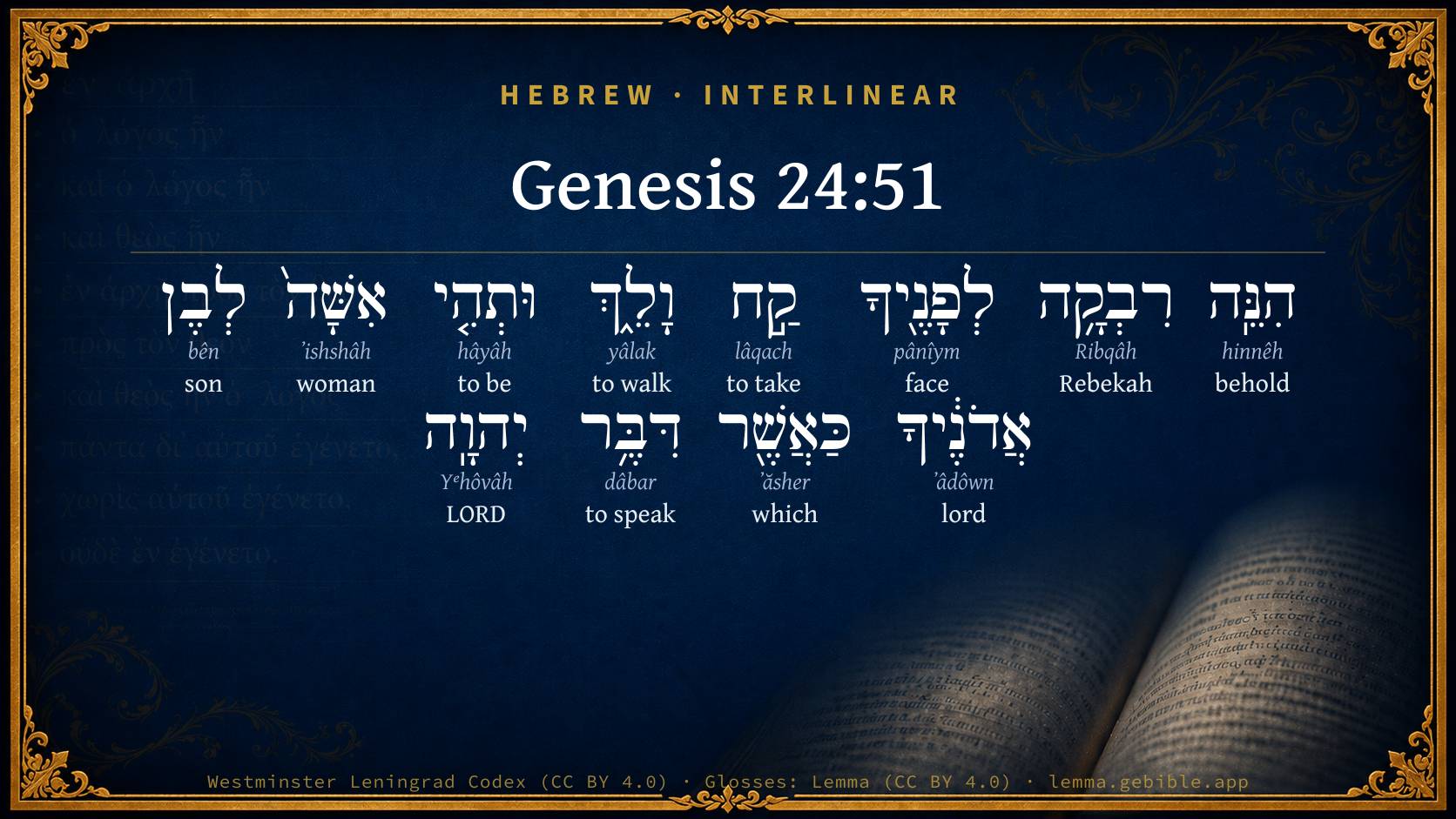
  1. הִנֵּֽה hinnêh H2009 “behold” Particle, Demonstrative
  2. לְפָנֶ֖יךָ pânîym H6440 “to/for · face(s) · your” Preposition + Noun, Common, Both, Plural, Construct + Suffix, Personal, 2nd Person, Masculine, Singular
  3. קַ֣ח lâqach H3947 “take” Verb, Qal, Imperative, 2nd Person, Masculine, Singular
  4. וָלֵ֑ךְ yâlak H3212 “and · walk” Conjunction + Verb, Qal, Imperative, 2nd Person, Masculine, Singular
  5. וּתְהִ֤י hâyâh H1961 “and · to be” Conjunction + Verb, Qal, Jussive, 3rd Person, Feminine, Singular
  6. אִשָּׁה֙ ʼishshâh H802 “woman” Noun, Common, Feminine, Singular, Absolute
  7. לְבֶן bên H1121 “to/for · son of” Preposition + Noun, Common, Masculine, Singular, Construct
  8. אֲדֹנֶ֔יךָ ʼâdôwn H113 “lords · your” Noun, Common, Masculine, Plural, Construct + Suffix, Personal, 2nd Person, Masculine, Singular
  9. כַּאֲשֶׁ֖ר ʼăsher H834 “like/as · which” Preposition + Particle, Relative
  10. דִּבֶּ֥ר dâbar H1696 “to speak” Verb, Piel, Perfect, 3rd Person, Masculine, Singular
  11. יְהוָֽה Yᵉhôvâh H3068 “LORD” Noun, Proper

About this verse

These counts appear in no published source. They are computed here, from the morphology-tagged text and Lemma’s own curated glosses. What Lemma adds →

12
words
12
distinct lemmas
Pentateuch
section

Shared distinctive vocabulary

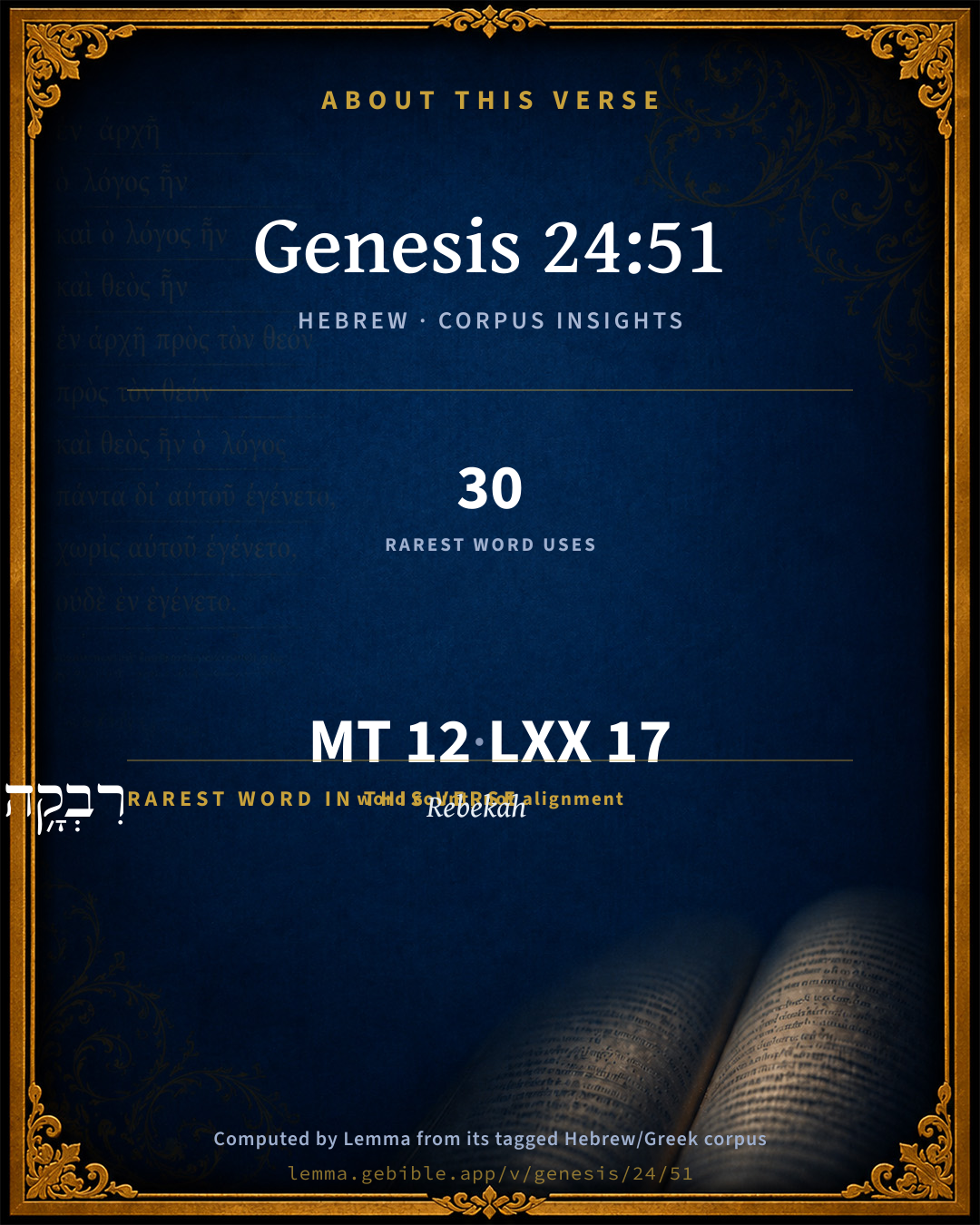
רִבְקָ֥ה Rebekah H7259 occurs in 29 verses of the Hebrew Bible. Also found in:

Grammatical profile

  • 4 verbs
  • 6 nouns
  • 2 particles

Verb forms

  • קַ֣ח Qal · Imperative
  • וָלֵ֑ךְ Qal · Imperative
  • וּתְהִ֤י Qal · Jussive
  • דִּבֶּ֥ר Piel · Perfect

Hebrew & Septuagint length

In English translation the verse runs 21 words from the Hebrew and 26 from the Septuagint (LXX English) — closely comparable.

A rough comparison of the two English renderings, which tokenize alike — not a word-level alignment.

Word counts can differ between the Hebrew and the Greek without any difference in meaning — e.g. the Hebrew direct-object marker אֵת has no separate Greek word, and Greek often adds the article ὁ.

In the original languages it is 12 Hebrew tokens and 17 Greek tokens — but the two are counted differently (Hebrew bundles its prefixes and suffixes into one token; the Greek is in lemma form), so that isn’t a like-for-like length.

Cross-references

3

Topical passages linked to Genesis 24:51 in the Treasury of Scripture Knowledge — connected by theme and wording, ordered by reader-vote popularity; previews shown in the World English Bible.

  • Genesis 20:15 Abimelech said, "Behold, my land is before you. Dwell where it pleases you."
  • Genesis 24:15 It happened, before he had done speaking, that behold, Rebekah came out, who was born to Bethuel the son of Milcah, the wife of Nahor, Abraham's brother, with her pitcher on her shoulder.
  • 2 Samuel 16:10 The king said, What have I to do with you, you sons of Zeruiah? Because he curses, and because Yahweh has said to him, Curse David; who then shall say, Why have you done so?

Cross-references courtesy of OpenBible.info (CC BY 4.0).

Hebrew and Greek witnesses Masoretic Hebrew ↔ Greek Septuagint

The same verse in the two great witnesses to the Old Testament, shown verse-for-verse.

These are two independent witnesses, not word-aligned to each other, and the Septuagint is shown in lemma (dictionary) form.

Hebrew Genesis 24:51 Masoretic · Westminster Leningrad Codex

הִנֵּֽה רִבְקָ֥ה לְפָנֶ֖יךָ קַ֣ח וָלֵ֑ךְ וּתְהִ֤י אִשָּׁה֙ לְבֶן אֲדֹנֶ֔יךָ כַּאֲשֶׁ֖ר דִּבֶּ֥ר יְהוָֽה

Behold, Rebekah is before you, take her, and go, and let her be your master's son's wife, as Yahweh has spoken."

World English Bible · Public Domain

Greek LXX Genesis 24:51 Septuagint · lemma form

ἰδού ρεβεκκα ἐνώπιον σύ λαμβάνω ἀποτρέχω καί εἰμί γυνή ὁ υἱός ὁ κύριος σύ καθά λαλέω κύριος

Behold, Rebecca is before you, take her and go away, and let her be wife to the son of your master, as the Lord has said.

LXX2012 (modern English Septuagint) · Public Domain

Hebrew: Westminster Leningrad Codex (CC BY 4.0). Greek: Septuagint (public domain); English from LXX2012 (modern English Septuagint) (Public Domain). How the Septuagint differs from the Hebrew →

Targum (Aramaic paraphrase)

2

The Targum is the ancient Jewish Aramaic paraphrase of the Hebrew Scriptures — an interpretive translation, not the Hebrew text itself. Onkelos (literal) and Pseudo-Jonathan (expansive) render the Torah, and Jonathan the Prophets. Coverage is partial: where no permissively-licensed English translation exists for a verse, only the Aramaic is shown. This is verse-level text, not a word-by-word alignment to the Hebrew.

  1. Targum Onkelos Torah (Genesis–Deuteronomy)
    הָא רִבְקָה קֳדָמָךְ דְּבַר וְאֵיזִיל וּתְהֵי אִתְּתָא לְבַר רִבּוֹנָךְ כְּמָא דִּי מַלֵּל יְיָ

    (no public-domain English translation for this verse)

    Targum Onkelos — Aramaic: “Onkelos Genesis” (public domain); “Onkelos Exodus” (public domain); “Onkelos Leviticus” (public domain); “Onkelos Numbers” (public domain); “Onkelos Deuteronomy” (public domain). English: “Sefaria Community Translation” (CC0 1.0 (public-domain dedication)); “J.W. Etheridge. The Targums of Onkelos and Jonathan Ben Uzziel on the Pentateuch. London: Longmans, Green, 1862” (public domain). Text via Sefaria.

  2. Targum Pseudo-Jonathan Torah (Genesis–Deuteronomy)
    הָא רִבְקָה קוּמָךְ דְבַר וְאֵיזִיל וּתְהֵי אִיתָא לְבַר רִבּוֹנָךְ כְּמָא דְמַלֵיל יְיָ

    Behold, Rivekah is before thee, take and go, and let her be the wife of thy master's son, as the Lord hath spoken.

    Targum Pseudo-Jonathan — Aramaic: “Targum Jonathan on Genesis” (public domain); “Targum Jonathan on Exodus” (public domain); “Targum Jonathan on Leviticus” (public domain); “Targum Jonathan on Numbers” (public domain); “Targum Jonathan on Deuteronomy” (public domain). English: “The Targum of Jonathan ben Uzziel, trans. J. W. Etheridge, London, 1862” (public domain). Text via Sefaria.

Commentary

Notes on Genesis 24:51 from classic Christian and Jewish commentators (each source and its license shown beneath its notes). The classic Christian expositions comment on the surrounding passage and are grouped to its opening verse, so a note may address several verses; the Jewish commentaries on the Tanakh (Rashi and others) are per-verse, so they appear only where the commentator wrote on this verse.

Lemma curates 59 commentaries, every one of them public domain or Creative Commons licensed, each selected and text-cleaned for this edition rather than reprinted as found. About our sources →

Trapp's Complete Commentary

John Trapp

Gen 24:51 Behold, Rebekah [is] before thee, take [her], and go, and let her be thy master’s son’s wife, as the LORD hath spoken.

Ver. 51. As the Lord hath spoken.] For his signs also are vocal. {Exo 4:8}

John Trapp, A Commentary or Exposition upon All the Books of the Old and New Testament (1647–1656) — public domain. Text from a community e-Sword module.

Geneva Bible (1599)

Geneva Bible translators

Or, at thy commandment.

Or, ordained.

Geneva Bible (1599) marginal notes — public domain. Text via Bolls.life.

The Cambridge Bible for Schools and Colleges

gen. ed. J. J. S. Perowne

51. take … and go] The betrothal is thus summarily settled. The bride is not consulted!

as the Lord hath spoken] Referring to the manner in which the will Jehovah had evidently been made known. Events, not words, had been the means of revelation.

The Cambridge Bible for Schools and Colleges (gen. ed. J. J. S. Perowne; Cambridge University Press, 1878–1918) — public domain. Text from a community e-Sword module.

John Gill's Exposition

And he said unto them, hinder me not,.... Do not detain me, let me set forward on my journey:

seeing, the Lord hath prospered my way; succeeded him in what he came about; and by his being succeeded so well, and so soon, it seemed to be the mind of the Lord that he should hasten his journey homeward:

send me away, that I may go to my master; and carry him the good news of his success, and attend his domestic affairs, over which he was set.

John Gill's Exposition of the Whole Bible (1746–1763) — public domain (CC PDM 1.0). Text via the HelloAO Bible API.

Matthew Poole's English Annotations

Rebekah is before thee, i.e. in thy power and disposal; as this phrase is taken, Gen 20:15, and elsewhere.

Matthew Poole's English Annotations on the Holy Bible (1683–1685) — public domain. Text from a community e-Sword/MySword module.

Sforno

Rabbi Ovadia Sforno

Take her and go. Since it is Hashem’s will, you are able to take her even without our permission.

As Hashem has spoken. Hashem declares who a person will marry and in this case He has given a clear sign of what He has decreed.

Sforno on the Tanakh — English translation: “Yalkut, Sifsei Chachomim Chumash, Metsudah Publications, 2009” (CC BY 4.0). Text via Sefaria.

Radak

Rabbi David Kimhi (Radak)

הנה.. כאשר דבר, for He has arranged everything in accordance with your request.

Radak on the Tanakh — English translations: “Sefaria Community Translation” (CC0 1.0 (public-domain dedication)); “Eliyahu Munk, HaChut Hameshulash” (CC BY 4.0); “Rabbi Mike Feuer, Jerusalem Anthology” (CC BY 4.0); and “R. David Kimhi on the first book of Psalms, Translated by R.G. Finch, London, 1919” (public domain). Text via Sefaria.

Lesson kit

Teaching starters — assembled from the data on this page, not authored interpretation. Every prompt links to the verse data it draws on. Edit before teaching.

Genesis, in the Pentateuch, opens this verse with 12 words (12 distinct Hebrew lemmas). Its most distinctive word is Ribqâh (“Rebekah”). A historical commentator’s framing appears above. Read the whole chapter for the surrounding context.

Discussion questions

  1. What does “Rebekah” (Ribqâh) contribute to the verse as a whole?
  2. Genesis 22:23 shares the word «Rebekah» with this verse. How do the two illuminate each other?
  3. The translations on this page render this verse differently — a whole-verse word diff, not a word-by-word alignment. What might account for the different wordings?
  4. The verb «קַ֣ח» is Qal Imperative. How does its form color the action?
  5. Reading how Trapp's Complete Commentary and Geneva Bible (1599) read this verse, where do the two commentators agree and where do they part?

Things to notice

Reading settings

Reading text

Shown beneath each verse's original-language words.

Old Testament
Old Testament edition

Read the OT as the Masoretic Hebrew (MT) or the Greek Septuagint (LXX).

English shown for the Greek Septuagint (in the Hebrew ↔ Greek comparison).

Comparing translations? Open the Compare panel on any verse page to stack up to four side by side.