
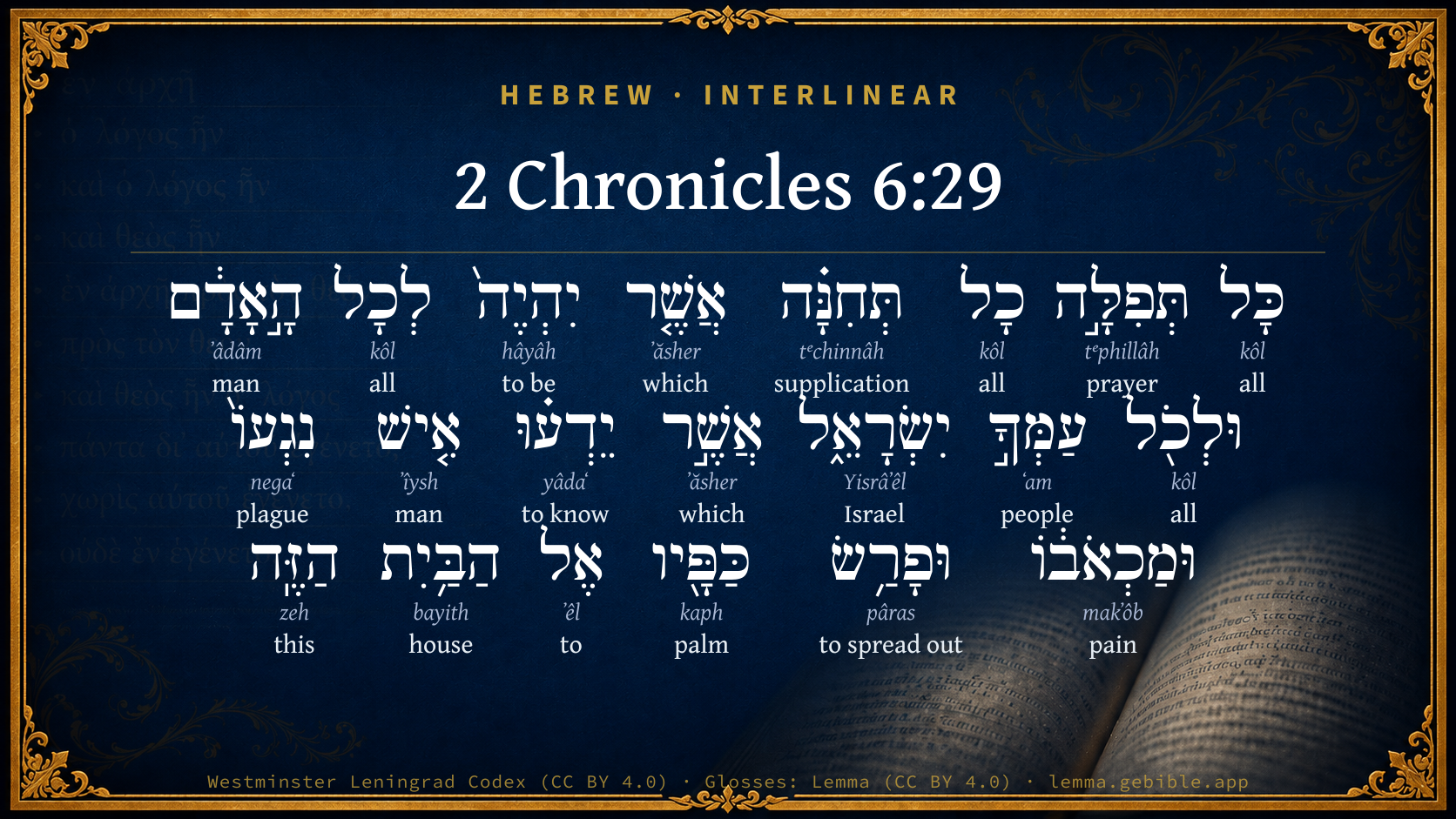
2 Chronicles 6:29

Hebrew (Westminster Leningrad Codex) 2 Chronicles 6:29 appears in the Hebrew Old Testament. The text above is from the Westminster Leningrad Codex. Each word links to its Strong’s number, a concise gloss, and parsing drawn from the Open Scriptures Hebrew Bible morphology. Click any word for its full Brown-Driver-Briggs (BDB) entry.
Download image
Cite this verse

2 Chronicles 6:29 (World English Bible). Public Domain. Lemma interlinear Bible study tool, https://lemma.gebible.app/v/2-chronicles/6/29.

Show BibTeX & RIS
BibTeX
RIS
English Translation
whatever prayer and supplication be made by any man, or by all your people Israel, who shall know every man his own plague and his own sorrow, and shall spread forth his hands toward this house:
World English Bible · Public Domain
Download a study sheet

One document with this verse’s original text, its word-by-word gloss line, the meaning frame, cross-references with their text, attributed commentary, and full source and license credits — printable, and it pastes into notes with its structure intact.

This verse Autodidact and up

Study sheet (.html) Plain text (.txt)

A passage Seminary Student

Up to 50 verses in one chapter. A passage sheet keeps up to 6 commentary sources and 12 cross-references per verse, in the order this page ranks them, and says so on the sheet whenever that leaves anything out. Ask for a single verse and you get the Autodidact verse sheet above.

Everything on this page stays free to read, with no account — the sheet is a download of what is already on screen, not access to it.

Want to remove ads? Support Godless Engineer
Compare translations 3

The same verse in 3 English versions, stacked beneath the original-language interlinear above. Click any original word for its lexicon entry.

Each is an independent rendering of the whole verse — the interlinear is not word-aligned to these translations.

Highlighted words mark where these versions differ — a whole-verse word diff, not a word-by-word alignment.

  • World English Bible Public Domain
    whatever prayer and supplication be made by any man, or by all your people Israel, who shall know every man his own plague and his own sorrow, and shall spread forth his hands toward this house:
  • King James Version Public Domain
    Then what prayer or what supplication soever shall be made of any man, or of all thy people Israel, when every one shall know his own sore and his own grief, and shall spread forth his hands in this house:
  • unfoldingWord Literal Text CC BY-SA 4.0
    any prayer, any supplication which is by any person or by all your people Israel which they know each his own plague and his own sorrow, and he spreads out his hands toward this house,

unfoldingWord Literal Text — © unfoldingWord, licensed CC BY-SA 4.0. Word-aligned USFM3 via Door43 (git.door43.org/unfoldingWord/en_ult).

Versions to compare (up to 4)

3 of 4 selected

Show all 18 translations

Every available English version of this verse, each an independent rendering of the whole verse.

  • World English Bible Public Domain
    whatever prayer and supplication be made by any man, or by all your people Israel, who shall know every man his own plague and his own sorrow, and shall spread forth his hands toward this house:
  • Berean Standard Bible Public Domain
    then may whatever prayer or petition Your people Israel make—each knowing his own afflictions and spreading out his hands toward this temple—
  • Majority Standard Bible Public Domain
    then may whatever prayer or plea Your people Israel make—each knowing his own afflictions and spreading out his hands toward this temple—
  • King James Version Public Domain
    Then what prayer or what supplication soever shall be made of any man, or of all thy people Israel, when every one shall know his own sore and his own grief, and shall spread forth his hands in this house:
  • American Standard Version (1901) Public Domain
    what prayer and supplication soever be made by any man, or by all thy people Israel, who shall know every man his own plague and his own sorrow, and shall spread forth his hands toward this house:
  • Revised Version (1885) Public Domain
    what prayer and supplication soever be made by any man or by all thy people Israel, which shall know every man his own plague and his own sorrow, and shall spread forth his hands toward this house:
  • Geneva Bible (1599) Public Domain
    Then what prayer and supplication so euer shalbe made of any man, or of all thy people Israel, whe euery one shall knowe his owne plague, and his owne disease, and shall stretch forth his hands toward this house,
  • Douay-Rheims (1899) Public Domain
    Then if any of thy people Israel, knowing his own scourge and infirmity shall pray, and shall spread forth his hands in this house,
  • Young's Literal Translation Public Domain
    any prayer, any supplication that is for any man, and for all Thy people Israel, when they know each his own plague, and his own pain, and he hath spread out his hands towards this house:
  • Literal Standard Version CC BY-SA 4.0
    any prayer, any supplication that is for any man, and for all Your people Israel, when they each know his own plague, and his own pain, and he has spread out his hands toward this house—
  • Unlocked Literal Bible CC BY-SA 4.0
    and suppose then that prayers and requests are made by a person or by all your people Israel—each knowing the plague and sorrow in his own heart as he spreads out his hands toward this temple.
  • unfoldingWord Literal Text CC BY-SA 4.0
    any prayer, any supplication which is by any person or by all your people Israel which they know each his own plague and his own sorrow, and he spreads out his hands toward this house,
  • Darby Bible Public Domain
    what prayer, what supplication soever be made by any man, or by all thy people Israel, when they shall know every man his own plague, and his own grief, and shall spread forth his hands toward this house;
  • World Messianic Bible Public Domain
    whatever prayer and supplication is made by any man, or by all your people Israel, who will each know his own plague and his own sorrow, and shall spread out his hands toward this house,
  • Webster's Bible Public Domain
    Then whatever prayer, or whatever supplication shall be made by any man, or by all the people of Israel, when every one shall know his own calamity, and his own grief, and shall spread forth his hands in this house:
  • Free Bible Version CC BY-SA 4.0
    then whatever kind of prayer or whatever kind of appeal is made by anyone or all your people Israel, in fact anyone who, knowing their problems and pains, prays toward this Temple,
  • Bible in Basic English Public Domain
    Whatever prayer or request for your grace is made by any man, or by all your people Israel, whatever his trouble may be, whose hands are stretched out to this house:
  • JPS Tanakh (1917) Public Domain
    what prayer and supplication soever be made by any man, or by all Thy people Israel, who shall know every man his own plague and his own pain, and shall spread forth his hands toward this house;

Literal Standard Version (2020), Covenant Press — licensed CC BY-SA 4.0. Text via the HelloAO Bible API (eBible.org). Unlocked Literal Bible (unfoldingWord) — licensed CC BY-SA 4.0. Text via the HelloAO Bible API (eBible.org). unfoldingWord Literal Text — © unfoldingWord, licensed CC BY-SA 4.0. Word-aligned USFM3 via Door43 (git.door43.org/unfoldingWord/en_ult). Free Bible Version, Dr. Jonathan Gallagher — licensed CC BY-SA 4.0. Text via the HelloAO Bible API (eBible.org).

Word by word

More ways to search: Search by grammar → Find every occurrence → Compare this word →

Practice this passage: Drill this verse → Learn its vocabulary →

וּמַכְאֹב֔וֹ
makʼôb
H4341
“and · pain · his”
Conjunction + Noun, Common, Masculine, Singular, Construct + Suffix, Personal, 3rd Person, Masculine, Singular
Part of Speech
Conjunction + Noun
Type
Common
Gender
Masculine
Number
Singular
State
Construct
Full BDB Definition

Origin: from H3510

TWOT: 940b

also feminine ( Isa 53:3 ) mak'obah - pain, sorrow - pain (physical) - pain (mental)
  1. כָּל kôl H3605 “all of” Noun, Common, Masculine, Singular, Construct
  2. תְּפִלָּ֣ה tᵉphillâh H8605 “prayer” Noun, Common, Feminine, Singular, Absolute
  3. כָל kôl H3605 “all of” Noun, Common, Masculine, Singular, Construct
  4. תְּחִנָּ֗ה tᵉchinnâh H8467 “supplication” Noun, Common, Feminine, Singular, Absolute
  5. אֲשֶׁ֤ר ʼăsher H834 “which” Particle, Relative
  6. יִהְיֶה֙ hâyâh H1961 “to be” Verb, Qal, Imperfect, 3rd Person, Masculine, Singular
  7. לְכָל kôl H3605 “to/for · all of” Preposition + Noun, Common, Masculine, Singular, Construct
  8. הָ֣אָדָ֔ם ʼâdâm H120 “the · man” Particle, Definite Article + Noun, Common, Masculine, Singular, Absolute
  9. וּלְכֹ֖ל kôl H3605 “and · to/for · all of” Conjunction + Preposition + Noun, Common, Masculine, Singular, Construct
  10. עַמְּךָ֣ ʻam H5971 “people · your” Noun, Common, Masculine, Singular, Construct + Suffix, Personal, 2nd Person, Masculine, Singular
  11. יִשְׂרָאֵ֑ל Yisrâʼêl H3478 “Israel” Noun, Proper
  12. אֲשֶׁ֣ר ʼăsher H834 “which” Particle, Relative
  13. יֵדְע֗וּ yâdaʻ H3045 “to know” Verb, Qal, Imperfect, 3rd Person, Masculine, Plural
  14. אִ֤ישׁ ʼîysh H376 “man” Noun, Common, Masculine, Singular, Absolute
  15. נִגְעוֹ֙ negaʻ H5061 “plague · his” Noun, Common, Masculine, Singular, Construct + Suffix, Personal, 3rd Person, Masculine, Singular
  16. וּפָרַ֥שׂ pâras H6566 “and · to spread out” Conjunction + Verb, Qal, Sequential Perfect, 3rd Person, Masculine, Singular
  17. כַּפָּ֖יו kaph H3709 “palms · his” Noun, Common, Feminine, Dual, Construct + Suffix, Personal, 3rd Person, Masculine, Singular
  18. אֶל ʼêl H413 “to” Preposition
  19. הַבַּ֥יִת bayith H1004 “the · house” Particle, Definite Article + Noun, Common, Masculine, Singular, Absolute
  20. הַזֶּֽה zeh H2088 “the · this” Particle, Definite Article + Pronoun, Demonstrative, Masculine, Singular

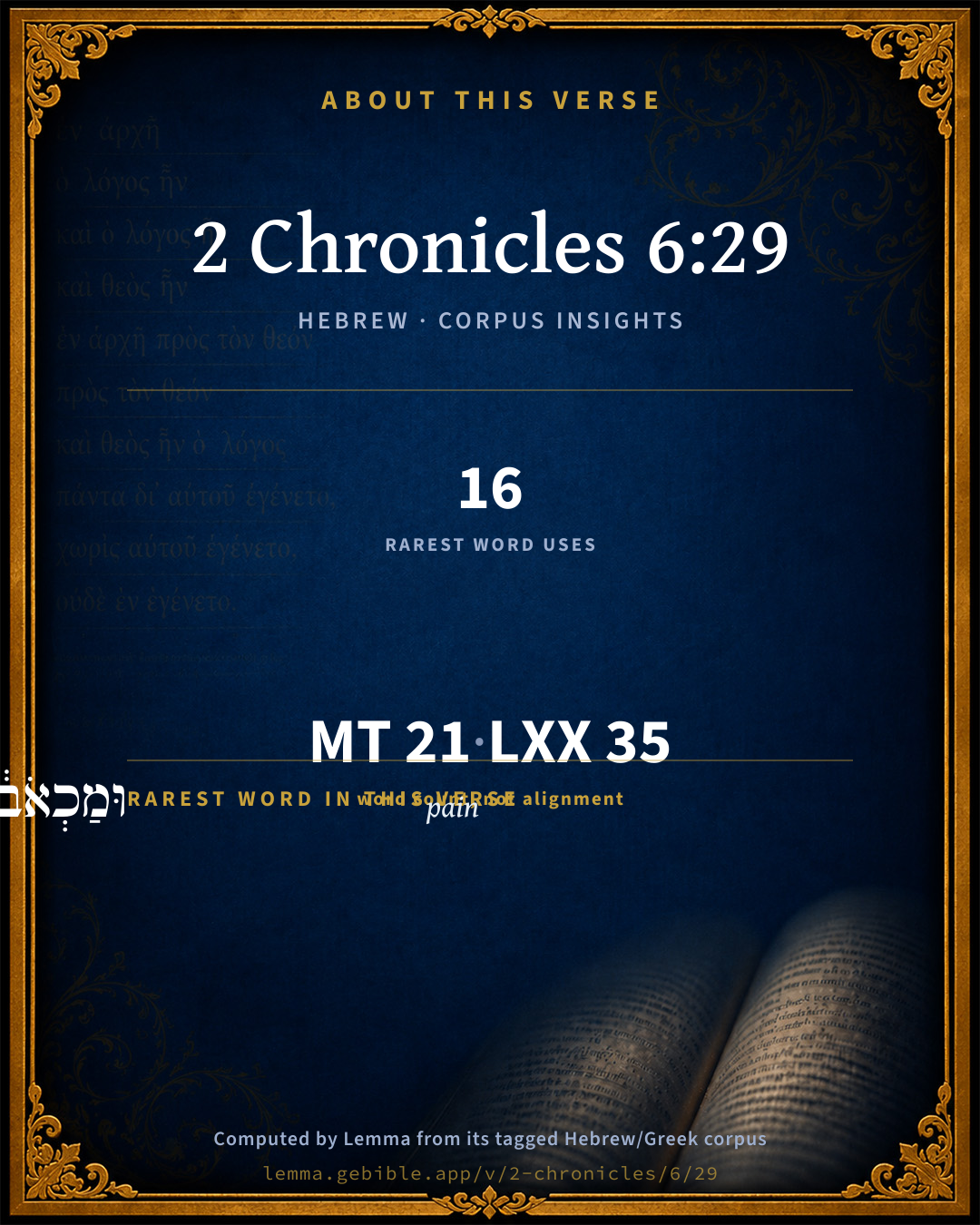
About this verse

These counts appear in no published source. They are computed here, from the morphology-tagged text and Lemma’s own curated glosses. What Lemma adds →

21
words
17
distinct lemmas
Historical
section

Notable vocabulary

The rarest word here is וּמַכְאֹב֔וֹ pain H4341 — appearing just 16 times in the whole Hebrew Bible.

Shared distinctive vocabulary

וּמַכְאֹב֔וֹ pain H4341 occurs in 15 verses of the Hebrew Bible. Also found in:

Grammatical profile

  • 3 verbs
  • 14 nouns
  • 1 pronoun
  • 1 preposition
  • 2 particles

Verb forms

  • יִהְיֶה֙ Qal · Imperfect
  • יֵדְע֗וּ Qal · Imperfect
  • וּפָרַ֥שׂ Qal · Sequential Perfect

Repetition

Words recur within this verse — often emphatic in Hebrew:

  • כָּל all H3605 ×4
  • אֲשֶׁ֤ר which H834 ×2

Hebrew & Septuagint length

In English translation the verse runs 36 words from the Hebrew and 38 from the Septuagint (LXX English) — closely comparable.

A rough comparison of the two English renderings, which tokenize alike — not a word-level alignment.

Word counts can differ between the Hebrew and the Greek without any difference in meaning — e.g. the Hebrew direct-object marker אֵת has no separate Greek word, and Greek often adds the article ὁ.

In the original languages it is 21 Hebrew tokens and 35 Greek tokens — but the two are counted differently (Hebrew bundles its prefixes and suffixes into one token; the Greek is in lemma form), so that isn’t a like-for-like length.

Cross-references

8

Topical passages linked to 2 Chronicles 6:29 in the Treasury of Scripture Knowledge — connected by theme and wording, ordered by reader-vote popularity; previews shown in the World English Bible.

  • 2 Chronicles 6:12–13 He stood before the altar of Yahweh in the presence of all the assembly of Israel, and spread forth his hands
  • Psalms 32:2–6 Blessed is the man to whom Yahweh doesn't impute iniquity, In whose spirit there is no deceit.
  • Psalms 33:12–13 Blessed is the nation whose God is Yahweh, The people whom he has chosen for his own inheritance.
  • Psalms 50:15 Call on me in the day of trouble. I will deliver you, and you will honor me."
  • Psalms 91:15 He will call on me, and I will answer him. I will be with him in trouble. I will deliver him, and honor him.
  • Psalms 142:1–2 I cry with my voice to Yahweh. With my voice, I ask Yahweh for mercy.
  • Proverbs 14:10 The heart knows its own bitterness and joy; He will not share these with a stranger.
  • Isaiah 1:15 When you spread forth your hands, I will hide my eyes from you; Yes, when you make many prayers, I will not hear. Your hands are full of blood.

Cross-references courtesy of OpenBible.info (CC BY 4.0).

Hebrew and Greek witnesses Masoretic Hebrew ↔ Greek Septuagint

The same verse in the two great witnesses to the Old Testament, shown verse-for-verse.

These are two independent witnesses, not word-aligned to each other, and the Septuagint is shown in lemma (dictionary) form.

Hebrew 2 Chronicles 6:29 Masoretic · Westminster Leningrad Codex

כָּל תְּפִלָּ֣ה כָל תְּחִנָּ֗ה אֲשֶׁ֤ר יִהְיֶה֙ לְכָל הָ֣אָדָ֔ם וּלְכֹ֖ל עַמְּךָ֣ יִשְׂרָאֵ֑ל אֲשֶׁ֣ר יֵדְע֗וּ אִ֤ישׁ נִגְעוֹ֙ וּמַכְאֹב֔וֹ וּפָרַ֥שׂ כַּפָּ֖יו אֶל הַבַּ֥יִת הַזֶּֽה

whatever prayer and supplication be made by any man, or by all your people Israel, who shall know every man his own plague and his own sorrow, and shall spread forth his hands toward this house:

World English Bible · Public Domain

Greek LXX 2 Chronicles 6:29 Septuagint · lemma form

καί πᾶς προσευχή καί πᾶς δέησις ὅς ἐάν γίγνομαι πᾶς ἄνθρωπος καί πᾶς λαός σύ ἰσραήλ ἐάν γιγνώσκω ἄνθρωπος ὁ ἁφή αὐτός καί ὁ μαλακία αὐτός καί διαπετάζω ὁ χείρ αὐτός εἰς ὁ οἶκος οὗτος

Then whatever prayer and whatever supplication shall be made by any man and all your people Israel, if a man should know his own plague and his own sickness, and should spread forth his hands toward this house;

LXX2012 (modern English Septuagint) · Public Domain

On this verse, Ellicott's Commentary for English Readers discusses the Septuagint’s reading. Read the note in Commentary ↓

Hebrew: Westminster Leningrad Codex (CC BY 4.0). Greek: Septuagint (public domain); English from LXX2012 (modern English Septuagint) (Public Domain). How the Septuagint differs from the Hebrew →

Commentary

Notes on 2 Chronicles 6:29 from classic Christian and Jewish commentators (each source and its license shown beneath its notes). The classic Christian expositions comment on the surrounding passage and are grouped to its opening verse, so a note may address several verses; the Jewish commentaries on the Tanakh (Rashi and others) are per-verse, so they appear only where the commentator wrote on this verse.

Lemma curates 59 commentaries, every one of them public domain or Creative Commons licensed, each selected and text-cleaned for this edition rather than reprinted as found. About our sources →

Ellicott's Commentary for English Readers

(29) When.—Or if, as in LXX. Hebrew, ‘asher. (See Note on 2Ch_6:24.)

His own sore (plague) and his own grief.—Kings, “the plague of his own heart.” So Syriac and Arabic. The phrase of the chronicler looks like a gloss on this.

In this house.—The margin is right.

A Bible Commentary for English Readers, edited by Charles John Ellicott (1878–1897) — public domain. Text from a community e-Sword module.

The Cambridge Bible for Schools and Colleges

gen. ed. J. J. S. Perowne

29. his man sore and his own grief] R.V. his own plague and his own sorrow. Cp. last note.

in this house] R.V. toward this house.

The Cambridge Bible for Schools and Colleges (gen. ed. J. J. S. Perowne; Cambridge University Press, 1878–1918) — public domain. Text from a community e-Sword module.

Haydock's Catholic Bible Commentary

Any. Hebrew adds, "man, or thy people." Septuagint, "and (that is) to thy." See ver. 32. (Haydock) --- Both strangers and Israelites may there sue for mercy, and obtain it. (Calmet) --- From this chapter, as well as from many other passages, it is evident that places consecrated to God, are more acceptable to him than other places; (Worthington) and here the prayers of the faithful are sooner heard, as they testify their unity. (Du Hamel)

George Leo Haydock (1774–1849), Haydock's Catholic Family Bible and Commentary, 1859 edition — public domain. Excludes Psalms (Douay-Rheims chapter numbering differs from Protestant) and Deuterocanonical books (Catholic canon only).

The Pulpit Commentary

Vers. 29-31.

God and the individual soul.

Not only during the time of national calamity (ver. 28), though especially then, do families and individual men find themselves in sore need of Divine succour. There is never any considerable congregation which does not include at least a few hearts that come up in hope of comfort and relief from Heaven.

I THE BURDEN WHICH IS BORNE BY EACH HUMAN HEART. With our complex nature, and our many human relationships, we lie open to many ills and sorrows. These may be:

1. Bodily; pain or weakness, or threatened serious disease.

2. Temporal; some difficulty or danger connected with "our circumstances.

3. S ympathetic; some trouble of heart we are suffering by reason of our strong attachment to others who suffer and are in distress.

4. Spiritual; heart-ache, disappointment, compunction, doubt, anxious inquiry after God. "Every one knows his own sore and his own grief.

II THE APPEAL OF THE SOUL TO THE SUPREME. Trouble does lead men to the God of their life, to the Father of their spirit. "Men say, "God be pitiful," who ne"er said, "God be praised. We cannot supply our own need; we find our own "insufficiency for ourselves;" we must look beyond ourselves, and in what direction? Man often fails us.

1. We cannot speak to him, either because we cannot get his ear, orbecause we do not care to divulge our secret grief to any human heart whatsoever.

2. Or we have tried to secure human sympathy, and have failed; men aretoo much occupied with their own affairs and their own troubles to make much room in their hearts for ours.

3. Or we cannot discover the human hand that will help us; those that pitycannot serve us, cannot save us. We must have recourse to God. And we bring our grief, our sore, to him.

1. We are sure that he is accessible. He invites our approach; he says, "Callupon me in the time of trouble; I will deliver thee, and thou shalt glorify me.

2. We are sure of his attention. He is our Father, who pities us withparental kindness; (Psa_103:13) he is our Saviour, who has trodden the path of struggle and of sorrow before us, on whose tender sympathy we may confidently count. (Heb_2:18 Heb_4:15, 16 5:2)

3. We may depend on his power. He is able to save, to rescue, to restore,to renew.

III THE DIVINE RESPONSE.

1. It is a question of our spiritual integrity. God answers "according to all our ways; " that is, according to our integrity. We must have the spirit of obedience in us. We may not look for a response if we are "regarding iniquity in our heart;" but, on the other hand, if we are seriously bent on serving the Lord, if "our heart condemn us not," if it acquit us of all insincerity and double-mindedness, "then have we confidence toward God; and whatsoever we ask we receive of him, because we keep his commandments". (1Jn_3:21, 1Jn_3:22) We may not, we are not able to keep all his precepts in all particulars; but the spirit of filial obedience, the desire to do what is "pleasing in his sight," is dwelling within us and inspiring us, and we are, therefore, of those whose prayer he hears. He forgives our shortcoming ("hear and forgive"), and he "renders according to our ways.

2. It is a question of Divine knowledge. Who shall tell that this spirit of submission and obedience is within us? Only One can; it is he who "only knows the hearts of the children of men." He looks beneath our words and actions, and sees the motives and the purposes of our hearts.

3. It is a question of our character and the Divine intention. And God"s design is so to hear and heed our prayers, so to grant or to withhold the desires of our heart, that we shall "fear God and walk in his ways," shall be "partakers of his holiness. C.

The Pulpit Commentary (1880–1919), ed. H.D.M. Spence-Jones & Joseph S. Exell — public domain. Text from a community e-Sword module.

Rashi

Rabbi Shlomo Yitzchaki (Rashi)

Any prayer, any supplication that he will pray and supplicate about, concerning any of these matters.

every man shall know his plague i.e., if he pray about his affliction or about his sickness to remove it from him.

Rashi on the Tanakh — English translations: “The Judaica Press complete Tanach with Rashi, translated by A. J. Rosenberg” (CC BY 4.0); “Pentateuch with Rashi's commentary by M. Rosenbaum and A.M. Silbermann, 1929-1934” (public domain); “The Metsudah Tanach series, Lakewood, N.J” (CC BY 4.0); and “The Book of Joshua, Metsudah Publications, 1997” (CC BY 4.0). Text via Sefaria.

Lesson kit

Teaching starters — assembled from the data on this page, not authored interpretation. Every prompt links to the verse data it draws on. Edit before teaching.

2 Chronicles, in the Historical, opens this verse with 21 words (17 distinct Hebrew lemmas). Its most distinctive word is makʼôb (“pain”). A historical commentator’s framing appears above. Read the whole chapter for the surrounding context.

Discussion questions

  1. The word makʼôb carries the sense “pain.” How does it shape the verse?
  2. How does Exodus 3:7, which shares the word «pain», read alongside this verse?
  3. What does the repetition of “all” (4× in this one verse) do in this verse?
  4. The translations on this page render this verse differently — a whole-verse word diff, not a word-by-word alignment. What might account for the different wordings?
  5. «יִהְיֶה֙» is a Qal Imperfect verb. How does that grammatical form shape the action described?
  6. Compare how Ellicott's Commentary for English Readers and The Cambridge Bible for Schools and Colleges read this verse. Where do they agree or differ?

Things to notice

Reading settings

Reading text

Shown beneath each verse's original-language words.

Old Testament
Old Testament edition

Read the OT as the Masoretic Hebrew (MT) or the Greek Septuagint (LXX).

English shown for the Greek Septuagint (in the Hebrew ↔ Greek comparison).

Comparing translations? Open the Compare panel on any verse page to stack up to four side by side.