
Ezra 9:8

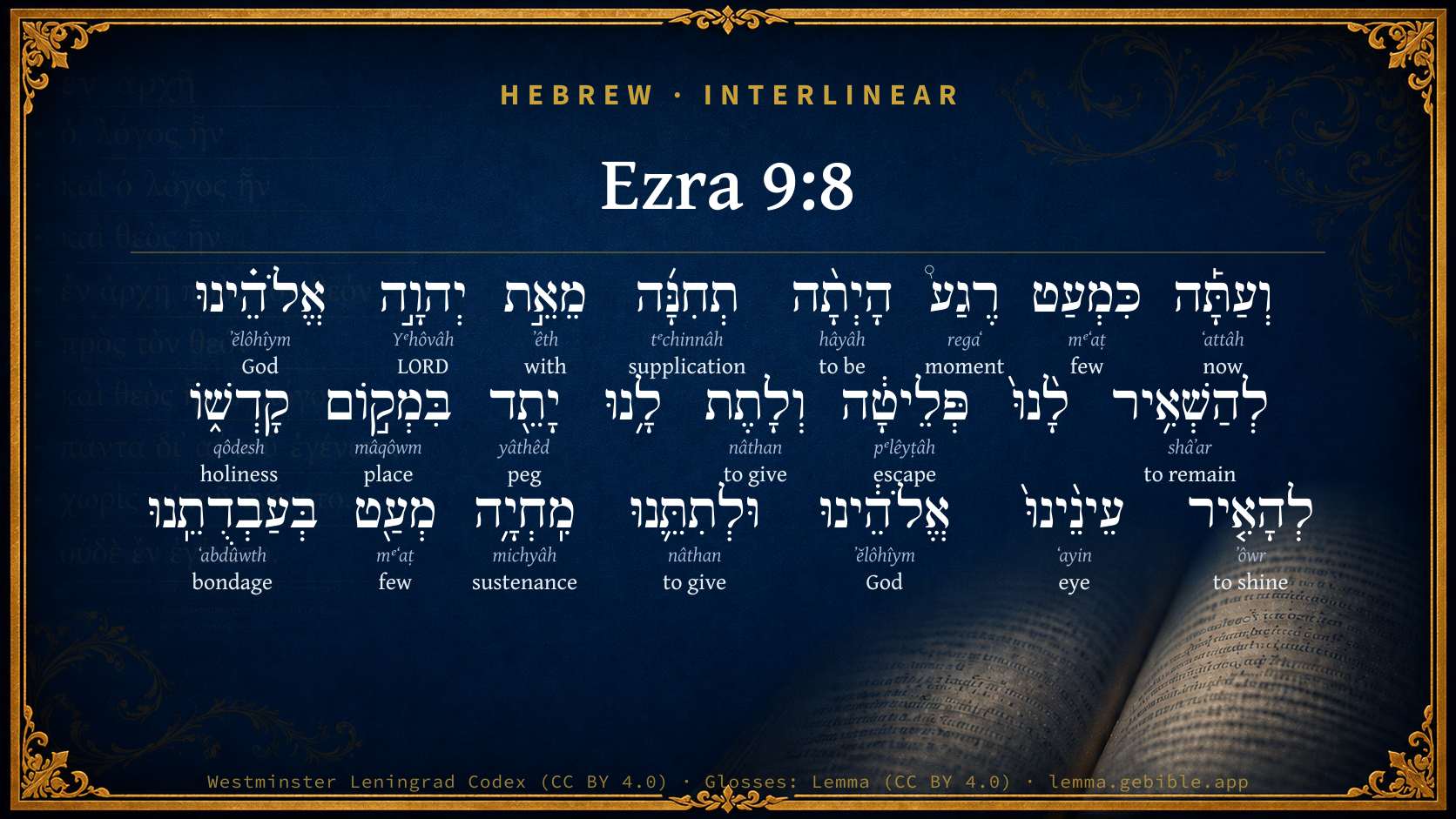
Hebrew (Westminster Leningrad Codex) Ezra 9:8 appears in the Hebrew Old Testament. The text above is from the Westminster Leningrad Codex. Each word links to its Strong’s number, a concise gloss, and parsing drawn from the Open Scriptures Hebrew Bible morphology. Click any word for its full Brown-Driver-Briggs (BDB) entry.
Download image
Cite this verse

Ezra 9:8 (World English Bible). Public Domain. Lemma interlinear Bible study tool, https://lemma.gebible.app/v/ezra/9/8.

Show BibTeX & RIS
BibTeX
RIS
English Translation
Now for a little moment grace has been shown from Yahweh our God, to leave us a remnant to escape, and to give us a nail in his holy place, that our God may lighten our eyes, and give us a little reviving in our bondage.
World English Bible · Public Domain
Highlights
  • 1 first appearance in the Hebrew Bible
Full analysis ↓
Download a study sheet

One document with this verse’s original text, its word-by-word gloss line, the meaning frame, cross-references with their text, attributed commentary, and full source and license credits — printable, and it pastes into notes with its structure intact.

This verse Autodidact and up

Study sheet (.html) Plain text (.txt)

A passage Seminary Student

Up to 50 verses in one chapter. A passage sheet keeps up to 6 commentary sources and 12 cross-references per verse, in the order this page ranks them, and says so on the sheet whenever that leaves anything out. Ask for a single verse and you get the Autodidact verse sheet above.

Everything on this page stays free to read, with no account — the sheet is a download of what is already on screen, not access to it.

Want to remove ads? Support Godless Engineer
Compare translations 3

The same verse in 3 English versions, stacked beneath the original-language interlinear above. Click any original word for its lexicon entry.

Each is an independent rendering of the whole verse — the interlinear is not word-aligned to these translations.

Highlighted words mark where these versions differ — a whole-verse word diff, not a word-by-word alignment.

  • World English Bible Public Domain
    Now for a little moment grace has been shown from Yahweh our God, to leave us a remnant to escape, and to give us a nail in his holy place, that our God may lighten our eyes, and give us a little reviving in our bondage.
  • King James Version Public Domain
    And now for a little space grace hath been shewed from the LORD our God, to leave us a remnant to escape, and to give us a nail in his holy place, that our God may lighten our eyes, and give us a little reviving in our bondage.
  • unfoldingWord Literal Text CC BY-SA 4.0
    But now, according to a little moment, favor has come from with Yahweh our God to leave for us survivors and to give to us a peg in his holy place, for our God to brighten our eyes and to give us a little reviving in our slavery.

unfoldingWord Literal Text — © unfoldingWord, licensed CC BY-SA 4.0. Word-aligned USFM3 via Door43 (git.door43.org/unfoldingWord/en_ult).

Versions to compare (up to 4)

3 of 4 selected

Show all 18 translations

Every available English version of this verse, each an independent rendering of the whole verse.

  • World English Bible Public Domain
    Now for a little moment grace has been shown from Yahweh our God, to leave us a remnant to escape, and to give us a nail in his holy place, that our God may lighten our eyes, and give us a little reviving in our bondage.
  • Berean Standard Bible Public Domain
    But now, for a brief moment, grace has come from the LORD our God to preserve for us a remnant and to give us a stake in His holy place. Even in our bondage, our God has given us new life and light to our eyes.
  • Majority Standard Bible Public Domain
    But now, for a brief moment, grace has come from the LORD our God to preserve for us a remnant and to give us a stake in His holy place. Even in our bondage, our God has given us new life and light to our eyes.
  • King James Version Public Domain
    And now for a little space grace hath been shewed from the LORD our God, to leave us a remnant to escape, and to give us a nail in his holy place, that our God may lighten our eyes, and give us a little reviving in our bondage.
  • American Standard Version (1901) Public Domain
    And now for a little moment grace hath been showed from Jehovah our God, to leave us a remnant to escape, and to give us a nail in his holy place, that our God may lighten our eyes, and give us a little reviving in our bondage.
  • Revised Version (1885) Public Domain
    And now for a little moment grace hath been shewed from the LORD our God, to leave us a remnant to escape, and to give us a nail in his holy place, that our God may lighten our eyes, and give us a little reviving in our bondage.
  • Geneva Bible (1599) Public Domain
    And now for a litle space grace hath bene shewed from the Lord our God, in causing a remnant to escape, and in giuing vs a nayle in his holy place, that our God may light our eyes, and giue vs a litle reuiuing in our seruitude.
  • Douay-Rheims (1899) Public Domain
    And now as a little, and for a moment has our prayer been made before the Lord our God, to leave us a remnant, and give us a pin in his holy place, and that our God would enlighten our eyes, and would give us a little life in our bondage.
  • Young's Literal Translation Public Domain
    `And now, as a small moment hath grace been from Jehovah our God, to leave to us an escape, and to give to us a nail in His holy place, by our God's enlightening our eyes, and by giving us a little quickening in our servitude;
  • Literal Standard Version CC BY-SA 4.0
    And now, as a small moment grace has been from our God YHWH, to leave an escape for us, and to give to us a nail in His holy place, by our God’s enlightening our eyes, and by giving us a little quickening in our servitude;
  • Unlocked Literal Bible CC BY-SA 4.0
    Yet now for a short time, mercy from Yahweh our God has come to leave us a few survivors and to give us a foothold in his holy place. This was for our God to enlighten our eyes and to give us a little relief in our slavery.
  • unfoldingWord Literal Text CC BY-SA 4.0
    But now, according to a little moment, favor has come from with Yahweh our God to leave for us survivors and to give to us a peg in his holy place, for our God to brighten our eyes and to give us a little reviving in our slavery.
  • Darby Bible Public Domain
    And now for a little space there hath been favour from Jehovah our God, to leave us a remnant to escape, and to give us a nail in his holy place, that our God may lighten our eyes, and give us a little reviving in our bondage.
  • World Messianic Bible Public Domain
    Now for a little moment grace has been shown from the LORD our God, to leave us a remnant to escape, and to give us a stake in his holy place, that our God may lighten our eyes, and revive us a little in our bondage.
  • Webster's Bible Public Domain
    And now for a little space grace hath been shown from the LORD our God, to leave us a remnant to escape, and to give us a nail in his holy place, that our God may lighten our eyes, and give us a little reviving in our bondage.
  • Free Bible Version CC BY-SA 4.0
    Now for a short time the Lord our God has given us grace, preserving a few of us as a remnant, and giving us safety in his holy place. Our God has brightened our lives by giving us some relief from our slavery.
  • Bible in Basic English Public Domain
    And now for a little time grace has come to us from the Lord our God, to let a small band of us get free and to give us a nail in his holy place, so that our God may give light to our eyes and a measure of new life in our prison chains.
  • JPS Tanakh (1917) Public Domain
    And now for a little moment grace hath been shown from the LORD our God, to leave us a remnant to escape, and to give us a nail in His holy place, that our God may lighten our eyes, and give us a little reviving in our bondage.

Literal Standard Version (2020), Covenant Press — licensed CC BY-SA 4.0. Text via the HelloAO Bible API (eBible.org). Unlocked Literal Bible (unfoldingWord) — licensed CC BY-SA 4.0. Text via the HelloAO Bible API (eBible.org). unfoldingWord Literal Text — © unfoldingWord, licensed CC BY-SA 4.0. Word-aligned USFM3 via Door43 (git.door43.org/unfoldingWord/en_ult). Free Bible Version, Dr. Jonathan Gallagher — licensed CC BY-SA 4.0. Text via the HelloAO Bible API (eBible.org).

Word by word

More ways to search: Search by grammar → Find every occurrence → Compare this word →

Practice this passage: Drill this verse → Learn its vocabulary →

בְּעַבְדֻתֵֽנוּ
ʻabdûwth
H5659
“in/at · bondage · our”
Preposition + Noun, Common, Feminine, Singular, Construct + Suffix, Personal, 1st Person, Common, Plural
Part of Speech
Preposition + Noun
Type
Common
Gender
Feminine
Number
Singular
State
Construct
Full BDB Definition

Origin: from H5647

TWOT: 1553e

servitude, bondage
  1. וְעַתָּ֡ה ʻattâh H6258 “and · now” Conjunction + Adverb
  2. כִּמְעַט mᵉʻaṭ H4592 “like/as · few” Preposition + Noun, Common, Masculine, Singular, Absolute
  3. רֶגַע֩ regaʻ H7281 “moment” Noun, Common, Masculine, Singular, Absolute
  4. הָיְתָ֨ה hâyâh H1961 “to be” Verb, Qal, Perfect, 3rd Person, Feminine, Singular
  5. תְחִנָּ֜ה tᵉchinnâh H8467 “supplication” Noun, Common, Feminine, Singular, Absolute
  6. מֵאֵ֣ת ʼêth H854 “from · with” Preposition + Preposition
  7. יְהוָ֣ה Yᵉhôvâh H3068 “LORD” Noun, Proper
  8. אֱלֹהֵ֗ינוּ ʼĕlôhîym H430 “God(s) · our” Noun, Common, Masculine, Plural, Construct + Suffix, Personal, 1st Person, Common, Plural
  9. לְהַשְׁאִ֥יר shâʼar H7604 “to remain” Preposition + Verb, Hiphil, Infinitive Construct
  10. פְּלֵיטָ֔ה pᵉlêyṭâh H6413 “escape” Noun, Common, Feminine, Singular, Absolute
  11. וְלָתֶת nâthan H5414 “and · to give” Conjunction + Preposition + Verb, Qal, Infinitive Construct
  12. יָתֵ֖ד yâthêd H3489 “peg” Noun, Common, Feminine, Singular, Absolute
  13. בִּמְק֣וֹם mâqôwm H4725 “in/at · place of” Preposition + Noun, Common, Masculine, Singular, Construct
  14. קָדְשׁ֑וֹ qôdesh H6944 “holiness · his” Noun, Common, Masculine, Singular, Construct + Suffix, Personal, 3rd Person, Masculine, Singular
  15. לְהָאִ֤יר ʼôwr H215 “to shine” Preposition + Verb, Hiphil, Infinitive Construct
  16. עֵינֵ֨ינוּ֙ ʻayin H5869 “eyes · our” Noun, Common, Both, Dual, Construct + Suffix, Personal, 1st Person, Common, Plural
  17. אֱלֹהֵ֔ינוּ ʼĕlôhîym H430 “God(s) · our” Noun, Common, Masculine, Plural, Construct + Suffix, Personal, 1st Person, Common, Plural
  18. וּלְתִתֵּ֛נוּ nâthan H5414 “and · to give · us” Conjunction + Preposition + Verb, Qal, Infinitive Construct + Suffix, Personal, 1st Person, Common, Plural
  19. מִֽחְיָ֥ה michyâh H4241 “sustenance” Noun, Common, Feminine, Singular, Absolute
  20. מְעַ֖ט mᵉʻaṭ H4592 “few” Noun, Common, Masculine, Singular, Absolute

About this verse

These counts appear in no published source. They are computed here, from the morphology-tagged text and Lemma’s own curated glosses. What Lemma adds →

23
words
18
distinct lemmas
Historical
section

Notable vocabulary

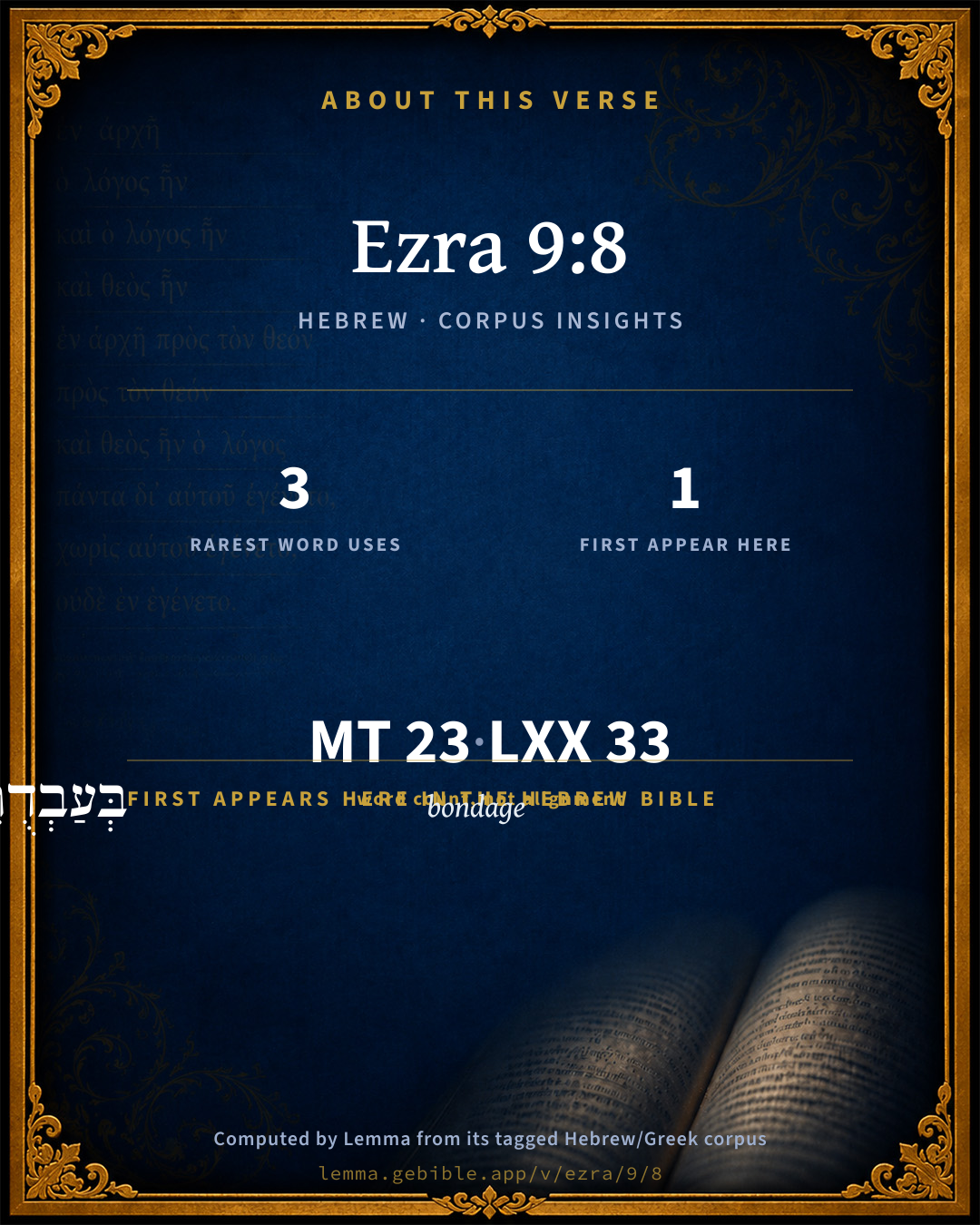
The rarest word here is בְּעַבְדֻתֵֽנוּ bondage H5659 — appearing just 3 times in the whole Hebrew Bible.

First appearance in Scripture

This word makes its first canonical appearance in the Hebrew Bible here:

  • בְּעַבְדֻתֵֽנוּ bondage H5659

Shared distinctive vocabulary

בְּעַבְדֻתֵֽנוּ bondage H5659 occurs in 3 verses of the Hebrew Bible. Also found in:

Grammatical profile

  • 5 verbs
  • 14 nouns
  • 3 prepositions
  • 1 adverb

Verb forms

  • הָיְתָ֨ה Qal · Perfect
  • לְהַשְׁאִ֥יר Hiphil · Infinitive Construct
  • וְלָתֶת Qal · Infinitive Construct
  • לְהָאִ֤יר Hiphil · Infinitive Construct
  • וּלְתִתֵּ֛נוּ Qal · Infinitive Construct

Repetition

Words recur within this verse — often emphatic in Hebrew:

  • כִּמְעַט few H4592 ×2
  • אֱלֹהֵ֗ינוּ God H430 ×2
  • וְלָתֶת to give H5414 ×2

Hebrew & Septuagint length

In English translation the verse runs 46 words from the Hebrew and 41 from the Septuagint (LXX English) — closely comparable.

A rough comparison of the two English renderings, which tokenize alike — not a word-level alignment.

Word counts can differ between the Hebrew and the Greek without any difference in meaning — e.g. the Hebrew direct-object marker אֵת has no separate Greek word, and Greek often adds the article ὁ.

In the original languages it is 23 Hebrew tokens and 33 Greek tokens — but the two are counted differently (Hebrew bundles its prefixes and suffixes into one token; the Greek is in lemma form), so that isn’t a like-for-like length.

Cross-references

31

Topical passages linked to Ezra 9:8 in the Treasury of Scripture Knowledge — connected by theme and wording, ordered by reader-vote popularity; previews shown in the World English Bible.

  • Psalms 13:3 Behold, and answer me, Yahweh, my God. Give light to my eyes, lest I sleep in death;
  • Romans 11:5–6 Even so then at this present time also there is a remnant according to the election of grace.
  • Hosea 6:2 After two days will he revive us. On the third day he will raise us up, And we will live before him.
  • Psalms 85:6 Won't you revive us again, That your people may rejoice in you?
  • Isaiah 57:15 For thus says the high and lofty One who inhabits eternity, whose name is Holy: I dwell in the high and holy place, with him also who is of a contrite and humble spirit, to revive the spirit of the humble, and to revive the heart of the contrite.
  • Ezekiel 37:11–14 Then he said to me, Son of man, these bones are the whole house of Israel: behold, they say, Our bones are dried up, and our hope is lost; we are clean cut off.
  • Habakkuk 3:2 Yahweh, I have heard of your fame. I stand in awe of your deeds, Yahweh. Renew your work in the midst of the years. In the midst of the years make it known. In wrath, you remember mercy.
  • Nehemiah 9:31 Nevertheless in your manifold mercies you did not make a full end of them, nor forsake them; for you are a gracious and merciful God.
  • Job 33:30 To bring back his soul from the pit, That he may be enlightened with the light of the living.
  • Psalms 34:5 They looked to him, and were radiant. Their faces shall never be covered with shame.
  • Psalms 138:7 Though I walk in the midst of trouble, you will revive me. You will stretch forth your hand against the wrath of my enemies. Your right hand will save me.
  • Ecclesiastes 12:11 The words of the wise are like goads; and like nails well fastened are words from the masters of assemblies, which are given from one shepherd.
  • Isaiah 1:9 Unless Yahweh of hosts had left to us a very small remnant, We would have been as Sodom; We would have been like Gomorrah.
  • Isaiah 22:23–25 I will fasten him as a nail in a sure place; and he shall be for a throne of glory to his father's house.
  • Isaiah 56:5 To them will I give in my house and within my walls a memorial and a name better than of sons and of daughters; I will give them an everlasting name, that shall not be cut off.
  • Jeremiah 42:2 and said to Jeremiah the prophet, Let, we pray you, our supplication be presented before you, and pray for us to Yahweh your God, even for all this remnant; for we are left but a few of many, as your eyes do see us:
  • Jeremiah 44:14 so that none of the remnant of Judah, who have gone into the land of Egypt to sojourn there, shall escape or be left, to return into the land of Judah, to which they have a desire to return to dwell there: for none shall return save such as shall escape.
  • Ezekiel 6:8–9 Yet will I leave a remnant, in that you shall have some that escape the sword among the nations, when you shall be scattered through the countries.
  • Ezekiel 14:22 Yet, behold, therein shall be left a remnant that shall be carried forth, both sons and daughters: behold, they shall come forth to you, and you shall see their way and their doings; and you shall be comforted concerning the evil that I have brought on Jerusalem, even concerning all that I have brought on it.
  • Zechariah 8:6 Thus says Yahweh of Hosts: "If it is marvelous in the eyes of the remnant of this people in those days, should it also be marvelous in my eyes?" says Yahweh of Hosts.
  • Zechariah 8:12 "For the seed of peace and the vine will yield its fruit, and the ground will give its increase, and the heavens will give their dew; and I will cause the remnant of this people to inherit all these things.
  • Zechariah 10:4 From him will come forth the corner-stone, From him the nail, From him the battle bow, From him every ruler together.
  • Romans 9:27 Isaiah cries concerning Israel, "If the number of the children of Israel are as the sand of the sea, It is the remnant who will be saved;
  • Revelation 3:12 He who overcomes, I will make him a pillar in the temple of my God, and he will go out from there no more. I will write on him the name of my God, and the name of the city of my God, the new Jerusalem, which comes down out of heaven from my God, and my own new name.
  • 1 Samuel 14:27 But Jonathan didn't hear when his father charged the people with the oath: therefore he put forth the end of the rod who was in his hand, and dipped it in the honeycomb, and put his hand to his mouth; and his eyes were enlightened.
  • 1 Samuel 14:29 Then said Jonathan, My father has troubled the land. Please look how my eyes have been enlightened, because I tasted a little of this honey.
  • 2 Kings 19:4 It may be Yahweh your God will hear all the words of Rabshakeh, whom the king of Assyria his master has sent to defy the living God, and will rebuke the words which Yahweh your God has heard. Therefore lift up your prayer for the remnant that is left.
  • 2 Kings 19:30–31 The remnant that has escaped of the house of Judah shall again take root downward, and bear fruit upward.
  • Ezra 9:9 For we are bondservants; yet our God has not forsaken us in our bondage, but has extended loving kindness to us in the sight of the kings of Persia, to give us a reviving, to set up the house of our God, and to repair the ruins of it, and to give us a wall in Judah and in Jerusalem.
  • Ezra 9:13–15 After all that is come on us for our evil deeds, and for our great guilt, seeing that you our God have punished us less than our iniquities deserve, and have given us such a remnant,
  • Nehemiah 1:11 Lord, I beg you, let now your ear be attentive to the prayer of your servant, and to the prayer of your servants, who delight to fear your name; and please prosper your servant this day, and grant him mercy in the sight of this man. Now I was cup bearer to the king.

Cross-references courtesy of OpenBible.info (CC BY 4.0).

Hebrew and Greek witnesses Masoretic Hebrew ↔ Greek Septuagint

The same verse in the two great witnesses to the Old Testament, shown verse-for-verse.

These are two independent witnesses, not word-aligned to each other, and the Septuagint is shown in lemma (dictionary) form.

Hebrew Ezra 9:8 Masoretic · Westminster Leningrad Codex

וְעַתָּ֡ה כִּמְעַט רֶגַע֩ הָיְתָ֨ה תְחִנָּ֜ה מֵאֵ֣ת יְהוָ֣ה אֱלֹהֵ֗ינוּ לְהַשְׁאִ֥יר לָ֨נוּ֙ פְּלֵיטָ֔ה וְלָתֶת לָ֥נוּ יָתֵ֖ד בִּמְק֣וֹם קָדְשׁ֑וֹ לְהָאִ֤יר עֵינֵ֨ינוּ֙ אֱלֹהֵ֔ינוּ וּלְתִתֵּ֛נוּ מִֽחְיָ֥ה מְעַ֖ט בְּעַבְדֻתֵֽנוּ

Now for a little moment grace has been shown from Yahweh our God, to leave us a remnant to escape, and to give us a nail in his holy place, that our God may lighten our eyes, and give us a little reviving in our bondage.

World English Bible · Public Domain

Greek LXX Ezra 9:8 Septuagint · lemma form

καί νῦν ἐπιεἰκούομαι ἐγώ κύριος ὁ θεός ἐγώ ὁ καταλείπω ἐγώ εἰς σωτηρία καί δίδωμι ἐγώ στήριγμα ἐν τόπος ἁγίασμα αὐτός ὁ φωτίζω ὀφθαλμός ἐγώ καί δίδωμι ζωοποιέω μικρός ἐν ὁ δουλεία ἐγώ

And now our God has dealt mercifully with us, so as to leave us to escape, and to give us an establishment in the place of his sanctuary, to enlighten our eyes, and to give a little quickening in our servitude.

LXX2012 (modern English Septuagint) · Public Domain

In the Septuagint this is one book — Esdras B (2 Esdras): Ezra is chapters 1–10, Nehemiah 11–23.

On this verse, Haydock's Catholic Bible Commentary discusses the Septuagint’s reading. Read the note in Commentary ↓

Hebrew: Westminster Leningrad Codex (CC BY 4.0). Greek: Septuagint (public domain); English from LXX2012 (modern English Septuagint) (Public Domain). How the Septuagint differs from the Hebrew →

Commentary

Notes on Ezra 9:8 from classic Christian and Jewish commentators (each source and its license shown beneath its notes). The classic Christian expositions comment on the surrounding passage and are grouped to its opening verse, so a note may address several verses; the Jewish commentaries on the Tanakh (Rashi and others) are per-verse, so they appear only where the commentator wrote on this verse.

Lemma curates 59 commentaries, every one of them public domain or Creative Commons licensed, each selected and text-cleaned for this edition rather than reprinted as found. About our sources →

Trapp's Complete Commentary

John Trapp

Ezr 9:8 And now for a little space grace hath been [shewed] from the LORD our God, to leave us a remnant to escape, and to give us a nail in his holy place, that our God may lighten our eyes, and give us a little reviving in our bondage.

Ver. 8. And now for a little space] Heb. point, or moment of time. God let loose his hand for a while, and gave them some little liberty, to make them instances of his mercy who had been objects of his wrath; but nothing would mend them and make them better.

And to give us a nail] That is, some settlement, some subject of hope, and support of faith. He seemeth to allude to such nails as wherewith they fastened their tents to the ground (Jael drove one of those tent nails through Sisera’s temples, and laid him safe enough), or else to those nails that, driven into pales, do fasten them to their rails.

That our God may lighten our eyes] i.e. cheer up our hearts, and so clear up our eyesight; which, when the spirit is dejected, grows dim, for want of spirits. Profecto oculis animus inhabitat, saith Pliny (lib. ii. cap. 32); truly so it is, that the heart dwelleth in the eye; there it sitteth and showeth itself pleased or displeased with whatsoever occurrences. And as a looking-glass is the eye of art; so is the eye the looking-glass of nature.

And give us a little reviving in our bondage] Not light only, but heat also, by the beams of his pleased countenance, which is better than life. The life of some kind of creatures is merely in the sun; in winter they lie for dead; in summer they revive. So it is with the saints; all their comfort consists in God’s grace and favour. They look unto him and are lightened, Psa 34:5; he hideth his face, and they are troubled; their breath is taken away, they die and return to their dust, Psa 104:29. These captives in Babylon lay for that time as dead and buried, Isa 26:19. God opened their graves, and caused them to come up out of their graves, and brought them to the land of Israel, Eze 37:13. For his favour is no empty favour; it is not like the winter sun, that casts a goodly countenance when it shineth, but gives little comfort and heat. He is the Father of lights, and the God of all grace and consolation, &c., he gives all things needful to life and godliness, so that to have sinned against so good a God, to kick against such tender bowels, was a further aggravation of their sin; and so it is here used and urged.

John Trapp, A Commentary or Exposition upon All the Books of the Old and New Testament (1647–1656) — public domain. Text from a community e-Sword module.

Tyndale Open Study Notes

Tyndale Open Resources

9:8-9 God’s abundant grace and unfailing love should affect how people respond to him (cp. Deut 30:1-5). After all that God had done for the remnant, it was shameful that they were so ready to betray him. • the kings of Persia to treat us favorably: Babylon and Assyria had tortured and exiled their enemies (2 Kgs 17; 25), but Persia treated exiled people kindly and returned them to their homelands (see Ezra 1:1-3). • protective wall: This phrase refers to God’s presence protecting the nation of Judah, not the physical walls of Jerusalem, which were rebuilt several years later by Nehemiah.

Tyndale Open Study Notes — © Tyndale Open Resources, licensed CC BY-SA 4.0. Text via the HelloAO Bible API.

Geneva Bible (1599)

Geneva Bible translators

In giving us a resting place. It is a similitude taken of them that remain still in a place, which smite nails to hang things upon, Isa. 22:23.

Geneva Bible (1599) marginal notes — public domain. Text via Bolls.life.

Adam Clarke's Commentary

Verse 8. And now for a little space] This interval in which they were returning from servitude to their own land.

Grace hath been showed] God has disposed the hearts of the Persian kings to publish edicts in our favour.

To leave us a remnant to escape] The ten tribes are gone irrecoverably into captivity; a great part even of Judah and Benjamin had continued beyond the Euphrates: so that Ezra might well say, there was but a remnant which had escaped.

A nail in his holy place] Even so much ground as to fix our tent-poles in.

May lighten our eyes] To give us a thorough knowledge of ourselves and of our highest interest, and to enable us to re-establish his worship, is the reason why God has brought us back to this place.

A little reviving] We were perishing, and our hopes were almost dead; and, because of our sins, we were sentenced to death: but God in his great mercy has given us a new trial; and he begins with little, to see if we will make a wise and faithful use of it.

Adam Clarke's Commentary on the Bible (1810–1826) — public domain. Text from a community e-Sword/MySword module.

The Cambridge Bible for Schools and Colleges

gen. ed. J. J. S. Perowne

8. The period since the decree of Cyrus a divinely appointed respite of probation.

And now for a little space] R.V. And now for a little moment. ‘For a little moment’, as in Isa_26:20 ‘Hide thyself for a little moment, until the indignation be overpast’. Ezra means that as compared with the long periods of Israel’s disobedience (Ezr_9:7), and Israel’s punishment, the interval of eighty years since Zerubbabel’s return was but a short chapter in the people’s history.

grace] The word in the Hebrew is practically always elsewhere in the O.T. rendered ‘supplication’ (e.g. 1Ki_8:30; 1Ki_8:38; 1Ki_8:52; 1Ki_9:3; Psa_6:9; Psa_55:1; Psa_119:170; Jer_36:7; Jer_37:20; Jer_38:26; Jer_42:9; Dan_9:20; 2Ch_6:19; 2Ch_6:29; 2Ch_6:35; 2Ch_6:39; 2Ch_33:13). The only possible exception is Jos_11:20 ‘That they might utterly destroy them, that they might have no favour’ (marg. Or, might not sue for favour). Here the word clearly means the favour or grace, for which the supplication is made.

to leave us a remnant to escape] A remnant to escape (p‘lêtah) (1) from the destruction of Jerusalem, as in Eze_14:22 ‘Yet, behold, therein shall be left a remnant that shall be carried forth’, (2) from the evils and degenerating influences of the captivity, as in Neh_1:3 ‘I asked them concerning the Jews that had escaped, which were left of the captivity, and concerning Jerusalem’.

and to give us a nail in his holy place] R.V. marg. ‘See Isa_22:23’, ‘And I will fasten him as a nail in a sure place’, referring to Eliakim. The writer makes use of a metaphor, which to us is a little obscure. The passage from Isaiah gives us the image of a nail or peg firmly fastened into a wall so that vessels could be hung from it securely. Others have derived the metaphor from camp life: upon the peg being driven into a firm soil depended the security of the tent. Cf. Isa_54:2 ‘lengthen thy cords and strengthen thy stakes’ (or nails). In either case the nail is that which holds up or supports. Its power to do so, however strong the nail may be itself, depends upon the firmness of that into which it is driven.—‘The nail’ here is neither the Temple, as some have supposed, nor the princes and priests, but the community returned from Babylon established at Jerusalem. Upon this community depended the whole hopes of Israel. Ezra acknowledges the mercy which has permitted ‘the nail’ of the new Israel to be fixed once more in the place which God had chosen.

in his holy place] i.e. in Jerusalem, and at his Temple. The phrase occurs again in Psa_24:3 ‘Who shall ascend into the hill of the Lord? and who shall stand in his holy place’? cf. Isa_60:13. That ‘holy place’ was the centre of the nation’s life, the witness to the Divine Presence. ‘The nail’ fixed there should bear any weight and resist all pressure; it was ‘the place of the name of the Lord of hosts, the mount Zion’ (Isa_18:7), ‘the place which the Lord shall choose’ (Deu_12:14 passim), cf. ‘the holy mountain of my God’ Dan_9:20 (16, 24), ‘the holy city’ Mat_4:5; Mat_27:53.

that our God may lighten our eyes] The period of punishment had been one of night and gloom. The new gracious period of respite had brought daylight and brightness, cf. Psa_13:3 ‘Lighten mine eyes, lest I sleep the sleep of death’.

and give us a little reviving in our bondage] The restoration of the Jews had been a renewal of life (cf. Eze_32:1-14) out of death. Ezra says ‘a little’; for (1) the period had been short, (2) they were still subject to foreign rulers. But it was a rekindling of the vital spark—a reviving. The Hebrew word is not very common, comp. Gen_45:5 ‘God did send me before you to preserve life’ (lit. for reviving or the maintenance of life).

The Cambridge Bible for Schools and Colleges (gen. ed. J. J. S. Perowne; Cambridge University Press, 1878–1918) — public domain. Text from a community e-Sword module.

John Gill's Exposition

And now, for a little space, grace hath been showed from the Lord our God,.... It was but a small time since the Lord first began to show favour to them, so that they soon after began to revolt from him; which argued the strange propensity of their minds to that which is evil, and from which they could not be restrained by the recent goodness of God unto them:

to leave us a remnant to escape; out of captivity, from whence a small number were graciously and safely returned to their own land:

and to give us a nail in his holy place; a fixed settlement in the land of Judea, the holy land the Lord had chosen, and in the temple, the holy place sacred to his worship; or a prince of their own, Zerubbabel, to be the governor of them, under whom they might enjoy settled happiness and prosperity, see Isa 22:23,

that our God may lighten our eyes; refresh our spirits, cheer our souls, and give us light and gladness, see Sa1 14:27

and give us a little reviving in our bondage; for they were still in some degree of bondage, being in subjection, and tributaries to the kings of Persia; but yet being returned to their own land, it was as life from the dead unto them, at least it was giving them a little life, liberty, and joy.

John Gill's Exposition of the Whole Bible (1746–1763) — public domain (CC PDM 1.0). Text via the HelloAO Bible API.

Albert Barnes' Notes on the Bible

The “little space” was above 60 years, counting from the second year of Darius Ezr 4:24, or about 80 years, counting from the first year of Cyrus Ezr 1:1. This does not seem to Ezra much in the “lifetime” of a nation.

A remnant to escape - Rather, “a remnant that has escaped.” The “remnant” is the new community that has returned from the captivity.

A nail - Compare the marginal note and reference. The metaphor is probably drawn from a tent-pin, which is driven into the earth to make the tent firm and secure.

Albert Barnes' Notes on the Bible (1834–1885) — public domain. Text from a community e-Sword/MySword module.

Haydock's Catholic Bible Commentary

As a. Protestants, "for a little space, grace hath been shewed from the Lord," (Haydock) and yet we are again irritating Him! (Calmet) --- A pin, or nail, here signifies a small settlement or holding; which Esdras begs for, to preserve even a part of the people, who, by their great iniquity, had incurred the anger of God. (Challoner) --- Allusion is made to the pins which fasten down a tent, (Isaias xxxiii. 20., and liv. 2.) or hinder a ship from being carried from the shore, (Tigurin; Menochius) on which utensils are hung up, (Tournemine) referring to the magistrates, who were now of the same country. (Tirinus) (Isaias xxii. 21.) (Delrio, adag. 218.) --- Septuagint, "a support." Hebrew yathed, denotes also a walking-stick, nail, &c. (Menochius) --- Eyes, fill us with joy, in perfect security. --- Little life, free us from danger. (Calmet) --- Esdras is afraid to ask for the impunity of all, but only begs that a small part may be spared, like a nail or post from a house, which may serve to rebuild it. (Worthington)

George Leo Haydock (1774–1849), Haydock's Catholic Family Bible and Commentary, 1859 edition — public domain. Excludes Psalms (Douay-Rheims chapter numbering differs from Protestant) and Deuterocanonical books (Catholic canon only).

Matthew Poole's English Annotations

Now for a little space: it is but a little while since God hath delivered and restored us, and yet we are already returned to our former sin and folly. Or thus, We have enjoyed this favour but a little while, and now we are sinning it away, and shortening our own happiness.

To leave us a remnant to escape; that by his favour many of us should escape out of captivity; whom he calls but a remnant, because the far greatest part of the Israelitish nation were yet in captivity.

To give us a nail, i.e. either,

1. A just and merciful prince of our own nation and religion; such being compared to nails or pins, as Isa 22:23. Or rather,

2. Some kind of settlement; whereas before we were tossed and removed from place to place as our masters pleased. It is a metaphor from tents, which are fastened by cords and nails, or pins. In his holy place, i.e. in this holy land, as the land of Judah is called, Zec 2:12. Or, in Jerusalem, which is called the holy city, Neh 11:1,18; Da 9:24; which is peculiarly mentioned, because of the temple, which was the nail which fastened their tents, and gave them some ground of hopes to continue in their land.

That our God may lighten our eyes, i.e. that he might revive and comfort our hearts. For as darkness is oft put for a state of sorrow and affliction, so light is put for joy and comfort.

Give us a little reviving in our bondage; for we are not quite delivered, but still wear our fetters upon us, being even here in subjection to our former lords.

Matthew Poole's English Annotations on the Holy Bible (1683–1685) — public domain. Text from a community e-Sword/MySword module.

Whedon's Commentary on the Bible

Daniel D. Whedon

8. Now for a little space — From the time of Cyrus. Yet in that short time not a few sorrows had befallen them.

Give us a nail in his holy place — The Hebrew for nail means a tent-pin, and is here used metaphorically for pitching one’s tent and abiding in a place. So these exiles had been permitted to return and settle in and about the holy city.

Lighten our eyes — Make them shine and sparkle with hope of returning good.

Daniel D. Whedon (gen. ed.), Commentary on the Old and New Testaments (1874–1909) — public domain. Text from a community e-Sword module.

The Pulpit Commentary

And now for a little space grace hath been showed. The "little space" must be understood relatively to the long enjoyment of Divine favour from Abraham to Zedekiah. It was a space of more than eighty years. A remnant to escape. The Hebrew has simply p"leythah, "a remnant," the "remnant" being that which had escaped the two dangers of destruction and absorption, and had returned from Babylon to Palestine. To give us a nail. "A nail" seems to mean here "a firm and sure abode," as our translators note in the margin.

The Pulpit Commentary (1880–1919), ed. H.D.M. Spence-Jones & Joseph S. Exell — public domain. Text from a community e-Sword module.

John Wesley's Explanatory Notes

A little space - It is but a little while since God hath delivered us, and yet we are already returned to our sin. A remnant - The far greatest part of the Israelitish nation were yet in captivity. A nail - Some kind of settlement; whereas before we were tossed and removed from place to place as our masters pleased. It is a metaphor from tents, which are fastened by cords and nails, or pins. Holy place - In Jerusalem, called the holy city, Neh. xi, 1, 18 Dan. ix, 24, which is peculiarly mentioned, because of the temple, which was the nail that fastened their tents and gave them some hopes of continuing in their land. To lighten - That he might revive and comfort our hearts. For as darkness is often put for a state of sorrow and affliction, so light is put for joy and comfort. In bondage - For we are not quite delivered, being even here in subjection to our former lords.

John Wesley, Explanatory Notes Upon the Whole Bible (1754–1765) — public domain. Text via the GEBible commentary corpus.

unfoldingWord translationNotes

Door43 World Missions Community

mercy from Yahweh our God has come

God deciding to be merciful is spoken of as if mercy were a person who could move. AT: "Yahweh our God has decided to be merciful to us and" (See: Metaphor)

but has extended covenant faithfulness to us

The abstract noun "faithfulness" can be stated as "faithful" or "loyal." See how you translated a similar phrase in Esra 7:28. AT: "but he as been faithful to us" or "he has been loyal to us" (See: Abstract Nouns)

in the sight of the king of Persia

The king could not literally see the temple, but he did know about what was happening in Jerusalem. Here "sight" is a metonym for what a person knows. AT: "so that the king of Persia knows about it" (See: Metonymy)

God's house

the temple

could give us a wall of safety

The wall that keeps people safe is a metaphor for Yahweh protecting his people. AT: "could keep us safe" (See: Metaphor)

translationWords

mercy

Yahweh

God

holy place

covenant faithfulness

king

Persia

house of God

Judah

Jerusalem

unfoldingWord translationNotes — © Distant Shores Media and the Door43 World Missions Community, licensed CC BY-SA 4.0. Source: git.door43.org/Door43/en_tn.

Rashi

Rabbi Shlomo Yitzchaki (Rashi)

And now, for a short moment temporarily.

favor Heb. תְּחִנָה, like חֲנִינָה

and to give us a peg to establish us in the land of Israel.

a peg יָתֵד, like (Isa. 22:23): “And I will thrust him like a peg (יָתֵד) in a sure place.”

a little life [as translated,] a little life.

Rashi on the Tanakh — English translations: “The Judaica Press complete Tanach with Rashi, translated by A. J. Rosenberg” (CC BY 4.0); “Pentateuch with Rashi's commentary by M. Rosenbaum and A.M. Silbermann, 1929-1934” (public domain); “The Metsudah Tanach series, Lakewood, N.J” (CC BY 4.0); and “The Book of Joshua, Metsudah Publications, 1997” (CC BY 4.0). Text via Sefaria.

Lesson kit

Teaching starters — assembled from the data on this page, not authored interpretation. Every prompt links to the verse data it draws on. Edit before teaching.

Ezra, in the Historical, opens this verse with 23 words (18 distinct Hebrew lemmas). Its most distinctive word is ʻabdûwth (“bondage”). A historical commentator’s framing appears above. Read the whole chapter for the surrounding context.

Discussion questions

  1. How does “bondage” (ʻabdûwth) shape what this verse is saying?
  2. This is the first place “bondage” appears in Scripture (first appears here). What does its debut here establish?
  3. How does Ezra 9:9, which shares the word «bondage», read alongside this verse?
  4. What does the repetition of “few” (2× in this one verse) do in this verse?
  5. The translations on this page render this verse differently — a whole-verse word diff, not a word-by-word alignment. What might account for the different wordings?
  6. «הָיְתָ֨ה» is a Qal Perfect verb. How does that grammatical form shape the action described?
  7. Compare how Trapp's Complete Commentary and Tyndale Open Study Notes read this verse. Where do they agree or differ?

Things to notice

Reading settings

Reading text

Shown beneath each verse's original-language words.

Old Testament
Old Testament edition

Read the OT as the Masoretic Hebrew (MT) or the Greek Septuagint (LXX).

English shown for the Greek Septuagint (in the Hebrew ↔ Greek comparison).

Comparing translations? Open the Compare panel on any verse page to stack up to four side by side.