Exodus 1:5

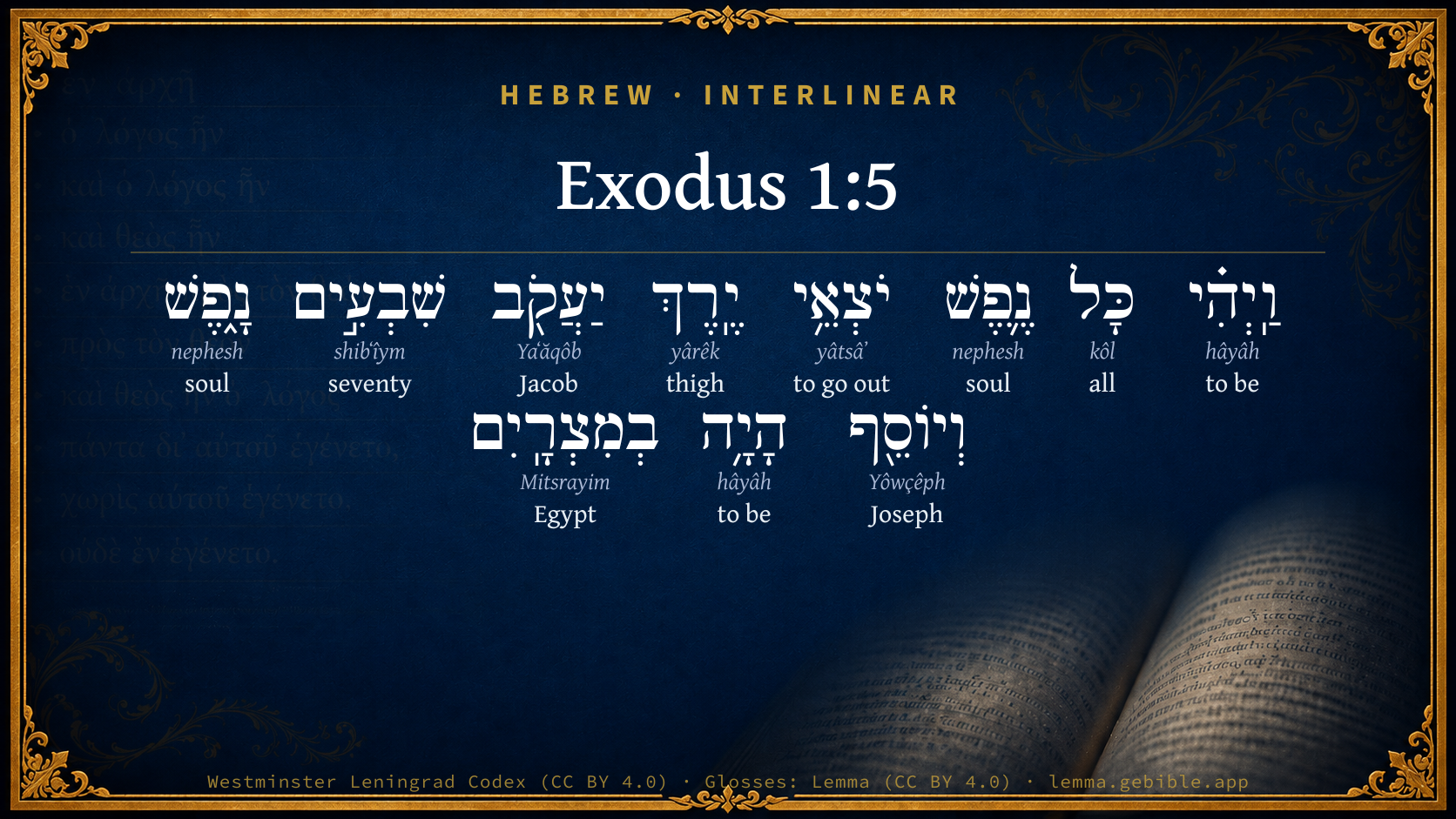
Hebrew (Westminster Leningrad Codex) Exodus 1:5 appears in the Hebrew Old Testament. The text above is from the Westminster Leningrad Codex. Each word links to its Strong’s number, a concise gloss, and parsing drawn from the Open Scriptures Hebrew Bible morphology. Click any word for its full Brown-Driver-Briggs (BDB) entry.
Download image
Cite this verse

Exodus 1:5 (World English Bible). Public Domain. Lemma interlinear Bible study tool, https://lemma.gebible.app/v/exodus/1/5.

Show BibTeX & RIS
BibTeX
RIS
English Translation
All the souls who came out of the Jacob's body were seventy souls, and Joseph was in Egypt already.
World English Bible · Public Domain
Download a study sheet

One document with this verse’s original text, its word-by-word gloss line, the meaning frame, cross-references with their text, attributed commentary, and full source and license credits — printable, and it pastes into notes with its structure intact.

This verse Autodidact and up

Study sheet (.html) Plain text (.txt)

A passage Seminary Student

Up to 50 verses in one chapter. A passage sheet keeps up to 6 commentary sources and 12 cross-references per verse, in the order this page ranks them, and says so on the sheet whenever that leaves anything out. Ask for a single verse and you get the Autodidact verse sheet above.

Everything on this page stays free to read, with no account — the sheet is a download of what is already on screen, not access to it.

Want to remove ads? Support Godless Engineer
Compare translations 3

The same verse in 3 English versions, stacked beneath the original-language interlinear above. Click any original word for its lexicon entry.

Each is an independent rendering of the whole verse — the interlinear is not word-aligned to these translations.

Highlighted words mark where these versions differ — a whole-verse word diff, not a word-by-word alignment.

  • World English Bible Public Domain
    All the souls who came out of the Jacob's body were seventy souls, and Joseph was in Egypt already.
  • King James Version Public Domain
    And all the souls that came out of the loins of Jacob were seventy souls: for Joseph was in Egypt already.
  • unfoldingWord Literal Text CC BY-SA 4.0
    And all the lives going out of the loins of Jacob, were 70 lives. And Joseph was in Egypt.

unfoldingWord Literal Text — © unfoldingWord, licensed CC BY-SA 4.0. Word-aligned USFM3 via Door43 (git.door43.org/unfoldingWord/en_ult).

Versions to compare (up to 4)

3 of 4 selected

Show all 18 translations

Every available English version of this verse, each an independent rendering of the whole verse.

  • World English Bible Public Domain
    All the souls who came out of the Jacob's body were seventy souls, and Joseph was in Egypt already.
  • Berean Standard Bible Public Domain
    The descendants of Jacob numbered seventy in all, including Joseph, who was already in Egypt.
  • Majority Standard Bible Public Domain
    The descendants of Jacob numbered seventy in all, including Joseph, who was already in Egypt.
  • King James Version Public Domain
    And all the souls that came out of the loins of Jacob were seventy souls: for Joseph was in Egypt already.
  • American Standard Version (1901) Public Domain
    And all the souls that came out of the loins of Jacob were seventy souls: and Joseph was in Egypt already.
  • Revised Version (1885) Public Domain
    And all the souls that came out of the loins of Jacob were seventy souls: and Joseph was in Egypt already.
  • Geneva Bible (1599) Public Domain
    So al the soules, that came out of the loines of Iaakob, were seuentie soules: Ioseph was in Egypt already.
  • Douay-Rheims (1899) Public Domain
    And all the souls that came out of Jacob's thigh, were seventy: but Joseph was in Egypt.
  • Young's Literal Translation Public Domain
    And all the persons coming out of the thigh of Jacob are seventy persons; as to Joseph, he was in Egypt.
  • Literal Standard Version CC BY-SA 4.0
    And all the persons coming out of the thigh of Jacob are seventy persons; as for Joseph, he was in Egypt.
  • Unlocked Literal Bible CC BY-SA 4.0
    All the people who were descendants of Jacob were seventy in number. Joseph was already in Egypt.
  • unfoldingWord Literal Text CC BY-SA 4.0
    And all the lives going out of the loins of Jacob, were 70 lives. And Joseph was in Egypt.
  • Darby Bible Public Domain
    And all the souls that had come out of the loins of Jacob were seventy souls; and Joseph was in Egypt.
  • World Messianic Bible Public Domain
    All the souls who came out of Jacob’s body were seventy souls, and Joseph was in Egypt already.
  • Webster's Bible Public Domain
    And all the souls that descended from Jacob, were seventy souls: for Joseph was in Egypt already.
  • Free Bible Version CC BY-SA 4.0
    Jacob had 70 descendants there, including Joseph who was already in Egypt.
  • Bible in Basic English Public Domain
    All the offspring of Jacob were seventy persons: and Joseph had come to Egypt before them.
  • JPS Tanakh (1917) Public Domain
    And all the souls that came out of the loins of Jacob were seventy souls; and Joseph was in Egypt already.

Literal Standard Version (2020), Covenant Press — licensed CC BY-SA 4.0. Text via the HelloAO Bible API (eBible.org). Unlocked Literal Bible (unfoldingWord) — licensed CC BY-SA 4.0. Text via the HelloAO Bible API (eBible.org). unfoldingWord Literal Text — © unfoldingWord, licensed CC BY-SA 4.0. Word-aligned USFM3 via Door43 (git.door43.org/unfoldingWord/en_ult). Free Bible Version, Dr. Jonathan Gallagher — licensed CC BY-SA 4.0. Text via the HelloAO Bible API (eBible.org).

Word by word

More ways to search: Search by grammar → Find every occurrence → Compare this word →

Practice this passage: Drill this verse → Learn its vocabulary →

יֶֽרֶךְ
yârêk
H3409
“thigh of”
Noun, Common, Feminine, Singular, Construct
Part of Speech
Noun
Type
Common
Gender
Feminine
Number
Singular
State
Construct
Full BDB Definition

Origin: from an unused root meaning to be soft

TWOT: 916a

thigh, side, loin, base - thigh - outside of thigh (where sword was worn) - loins (as the seat of procreative power) - side (flank) (of object) - base
  1. וַֽיְהִ֗י hâyâh H1961 “and · to be” Conjunction + Verb, Qal, Sequential Imperfect, 3rd Person, Masculine, Singular
  2. כָּל kôl H3605 “all of” Noun, Common, Masculine, Singular, Construct
  3. נֶ֛פֶשׁ nephesh H5315 “soul of” Noun, Common, Both, Singular, Construct
  4. יֹצְאֵ֥י yâtsâʼ H3318 “going out” Verb, Qal, Participle Active, Masculine, Plural, Construct
  5. יַעֲקֹ֖ב Yaʻăqôb H3290 “Jacob” Noun, Proper
  6. שִׁבְעִ֣ים shibʻîym H7657 “seventy” Adjective, Cardinal number, Both, Plural, Absolute
  7. נָ֑פֶשׁ nephesh H5315 “soul” Noun, Common, Both, Singular, Absolute
  8. וְיוֹסֵ֖ף Yôwçêph H3130 “and · Joseph” Conjunction + Noun, Proper
  9. הָיָ֥ה hâyâh H1961 “to be” Verb, Qal, Perfect, 3rd Person, Masculine, Singular
  10. בְמִצְרָֽיִם Mitsrayim H4714 “in/at · Egypt” Preposition + Noun, Proper

About this verse

These counts appear in no published source. They are computed here, from the morphology-tagged text and Lemma’s own curated glosses. What Lemma adds →

11
words
9
distinct lemmas
Pentateuch
section

Shared distinctive vocabulary

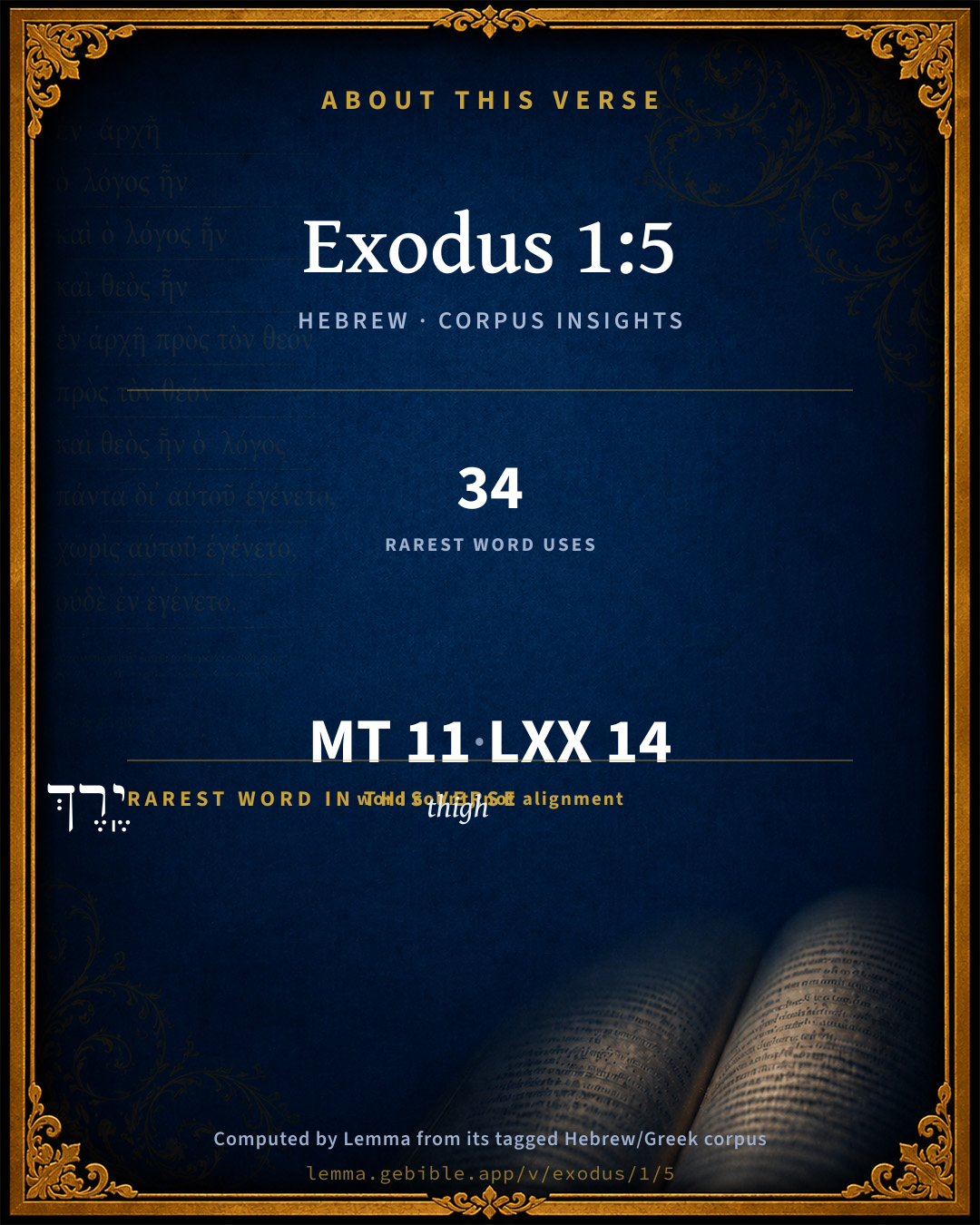
יֶֽרֶךְ thigh H3409 occurs in 32 verses of the Hebrew Bible. Also found in:

Grammatical profile

  • 3 verbs
  • 7 nouns
  • 1 adjective

Verb forms

  • וַֽיְהִ֗י Qal · Sequential Imperfect
  • יֹצְאֵ֥י Qal · Participle Active
  • הָיָ֥ה Qal · Perfect

Repetition

Words recur within this verse — often emphatic in Hebrew:

  • וַֽיְהִ֗י to be H1961 ×2
  • נֶ֛פֶשׁ soul H5315 ×2

Hebrew & Septuagint length

In English translation the verse runs 19 words from the Hebrew and 14 from the Septuagint (LXX English) — closely comparable.

A rough comparison of the two English renderings, which tokenize alike — not a word-level alignment.

Word counts can differ between the Hebrew and the Greek without any difference in meaning — e.g. the Hebrew direct-object marker אֵת has no separate Greek word, and Greek often adds the article ὁ.

In the original languages it is 11 Hebrew tokens and 14 Greek tokens — but the two are counted differently (Hebrew bundles its prefixes and suffixes into one token; the Greek is in lemma form), so that isn’t a like-for-like length.

Cross-references

4

Topical passages linked to Exodus 1:5 in the Treasury of Scripture Knowledge — connected by theme and wording, ordered by reader-vote popularity; previews shown in the World English Bible.

  • Deuteronomy 10:22 Your fathers went down into Egypt with seventy persons; and now Yahweh your God has made you as the stars of the sky for multitude.
  • Genesis 46:26–27 All the souls who came with Jacob into Egypt, who were his direct descendants, besides Jacob's sons' wives, all the souls were sixty-six.
  • Judges 8:30 Gideon had seventy sons conceived from his body; for he had many wives.
  • Exodus 1:20 God dealt well with the midwives, and the people multiplied, and grew very mighty.

Cross-references courtesy of OpenBible.info (CC BY 4.0).

Hebrew and Greek witnesses Masoretic Hebrew ↔ Greek Septuagint

The same verse in the two great witnesses to the Old Testament, shown verse-for-verse.

These are two independent witnesses, not word-aligned to each other, and the Septuagint is shown in lemma (dictionary) form.

Hebrew Exodus 1:5 Masoretic · Westminster Leningrad Codex

וַֽיְהִ֗י כָּל נֶ֛פֶשׁ יֹצְאֵ֥י יֶֽרֶךְ יַעֲקֹ֖ב שִׁבְעִ֣ים נָ֑פֶשׁ וְיוֹסֵ֖ף הָיָ֥ה בְמִצְרָֽיִם

All the souls who came out of the Jacob's body were seventy souls, and Joseph was in Egypt already.

World English Bible · Public Domain

Greek LXX Exodus 1:5 Septuagint · lemma form

ιωσηφ δέ εἰμί ἐν αἴγυπτος εἰμί δέ πᾶς ψυχή ἐκ ἰακώβ πέντε καί ἑβδομήκοντα

But Joseph was in Egypt. And all the souls born of Jacob were seventy-five.

LXX2012 (modern English Septuagint) · Public Domain

On this verse, Haydock's Catholic Bible Commentary discusses the Septuagint’s reading. Read the note in Commentary ↓

Hebrew: Westminster Leningrad Codex (CC BY 4.0). Greek: Septuagint (public domain); English from LXX2012 (modern English Septuagint) (Public Domain). How the Septuagint differs from the Hebrew →

Targum (Aramaic paraphrase)

2

The Targum is the ancient Jewish Aramaic paraphrase of the Hebrew Scriptures — an interpretive translation, not the Hebrew text itself. Onkelos (literal) and Pseudo-Jonathan (expansive) render the Torah, and Jonathan the Prophets. Coverage is partial: where no permissively-licensed English translation exists for a verse, only the Aramaic is shown. This is verse-level text, not a word-by-word alignment to the Hebrew.

  1. Targum Onkelos Torah (Genesis–Deuteronomy)
    וַהֲוָה כָּל נַפְשָׁתָא נַפְקֵי יַרְכָּא דְיַעֲקֹב שַׁבְעִין נַפְשָׁן וְיוֹסֵף דַהֲוָה בְּמִצְרָיִם:

    (no public-domain English translation for this verse)

    Targum Onkelos — Aramaic: “Onkelos Genesis” (public domain); “Onkelos Exodus” (public domain); “Onkelos Leviticus” (public domain); “Onkelos Numbers” (public domain); “Onkelos Deuteronomy” (public domain). English: “Sefaria Community Translation” (CC0 1.0 (public-domain dedication)); “J.W. Etheridge. The Targums of Onkelos and Jonathan Ben Uzziel on the Pentateuch. London: Longmans, Green, 1862” (public domain). Text via Sefaria.

  2. Targum Pseudo-Jonathan Torah (Genesis–Deuteronomy)
    וַהֲוָה סְכוּם כָּל נַפְשָׁתָא נַפְקֵי יַרְכָא דְיַעֲקב שׁוּבְעִין נַפְשָׁתָא עִם יוֹסֵף וּבְנוֹהִי דַהֲוָה בְּמִצְרַיִם

    And the number of all the souls coming from the thigh of Jakob, seventy souls, with Joseph and his sons, who were in Mizraim.

    Targum Pseudo-Jonathan — Aramaic: “Targum Jonathan on Genesis” (public domain); “Targum Jonathan on Exodus” (public domain); “Targum Jonathan on Leviticus” (public domain); “Targum Jonathan on Numbers” (public domain); “Targum Jonathan on Deuteronomy” (public domain). English: “The Targum of Jonathan ben Uzziel, trans. J. W. Etheridge, London, 1862” (public domain). Text via Sefaria.

Commentary

Notes on Exodus 1:5 from classic Christian and Jewish commentators (each source and its license shown beneath its notes). The classic Christian expositions comment on the surrounding passage and are grouped to its opening verse, so a note may address several verses; the Jewish commentaries on the Tanakh (Rashi and others) are per-verse, so they appear only where the commentator wrote on this verse.

Lemma curates 59 commentaries, every one of them public domain or Creative Commons licensed, each selected and text-cleaned for this edition rather than reprinted as found. About our sources →

Trapp's Complete Commentary

John Trapp

Exo 1:5 And all the souls that came out of the loins of Jacob were seventy souls: for Joseph was in Egypt [already].

Ver. 5. And all the souls.] That is, persons; for souls are not begotten, but infused, being divinae particulae aurae. {Ecc 12:7} Aristotle himself saw and acknowledged as much. {a}

Were seventy souls.] More worth than the seventy nations of the whole world, say the Jews: God reckons of men by their righteousness.

{a} λειπεται, τον νουν μονον θυραθεν επειστεναι και θειον ειναι. - De Gene. Ar., lib. ii. cap. 9.

John Trapp, A Commentary or Exposition upon All the Books of the Old and New Testament (1647–1656) — public domain. Text from a community e-Sword module.

Joseph Benson's Commentary

Exo 1:5. Seventy souls — Or persons, according to the computation we had, Gen 46:27, including Joseph and his two sons. This was just the number of the nations by which the earth was peopled, (Genesis 10.,) for when “God separated the sons of Adam, he set the bounds of the people according to the number of the children of Israel,”

Deu 32:8.

Joseph Benson's Commentary on the Old and New Testaments (1811–1818) — public domain. Text from a community e-Sword module.

Tyndale Open Study Notes

Tyndale Open Resources

1:5 seventy descendants: The number 75 in the Greek version and the Dead Sea Scrolls might include the five sons of Ephraim and Manasseh (Num 26:29, 35). • Jacob’s eleventh son, Joseph, had been sold into Egyptian slavery by his jealous brothers (Gen 37:18-28). God accomplished good for his people in spite of the brothers’ sin. With Joseph present in Egypt, God could use him to save the lives of the chosen people from the famine that would have destroyed them (Gen 42:1-2; 50:19-20).

Tyndale Open Study Notes — © Tyndale Open Resources, licensed CC BY-SA 4.0. Text via the HelloAO Bible API.

Geneva Bible (1599)

Geneva Bible translators

Or, persons.

Geneva Bible (1599) marginal notes — public domain. Text via Bolls.life.

Ellicott's Commentary for English Readers

(5) All the souls . . . were seventy souls. Comp. Gen_46:8-27. The number is made up as follows:—Jacob himself, 1; his sons, 12; his daughter, Dinah, 1; his grandsons, 51; his grand-daughter Serah, 1; his great-grandsons, 4—Total, 70. His daughters, except Dinah, and his sons’ daughters, except Serah, spoken of in Gen_46:7, are not included. If his female descendants were, at the time of his descent into Egypt, as numerous as the males, the entire number of those who “came out of his loins” must have been 132. To form a calculation of the number of persons who entered Egypt with him, we must add the wives of his sons and grandsons, and the husbands of his daughters and granddaughters. A further liberal allowance must be also made for retainers. (See the comment on Exo_1:1.) It is not perhaps surprising that Kurtz, taking all these classes into account, should calculate that those who entered Egypt with Jacob amounted to “several thousands” (History of The Old Covenant, vol. ii. p. 149, E.T.).

A Bible Commentary for English Readers, edited by Charles John Ellicott (1878–1897) — public domain. Text from a community e-Sword module.

The Cambridge Bible for Schools and Colleges

gen. ed. J. J. S. Perowne

5. all the souls that came out, &c.] As Gen_46:26 (also P).

seventy souls] The number was traditional: cf. Deu_10:22 (where ‘with’ should be as). This passage shews that P interpreted the tradition in the sense of 70 souls without Jacob: other writers interpreted it in the sense of Deu_10:22, and made the number 70 souls including Jacob (cf. Gen_46:8; Gen_46:27 b). See the writer’s Genesis (in the ‘Westminster Commentaries’), pp. 365, 368. Soul in the sense of ‘person,’ though found occasionally elsewhere (but never in the earlier historical books), is peculiarly frequent in P (nearly 100 times).

The Cambridge Bible for Schools and Colleges (gen. ed. J. J. S. Perowne; Cambridge University Press, 1878–1918) — public domain. Text from a community e-Sword module.

Albert Barnes' Notes on the Bible

Seventy - See Gen 46:27. The object of the writer in this introductory statement is to give a complete list of the heads of separate families at the time of their settlement in Egypt. See the note at Num 26:5.

Albert Barnes' Notes on the Bible (1834–1885) — public domain. Text from a community e-Sword/MySword module.

Haydock's Catholic Bible Commentary

Seventy: Septuagint, "75," including the offspring of Joseph. See Genesis xlvi. 26.

George Leo Haydock (1774–1849), Haydock's Catholic Family Bible and Commentary, 1859 edition — public domain. Excludes Psalms (Douay-Rheims chapter numbering differs from Protestant) and Deuterocanonical books (Catholic canon only).

Matthew Poole's English Annotations

Seventy souls, including Jacob and Joseph, and his two sons. See Gen 46:26,27; Deu 10:22. Or if they were but sixty-nine, they are called seventy by a round number, of which we shall have many instances. i.e. All that were of the same age with Joseph and his brethren.

Matthew Poole's English Annotations on the Holy Bible (1683–1685) — public domain. Text from a community e-Sword/MySword module.

The Pulpit Commentary

All the souls that came out of the loins of Jacob were seventy souls. This is manifestly intended as a repetition of Gen_46:27, and throws the reader back upon the details there adduced, which make up the exact number of "seventy souls," by the inclusion of Jacob himself, of Joseph, and of Joseph"s two sons, Ephraim and Manasseh. The inaccuracy by which Jacob is counted among his own descendants, is thoroughly Oriental and Hebraistic, however opposed to Western habits of thought. To stumble at it shows a narrow and carping spirit. (Compare note on Gen_46:15) For Joseph was in Egypt already. Joseph, i.e., has not been mentioned with the other sons of Jacob, since he did not "come into Egypt with Jacob," but was there previously. The transfer of the clause to the commencement of the verse, which is made by the LXX, is unnecessary.

Joseph in Egypt.

Exodus here points back to Genesis. So the present is always pointing back to the past. In the life of an individual, in the life of a family, in the life of a nation, there is a continuity: no past act but affects the present no present act but affects the future. Joseph"s descent into Egypt is at the root of the whole of Exodus, underlies it, forms its substratum. Without an incoming, no outgoing; and it was at Joseph"s instance that his brethren had come into the country. (Gen_45:9-24) Or our thoughts may travel further back. "Joseph in Egypt." How had he come there? Through the envy and jealousy of brethren, provoked by the favouritism of a too fond father. Here are evils to be guarded against; here are sins to be east out. And yet of the evil good had come: "Ye thought evil against me; but God meant it unto good". (Gen_50:20) "The fierceness of men he turns to his praise; and the fierceness of them he doth refrain". (Psa_76:10) The cruel wrong done to Joseph had saved from starvation his father and his father"s house, had preserved the entire people of the Egyptians from extreme suffering, and had brought Joseph himself to the highest honour. "God"s ways are not as our ways, nor his thoughts as our thoughts." He is potent to bring good out of evil, and to turn the worst calamity into the choicest blessing.

The Pulpit Commentary (1880–1919), ed. H.D.M. Spence-Jones & Joseph S. Exell — public domain. Text from a community e-Sword module.

John Wesley's Explanatory Notes

Seventy souls - According to the computation we had, Gen. xlvi, 27, including Joseph and his two sons. This was just the number of the nations by which the earth was peopled, Gen. x, 1- 32, for when God separated the sons of Adam, he set the bounds of the people according to the number of the children of Israel, Deut. xxxii, 8.

John Wesley, Explanatory Notes Upon the Whole Bible (1754–1765) — public domain. Text via the GEBible commentary corpus.

Rashi

Rabbi Shlomo Yitzchaki (Rashi)

ויוסף היה במצרים lit., AND JOSEPH WAS IN EGYPT — But were not he and his sons included in the seventy? What, then, is this statement intended to tell us? Do we not know that he was in Egypt? But its purpose is to inform you of Joseph’s righteousness: this is the same Joseph who tended his father’s sheep; this is the same Joseph who was in Egypt and became king there, and yet he remained steadfast in his righteousness, and the change from a humble position to exalted rank in Egypt caused no deterioration in his character (cf. Sifrei האזינו; Exodus Rabbah 1:7).

Rashi on the Tanakh — English translations: “The Judaica Press complete Tanach with Rashi, translated by A. J. Rosenberg” (CC BY 4.0); “Pentateuch with Rashi's commentary by M. Rosenbaum and A.M. Silbermann, 1929-1934” (public domain); “The Metsudah Tanach series, Lakewood, N.J” (CC BY 4.0); and “The Book of Joshua, Metsudah Publications, 1997” (CC BY 4.0). Text via Sefaria.

Lesson kit

Teaching starters — assembled from the data on this page, not authored interpretation. Every prompt links to the verse data it draws on. Edit before teaching.

Exodus, in the Pentateuch, opens this verse with 11 words (9 distinct Hebrew lemmas). Its most distinctive word is yârêk (“thigh”). A historical commentator’s framing appears above. Read the whole chapter for the surrounding context.

Discussion questions

  1. The word yârêk carries the sense “thigh.” How does it shape the verse?
  2. Genesis 24:2 shares the word «thigh» with this verse. How do the two illuminate each other?
  3. “to be” occurs 2× in this one verse. What is the effect of the repetition?
  4. These translations render this verse differently. What is at stake in choosing one wording over another?
  5. The verb «וַֽיְהִ֗י» is Qal Sequential Imperfect. How does its form color the action?
  6. Reading how Trapp's Complete Commentary and Joseph Benson's Commentary read this verse, where do the two commentators agree and where do they part?

Things to notice

Reading settings

Reading text

Shown beneath each verse's original-language words.

Old Testament
Old Testament edition

Read the OT as the Masoretic Hebrew (MT) or the Greek Septuagint (LXX).

English shown for the Greek Septuagint (in the Hebrew ↔ Greek comparison).

Comparing translations? Open the Compare panel on any verse page to stack up to four side by side.