
2 Chronicles 19:7

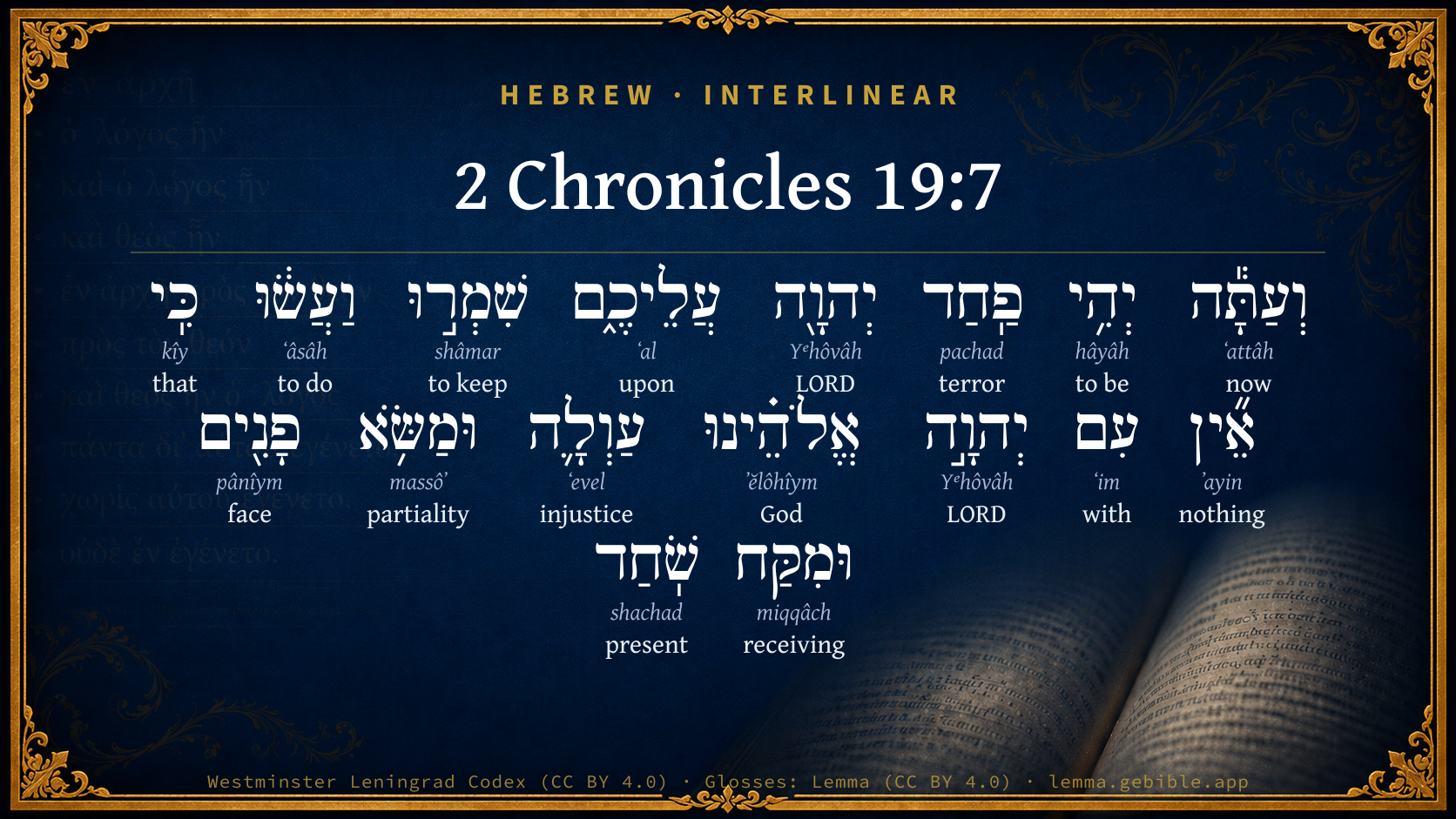
Hebrew (Westminster Leningrad Codex) 2 Chronicles 19:7 appears in the Hebrew Old Testament. The text above is from the Westminster Leningrad Codex. Each word links to its Strong’s number, a concise gloss, and parsing drawn from the Open Scriptures Hebrew Bible morphology. Click any word for its full Brown-Driver-Briggs (BDB) entry.
Download image
Cite this verse

2 Chronicles 19:7 (World English Bible). Public Domain. Lemma interlinear Bible study tool, https://lemma.gebible.app/v/2-chronicles/19/7.

Show BibTeX & RIS
BibTeX
RIS
English Translation
Now therefore let the fear of Yahweh be on you; take heed and do it: for there is no iniquity with Yahweh our God, nor respect of persons, nor taking of bribes.
World English Bible · Public Domain
Highlights
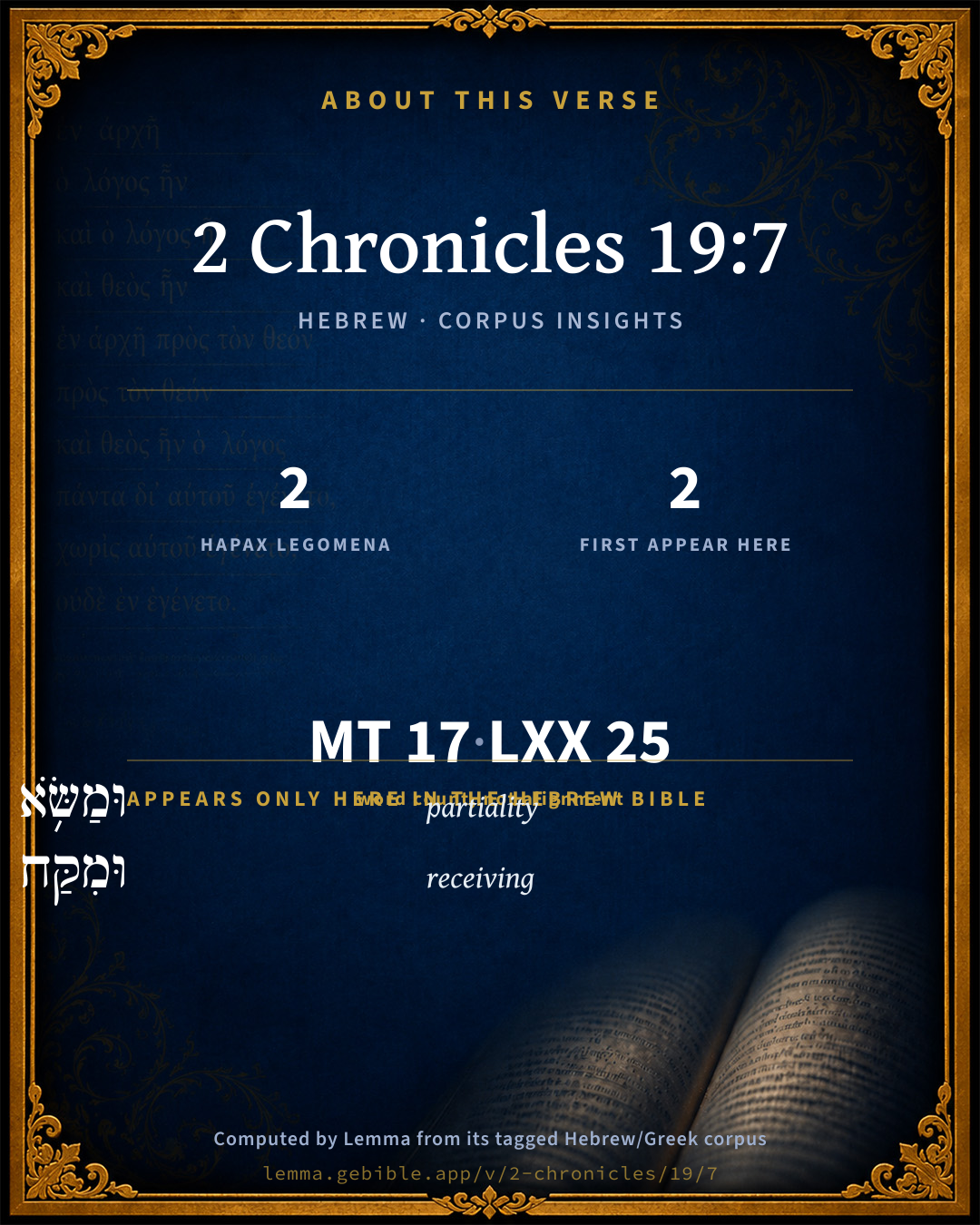
  • 2 hapax legomena — only here in the Hebrew Bible
  • 2 first appearances in the Hebrew Bible
Full analysis ↓
Download a study sheet

One document with this verse’s original text, its word-by-word gloss line, the meaning frame, cross-references with their text, attributed commentary, and full source and license credits — printable, and it pastes into notes with its structure intact.

This verse Autodidact and up

Study sheet (.html) Plain text (.txt)

A passage Seminary Student

Up to 50 verses in one chapter. A passage sheet keeps up to 6 commentary sources and 12 cross-references per verse, in the order this page ranks them, and says so on the sheet whenever that leaves anything out. Ask for a single verse and you get the Autodidact verse sheet above.

Everything on this page stays free to read, with no account — the sheet is a download of what is already on screen, not access to it.

Want to remove ads? Support Godless Engineer
Compare translations 3

The same verse in 3 English versions, stacked beneath the original-language interlinear above. Click any original word for its lexicon entry.

Each is an independent rendering of the whole verse — the interlinear is not word-aligned to these translations.

Highlighted words mark where these versions differ — a whole-verse word diff, not a word-by-word alignment.

  • World English Bible Public Domain
    Now therefore let the fear of Yahweh be on you; take heed and do it: for there is no iniquity with Yahweh our God, nor respect of persons, nor taking of bribes.
  • King James Version Public Domain
    Wherefore now let the fear of the LORD be upon you; take heed and do it: for there is no iniquity with the LORD our God, nor respect of persons, nor taking of gifts.
  • unfoldingWord Literal Text CC BY-SA 4.0
    And now, let the dread of Yahweh be upon you all. Watch and act for there is not with Yahweh our God injustice or lifting of faces or taking a bribe.”

unfoldingWord Literal Text — © unfoldingWord, licensed CC BY-SA 4.0. Word-aligned USFM3 via Door43 (git.door43.org/unfoldingWord/en_ult).

Versions to compare (up to 4)

3 of 4 selected

Show all 18 translations

Every available English version of this verse, each an independent rendering of the whole verse.

  • World English Bible Public Domain
    Now therefore let the fear of Yahweh be on you; take heed and do it: for there is no iniquity with Yahweh our God, nor respect of persons, nor taking of bribes.
  • Berean Standard Bible Public Domain
    And now, may the fear of the LORD be upon you. Be careful what you do, for with the LORD our God there is no injustice or partiality or bribery.”
  • Majority Standard Bible Public Domain
    And now, may the fear of the LORD be upon you. Be careful what you do, for with the LORD our God there is no injustice or partiality or bribery.”
  • King James Version Public Domain
    Wherefore now let the fear of the LORD be upon you; take heed and do it: for there is no iniquity with the LORD our God, nor respect of persons, nor taking of gifts.
  • American Standard Version (1901) Public Domain
    Now therefore let the fear of Jehovah be upon you; take heed and do it: for there is no iniquity with Jehovah our God, nor respect of persons, nor taking of bribes.
  • Revised Version (1885) Public Domain
    Now therefore let the fear of the LORD be upon you; take heed and do it: for there is no iniquity with the LORD our God, nor respect of persons, nor taking of gifts.
  • Geneva Bible (1599) Public Domain
    Wherefore nowe let the feare of the Lord be vpon you: take heede, and do it: for there is no iniquitie with the Lord our God, neither respect of persons, nor receiuing of reward.
  • Douay-Rheims (1899) Public Domain
    Let the fear of the Lord be with you, and do all things with diligence: for there is no iniquity with the Lord our God, a nor respect of persons, nor desire of gifts.
  • Young's Literal Translation Public Domain
    and now, let fear of Jehovah be upon you, observe and do, for there is not with Jehovah our God perverseness, and acceptance of faces, and taking of a bribe.'
  • Literal Standard Version CC BY-SA 4.0
    and now, let fear of YHWH be on you, observe and do, for there is not perverseness with our God YHWH, and favoring by appearance, and taking of a bribe.”
  • Unlocked Literal Bible CC BY-SA 4.0
    Now then, let the fear of Yahweh be upon you. Be careful when you judge, for there is no iniquity with Yahweh our God, nor is there any favoritism or bribe taking.”
  • unfoldingWord Literal Text CC BY-SA 4.0
    And now, let the dread of Yahweh be upon you all. Watch and act for there is not with Yahweh our God injustice or lifting of faces or taking a bribe.”
  • Darby Bible Public Domain
    And now, let the terror of Jehovah be upon you; be careful what ye do, for there is no iniquity with Jehovah, nor respect of persons, nor taking of presents.
  • World Messianic Bible Public Domain
    Now therefore let the fear of the LORD be on you. Take heed and do it; for there is no iniquity with the LORD our God, nor respect of persons, nor taking of bribes.”
  • Webster's Bible Public Domain
    Wherefore now let the fear of the LORD be upon you; take heed and do it: for there is no iniquity with the LORD our God, nor respect of persons, nor taking of gifts.
  • Free Bible Version CC BY-SA 4.0
    So then, be sure to have reverence for God, obeying him and doing what he wants, for God does not permit any kind of injustice, favoritism, or bribery.”
  • Bible in Basic English Public Domain
    So now let the fear of the Lord be in you; do your work with care; for in the Lord our God there is no evil, or respect for high position, or taking of payment to do wrong.
  • JPS Tanakh (1917) Public Domain
    Now therefore let the fear of the LORD be upon you; take heed and do it; for there is no iniquity with the LORD our God, nor respect of persons, nor taking of bribes.'

Literal Standard Version (2020), Covenant Press — licensed CC BY-SA 4.0. Text via the HelloAO Bible API (eBible.org). Unlocked Literal Bible (unfoldingWord) — licensed CC BY-SA 4.0. Text via the HelloAO Bible API (eBible.org). unfoldingWord Literal Text — © unfoldingWord, licensed CC BY-SA 4.0. Word-aligned USFM3 via Door43 (git.door43.org/unfoldingWord/en_ult). Free Bible Version, Dr. Jonathan Gallagher — licensed CC BY-SA 4.0. Text via the HelloAO Bible API (eBible.org).

Word by word

More ways to search: Search by grammar → Find every occurrence → Compare this word →

Practice this passage: Drill this verse → Learn its vocabulary →

וּמַשֹּׂ֥א
massôʼ
H4856
“and · partiality of”
Conjunction + Noun, Common, Masculine, Singular, Construct
Part of Speech
Conjunction + Noun
Type
Common
Gender
Masculine
Number
Singular
State
Construct
Full BDB Definition

Origin: from H5375

TWOT: 1421f

a lifting up - partiality (in construct)
  1. וְעַתָּ֕ה ʻattâh H6258 “and · now” Conjunction + Adverb
  2. יְהִ֥י hâyâh H1961 “to be” Verb, Qal, Jussive, 3rd Person, Masculine, Singular
  3. פַֽחַד pachad H6343 “terror of” Noun, Common, Masculine, Singular, Construct
  4. יְהוָ֖ה Yᵉhôvâh H3068 “LORD” Noun, Proper
  5. עֲלֵיכֶ֑ם ʻal H5921 “upon · you” Preposition + Suffix, Personal, 2nd Person, Masculine, Plural
  6. שִׁמְר֣וּ shâmar H8104 “keep” Verb, Qal, Imperative, 2nd Person, Masculine, Plural
  7. וַעֲשׂ֔וּ ʻâsâh H6213 “and · do” Conjunction + Verb, Qal, Imperative, 2nd Person, Masculine, Plural
  8. כִּֽי kîy H3588 “that” Conjunction
  9. אֵ֞ין ʼayin H369 “nothing” Particle, Negative
  10. עִם ʻim H5973 “with” Preposition
  11. יְהוָ֣ה Yᵉhôvâh H3068 “LORD” Noun, Proper
  12. אֱלֹהֵ֗ינוּ ʼĕlôhîym H430 “God(s) · our” Noun, Common, Masculine, Plural, Construct + Suffix, Personal, 1st Person, Common, Plural
  13. עַוְלָ֛ה ʻevel H5766 “injustice” Noun, Common, Both, Singular, Absolute
  14. פָנִ֖ים pânîym H6440 “face(s)” Noun, Common, Both, Plural, Absolute
  15. וּמִקַּח miqqâch H4727 “and · receiving of” Conjunction + Noun, Common, Masculine, Singular, Construct
  16. שֹֽׁחַד shachad H7810 “present” Noun, Common, Masculine, Singular, Absolute

About this verse

These counts appear in no published source. They are computed here, from the morphology-tagged text and Lemma’s own curated glosses. What Lemma adds →

17
words
16
distinct lemmas
Historical
section

Notable vocabulary

2 hapax legomena — words that appear only here in the entire Hebrew Bible:

  • וּמַשֹּׂ֥א partiality H4856
  • וּמִקַּח receiving H4727

First appearance in Scripture

These words make their first canonical appearance in the Hebrew Bible here:

  • וּמַשֹּׂ֥א partiality H4856
  • וּמִקַּח receiving H4727

Shared distinctive vocabulary

שֹֽׁחַד present H7810 occurs in 21 verses of the Hebrew Bible. Also found in:

Grammatical profile

  • 3 verbs
  • 9 nouns
  • 2 prepositions
  • 1 conjunction
  • 1 adverb
  • 1 particle

Verb forms

  • יְהִ֥י Qal · Jussive
  • שִׁמְר֣וּ Qal · Imperative
  • וַעֲשׂ֔וּ Qal · Imperative

Repetition

A word recurs within this verse — often emphatic in Hebrew:

  • יְהוָ֖ה LORD H3068 ×2

Hebrew & Septuagint length

In English translation the verse runs 32 words from the Hebrew and 39 from the Septuagint (LXX English) — closely comparable.

A rough comparison of the two English renderings, which tokenize alike — not a word-level alignment.

Word counts can differ between the Hebrew and the Greek without any difference in meaning — e.g. the Hebrew direct-object marker אֵת has no separate Greek word, and Greek often adds the article ὁ.

In the original languages it is 17 Hebrew tokens and 25 Greek tokens — but the two are counted differently (Hebrew bundles its prefixes and suffixes into one token; the Greek is in lemma form), so that isn’t a like-for-like length.

Cross-references

22

Topical passages linked to 2 Chronicles 19:7 in the Treasury of Scripture Knowledge — connected by theme and wording, ordered by reader-vote popularity; previews shown in the World English Bible.

  • Deuteronomy 32:4 The Rock, his work is perfect; For all his ways are justice: A God of faithfulness and without iniquity, Just and right is he.
  • Genesis 18:25 Be it far from you to do things like that, to kill the righteous with the wicked, that so the righteous should be as the wicked. May that be far from you. Shouldn't the Judge of all the earth do right?"
  • Romans 2:11 For there is no partiality with God.
  • Deuteronomy 10:17–18 For Yahweh your God, he is God of gods, and Lord of lords, the great God, the mighty, and the awesome, who doesn't regard persons, nor takes reward.
  • Exodus 23:8 You shall take no bribe, for a bribe blinds those who have sight and perverts the words of the righteous.
  • Romans 9:14 What shall we say then? Is there unrighteousness with God? May it never be!
  • Colossians 3:25 But he who does wrong will receive again for the wrong that he has done, and there is no partiality.
  • Deuteronomy 16:18–19 Judges and officers shall you make you in all your gates, which Yahweh your God gives you, according to your tribes; and they shall judge the people with righteous judgment.
  • Job 34:19 Who doesn't respect the persons of princes, Nor regards the rich more than the poor; For they all are the work of his hands.
  • Isaiah 1:23–26 Your princes are rebellious, and companions of thieves. Everyone loves bribes, and follows after rewards. They don't judge the fatherless, Neither does the cause of the widow come to them.
  • Acts 10:34 Peter opened his mouth and said, "Truly I perceive that God doesn't show favoritism;
  • Exodus 18:21–22 Moreover you shall provide out of all the people able men, such as fear God: men of truth, hating unjust gain; and place such over them, to be rulers of thousands, rulers of hundreds, rulers of fifties, and rulers of tens.
  • Exodus 18:25–26 Moses chose able men out of all Israel, and made them heads over the people, rulers of thousands, rulers of hundreds, rulers of fifties, and rulers of tens.
  • Nehemiah 5:15 But the former governors who were before me were chargeable to the people, and took of them bread and wine, besides forty shekels of silver; yes, even their servants bore rule over the people: but I didn't do so, because of the fear of God.
  • Isaiah 33:15 He who walks righteously, and speaks blamelessly; he who despises the gain of oppressions, who shakes his hands from taking a bribe, who stops his ears from hearing of blood, and shuts his eyes from looking on evil:
  • Micah 7:3 Their hands are on that which is evil to do it diligently. The ruler and judge ask for a bribe; And the powerful man dictates the evil desire of his soul. Thus they conspire together.
  • Matthew 22:16 They sent their disciples to him, along with the Herodians, saying, "Teacher, we know that you are honest, and teach the way of God in truth, no matter who you teach, for you aren't partial to anyone.
  • Romans 3:5–6 But if our unrighteousness commends the righteousness of God, what will we say? Is God unrighteous who inflicts wrath? I speak like men do.
  • Galatians 2:6 But from those who were reputed to be important (whatever they were, it makes no difference to me; God doesn't show partiality to man)--they, I say, who were respected imparted nothing to me,
  • Ephesians 6:9 You masters, do the same things to them, and give up threatening, knowing that he who is both their Master and yours is in heaven, and there is no partiality with him.
  • 1 Peter 1:17 If you call on him as Father, who without respect of persons judges according to each man's work, pass the time of your living as strangers here in reverent fear:
  • Genesis 42:18 Joseph said to them the third day, "Do this, and live, for I fear God.

Cross-references courtesy of OpenBible.info (CC BY 4.0).

Hebrew and Greek witnesses Masoretic Hebrew ↔ Greek Septuagint

The same verse in the two great witnesses to the Old Testament, shown verse-for-verse.

These are two independent witnesses, not word-aligned to each other, and the Septuagint is shown in lemma (dictionary) form.

Hebrew 2 Chronicles 19:7 Masoretic · Westminster Leningrad Codex

וְעַתָּ֕ה יְהִ֥י פַֽחַד יְהוָ֖ה עֲלֵיכֶ֑ם שִׁמְר֣וּ וַעֲשׂ֔וּ כִּֽי אֵ֞ין עִם יְהוָ֣ה אֱלֹהֵ֗ינוּ עַוְלָ֛ה וּמַשֹּׂ֥א פָנִ֖ים וּמִקַּח שֹֽׁחַד

Now therefore let the fear of Yahweh be on you; take heed and do it: for there is no iniquity with Yahweh our God, nor respect of persons, nor taking of bribes.

World English Bible · Public Domain

Greek LXX 2 Chronicles 19:7 Septuagint · lemma form

καί νῦν γίγνομαι φόβος κύριος ἐπί σύ καί φυλάσσω καί ποιέω ὅτι οὐ εἰμί μετά κύριος θεός ἐγώ ἀδικία οὐδέ θαυμάζω πρόσωπον οὐδέ λαμβάνω δῶρον

And now let the fear of the Lord be upon you, and be wary, and do your duty: for there is no unrighteousness with the Lord our God, neither is it for him to respect persons, nor take bribes.

LXX2012 (modern English Septuagint) · Public Domain

Hebrew: Westminster Leningrad Codex (CC BY 4.0). Greek: Septuagint (public domain); English from LXX2012 (modern English Septuagint) (Public Domain). How the Septuagint differs from the Hebrew →

Commentary

Notes on 2 Chronicles 19:7 from classic Christian and Jewish commentators (each source and its license shown beneath its notes). The classic Christian expositions comment on the surrounding passage and are grouped to its opening verse, so a note may address several verses; the Jewish commentaries on the Tanakh (Rashi and others) are per-verse, so they appear only where the commentator wrote on this verse.

Lemma curates 59 commentaries, every one of them public domain or Creative Commons licensed, each selected and text-cleaned for this edition rather than reprinted as found. About our sources →

Trapp's Complete Commentary

John Trapp

2Ch 19:7 Wherefore now let the fear of the LORD be upon you; take heed and do [it]: for [there is] no iniquity with the LORD our God, nor respect of persons, nor taking of gifts.

Ver. 7. Wherefore now let the fear of the Lord be upon you.] Fear to offend so great a majesty. Cave, spectat Cato, was a watchword among the Romans. The Turkish senate is very careful what they say or do, when they know that the grand signior is at the dangerous door, and hears all.

Take heed and do it.] Abundans cautela hic non nocet.

For there is no iniquity with the Lord our God.] As neither must there be with you, whom he hath intrusted with the administration of his earthly kingdom. The Athenian judges, before they ascended the tribunal, swore that they would without writhing or warping, give sentence according to the laws; and in those things concerning which there were no laws, according to conscience and equity, which the Greeks call γνωμην δικαιοτατην, - the most righteous sentence. {a}

Nor respect of persons.] He heareth causes speak, and not persons; so should ye. The ancients, for this, pictured justice blind. The Areopagites heard causes in the dark; but so did not those other Athenian judges, who, having the fair harlot Phryne before them, convicted of some great crime, and being about to condemn her, absolverunt tamen postquam conspexerunt speciosissimum eius pectus, &c., acquitted her nevertheless, when they had beheld her beautiful bosom, which Hyperides her lawyer showed them, to move them to pity her. Was this agreeable to their oath mentioned in the former note? It is reported of Trajan the emperor, that he neither feared nor hated any man living. {b}

Nor taking of gifts.] God is not δωροφαγος: he rejecteth the sacrifices of the wicked, and will not be bribed. Demosthenes was by Harpalus, to the hazard of his country; but Phocion would not, for when Alexander the Great sent him great gifts to win him over thereby to his side, he asked the messengers why their master sent gifts to him rather than to any other of the Athenians. They answered, Because he holdeth you to be honest, and therefore best deserving. He replied, Carry back his gifts therefore; Et me talem esse porro sinat, and let him suffer me still to continue in mine honesty.

{a} Archaeol. Attic., 113.

{b} Plutarch., Vit. x., Rhet. in Hyperide.

John Trapp, A Commentary or Exposition upon All the Books of the Old and New Testament (1647–1656) — public domain. Text from a community e-Sword module.

The Biblical Illustrator

Joseph S. Exell

2Ch_19:7

Wherefore now let the fear of the Lord be upon you.

Jehoshaphat reproved

I. His sin. This was--

1. Helping in an ungodly enterprise, against which the prophet had warned him.

2. Forming an alliance, of which the influence on himself, his family, and people could only be bad. It fills one with a kind of despair to see how, among those who profess to regard religion an all-important, friendships and alliances discussed and fixed without this ever coming into view.

II. The rebuke which followed the kings sin.

III. The kings repentance.

1. He received reproof with meekness.

2. He kept aloof from occasions of fresh sin.

3. He did what he could to repair the wrong his example had done.

IV. What made jehoshaphat so prompt to return to the right path when once he had left it? His deep sense of God and right appreciation of His character. Wherefore now let the fear of the Lord be upon you; take heed and do it: for there is no iniquity with the Lord, nor respect of persons, nor taking of gifts. Nothing so controllingly underlies what a man is and does as his cherished thoughts of God. (Monday Club Sermons.)

The Biblical Illustrator, edited by Joseph S. Exell (c. 1880s–1900s) — public domain. Text from a community e-Sword module.

Joseph Benson's Commentary

2Ch 19:7. Wherefore, let the fear of the Lord be upon you — Which will be a restraint upon you to keep you from doing wrong, and an encouragement to you to be active in fulfilling the duties of your office. For there is no iniquity in our God, nor respect of persons — And therefore you, who are in God’s stead, and do his work, and must give an account to him, must imitate him herein. Nor taking of gifts — So as to pervert judgment. See Exo 23:8; Deu 16:19; Pro 17:23.

Joseph Benson's Commentary on the Old and New Testaments (1811–1818) — public domain. Text from a community e-Sword module.

Geneva Bible (1599)

Geneva Bible translators

He will declare by the sharpness of the punishment, that he hateth all iniquity.

Geneva Bible (1599) marginal notes — public domain. Text via Bolls.life.

Ellicott's Commentary for English Readers

(7) Wherefore.—And.

The fear of the Lord.—A dread, or awe, of Jehovah. (See 2Ch_17:10.)

Take heed and do (a hendiadys, i.e., act heedfully. deal warily).

Iniquity—i.e., want of equity, unfairness, injustice i’avlah). To the marginal references add the prohibition, Deu_16:19. They who judge for Jehovah (2Ch_19:6) are bound to judge like Jehovah.

A Bible Commentary for English Readers, edited by Charles John Ellicott (1878–1897) — public domain. Text from a community e-Sword module.

John Gill's Exposition

Moreover, in Jerusalem did Jehoshaphat set of the Levites, and of the priests, and of the chief of the fathers of Israel,.... This was the great court of judicature, consisting of princes, priests, and Levites, of ecclesiastics and political persons; for causes of both sorts were brought thither:

for the judgment of the Lord; in things sacred, which related to the worship of God, and the support of it:

and for controversies; of a civil kind between man and man, whether pecuniary or capital, of a more private or public kind:

when they returned to Jerusalem; that is, this court was set up at Jerusalem, when Jehoshaphat, the priests, Levites, and chief men that went with him, returned thither.

John Gill's Exposition of the Whole Bible (1746–1763) — public domain (CC PDM 1.0). Text via the HelloAO Bible API.

Haydock's Catholic Bible Commentary

Gifts. The contrary is the source of so much corruption. H. --- It would be proper to inscribe this sentence on the walls of all courts of judicature, or rather on the hearts of all in office. T. --- None but the true religion can produce such maxims. C.

George Leo Haydock (1774–1849), Haydock's Catholic Family Bible and Commentary, 1859 edition — public domain. Excludes Psalms (Douay-Rheims chapter numbering differs from Protestant) and Deuterocanonical books (Catholic canon only).

Matthew Poole's English Annotations

And therefore you who are in God’s stead, and do his work, and must give an account to him, must imitate God here. Of

respect of persons, see Deu 10:17; Job 34:19; Act 10:4.

No taking of gifts; so as to pervert judgment for them, by comparing this with Exo 23:8; Deu 16:19; Pro 17:23.

Matthew Poole's English Annotations on the Holy Bible (1683–1685) — public domain. Text from a community e-Sword/MySword module.

John Wesley's Explanatory Notes

Wherefore - And therefore you who are in God's stead, and do his work, and must give an account to him, must imitate God herein.

John Wesley, Explanatory Notes Upon the Whole Bible (1754–1765) — public domain. Text via the GEBible commentary corpus.

Rashi

Rabbi Shlomo Yitzchaki (Rashi)

for with the Lord your God there is neither injustice, favoritism, nor bribe-taking and He is with you in judgment; therefore, He does not wish you to commit injustice in judgment.

Rashi on the Tanakh — English translations: “The Judaica Press complete Tanach with Rashi, translated by A. J. Rosenberg” (CC BY 4.0); “Pentateuch with Rashi's commentary by M. Rosenbaum and A.M. Silbermann, 1929-1934” (public domain); “The Metsudah Tanach series, Lakewood, N.J” (CC BY 4.0); and “The Book of Joshua, Metsudah Publications, 1997” (CC BY 4.0). Text via Sefaria.

Lesson kit

Teaching starters — assembled from the data on this page, not authored interpretation. Every prompt links to the verse data it draws on. Edit before teaching.

2 Chronicles, in the Historical, opens this verse with 17 words (16 distinct Hebrew lemmas). Its most distinctive word is massôʼ (“partiality”). A historical commentator’s framing appears above. Read the whole chapter for the surrounding context.

Discussion questions

  1. The word massôʼ carries the sense “partiality.” How does it shape the verse?
  2. 2 words here appear nowhere else in the Hebrew Bible. Why might the author reach for such rare wording?
  3. 2 words make their first appearance in Scripture here. What does this debut establish?
  4. How does Exodus 23:8, which shares the word «present», read alongside this verse?
  5. What does the repetition of “LORD” (2× in this one verse) do in this verse?
  6. These translations render this verse differently. What is at stake in choosing one wording over another?
  7. «יְהִ֥י» is a Qal Jussive verb. How does that grammatical form shape the action described?
  8. Compare how Trapp's Complete Commentary and The Biblical Illustrator read this verse. Where do they agree or differ?

Things to notice

  • 2 words in this verse appear nowhere else in the Hebrew Bible.
  • 2 words make their first canonical appearance in Scripture here.
  • This verse counts 17 Hebrew ↔ 25 Greek words.
  • These translations choose different wording for 22 words in this verse.
  • “LORD” occurs 2× in this single verse.

Reading settings

Reading text

Shown beneath each verse's original-language words.

Old Testament
Old Testament edition

Read the OT as the Masoretic Hebrew (MT) or the Greek Septuagint (LXX).

English shown for the Greek Septuagint (in the Hebrew ↔ Greek comparison).

Comparing translations? Open the Compare panel on any verse page to stack up to four side by side.