Genesis 12:16

Hebrew (Westminster Leningrad Codex) Genesis 12:16 appears in the Hebrew Old Testament. The text above is from the Westminster Leningrad Codex. Each word links to its Strong’s number, a concise gloss, and parsing drawn from the Open Scriptures Hebrew Bible morphology. Click any word for its full Brown-Driver-Briggs (BDB) entry.
Download image
Cite this verse

Genesis 12:16 (World English Bible). Public Domain. Lemma interlinear Bible study tool, https://lemma.gebible.app/v/genesis/12/16.

Show BibTeX & RIS
BibTeX
RIS
English Translation
He dealt well with Abram for her sake. He had sheep, and oxen, and male donkeys, and men-servants, and maid-servants, and female donkeys, and camels.
World English Bible · Public Domain
Highlights
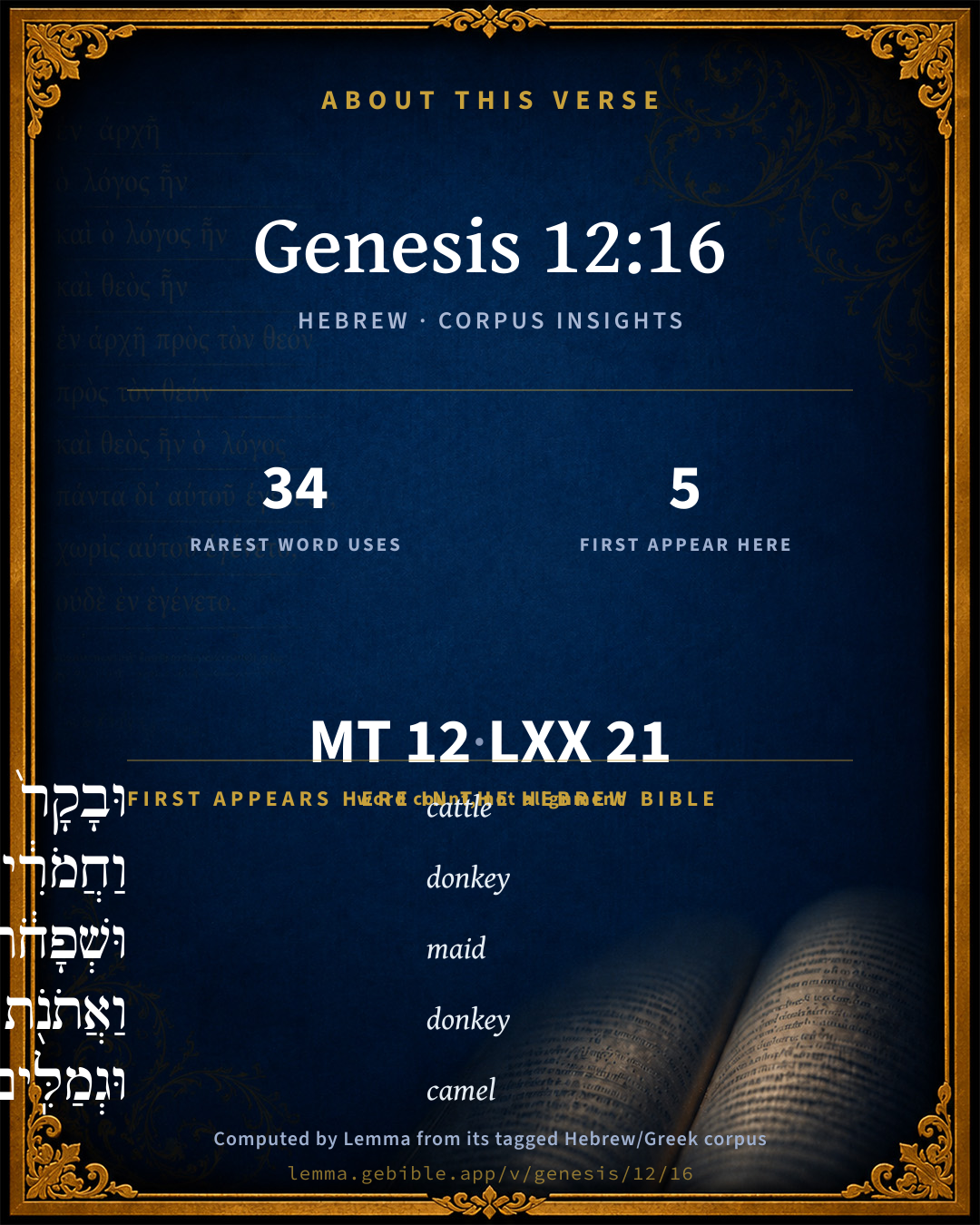
  • 5 first appearances in the Hebrew Bible
Full analysis ↓
Download a study sheet

One document with this verse’s original text, its word-by-word gloss line, the meaning frame, cross-references with their text, attributed commentary, and full source and license credits — printable, and it pastes into notes with its structure intact.

This verse Autodidact and up

Study sheet (.html) Plain text (.txt)

A passage Seminary Student

Up to 50 verses in one chapter. A passage sheet keeps up to 6 commentary sources and 12 cross-references per verse, in the order this page ranks them, and says so on the sheet whenever that leaves anything out. Ask for a single verse and you get the Autodidact verse sheet above.

Everything on this page stays free to read, with no account — the sheet is a download of what is already on screen, not access to it.

Want to remove ads? Support Godless Engineer
Compare translations 3

The same verse in 3 English versions, stacked beneath the original-language interlinear above. Click any original word for its lexicon entry.

Each is an independent rendering of the whole verse — the interlinear is not word-aligned to these translations.

Highlighted words mark where these versions differ — a whole-verse word diff, not a word-by-word alignment.

  • World English Bible Public Domain
    He dealt well with Abram for her sake. He had sheep, and oxen, and male donkeys, and men-servants, and maid-servants, and female donkeys, and camels.
  • King James Version Public Domain
    And he entreated Abram well for her sake: and he had sheep, and oxen, and he asses, and menservants, and maidservants, and she asses, and camels.
  • unfoldingWord Literal Text CC BY-SA 4.0
    Then he treated Abram well for her sake, so that he had flock and herd and male donkeys and male slaves and female slaves and female donkeys and camels.

unfoldingWord Literal Text — © unfoldingWord, licensed CC BY-SA 4.0. Word-aligned USFM3 via Door43 (git.door43.org/unfoldingWord/en_ult).

Versions to compare (up to 4)

3 of 4 selected

Show all 18 translations

Every available English version of this verse, each an independent rendering of the whole verse.

  • World English Bible Public Domain
    He dealt well with Abram for her sake. He had sheep, and oxen, and male donkeys, and men-servants, and maid-servants, and female donkeys, and camels.
  • Berean Standard Bible Public Domain
    He treated Abram well on her account, and Abram acquired sheep and cattle, male and female donkeys, menservants and maidservants, and camels.
  • Majority Standard Bible Public Domain
    He treated Abram well on her account, and Abram acquired sheep and cattle, male and female donkeys, menservants and maidservants, and camels.
  • King James Version Public Domain
    And he entreated Abram well for her sake: and he had sheep, and oxen, and he asses, and menservants, and maidservants, and she asses, and camels.
  • American Standard Version (1901) Public Domain
    And he dealt well with Abram for her sake: and he had sheep, and oxen, and he-asses, and men-servants, and maid-servants, and she-asses, and camels.
  • Revised Version (1885) Public Domain
    And he entreated Abram well for her sake: and he had sheep, and oxen, and he-asses, and menservants, and maidservants, and she-asses, and camels.
  • Geneva Bible (1599) Public Domain
    Who intreated Abram well for her sake, and he had sheepe, and beeues, and hee asses, and men seruants and maide seruants, and shee asses, and camelles.
  • Douay-Rheims (1899) Public Domain
    And they used Abram well for her sake. And he had sheep and oxen, and he asses, and menservants and maidservants, and she asses, and camels.
  • Young's Literal Translation Public Domain
    and to Abram he hath done good because of her, and he hath sheep and oxen, and he-asses, and men-servants, and handmaids, and she-asses, and camels.
  • Literal Standard Version CC BY-SA 4.0
    and to Abram he has done good because of her, and he has sheep and oxen, and male donkeys, and menservants, and handmaids, and female donkeys, and camels.
  • Unlocked Literal Bible CC BY-SA 4.0
    Pharaoh treated Abram well for her sake, and gave him sheep, oxen, male donkeys, male servants, female servants, female donkeys, and camels.
  • unfoldingWord Literal Text CC BY-SA 4.0
    Then he treated Abram well for her sake, so that he had flock and herd and male donkeys and male slaves and female slaves and female donkeys and camels.
  • Darby Bible Public Domain
    And he treated Abram well on her account; and he had sheep, and oxen, and he-asses, and bondmen, and bondwomen, and she-asses, and camels.
  • World Messianic Bible Public Domain
    He dealt well with Abram for her sake. He had sheep, cattle, male donkeys, male servants, female servants, female donkeys, and camels.
  • Webster's Bible Public Domain
    And he treated Abram well for her sake: and he had sheep, and oxen, and he-asses, and men-servants, and maid-servants, and she-asses, and camels.
  • Free Bible Version CC BY-SA 4.0
    Pharaoh treated Abram well because of her, giving him sheep and cattle, male donkeys, male servants, female servants, female donkeys, and camels.
  • Bible in Basic English Public Domain
    And because of her, he was good to Abram, and he had sheep and oxen and asses, and men-servants and women-servants, and camels.
  • JPS Tanakh (1917) Public Domain
    And he dealt well with Abram for her sake; and he had sheep, and oxen, and he-asses, and men-servants, and maid-servants, and she-asses, and camels.

Literal Standard Version (2020), Covenant Press — licensed CC BY-SA 4.0. Text via the HelloAO Bible API (eBible.org). Unlocked Literal Bible (unfoldingWord) — licensed CC BY-SA 4.0. Text via the HelloAO Bible API (eBible.org). unfoldingWord Literal Text — © unfoldingWord, licensed CC BY-SA 4.0. Word-aligned USFM3 via Door43 (git.door43.org/unfoldingWord/en_ult). Free Bible Version, Dr. Jonathan Gallagher — licensed CC BY-SA 4.0. Text via the HelloAO Bible API (eBible.org).

Word by word

More ways to search: Search by grammar → Find every occurrence → Compare this word →

Practice this passage: Drill this verse → Learn its vocabulary →

וַאֲתֹנֹ֖ת
ʼâthôwn
H860
“and · donkeys”
Conjunction + Noun, Common, Feminine, Plural, Absolute
Part of Speech
Conjunction + Noun
Type
Common
Gender
Feminine
Number
Plural
State
Absolute
Full BDB Definition

Origin: probably from the same as H386 (sense of patience)

TWOT: 190a

she-ass, she-donkey
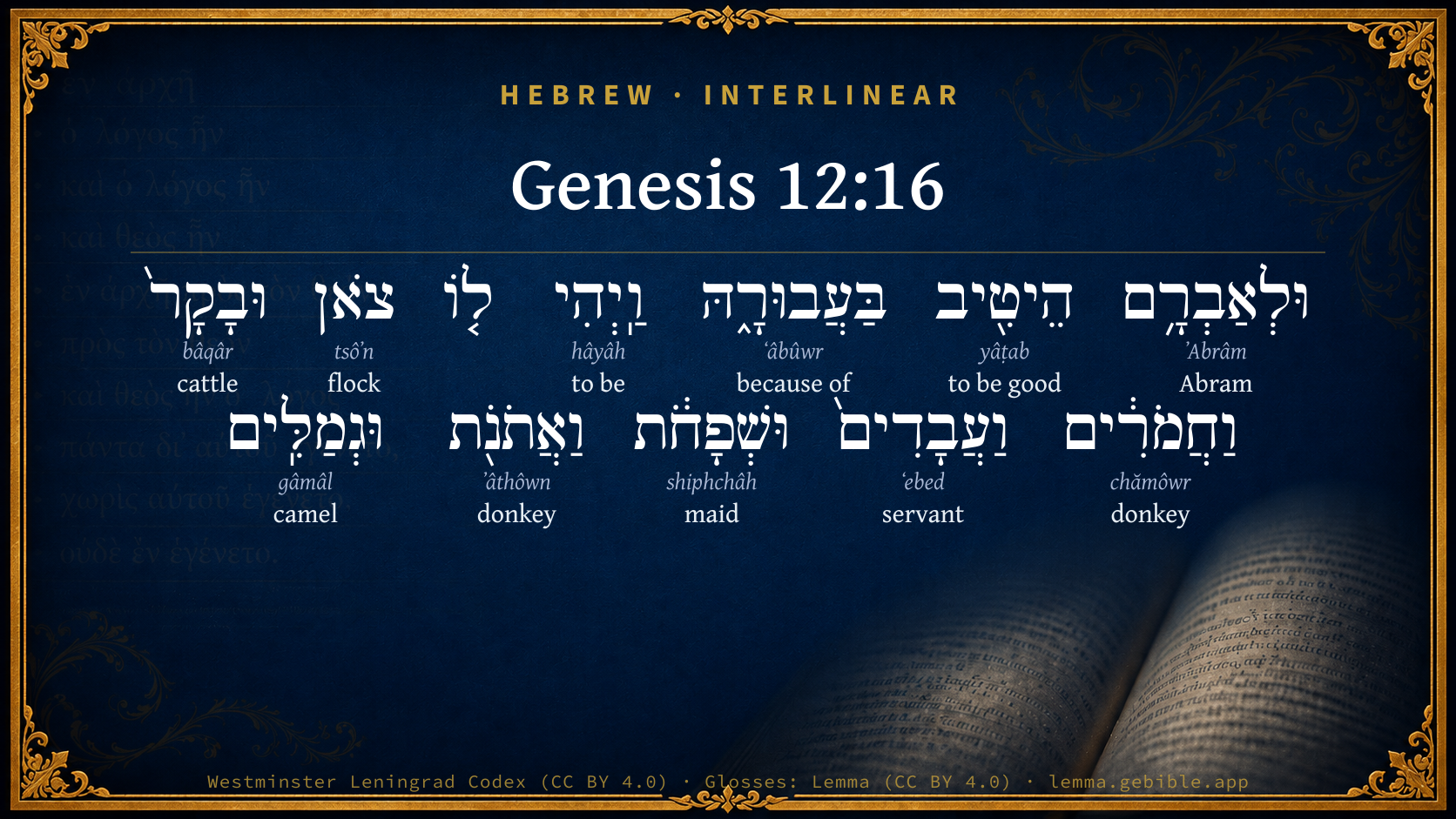
  1. וּלְאַבְרָ֥ם ʼAbrâm H87 “and · to/for · Abram” Conjunction + Preposition + Noun, Proper
  2. הֵיטִ֖יב yâṭab H3190 “to be good” Verb, Hiphil, Perfect, 3rd Person, Masculine, Singular
  3. בַּעֲבוּרָ֑הּ ʻâbûwr H5668 “in/at · because of · her” Preposition + Noun, Common, Masculine, Singular, Construct + Suffix, Personal, 3rd Person, Feminine, Singular
  4. וַֽיְהִי hâyâh H1961 “and · to be” Conjunction + Verb, Qal, Sequential Imperfect, 3rd Person, Masculine, Singular
  5. צֹאן tsôʼn H6629 “flock” Noun, Common, Both, Singular, Absolute
  6. וּבָקָר֙ bâqâr H1241 “and · cattle” Conjunction + Noun, Common, Both, Singular, Absolute
  7. וַחֲמֹרִ֔ים chămôwr H2543 “and · donkeys” Conjunction + Noun, Common, Both, Plural, Absolute
  8. וַעֲבָדִים֙ ʻebed H5650 “and · servants” Conjunction + Noun, Common, Masculine, Plural, Absolute
  9. וּשְׁפָחֹ֔ת shiphchâh H8198 “and · maids” Conjunction + Noun, Common, Feminine, Plural, Absolute
  10. וּגְמַלִּֽים gâmâl H1581 “and · camels” Conjunction + Noun, Common, Masculine, Plural, Absolute

About this verse

These counts appear in no published source. They are computed here, from the morphology-tagged text and Lemma’s own curated glosses. What Lemma adds →

12
words
11
distinct lemmas
Pentateuch
section

First appearance in Scripture

These words make their first canonical appearance in the Hebrew Bible here:

  • וּבָקָר֙ cattle H1241
  • וַחֲמֹרִ֔ים donkey H2543
  • וּשְׁפָחֹ֔ת maid H8198
  • וַאֲתֹנֹ֖ת donkey H860
  • וּגְמַלִּֽים camel H1581

Shared distinctive vocabulary

וַאֲתֹנֹ֖ת donkey H860 occurs in 28 verses of the Hebrew Bible. Also found in:

Grammatical profile

  • 2 verbs
  • 9 nouns
  • 1 preposition

Verb forms

  • הֵיטִ֖יב Hiphil · Perfect
  • וַֽיְהִי Qal · Sequential Imperfect

Hebrew & Septuagint length

In English translation the verse runs 25 words from the Hebrew and 24 from the Septuagint (LXX English) — closely comparable.

A rough comparison of the two English renderings, which tokenize alike — not a word-level alignment.

Word counts can differ between the Hebrew and the Greek without any difference in meaning — e.g. the Hebrew direct-object marker אֵת has no separate Greek word, and Greek often adds the article ὁ.

In the original languages it is 12 Hebrew tokens and 21 Greek tokens — but the two are counted differently (Hebrew bundles its prefixes and suffixes into one token; the Greek is in lemma form), so that isn’t a like-for-like length.

Cross-references

9

Topical passages linked to Genesis 12:16 in the Treasury of Scripture Knowledge — connected by theme and wording, ordered by reader-vote popularity; previews shown in the World English Bible.

  • Genesis 20:14 Abimelech took sheep and oxen, men-servants and women-servants, and gave them to Abraham, and restored Sarah, his wife to him.
  • Genesis 13:2 Abram was very rich in cattle, in silver, and in gold.
  • Genesis 24:35 Yahweh has blessed my master greatly. He has become great. He has given him flocks and herds, silver and gold, men-servants and maid-servants, and camels and donkeys.
  • Genesis 26:14 He had possessions of flocks, possessions of herds, and a great household. The Philistines envied him.
  • Genesis 32:5 I have oxen, donkeys, flocks, men-servants, and maid-servants. I have sent to tell my lord, that I may find favor in your sight.'"
  • Genesis 32:13–15 He lodged there that night, and took from that which he had with him, a present for Esau, his brother:
  • Job 1:3 His possessions also were seven thousand sheep, three thousand camels, five hundred yoke of oxen, five hundred she-donkeys, and a very great household; so that this man was the greatest of all the children of the east.
  • Job 42:12 So Yahweh blessed the latter end of Job more than his beginning. He had fourteen thousand sheep, six thousand camels, one thousand yoke of oxen, and a thousand female donkeys.
  • Psalms 144:13–14 Our barns are full, filled with all kinds of provision. Our sheep bring forth thousands and ten thousands in our fields.

Cross-references courtesy of OpenBible.info (CC BY 4.0).

Hebrew and Greek witnesses Masoretic Hebrew ↔ Greek Septuagint

The same verse in the two great witnesses to the Old Testament, shown verse-for-verse.

These are two independent witnesses, not word-aligned to each other, and the Septuagint is shown in lemma (dictionary) form.

Hebrew Genesis 12:16 Masoretic · Westminster Leningrad Codex

וּלְאַבְרָ֥ם הֵיטִ֖יב בַּעֲבוּרָ֑הּ וַֽיְהִי ל֤וֹ צֹאן וּבָקָר֙ וַחֲמֹרִ֔ים וַעֲבָדִים֙ וּשְׁפָחֹ֔ת וַאֲתֹנֹ֖ת וּגְמַלִּֽים

He dealt well with Abram for her sake. He had sheep, and oxen, and male donkeys, and men-servants, and maid-servants, and female donkeys, and camels.

World English Bible · Public Domain

Greek LXX Genesis 12:16 Septuagint · lemma form

καί ὁ αβραμ εὖ χράω διά αὐτός καί γίγνομαι αὐτός πρόβατον καί μόσχος καί ὄνος παῖς καί παιδίσκη ἡμίονος καί κάμηλος

And they treated Abram well on her account, and he had sheep, and calves, and asses, and menservants, and women-servants, and mules, and camels.

LXX2012 (modern English Septuagint) · Public Domain

On this verse, The Pulpit Commentary discusses the Septuagint’s reading. Read the note in Commentary ↓

Hebrew: Westminster Leningrad Codex (CC BY 4.0). Greek: Septuagint (public domain); English from LXX2012 (modern English Septuagint) (Public Domain). How the Septuagint differs from the Hebrew →

Targum (Aramaic paraphrase)

2

The Targum is the ancient Jewish Aramaic paraphrase of the Hebrew Scriptures — an interpretive translation, not the Hebrew text itself. Onkelos (literal) and Pseudo-Jonathan (expansive) render the Torah, and Jonathan the Prophets. Coverage is partial: where no permissively-licensed English translation exists for a verse, only the Aramaic is shown. This is verse-level text, not a word-by-word alignment to the Hebrew.

  1. Targum Onkelos Torah (Genesis–Deuteronomy)
    וּלְאַבְרָם אוֹטִיב בְּדִילַהּ וַהֲווֹ לֵהּ עָאן וְתוֹרִין וַחֲמָרִין וְעַבְדִין וְאַמְהָן וְאַתְנָן וְגַמְלִין

    And Abram was well treated on account of her. And he had sheep, and oxen, and asses, and servants, and maidens, and camels.

    Targum Onkelos — Aramaic: “Onkelos Genesis” (public domain); “Onkelos Exodus” (public domain); “Onkelos Leviticus” (public domain); “Onkelos Numbers” (public domain); “Onkelos Deuteronomy” (public domain). English: “Sefaria Community Translation” (CC0 1.0 (public-domain dedication)); “J.W. Etheridge. The Targums of Onkelos and Jonathan Ben Uzziel on the Pentateuch. London: Longmans, Green, 1862” (public domain). Text via Sefaria.

  2. Targum Pseudo-Jonathan Torah (Genesis–Deuteronomy)
    וּלְאַבְרָם אוֹטֵב פַּרְעה בְּגִינָהּ וַהֲווֹ לֵיהּ מִדִילֵיהּ עָאן וְתוֹרִין וְחַמְרִין וְעַבְדִין וְאַמְהָן וְאַתְנָן וּגְמַלִין

    And Pharoh did good to Abram for her sake; and he had sheep, and oxen, and asses, and servants, and handmaids, and she-asses, and camels.

    Targum Pseudo-Jonathan — Aramaic: “Targum Jonathan on Genesis” (public domain); “Targum Jonathan on Exodus” (public domain); “Targum Jonathan on Leviticus” (public domain); “Targum Jonathan on Numbers” (public domain); “Targum Jonathan on Deuteronomy” (public domain). English: “The Targum of Jonathan ben Uzziel, trans. J. W. Etheridge, London, 1862” (public domain). Text via Sefaria.

Commentary

Notes on Genesis 12:16 from classic Christian and Jewish commentators (each source and its license shown beneath its notes). The classic Christian expositions comment on the surrounding passage and are grouped to its opening verse, so a note may address several verses; the Jewish commentaries on the Tanakh (Rashi and others) are per-verse, so they appear only where the commentator wrote on this verse.

Lemma curates 59 commentaries, every one of them public domain or Creative Commons licensed, each selected and text-cleaned for this edition rather than reprinted as found. About our sources →

Trapp's Complete Commentary

John Trapp

Gen 12:16 And he entreated Abram well for her sake: and he had sheep, and oxen, and he asses, and menservants, and maidservants, and she asses, and camels.

Ver. 16. And he entreated Abram well for her sake.] To the end that he might solicit his sister to yield consent; or might not be a backward friend, at least, out of displeasure because they had taken away his sister from him to the court. So King Henry VIII advanced all Anne Boleyn’s kindred, &c.

John Trapp, A Commentary or Exposition upon All the Books of the Old and New Testament (1647–1656) — public domain. Text from a community e-Sword module.

Jamieson, Fausset & Brown

Robert Jamieson, A. R. Fausset & David Brown

he entreated Abram well for her sake--The presents are just what one pastoral chief would give to another.

Jamieson, Fausset & Brown — Commentary Critical and Explanatory on the Whole Bible (1871) — public domain (CC PDM 1.0). Text via the HelloAO Bible API.

Adam Clarke's Commentary

Verse 16. He had sheep, and oxen, c.] As some of these terms are liable to be confounded, and as they frequently occur, especially in the Pentateuch, it may be necessary to consider and fix their meaning in this place.

SHEEP צאן tson, from tsaan, to be plentiful or abundant; a proper term for the eastern sheep, which almost constantly bring forth twins, Cant. So 4:2, and sometimes three and even four at a birth. Hence their great fruitfulness is often alluded to in the Scripture. See Ps 65:13; Ps 144:13. But under this same term, which almost invariably means a flock, both sheep and goats are included. So the Romans include sheep, goats, and small cattle in general, under the term PECUS pecoris; so likewise they do larger cattle under that of PECUS pecudis.

OXEN; בקר bakar, from the root, to examine, look out, because of the full, broad, steady, unmoved look of most animals of the beeve kind; and hence the morning is termed boker, because of the light springing out of the east, and looking out over the whole of the earth's surface.

HE-ASSES; חמרים chamorim, from חמר chamar, to be disturbed, muddy; probably from the dull, stupid appearance of this animal, as if it were always affected with melancholy. Scheuchzer thinks the sandy-coloured domestic Asiatic ass is particularly intended. The word is applied to asses in general, though most frequently restrained to those of the male kind.

SHE-ASSES; אתנת athonoth, from אתן ethan, strength, probably the strong animal, as being superior in muscular force to every other animal of its size. Under this term both the male and female are sometimes understood.

CAMELS; גמלים gemallim, from גמל gamal, to recompense, return, repay; so called from its resentment of injuries, and revengeful temper, for which it is proverbial in the countries of which it is a native. On the animals and natural history in general, of the Scriptures, I must refer to the Hicrozoicon of BOCHART, and the Physica Sacra of SCHEUCHZER. The former is the most learned and accurate work. perhaps, ever produced by one man.

From this enumeration of the riches of Abram we may conclude that this patriarch led a pastoral and itinerant life; that his meat must have chiefly consisted in the flesh of clean animals, with a sufficiency of pulse for bread; that his chief drink was their milk; his clothing, their skins; and his beasts of burden, asses and camels; (for as yet we read of no horses;) and the ordinary employment of his servants, to take care of the flocks, and to serve their master. Where the patriarchs became resident for any considerable time, they undoubtedly cultivated the ground to produce grain.

Adam Clarke's Commentary on the Bible (1810–1826) — public domain. Text from a community e-Sword/MySword module.

Ellicott's Commentary for English Readers

(16) He entreated Abram well.—Heb., did good to Abram. It was usual to give the relatives a sum of money when taking a daughter or sister to wife. The presents here show that Pharaoh fully believed that he was acting lawfully, while the largeness of them proves that Sarai, in spite of her years, was looked upon as a valuable acquisition. Among the presents are “asses.” The charge on this account brought against the author of “inaccuracy,” as if asses were not known at this time in Egypt, is disproved by the occurrence of representations of this animal on the tombs of Benihassan: we have proof even that they were numerous as far back as when the Pyramids of Gizeh were built. The horse is not mentioned, and the earliest representation of one is in the war-chariot of Ahmes, the first: Pharaoh of the eighteenth dynasty, who expelled the Hyksôs. Male and female slaves are, curiously enough, introduced between “he-asses” and “she-asses.” As she-asses were especially valuable, perhaps these and the camels were looked upon as the monarch’s choicest gifts.

Camels are not represented on the monuments, and are said not to thrive well in Egypt; but the Semitic hordes who were peopling the Delta would certainly bring camels with them. Many, too, of the Egyptian monarchs—as, for instance, those of the twelfth dynasty—held rule over a great part of the Sinaitic peninsula, and must have known the value of the camel for transporting heavy burdens in the desert, and its usefulness to a nomad sheik like Abram. (See Gen_24:10.)

A Bible Commentary for English Readers, edited by Charles John Ellicott (1878–1897) — public domain. Text from a community e-Sword module.

The Cambridge Bible for Schools and Colleges

gen. ed. J. J. S. Perowne

16. entreated] Old Eng. word for “treated,” or “used.” The manner in which Abram received and retained these extensive gifts implies his consent to Sarai’s position at the court. Abram’s acceptance of the purchase-money was his ratification of the transaction. If it struck the Hebrew mind as clever, it seems to us only base and despicable.

sheep, and oxen, &c.] This list represents the principal possessions of a nomad chieftain. The following points should be noticed: (a) men-servants and maidservants (i.e. male and female slaves) are placed between the animals, either by mistake of a copyist, or being regarded as the chattels of the household, cf. Gen_24:35; (b) the mention of camels has been criticized as an anachronism, because the camel is not represented in the Egyptian inscriptions before the Persian period. But, whether used or not by the ancient Egyptians, the camel was certainly employed both by traders and nomads in Western Asia, and in the tradition, whether correctly or not, would be considered to be obtainable; (c) the horse is omitted; and the omission has been considered a sign of ignorance of Egyptian life. But the horse never appears among the possessions of the patriarchs, e.g. Gen_24:35, Gen_30:43, and its use is condemned in Deu_17:16; (d) the order of the items in the list may possibly denote their relative values, the camel being the most precious.

The Cambridge Bible for Schools and Colleges (gen. ed. J. J. S. Perowne; Cambridge University Press, 1878–1918) — public domain. Text from a community e-Sword module.

John Gill's Exposition

And he entreated Abram well for her sake,.... Pharaoh was very complaisant to him, showed him great respect, and bestowed many favours on him on account of Sarai, whom he took to be his sister, and which were done, that he would consent that she might be his wife:

and he had sheep, and oxen, and he asses, and menservants, and maidservants, and she asses, and camels; which were, some at least, if not all, the gifts of Pharaoh to him, or otherwise there seems to be no reason why they should be made mention of here. The Jews say (g), that Pharaoh, because of the love he had to Sarai, gave to her by writing all his substance, whether silver or gold, or servants or farms, and also the land of Goshen for an inheritance; and therefore the children of Israel dwelt in the land of Goshen, because it was Sarai our mother's, say they.

(g) Pirke Eliezer, c. 26.

John Gill's Exposition of the Whole Bible (1746–1763) — public domain (CC PDM 1.0). Text via the HelloAO Bible API.

Haydock's Catholic Bible Commentary

Well. Perhaps they made him some presents to gain his favour; (Menochius) or, at least, they suffered him to remain quietly among them.

George Leo Haydock (1774–1849), Haydock's Catholic Family Bible and Commentary, 1859 edition — public domain. Excludes Psalms (Douay-Rheims chapter numbering differs from Protestant) and Deuterocanonical books (Catholic canon only).

Matthew Poole's English Annotations

To wit, by Pharaoh’s gift, over and above his own; else it had been impertinent to mention it in this place.

Matthew Poole's English Annotations on the Holy Bible (1683–1685) — public domain. Text from a community e-Sword/MySword module.

Whedon's Commentary on the Bible

Daniel D. Whedon

16. He entreated Abram well — Observe that the presents which Pharaoh makes Abram are such as were suited to his nomad life. It is noticeable that nothing is here said of horses, which, as shown by the monuments, were introduced at a later period of Egyptian civilization. We find them there in the time of Moses.

Daniel D. Whedon (gen. ed.), Commentary on the Old and New Testaments (1874–1909) — public domain. Text from a community e-Sword module.

The Pulpit Commentary

And he entreated Abram well literally, did good to Abram; eu ejcrhsanto (LXX, Hieronymus, Poole) supposes that the court of Pharaoh or the Egyptian people generally conferred favors on the patriarch, which is not at all so probable as that Pharaoh didfor her sake. Marriage negotiations in Oriental countries are usually accompanied by presents to the relatives of the de as a sort of payment. "The marriage price is distinctly mentioned in Scripture (Exo_22:15, Exo_22:16; 1Sa_18:23, 1Sa_18:25; Hos_3:2) was commonly demanded by the nations of antiquity, as by the Babylonians (Herod., 1:196), Assyrians (AElian V H., 4. 1; Strabo, 16:745), the ancient Greeks ("Odyss.," 8:318 ff.), and the Germans (Tacit., "German.," 18.); and still obtains in the East to the present day" (vide Kitto"s "Cyclopedia," art. Marriage, by Dr. Ginsburg). And he had literally, there was (given) to him sheep, and oxen . Flocks of small cattle and herds of larger quadrupeds, together constituted the chief wealth of nomads; (cf. Gen_13:5) And (Job_1:3) he asses. Chamor, so named from the reddish color which in southern countries belongs not only to the wild, but also to the common or domestic, ass (Gesenius). The mention of asses among Pharaoh"s presents has been regarded as an inaccuracy" and a "blunder," at once a sign of the late origin of Genesis and a proof its author"s ignorance of Egypt (Bohlen, Introd., Ge 6); but

(1) asses were among the most common of Egyptian animals, a single individual, according to Wilkinson (vol. 3. p. 34), possessing sometimes as many as 700 or 800; and

(2) it is certain that asses appear on the early monuments (cf. " Records of the Past," vol. 2. p. 26). And men-servants, and maid-servants, and she asses. Athon; from athan, to walk with short steps; so named from its slowness, (Gen_32:16) though "the ass in Egypt is of a very superior kind, tall, handsome, docile, swift" (Kitto"s "Cyclopedia," art. Egypt). And camels. Gamal (from gamal, to repay, because the camel is an animal that remembers past injuries (Bochart), or from a cogmate Arabic root hamala, meaning he or it carried, with reference to its being a beast of burden (Gesenius); both of which derivations Stuart Poole declares farfetched, and proposes to connect the term with the Sanskrit kramela, from kram, to walk or step, which would then signify the walking animal (vide Kitto, art. Camel). Cf. with the Hebrew the Sanskrit as above, the Arab jemel or gemel, the Egyptian sjamoul, Greek kamhlov, Latin camelus) is the well-known strong animal belonging to Palestine, (Ezr_2:67) Arabia, (Jud_1:7:12) Egypt, (Exo_9:3) Syria, (2Ki_8:9) which serves the inhabitants of the desert for travelling (Gen_24:10 Gen_31:17) as well as for carrying burdens, (Isa_30:6) and for warlike operations, (Gen_21:7) and in which their fiches consisted. (Job_1:3 Job_42:2) Though the camel does not thrive well in Egypt, and seldom appears on the monuments, the historian has not necessarily been guilty of an inaccuracy and a blunder" in assigning it to Abram as one of Pharaoh"s presents (Bohlen); for

(1) the camel thrives better in Egypt than it does anywhere else out of its own proper habitat;

(2) if camels were not generally kept in Egypt, this Pharaoh may have been "one of the shepherd kings who partly lived at Avaris, the Zoan of Scripture," a region much inhabited by strangers (Poole in Kitto, art. Camel); and

(3) if camels have not been discovered among the delineations on the monuments, this may have been because of its connection with the foreign conqueror of Egypt, which caused it to be regarded as a beast of ill omen; though

(4) according to Heeren they do appear on the monuments (Havernick, 18, p. 142). That horses, though the glory of Egypt, were not included among the monarch"s gifts was doubtless owing to the fact that they could not have been of much service to the patriarch.

The Pulpit Commentary (1880–1919), ed. H.D.M. Spence-Jones & Joseph S. Exell — public domain. Text from a community e-Sword module.

Rashi

Rabbi Shlomo Yitzchaki (Rashi)

ולאברם הטיב בעבורה AND TO ABRAM HE DEALT WELL — he means Pharaoh — בעבורה FOR HER SAKE.

Rashi on the Tanakh — English translations: “The Judaica Press complete Tanach with Rashi, translated by A. J. Rosenberg” (CC BY 4.0); “Pentateuch with Rashi's commentary by M. Rosenbaum and A.M. Silbermann, 1929-1934” (public domain); “The Metsudah Tanach series, Lakewood, N.J” (CC BY 4.0); and “The Book of Joshua, Metsudah Publications, 1997” (CC BY 4.0). Text via Sefaria.

Radak

Rabbi David Kimhi (Radak)

ולאברם היטיב בעבורה, as soon as the king had taken Sarai he showered Avram with favours, seeing that she had described him as her brother. The favours consisted of the king sending him livestock, as well as other gifts which he could enjoy personally, so that he would give his consent to the marriage. Afterwards, when he had been punished by G’d, he did not ask Avram for forgiveness but deported him, as opposed to Avimelech (Genesis 20,14) The meaning of the words

ויהי לו, is that these gifts which used to belong to Pharaoh remained in Avram’s possession.

Radak on the Tanakh — English translations: “Sefaria Community Translation” (CC0 1.0 (public-domain dedication)); “Eliyahu Munk, HaChut Hameshulash” (CC BY 4.0); “Rabbi Mike Feuer, Jerusalem Anthology” (CC BY 4.0); and “R. David Kimhi on the first book of Psalms, Translated by R.G. Finch, London, 1919” (public domain). Text via Sefaria.

Lesson kit

Teaching starters — assembled from the data on this page, not authored interpretation. Every prompt links to the verse data it draws on. Edit before teaching.

Genesis, in the Pentateuch, opens this verse with 12 words (11 distinct Hebrew lemmas). Its most distinctive word is ʼâthôwn (“donkey”). A historical commentator’s framing appears above. Read the whole chapter for the surrounding context.

Discussion questions

  1. What does “donkey” (ʼâthôwn) contribute to the verse as a whole?
  2. 5 words here appear for the first time in Scripture. What is being introduced at this debut?
  3. Genesis 32:15 shares the word «donkey» with this verse. How do the two illuminate each other?
  4. The translations on this page render this verse differently — a whole-verse word diff, not a word-by-word alignment. What might account for the different wordings?
  5. The verb «הֵיטִ֖יב» is Hiphil Perfect. How does its form color the action?
  6. Reading how Trapp's Complete Commentary and Jamieson, Fausset & Brown read this verse, where do the two commentators agree and where do they part?

Things to notice

Reading settings

Reading text

Shown beneath each verse's original-language words.

Old Testament
Old Testament edition

Read the OT as the Masoretic Hebrew (MT) or the Greek Septuagint (LXX).

English shown for the Greek Septuagint (in the Hebrew ↔ Greek comparison).

Comparing translations? Open the Compare panel on any verse page to stack up to four side by side.