Deuteronomy 15:21

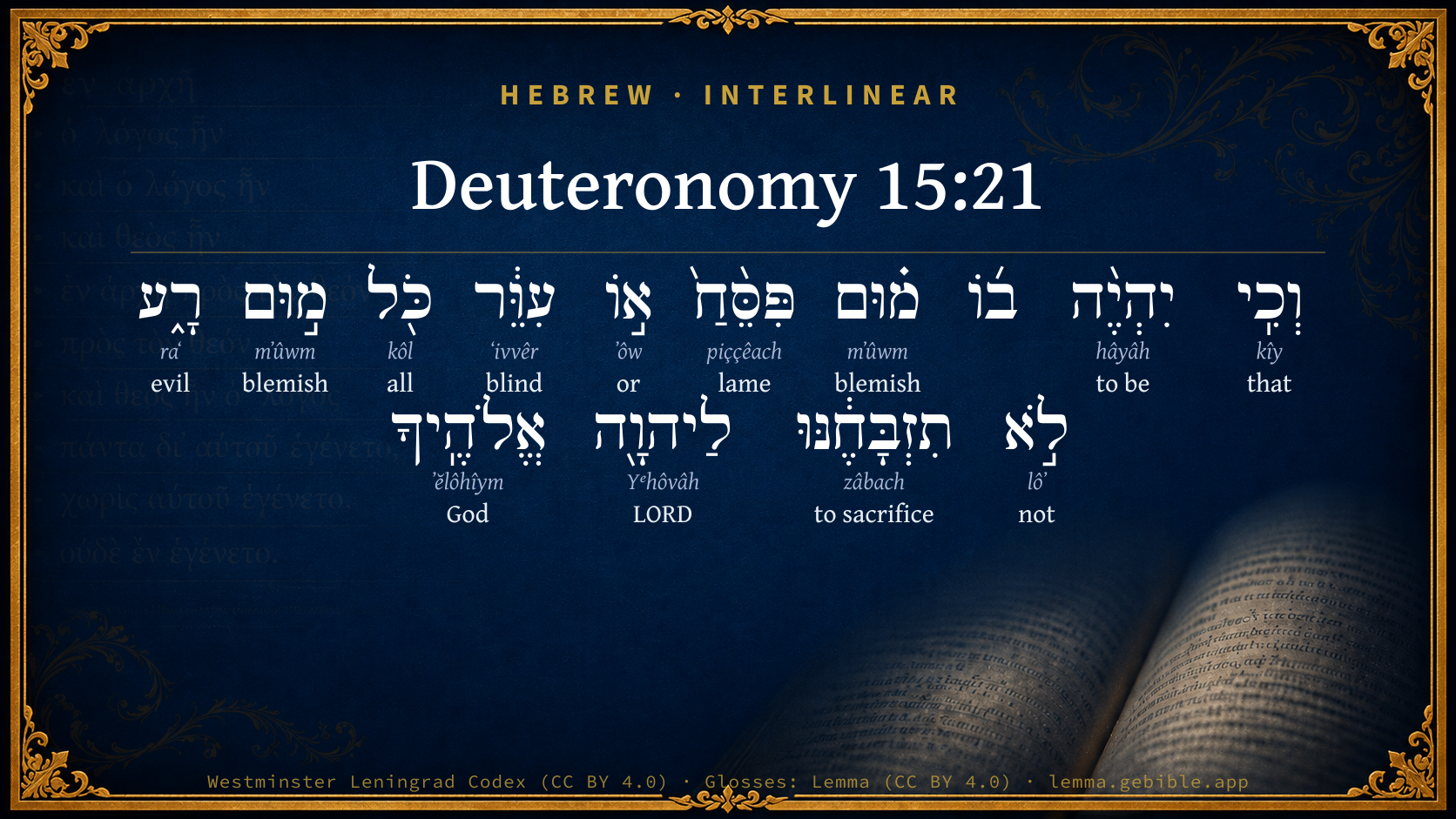
Hebrew (Westminster Leningrad Codex) Deuteronomy 15:21 appears in the Hebrew Old Testament. The text above is from the Westminster Leningrad Codex. Each word links to its Strong’s number, a concise gloss, and parsing drawn from the Open Scriptures Hebrew Bible morphology. Click any word for its full Brown-Driver-Briggs (BDB) entry.
Download image
Cite this verse

Deuteronomy 15:21 (World English Bible). Public Domain. Lemma interlinear Bible study tool, https://lemma.gebible.app/v/deuteronomy/15/21.

Show BibTeX & RIS
BibTeX
RIS
English Translation
If it have any blemish, [as if it be] lame or blind, any ill blemish whatever, you shall not sacrifice it to Yahweh your God.
World English Bible · Public Domain
Download a study sheet

One document with this verse’s original text, its word-by-word gloss line, the meaning frame, cross-references with their text, attributed commentary, and full source and license credits — printable, and it pastes into notes with its structure intact.

This verse Autodidact and up

Study sheet (.html) Plain text (.txt)

A passage Seminary Student

Up to 50 verses in one chapter. A passage sheet keeps up to 6 commentary sources and 12 cross-references per verse, in the order this page ranks them, and says so on the sheet whenever that leaves anything out. Ask for a single verse and you get the Autodidact verse sheet above.

Everything on this page stays free to read, with no account — the sheet is a download of what is already on screen, not access to it.

Want to remove ads? Support Godless Engineer
Compare translations 3

The same verse in 3 English versions, stacked beneath the original-language interlinear above. Click any original word for its lexicon entry.

Each is an independent rendering of the whole verse — the interlinear is not word-aligned to these translations.

Highlighted words mark where these versions differ — a whole-verse word diff, not a word-by-word alignment.

  • World English Bible Public Domain
    If it have any blemish, [as if it be] lame or blind, any ill blemish whatever, you shall not sacrifice it to Yahweh your God.
  • King James Version Public Domain
    And if there be any blemish therein, as if it be lame, or blind, or have any ill blemish, thou shalt not sacrifice it unto the LORD thy God.
  • unfoldingWord Literal Text CC BY-SA 4.0
    And if it has on it a blemish (lame or blind, any severe blemish), you must not sacrifice it to Yahweh your God.

unfoldingWord Literal Text — © unfoldingWord, licensed CC BY-SA 4.0. Word-aligned USFM3 via Door43 (git.door43.org/unfoldingWord/en_ult).

Versions to compare (up to 4)

3 of 4 selected

Show all 18 translations

Every available English version of this verse, each an independent rendering of the whole verse.

  • World English Bible Public Domain
    If it have any blemish, [as if it be] lame or blind, any ill blemish whatever, you shall not sacrifice it to Yahweh your God.
  • Berean Standard Bible Public Domain
    But if an animal has a defect, is lame or blind, or has any serious flaw, you must not sacrifice it to the LORD your God.
  • Majority Standard Bible Public Domain
    But if an animal has a defect, is lame or blind, or has any serious flaw, you must not sacrifice it to the LORD your God.
  • King James Version Public Domain
    And if there be any blemish therein, as if it be lame, or blind, or have any ill blemish, thou shalt not sacrifice it unto the LORD thy God.
  • American Standard Version (1901) Public Domain
    And if it have any blemish, `as if it be' lame or blind, any ill blemish whatsoever, thou shalt not sacrifice it unto Jehovah thy God.
  • Revised Version (1885) Public Domain
    And if it have any blemish, as if it be lame or blind, any ill blemish whatsoever, thou shalt not sacrifice it unto the LORD thy God.
  • Geneva Bible (1599) Public Domain
    But if there be any blemish therein, as if it be lame, or blind, or haue any euill fault, thou shalt not offer it vnto the Lord thy God,
  • Douay-Rheims (1899) Public Domain
    But if it have a blemish, or be lame, or blind, or in any part disfigured or feeble, it shall not be sacrificed to the Lord thy God.
  • Young's Literal Translation Public Domain
    `And when there is in it a blemish, lame, or blind, any evil blemish, thou dost not sacrifice it to Jehovah thy God;
  • Literal Standard Version CC BY-SA 4.0
    And when there is a blemish in it, [or it is] lame or blind, [or has] any evil blemish, you do not sacrifice it to your God YHWH;
  • Unlocked Literal Bible CC BY-SA 4.0
    If it has any blemish—for example, if it is lame or blind, or has any blemish whatever—you must not sacrifice it to Yahweh your God.
  • unfoldingWord Literal Text CC BY-SA 4.0
    And if it has on it a blemish (lame or blind, any severe blemish), you must not sacrifice it to Yahweh your God.
  • Darby Bible Public Domain
    But if there be a defect therein, [if it be] lame, or blind, [or have] any evil defect, thou shalt not sacrifice it to Jehovah thy God.
  • World Messianic Bible Public Domain
    If it has any defect—is lame or blind, or has any defect whatever, you shall not sacrifice it to the LORD your God.
  • Webster's Bible Public Domain
    And if there is any blemish in it, as if it is lame, or blind, or hath any ill blemish, thou shalt not sacrifice it to the LORD thy God.
  • Free Bible Version CC BY-SA 4.0
    However, if an animal has some defect or is lame or blind, in fact if it has any serious defect at all, you are not to sacrifice it to the Lord your God.
  • Bible in Basic English Public Domain
    But if it has any mark on it, if it is blind or has damaged legs, or if there is anything wrong with it, it may not be offered to the Lord your God.
  • JPS Tanakh (1917) Public Domain
    And if there be any blemish therein, lameness, or blindness, any ill blemish whatsoever, thou shalt not sacrifice it unto the LORD thy God.

Literal Standard Version (2020), Covenant Press — licensed CC BY-SA 4.0. Text via the HelloAO Bible API (eBible.org). Unlocked Literal Bible (unfoldingWord) — licensed CC BY-SA 4.0. Text via the HelloAO Bible API (eBible.org). unfoldingWord Literal Text — © unfoldingWord, licensed CC BY-SA 4.0. Word-aligned USFM3 via Door43 (git.door43.org/unfoldingWord/en_ult). Free Bible Version, Dr. Jonathan Gallagher — licensed CC BY-SA 4.0. Text via the HelloAO Bible API (eBible.org).

Word by word

More ways to search: Search by grammar → Find every occurrence → Compare this word →

Practice this passage: Drill this verse → Learn its vocabulary →

פִּסֵּ֨חַ֙
piççêach
H6455
“lame”
Adjective, Adjective, Masculine, Singular, Absolute
Part of Speech
Adjective
Type
Adjective
Gender
Masculine
Number
Singular
State
Absolute
Full BDB Definition

Origin: from H6452

TWOT: 1787a

lame
  1. וְכִֽי kîy H3588 “and · that” Conjunction + Conjunction
  2. יִהְיֶ֨ה hâyâh H1961 “to be” Verb, Qal, Imperfect, 3rd Person, Masculine, Singular
  3. מ֗וּם mʼûwm H3971 “blemish” Noun, Common, Masculine, Singular, Absolute
  4. א֣וֹ ʼôw H176 “or” Conjunction
  5. עִוֵּ֔ר ʻivvêr H5787 “blind” Adjective, Adjective, Masculine, Singular, Absolute
  6. כֹּ֖ל kôl H3605 “all of” Noun, Common, Masculine, Singular, Construct
  7. מ֣וּם mʼûwm H3971 “blemish” Noun, Common, Masculine, Singular, Absolute
  8. רָ֑ע raʻ H7451 “evil” Adjective, Adjective, Masculine, Singular, Absolute
  9. לֹ֣א lôʼ H3808 “not” Particle, Negative
  10. תִזְבָּחֶ֔נּוּ zâbach H2076 “to sacrifice · him” Verb, Qal, Imperfect, 2nd Person, Masculine, Singular + Suffix, Personal, 3rd Person, Masculine, Singular
  11. לַיהוָ֖ה Yᵉhôvâh H3068 “to/for · LORD” Preposition + Noun, Proper
  12. אֱלֹהֶֽיךָ ʼĕlôhîym H430 “God(s) · your” Noun, Common, Masculine, Plural, Construct + Suffix, Personal, 2nd Person, Masculine, Singular

About this verse

These counts appear in no published source. They are computed here, from the morphology-tagged text and Lemma’s own curated glosses. What Lemma adds →

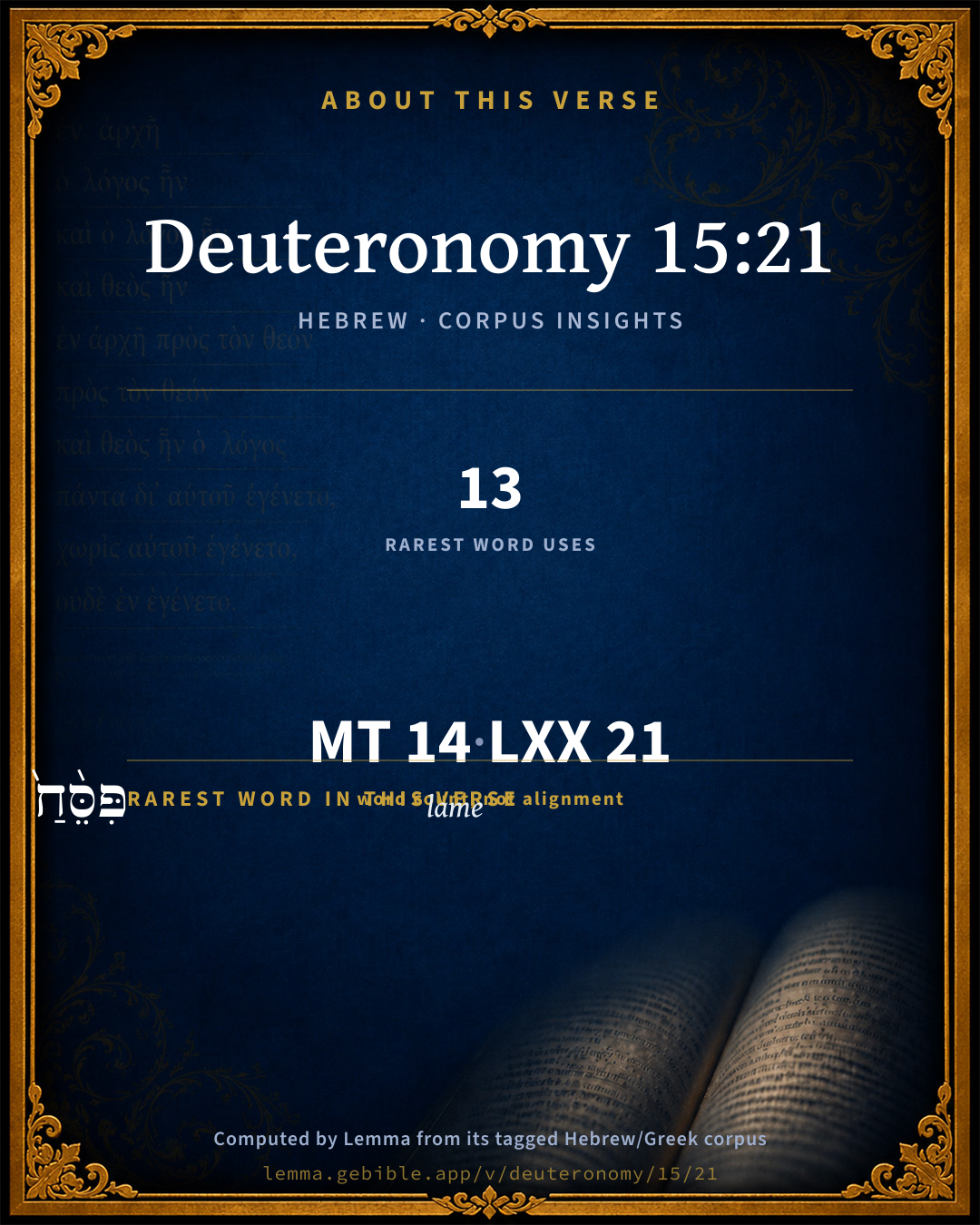
14
words
12
distinct lemmas
Pentateuch
section

Notable vocabulary

The rarest word here is פִּסֵּ֨חַ֙ lame H6455 — appearing just 13 times in the whole Hebrew Bible.

Shared distinctive vocabulary

פִּסֵּ֨חַ֙ lame H6455 occurs in 12 verses of the Hebrew Bible. Also found in:

Grammatical profile

  • 2 verbs
  • 5 nouns
  • 3 adjectives
  • 1 preposition
  • 2 conjunctions
  • 1 particle

Verb forms

  • יִהְיֶ֨ה Qal · Imperfect
  • תִזְבָּחֶ֔נּוּ Qal · Imperfect

Repetition

A word recurs within this verse — often emphatic in Hebrew:

  • מ֗וּם blemish H3971 ×2

Hebrew & Septuagint length

In English translation the verse runs 25 words from the Hebrew and 27 from the Septuagint (LXX English) — closely comparable.

A rough comparison of the two English renderings, which tokenize alike — not a word-level alignment.

Word counts can differ between the Hebrew and the Greek without any difference in meaning — e.g. the Hebrew direct-object marker אֵת has no separate Greek word, and Greek often adds the article ὁ.

In the original languages it is 14 Hebrew tokens and 21 Greek tokens — but the two are counted differently (Hebrew bundles its prefixes and suffixes into one token; the Greek is in lemma form), so that isn’t a like-for-like length.

Cross-references

3

Topical passages linked to Deuteronomy 15:21 in the Treasury of Scripture Knowledge — connected by theme and wording, ordered by reader-vote popularity; previews shown in the World English Bible.

  • Deuteronomy 17:1 You shall not sacrifice to Yahweh your God an ox, or a sheep, in which is a blemish, [or] anything evil; for that is an abomination to Yahweh your God.
  • Malachi 1:7–8 You offer polluted bread on my altar. You say, 'How have we polluted you?' In that you say, 'Yahweh's table contemptible.'
  • Leviticus 22:19–25 that you may be accepted, you shall offer a male without blemish, of the bulls, of the sheep, or of the goats.

Cross-references courtesy of OpenBible.info (CC BY 4.0).

Hebrew and Greek witnesses Masoretic Hebrew ↔ Greek Septuagint

The same verse in the two great witnesses to the Old Testament, shown verse-for-verse.

These are two independent witnesses, not word-aligned to each other, and the Septuagint is shown in lemma (dictionary) form.

Hebrew Deuteronomy 15:21 Masoretic · Westminster Leningrad Codex

וְכִֽי יִהְיֶ֨ה ב֜וֹ מ֗וּם פִּסֵּ֨חַ֙ א֣וֹ עִוֵּ֔ר כֹּ֖ל מ֣וּם רָ֑ע לֹ֣א תִזְבָּחֶ֔נּוּ לַיהוָ֖ה אֱלֹהֶֽיךָ

If it have any blemish, [as if it be] lame or blind, any ill blemish whatever, you shall not sacrifice it to Yahweh your God.

World English Bible · Public Domain

Greek LXX Deuteronomy 15:21 Septuagint · lemma form

ἐάν δέ εἰμί ἐν αὐτός μῶμος χωλός ἤ τυφλός ἤ καί πᾶς μῶμος πονηρός οὐ θύω αὐτός κύριος ὁ θεός σύ

And if there be in it a blemish, if it be lame or blind, an evil blemish, you shall not sacrifice it to the Lord your God.

LXX2012 (modern English Septuagint) · Public Domain

Hebrew: Westminster Leningrad Codex (CC BY 4.0). Greek: Septuagint (public domain); English from LXX2012 (modern English Septuagint) (Public Domain). How the Septuagint differs from the Hebrew →

Targum (Aramaic paraphrase)

2

The Targum is the ancient Jewish Aramaic paraphrase of the Hebrew Scriptures — an interpretive translation, not the Hebrew text itself. Onkelos (literal) and Pseudo-Jonathan (expansive) render the Torah, and Jonathan the Prophets. Coverage is partial: where no permissively-licensed English translation exists for a verse, only the Aramaic is shown. This is verse-level text, not a word-by-word alignment to the Hebrew.

  1. Targum Onkelos Torah (Genesis–Deuteronomy)
    וַאֲרֵי יְהֵי בֵהּ מוּמָא חֲגִיר אוֹ עֲוִיר כֹּל מוּם בִּישׁ לָא תִכְּסִנֵהּ קֳדָם יְיָ אֱלָהָךְ

    (no public-domain English translation for this verse)

    Targum Onkelos — Aramaic: “Onkelos Genesis” (public domain); “Onkelos Exodus” (public domain); “Onkelos Leviticus” (public domain); “Onkelos Numbers” (public domain); “Onkelos Deuteronomy” (public domain). English: “Sefaria Community Translation” (CC0 1.0 (public-domain dedication)); “J.W. Etheridge. The Targums of Onkelos and Jonathan Ben Uzziel on the Pentateuch. London: Longmans, Green, 1862” (public domain). Text via Sefaria.

  2. Targum Pseudo-Jonathan Torah (Genesis–Deuteronomy)
    וַאֲרוּם יְהֵי בֵּיהּ מוּמָא חֲגִיר אוֹ סָמֵי כָּל מִדַּעַם בִּישׁ לָא תִכְסִינֵיהּ קֳדָם יְיָ אֱלָהָכוֹן

    But if there be any spot in it, if it be lame or blind, or have any blemish, you shall not sacrifice it before the Lord your God:

    Targum Pseudo-Jonathan — Aramaic: “Targum Jonathan on Genesis” (public domain); “Targum Jonathan on Exodus” (public domain); “Targum Jonathan on Leviticus” (public domain); “Targum Jonathan on Numbers” (public domain); “Targum Jonathan on Deuteronomy” (public domain). English: “The Targum of Jonathan ben Uzziel, trans. J. W. Etheridge, London, 1862” (public domain). Text via Sefaria.

Commentary

Notes on Deuteronomy 15:21 from classic Christian and Jewish commentators (each source and its license shown beneath its notes). The classic Christian expositions comment on the surrounding passage and are grouped to its opening verse, so a note may address several verses; the Jewish commentaries on the Tanakh (Rashi and others) are per-verse, so they appear only where the commentator wrote on this verse.

Lemma curates 59 commentaries, every one of them public domain or Creative Commons licensed, each selected and text-cleaned for this edition rather than reprinted as found. About our sources →

Tyndale Open Study Notes

Tyndale Open Resources

15:21 A defect was any imperfection that devalued an animal; it was no sacrifice to give up something that was of little or no worth to begin with (2 Sam 24:24).

Tyndale Open Study Notes — © Tyndale Open Resources, licensed CC BY-SA 4.0. Text via the HelloAO Bible API.

Adam Clarke's Commentary

Verse 21. If there be any blemish] See Clarke on Le 22:20. God will have both a perfect priest and a perfect offering.

Adam Clarke's Commentary on the Bible (1810–1826) — public domain. Text from a community e-Sword/MySword module.

The Cambridge Bible for Schools and Colleges

gen. ed. J. J. S. Perowne

21. any blemish] See on Deu_17:1. Thou shalt not sacrifice it, i.e. at the one altar where alone sacrifice was now lawful; but—

The Cambridge Bible for Schools and Colleges (gen. ed. J. J. S. Perowne; Cambridge University Press, 1878–1918) — public domain. Text from a community e-Sword module.

John Gill's Exposition

And if there be any blemish therein,.... In the firstling, as if it be "lame or blind", or have

any ill blemish: thou shall not sacrifice it unto the Lord thy God; blemishes in any beast made it unfit for sacrifices which were required; and so all peace offerings, vows, and freewill offerings, were to be free from any, Lev 22:19, such were not fit for an holy sacrifice or an holy feast.

John Gill's Exposition of the Whole Bible (1746–1763) — public domain (CC PDM 1.0). Text via the HelloAO Bible API.

The Pulpit Commentary

Sacrifices to be without blemish.

A reference to passages in the Books of Exodus, Leviticus, and Numbers, will show the frequency with which the injunction here contained was insisted upon, and the importance attached to it. Sacrifices offered to God must be without blemish. The entire Mosaic system of sacrifice was symbolic in relation to the Church that then was, and typical in relation to the Church of the future. We can scarcely miss the teaching of the enactment before us, if only we seek to interpret it with reverent and loyal hearts. Surely it taught two things in the region of law, and also two things in the sphere of grace. The former were:

1. That in the eye of the All-pure One, every moral flaw or defect was an offence, and therefore could not be accepted by him.

2. That as man was guilty before God, he could not, on the reckoning of bare law, be well-pleasing in the eyes of a righteous Being, to whom all evil was an abomination.

The latter were:

1. That a flawless sacrifice was to be selected and offered to God by, and in the name, and on the behalf of, the guilty one.

2. That such flawless sacrifice, if offered in sincerity and penitence of spirit, would be accepted on his behalf. Now, we are not left to interpret the type as best we may, nor are we called on to offer the symbolic sacrifice. The antitype has come. The reality is ours. And an inspired interpretation of ancient rites is given us by apostles and prophets of our Lord and Savior. (Heb_9:14; 1Pe_1:19; Eph_5:27; Jud_1:24; Rev_14:5) With such teaching before us, we can see a sixfold significance in our text.

I HERE IS A DIVINE APPEAL TO THE CONSCIENCE. It says, in language which ought never to be mistaken, "the least speck of sin is an offence to God;" and guilty man cannot, on the ground of his own right, have any standing-ground for an instant before him. It is said that in the later days of the Jewish economy, when the offerer brought his sacrifice, the slaughterer (who was other than the priest) took a two-edged knife and ran it from the nape of the neck down the spine, laying it bare. Not infrequently this would disclose a dark spot: this was a blemish; the animal was unfit for sacrifice, and had to be cast away. Hence the allusion in Heb_4:12, which, so understood, has in it marvelous power. For this blemish did not appear on the surface, it came not out to the light till the spinal marrow was exposed to view. Hence, see Heb_4:13, specially the marvelous phrase, "pa de gumna kaina k.t.l.. Every creature is "opened" unto the eyes of him with whom is our account. And though exterior conduct may be such as to commend itself to the eye of man, yet in the "marrow" of one"s being there may be a sin which is an offence to God. May be? There is. There are sins upon sins, and there is sinfulness, which is the root and ground of all. And hence it must be the case that sinful man has no right, on the ground of his own merits, to expect acceptance before God. This is the very ground-work of evangelical theology. It is said, "Pectus facit theologum," but we would say rather theolgum; for only as this appeal to (as has been remarked to us), "Conscientia facit" the conscience is felt, will the after-appeals properly tell.

II HERE IS A DIVINE INVITATION TO FAITH. There was to be a sacrifice chosen, without blemish, which was to be presented by and on behalf of the offerer. (Joh_1:29) God has provided a Lamb for a burnt offering, and for a sin offering too (Isa_53:6; 2Co_5:21) (For a discussion of the grounds on which the offering of the Body of Jesus Christ once for all could be valid for the race, see Dale on the Atonement, sect. 10.) Suffice it here to say that this offering had the dignity of a Divine Sacrifice, the appropriateness of a human one, and the "sweet-smelling savor" of a perfectly pure one. Besides which it had all the spontaneity of a voluntary offering, and all the generosity of a noble serf-surrender for the sake of others; in making which the Redeemer was satisfied. And this offering which infinite love has made, loving faith may take and call its own; and abandoning all pretence to a standing-ground in native right, it may find an everlastingly firm one in sovereign grace!

III HERE IS A DIVINE CALL TO PENITENCE. The sacrifice was to be offered with confession of sin. (see Lev_16:21) All the several ordinances which were spread over different sacrificial services in Israel, find their varied significances grouped in one, in the attitude of the sinner before the cross of his Savior. Well might Watts write, "My faith would lay her hand," etc. While we accept the Divine Sacrifice for sin, penitential confession over sin should ever mark us. (see Ps 51)

IV HERE IS A DIVINE DEMAND FOR RECTITUDE OF HEART. When we bring our offerings to the Lord, no defect should be knowingly tolerated by us. Grace gives no warrant to laxity, and true penitence will be scrupulously intolerant of it. (Psa_66:18) The freeness of pardon to the penitent involves no modification of ethical stringency, for the fact is, wherever there is any known tolerance of ill, to that extent penitence does not exist. God puts away sin by forgiving it, only as we put it away by repenting of it and casting it off.

V HERE IS A DIVINE SUMMONS TO DEVOTION. Jesus died, the just for the unjust, that he might bring us to God. And where a man, sorry for sin, intolerant of the evil in his nature, struggling against it, and pleading with God to uproot it, casts himself before God in this genuine uprightness of soul, none of the imperfections over which he mourns shall prevent the Divine acceptance of such an offering, presented, as it will be, in the name of the spotless Son of God. The virtue of his spotless sacrifice ensures the acceptance of ours. Every true and sincere penitent is, on this ground of free grace and dying love, as well-pleasing to God and as near to his heart as the purest angel before the eternal throne. The offering to God of a broken and a contrite heart is one which he cannot and will not despise. (see also Heb_13:15, Heb_13:16)

VI HERE IS A DIVINE PROPHECY, TO INSPIRE HOPE. These sacrifices of ours, offered in penitence, faith, and love, are still but imperfect. And the holiest souls are most alive to such imperfection, and most sorrowful over it. Hence it should be no small joy to find in the Word of God precisely the same expressions used to express the future purity of believers that are employed to indicate the perfection of the Redeemer"s sacrifice. As the one Great Sacrifice was "without blemish and without spot," so all those who are themselves living sacrifices to God, shall be "without spot or wrinkle, or any such thing." He who received them at first on the ground of his own purity, shall create in them a spotlessness like his own. They shall be "without fault" before the throne of God. And he who died for them shall then present them as his own!

Have we not here (in conclusion) a remarkable illustration of what the Apostle Paul so often speaks of as "the righteousness of God?" Each one of these six steps is a fresh aspect of it. The first shows the righteousness of God in taking cognizance of sin; the second, the righteousness of God in offering a spotless sacrifice for sin; the third, the righteousness of God in requiring penitential acknowledgment of sin; the fourth, the righteousness of God in demanding intolerance of sin; the fifth, the righteousness of God in accepting our consecration in the name of a Sinless One, only when we penitently put away sin; the sixth, the righteousness of God in ensuring that those who are living sacrifices to him shall ultimately be perfectly freed from all sin! Thus from beginning to end "grace reigns through righteousness, unto eternal life, by Jesus Christ our Lord." Now unto him that is able to keep us from falling, and to present us faultless before the presence of his glory with exceeding joy, to the only wise God our Savior, be glory and majesty, dominion and power, both now and ever. Amen."

The Pulpit Commentary (1880–1919), ed. H.D.M. Spence-Jones & Joseph S. Exell — public domain. Text from a community e-Sword module.

Rashi

Rabbi Shlomo Yitzchaki (Rashi)

מום [AND IF THERE BE] ANY BLEMISH [THEREIN, IF IT BE LAME, OR BLIND, OR HAVE ANY ILL BLEMISH, THOU SHALT NOT SACRIFICE IT …] — any blemish is a general statement,

פסח או עור LAME OR BLIND is a particularization,

כל מום רע ANY ILL BLEMISH — it again comprises them in a general statement. How is it with the blemishes particularised? They have the characteristic that each is a visible (external) blemish and the animal never returns naturally to its original condition (i.e. never becomes free from the blemish). So, too, the general statement includes all such blemishes that are visible and incurable [while in the case of a transitory blemish the animal may be sacrificed when the blemish has disappeared] (Bekhorot 37a; cf. Sifrei Devarim 126:2).

Rashi on the Tanakh — English translations: “The Judaica Press complete Tanach with Rashi, translated by A. J. Rosenberg” (CC BY 4.0); “Pentateuch with Rashi's commentary by M. Rosenbaum and A.M. Silbermann, 1929-1934” (public domain); “The Metsudah Tanach series, Lakewood, N.J” (CC BY 4.0); and “The Book of Joshua, Metsudah Publications, 1997” (CC BY 4.0). Text via Sefaria.

Lesson kit

Teaching starters — assembled from the data on this page, not authored interpretation. Every prompt links to the verse data it draws on. Edit before teaching.

Deuteronomy, in the Pentateuch, opens this verse with 14 words (12 distinct Hebrew lemmas). Its most distinctive word is piççêach (“lame”). A historical commentator’s framing appears above. Read the whole chapter for the surrounding context.

Discussion questions

  1. How does “lame” (piççêach) shape what this verse is saying?
  2. Leviticus 21:18 shares the word «lame» with this verse. How do the two illuminate each other?
  3. “blemish” occurs 2× in this one verse. What is the effect of the repetition?
  4. These translations render this verse differently. What is at stake in choosing one wording over another?
  5. The verb «יִהְיֶ֨ה» is Qal Imperfect. How does its form color the action?
  6. Reading how Tyndale Open Study Notes and Adam Clarke's Commentary read this verse, where do the two commentators agree and where do they part?

Things to notice

Reading settings

Reading text

Shown beneath each verse's original-language words.

Old Testament
Old Testament edition

Read the OT as the Masoretic Hebrew (MT) or the Greek Septuagint (LXX).

English shown for the Greek Septuagint (in the Hebrew ↔ Greek comparison).

Comparing translations? Open the Compare panel on any verse page to stack up to four side by side.