
Nehemiah 4:6

Hebrew (Westminster Leningrad Codex) Nehemiah 4:6 appears in the Hebrew Old Testament. The text above is from the Westminster Leningrad Codex. Each word links to its Strong’s number, a concise gloss, and parsing drawn from the Open Scriptures Hebrew Bible morphology. Click any word for its full Brown-Driver-Briggs (BDB) entry.
Download image
Cite this verse

Nehemiah 4:6 (World English Bible). Public Domain. Lemma interlinear Bible study tool, https://lemma.gebible.app/v/nehemiah/4/6.

Show BibTeX & RIS
BibTeX
RIS
English Translation
So we built the wall; and all the wall was joined together to half [the height] of it: for the people had a mind to work.
World English Bible · Public Domain
Download a study sheet

One document with this verse’s original text, its word-by-word gloss line, the meaning frame, cross-references with their text, attributed commentary, and full source and license credits — printable, and it pastes into notes with its structure intact.

This verse Autodidact and up

Study sheet (.html) Plain text (.txt)

A passage Seminary Student

Up to 50 verses in one chapter. A passage sheet keeps up to 6 commentary sources and 12 cross-references per verse, in the order this page ranks them, and says so on the sheet whenever that leaves anything out. Ask for a single verse and you get the Autodidact verse sheet above.

Everything on this page stays free to read, with no account — the sheet is a download of what is already on screen, not access to it.

Want to remove ads? Support Godless Engineer
Compare translations 3

The same verse in 3 English versions, stacked beneath the original-language interlinear above. Click any original word for its lexicon entry.

Each is an independent rendering of the whole verse — the interlinear is not word-aligned to these translations.

Highlighted words mark where these versions differ — a whole-verse word diff, not a word-by-word alignment.

  • World English Bible Public Domain
    So we built the wall; and all the wall was joined together to half [the height] of it: for the people had a mind to work.
  • King James Version Public Domain
    So built we the wall; and all the wall was joined together unto the half thereof: for the people had a mind to work.
  • unfoldingWord Literal Text CC BY-SA 4.0
    So we built the wall, and all the wall was joined together up to half of it. And the heart of the people was for working.

unfoldingWord Literal Text — © unfoldingWord, licensed CC BY-SA 4.0. Word-aligned USFM3 via Door43 (git.door43.org/unfoldingWord/en_ult).

Versions to compare (up to 4)

3 of 4 selected

Show all 18 translations

Every available English version of this verse, each an independent rendering of the whole verse.

  • World English Bible Public Domain
    So we built the wall; and all the wall was joined together to half [the height] of it: for the people had a mind to work.
  • Berean Standard Bible Public Domain
    So we rebuilt the wall until all of it was joined together up to half its height, for the people had a mind to work.
  • Majority Standard Bible Public Domain
    So we rebuilt the wall until all of it was joined together up to half its height, for the people had a mind to work.
  • King James Version Public Domain
    So built we the wall; and all the wall was joined together unto the half thereof: for the people had a mind to work.
  • American Standard Version (1901) Public Domain
    So we built the wall; and all the wall was joined together unto half `the height' thereof: for the people had a mind to work.
  • Revised Version (1885) Public Domain
    So we built the wall; and all the wall was joined together unto half the height thereof: for the people had a mind to work.
  • Geneva Bible (1599) Public Domain
    So we built the wall, and all the wall was ioyned vnto the halfe thereof, and the heart of the people was to worke.
  • Douay-Rheims (1899) Public Domain
    So we built the wall, and joined it all together unto the half thereof: and the heart of the people was excited to work.
  • Young's Literal Translation Public Domain
    And we build the wall, and all the wall is joined -- unto its half, and the people have a heart to work.
  • Literal Standard Version CC BY-SA 4.0
    And we build the wall, and all the wall is joined—to its half, and the people have a heart to work.
  • Unlocked Literal Bible CC BY-SA 4.0
    So we built the wall and all the wall was joined together to half its height, for the people had a desire to work.
  • unfoldingWord Literal Text CC BY-SA 4.0
    So we built the wall, and all the wall was joined together up to half of it. And the heart of the people was for working.
  • Darby Bible Public Domain
    But we built the wall; and all the wall was joined together to the half thereof; for the people had a mind to work.
  • World Messianic Bible Public Domain
    So we built the wall; and all the wall was joined together to half its height, for the people had a mind to work.
  • Webster's Bible Public Domain
    So we built the wall; and all the wall was joined together to the half of it, for the people had a mind to work.
  • Free Bible Version CC BY-SA 4.0
    So we rebuilt the wall until it was all connected, reaching half its height, because the people were keen to work.
  • Bible in Basic English Public Domain
    So we went on building the wall; and all the wall was joined together half-way up: for the people were working hard.
  • JPS Tanakh (1917) Public Domain
    (3-38) So we built the wall; and all the wall was joined together unto half the height thereof; for the people had a mind to work.

Literal Standard Version (2020), Covenant Press — licensed CC BY-SA 4.0. Text via the HelloAO Bible API (eBible.org). Unlocked Literal Bible (unfoldingWord) — licensed CC BY-SA 4.0. Text via the HelloAO Bible API (eBible.org). unfoldingWord Literal Text — © unfoldingWord, licensed CC BY-SA 4.0. Word-aligned USFM3 via Door43 (git.door43.org/unfoldingWord/en_ult). Free Bible Version, Dr. Jonathan Gallagher — licensed CC BY-SA 4.0. Text via the HelloAO Bible API (eBible.org).

Word by word

More ways to search: Search by grammar → Find every occurrence → Compare this word →

Practice this passage: Drill this verse → Learn its vocabulary →

וַתִּקָּשֵׁ֥ר
qâshar
H7194
“and · to bind”
Conjunction + Verb, Niphal, Sequential Imperfect, 3rd Person, Feminine, Singular
Part of Speech
Conjunction + Verb
Stem
Niphal
Form
Sequential Imperfect
Person
3rd Person
Gender
Feminine
Number
Singular
Full BDB Definition

Origin: a primitive root: to tie, physically (gird, confine, compact) or mentally (in love, league)

TWOT: 2090

to bind, tie, bind together, league together, conspire - (Qal) - to bind, confine - to league together, conspire - (Niphal) to be bound, be bound up - (Piel) - to bind on - to bind fast - to bind, tie - to bind to oneself - (Pual) robust, vigorous (participle) - (Hithpael) to conspire
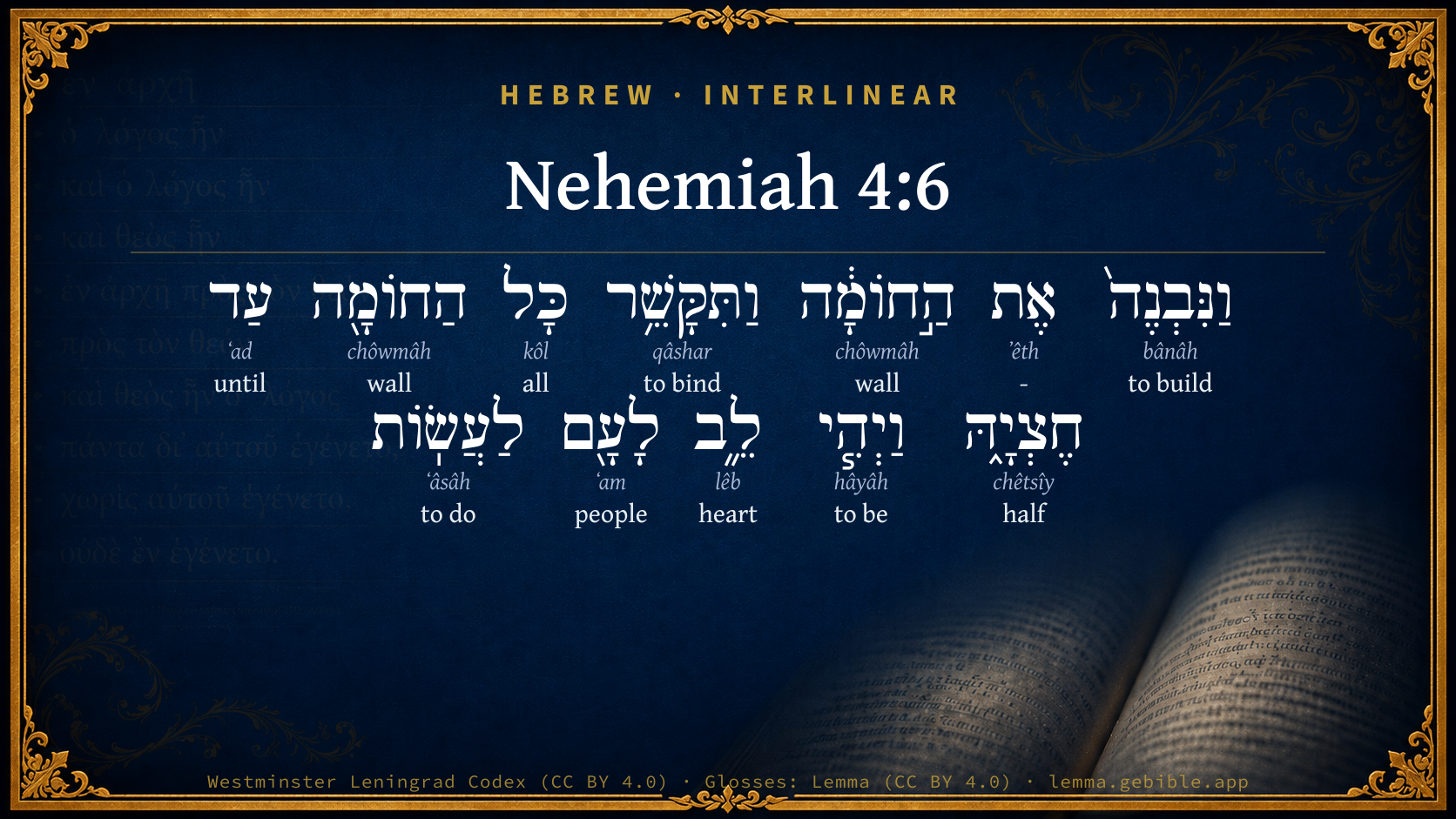
  1. וַנִּבְנֶה֙ bânâh H1129 “and · to build” Conjunction + Verb, Qal, Sequential Imperfect, 1st Person, Common, Plural
  2. אֶת ʼêth H853 “-” Particle, Direct Object
  3. הַ֣חוֹמָ֔ה chôwmâh H2346 “the · wall” Particle, Definite Article + Noun, Common, Feminine, Singular, Absolute
  4. כָּל kôl H3605 “all of” Noun, Common, Masculine, Singular, Construct
  5. הַחוֹמָ֖ה chôwmâh H2346 “the · wall” Particle, Definite Article + Noun, Common, Feminine, Singular, Absolute
  6. עַד ʻad H5704 “until” Preposition
  7. חֶצְיָ֑הּ chêtsîy H2677 “half · her” Noun, Common, Masculine, Singular, Construct + Suffix, Personal, 3rd Person, Feminine, Singular
  8. וַיְהִ֧י hâyâh H1961 “and · to be” Conjunction + Verb, Qal, Sequential Imperfect, 3rd Person, Masculine, Singular
  9. לֵ֦ב lêb H3820 “heart” Noun, Common, Masculine, Singular, Absolute
  10. לָעָ֖ם ʻam H5971 “to/for the · people” Preposition, Determined + Noun, Common, Masculine, Singular, Absolute
  11. לַעֲשֽׂוֹת ʻâsâh H6213 “to do” Preposition + Verb, Qal, Infinitive Construct

About this verse

These counts appear in no published source. They are computed here, from the morphology-tagged text and Lemma’s own curated glosses. What Lemma adds →

12
words
11
distinct lemmas
Historical
section

Shared distinctive vocabulary

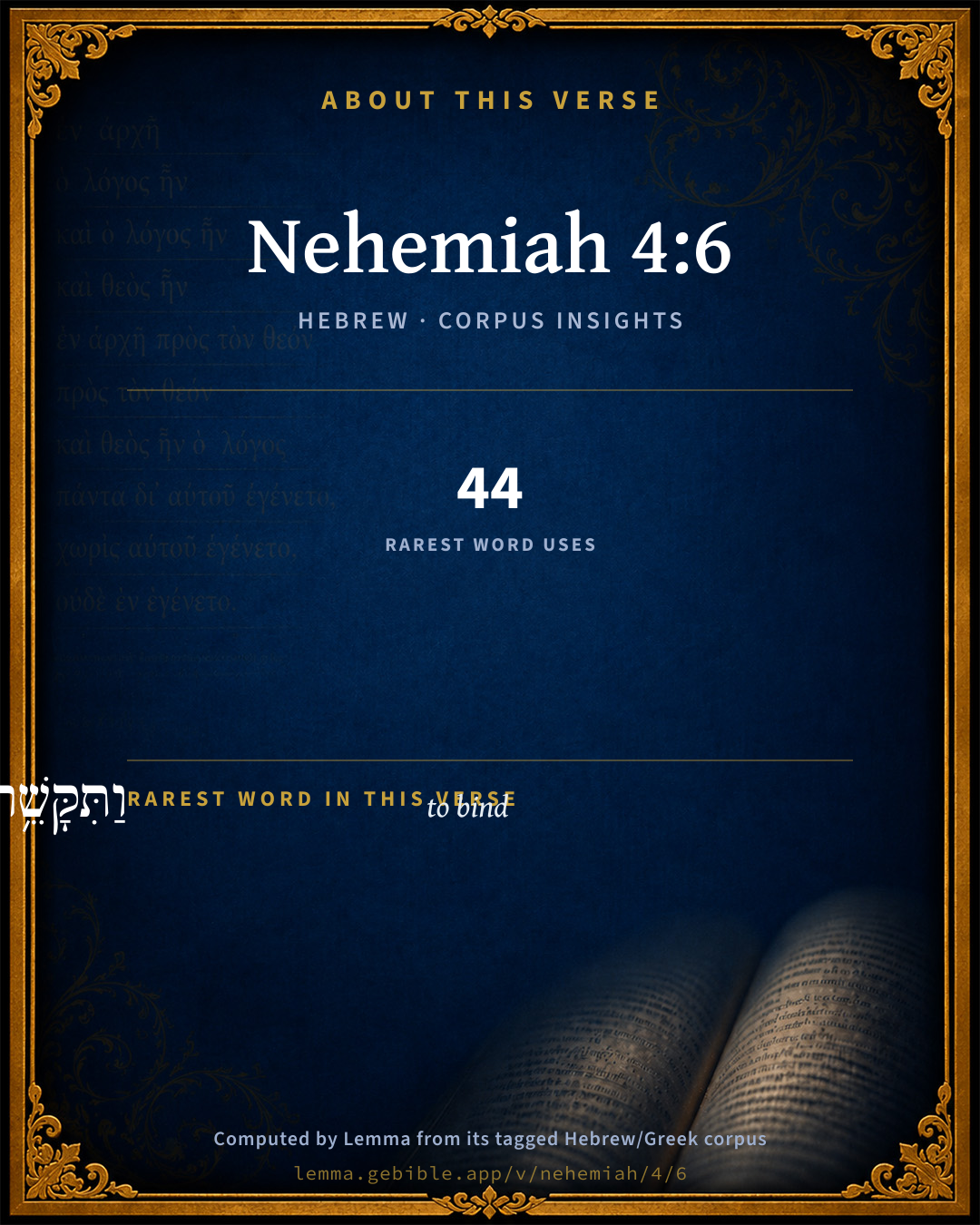
וַתִּקָּשֵׁ֥ר to bind H7194 occurs in 44 verses of the Hebrew Bible. Also found in:

Grammatical profile

  • 4 verbs
  • 6 nouns
  • 1 preposition
  • 1 particle

Verb forms

  • וַנִּבְנֶה֙ Qal · Sequential Imperfect
  • וַתִּקָּשֵׁ֥ר Niphal · Sequential Imperfect
  • וַיְהִ֧י Qal · Sequential Imperfect
  • לַעֲשֽׂוֹת Qal · Infinitive Construct

Repetition

A word recurs within this verse — often emphatic in Hebrew:

  • הַ֣חוֹמָ֔ה wall H2346 ×2

Cross-references

9

Topical passages linked to Nehemiah 4:6 in the Treasury of Scripture Knowledge — connected by theme and wording, ordered by reader-vote popularity; previews shown in the World English Bible.

  • Philippians 2:13 For it is God who works in you both to will and to work, for his good pleasure.
  • 1 Chronicles 29:3 In addition, because I have set my affection on the house of my God, seeing that I have a treasure of my own of gold and silver, I give it to the house of my God, over and above all that I have prepared for the holy house,
  • Nehemiah 6:15 So the wall was finished in the twenty-fifth [day] of [the month] Elul, in fifty-two days.
  • Hebrews 13:21 make you complete in every good work to do his will, working in you that which is well pleasing in his sight, through Jesus Christ, to whom be the glory forever and ever. Amen.
  • 1 Chronicles 29:14 But who am I, and what is my people, that we should be able to offer so willingly as this? For all things come of you, and of your own have we given you.
  • 1 Chronicles 29:17–18 I know also, my God, that you try the heart, and have pleasure in uprightness. As for me, in the uprightness of my heart I have willingly offered all these things: and now have I seen with joy your people, that are present here, offer willingly to you.
  • Psalms 110:3 Your people offer themselves willingly in the day of your power, in holy array. Out of the womb of the morning, you have the dew of your youth.
  • 2 Chronicles 29:36 Hezekiah rejoiced, and all the people, because of that which God had prepared for the people: for the thing was done suddenly.

Cross-references courtesy of OpenBible.info (CC BY 4.0).

Hebrew and Greek witnesses Masoretic Hebrew ↔ Greek Septuagint

The same verse in the two great witnesses to the Old Testament, shown verse-for-verse.

These are two independent witnesses, not word-aligned to each other, and the Septuagint is shown in lemma (dictionary) form.

Hebrew Nehemiah 4:6 Masoretic · Westminster Leningrad Codex

וַנִּבְנֶה֙ אֶת הַ֣חוֹמָ֔ה וַתִּקָּשֵׁ֥ר כָּל הַחוֹמָ֖ה עַד חֶצְיָ֑הּ וַיְהִ֧י לֵ֦ב לָעָ֖ם לַעֲשֽׂוֹת

So we built the wall; and all the wall was joined together to half [the height] of it: for the people had a mind to work.

World English Bible · Public Domain

Greek LXX Structure differs

The Septuagint has no separate book of Nehemiah. Its Greek text is the second half of Esdras B (2 Esdras), chapters 11–23; Ezra is the first half (1–10).

A verse-for-verse comparison isn’t shown here because the chapters and verses don’t line up. Switch to the LXX edition with the MT / LXX toggle above to read the Greek directly.

On this verse, Adam Clarke's Commentary discusses the Septuagint’s reading. Read the note in Commentary ↓

Hebrew: Westminster Leningrad Codex (CC BY 4.0). Greek: Septuagint (public domain); English from a public-domain English Septuagint. How the Septuagint differs from the Hebrew →

Commentary

Notes on Nehemiah 4:6 from classic Christian and Jewish commentators (each source and its license shown beneath its notes). The classic Christian expositions comment on the surrounding passage and are grouped to its opening verse, so a note may address several verses; the Jewish commentaries on the Tanakh (Rashi and others) are per-verse, so they appear only where the commentator wrote on this verse.

Lemma curates 59 commentaries, every one of them public domain or Creative Commons licensed, each selected and text-cleaned for this edition rather than reprinted as found. About our sources →

Trapp's Complete Commentary

John Trapp

Neh 4:6 So built we the wall; and all the wall was joined together unto the half thereof: for the people had a mind to work.

Ver. 6. So built we the wall] This followed upon his prayer, as a gracious answer to it; the people were encouraged, and the wall finished. Faithful prayer is never ineffectual. Reproaching is a heart breaking, Psa 66:20, but so long as a Christian can pray he is not without his cordial. "I came for thy prayer," Dan 10:12.

And all the wall was joined together] Not with gold indeed (as Cassiodorus saith the walls of Susa in Persia were), but with that which was better than gold, faith in God’s goodness and zeal of his glory.

Unto the half thereof] Unto half the height, for they could not do all at once: neither can we in the spiritual building; but grow up and increase with the increase of God, Col 2:19.

For the people had a mind to work] And the more mind because they met with so much opposition. A free spirit is most seen, saith one, when there be most rubs in the way; when he that moves by outward poises will stick and be dull: as when a bowl runs up a hill, every bounce slows it; but when downhill, a bounce quickeneth it.

John Trapp, A Commentary or Exposition upon All the Books of the Old and New Testament (1647–1656) — public domain. Text from a community e-Sword module.

The Biblical Illustrator

Joseph S. Exell

Neh_4:6

So we built the wall.

Fellowship in Christian service

1. They built it notwithstanding sneers. What do these feeble Jews? Sanballat said. All the Sanballats are not dead yet. Often, when you would attempt some new or difficult work for Christ, there are a good many modern Sanballats ready to stand about and say, You cant do anything; you are not strong enough; you are not experienced enough; you havent money enough; the idea of your attempting such a thing!

2. they built the wall, notwithstanding active opposition they kept right on steadily building. Said the great William Carey--who wrought such wonders, and against such opposition, in modern missions--to his son Eustace, Eustace, if they say I am a genius, it is not true; but if they say I can plod, that is true. Yes, I can plod, I can plod. And a plodding persistence, in the face of almost any opposition, is sure at last to triumph.

3. They built the wall, notwithstanding despairing friends. I have been reading how General Washington, only a little time before the battle of Yorktown, was in the very darkest time of the long, hard struggle. Friends on every side were despairingly saying, You cant do it; you might just as well give up. But the great Washington would not let himself despair. Whoever else might, he would not. He would keep at it; and, keeping at it, notwithstanding the despair of friends, a nations independence was achieved at Yorktown.

4. They built the wall by prayer. I asked Mr. Spurgeon once how he prayed. He answered, I go to the Bible and find a promise applicable to my need, then I reverently plead that promise before the Lord, asking Him to keep it for Jesus sake; and I believe God will, and He does. That is the prayer of faith--the prayer of great grip on the Divine promise.

5. They built the wall by working together. Did you notice that we? So we built the wail, our Scripture says. Even one is worth something, but two are worth more, and many striving together are worth immeasurably more. Associate others with yourself, or yourself with others. It was because the Rough Riders rushed up the heights of San Juan together, and because the coloured regiments rushed up together, and together with them they were enabled to plant Old Glory on the summit. Fellow ship is better than individualism in all noble service.

6. They built the wall by willingness on the part of each to do whatever he could. Sometimes they bore burdens; sometimes they grasped swords and spears; sometimes they stood sentinel. There was no selfish picking and choosing. There was no mean declaring I will do this, but I wont do that. Each one was ready to do anything; the thing which seemed just then the thing best to be done. It is no wonder that the wall went steadily and triumphantly up.

7. They built the wall by courageous trust in God. Said Nehemiah, Be not afraid of them; remember the Lord. (W. Hoyt, D. D.)

For the people had a mind to work--

Conditions of success in Christian work

The chief characteristics displayed by Nehemiah and his fellow-citizens in prosecuting their work were--

1. Earnestness. Earnestness is an important factor in all Christian work and consists--

(1) In a thorough persuasion of the truth of the message we make known--the efficacy of the remedy we convey to men.

(2) A deep sense of the value of those we seek to save.

(3) An intense conviction that it is Gods work and not our own we are seeking to do.

2. Persistency.

3. Union.

4. Courage.

5. Prayerfulness.

Summing up these characteristics, we may say to the Christian worker, Add to your work earnestness, and to earnestness persistency, and to persistency union, and to union wisdom, and to wisdom courage, and to courage prayer; for if these things be in you, and abound, they make you that ye shall neither be barren nor unfruitful in the knowledge of our Lord Jesus Christ (2Pe_1:8). (W. P. Lockhart.)

A mind to work

This implies--

I. A recognition of the duty of work.

II. A recognition of the privilege of work.

III. An earnest sympathy with, and longing for, the results of work. (The Church.)

A mind to work

I. The work. Circumstances have changed, and the methods are altered, but the work is the same. You are entitled to ask me, What are we to do?

1. Bear the insignia of your religion before the world. Let all men know that you are the followers of Christ.

2. Maintain His public worship.

3. Christianise the world.

II. The mind. This implies--

1. Readiness.

2. Heartiness.

3. Cheerfulness.

4. Thoroughness amid discouragement and opposition. (T. Davies, M. A.)

A mind to work

I. The work the Jews had to perform. The work they had undertaken was one in which it was natural to suppose they felt the deepest possible interest. It will be admitted that the work they had undertaken was a great work. Then as to the magnitude of the work, it is indescribable--it is, in a word, to seek the present and eternal salvation of a guilty, ruined, and perishing world. Nor must good men lose sight of the fact, that this glorious work is to be accomplished, not by miracle, nor by a Divine power or agency in the abstract, but by the feeble, and of itself powerless, instrumentality of Christian men, as accompanied with the sanctifying and saving influences of the Holy Spirit of God.

II. The obstacles which, in the prosecution of their work, the Jews had to encounter. The Church, then, must never forget that her adversaries are both numerous and powerful. But have not the Churchs greatest difficulties often proved her greatest blessings? It has led the Lords people both to see and to feel more of their dependence upon Him.

III. The spirit in which the jews carried on their work. They had their minds, that is to say, their souls, in it, and they were determined to accomplish it. They loved their Master, their work, and each other.

IV. The success of which their labour was productive.

1. Are there any of us who are engaged in the Lords service, but whose hearts are not in it?

2. Are there any who have no disposition to labour for the Lord Jesus Christ? (Essex Remembrancer.)

A mind to work

We have here--

I. co-operation. The people had a mind to work. Nehemiah was, of course, the ruling spirit. He was only one man, but he was one of those men who count for thousands. He was one of those men who not only embody but create the spirit of an age and lead it on to victory. He was only one man, but in this world men have not to be counted but weighed; and it is when men are weighed--weighed as to their intellect, their convictions, their courage, their principles, their self-denial--that it is seen that one man is not as good as another. All the great epochs of the world have gathered around one man, just as the restoration gathered around Nehemiah, and so filled his soul that the electric power of his patriotic purpose enkindled the hearts of the people with a flame that never expired till the work was done. Then as ever, it was seen that the worlds work must be done by a combination of men who toil with the brain and who toil with the hands. Nehemiah was architect, clerk of the works, diplomatist, general, all in one. But he could have done nothing unless he had been able to secure the co-operation of the people. There is here a lesson on the value and the necessity of co-operation in work for Christ. Success in war is due to two principles--the one is divide your enemy, and the other is unite yourselves. On these two conditions success is certain. Real and vital co-operation in Church work will be equally successful. There may be a Church and no co-operation. It may be a mass, but not a body. Many individual men do far more than a society, because the individual men work, and the society does not, but thinks that it has fulfilled all its duty when it has appointed a committee, with its usual complement of officers. You would think that an army had strangely misconceived its mission if because it saw its staff-officers it lay down and left the fortunes of battle to be settled by them. But this is just what is done by societies which devolve on committees the whole work.

II. Cheerful resolution. There is a great deal of work done in our world, and has always been, in which there has been no mind at all, either in the shape of intelligence or goodwill. I suppose that some of the greatest structures of the world were so built--the Pyramids, the great aqueducts of Rome and the Coliseum. The slaves had not a mind to work, but had an eye to the rod of the taskmaster. You will search this book in vain for the trace of a taskmaster. They had a mind to work, and not to criticise or cavil. This is a suggestive warning to all such characters in our day. Many have a mind only to think, and not to work. You ask them to come and set their shoulder to the wheel, but they prefer to spend their time in solving, so far as they can, sundry theological or religious fiddles. H by their thinking they accomplished anything, then they might think on, but they are like a corn-mill, the stones of which are perpetually revolving, but there is no corn between them, and so they only grind themselves. More doubts are removed and more difficulties are solved by working than by thinking. If any man will do the will of God, etc. Some people have a mind to speak, but not to work. Speech is good enough in its place. The end of all talk should be action. As a rule most work is done where there is least noise. When a machine goes noiselessly, it means that the friction is reduced to the smallest possible quantity, and that the force is not wasted on the process, but comes out in the accomplished work. At the building of Babel there was far more noise than at the building of the temple, but the temple was the successful work. Their heart was in their work, and by their heart we mean chiefly their purpose and their cheerfulness. He that works without a will is nothing better than a machine, and may be worse. When people have a mind to work there will be no unseemly ambitions, no quarrels for posts of honour. The man who can lighten labour with a song is likely to be a good worker. He will be like a soldier, who marches best to the rhythmic throb of the drum, and to the sounds of inspiring music. As to Christian work, none can be entitled to such a name unless it be cheerful. God loveth, we are told, not a giver, but a cheerful giver. If we show mercy we are to show it cheerfully. We are to serve the Lord with gladness. We are to come into His presence with songs. Saints are to be joyful in the Lord.

III. Work crowned with success. (Enoch Mellor, D. D.)

The secret of success in the work of the Lord

I. That we have a great and an important work devolving upon us: to aid in raising the world from the ruins of the fall, and restoring it to something of its former order and beauty, that the Lord may dwell among us. This work has been committed to the Church. It is her high corn, mission. This work must commence with our own hearts.

II. That this work must re engaged in with consecrated zeal and activity.

III. The diligent use of all appointed means. Nehemiah having set his heart upon his work, judiciously employed every means calculated to promote it.

1. Let us stimulate each other to engage vigorously and unitedly in this work. Generally speaking, there is only a small fraction of every Church that engages actively in the great purposes of religion.

2. Having brought all the truly pious up to a proper point, we should then address ourselves, every one to his proper sphere of labour.

IV. That in the use of means the work must be followed up with fortitude and perseverance. Such was the perseverance of the Jews in rebuilding the walls, that they never pulled off their clothes, except for the means of cleanliness, during the whole of the work; but continued night and day working. There was no time for delay or indulgence.

V. That to insure the successful issue of the work, there must be an entire dependence on the blessing of god. Here was the grand secret of Nehemiahs success. He first sought Divine direction, then employed the means, and then implored the Divine blessing. In no other way can we account for the rapid progress of the work, and its successful issue in so short a time. (G. Richards.)

Rebuilding of the walls of Jerusalem

Consider--

I. The persons by whom the work was mainly performed.

II. The spirit in which it was accomplished. In a great multitude of instances the work of conversion or reform is begun too near the surface. You ask the hand to work, and what is wanting is the mind to work. What we want is, not a new power but a new disposition, to have the mind newly cast in the image and character of God. It is in vain to change the hand of the watch if the mainspring is defective; it is in vain to heal the muscle or the sinew if there is no lifes blood in the heart; it is in vain to mould the mere image of a man if the spirit of life is not communicated. All these typify the man without the mind, without the will. (J. W. Cunningham, A. M.)

Advance in solid column to Christian work

When General Grant was in front of Richmond, and his army had been repulsed in the Wilderness, he called together his co-commanders and held a council, and asked them what they thought he had better do. There were General Sherman and General Howard, now leading generals, and all thought he had better retreat. He heard them through, and then broke up the council of war and sent them back to their headquarters; but before morning an orderly came round with a despatch from the General directing an advance in solid column on the enemy at daylight. That was what took Richmond and broke down the rebellion in our country. Christians, let us advance in solid column against the enemy; let us lift high the standard, and in the name of our God let us lift up our voice, and let us work together, shoulder to shoulder, and keep our eye single to the honour and glory of Christ. (D. L. Moody.)

Absorbing work is successful

A gentleman who recently visited Mr. Edisons great laboratory, at Menlo Park, and whose son was about to enter upon business life, asked the Professor to give him a motto for his boy, so that he might remember it as a guide and stimulus in after-life. Mr. Edison laughed a little at the novel request, and then said, Well, Ill give him this--tell him never to look at the clock! Which means this--that the man who succeeds to-day is not the man who does just what he has contracted to do and no more, but the man who throws his heart into his work, feels a genuine interest in it, and does not grumble if he has to work ten minutes after office hours.

Putting heart into work

An employer, pointing to two men working side by side in his shop, said, Though I pay them the same wages, one of them is worth twice as much to me as the other, because he puts his heart into everything that he does. He is interested. He is always anxious to do his best. His neighbour, on the contrary, thinks only of his wages. He will shirk whenever he thinks that he can do so and not be found out. I cannot trust him. I have to watch him closely, or he will send out work that is imperfect, and will injure the reputation of the shop. Well, what does the man you commend gain by putting his heart in it, if you pay the same wages? Nothing at present except the satisfaction one feels in trying to do his duty.

The Biblical Illustrator, edited by Joseph S. Exell (c. 1880s–1900s) — public domain. Text from a community e-Sword module.

Joseph Benson's Commentary

Neh 4:6. All the wall was joined unto the half thereof — That is, the wall was built round the whole city, there being no space unbuilt, and it was carried up to half the height that it was intended to be. For the people had a mind to work — Were very much set upon it, and went about it cheerfully, notwithstanding the jeers and scoffs of their enemies.

Joseph Benson's Commentary on the Old and New Testaments (1811–1818) — public domain. Text from a community e-Sword module.

Tyndale Open Study Notes

Tyndale Open Resources

4:6 half its height: Perhaps 10–12 feet (3.0–3.7 meters) tall, since some scholars speculate that the original wall was 20–24 feet (6.0–7.3 meters) high.

Tyndale Open Study Notes — © Tyndale Open Resources, licensed CC BY-SA 4.0. Text via the HelloAO Bible API.

Geneva Bible (1599)

Geneva Bible translators

Or, half height.

Geneva Bible (1599) marginal notes — public domain. Text via Bolls.life.

Jamieson, Fausset & Brown

Robert Jamieson, A. R. Fausset & David Brown

all the wall was joined together unto the half thereof--The whole circuit of the wall had been distributed in sections to various companies of the people, and was completed to the half of the intended height.

Jamieson, Fausset & Brown — Commentary Critical and Explanatory on the Whole Bible (1871) — public domain (CC PDM 1.0). Text via the HelloAO Bible API.

Adam Clarke's Commentary

Verse 6. For the people had a mind to work.] The original is very emphatic: ויהי לב לעם לעשות vayehi leb leam laasoth, "For the people had a heart to work." Their hearts were engaged in it; and where the heart is engaged, the work of God goes on well. The whole of this 6th verse is omitted by the Septuagint.

Adam Clarke's Commentary on the Bible (1810–1826) — public domain. Text from a community e-Sword/MySword module.

Ellicott's Commentary for English Readers

(6) Unto the half.—Up to half the height the wall was now continuous.

A Bible Commentary for English Readers, edited by Charles John Ellicott (1878–1897) — public domain. Text from a community e-Sword module.

The Cambridge Bible for Schools and Colleges

gen. ed. J. J. S. Perowne

6. So built we] R.V. So we built. No emphasis on ‘we.’

unto the half thereof] R.V. unto half the height thereof. ‘All the wall was joined together.’ The circumvallation was complete. There were no gaps or breaches. The wall had been raised to half its height all the way round. The most ancient wall, the foundations of which were discovered by Sir Charles Warren, must have had a height of 200 feet!

for the people had a mind to work] The enthusiasm of the people explains the rapidity of the work. Nehemiah disclaims any credit to himself.

a mind] literally, ‘heart.’

The Cambridge Bible for Schools and Colleges (gen. ed. J. J. S. Perowne; Cambridge University Press, 1878–1918) — public domain. Text from a community e-Sword module.

John Gill's Exposition

So built we the wall,.... Went on in building it, notwithstanding their scoffs and threats:

and all the wall was joined together unto the half thereof; it was carried all round the city to half the height of it:

for the people had a mind to work; their heart was in it, they had a good will to it, and they made haste to finish it.

John Gill's Exposition of the Whole Bible (1746–1763) — public domain (CC PDM 1.0). Text via the HelloAO Bible API.

Albert Barnes' Notes on the Bible

Unto the half thereof - i. e. to half the intended height.

Albert Barnes' Notes on the Bible (1834–1885) — public domain. Text from a community e-Sword/MySword module.

Haydock's Catholic Bible Commentary

Thereof, all round; as masons were stationed in different parts, (ver. 19.) and not barely on one side of the city. (Calmet) --- Tobias alludes to the present lowness of the walls, ver. 3. (Haydock)

George Leo Haydock (1774–1849), Haydock's Catholic Family Bible and Commentary, 1859 edition — public domain. Excludes Psalms (Douay-Rheims chapter numbering differs from Protestant) and Deuterocanonical books (Catholic canon only).

Matthew Poole's English Annotations

Unto the half thereof; either,

1. In length; or rather,

2. In height; for the whole circumference of the wall was distributed among the builders, who also had carried on the work, beginning at the sheep-gate, and ending there also, as appears from Neh 3:1,32; and the walls of Jerusalem are said to be made up, here, Neh 4:7.

Matthew Poole's English Annotations on the Holy Bible (1683–1685) — public domain. Text from a community e-Sword/MySword module.

Whedon's Commentary on the Bible

Daniel D. Whedon

6. Unto the half thereof — That is, until it was half completed. Some understand this of half way around the city, others of half the height of the wall. The latter seems to be the true meaning, inasmuch as the work was going on at all points in the city at the same time, so that the workmen were greatly scattered. Neh_4:19. So, also, the previous chapter shows that the different families or classes of the people had each a distinct portion of the work, so that the rebuilding of the wall would be prosecuted on all sides at the same time.

Daniel D. Whedon (gen. ed.), Commentary on the Old and New Testaments (1874–1909) — public domain. Text from a community e-Sword module.

The Pulpit Commentary

So built we the wall. Rather, "and we (still) built the wall" Insults and gibes had no effect on us did not touch us. Despite of them we steadily kept on our building, and the result was that soon all the wall was joined together unto the half thereof the whole continuous line of wall was completed to half the contemplated height. For the people had a mind to work. Literally, "there was a heart to the people to work." They wrought, as we should say, "with a will they had their heart in the work. Insult and gibe rather stimulated than daunted them.

A mind to work.

"The people had a mind to work." In our age the calls and opportunities for Christian work are numerous and urgent. The prevalence of "a mind to work" is therefore of great importance; its existence throughout any Christian community is matter for thankfulness, when at least it springs from Christian principle, and is directed wisely to valuable ends.

I WHENCE A TRULY CHRISTIAN "MIND TO WORK" SPRINGS.

1. Sense of necessity. Perception of evils needing to be removed; of good requiring to be done.

2. Sense of duty.

3. Gratitude and love to God and the Redeemer.

4. Benevolence.

5. Hope. Of accomplishing good; of obtaining good.

6. All these may be excited and guided by good leaders. Such as Nehemiah.

II How IT WILL SHOW ITSELF. In actual work.

1. Prompt.

2. Hearty.

3. Happy.

4. Abundant.

5. Steady and persevering.

Notwithstanding scoffers, difficulties, etc.

III WHAT IT WILL SECURE.

1. Freedom from fruitless speculation and unhealthy controversy.

2. Growth in true Christian life.

3. Success in doing good.

The Pulpit Commentary (1880–1919), ed. H.D.M. Spence-Jones & Joseph S. Exell — public domain. Text from a community e-Sword module.

John Wesley's Explanatory Notes

The half - Unto half its height.

John Wesley, Explanatory Notes Upon the Whole Bible (1754–1765) — public domain. Text via the GEBible commentary corpus.

Keil & Delitzsch

C. F. Keil & F. Delitzsch

The Jews continued to build without heeding the ridicule of their enemies, "and all the wall was joined together unto the half thereof," i.e., the wall was so far repaired throughout its whole circumference, that no breach or gap was left up to half its height; "and the people had a heart to work," i.e., the restoration went on so quickly because the people had a mind to work.

The attempts of the enemies to hinder the work by force, and Nehemiah's precautions against them. - When the enemies learnt that the restoration of the wall was evidently getting on, they conspired together to fight against Jerusalem (Neh 4:1 and Neh 4:2). The Jews then prayed to God, and set a watch (Neh 4:3). When the courage of the people began to fail, and their enemies spread a report of sudden attack being imminent, Nehemiah furnished the people on the wall with weapons, and encouraged the nobles and rulers to fight boldly for their brethren, their children, and their possessions (vv. 4-8). The Arabians, Ammonites, and Ashdodites are here enumerated as enemies, besides Sanballat and Tobiah (vv. 2, 10, 19). The Arabians were incited to hostilities against the Jews by Geshem (vv. 11, 19), and the Ammonites by Tobiah; the Ashdodites, the inhabitants of the city and territory of Ashdod, in the coast district of Philistia, were perhaps encouraged to renew their old hatred of Judah by Sanballat the Horonite. When these enemies heard that the walls of Jerusalem were bandaged, i.e., that the breaches and damages in the wall were repaired, they were filled with wrath. The biblical expression, to lay on a bandage, here and Ch2 24:13; Jer 8:22; Jer 30:17; Jer 33:6, is derived from the healing of wounds by means of a bandage, and is explained by the sentence following: that the breaches began to be closed or stopped. The enemies conspired together to march against Jerusalem and injure it. לו, because the people of the town are meant. תּועה occurs but once more, viz., in Isa 32:6, in the sense of error; here it signifies calamities, for, as Aben Ezra well remarks, qui in angustiis constitutus est, est velut errans, qui nescit quid agat quove se vertat.

Keil & Delitzsch — Biblical Commentary on the Old Testament (1861–1891) — public domain (CC PDM 1.0). Text via the HelloAO Bible API. (Old Testament only.)

Rashi

Rabbi Shlomo Yitzchaki (Rashi)

Now it came to pass when the Jews came And now, the adversaries who had conspired together to wage war against us gathered with the Jews who were among them in their lands, and those Jews who had joined them came before the army, as is customary for soldiers to do, to speak to us, and in this manner the Jews conspired against the enemies. Now it came to pass when the Jews who dwelt beside them came, etc.

that they said to us ten times Those Jews warned us as many as ten times to wage war against our enemies because they were coming to war. And this is what they said to us, “From all the places, etc.” From all those places where you will be scattered while building the wall, here and there, be careful to assemble until you return upon us together to wage war against us.

Rashi on the Tanakh — English translations: “The Judaica Press complete Tanach with Rashi, translated by A. J. Rosenberg” (CC BY 4.0); “Pentateuch with Rashi's commentary by M. Rosenbaum and A.M. Silbermann, 1929-1934” (public domain); “The Metsudah Tanach series, Lakewood, N.J” (CC BY 4.0); and “The Book of Joshua, Metsudah Publications, 1997” (CC BY 4.0). Text via Sefaria.

Lesson kit

Teaching starters — assembled from the data on this page, not authored interpretation. Every prompt links to the verse data it draws on. Edit before teaching.

Nehemiah, in the Historical, opens this verse with 12 words (11 distinct Hebrew lemmas). Its most distinctive word is qâshar (“to bind”). A historical commentator’s framing appears above. Read the whole chapter for the surrounding context.

Discussion questions

  1. How does “to bind” (qâshar) shape what this verse is saying?
  2. How does Genesis 30:41, which shares the word «to bind», read alongside this verse?
  3. What does the repetition of “wall” (2× in this one verse) do in this verse?
  4. The translations on this page render this verse differently — a whole-verse word diff, not a word-by-word alignment. What might account for the different wordings?
  5. «וַנִּבְנֶה֙» is a Qal Sequential Imperfect verb. How does that grammatical form shape the action described?
  6. Compare how Trapp's Complete Commentary and The Biblical Illustrator read this verse. Where do they agree or differ?

Things to notice

Reading settings

Reading text

Shown beneath each verse's original-language words.

Old Testament
Old Testament edition

Read the OT as the Masoretic Hebrew (MT) or the Greek Septuagint (LXX).

English shown for the Greek Septuagint (in the Hebrew ↔ Greek comparison).

Comparing translations? Open the Compare panel on any verse page to stack up to four side by side.