
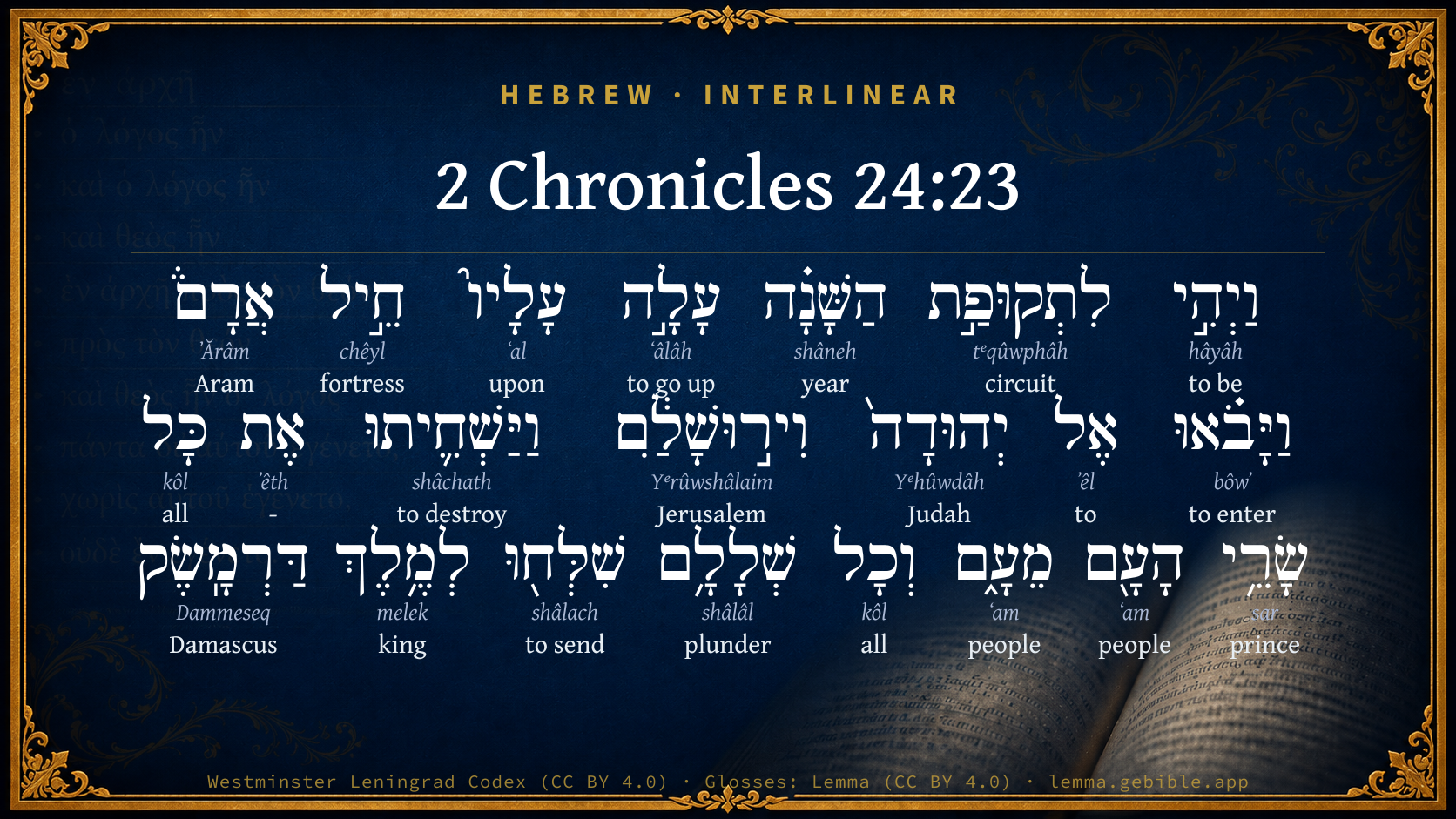
2 Chronicles 24:23

Hebrew (Westminster Leningrad Codex) 2 Chronicles 24:23 appears in the Hebrew Old Testament. The text above is from the Westminster Leningrad Codex. Each word links to its Strong’s number, a concise gloss, and parsing drawn from the Open Scriptures Hebrew Bible morphology. Click any word for its full Brown-Driver-Briggs (BDB) entry.
Download image
Cite this verse

2 Chronicles 24:23 (World English Bible). Public Domain. Lemma interlinear Bible study tool, https://lemma.gebible.app/v/2-chronicles/24/23.

Show BibTeX & RIS
BibTeX
RIS
English Translation
It happened at the end of the year, that the army of the Syrians came up against him: and they came to Judah and Jerusalem, and destroyed all the princes of the people from among the people, and sent all the spoil of them to the king of Damascus.
World English Bible · Public Domain
Download a study sheet

One document with this verse’s original text, its word-by-word gloss line, the meaning frame, cross-references with their text, attributed commentary, and full source and license credits — printable, and it pastes into notes with its structure intact.

This verse Autodidact and up

Study sheet (.html) Plain text (.txt)

A passage Seminary Student

Up to 50 verses in one chapter. A passage sheet keeps up to 6 commentary sources and 12 cross-references per verse, in the order this page ranks them, and says so on the sheet whenever that leaves anything out. Ask for a single verse and you get the Autodidact verse sheet above.

Everything on this page stays free to read, with no account — the sheet is a download of what is already on screen, not access to it.

Want to remove ads? Support Godless Engineer
Compare translations 3

The same verse in 3 English versions, stacked beneath the original-language interlinear above. Click any original word for its lexicon entry.

Each is an independent rendering of the whole verse — the interlinear is not word-aligned to these translations.

Highlighted words mark where these versions differ — a whole-verse word diff, not a word-by-word alignment.

  • World English Bible Public Domain
    It happened at the end of the year, that the army of the Syrians came up against him: and they came to Judah and Jerusalem, and destroyed all the princes of the people from among the people, and sent all the spoil of them to the king of Damascus.
  • King James Version Public Domain
    And it came to pass at the end of the year, that the host of Syria came up against him: and they came to Judah and Jerusalem, and destroyed all the princes of the people from among the people, and sent all the spoil of them unto the king of Damascus.
  • unfoldingWord Literal Text CC BY-SA 4.0
    And it happened at the turn of the year, the army of Aram came up against him, and they came to Judah and Jerusalem. And they destroyed all the chiefs of the people from the people. And all the plunder they sent to the king of Damascus.

unfoldingWord Literal Text — © unfoldingWord, licensed CC BY-SA 4.0. Word-aligned USFM3 via Door43 (git.door43.org/unfoldingWord/en_ult).

Versions to compare (up to 4)

3 of 4 selected

Show all 18 translations

Every available English version of this verse, each an independent rendering of the whole verse.

  • World English Bible Public Domain
    It happened at the end of the year, that the army of the Syrians came up against him: and they came to Judah and Jerusalem, and destroyed all the princes of the people from among the people, and sent all the spoil of them to the king of Damascus.
  • Berean Standard Bible Public Domain
    In the spring, the army of Aram went to war against Joash. They entered Judah and Jerusalem and destroyed all the leaders of the people, and they sent all the plunder to their king in Damascus.
  • Majority Standard Bible Public Domain
    In the spring, the army of Aram went to war against Joash. They entered Judah and Jerusalem and destroyed all the leaders of the people, and they sent all the plunder to their king in Damascus.
  • King James Version Public Domain
    And it came to pass at the end of the year, that the host of Syria came up against him: and they came to Judah and Jerusalem, and destroyed all the princes of the people from among the people, and sent all the spoil of them unto the king of Damascus.
  • American Standard Version (1901) Public Domain
    And it came to pass at the end of the year, that the army of the Syrians came up against him: and they came to Judah and Jerusalem, and destroyed all the princes of the people from among the people, and sent all the spoil of them unto the king of Damascus.
  • Revised Version (1885) Public Domain
    And it came to pass at the end of the year, that the army of the Syrians came up against him: and they came to Judah and Jerusalem, and destroyed all the princes of the people from among the people, and sent all the spoil of them unto the king of Damascus.
  • Geneva Bible (1599) Public Domain
    And when the yeere was out, the host of Aram came vp against him, and they came against Iudah and Ierusalem, and destroyed all the princes of the people from among the people, and sent all the spoyle of them vnto the King of Damascus.
  • Douay-Rheims (1899) Public Domain
    And when a year was come about, the army of Syria came up against him: and they came to Juda and Jerusalem, end killed all the princes of the people, and they sent all the spoils to the king of Damascus.
  • Young's Literal Translation Public Domain
    And it cometh to pass, at the turn of the year, come up hath the force of Aram against him, and they come in unto Judah and Jerusalem, and destroy all the heads of the people from the people, and all their spoil they have sent to the king of Damascus,
  • Literal Standard Version CC BY-SA 4.0
    And it comes to pass, at the turn of the year, the force of Aram has come up against him, and they come to Judah and Jerusalem, and destroy all the heads of the people from the people, and they have sent all their spoil to the king of Damascus,
  • Unlocked Literal Bible CC BY-SA 4.0
    It came about at the end of the year, that the army of Aram came up against Joash. They came to Judah and Jerusalem; they killed all the leaders of the people and sent all the plunder from them to the king of Damascus.
  • unfoldingWord Literal Text CC BY-SA 4.0
    And it happened at the turn of the year, the army of Aram came up against him, and they came to Judah and Jerusalem. And they destroyed all the chiefs of the people from the people. And all the plunder they sent to the king of Damascus.
  • Darby Bible Public Domain
    And it came to pass at the end of the year [that] the army of Syria came up against him; and they entered into Judah and Jerusalem, and destroyed all the princes of the people from among the people, and sent all the spoil of them to the king at Damascus.
  • World Messianic Bible Public Domain
    At the end of the year, the army of the Syrians came up against him. They came to Judah and Jerusalem, and destroyed all the princes of the people from among the people, and sent all their plunder to the king of Damascus.
  • Webster's Bible Public Domain
    And it came to pass at the end of the year, that the army of Syria came up against him: and they came to Judah and Jerusalem, and destroyed all the princes of the people from among the people, and sent all the spoil of them to the king of Damascus.
  • Free Bible Version CC BY-SA 4.0
    At the end of the year, the Aramean army came to attack Joash. They invaded Judah and Jerusalem and killed all the people's leaders, and sent all their plunder back to the king of Damascus.
  • Bible in Basic English Public Domain
    Now in the spring, the army of the Aramaeans came up against him; they came against Judah and Jerusalem, putting to death all the great men of the people and sending all the goods they took from them to the king of Damascus.
  • JPS Tanakh (1917) Public Domain
    And it came to pass, when the year was come about, that the army of the Arameans came up against him; and they came to Judah and Jerusalem, and destroyed all the princes of the people from among the people, and sent all the spoil of them unto the king of Damascus.

Literal Standard Version (2020), Covenant Press — licensed CC BY-SA 4.0. Text via the HelloAO Bible API (eBible.org). Unlocked Literal Bible (unfoldingWord) — licensed CC BY-SA 4.0. Text via the HelloAO Bible API (eBible.org). unfoldingWord Literal Text — © unfoldingWord, licensed CC BY-SA 4.0. Word-aligned USFM3 via Door43 (git.door43.org/unfoldingWord/en_ult). Free Bible Version, Dr. Jonathan Gallagher — licensed CC BY-SA 4.0. Text via the HelloAO Bible API (eBible.org).

Word by word

More ways to search: Search by grammar → Find every occurrence → Compare this word →

Practice this passage: Drill this verse → Learn its vocabulary →

לִתְקוּפַ֣ת
tᵉqûwphâh
H8622
“to/for · circuit of”
Preposition + Noun, Common, Feminine, Singular, Construct
Part of Speech
Preposition + Noun
Type
Common
Gender
Feminine
Number
Singular
State
Construct
Full BDB Definition

Origin: from H5362

TWOT: 2001a

coming round, circuit of time or space, a turning, circuit - at the circuit (as adverb)
  1. וַיְהִ֣י hâyâh H1961 “and · to be” Conjunction + Verb, Qal, Sequential Imperfect, 3rd Person, Masculine, Singular
  2. הַשָּׁנָ֗ה shâneh H8141 “the · year” Particle, Definite Article + Noun, Common, Feminine, Singular, Absolute
  3. עָלָ֣ה ʻâlâh H5927 “to go up” Verb, Qal, Perfect, 3rd Person, Masculine, Singular
  4. עָלָיו֮ ʻal H5921 “upon · him” Preposition + Suffix, Personal, 3rd Person, Masculine, Singular
  5. חֵ֣יל chêyl H2426 “fortress of” Noun, Common, Masculine, Singular, Construct
  6. אֲרָם֒ ʼĂrâm H758 “Aram” Noun, Proper
  7. וַיָּבֹ֗אוּ bôwʼ H935 “and · to enter” Conjunction + Verb, Qal, Sequential Imperfect, 3rd Person, Masculine, Plural
  8. אֶל ʼêl H413 “to” Preposition
  9. יְהוּדָה֙ Yᵉhûwdâh H3063 “Judah” Noun, Proper
  10. וִיר֣וּשָׁלִַ֔ם Yᵉrûwshâlaim H3389 “and · Jerusalem” Conjunction + Noun, Proper
  11. וַיַּשְׁחִ֛יתוּ shâchath H7843 “and · to destroy” Conjunction + Verb, Hiphil, Sequential Imperfect, 3rd Person, Masculine, Plural
  12. אֶת ʼêth H853 “-” Particle, Direct Object
  13. כָּל kôl H3605 “all of” Noun, Common, Masculine, Singular, Construct
  14. שָׂרֵ֥י sar H8269 “princes of” Noun, Common, Masculine, Plural, Construct
  15. הָעָ֖ם ʻam H5971 “the · people” Particle, Definite Article + Noun, Common, Masculine, Singular, Absolute
  16. מֵעָ֑ם ʻam H5971 “from · people” Preposition + Noun, Common, Masculine, Singular, Absolute
  17. וְכָל kôl H3605 “and · all of” Conjunction + Noun, Common, Masculine, Singular, Construct
  18. שְׁלָלָ֥ם shâlâl H7998 “plunder · their” Noun, Common, Masculine, Singular, Construct + Suffix, Personal, 3rd Person, Masculine, Plural
  19. שִׁלְּח֖וּ shâlach H7971 “to send” Verb, Piel, Perfect, 3rd Person, Common, Plural
  20. לְמֶ֥לֶךְ melek H4428 “to/for · king of” Preposition + Noun, Common, Masculine, Singular, Construct
  21. דַּרְמָֽשֶׂק Dammeseq H1834 “Damascus” Noun, Proper

About this verse

These counts appear in no published source. They are computed here, from the morphology-tagged text and Lemma’s own curated glosses. What Lemma adds →

22
words
20
distinct lemmas
Historical
section

Notable vocabulary

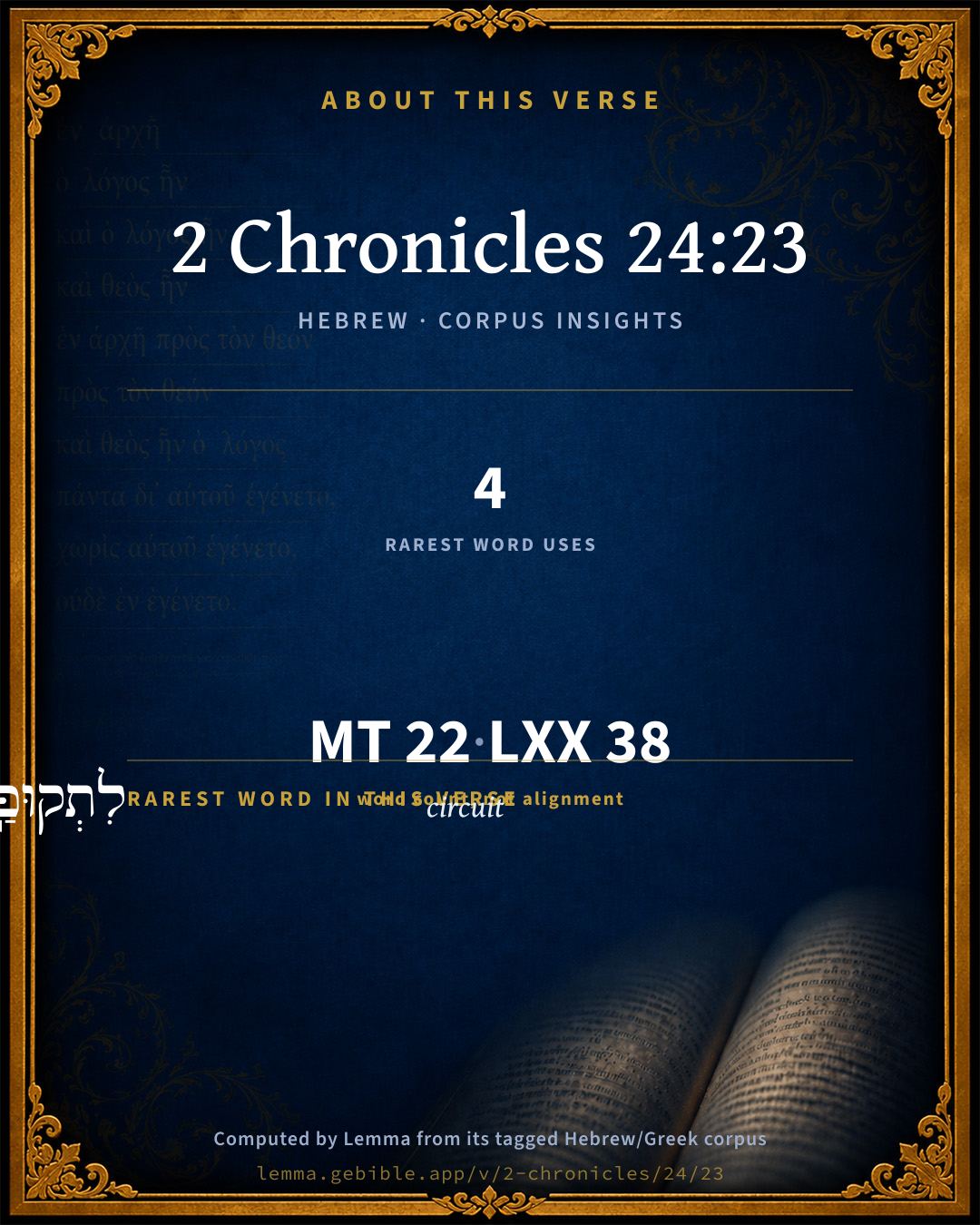
The rarest word here is לִתְקוּפַ֣ת circuit H8622 — appearing just 4 times in the whole Hebrew Bible.

Shared distinctive vocabulary

לִתְקוּפַ֣ת circuit H8622 occurs in 4 verses of the Hebrew Bible. Also found in:

Grammatical profile

  • 5 verbs
  • 14 nouns
  • 2 prepositions
  • 1 particle

Verb forms

  • וַיְהִ֣י Qal · Sequential Imperfect
  • עָלָ֣ה Qal · Perfect
  • וַיָּבֹ֗אוּ Qal · Sequential Imperfect
  • וַיַּשְׁחִ֛יתוּ Hiphil · Sequential Imperfect
  • שִׁלְּח֖וּ Piel · Perfect

Repetition

Words recur within this verse — often emphatic in Hebrew:

  • כָּל all H3605 ×2
  • הָעָ֖ם people H5971 ×2

Hebrew & Septuagint length

In English translation the verse runs 49 words from the Hebrew and 49 from the Septuagint (LXX English) — the same length.

A rough comparison of the two English renderings, which tokenize alike — not a word-level alignment.

Word counts can differ between the Hebrew and the Greek without any difference in meaning — e.g. the Hebrew direct-object marker אֵת has no separate Greek word, and Greek often adds the article ὁ.

In the original languages it is 22 Hebrew tokens and 38 Greek tokens — but the two are counted differently (Hebrew bundles its prefixes and suffixes into one token; the Greek is in lemma form), so that isn’t a like-for-like length.

Cross-references

8

Topical passages linked to 2 Chronicles 24:23 in the Treasury of Scripture Knowledge — connected by theme and wording, ordered by reader-vote popularity; previews shown in the World English Bible.

  • 2 Kings 12:17–18 Then Hazael king of Syria went up, and fought against Gath, and took it; and Hazael set his face to go up to Jerusalem.
  • Deuteronomy 32:35 Vengeance is mine, and recompense, At the time when their foot shall slide: For the day of their calamity is at hand, The things that are to come on them shall make haste.
  • 1 Kings 20:22 The prophet came near to the king of Israel, and said to him, Go, strengthen yourself, and mark, and see what you do; for at the return of the year the king of Syria will come up against you.
  • 1 Kings 20:26 It happened at the return of the year, that Ben Hadad mustered the Syrians, and went up to Aphek, to fight against Israel.
  • 2 Chronicles 24:17–18 Now after the death of Jehoiada came the princes of Judah, and made obeisance to the king. Then the king listened to them.
  • Psalms 2:10–11 Now therefore be wise, you kings. Be instructed, you judges of the earth.
  • Psalms 58:10–11 The righteous shall rejoice when he sees the vengeance. He shall wash his feet in the blood of the wicked;
  • Psalms 82:6–7 I said, "You are gods, All of you are sons of the Most High.

Cross-references courtesy of OpenBible.info (CC BY 4.0).

Hebrew and Greek witnesses Masoretic Hebrew ↔ Greek Septuagint

The same verse in the two great witnesses to the Old Testament, shown verse-for-verse.

These are two independent witnesses, not word-aligned to each other, and the Septuagint is shown in lemma (dictionary) form.

Hebrew 2 Chronicles 24:23 Masoretic · Westminster Leningrad Codex

וַיְהִ֣י לִתְקוּפַ֣ת הַשָּׁנָ֗ה עָלָ֣ה עָלָיו֮ חֵ֣יל אֲרָם֒ וַיָּבֹ֗אוּ אֶל יְהוּדָה֙ וִיר֣וּשָׁלִַ֔ם וַיַּשְׁחִ֛יתוּ אֶת כָּל שָׂרֵ֥י הָעָ֖ם מֵעָ֑ם וְכָל שְׁלָלָ֥ם שִׁלְּח֖וּ לְמֶ֥לֶךְ דַּרְמָֽשֶׂק

It happened at the end of the year, that the army of the Syrians came up against him: and they came to Judah and Jerusalem, and destroyed all the princes of the people from among the people, and sent all the spoil of them to the king of Damascus.

World English Bible · Public Domain

Greek LXX 2 Chronicles 24:23 Septuagint · lemma form

καί γίγνομαι μετά ὁ συντέλεια ὁ ἐνιαυτός ἀναβαίνω ἐπί αὐτός δύναμις συρία καί ἔρχομαι ἐπί ἰούδας καί ἐπί ἰερουσαλήμ καί καταφθείρω πᾶς ὁ ἄρχων ὁ λαός ἐν ὁ λαός καί πᾶς ὁ σκῦλον αὐτός ἀποστέλλω ὁ βασιλεύς δαμάσκος

And it came to pass after the end of the year, that the host of Syria went up against him, and came against Juda and Jerusalem: and they killed all the chiefs of the people among the people, and all their spoils they sent to the king of Damascus.

LXX2012 (modern English Septuagint) · Public Domain

On this verse, Ellicott's Commentary for English Readers discusses the Septuagint’s reading. Read the note in Commentary ↓

Hebrew: Westminster Leningrad Codex (CC BY 4.0). Greek: Septuagint (public domain); English from LXX2012 (modern English Septuagint) (Public Domain). How the Septuagint differs from the Hebrew →

Commentary

Notes on 2 Chronicles 24:23 from classic Christian and Jewish commentators (each source and its license shown beneath its notes). The classic Christian expositions comment on the surrounding passage and are grouped to its opening verse, so a note may address several verses; the Jewish commentaries on the Tanakh (Rashi and others) are per-verse, so they appear only where the commentator wrote on this verse.

Lemma curates 59 commentaries, every one of them public domain or Creative Commons licensed, each selected and text-cleaned for this edition rather than reprinted as found. About our sources →

Jamieson, Fausset & Brown

Robert Jamieson, A. R. Fausset & David Brown

HE IS SLAIN BY HIS SERVANTS. (Ch2 24:23-27)

at the end of the year the host of Syria came up--This invasion took place under the personal conduct of Hazael, whom Joash, to save the miseries of a siege, prevailed on to withdraw his forces by a large present of gold (Kg2 12:18). Most probably, also, he promised the payment of an annual tribute, on the neglect or refusal of which the Syrians returned the following year, and with a mere handful of men inflicted a total and humiliating defeat on the collected force of the Hebrews.

Jamieson, Fausset & Brown — Commentary Critical and Explanatory on the Whole Bible (1871) — public domain (CC PDM 1.0). Text via the HelloAO Bible API.

Ellicott's Commentary for English Readers

THE LORD’S VENGEANCE, viz., THE SYRIAN INVASION AND SLAUGHTER OF THE PRINCES, AND THE MURDER OF JOASH (2Ch_24:23-27). (Comp. 2Ki_12:17-21.)

(23) At the end of the year.—At the running out of the year, viz., the year of the murder of Zechariah. (See for the phrase, Exo_34:22.)

The host of Syria came up against him.—Comp. 2Ki_12:17. Our passage seems to show that a small part (2Ch_24:24) of the besieging army was detached, and sent against Jerusalem. (Comp. 2Ki_18:14; 2Ki_18:17.) The princes of Judah (2Ch_24:17) at the head of a large force met the invaders in the field; but the Syrians routed them, and “destroyed all the princes of the people from among the people.” We may suppose that they made it their special aim to cut off the leaders of the Jewish host. (Comp. 2Ch_18:30.) Thus the apostate princes were overtaken by the prophetic doom. (LXX., “the princes of the people among the people; “Syriac and Vulg. and Arabic omit “from among the people.” But comp. Isa_7:8.)

And sent all the spoil of them.—To Hazael, who was probably still at Gath with the main body of his troops.

A Bible Commentary for English Readers, edited by Charles John Ellicott (1878–1897) — public domain. Text from a community e-Sword module.

Trapp's Complete Commentary

John Trapp

2Ch 24:23 And it came to pass at the end of the year, [that] the host of Syria came up against him: and they came to Judah and Jerusalem, and destroyed all the princes of the people from among the people, and sent all the spoil of them unto the king of Damascus.

Ver. 23. And it came to pass, &c.] Agminatim mala irruunt: now began their misery in answer to Zechariah’s last, whether prayer or prophecy. Sir Con. MacGenis, one of the late Irish rebels, after he had murdered one Mr Trug, a minister, was so haunted with the furies of his own conscience, that he thought his ghost followed him day and night. {a} The like we may very well think of bloody Joash. But besides what he felt within, "the Syrians before and the Philistines behind came upon him with open mouth to devour him; and for all this God’s anger was not turned away, but his hand was stretched out still." {Isa 9:12} {See Trapp on "2Ki 12:17"} {See Trapp on "2Ki 12:18"}

And destroyed all the princes.] Those cursed clawbacks that had marred a good king. {2Ch 24:17} Now it comes home to them, by God’s special direction to the enemy, who executed judgment upon Joash. {2Ch 24:24}

{a} Mr Clark’s Martyrol., 36.

John Trapp, A Commentary or Exposition upon All the Books of the Old and New Testament (1647–1656) — public domain. Text from a community e-Sword module.

Joseph Benson's Commentary

2Ch 24:23. At the end of the year the host of Syria came up — So soon did God hear the cry of his holy prophet’s blood and revenge it. They came and destroyed all the princes — That it might appear they were sent and directed by God, to single out to destruction the first beginners, and chief promoters, of this general apostacy. And sent all the spoil unto the king of Damascus — To Hazael the king of that part of Syria called Syria Damascena, from its capital city Damascus.

Joseph Benson's Commentary on the Old and New Testaments (1811–1818) — public domain. Text from a community e-Sword module.

Tyndale Open Study Notes

Tyndale Open Resources

24:23-26 God could use war to render judgment on Israel just as surely as on any other nation; one of the characteristics of a “holy war” was a small force’s defeat of a much larger army.

Tyndale Open Study Notes — © Tyndale Open Resources, licensed CC BY-SA 4.0. Text via the HelloAO Bible API.

The Cambridge Bible for Schools and Colleges

gen. ed. J. J. S. Perowne

23. at the end of the year] Rather, in the course of a year, i.e. when the same time of year had come round again.

the host of Syria] R.V. the army of the Syrians (as in 2Ch_24:24).

the princes] Who had been leaders in the apostasy (2Ch_24:17).

from among the people] The reading of the Heb. is doubtful; the words should perhaps be expunged.

23, 24 (cp. 2Ki_12:17-18). The Syrian Invasion

In 2 Kin. the invasion is not represented as a judgment on Joash, for no sin is mentioned for which this could be the punishment.

As regards the campaign itself 2 Kin. simply says that the Syrians were bought off with a heavy bribe from attacking Jerusalem; nothing is said of the amount of damage done during the invasion. The Chronicler on the contrary says nothing of the cause of the withdrawal of the Syrians, but simply says that a small force of them inflicted great loss and took much spoil. The two accounts supplement rather than contradict each other.

The Cambridge Bible for Schools and Colleges (gen. ed. J. J. S. Perowne; Cambridge University Press, 1878–1918) — public domain. Text from a community e-Sword module.

John Gill's Exposition

And when they were departed from him,.... Having got what wealth and spoil they could:

for they left him in great diseases; through the wounds they gave him, and the distress they brought him into:

his own servants conspired against him, for the blood of the sons of Jehoiada the priest; for perhaps more than one was slain at the same time; the rest vindicating the cause of their brother, shared the same fate; or the plural is put for the singular:

and slew him on his bed; in the house of Millo, where he lay ill of his wounds, and sick of his diseases, and could not defend himself:

and he died: of the wounds his servants gave him:

and they buried him in the city of David, but they buried him not in the sepulchres of the kings; see Kg2 12:21.

John Gill's Exposition of the Whole Bible (1746–1763) — public domain (CC PDM 1.0). Text via the HelloAO Bible API.

Albert Barnes' Notes on the Bible

On the unusual character of this expedition, see the marginal reference note.

Albert Barnes' Notes on the Bible (1834–1885) — public domain. Text from a community e-Sword/MySword module.

Haydock's Catholic Bible Commentary

Damascus. Hazael had before invaded Jerusalem, 4 K. xii. 17. The Syrian army, which routed Juda, was comparatively small. C. --- The idolatrous princes now received the due punishment of their crimes, v. 17.

George Leo Haydock (1774–1849), Haydock's Catholic Family Bible and Commentary, 1859 edition — public domain. Excludes Psalms (Douay-Rheims chapter numbering differs from Protestant) and Deuterocanonical books (Catholic canon only).

Matthew Poole's English Annotations

At the end of the year; so soon did God hear the cry of his holy prophet’s blood, and revenge it.

Destroyed all the princes of the people; that it might appear they were sent and directed by God to single out to destruction the first beginners and chief promoters of this general apostacy.

Unto the king of Damascus; to Hazael, the king of that part of Syria called Syria Damascena, from its capital city Damascus.

Matthew Poole's English Annotations on the Holy Bible (1683–1685) — public domain. Text from a community e-Sword/MySword module.

The Pulpit Commentary

At the end of the year; Hebrew, tpWqT; margin, both of the Authorized Version and the Revised Version, revolution. The word is found three other times, Exo_34:22; 1Sa_1:20; Psa_19:7. The versions, of course, express correctly what is meant, butprobably the season of spring is also conveyed (2Sa_11:1; 1Ch_20:1) The host of Syria. Their king was Hazael, (2Ki_12:17) whether actually with them is perhaps not certain, but the last clause in the verse just quoted would seem to convey that impression. He was King of Damascus (Aram, or Syria), and having already temporarily mastered Israel, (2Ki_13:3, 2Ki_13:4, 2Ki_13:22) the way was paved to Gath, (2Ch_11:8 2Ch_17:11) whence wistful eyes were bent on Jerusalem, nearly thirty miles distant thence. Destroyed all the princes of the people; i.e. as in the next verse. And sent all the spoil. Whether intended so here or not, probably the strict subject of the verb in this clause is Joash and his counsellors (ver. 18 in parallel), in their fright and just fright helpless after the slaughter chronicled in our following verse, bribing off Hazael and his host, as in parallel. The suggestion is most plausible that tidings of Zechariah"s martyrdom and of the occasion of it were the very incentive to Hazael"s incursion, and an illustration of the "means" by which God works, and by which he wrought his purpose in this instance. The spoil of them. If this means only the spoil of the defeated army strictly, then our text gives no trace of the contents of ver. 18 in parallel just alluded to; but the frequent dislocation incident to copied extracts and matter borrowed from original sources, and so often evidenced in the present history, when we have been comparing the two derived accounts to which we are indebted for it, incline us to the above view, as one quite open at any rate to possibility.

Vers. 23-27.

Divine retributions; or, the predictions and prayers of a dying mar, coming true.

I JUDAH INVADED BY THE SYRIANS. (Ver. 23.) Zechariah had predicted that prosperity should no longer attend Judah in consequence of her apostasy from Jehovah (ver. 20); and, before breathing his last, had prayed, and so practically predicted, (Jam_5:16) that Jehovah would avenge his murder upon the king, his princes, and people (ver. 22). That this incursion of Hazael, (1Ki_19:15) who had first assassinated Benhadad II and seized upon the throne, (2Ki_8:7-15) and whose historicity is guaranteed by an inscription on Shalmaneser"s black obelisk, which says, "In my eighteenth year, for the sixteenth time the Euphrates I crossed. Hazael of Damascus to battle came In my twenty-first campaign, to the cities of Hazael of Damascus I went. Four of his fortresses I took" ("Records," etc., 5:34, 35; Schrader, "Keilinschriften," p. 206) that this incursion of the Syrian monarch into Judaean territory, as far even as to Jerusalem, was an instalment of the wrath which the nation"s apostasy had stirred up against itself, several things convinced the Chronicler.

1. The time when it happened. "At the end," or revolution, "of the year." No doubt Divine judgment often tarries, and when it does inert are apt to question its existence. (Ps 1) But sometimes it hastens on the heels of crime, as it did in the cases of Cain, (Gen_4:8, Gen_4:9) Pharaoh, (Exo_14:27) Israel in Shittim (Num_25:4) the murderers of Ishbosheth, (2Sa_4:12) (1Ki_22:34-37) Haman, (Est_7:10) Judas (Acts, (Mat_27:5) and others; and their observers instinctively exclaim, "Verily there is a God that judgeth in the earth". (Psa_58:11)

2. The success it attained.

(1) The Syrian army, having probably conquered Israel, succeeded in capturing Gath, one of the five cities of the Philistines, (Jos_13:3) which David annexed to Judah, (1Ch_18:1) and which may still have belonged to the kingdom of Jonah.

(2) Next it moved upon Jerusalem, which was not far distant, and defeated the Judaean troops in a pitched battle, in which all the princes of Judah were cut off, and Joash himself seriously wounded.

(3) As an inducement to make peace and withdraw his forces from the capital, Hazael obtained from Joash "all the hallowed things that Jehoshaphat, and Jehoram, and Ahaziah his fathers, kings of Judah, had dedicated," which had been recovered from the temple of Baal (ver. 7), "and his own hallowed things, and all the gold that was found in the treasures of the house of the Lord and in the king"s house". (2Ki_12:18)

(4) That which specially revealed the hand of God in this disaster was not so much the extent as the incidence of it. The blow descended, indeed, upon the common people, who are chief sufferers in most wars; but in this instance a striking fitness was visible in the cutting off of the princes who had instigated the sovereign and his subjects to idolatry, and in the despoliation of the temple, which they had desecrated by their idolatries.

3. The weapon it employed. A small army, which had routed Judah"s large host. This was reversing the experience of Judah, as, e.g., when Asa with five hundred and eighty thousand soldiers defeated Zerah with a million of infantry and three hundred charioteers. (2Ch_14:10) As Asa"s victory was due to Jehovah"s help, so Joash"s surrender was explicable only on the supposition that Jehovah had forsaken him and Hazael been commissioned to execute wrath upon him.

II JOASH SLAIN BY CONSPIRATORS. (Ver. 25.)

1. When? "After the Syrians had departed from him." Though he had escaped the doom which sought him on the battlefield, it seemed as if justice would not suffer him to live. (cf. Act_28:4) Scarcely had the Syrians departed than the sleuth-houn1d of retribution was again upon his trail. Only wounded by soldiers" spears, he was slaughtered by assassins" swords.

2. Where? In his castle-palace at Mille, (2Ki_12:20) and on his bed, i.e. while invalided by his wounds. Death found him in a fortress, behind which he doubtless expected to be secure, and at a moment when, perhaps, that expectation was high through the healing of his wounds.

1. By whom? His own servants, whose names are given: "Zabad or Jozakat, Kings the son of Shimeath an Ammonitess, and Jehozabad the son of Shimrith a Moabitess." Led astray by those who should have been his servants, the princes, he was put to death by his actual servants. He had betrayed his country to foreign gods, by men of foreign extraction he was destroyed. Divine retributions frequently correspond to the character of the offence they punish.

2. Why? Because of the "blood of the son of Jehoiada the priest." They meant to reward him for his truculent deed against Zechariah. How they came to champion the cause of Jehoiada"s murdered son is not said. Perhaps they shared the popular feeling, which trod never wholly approved of the murder; and when they witnessed the disaster which had come upon their arms, with the judgment that had fallen on the princes, they concluded that Zechariah"s blood must be avenged if prosperity was again to return to Judah; and believing they would find, in the public mind, approval for their action, they despatched the wounded man upon his bed at Mille. Their calculations concerning the verdict of the people were not astray. Nobody regretted Joash"s untimely end. His subjects "buried him in the city of David," where his fathers lay entombed, but they suffered not his carcase to desecrate the mausoleum of the kings.

Learn:

1. The overruling providence of God. Things come to pass at his ordering.

2. The certainty that sin will be punished. Though judgment be delayed, itis not averted. W.

The Pulpit Commentary (1880–1919), ed. H.D.M. Spence-Jones & Joseph S. Exell — public domain. Text from a community e-Sword module.

John Wesley's Explanatory Notes

The year - So soon did God hear the cry of his holy prophet's blood, and revenge it. The princes - That it might appear they were sent and directed by God to single out to destruction the first beginners of this general apostacy.

John Wesley, Explanatory Notes Upon the Whole Bible (1754–1765) — public domain. Text via the GEBible commentary corpus.

unfoldingWord translationNotes

Door43 World Missions Community

It came about

This phrase is used here to mark the beginning of a new part of the story. If your language has a way for doing this, you could consider using it here.

sent all the plunder from them

"sent all the plunder from Judah and Jerusalem"

victory over a very great army

"victory over the much larger army of Judah"

In this way the Arameans brought judgment on Joash

This refers to God's judgment. This can be stated as an action. AT: "In this way God used the Arameans to judge Joash" (See: Abstract Nouns and Assumed Knowledge and Implicit Information)

translationWords

Aram

Judah

Jerusalem

Damascus

judge

unfoldingWord translationNotes — © Distant Shores Media and the Door43 World Missions Community, licensed CC BY-SA 4.0. Source: git.door43.org/Door43/en_tn.

Rashi

Rabbi Shlomo Yitzchaki (Rashi)

And it came to pass at the turn of the year Because the sons of Judah sinned more than the other tribes, as it is written above (verse 18): “And they forsook the House of the Lord, the God of their fathers.”

and they destroyed all the princes of the people This refers back to the above (verse 17): “And after the death of Jehoiada, the princes of Judah came and prostrated themselves to the king,” and caused Joash to sin after them. Because of that, they were paid in kind: the army of Aram came and destroyed all the princes of the people.

from among the people from being a people.

Rashi on the Tanakh — English translations: “The Judaica Press complete Tanach with Rashi, translated by A. J. Rosenberg” (CC BY 4.0); “Pentateuch with Rashi's commentary by M. Rosenbaum and A.M. Silbermann, 1929-1934” (public domain); “The Metsudah Tanach series, Lakewood, N.J” (CC BY 4.0); and “The Book of Joshua, Metsudah Publications, 1997” (CC BY 4.0). Text via Sefaria.

Lesson kit

Teaching starters — assembled from the data on this page, not authored interpretation. Every prompt links to the verse data it draws on. Edit before teaching.

2 Chronicles, in the Historical, opens this verse with 22 words (20 distinct Hebrew lemmas). Its most distinctive word is tᵉqûwphâh (“circuit”). A historical commentator’s framing appears above. Read the whole chapter for the surrounding context.

Discussion questions

  1. What does “circuit” (tᵉqûwphâh) contribute to the verse as a whole?
  2. How does Exodus 34:22, which shares the word «circuit», read alongside this verse?
  3. What does the repetition of “all” (2× in this one verse) do in this verse?
  4. These translations render this verse differently. What is at stake in choosing one wording over another?
  5. «וַיְהִ֣י» is a Qal Sequential Imperfect verb. How does that grammatical form shape the action described?
  6. Compare how Jamieson, Fausset & Brown and Ellicott's Commentary for English Readers read this verse. Where do they agree or differ?

Things to notice

Reading settings

Reading text

Shown beneath each verse's original-language words.

Old Testament
Old Testament edition

Read the OT as the Masoretic Hebrew (MT) or the Greek Septuagint (LXX).

English shown for the Greek Septuagint (in the Hebrew ↔ Greek comparison).

Comparing translations? Open the Compare panel on any verse page to stack up to four side by side.