
Ecclesiastes 4:16

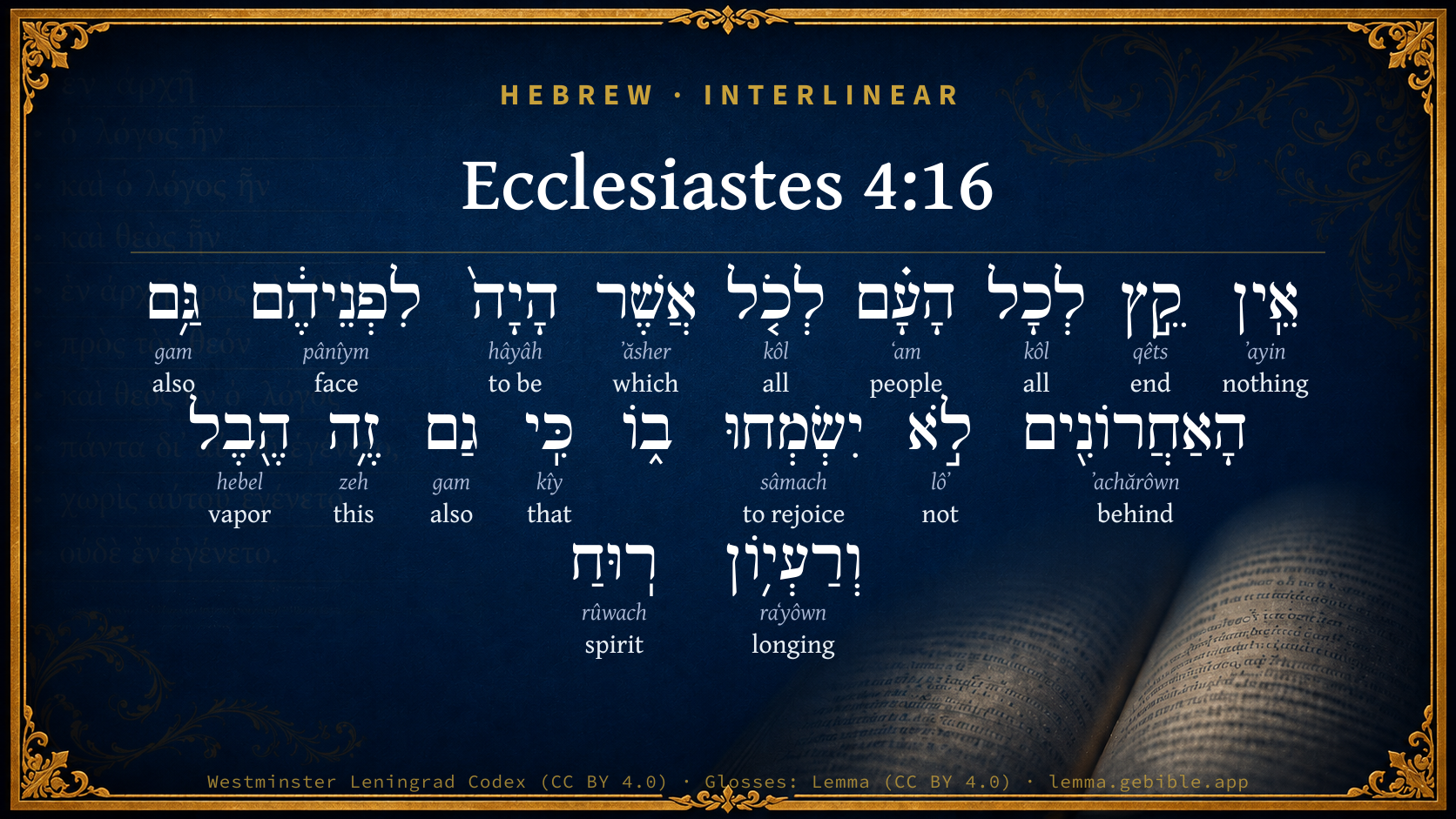
Hebrew (Westminster Leningrad Codex) Ecclesiastes 4:16 appears in the Hebrew Old Testament. The text above is from the Westminster Leningrad Codex. Each word links to its Strong’s number, a concise gloss, and parsing drawn from the Open Scriptures Hebrew Bible morphology. Click any word for its full Brown-Driver-Briggs (BDB) entry.
Download image
Cite this verse

Ecclesiastes 4:16 (World English Bible). Public Domain. Lemma interlinear Bible study tool, https://lemma.gebible.app/v/ecclesiastes/4/16.

Show BibTeX & RIS
BibTeX
RIS
English Translation
There was no end of all the people, even of all them over whom he was--yet those who come after shall not rejoice in him. Surely this also is vanity and a chasing after wind.
World English Bible · Public Domain
Download a study sheet

One document with this verse’s original text, its word-by-word gloss line, the meaning frame, cross-references with their text, attributed commentary, and full source and license credits — printable, and it pastes into notes with its structure intact.

This verse Autodidact and up

Study sheet (.html) Plain text (.txt)

A passage Seminary Student

Up to 50 verses in one chapter. A passage sheet keeps up to 6 commentary sources and 12 cross-references per verse, in the order this page ranks them, and says so on the sheet whenever that leaves anything out. Ask for a single verse and you get the Autodidact verse sheet above.

Everything on this page stays free to read, with no account — the sheet is a download of what is already on screen, not access to it.

Want to remove ads? Support Godless Engineer
Compare translations 3

The same verse in 3 English versions, stacked beneath the original-language interlinear above. Click any original word for its lexicon entry.

Each is an independent rendering of the whole verse — the interlinear is not word-aligned to these translations.

Highlighted words mark where these versions differ — a whole-verse word diff, not a word-by-word alignment.

  • World English Bible Public Domain
    There was no end of all the people, even of all them over whom he was--yet those who come after shall not rejoice in him. Surely this also is vanity and a chasing after wind.
  • King James Version Public Domain
    There is no end of all the people, even of all that have been before them: they also that come after shall not rejoice in him. Surely this also is vanity and vexation of spirit.
  • unfoldingWord Literal Text CC BY-SA 4.0
    There no end to all the people, to all who were to their faces. Even the latter will not rejoice in him, because even this vapor and pursuit of wind.

unfoldingWord Literal Text — © unfoldingWord, licensed CC BY-SA 4.0. Word-aligned USFM3 via Door43 (git.door43.org/unfoldingWord/en_ult).

Versions to compare (up to 4)

3 of 4 selected

Show all 18 translations

Every available English version of this verse, each an independent rendering of the whole verse.

  • World English Bible Public Domain
    There was no end of all the people, even of all them over whom he was--yet those who come after shall not rejoice in him. Surely this also is vanity and a chasing after wind.
  • Berean Standard Bible Public Domain
    There is no limit to all the people who were before them. Yet the successor will not be celebrated by those who come even later. This too is futile and a pursuit of the wind.
  • Majority Standard Bible Public Domain
    There is no limit to all the people who were before them. Yet the successor will not be celebrated by those who come even later. This too is futile and a pursuit of the wind.
  • King James Version Public Domain
    There is no end of all the people, even of all that have been before them: they also that come after shall not rejoice in him. Surely this also is vanity and vexation of spirit.
  • American Standard Version (1901) Public Domain
    There was no end of all the people, even of all them over whom he was: yet they that come after shall not rejoice in him. Surely this also is vanity and a striving after wind.
  • Revised Version (1885) Public Domain
    There was no end of all the people, even of all them over whom he was: yet they that come after shall not rejoice in him. Surely this also is vanity and a striving after wind.
  • Geneva Bible (1599) Public Domain
    There is none ende of all the people, nor of all that were before them, and they that come after, shall not reioyce in him: surely this is also vanitie and vexation of spirit.
  • Douay-Rheims (1899) Public Domain
    The number of the people, of all that were before him is infinite: and they that shall come afterwards, shall not rejoice in him: but this also is vanity, and vexation of spirit.
  • Young's Literal Translation Public Domain
    there is no end to all the people, to all who were before them; also, the latter rejoice not in him. Surely this also is vanity and vexation of spirit.
  • Literal Standard Version CC BY-SA 4.0
    there is no end to all the people, to all who were before them; also, the latter do not rejoice in him. Surely this also is vanity and distress of spirit.
  • Unlocked Literal Bible CC BY-SA 4.0
    There is no end to all the people who want to obey the new king, but later many of them will no longer praise him. Surely this situation is vapor and an attempt to shepherd the wind.
  • unfoldingWord Literal Text CC BY-SA 4.0
    There no end to all the people, to all who were to their faces. Even the latter will not rejoice in him, because even this vapor and pursuit of wind.
  • Darby Bible Public Domain
    [There is] no end of all the people, of all that stood before them; those however that come after shall not rejoice in him. Surely this also is vanity and a striving after the wind.
  • World Messianic Bible Public Domain
    There was no end of all the people, even of all them over whom he was—yet those who come after shall not rejoice in him. Surely this also is vanity and a chasing after wind.
  • Webster's Bible Public Domain
    There is no end of all the people, even of all that have been before them: they also that come after shall not rejoice in him. Surely this also is vanity and vexation of spirit.
  • Free Bible Version CC BY-SA 4.0
    He is surrounded by crowds of supporters, but the next generation isn't happy with him. This also illustrates the passing nature of life whose meaning is elusive, like pursuing the wind for understanding.
  • Bible in Basic English Public Domain
    There was no end of all the people, of all those whose head he was, but they who come later will have no delight in him. This again is to no purpose and desire for wind.
  • JPS Tanakh (1917) Public Domain
    There was no end of all the people, even of all them whom he did lead; yet they that come after shall not rejoice in him. Surely this also is vanity and a striving after wind.

Literal Standard Version (2020), Covenant Press — licensed CC BY-SA 4.0. Text via the HelloAO Bible API (eBible.org). Unlocked Literal Bible (unfoldingWord) — licensed CC BY-SA 4.0. Text via the HelloAO Bible API (eBible.org). unfoldingWord Literal Text — © unfoldingWord, licensed CC BY-SA 4.0. Word-aligned USFM3 via Door43 (git.door43.org/unfoldingWord/en_ult). Free Bible Version, Dr. Jonathan Gallagher — licensed CC BY-SA 4.0. Text via the HelloAO Bible API (eBible.org).

Word by word

More ways to search: Search by grammar → Find every occurrence → Compare this word →

Practice this passage: Drill this verse → Learn its vocabulary →

וְרַעְי֥וֹן
raʻyôwn
H7475
“and · longing of”
Conjunction + Noun, Common, Masculine, Singular, Construct
Part of Speech
Conjunction + Noun
Type
Common
Gender
Masculine
Number
Singular
State
Construct
Full BDB Definition

Origin: from H7462 in the sense of H7469

TWOT: 2187c

longing, striving
  1. אֵֽין ʼayin H369 “nothing” Particle, Negative
  2. קֵ֣ץ qêts H7093 “end” Noun, Common, Masculine, Singular, Absolute
  3. לְכָל kôl H3605 “to/for · all of” Preposition + Noun, Common, Masculine, Singular, Construct
  4. הָעָ֗ם ʻam H5971 “the · people” Particle, Definite Article + Noun, Common, Masculine, Singular, Absolute
  5. לְכֹ֤ל kôl H3605 “to/for · all” Preposition + Noun, Common, Masculine, Singular, Absolute
  6. אֲשֶׁר ʼăsher H834 “which” Particle, Relative
  7. הָיָה֙ hâyâh H1961 “to be” Verb, Qal, Perfect, 3rd Person, Masculine, Singular
  8. לִפְנֵיהֶ֔ם pânîym H6440 “to/for · face(s) · their” Preposition + Noun, Common, Both, Plural, Construct + Suffix, Personal, 3rd Person, Masculine, Plural
  9. גַּ֥ם gam H1571 “also” Particle, Accusative
  10. הָאַחֲרוֹנִ֖ים ʼachărôwn H314 “the · behind” Particle, Definite Article + Adjective, Adjective, Masculine, Plural, Absolute
  11. לֹ֣א lôʼ H3808 “not” Particle, Negative
  12. יִשְׂמְחוּ sâmach H8055 “to rejoice” Verb, Qal, Imperfect, 3rd Person, Masculine, Plural
  13. כִּֽי kîy H3588 “that” Conjunction
  14. גַם gam H1571 “also” Adverb
  15. זֶ֥ה zeh H2088 “this” Pronoun, Demonstrative, Masculine, Singular
  16. הֶ֖בֶל hebel H1892 “vapor” Noun, Common, Masculine, Singular, Absolute
  17. רֽוּחַ rûwach H7307 “spirit” Noun, Common, Both, Singular, Absolute

About this verse

These counts appear in no published source. They are computed here, from the morphology-tagged text and Lemma’s own curated glosses. What Lemma adds →

19
words
16
distinct lemmas
Wisdom
section

Notable vocabulary

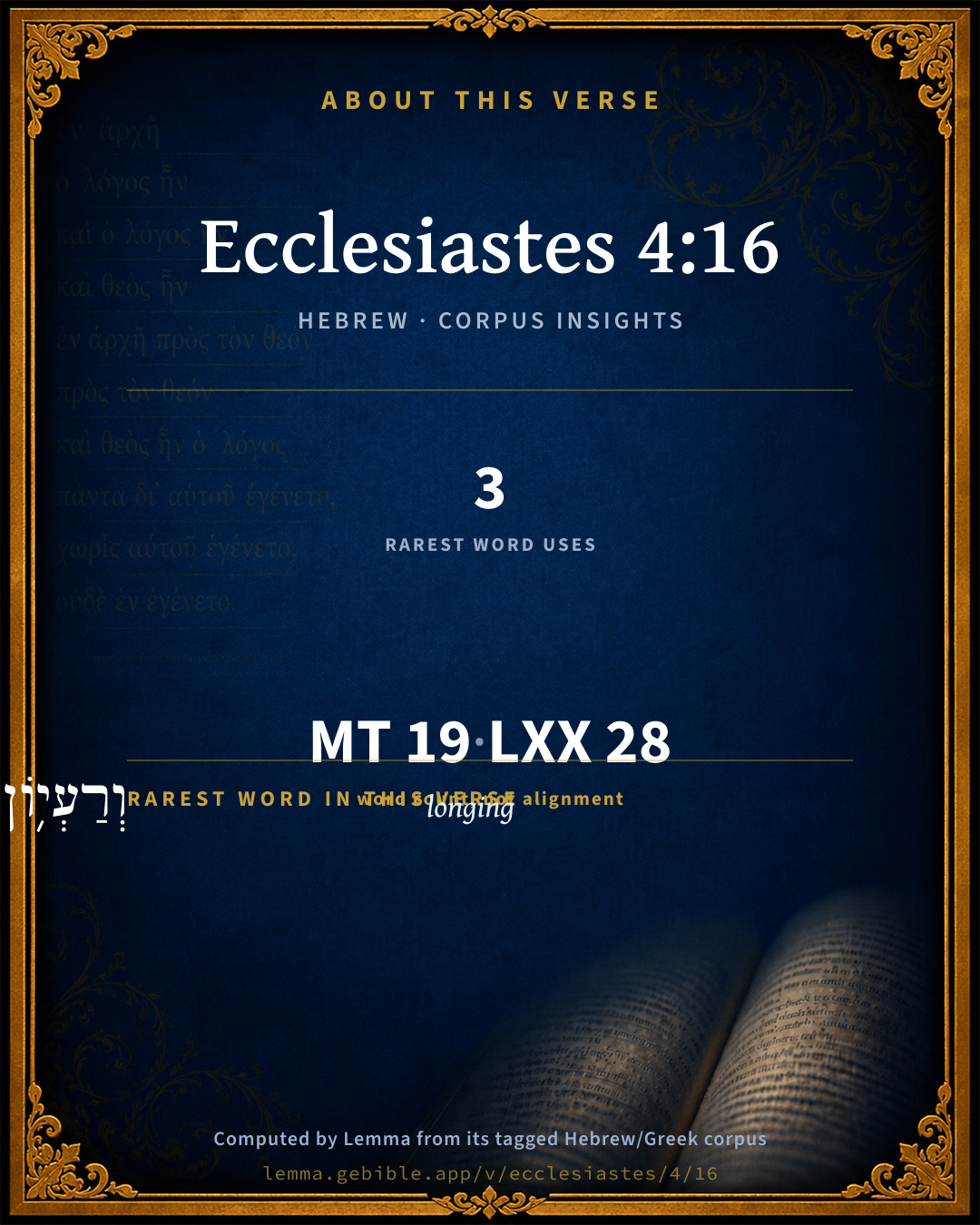
The rarest word here is וְרַעְי֥וֹן longing H7475 — appearing just 3 times in the whole Hebrew Bible.

Shared distinctive vocabulary

וְרַעְי֥וֹן longing H7475 occurs in 3 verses of the Hebrew Bible. Also found in:

Grammatical profile

  • 2 verbs
  • 8 nouns
  • 1 adjective
  • 1 pronoun
  • 1 preposition
  • 1 conjunction
  • 1 adverb
  • 4 particles

Verb forms

  • הָיָה֙ Qal · Perfect
  • יִשְׂמְחוּ Qal · Imperfect

Repetition

Words recur within this verse — often emphatic in Hebrew:

  • לְכָל all H3605 ×2
  • גַּ֥ם also H1571 ×2

Hebrew & Septuagint length

In English translation the verse runs 35 words from the Hebrew and 31 from the Septuagint (LXX English) — closely comparable.

A rough comparison of the two English renderings, which tokenize alike — not a word-level alignment.

Word counts can differ between the Hebrew and the Greek without any difference in meaning — e.g. the Hebrew direct-object marker אֵת has no separate Greek word, and Greek often adds the article ὁ.

In the original languages it is 19 Hebrew tokens and 28 Greek tokens — but the two are counted differently (Hebrew bundles its prefixes and suffixes into one token; the Greek is in lemma form), so that isn’t a like-for-like length.

Cross-references

11

Topical passages linked to Ecclesiastes 4:16 in the Treasury of Scripture Knowledge — connected by theme and wording, ordered by reader-vote popularity; previews shown in the World English Bible.

  • Ecclesiastes 1:14 I have seen all the works that are done under the sun; and, behold, all is vanity and a chasing after wind.
  • 1 Kings 1:40 All the people came up after him, and the people piped with pipes, and rejoiced with great joy, so that the earth shook with the sound of them.
  • Ecclesiastes 2:17 So I hated life, because the work that is worked under the sun was grievous to me; for all is vanity and a chasing after wind.
  • Judges 9:19–20 if you then have dealt truly and righteously with Jerubbaal and with his house this day, then rejoice you in Abimelech, and let him also rejoice in you:
  • 2 Samuel 15:12–13 Absalom sent for Ahithophel the Gilonite, David's counselor, from his city, even from Giloh, while he was offering the sacrifices. The conspiracy was strong; for the people increased continually with Absalom.
  • 2 Samuel 18:7–8 The people of Israel were struck there before the servants of David, and there was a great slaughter there that day of twenty thousand men.
  • 2 Samuel 19:9 All the people were at strife throughout all the tribes of Israel, saying, The king delivered us out of the hand of our enemies, and he saved us out of the hand of the Philistines; and now he is fled out of the land from Absalom.
  • 1 Kings 1:5–7 Then Adonijah the son of Haggith exalted himself, saying, I will be king: and he prepared him chariots and horsemen, and fifty men to run before him.
  • 1 Kings 12:10–16 The young men who had grown up with him spoke to him, saying, Thus shall you tell this people who spoke to you, saying, Your father made our yoke heavy, but make you it lighter to us; thus shall you speak to them, My little finger is thicker than my father's loins.
  • Ecclesiastes 2:11 Then I looked at all the works that my hands had worked, and at the labor that I had labored to do; and, behold, all was vanity and a chasing after wind, and there was no profit under the sun.
  • Ecclesiastes 2:26 For to the man who pleases him, God gives wisdom, knowledge, and joy; but to the sinner he gives travail, to gather and to heap up, that he may give to him who pleases God. This also is vanity and a chasing after wind.

Cross-references courtesy of OpenBible.info (CC BY 4.0).

Hebrew and Greek witnesses Masoretic Hebrew ↔ Greek Septuagint

The same verse in the two great witnesses to the Old Testament, shown verse-for-verse.

These are two independent witnesses, not word-aligned to each other, and the Septuagint is shown in lemma (dictionary) form.

Hebrew Ecclesiastes 4:16 Masoretic · Westminster Leningrad Codex

אֵֽין קֵ֣ץ לְכָל הָעָ֗ם לְכֹ֤ל אֲשֶׁר הָיָה֙ לִפְנֵיהֶ֔ם גַּ֥ם הָאַחֲרוֹנִ֖ים לֹ֣א יִשְׂמְחוּ ב֑וֹ כִּֽי גַם זֶ֥ה הֶ֖בֶל וְרַעְי֥וֹן רֽוּחַ

There was no end of all the people, even of all them over whom he was--yet those who come after shall not rejoice in him. Surely this also is vanity and a chasing after wind.

World English Bible · Public Domain

Greek LXX Ecclesiastes 4:16 Septuagint · lemma form

οὐ εἰμί περασμός ὁ πᾶς λαός ὁ πᾶς ὅσος γίγνομαι ἔμπροσθεν αὐτός καί γέ ὁ ἔσχατος οὐ εὐφραίνω ἐν αὐτός ὅτι καί γέ οὗτος ματαιότης καί προαίρεσις πνεῦμα

There is no end to all the people, to all who were before them: and the last shall not rejoice in him: for this also is vanity and waywardness of spirit.

LXX2012 (modern English Septuagint) · Public Domain

Hebrew: Westminster Leningrad Codex (CC BY 4.0). Greek: Septuagint (public domain); English from LXX2012 (modern English Septuagint) (Public Domain). How the Septuagint differs from the Hebrew →

Commentary

Notes on Ecclesiastes 4:16 from classic Christian and Jewish commentators (each source and its license shown beneath its notes). The classic Christian expositions comment on the surrounding passage and are grouped to its opening verse, so a note may address several verses; the Jewish commentaries on the Tanakh (Rashi and others) are per-verse, so they appear only where the commentator wrote on this verse.

Lemma curates 59 commentaries, every one of them public domain or Creative Commons licensed, each selected and text-cleaned for this edition rather than reprinted as found. About our sources →

Trapp's Complete Commentary

John Trapp

Ecc 4:16 [There is] no end of all the people, [even] of all that have been before them: they also that come after shall not rejoice in him. Surely this also [is] vanity and vexation of spirit.

Ver. 16. There is no end of all the people,] i.e., They are infinitely discontented and restless in their desires after a new and another governor. Aει γαρ το παρον βαρυ, as Thucydides long since observed, The present government, be it never so good, is always grievous. "O that I were made judge in the land," said Absalom. {2Sa 15:4} Oh that thou wert, said the people, who yet soon had enough of him. And so had they of their new king, Saul, whom contra gentes, they would needlessly have, after the manner of all other nations. {1Sa 8:6-7} How soon did the Baptist grow stale to the Jews, that had lately "heard him gladly," {Mar 6:20} and was no more set by than "a reed shaken with the wind!" {Mat 11:7} How suddenly did they change their note concerning Christ from "Hosanna" to Crucify him! The common people are like to children, saith an interpreter, that rest not contented with any schoolmaster, and like to servants that love to change every year their masters. People are desirous to hear new preachers, as feasters to hear new songs and new instruments. {Eze 33:32}

John Trapp, A Commentary or Exposition upon All the Books of the Old and New Testament (1647–1656) — public domain. Text from a community e-Sword module.

Joseph Benson's Commentary

Ecc 4:16. There is no end of the people — The sense seems to be, either, 1st, The people who have this humour are without end, or innumerable: or, 2d, This humour of the common people hath no end, but passes from one generation to another: they ever were, and are, and will be, unstable and restless, and given to change: which sense the following words favour: Even of all that have been before them — Before the present generation of subjects, who earnestly desired and promoted the change of government here expressed. And so, here are three generations of people mentioned; the authors of the present change, and their parents, and their children; and all are observed to have the same inclinations in these matters. They also that come after shall not rejoice in him — They shall be as weary of the successor, though a wise and worthy prince, as their parents were of his foolish predecessor. Surely, this also is vanity — From all this it appears, that happiness is not to be found in honour and power; no, not in the very highest pitch of it: for there also is not only dissatisfaction to be found, but many dangers, troubles, and vexatious cares, which much disturb and perplex the minds of those that possess it. See Bishop Patrick.

Joseph Benson's Commentary on the Old and New Testaments (1811–1818) — public domain. Text from a community e-Sword module.

Geneva Bible (1599)

Geneva Bible translators

They never cease by all means to creep into favor, but when they obtain not, their greedy desires, they think themselves abused, as others have been in time past, and so care no more for him.

Geneva Bible (1599) marginal notes — public domain. Text via Bolls.life.

Jamieson, Fausset & Brown

Robert Jamieson, A. R. Fausset & David Brown

Notwithstanding their now worshipping the rising sun, the heir-apparent, I reflected that "there were no bounds, no stability (Sa2 15:6; Sa2 20:1), no check on the love of innovation, of all that have been before them," that is, the past generation; so

also they that come after--that is, the next generation,

shall not rejoice in him--namely, Rehoboam. The parallel, "shall not rejoice," fixes the sense of "no bounds," no permanent adherence, though now men rejoice in him.

Next: Ecclesiastes Chapter 5

Jamieson, Fausset & Brown — Commentary Critical and Explanatory on the Whole Bible (1871) — public domain (CC PDM 1.0). Text via the HelloAO Bible API.

Adam Clarke's Commentary

Verse 16. There is no end of all the people] This is supposed to refer to the multitudes of people who hail the advent and accession of a new sovereign; for, as Suetonius remarks, A plerisque adorari solem orientem, "Most people adore the rising sun." But when the new king becomes old, very few regard him; and perhaps he lives long enough to be as much despised by the very persons who before were ready to worship him. This is also a miserable vanity. Thus the blooming heir -

"Shall feel the sad reverse: honoured awhile;

Then, like his sire, contemn'd, abhorr'd, forgot."

C.

Adam Clarke's Commentary on the Bible (1810–1826) — public domain. Text from a community e-Sword/MySword module.

The Cambridge Bible for Schools and Colleges

gen. ed. J. J. S. Perowne

16. There is no end of all the people] The words continue the picture of the crowds who follow the young king.

even of all that have been before them] The last words are not of time but position. The people are before their king, or rather, he is before them all, going in and out before them (1Sa_18:16; 2Ch_1:10), ruling and guiding. The reference of the words to the Messianic child of Isa_7:14; Isa_9:6, falls under the same category as the interpretation which finds the doctrine of the Trinity in the “threefold cord” of Ecc_4:12. It is true of both that they may be devout applications of the words, but are in no sense explanatory of their meaning.

they also that come after] This is added as the crowning stroke of the irony of history. The reign which begins so brightly shares the inevitable doom, and ends in darkness, and murmuring and failure. “Il n’y a pas d’homme necessaire,” and the popular hero of the hour finds himself slighted even in life, and is forgotten by the next generation. The glory of the most popular and successful king shares the common doom and is but as a feeding upon wind. Here again the statement is so wide in its generalization that it is not easy to fix on any historical identification. David, Solomon himself, Jeroboam, Cyrus, Antiochus the Great, Herod have been suggested by the ingenuity of commentators.

The Cambridge Bible for Schools and Colleges (gen. ed. J. J. S. Perowne; Cambridge University Press, 1878–1918) — public domain. Text from a community e-Sword module.

John Gill's Exposition

There is no end of all the people, even of all that have been before them,.... Before the present generation, the living that walked under the sun; a vast number they were that lived before them, and they were of the same restless temper and disposition; changeable in their affection and behaviour towards their governors; no end of their number, nor any stable affection for, nor settled satisfaction in, their rulers; but this itch of novelty, of having new princes over them, went from age to age, from generation to generation. Some understand this of the king and his son, the predecessor and successor, and of those that went before them; and of their behaviour to the kings that reigned before them; the people have not their end or satisfaction in their governors, but are restless: which comes to the same sense;

they also that come after shall not rejoice in him; that come after the present generation, and after both the reigning prince, and even after his successor; they will not rejoice long in him that shall be upon the throne after them, any more than the present subjects of the old king, or those that now pay their court to the heir apparent; they will be so far from rejoicing in him, that they will loath and despise him, and wish him dead or dethroned, and another in his room.

Surely this also is vanity and vexation of spirit; to a king, to see himself thus used by his subjects; for a short time extolled and praised, and then despised and forsaken.

Next: Ecclesiastes Chapter 5

John Gill's Exposition of the Whole Bible (1746–1763) — public domain (CC PDM 1.0). Text via the HelloAO Bible API.

Haydock's Catholic Bible Commentary

In him. Many are perfectly unacquainted with the king, who finds so many admirers about his person, and even of these the greatest part begin to be presently disgusted, and wish for another change.

George Leo Haydock (1774–1849), Haydock's Catholic Family Bible and Commentary, 1859 edition — public domain. Excludes Psalms (Douay-Rheims chapter numbering differs from Protestant) and Deuterocanonical books (Catholic canon only).

Matthew Poole's English Annotations

There is no end of all the people: the sense is either,

1. The people which have this humour are without end, or innumerable, as this phrase signifies, Job 22:5; Isa 2:7; 9:7. Or,

2. This humour of the common people hath no end, but passeth from one generation to another; they ever were, and are, and will be unstable and restless, and given to change; which sense the following words seem to favour.

Before them; either,

1. Before the two kings above mentioned, the father and the son, or the predecessor and successor. All those who stood or desired to stand in their presence, and waited upon them, as this phrase is used, 2Sa 16:19; 1Ki 10:8. Or rather,

2. Before the present generation of subjects, who earnestly desired and promoted the change of government here expressed; for these are evidently opposed to them that come after, which all interpreters understand of the people, not of the kings. And so here are three generations of people noted, the authors of the present change, and their parents, and their children, and all are observed to have the same inclinations in these matters.

Shall not rejoice in him; they shall be as weary of the successor, though a wise and worthy prince, as their parents were of his foolish predecessor; the reason whereof is partly from that itch of novelty and curiosity which is natural and common to mankind, and partly from their vain and foolish hopes of advantage from such changes.

Matthew Poole's English Annotations on the Holy Bible (1683–1685) — public domain. Text from a community e-Sword/MySword module.

Whedon's Commentary on the Bible

Daniel D. Whedon

16. Of all that have been before them — Really, Of all before whom he was, that is, whose leader he was. His popularity was boundless. Everybody seemed to follow him.

Also — Better, yet. They who come after him may find that a brilliant reign has been really disastrous to the land. Or, it may be that his beneficent career was brief, and followed by some one who so spoiled all, that it left no more lasting impression —

“Than smoke in air, or on the water, foam.”

Therefore, this career of this man, however successful, was also vanity and a grasping after wind.

Daniel D. Whedon (gen. ed.), Commentary on the Old and New Testaments (1874–1909) — public domain. Text from a community e-Sword module.

The Pulpit Commentary

There is no end of all the people, even of all that have been before them. The paragraph plainly is carrying on the description of the popular enthusiasm for the new favorite. The Authorized Version completely obscures this meaning. It is better to translate, Numberless were the people, all, at whose head he stood. Koheleth places himself in the position of a spectator, and marks how numerous are the adherents who flock around the youthful aspirant. "Nullus finis omni populo, omnibus, quibus praefuit" (Gesenius, Rosenm Volck). Yet his popularity was not lasting and his influence was not permanent. They also that come after shall not rejoice in him. In spite of his cleverness, and notwithstanding the favor with which he is now regarded, those of a later generation shall flout his pretensions and forget his benefits. If we still continue the allusion to Joseph, we may see here in this last clause a reference to the change that supervened when another king arose who knew him not, (Exo_1:8) and who, oblivious of the services of this great benefactor, heavily oppressed the Israelites. This experience leads to the same result; it is all vanity and vexation of spirit.

The Pulpit Commentary (1880–1919), ed. H.D.M. Spence-Jones & Joseph S. Exell — public domain. Text from a community e-Sword module.

John Wesley's Explanatory Notes

No end - This humour of the common people hath no end, but passes from one generation to another. Before them - Before the present generation. And so here are three generations of people noted, the authors of the present change, and their parents, and their children; and all are observed to have the same inclinations. In him - They shall be as weary of the successor, though a wise and worthy prince, as their parents were of his foolish predecessor.

John Wesley, Explanatory Notes Upon the Whole Bible (1754–1765) — public domain. Text via the GEBible commentary corpus.

Rashi

Rabbi Shlomo Yitzchaki (Rashi)

There is no end to all the people They were fruitful and multiplied too much, as it is said (Job 21: 8): “Their children are well established in their sight.” A woman would conceive and bear in three days; (ibid. verse 11): “They send forth their infants like sheep.”

to all that were before them There was no end to all the good that was before them, but all was lost, and in a moment descended to the grave.

also the last ones the Generation of the Dispersion.

will not rejoice with the good that was given into their hands.

for this too Its end is that of vanity and frustration, when one follows his evil inclination.

Rashi on the Tanakh — English translations: “The Judaica Press complete Tanach with Rashi, translated by A. J. Rosenberg” (CC BY 4.0); “Pentateuch with Rashi's commentary by M. Rosenbaum and A.M. Silbermann, 1929-1934” (public domain); “The Metsudah Tanach series, Lakewood, N.J” (CC BY 4.0); and “The Book of Joshua, Metsudah Publications, 1997” (CC BY 4.0). Text via Sefaria.

Lesson kit

Teaching starters — assembled from the data on this page, not authored interpretation. Every prompt links to the verse data it draws on. Edit before teaching.

Ecclesiastes, in the Wisdom, opens this verse with 19 words (16 distinct Hebrew lemmas). Its most distinctive word is raʻyôwn (“longing”). A historical commentator’s framing appears above. Read the whole chapter for the surrounding context.

Discussion questions

  1. How does “longing” (raʻyôwn) shape what this verse is saying?
  2. How does Ecclesiastes 1:17, which shares the word «longing», read alongside this verse?
  3. What does the repetition of “all” (2× in this one verse) do in this verse?
  4. These translations render this verse differently; the difference is in the English rendering, not the original. What questions does that raise?
  5. «הָיָה֙» is a Qal Perfect verb. How does that grammatical form shape the action described?
  6. Compare how Trapp's Complete Commentary and Joseph Benson's Commentary read this verse. Where do they agree or differ?

Things to notice

Reading settings

Reading text

Shown beneath each verse's original-language words.

Old Testament
Old Testament edition

Read the OT as the Masoretic Hebrew (MT) or the Greek Septuagint (LXX).

English shown for the Greek Septuagint (in the Hebrew ↔ Greek comparison).

Comparing translations? Open the Compare panel on any verse page to stack up to four side by side.