
Ezra 8:31

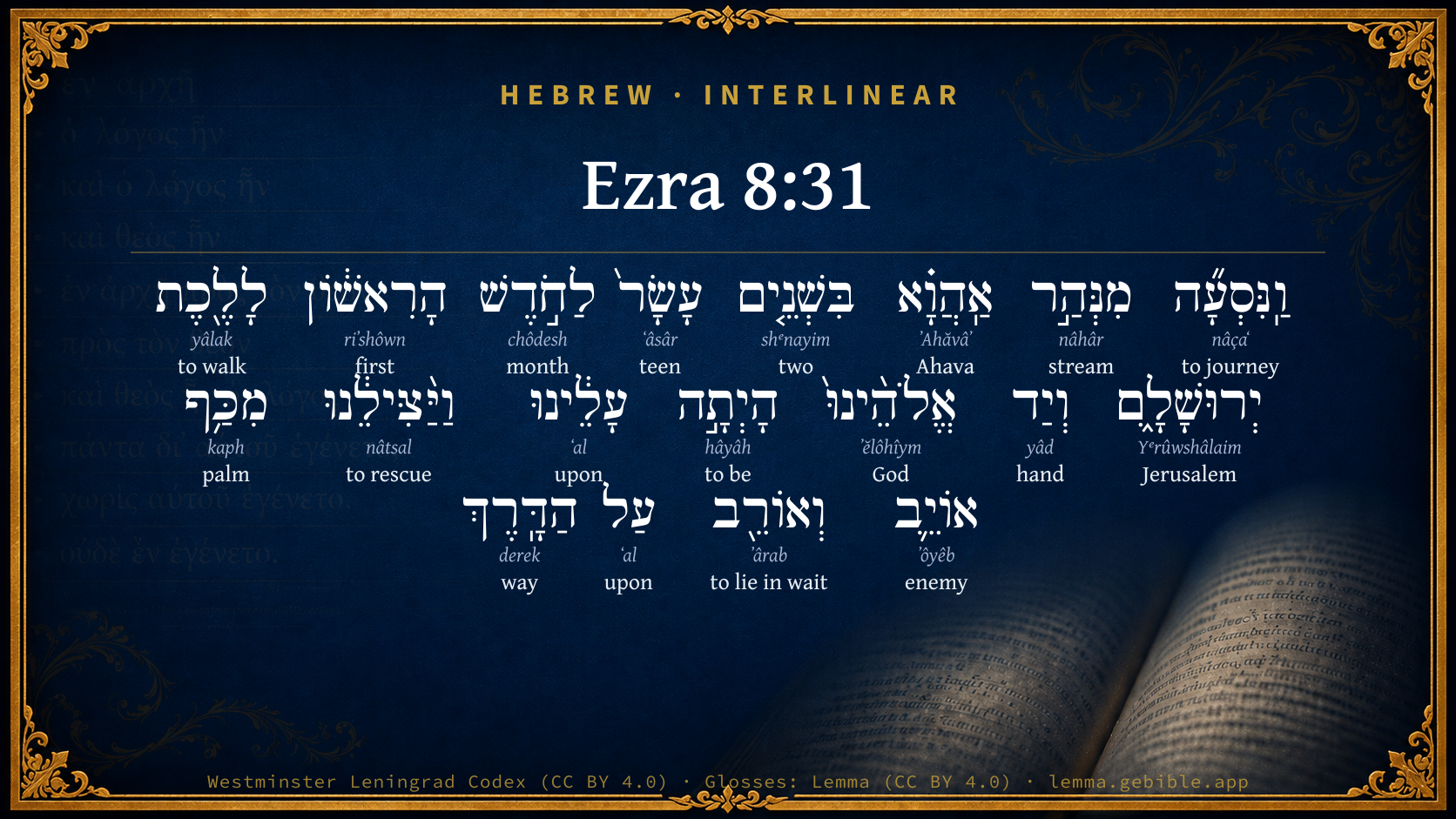
Hebrew (Westminster Leningrad Codex) Ezra 8:31 appears in the Hebrew Old Testament. The text above is from the Westminster Leningrad Codex. Each word links to its Strong’s number, a concise gloss, and parsing drawn from the Open Scriptures Hebrew Bible morphology. Click any word for its full Brown-Driver-Briggs (BDB) entry.
Download image
Cite this verse

Ezra 8:31 (World English Bible). Public Domain. Lemma interlinear Bible study tool, https://lemma.gebible.app/v/ezra/8/31.

Show BibTeX & RIS
BibTeX
RIS
English Translation
Then we departed from the river Ahava on the twelfth [day] of the first month, to go to Jerusalem: and the hand of our God was on us, and he delivered us from the hand of the enemy and the bandit by the way.
World English Bible · Public Domain
Download a study sheet

One document with this verse’s original text, its word-by-word gloss line, the meaning frame, cross-references with their text, attributed commentary, and full source and license credits — printable, and it pastes into notes with its structure intact.

This verse Autodidact and up

Study sheet (.html) Plain text (.txt)

A passage Seminary Student

Up to 50 verses in one chapter. A passage sheet keeps up to 6 commentary sources and 12 cross-references per verse, in the order this page ranks them, and says so on the sheet whenever that leaves anything out. Ask for a single verse and you get the Autodidact verse sheet above.

Everything on this page stays free to read, with no account — the sheet is a download of what is already on screen, not access to it.

Want to remove ads? Support Godless Engineer
Compare translations 3

The same verse in 3 English versions, stacked beneath the original-language interlinear above. Click any original word for its lexicon entry.

Each is an independent rendering of the whole verse — the interlinear is not word-aligned to these translations.

Highlighted words mark where these versions differ — a whole-verse word diff, not a word-by-word alignment.

  • World English Bible Public Domain
    Then we departed from the river Ahava on the twelfth [day] of the first month, to go to Jerusalem: and the hand of our God was on us, and he delivered us from the hand of the enemy and the bandit by the way.
  • King James Version Public Domain
    Then we departed from the river of Ahava on the twelfth day of the first month, to go unto Jerusalem: and the hand of our God was upon us, and he delivered us from the hand of the enemy, and of such as lay in wait by the way.
  • unfoldingWord Literal Text CC BY-SA 4.0
    Then we set out from the river Ahava on day 12 of the first month to go to Jerusalem. And the hand of our God was upon us, and he delivered us from the palm of the enemy and ambush on the way.

unfoldingWord Literal Text — © unfoldingWord, licensed CC BY-SA 4.0. Word-aligned USFM3 via Door43 (git.door43.org/unfoldingWord/en_ult).

Versions to compare (up to 4)

3 of 4 selected

Show all 18 translations

Every available English version of this verse, each an independent rendering of the whole verse.

  • World English Bible Public Domain
    Then we departed from the river Ahava on the twelfth [day] of the first month, to go to Jerusalem: and the hand of our God was on us, and he delivered us from the hand of the enemy and the bandit by the way.
  • Berean Standard Bible Public Domain
    On the twelfth day of the first month we set out from the Ahava Canal to go to Jerusalem, and the hand of our God was upon us to protect us from the hands of the enemies and bandits along the way.
  • Majority Standard Bible Public Domain
    On the twelfth day of the first month we set out from the Ahava Canal to go to Jerusalem, and the hand of our God was upon us to protect us from the hands of the enemies and bandits along the way.
  • King James Version Public Domain
    Then we departed from the river of Ahava on the twelfth day of the first month, to go unto Jerusalem: and the hand of our God was upon us, and he delivered us from the hand of the enemy, and of such as lay in wait by the way.
  • American Standard Version (1901) Public Domain
    Then we departed from the river Ahava on the twelfth `day' of the first month, to go unto Jerusalem: and the hand of our God was upon us, and he delivered us from the hand of the enemy and the lier-in-wait by the way.
  • Revised Version (1885) Public Domain
    Then we departed from the river of Ahava on the twelfth day of the first month, to go unto Jerusalem: and the hand of our God was upon us, and he delivered us from the hand of the enemy and the lier in wait by the way.
  • Geneva Bible (1599) Public Domain
    Then we departed from the Riuer of Ahauah on the twelft day of the first moneth, to go vnto Ierusalem, and the hand of our God was vpon vs, and deliuered vs from the hand of the enemie, and of such as layde waite by the way.
  • Douay-Rheims (1899) Public Domain
    Then we set forward from the river Ahava on the twelfth day of the first month to go to Jerusalem: and the hand of our God was upon us, and delivered us from the hand of the enemy, and of such as lay in wait by the way.
  • Young's Literal Translation Public Domain
    And we journey from the river Ahava, on the twelfth of the first month, to go to Jerusalem, and the hand of our God hath been upon us, and He delivereth us from the hand of the enemy and the lier in wait by the way;
  • Literal Standard Version CC BY-SA 4.0
    And we journey from the river Ahava, on the twelfth of the first month, to go to Jerusalem, and the hand of our God has been on us, and He delivers us from the hand of the enemy and the one lying in wait by the way;
  • Unlocked Literal Bible CC BY-SA 4.0
    We went out from the Ahava Canal on the twelfth day of the first month to go to Jerusalem. The hand of our God was on us; he protected us from the hand of the enemy and the ones who wished to ambush us along the road.
  • unfoldingWord Literal Text CC BY-SA 4.0
    Then we set out from the river Ahava on day 12 of the first month to go to Jerusalem. And the hand of our God was upon us, and he delivered us from the palm of the enemy and ambush on the way.
  • Darby Bible Public Domain
    And we departed from the river Ahava on the twelfth of the first month, to go to Jerusalem; and the hand of our God was upon us, and he delivered us from the hand of the enemy, and of such as lay in wait by the way.
  • World Messianic Bible Public Domain
    Then we departed from the river Ahava on the twelfth day of the first month, to go to Jerusalem. The hand of our God was on us, and he delivered us from the hand of the enemy and the bandits by the way.
  • Webster's Bible Public Domain
    Then we departed from the river Ahava on the twelfth day of the first month, to go to Jerusalem: and the hand of our God was upon us, and he delivered us from the hand of the enemy, and of such as lay in wait by the way.
  • Free Bible Version CC BY-SA 4.0
    On the twelfth day of the first month, we left the Ahava Canal to go to Jerusalem, and our God was with us to protect us from enemy ambushes along the way.
  • Bible in Basic English Public Domain
    Then we went away from the river of Ahava on the twelfth day of the first month, to go to Jerusalem; and the hand of our God was on us, and he gave us salvation from our haters and those who were waiting to make an attack on us by the way.
  • JPS Tanakh (1917) Public Domain
    Then we departed from the river of Ahava on the twelfth day of the first month, to go unto Jerusalem; and the hand of our God was upon us, and He delivered us from the hand of the enemy and lier-in-wait by the way.

Literal Standard Version (2020), Covenant Press — licensed CC BY-SA 4.0. Text via the HelloAO Bible API (eBible.org). Unlocked Literal Bible (unfoldingWord) — licensed CC BY-SA 4.0. Text via the HelloAO Bible API (eBible.org). unfoldingWord Literal Text — © unfoldingWord, licensed CC BY-SA 4.0. Word-aligned USFM3 via Door43 (git.door43.org/unfoldingWord/en_ult). Free Bible Version, Dr. Jonathan Gallagher — licensed CC BY-SA 4.0. Text via the HelloAO Bible API (eBible.org).

Word by word

More ways to search: Search by grammar → Find every occurrence → Compare this word →

Practice this passage: Drill this verse → Learn its vocabulary →

אַֽהֲוָ֗א
ʼAhăvâʼ
H163
“Ahava”
Noun, Proper
Part of Speech
Noun
Type
Proper
Full BDB Definition

Origin: probably of foreign origin

TWOT: None

Ahava = "I shall subsist" - town or area in Babylonia
  1. וַֽנִּסְעָ֞ה nâçaʻ H5265 “and · to journey” Conjunction + Verb, Qal, Sequential Imperfect, 1st Person, Common, Plural + Suffix, h
  2. מִנְּהַ֣ר nâhâr H5104 “from · stream of” Preposition + Noun, Common, Masculine, Singular, Construct
  3. בִּשְׁנֵ֤ים shᵉnayim H8147 “in/at · two” Preposition + Adjective, Cardinal number, Masculine, Dual, Absolute
  4. עָשָׂר֙ ʻâsâr H6240 “teen” Adjective, Cardinal number, Masculine, Singular, Absolute
  5. לַחֹ֣דֶשׁ chôdesh H2320 “to/for the · month” Preposition, Determined + Noun, Common, Masculine, Singular, Absolute
  6. הָרִאשׁ֔וֹן riʼshôwn H7223 “the · first” Particle, Definite Article + Adjective, Ordinal number, Masculine, Singular, Absolute
  7. לָלֶ֖כֶת yâlak H3212 “to walk” Preposition + Verb, Qal, Infinitive Construct
  8. יְרוּשָׁלִָ֑ם Yᵉrûwshâlaim H3389 “Jerusalem” Noun, Proper
  9. וְיַד yâd H3027 “and · hand of” Conjunction + Noun, Common, Both, Singular, Construct
  10. אֱלֹהֵ֨ינוּ֙ ʼĕlôhîym H430 “God(s) · our” Noun, Common, Masculine, Plural, Construct + Suffix, Personal, 1st Person, Common, Plural
  11. הָיְתָ֣ה hâyâh H1961 “to be” Verb, Qal, Perfect, 3rd Person, Feminine, Singular
  12. עָלֵ֔ינוּ ʻal H5921 “upon · us” Preposition + Suffix, Personal, 1st Person, Common, Plural
  13. וַיַּ֨צִּילֵ֔נוּ nâtsal H5337 “and · to rescue · us” Conjunction + Verb, Hiphil, Sequential Imperfect, 3rd Person, Masculine, Singular + Suffix, Personal, 1st Person, Common, Plural
  14. מִכַּ֥ף kaph H3709 “from · palm of” Preposition + Noun, Common, Feminine, Singular, Construct
  15. אוֹיֵ֛ב ʼôyêb H341 “enemy” Verb, Qal, Participle Active, Masculine, Singular, Absolute
  16. וְאוֹרֵ֖ב ʼârab H693 “and · lying in wait” Conjunction + Verb, Qal, Participle Active, Masculine, Singular, Absolute
  17. עַל ʻal H5921 “upon” Preposition
  18. הַדָּֽרֶךְ derek H1870 “the · way” Particle, Definite Article + Noun, Common, Both, Singular, Absolute

About this verse

These counts appear in no published source. They are computed here, from the morphology-tagged text and Lemma’s own curated glosses. What Lemma adds →

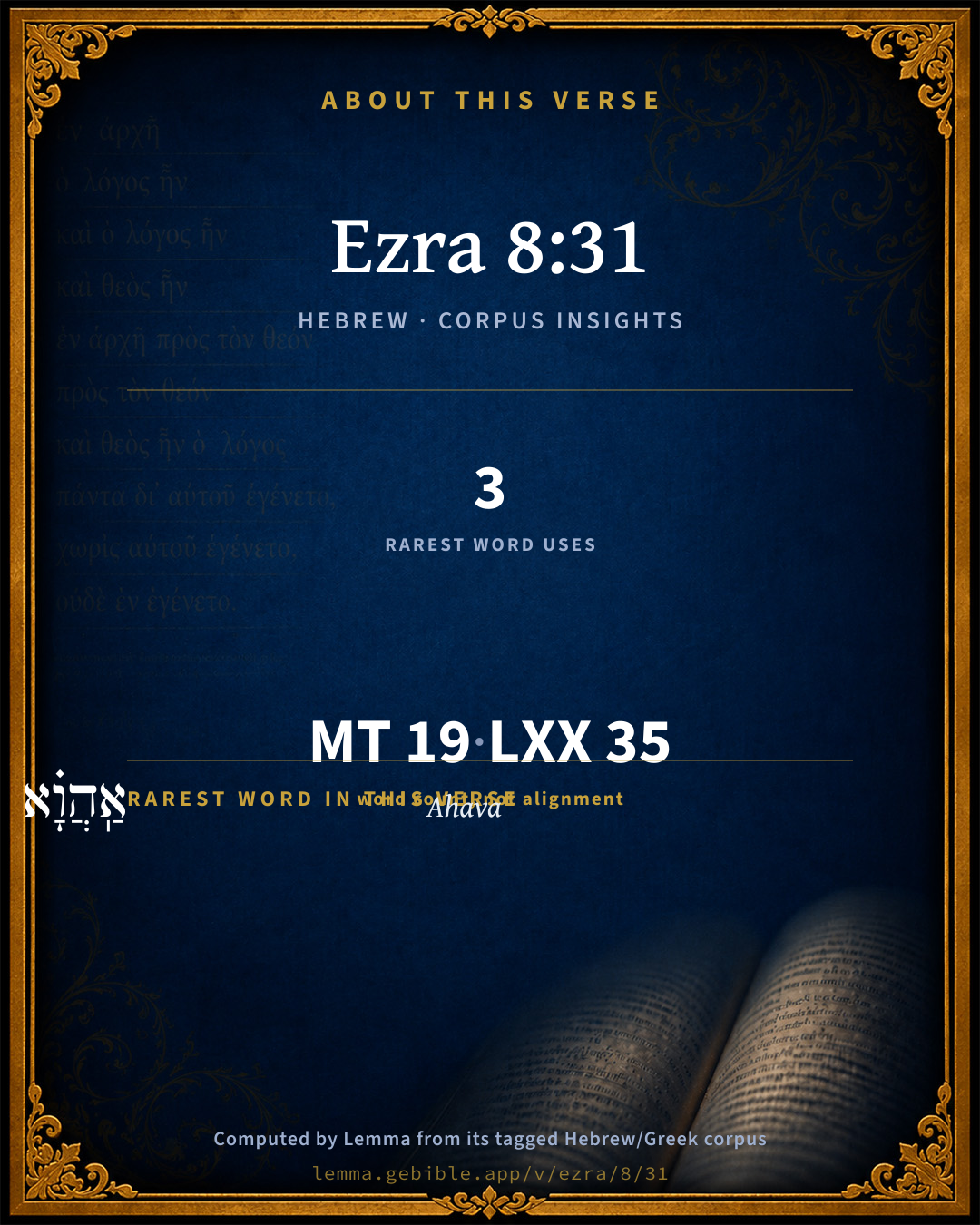
19
words
18
distinct lemmas
Historical
section

Notable vocabulary

The rarest word here is אַֽהֲוָ֗א Ahava H163 — appearing just 3 times in the whole Hebrew Bible.

Shared distinctive vocabulary

אַֽהֲוָ֗א Ahava H163 occurs in 3 verses of the Hebrew Bible. Also found in:

Grammatical profile

  • 6 verbs
  • 8 nouns
  • 3 adjectives
  • 2 prepositions

Verb forms

  • וַֽנִּסְעָ֞ה Qal · Sequential Imperfect
  • לָלֶ֖כֶת Qal · Infinitive Construct
  • הָיְתָ֣ה Qal · Perfect
  • וַיַּ֨צִּילֵ֔נוּ Hiphil · Sequential Imperfect
  • אוֹיֵ֛ב Qal · Participle Active
  • וְאוֹרֵ֖ב Qal · Participle Active

Repetition

A word recurs within this verse — often emphatic in Hebrew:

  • עָלֵ֔ינוּ upon H5921 ×2

Hebrew & Septuagint length

In English translation the verse runs 44 words from the Hebrew and 43 from the Septuagint (LXX English) — closely comparable.

A rough comparison of the two English renderings, which tokenize alike — not a word-level alignment.

Word counts can differ between the Hebrew and the Greek without any difference in meaning — e.g. the Hebrew direct-object marker אֵת has no separate Greek word, and Greek often adds the article ὁ.

In the original languages it is 19 Hebrew tokens and 35 Greek tokens — but the two are counted differently (Hebrew bundles its prefixes and suffixes into one token; the Greek is in lemma form), so that isn’t a like-for-like length.

Cross-references

9

Topical passages linked to Ezra 8:31 in the Treasury of Scripture Knowledge — connected by theme and wording, ordered by reader-vote popularity; previews shown in the World English Bible.

  • Ezra 8:21–22 Then I proclaimed a fast there, at the river Ahava, that we might humble ourselves before our God, to seek of him a straight way for us, and for our little ones, and for all our substance.
  • Ezra 7:9 For on the first [day] of the first month began he to go up from Babylon; and on the first [day] of the fifth month came he to Jerusalem, according to the good hand of his God on him.
  • Ezra 8:15 I gathered them together to the river that runs to Ahava; and there we encamped three days: and I viewed the people, and the priests, and found there none of the sons of Levi.
  • Isaiah 41:10–14 Don't you be afraid, for I am with you; don't be dismayed, for I am your God; I will strengthen you; yes, I will help you; yes, I will uphold you with the right hand of my righteousness.
  • Acts 26:22 Having therefore obtained the help that is from God, I stand to this day testifying both to small and great, saying nothing but what the prophets and Moses said would happen,
  • Ezra 7:28 and has extended loving kindness to me before the king, and his counselors, and before all the king's mighty princes. I was strengthened according to the hand of Yahweh my God on me, and I gathered together out of Israel chief men to go up with me.
  • Job 5:19–24 He will deliver you in six troubles; Yes, in seven there shall no evil touch you.
  • Psalms 91:9–14 Because you have made Yahweh your refuge, And the Most High your dwelling place,
  • Acts 25:3 asking a favor against him, that he would summon him to Jerusalem; plotting to kill him on the way.

Cross-references courtesy of OpenBible.info (CC BY 4.0).

Hebrew and Greek witnesses Masoretic Hebrew ↔ Greek Septuagint

The same verse in the two great witnesses to the Old Testament, shown verse-for-verse.

These are two independent witnesses, not word-aligned to each other, and the Septuagint is shown in lemma (dictionary) form.

Hebrew Ezra 8:31 Masoretic · Westminster Leningrad Codex

וַֽנִּסְעָ֞ה מִנְּהַ֣ר אַֽהֲוָ֗א בִּשְׁנֵ֤ים עָשָׂר֙ לַחֹ֣דֶשׁ הָרִאשׁ֔וֹן לָלֶ֖כֶת יְרוּשָׁלִָ֑ם וְיַד אֱלֹהֵ֨ינוּ֙ הָיְתָ֣ה עָלֵ֔ינוּ וַיַּ֨צִּילֵ֔נוּ מִכַּ֥ף אוֹיֵ֛ב וְאוֹרֵ֖ב עַל הַדָּֽרֶךְ

Then we departed from the river Ahava on the twelfth [day] of the first month, to go to Jerusalem: and the hand of our God was on us, and he delivered us from the hand of the enemy and the bandit by the way.

World English Bible · Public Domain

Greek LXX Ezra 8:31 Septuagint · lemma form

καί ἐκαἴρω ἀπό ὁ ποταμός αουε ἐν ὁ δωδέκατος ὁ μήν ὁ πρῶτος ὁ ἔρχομαι εἰς ἰερουσαλήμ καί χείρ θεός ἐγώ εἰμί ἐπί ἐγώ καί ῥύομαι ἐγώ ἀπό χείρ ἐχθρός καί πολέμιος ἐν ὁ ὁδός

And we departed from the river of Aue on the twelfth day of the first month, to come to Jerusalem: and the hand of our God was upon us, and delivered us from the hand of the enemy and adversary in the way.

LXX2012 (modern English Septuagint) · Public Domain

In the Septuagint this is one book — Esdras B (2 Esdras): Ezra is chapters 1–10, Nehemiah 11–23.

Hebrew: Westminster Leningrad Codex (CC BY 4.0). Greek: Septuagint (public domain); English from LXX2012 (modern English Septuagint) (Public Domain). How the Septuagint differs from the Hebrew →

Commentary

Notes on Ezra 8:31 from classic Christian and Jewish commentators (each source and its license shown beneath its notes). The classic Christian expositions comment on the surrounding passage and are grouped to its opening verse, so a note may address several verses; the Jewish commentaries on the Tanakh (Rashi and others) are per-verse, so they appear only where the commentator wrote on this verse.

Lemma curates 59 commentaries, every one of them public domain or Creative Commons licensed, each selected and text-cleaned for this edition rather than reprinted as found. About our sources →

Matthew Henry's Commentary

We are now to attend Ezra to Jerusalem, a journey of about four months in all; but his multitude made his marches slow and his stages short. Now here we are told,

I. That his God was good, and he acknowledged his goodness: The hand of our God was upon us, to animate us for our undertaking. To him they owed it, 1. That they were preserved in their journey, and not all cut off; for there were enemies that laid wait for them by the way to do them a mischief, or at least, like Amalek, to smite the hindmost of them, but God protected them, Ezr 8:31. Even the common perils of journeys are such as oblige us to sanctify our going out with prayer and our returns in peace with praise and thanksgiving; much more ought God to be thus eyed in such a dangerous expedition as this was. 2. That they were brought in safety to their journey's end, Ezr 8:32. Let those that have stedfastly set their faces towards the new Jerusalem proceed and persevere to the end till they appear before God in Zion, and they shall find that he who has begun the good work will perform it.

II. That his treasurers were faithful. When they had come to Jerusalem they were impatient to be discharged of their trust, and therefore applied to the great men of the temple, who received it from them and gave them an acquittance in full, Ezr 8:33, Ezr 8:34. It is a great ease to one's mind to be discharged from a trust, and a great honour to one's name to be able to make it appear that it has been faithfully discharged.

III. That his companions were devout. As soon as they came to be near the altar they thought themselves obliged to offer sacrifice, whatever they had done in Babylon, Ezr 8:35. That will be dispensed with when we want opportunity which when the door is opened again will be expected from us. It is observable, 1. That among their sacrifices they had a sin-offering; for it is the atonement that sweetens and secures every mercy to us, which will not be truly comfortable unless iniquity be taken away and our peace made with God. 2. That the number of their offerings related to the number of the tribes, twelve bullocks, twelve he-goats, and ninety-six rams (that is, eight times twelve), intimating the union of the two kingdoms, according to what was foretold, Eze 37:22. They did not any longer go two tribes one way and ten another, but all the twelve met by their representatives at the same altar.

IV. That even the enemies of the Jews became their friends, bowed to Ezra's commission, and, instead of hindering the people of God, furthered them (Ezr 8:36), purely in complaisance to the king: when he appeared moderate they all coveted to appear so too. Then had the churches rest.

Matthew Henry's Commentary on the Whole Bible (1708–1710) — public domain (CC PDM 1.0). Text via the HelloAO Bible API.

Trapp's Complete Commentary

John Trapp

Ezr 8:31 Then we departed from the river of Ahava on the twelfth [day] of the first month, to go unto Jerusalem: and the hand of our God was upon us, and he delivered us from the hand of the enemy, and of such as lay in wait by the way.

Ver. 31. And of such as lay in wait by the way] Enemies they had not a few, (when was it otherwise?) but some that purposely waylaid them; but were defeated by a gracious providence. So were the Manichees, who lay in wait for Austin; and those that pursued Jewel, about the beginning of Queen Mary’s reign, as he was going from Oxford to London. Both these had been caught, and made a prey to their enemies, but that they lost their way. What saith the prophet? As birds flying, so will the Lord of hosts defend Jerusalem (like as when the young are in danger of the kite, the bird flies to save them); defending also, he will deliver it, and passing over, he will preserve it.

John Trapp, A Commentary or Exposition upon All the Books of the Old and New Testament (1647–1656) — public domain. Text from a community e-Sword module.

Joseph Benson's Commentary

Ezr 8:31-32. The hand of our God was upon us — To protect and strengthen us in so dangerous and long a journey. And he delivered us from the hand of the enemy — There were not only many enemies who hated them, and were desirous to cut them off; but many robbers, who watched for a booty, whom God either diverted some other way, or disheartened from attempting any thing against them. And of such as lay in wait by the way — To wit, in the direct way. From this it may be conjectured, that God inclined them to fetch a little compass, and to go a more unsuspected way, as they had begged of him. And abode there three days — Before Ezra opened out his commission, or did any thing material.

Joseph Benson's Commentary on the Old and New Testaments (1811–1818) — public domain. Text from a community e-Sword module.

Whedon's Commentary on the Bible

Daniel D. Whedon

THE JOURNEY AND ARRIVAL AT JERUSALEM, Ezr_8:31-36.

31. On the twelfth day — They began to gather at Ahava on the first day, (Ezr_7:9,) but the fast and other events mentioned above (Ezr_8:15-30) occupied ten or eleven days.

The hand of our God was upon us — Providence favoured us, and delivered us from all enemies and dangers.

Daniel D. Whedon (gen. ed.), Commentary on the Old and New Testaments (1874–1909) — public domain. Text from a community e-Sword module.

MacLaren's Expositions of Holy Scripture

Alexander MacLaren

Ezra

HEROIC FAITH

Ezr 8:22 - Ezr 8:23, Ezr 8:31 - Ezr 8:32.

The memory of Ezra the scribe has scarcely had fairplay among Bible-reading people. True, neither his character nor the incidents of his life reach the height of interest or of grandeur belonging to the earlier men and their times. He is no hero, or prophet; only a scribe; and there is a certain narrowness as well as a prosaic turn about his mind, and altogether one feels that he is a smaller man than the Elijahs and Davids of the older days. But the homely garb of the scribe covered a very brave devout heart, and the story of his life deserves to be more familiar to us than it is.

This scrap from the account of his preparations for the march from Babylon to Jerusalem gives us a glimpse of a high-toned faith, and a noble strain of feeling. He and his company had a long weary journey of four months before them. They had had little experience of arms and warfare, or of hardships and desert marches, in their Babylonian homes. Their caravan was made unwieldy and feeble by the presence of a large proportion of women and children. They had much valuable property with them. The stony desert, which stretches unbroken from the Euphrates to the uplands on the east of Jordan, was infested then as now by wild bands of marauders, who might easily swoop down on the encumbered march of Ezra and his men, and make a clean sweep of all which they had. And he knew that he had but to ask and have an escort from the king that would ensure their safety till they saw Jerusalem. Artaxerxes’ surname, ‘the long-handed,’ may have described a physical peculiarity, but it also expressed the reach of his power; his arm could reach these wandering plunderers, and if Ezra and his troop were visibly under his protection, they could march secure. So it was not a small exercise of trust in a higher Hand that is told us here so simply. It took some strength of principle to abstain from asking what it would have been so natural to ask, so easy to get, so comfortable to have. But, as he says, he remembered how confidently he has spoken of God’s defence, and he feels that he must be true to his professed creed, even if it deprives him of the king’s guards. He halts his followers for three days at the last station before the desert, and there, with fasting and prayer, they put themselves in God’s hand; and then the band, with their wives and little ones, and their substance,-a heavily-loaded and feeble caravan,-fling themselves into the dangers of the long, dreary, robber-haunted march. Did not the scribe’s robe cover as brave a heart as ever beat beneath a breastplate?

That symbolic phrase, ‘the hand of our God,’ as expressive of the divine protection, occurs with remarkable frequency in the books of Ezra and Nehemiah, and though not peculiar to them, is yet strikingly characteristic of them. It has a certain beauty and force of its own. The hand is of course the seat of active power. It is on or over a man like some great shield held aloft above him, below which there is safe hiding. So that great Hand bends itself over us, and we are secure beneath its hollow. As a child sometimes carries a tender-winged butterfly in the globe of its two hands that the bloom on the wings may not be ruffled by fluttering, so He carries our feeble, unarmoured souls enclosed in the covert of His Almighty hand. ‘Who hath measured the waters in the hollow of His hand?’ ‘Who hath gathered the wind in His fists?’ In that curved palm where all the seas lie as a very little thing, we are held; the grasp that keeps back the tempests from their wild rush, keeps us, too, from being smitten by their blast. As a father may lay his own large muscular hand on his child’s tiny fingers to help him, or as ‘Elisha put his hands on the king’s hands,’ that the contact might strengthen him to shoot the ‘arrow of the Lord’s deliverance,’ so the hand of our God is upon us to impart power as well as protection; and our ‘bow abides in strength,’ when ‘the arms of our hands are made strong by the hands of the mighty God of Jacob.’ That was Ezra’s faith, and that should be ours.

Note Ezra’s sensitive shrinking from anything like inconsistency between his creed and his practice. It was easy to talk about God’s protection when he was safe behind the walls of Babylon; but now the pinch had come. There was a real danger before him and his unwarlike followers. No doubt, too, there were plenty of people who would have been delighted to catch him tripping; and he felt that his cheeks would have tingled with shame if they had been able to say, ‘Ah! that is what all his fine professions come to, is it? He wants a convoy, does he? We thought as much. It is always so with these people who talk in that style. They are just like the rest of us when the pinch comes.’ So, with a high and keen sense of what was required by his avowed principles, he will have no guards for the road. There was a man whose religion was at any rate not a fair-weather religion. It did not go off in fine speeches about trusting to the protection of God, spoken from behind the skirts of the king, or from the middle of a phalanx of his soldiers. He clearly meant what he said, and believed every word of it as a prose fact, which was solid enough to build conduct on.

I am afraid a great many of us would rather have tried to reconcile our asking for a band of horsemen with our professed trust in God’s hand; and there would have been plenty of excuses very ready about using means as well as exercising faith, and not being called upon to abandon advantages, and not pushing a good principle to Quixotic lengths, and so on, and so on. But whatever truth there is in such considerations, at any rate we may well learn the lesson of this story-to be true to our professed principles; to beware of making our religion a matter of words; to live, when the time for putting them into practice comes, by the maxims which we have been forward to proclaim when there was no risk in applying them; and to try sometimes to look at our lives with the eyes of people who do not share our faith, that we may bring our actions up to the mark of what they expect of us. If ‘the Church’ would oftener think of what ‘the world’ looks for from it, it would seldomer have cause to be ashamed of the terrible gap between its words and its deeds.

Especially in regard to this matter of trust in an unseen Hand, and reliance on visible helps, we all need to be very rigid in our self-inspection. Faith in the good hand of God upon us for good should often lead to the abandonment, and always to the subordination, of material aids. It is a question of detail, which each man must settle for himself as each occasion arises, whether in any given case abandonment or subordination is our duty. This is not the place to enter on so large and difficult a question. But, at all events, let us remember, and try to work into our own lives, that principle which the easy-going Christianity of this day has honeycombed with so many exceptions, that it scarcely has any whole surface left at all; that the absolute surrender and forsaking of external helps and goods is sometimes essential to the preservation and due expression of reliance on God.

There is very little fear of any of us pushing that principle to Quixotic lengths. The danger is all the other way. So it is worth while to notice that we have here an instance of a man’s being carried by a certain lofty enthusiasm further than the mere law of duty would take him. There would have been no harm in Ezra’s asking an escort, seeing that his whole enterprise was made possible by the king’s support. He would not have been ‘leaning on an arm of flesh’ by availing himself of the royal troops, any more than when he used the royal firman. But a true man often feels that he cannot do the things which he might without sin do. ‘All things are lawful for me, but all things are not expedient,’ said Paul. The same Apostle eagerly contended that he had a perfect right to money support from the Gentile Churches; and then, in the next breath, flamed up into, ‘I have used none of these things, for it were better for me to die, than that any man should make my glorying void.’ A sensitive spirit, or one profoundly stirred by religious emotion, will, like the apostle whose feet were moved by love, far outrun the slower soul, whose steps are only impelled by the thought of duty. Better that the cup should run over than that it should not be full. Where we delight to do His will, there will often be more than a scrupulously regulated enough; and where there is not sometimes that ‘more,’ there will never be enough.

‘Give all thou canst; high Heaven rejects the lore

Of nicely calculated less or more.’

What shall we say of people who profess that God is their portion, and are as eager in the scramble for money as anybody? What kind of a commentary will sharp-sighted, sharp-tongued observers have a right to make on us, whose creed is so unlike theirs, while our lives are identical? Do you believe, friends! that ‘the hand of our God is upon all them for good that seek Him’? Then, do you not think that racing after the prizes of this world, with flushed cheeks and labouring breath, or longing, with a gnawing hunger of heart, for any earthly good, or lamenting over the removal of creatural defences and joys, as if heaven were empty because some one’s place here is, or as if God were dead because dear ones die, may well be a shame to us, and a taunt on the lips of our enemies? Let us learn again the lesson from this old story,-that if our faith in God is not the veriest sham, it demands and will produce, the abandonment sometimes and the subordination always, of external helps and material good.

Notice, too, Ezra’s preparation for receiving the divine help. There, by the river Ahava, he halts his company like a prudent leader, to repair omissions, and put the last touches to their organisation before facing the wilderness. But he has another purpose also. ‘I proclaimed a fast there, to seek of God a right way for us.’ There was no foolhardiness in his courage; he was well aware of all the possible dangers on the road; and whilst he is confident of the divine protection, he knows that, in his own quiet, matter-of-fact words, it is given ‘to all them that seek Him.’ So his faith not only impels him to the renunciation of the Babylonian guard, but to earnest supplication for the defence in which he is so confident. He is sure it will be given-so sure, that he will have no other shield; and yet he fasts and prays that he and his company may receive it. He prays because he is sure that he will receive it, and does receive it because he prays and is sure.

So for us, the condition and preparation on and by which we are sheltered by that great Hand, is the faith that asks, and the asking of faith. We must forsake the earthly props, but we must also believingly desire to be upheld by the heavenly arms. We make God responsible for our safety when we abandon other defence, and commit ourselves to Him. With eyes open to our dangers, and full consciousness of our own unarmed and unwarlike weakness, let us solemnly commend ourselves to Him, rolling all our burden on His strong arms, knowing that He is able to keep that which we have committed to Him. He will accept the trust, and set His guards about us. As the song of the returning exiles, which may have been sung by the river Ahava, has it: ‘My help cometh from the Lord. The Lord is thy keeper. The Lord is thy shade upon thy right hand.’

So our story ends with the triumphant vindication of this Quixotic faith. A flash of joyful feeling breaks through the simple narrative, as it tells how the words spoken before the king came true in the experience of the weaponless pilgrims: ‘The hand of our God was upon us, and He delivered us from the hand of the enemy, and of such as lay in wait by the way; and we came to Jerusalem.’ It was no rash venture that we made. He was all that we hoped and asked. Through all the weary march He led us. From the wild, desert-born robbers, that watched us from afar, ready to come down on us, from ambushes and hidden perils, He kept us, because we had none other help, and all our hope was in Him. The ventures of faith are ever rewarded. We cannot set our expectations from God too high. What we dare scarcely hope now we shall one day remember. When we come to tell the completed story of our lives, we shall have to record the fulfilment of all God’s promises, and the accomplishment of all our prayers that were built on these. Here let us cry, ‘Be Thy hand upon us.’ Here let us trust, Thy hand will be upon us. Then we shall have to say, ‘The hand of our God was upon us,’ and as we look from the watch-towers of the city, on the desert that stretches to its very walls, and remember all the way by which He led us, we shall rejoice over His vindication of our poor faith, and praise Him that ‘not one thing hath failed of all the things which the Lord our God spake concerning us.’

Alexander MacLaren, Expositions of Holy Scripture (1904–1910) — public domain. Text from a community e-Sword module.

Tyndale Open Study Notes

Tyndale Open Resources

8:31-32 We broke camp . . . on April 19: It took twelve days to get organized, to encourage some Levites to join them, and to pray for God’s protection before Ezra could actually get the people moving toward Jerusalem (see 7:9).

Tyndale Open Study Notes — © Tyndale Open Resources, licensed CC BY-SA 4.0. Text via the HelloAO Bible API.

Geneva Bible (1599)

Geneva Bible translators

This declared that their journey was full of danger, and yet God delivered them according to their prayer.

Geneva Bible (1599) marginal notes — public domain. Text via Bolls.life.

Jamieson, Fausset & Brown

Robert Jamieson, A. R. Fausset & David Brown

we departed from the river of Ahava on the twelfth day of the first month--Computing from the time of their setting out to the period of their arrival, they occupied about four months on the way. Their health and security were marvellous during so long a journey. The pilgrim-caravans of the present day perform long journeys through the wildest deserts of the East under the protection of a firman from the Porte, and an escort of soldiers. But for a large body, composed as that of Ezra--of some thousands of men, women, and children, unaccustomed to travel, undisciplined to order, and without military strength, and with so large an amount of treasure tempting the cupidity of the marauding, plundering tribes of the desert--to accomplish a journey so long and so arduous in perfect safety, is one of the most astonishing events recorded in history. Nothing but the vigilant care of a superintending Providence could have brought them securely to their destination.

Jamieson, Fausset & Brown — Commentary Critical and Explanatory on the Whole Bible (1871) — public domain (CC PDM 1.0). Text via the HelloAO Bible API.

Ellicott's Commentary for English Readers

(31) The hand of our God was upon us.—This sums up the history of the journey.

A Bible Commentary for English Readers, edited by Charles John Ellicott (1878–1897) — public domain. Text from a community e-Sword module.

The Cambridge Bible for Schools and Colleges

gen. ed. J. J. S. Perowne

31–36. The Journey and the Arrival at Jerusalem

31. from the river of Ahava] See note on Ezr_8:15. Here ‘the river of Ahava’ translates the Hebrew accurately as ‘the river Ahava’ does in Ezr_8:21. Vulg. ‘a flumine Ahava’.

on the twelfth day of the first month] Compare with this date the statements in chap. Ezr_7:8-9, Ezr_8:15. The encampment at Ahava lasted three days (Ezr_8:15). The arrival at Ahava was therefore on the ninth day of the month. Supposing that Ahava is the same as Is (cf. Ezr_8:15), those nine days would have been consumed in the march from Babylon, and the march would have actually begun on the first of the month, Ezr_7:9.

Preferring another explanation of chap. Ezr_7:9, and regarding the encampment at Ahava as a preliminary muster of the whole company made at a convenient spot not far from Babylon, we consider the actual march did not begin till ‘the twelfth day of the first month’ (Nisan).

the hand, &c.] Cf. on Ezr_7:6.

the enemy] See note on 22.

and of such as lay in wait by the way] R.V. and the lier in wait by the way. This explains more fully who ‘the enemy’ was. Whether any attack was made we are not told. The deliverance may either imply the repulse of such an attack or the absence of any hostile movement.

The Cambridge Bible for Schools and Colleges (gen. ed. J. J. S. Perowne; Cambridge University Press, 1878–1918) — public domain. Text from a community e-Sword module.

John Gill's Exposition

And we came to Jerusalem, and abode there three days. Before they went about any business, delivered what was committed to them for the use of the temple, and the commissions to the king's officers; as it was but proper they should have some rest after such a fatiguing journey.

And we came to Jerusalem, and abode there three days. Before they went about any business, delivered what was committed to them for the use of the temple, and the commissions to the king's officers; as it was but proper they should have some rest after such a fatiguing journey.

Ezra 8:33

ezr 8:33

ezr 8:33

ezr 8:33Now on the fourth day,.... After their arrival at Jerusalem:

was the silver, and the gold, and the vessels, weighed in the house of our God; the temple, that it might be seen and known that the exact weight which had been deposited with them was now faithfully delivered:

this was done by the hand of Meremoth the son of Uriah the priest, and with him was Eleazar the son of Phinehas; these were priests:

and with them was Jozabad the son of Jeshua, and Noadiah the son of Binnui, Levites; two priests and two Levites; for since there were of both that were charged with the above things, it was proper there should be some of both, when weighed, that they might be witnesses of their fidelity.

John Gill's Exposition of the Whole Bible (1746–1763) — public domain (CC PDM 1.0). Text via the HelloAO Bible API.

Albert Barnes' Notes on the Bible

The Jews with Ezra left Babylon on the first day of the first month Ezr 7:9. They reached Ahava in nine days, and, having remained there three Ezr 8:15, quitted it, and resumed their journey on the twelfth. They reached Jerusalem on the first day of the fifth month Ezr 7:9, four months after the departure from Babylon.

Albert Barnes' Notes on the Bible (1834–1885) — public domain. Text from a community e-Sword/MySword module.

Matthew Poole's English Annotations

To wit, in the direct way; whereby it may be conjectured, that God directed them to fetch a little compass, and to go a more uncouth and unsuspected way, as they had begged of God, Ezr 8:21.

Matthew Poole's English Annotations on the Holy Bible (1683–1685) — public domain. Text from a community e-Sword/MySword module.

The Pulpit Commentary

The river of Ahava. Rather, "the river Ahava," as in the Vulgate ("a fiumine Ahava"). The place had probably taken its name from the stream. The twelfth day of the first month. Compare Ezr_7:9, and Ezr_8:15, from which it appears that Ahava was reached by Ezra and his company on the ninth day after they left Babylon, which helps to identify Ahava with Is, since Is (according to Herodotus) was eight days" journey from Babylon (see comment on ver. 15). God delivered us from such as lay in wait. The boast of Ezra (ver. 22) was justified by the event. He "trusted in God," and was "delivered how delivered we are not told, but evidently through no "arm of flesh." The hand of God led him safely through all the perils of the way, and brought him and his companions without loss or damage to the "city of their rest.

EZRA"S THREE DAYS" REST AT JERUSALEM, AND SUBSEQUENT EXECUTION OF THE MORE PRESSING OF THE COMMISSIONS INTRUSTED TO HIM. (Ezr_8:32-36) After the fatigues of a four months" journey, a brief period of complete rest was well-nigh necessary. Like Nehemiah, (Neh_2:11) Ezra was content with a rest of three days. On the fourth he discharged himself of his commission to present to the temple treasury the offerings of the Persian king, his counsellors and lords (ver. 25), together with that spontaneously contributed by the Israelites who had accompanied him. (Ezr_7:16) This he did by appearing in person before the priests and Levites who were in charge of the temple, and making over to them the entire offering of gold, silver, and vessels which had been brought to Jerusalem from Babylon. At the same time the exiles whom he had induced to return, and whom he had conducted in safety through so long a journey, sacrificed on the altar of burnt offerings a number of bullocks, rams, lambs, and he-goats, as a token of their thankfulness to God for delivering them from the perils of the way. After this Ezra proceeded to make known to the satraps and other governors of the provinces lying west of the Euphrates the terms of the permanent commission which he had received from the king. The result was that these officials thenceforth helped the Jews instead of hindering them, and furnished the necessary supplies for the temple service.

Vers. 31-36.

After arriving.

departed." "We came." Thus it is that Ezra here relates the rest of his journey, the only thing worthy of note between Ahava and Jerusalem being this, that, through "the good band of God" upon the travellers, they were kept in safety the whole way. This being acknowledged with a suitable note of thanksgiving, as something remarkable in such a journey (see end of ver. 31), the story goes onto tell us of the first doings of the pilgrims after reaching the place which they had sought and thought of so long. Some of these doings, we shall find, affect their position principally as travellers just arrived; and some have to do with them, on the other hand, rather as residents just admitted.

I TRAVELLERS JUST ARRIVED. Under this aspect we see them, very naturally,

(1) enjoying their rest. For the first three days this is all that we are told of them, that they abode or "sat" in Jerusalem for that time (comp. Neh_2:11) We can imagine easily what took place: the stir occasioned by their arrival (Rth_1:19; Mat_21:10) the family inquiries and recognitions; the consequent dispersions and hospitalities; and the final absorption and disappearance of all the newly-arrived within walls. There they would gradually recover from the effects of their long journey, and realise the grateful fact that they were no longer on the march. Those who have been long travelling, or otherwise labouring, in connection with God"s service have a kind of right at times to such rest. (Mar_6:30, 31; Act_28:17) if only with the object of enabling them thereby to do better service in time to come. In the present instance we may well believe that some part of these days of quiet was employed in this way, the result being that "on the fourth day" we see these just-arrived travellers

(2) discharging their trust. On that day there appears to have been a solemn gathering for this special purpose within the precincts of the temple. Ezra and his twenty-four trustees (ver. 24) would doubtless be on the one side to hand over the treasures; and four representatives of the Jerusalem hierarchy, two priests and two Levites, are described as being present on the other side to receive them. Very carefully, also, as became the place and the trust, was everything done. All the gifts of every description silver and the gold and the vessels were "weighed;" they were weighed by "the hand" of the chief man who had to receive them; they were weighed in the presence of the three others associated with him, and probably also in that of all the chief personages both in Church and state (see ver. 29) at Jerusalem; they were not only weighed in their presence, but also "numbered numbered "every one as a still fresher precaution against any error in the past; and then, finally, with a view to their safety for the future, they were "written down," or added formally to the existing catalogue of temple treasures and gifts. So honourably and so completely were these travelling treasurers relieved of their trust. And so happily, therefore, was their journey now terminated, both as to its labours and as to its special cares. Now they were able to rest indeed, both in body and mind.

II As RESIDENTS JUST ADMITTED. Their next cares, therefore, were in connection not with their journey, but their arrival. What were the duties devolving on them in connection with the place they bad come to? They had some such duties, it is clear,

(1) in regard to God and their brethren. For example, having been conducted safely, by God"s providence, to take up their abode in that place which he had chosen to put his name there, it was very fitting that they should openly declare their consecration to that name. This was represented by those "burnt offerings" of which we are twice informed in this place (ver. 35. See also Le 1; 2Ch_29:31, and Psa_66:13-15, for the connection of devotion or "vows" with burnt offerings, and the various kinds of animals so offered, almost the same as here) In so consecrating themselves, however, they only acted as a portion of that whole consecrated Israel of God to which they belonged. This identification of themselves with the covenant people they appear to have represented by their evidently studied reference in the number of animals offered to the appointed number of the covenant tribes, viz., by offering twelve bullocks, twelve he-goats, and 8 X 12, or ninety-six rams. Note, also, how it is expressly said of the twelve bullocks that they were offered "for all Israel," and comp. Ezr_6:17, and Num_7:2, etc. For the peculiar number of lambs (seventy-seven) it seems difficult to account, but the mention of the twelve he-goats as being for a "sin offering" was a silent confession on their part of their own need, and of all Israel"s need, of propitiation and atonement. In the next place, these three religious duties of consecration, communion, and confession being thus duly attended to, we find them turning to those civil duties which were required by their position; i.e. to their duties

(2) in regard to their earthly ruler and king. In the discharge of these they handed to the governors and deputy governors (ver. 36) of that part of the Persian empire the orders of Artaxerxes. (Ezr_7:21-24) This was done in the proper order. It was certainly true, in their case, that they were Israelites first, and Persian subjects afterwards (see also. (Mat_22:21) It was also done with proper completeness. To hand these orders of Artaxerxes to his deputies for the purpose of securing the advantages therein specified was to acknowledge, in the fullest manner, both his authority and theirs. It was to confess clearly that the Persian power extended so far. It was to acknowledge the authority of the Persian laws and officials over all souls in that land; and, therefore, to prove themselves not only true Israelites, but loyal subjects too.

CONCLUSION. Let all those who name the name of Christ see from all this

1. The importance of showing all good fidelity". (Tit_2:10) Before these returned children of the captivity allowed themselves to present their offerings in that house of God which they had travelled so far to visit and to benefit, they made all clear on this other point. We find a somewhat similar spirit in 1Sa_12:3-5; 2Co_8:20, 2Co_8:21; and may be reminded in two different yet equally instructive ways of Num_16:15, and Mat_5:23, Mat_5:24.

2. The importance of believing in the necessity of atonement. Even the burnt offerings of God"s own Israel, without the sin offering, would not be acceptable. That which we desire to offer to him must be purified first. But how can it be purified except by the sacrifice of the cross? (Heb_9:22 Heb_10:10)

3. The importance of being good subjects. We have seen the significance, in this respect, of the beginning of ver. 36. We may also see the good results thus secured in what is recorded in the end of that verse. It caused those who had the rule in that land to "further" the welfare of God"s "people," and the work of God"s "house." This is one advantage of honouring the "powers that be" as ordained of God. It causes them, in return, to honour and favour the religion we profess. Just as it is with servants in a household, so is it with subjects in a kingdom; it is thus they may especially "adorn the doctrine of God their Saviour" (Titus if. 9, 10). Other branches of "politics" may not be forbidden; this is positively enjoined. (Rom_13:1, etc.)

HOMILIES BY J.A. MACDONALD Vers. 31-36.

Progress.

When the treasure was disposed in custody of priests sanctified to watch over it, and the caravan was otherwise ordered, the pilgrims started from the camp of the Ahava en route for Jerusalem. As we might expect from the piety which influenced them in their preparations

I THEY WERE PROSPERED IN THEIR JOURNEY.

1. They enjoyed the blessing of their God. "The hand of our God was upon us.

(1) The hand is the symbol of power (Jud 1:35; 2Sa_24:14) Appropriately so, since it is the instrument by which commonly we exert our strength. So when the "hand of God" is mentioned his omnipotence is supposed (Exo_15:6; Psa_17:7)

(2) The hand of God "upon" men sometimes denotes his almighty judgments. (1Sa_5:11 1Pe_5:6) "It is a fearful thing to fall into the hands of the living God." Sometimes it denotes his all-sufficient protection and defence. (Joh_10:28, Joh_10:29) In this good sense it is intended here (see also vers. 18, 22; 7:9; Neh_2:18)

(3) The hand of God with his people coming up from Babylon may be likened to the glorious cloud which accompanied their fathers in their exodus from Egypt. (see Zec_2:9, where "I will turn my hand upon the little ones" denotes the sheltering of the little ones when the sword smites the Great One)

2. The Divine protection was respected by the enemy.

(1) There was the open "enemy" in the way. There ever were, as to this day there are, bold marauders in the East. Temptations often, with impudent ostentation, attack the Christian pilgrim.

(2) There were also "those that lie in wait." There are stealthy as well as sturdy foemen. The brood of the old serpent is legion. Temptations are often most successful when they attack by surprise.

(3) But the people were armed with "all prayer." The knowledge of this so over-awed the enemies that they did not attack. Or else if they did attack they were overwhelmed by the "hand of God." "If God be for us, who can be against us?

II THEY ENTERED INTO JERUSALEM WITH JOY.

1. It was the end of a toilsome march.

(1) The journey occupied four months. They "departed from the river of Ahava on the twelfth day of the first month." They "came to Jerusalem in the fifth month". (Ezr_7:8) It would be a joy to them to have the discomfort of that tedious pilgrimage ended.

(2) It will be an inexpressible joy to the Christian pilgrim to end life"s toils in the heavenly city.

2. It was the satisfaction of a cherished hope.

(1) They were "children of captivity," born in Babylon, never having seen Jerusalem. Yet would they not be without the traditions of the glory of their forefathers. The spirit which breathed in Psalm 79, and 137, could not leave them in ignorance of these things.

(2) They had also their Scriptures, which associated Zion with the glories of history and of prophecy. Now they were standing in the very place where their fathers had worshipped. In this also they had a pledge of the superior glories of the heavenly Jerusalem.

(3) They were relatives of those who had preceded them under the conduct of Zerubbabel. This is evident from a comparison of the catalogues of names (ch. 2. and ch. 8.). Therefore they would have happy recognitions, congratulations, and greetings. If in heaven now there is joy over the repentance of a sinner, what will be the joy of that entrance which shall be ministered abundantly into the kingdom!

III THEY ABODE IN JERUSALEM IN PEACE.

1. They had peace in themselves.

(1) This is the happy fruit of fidelity. Tranquillity dwells with integrity. They faithfully delivered up their precious charge. Now on the fourth day," etc. (vers. 33, 34).

(2) The balances of the sanctuary are true, and the weights are just. Sad is the case of him that shall be "found wanting". (see Dan_5:27)

2. They had peace with God.

(1) They went the right way to secure this by offering sacrifices (see ver. 35). Christ is our peace.

(2) Note These sacrifices were offered not only for themselves, but also "for all Israel." But "Judah and Benjamin" alone were present, and these only by a representation, for the bulk of the Jews remained on the Babylonish side of the river Euphrates. Query Is there not here an expression of faith in the ultimate restoration of all Israel? (Rom_10:2-6)

3. They had peace from their neighbours.

(1) This was secured to them, through the good providence of God, by the king"s commissions to lieutenants and governors. These documents were probably sealed; but the purport of them is evident from the letter of Artaxerxes. (Ezr_7:21-23)

(2) No wonder, then, that these lieutenants should 6, further the people and the house of God." Persecution would cease. "When a man"s ways please the Lord he maketh even his enemies to be at peace with him." Let us never move without God. Let us ever move with God. J.A.M.

The Pulpit Commentary (1880–1919), ed. H.D.M. Spence-Jones & Joseph S. Exell — public domain. Text from a community e-Sword module.

Scofield Reference Notes

C. I. Scofield

first month

i.e. April.

The Scofield Reference Bible (1917 edition), notes by C. I. Scofield — public domain. Text from a community e-Sword module.

unfoldingWord translationNotes

Door43 World Missions Community

We went out from the Ahava Canal

"We left the Ahava Canal" or "We started traveling from the Ahava Canal"

Ahava Canal

This is the name of the canal that flows to the place called Ahava. See how you translated this in Esra 8:21. (See: How to Translate Names)

twelfth day of the first month

This is the first month of the Hebrew calendar. The twelfth day is near the end of March on Western calendars. (See: Hebrew Months and Ordinal Numbers)

The hand of our God was on us

The hand of God being on people is a metonym for God helping people. AT: "God was helping us" (See: Metonymy)

he protected us from the hand of the enemy and the ones ... road

The hand represents what those people might do. It specifically refers to the enemy attacking the group that was traveling. AT: "he protected us from the attack of the enemy and the ones who wished to ambush us along the road" or "He kept the enemy from attacking us and he kept robbers from ambushing us along the road" (See: Metonymy)

the ones who wished to ambush us

This refers to thieves and robbers who wanted to attack them for their treasures.

translationWords

day

Jerusalem

hand

unfoldingWord translationNotes — © Distant Shores Media and the Door43 World Missions Community, licensed CC BY-SA 4.0. Source: git.door43.org/Door43/en_tn.

Rashi

Rabbi Shlomo Yitzchaki (Rashi)

on the twelfth of the first month on the twelfth of Nissan

the hand of our God was upon us to cause us to succeed in the way that we traversed.

Rashi on the Tanakh — English translations: “The Judaica Press complete Tanach with Rashi, translated by A. J. Rosenberg” (CC BY 4.0); “Pentateuch with Rashi's commentary by M. Rosenbaum and A.M. Silbermann, 1929-1934” (public domain); “The Metsudah Tanach series, Lakewood, N.J” (CC BY 4.0); and “The Book of Joshua, Metsudah Publications, 1997” (CC BY 4.0). Text via Sefaria.

Lesson kit

Teaching starters — assembled from the data on this page, not authored interpretation. Every prompt links to the verse data it draws on. Edit before teaching.

Ezra, in the Historical, opens this verse with 19 words (18 distinct Hebrew lemmas). Its most distinctive word is ʼAhăvâʼ (“Ahava”). A historical commentator’s framing appears above. Read the whole chapter for the surrounding context.

Discussion questions

  1. How does “Ahava” (ʼAhăvâʼ) shape what this verse is saying?
  2. Ezra 8:15 shares the word «Ahava» with this verse. How do the two illuminate each other?
  3. “upon” occurs 2× in this one verse. What is the effect of the repetition?
  4. The translations on this page render this verse differently — a whole-verse word diff, not a word-by-word alignment. What might account for the different wordings?
  5. The verb «וַֽנִּסְעָ֞ה» is Qal Sequential Imperfect. How does its form color the action?
  6. Reading how Matthew Henry's Commentary and Trapp's Complete Commentary read this verse, where do the two commentators agree and where do they part?

Things to notice

Reading settings

Reading text

Shown beneath each verse's original-language words.

Old Testament
Old Testament edition

Read the OT as the Masoretic Hebrew (MT) or the Greek Septuagint (LXX).

English shown for the Greek Septuagint (in the Hebrew ↔ Greek comparison).

Comparing translations? Open the Compare panel on any verse page to stack up to four side by side.