
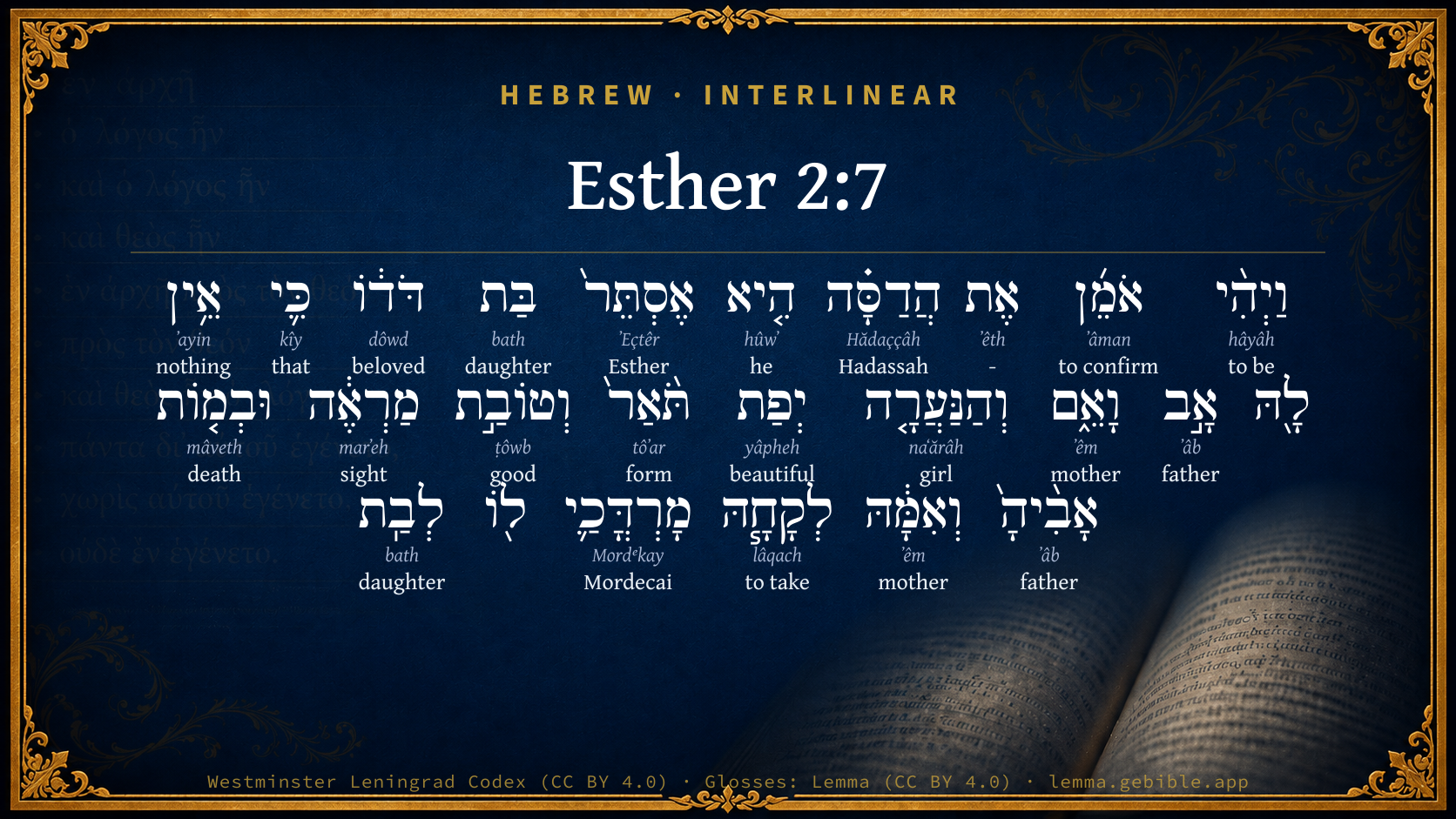
Esther 2:7

Hebrew (Westminster Leningrad Codex) Esther 2:7 appears in the Hebrew Old Testament. The text above is from the Westminster Leningrad Codex. Each word links to its Strong’s number, a concise gloss, and parsing drawn from the Open Scriptures Hebrew Bible morphology. Click any word for its full Brown-Driver-Briggs (BDB) entry.
Download image
Cite this verse

Esther 2:7 (World English Bible). Public Domain. Lemma interlinear Bible study tool, https://lemma.gebible.app/v/esther/2/7.

Show BibTeX & RIS
BibTeX
RIS
English Translation
He brought up Hadassah, who is, Esther, his uncle's daughter: for she had neither father nor mother, and the maiden was fair and beautiful; and when her father and mother were dead, Mordecai took her for his own daughter.
World English Bible · Public Domain
Highlights
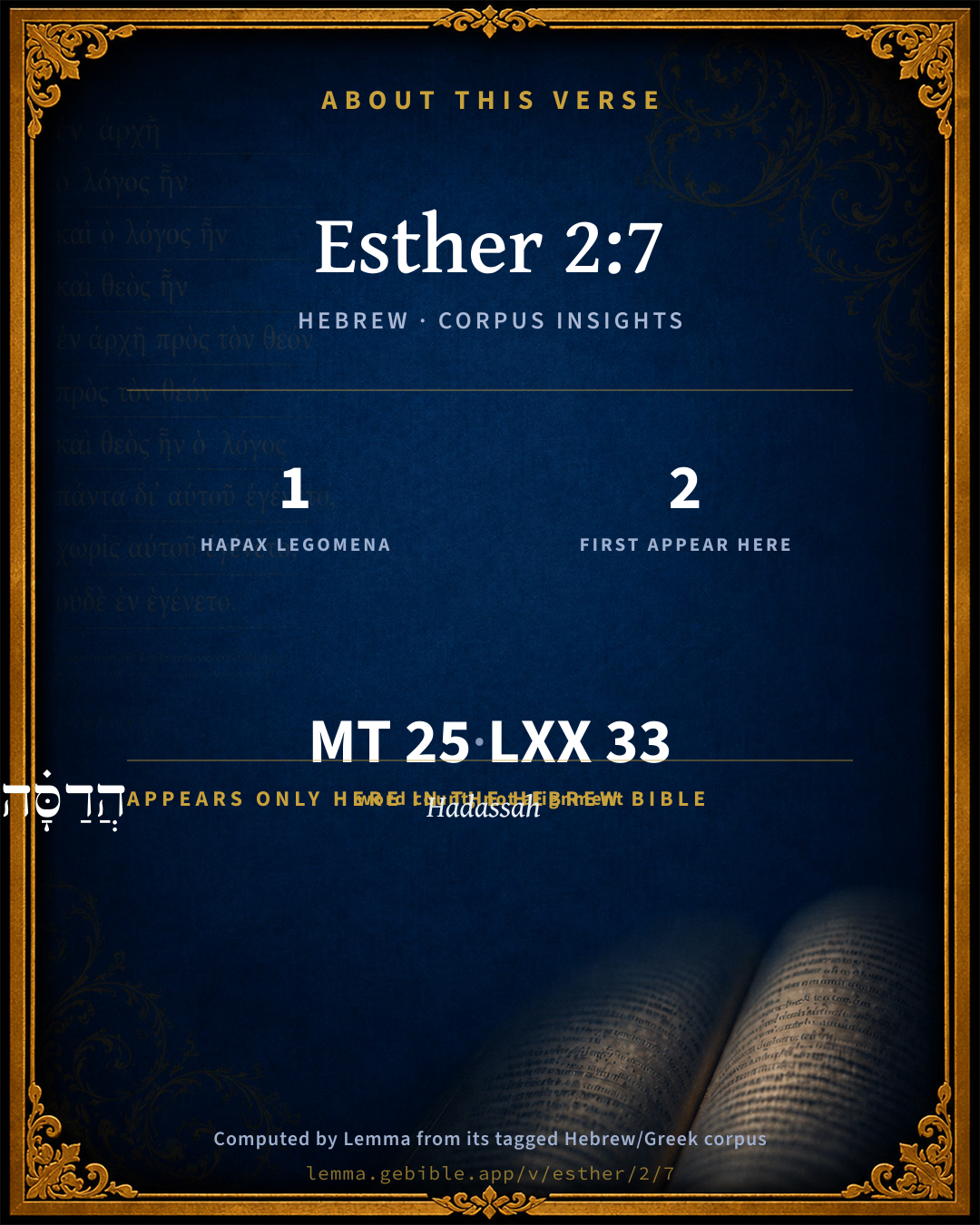
  • 1 hapax legomenon — only here in the Hebrew Bible
  • 2 first appearances in the Hebrew Bible
Full analysis ↓
Download a study sheet

One document with this verse’s original text, its word-by-word gloss line, the meaning frame, cross-references with their text, attributed commentary, and full source and license credits — printable, and it pastes into notes with its structure intact.

This verse Autodidact and up

Study sheet (.html) Plain text (.txt)

A passage Seminary Student

Up to 50 verses in one chapter. A passage sheet keeps up to 6 commentary sources and 12 cross-references per verse, in the order this page ranks them, and says so on the sheet whenever that leaves anything out. Ask for a single verse and you get the Autodidact verse sheet above.

Everything on this page stays free to read, with no account — the sheet is a download of what is already on screen, not access to it.

Want to remove ads? Support Godless Engineer
Compare translations 3

The same verse in 3 English versions, stacked beneath the original-language interlinear above. Click any original word for its lexicon entry.

Each is an independent rendering of the whole verse — the interlinear is not word-aligned to these translations.

Highlighted words mark where these versions differ — a whole-verse word diff, not a word-by-word alignment.

  • World English Bible Public Domain
    He brought up Hadassah, who is, Esther, his uncle's daughter: for she had neither father nor mother, and the maiden was fair and beautiful; and when her father and mother were dead, Mordecai took her for his own daughter.
  • King James Version Public Domain
    And he brought up Hadassah, that is, Esther, his uncle's daughter: for she had neither father nor mother, and the maid was fair and beautiful; whom Mordecai, when her father and mother were dead, took for his own daughter.
  • unfoldingWord Literal Text CC BY-SA 4.0
    And he was fostering Hadassah (she is Esther), the daughter of his uncle, because there was not for her a father or a mother. Now the young woman was beautiful of form and pleasing of appearance. And at the death of her father and her mother, Mordecai had taken her for him as a daughter.

unfoldingWord Literal Text — © unfoldingWord, licensed CC BY-SA 4.0. Word-aligned USFM3 via Door43 (git.door43.org/unfoldingWord/en_ult).

Versions to compare (up to 4)

3 of 4 selected

Show all 18 translations

Every available English version of this verse, each an independent rendering of the whole verse.

  • World English Bible Public Domain
    He brought up Hadassah, who is, Esther, his uncle's daughter: for she had neither father nor mother, and the maiden was fair and beautiful; and when her father and mother were dead, Mordecai took her for his own daughter.
  • Berean Standard Bible Public Domain
    And Mordecai had brought up Hadassah (that is, Esther), the daughter of his uncle, because she did not have a father or mother. The young woman was lovely in form and appearance, and when her father and mother had died, Mordecai had taken her in as his own daughter.
  • Majority Standard Bible Public Domain
    And Mordecai had brought up Hadassah (that is, Esther), the daughter of his uncle, because she did not have a father or mother. The young woman was lovely in form and appearance, and when her father and mother had died, Mordecai had taken her as his own daughter.
  • King James Version Public Domain
    And he brought up Hadassah, that is, Esther, his uncle's daughter: for she had neither father nor mother, and the maid was fair and beautiful; whom Mordecai, when her father and mother were dead, took for his own daughter.
  • American Standard Version (1901) Public Domain
    And he brought up Hadassah, that is, Esther, his uncle's daughter: for she had neither father nor mother, and the maiden was fair and beautiful; and when her father and mother were dead, Mordecai took her for his own daughter.
  • Revised Version (1885) Public Domain
    And he brought up Hadassah, that is, Esther, his uncle’s daughter: for she had neither father nor mother, and the maiden was fair and beautiful; and when her father and mother were dead, Mordecai took her for his own daughter.
  • Geneva Bible (1599) Public Domain
    And he nourished Hadassah, that is Ester, his vncles daughter: for she had neither father nor mother, and the mayde was fayre, and beautifull to looke on: and after the death of her father, and her mother, Mordecai tooke her for his own daughter
  • Douay-Rheims (1899) Public Domain
    And he had brought up his brother's daughter Edissa, who by another name was called Esther: now she had lost both her parents: and was exceeding fair and beautiful. And her father and mother being dead, Mardochai adopted her for his daughter.
  • Young's Literal Translation Public Domain
    and he is supporting Hadassah -- she `is' Esther -- daughter of his uncle, for she hath neither father nor mother, and the young woman `is' of fair form, and of good appearance, and at the death of her father and her mother hath Mordecai taken her to him for a daughter.
  • Literal Standard Version CC BY-SA 4.0
    and he is supporting Hadassah—she [is] Esther—daughter of his uncle, for she has neither father nor mother, and the young woman [is] of beautiful form, and of good appearance, and at the death of her father and her mother Mordecai has taken her to himself for a daughter.
  • Unlocked Literal Bible CC BY-SA 4.0
    He was caring for Hadassah, that is, Esther, his uncle's daughter, because she had neither father nor mother. The young woman had a beautiful figure and was lovely in appearance. Mordecai took her as his own daughter.
  • unfoldingWord Literal Text CC BY-SA 4.0
    And he was fostering Hadassah (she is Esther), the daughter of his uncle, because there was not for her a father or a mother. Now the young woman was beautiful of form and pleasing of appearance. And at the death of her father and her mother, Mordecai had taken her for him as a daughter.
  • Darby Bible Public Domain
    And he brought up Hadassah, that is, Esther, his uncle's daughter; for she had neither father nor mother -- and the maiden was fair and beautiful -- and when her father and mother were dead, Mordecai took her for his own daughter.
  • World Messianic Bible Public Domain
    He brought up Hadassah, that is, Esther, his uncle’s daughter; for she had neither father nor mother. The maiden was fair and beautiful; and when her father and mother were dead, Mordecai took her for his own daughter.
  • Webster's Bible Public Domain
    And he brought up Hadassah, that is, Esther, his uncle's daughter: for she had neither father nor mother, and the maid was fair and beautiful; whom Mordecai, when her father and mother were dead, took for his own daughter.
  • Free Bible Version CC BY-SA 4.0
    He had brought up Hadassah (or Esther), his uncle's daughter, because she had no father or mother. The young woman had a beautiful figure and was very attractive. After her father and mother died, Mordecai had adopted her as his own daughter.
  • Bible in Basic English Public Domain
    And he had been a father to Hadassah, that is Esther, the daughter of his father's brother: for she had no father or mother, and she was very beautiful; and when her father and mother were dead, Mordecai took her for his daughter.
  • JPS Tanakh (1917) Public Domain
    And he brought up Hadassah, that is, Esther, his uncle's daughter; for she had neither father nor mother, and the maiden was of beautiful form and fair to look on; and when her father and mother were dead, Mordecai took her for his own daughter.

Literal Standard Version (2020), Covenant Press — licensed CC BY-SA 4.0. Text via the HelloAO Bible API (eBible.org). Unlocked Literal Bible (unfoldingWord) — licensed CC BY-SA 4.0. Text via the HelloAO Bible API (eBible.org). unfoldingWord Literal Text — © unfoldingWord, licensed CC BY-SA 4.0. Word-aligned USFM3 via Door43 (git.door43.org/unfoldingWord/en_ult). Free Bible Version, Dr. Jonathan Gallagher — licensed CC BY-SA 4.0. Text via the HelloAO Bible API (eBible.org).

Word by word

More ways to search: Search by grammar → Find every occurrence → Compare this word →

Practice this passage: Drill this verse → Learn its vocabulary →

הֲדַסָּ֗ה
Hădaççâh
H1919
“Hadassah”
Noun, Proper
Part of Speech
Noun
Type
Proper
Full BDB Definition

Origin: from of H1918

TWOT: None

Hadassah = "myrtle" - queen Esther's Jewish name
  1. וַיְהִ֨י hâyâh H1961 “and · to be” Conjunction + Verb, Qal, Sequential Imperfect, 3rd Person, Masculine, Singular
  2. אֹמֵ֜ן ʼâman H539 “confirming” Verb, Qal, Participle Active, Masculine, Singular, Absolute
  3. אֶת ʼêth H853 “-” Particle, Direct Object
  4. הִ֤יא hûwʼ H1931 “he” Pronoun, Personal, 3rd Person, Feminine, Singular
  5. אֶסְתֵּר֙ ʼEçtêr H635 “Esther” Noun, Proper
  6. בַּת bath H1323 “daughter of” Noun, Common, Feminine, Singular, Construct
  7. דֹּד֔וֹ dôwd H1730 “beloved · his” Noun, Common, Masculine, Singular, Construct + Suffix, Personal, 3rd Person, Masculine, Singular
  8. כִּ֛י kîy H3588 “that” Conjunction
  9. אֵ֥ין ʼayin H369 “nothing” Particle, Negative
  10. אָ֣ב ʼâb H1 “father” Noun, Common, Masculine, Singular, Absolute
  11. וָאֵ֑ם ʼêm H517 “and · mother” Conjunction + Noun, Common, Feminine, Singular, Absolute
  12. וְהַנַּעֲרָ֤ה naʻărâh H5291 “and · the · girl” Conjunction + Particle, Definite Article + Noun, Common, Feminine, Singular, Absolute
  13. יְפַת yâpheh H3303 “beautiful of” Adjective, Adjective, Feminine, Singular, Construct
  14. תֹּ֨אַר֙ tôʼar H8389 “form” Noun, Common, Masculine, Singular, Absolute
  15. וְטוֹבַ֣ת ṭôwb H2896 “and · good of” Conjunction + Adjective, Adjective, Feminine, Singular, Construct
  16. מַרְאֶ֔ה marʼeh H4758 “sight” Noun, Common, Masculine, Singular, Absolute
  17. וּבְמ֤וֹת mâveth H4194 “and · in/at · death of” Conjunction + Preposition + Noun, Common, Masculine, Singular, Construct
  18. אָבִ֨יהָ֙ ʼâb H1 “father · her” Noun, Common, Masculine, Singular, Construct + Suffix, Personal, 3rd Person, Feminine, Singular
  19. וְאִמָּ֔הּ ʼêm H517 “and · mother · her” Conjunction + Noun, Common, Feminine, Singular, Construct + Suffix, Personal, 3rd Person, Feminine, Singular
  20. לְקָחָ֧הּ lâqach H3947 “to take · her” Verb, Qal, Perfect, 3rd Person, Masculine, Singular + Suffix, Personal, 3rd Person, Feminine, Singular
  21. מָרְדֳּכַ֛י Mordᵉkay H4782 “Mordecai” Noun, Proper
  22. לְבַֽת bath H1323 “to/for · daughter” Preposition + Noun, Common, Feminine, Singular, Absolute

About this verse

These counts appear in no published source. They are computed here, from the morphology-tagged text and Lemma’s own curated glosses. What Lemma adds →

25
words
20
distinct lemmas
Historical
section

Notable vocabulary

1 hapax legomenon — a word that appears only here in the entire Hebrew Bible:

  • הֲדַסָּ֗ה Hadassah H1919

First appearance in Scripture

These words make their first canonical appearance in the Hebrew Bible here:

  • הֲדַסָּ֗ה Hadassah H1919
  • אֶסְתֵּר֙ Esther H635

Shared distinctive vocabulary

תֹּ֨אַר֙ form H8389 occurs in 15 verses of the Hebrew Bible. Also found in:

Grammatical profile

  • 3 verbs
  • 14 nouns
  • 2 adjectives
  • 1 pronoun
  • 2 prepositions
  • 1 conjunction
  • 2 particles

Verb forms

  • וַיְהִ֨י Qal · Sequential Imperfect
  • אֹמֵ֜ן Qal · Participle Active
  • לְקָחָ֧הּ Qal · Perfect

Repetition

Words recur within this verse — often emphatic in Hebrew:

  • בַּת daughter H1323 ×2
  • אָ֣ב father H1 ×2
  • וָאֵ֑ם mother H517 ×2

Hebrew & Septuagint length

In English translation the verse runs 39 words from the Hebrew and 37 from the Septuagint (LXX English) — closely comparable.

A rough comparison of the two English renderings, which tokenize alike — not a word-level alignment.

Word counts can differ between the Hebrew and the Greek without any difference in meaning — e.g. the Hebrew direct-object marker אֵת has no separate Greek word, and Greek often adds the article ὁ.

In the original languages it is 25 Hebrew tokens and 33 Greek tokens — but the two are counted differently (Hebrew bundles its prefixes and suffixes into one token; the Greek is in lemma form), so that isn’t a like-for-like length.

Cross-references

7

Topical passages linked to Esther 2:7 in the Treasury of Scripture Knowledge — connected by theme and wording, ordered by reader-vote popularity; previews shown in the World English Bible.

  • Esther 2:15 Now when the turn of Esther, the daughter of Abihail the uncle of Mordecai, who had taken her for his daughter, was come to go in to the king, she required nothing but what Hegai the king's chamberlain, the keeper of the women, appointed. Esther obtained favor in the sight of all those who looked at her.
  • Esther 1:11 to bring Vashti the queen before the king with the crown royal, to show the peoples and the princes her beauty; for she was beautiful to look on.
  • 2 Corinthians 6:18 I will be to you a Father. You will be to me sons and daughters,' says the Lord Almighty."
  • Ephesians 6:4 You fathers, don't provoke your children to wrath, but nurture them in the discipline and instruction of the Lord.
  • Genesis 48:5 Now your two sons, who were born to you in the land of Egypt before I came to you into Egypt, are mine; Ephraim and Manasseh, even as Reuben and Simeon, will be mine.
  • Jeremiah 32:7–12 Behold, Hanamel the son of Shallum your uncle shall come to you, saying, Buy you my field that is in Anathoth; for the right of redemption is yours to buy it.
  • 1 John 3:1 Behold, how great a love the Father has bestowed on us, that we should be called children of God! For this cause the world doesn't know us, because it didn't know him.

Cross-references courtesy of OpenBible.info (CC BY 4.0).

Hebrew and Greek witnesses Masoretic Hebrew ↔ Greek Septuagint

The same verse in the two great witnesses to the Old Testament, shown verse-for-verse.

These are two independent witnesses, not word-aligned to each other, and the Septuagint is shown in lemma (dictionary) form.

Hebrew Esther 2:7 Masoretic · Westminster Leningrad Codex

וַיְהִ֨י אֹמֵ֜ן אֶת הֲדַסָּ֗ה הִ֤יא אֶסְתֵּר֙ בַּת דֹּד֔וֹ כִּ֛י אֵ֥ין לָ֖הּ אָ֣ב וָאֵ֑ם וְהַנַּעֲרָ֤ה יְפַת תֹּ֨אַר֙ וְטוֹבַ֣ת מַרְאֶ֔ה וּבְמ֤וֹת אָבִ֨יהָ֙ וְאִמָּ֔הּ לְקָחָ֧הּ מָרְדֳּכַ֛י ל֖וֹ לְבַֽת

He brought up Hadassah, who is, Esther, his uncle's daughter: for she had neither father nor mother, and the maiden was fair and beautiful; and when her father and mother were dead, Mordecai took her for his own daughter.

World English Bible · Public Domain

Greek LXX Esther 2:7 Septuagint · lemma form

καί εἰμί οὗτος παῖς θρεπτή θυγάτηρ αμιναδαβ ἀδελφός πατήρ αὐτός καί ὄνομα αὐτός εσθηρ ἐν δέ ὁ μεταἀλλάσσω αὐτός ὁ γονεύς παιδεύω αὐτός ἑαυτοῦ εἰς γυνή καί εἰμί ὁ κοράσιον καλός ὁ εἶδος

And he had a foster child, daughter of Aminadab his father's brother, and her name was Esther; and when her parents were dead, he brought her up for a wife for himself: and the damsel was beautiful.

LXX2012 (modern English Septuagint) · Public Domain

On this verse, John Gill's Exposition discusses the Septuagint’s reading. Read the note in Commentary ↓

Hebrew: Westminster Leningrad Codex (CC BY 4.0). Greek: Septuagint (public domain); English from LXX2012 (modern English Septuagint) (Public Domain). How the Septuagint differs from the Hebrew →

Commentary

Notes on Esther 2:7 from classic Christian and Jewish commentators (each source and its license shown beneath its notes). The classic Christian expositions comment on the surrounding passage and are grouped to its opening verse, so a note may address several verses; the Jewish commentaries on the Tanakh (Rashi and others) are per-verse, so they appear only where the commentator wrote on this verse.

Lemma curates 59 commentaries, every one of them public domain or Creative Commons licensed, each selected and text-cleaned for this edition rather than reprinted as found. About our sources →

Trapp's Complete Commentary

John Trapp

Est 2:7 And he brought up Hadassah, that [is], Esther, his uncle’s daughter: for she had neither father nor mother, and the maid [was] fair and beautiful; whom Mordecai, when her father and mother were dead, took for his own daughter.

Ver. 7. And he brought up] He both nourished and nurtured her in the true religion and admonition of the Lord, Eph 6:4, he was her foster-father and her instructor.

Hadassah] Not the same with Atossa, as Tremellius would have it. Hadassah was the name given her by her parents, and it signifieth a myrtle tree, which loveth to grow in a bottom; whence the Church is compared to it for her lowly mindedness, Zec 1:8. {See Trapp on "Zec 1:8"}

That is, Esther] This was her Persian name, say some: in heathen histories she is called Amestris (Herod. lib. 7, Sealig.).

His uncle’s daughter] Not his brother’s daughter, as the Vulgate rendereth it, after Josephus and Aben Ezra. She was his first cousin, and this was one reason that moved him to adopt her, viz. the bond of nature.

For she had neither father nor mother] A poor orphan she was; but Christ left her not comfortless, Joh 14:18. He had provided and enabled Mordecai, to feed her and raise her; to train her up in the fear of God, and to defend her chastity from the rage of lust; besides that her head was by him destined to a diadem; Esther the captive shall be Esther the queen; Esther, the fatherless and motherless, shall be a nursing mother to the Church; and meanwhile meet with a merciful guardian, Mordecai. Why, then, should we not trust God with ourselves and our children?

And the maid was fair and beautiful] {See Trapp on "Est 2:3"} Gratior est pulchro, &c. For her beauty she was brought to the king; and not without some respect to this it was that she was raised by Mordecai. This beauty was a privilege of nature; and because of the forcible battery that would be laid to it, God gives her a guarding. Esther was now in the flower of her age, and her beauty was the flower of her virtue, as Chrysippus called it.

Whom Mordecai, when her father and mother were dead] And so she might have been put to seek her bread in desolate places, being left to the wide world, as they say; but the Lord was her rereward, Isa 58:8, he took her up, Psa 27:10, as the gathering army or rear guard did the lame, feeble, and sick Israelites, Jos 6:9. In the civil law provision is made for orphans, and such as were cast out; some hospitals to entertain them, some liberties to comfort and compensate their troubles. Among us also, besides harbours and hospitals for such, to the great commendation of the founders, very good provision is made by the laws, and many lives thereby preserved. God oft professes himself the pupils’ patron; gives great charge to all not to hurt them, and menaces the Jews for their hardheartedness toward them. Let, therefore, the dying parents of such (though they have as little to leave them as Esther’s had) cast them by faith into God’s everlasting arms, who hath charged his angels with them, and hath promised heaven to them; commanding his best creatures to cater for them, Hos 2:21-22.

Took for his own daughter] He hid not his eyes from his own flesh, Isa 58:7, as some unnatural ostrich or sea monster; he made not, as many do, tuition a broker for private gain; he made not instead of a daughter a slave, or spunge, of his pupil; he devoured her not under pretence of devotion; but freely took her for his child, and bred her in the best manner. Now the Jews at this very day account a child’s tutor or monitor worthy of more respect than his father; for he, say they, hath given him only his being, but the other his well-being (Leo. Mod.).

John Trapp, A Commentary or Exposition upon All the Books of the Old and New Testament (1647–1656) — public domain. Text from a community e-Sword module.

Joseph Benson's Commentary

Est 2:7-8. And he brought up Hadassah, that is, Esther — Hadassah was her Hebrew name, before her marriage; and she was called Esther by the king after it. Esther was brought also unto the king’s house — Or taken, and that by force, as the word תלקח, tillakach, often signifies: for so great was the power and tyranny of the Persian kings, that they could and did take what persons they liked to their own use.

Joseph Benson's Commentary on the Old and New Testaments (1811–1818) — public domain. Text from a community e-Sword module.

Tyndale Open Study Notes

Tyndale Open Resources

2:7 Hadassah is a Hebrew name that means myrtle; Esther is a Persian name that means star.

Tyndale Open Study Notes — © Tyndale Open Resources, licensed CC BY-SA 4.0. Text via the HelloAO Bible API.

Adam Clarke's Commentary

Verse 7. He brought up Hadassah] הדשה hadassah signifies a myrtle in Chaldee: this was probably her first or Babylonish name. When she came to the Persian court, she was called Esther, [Persian] aster, or [Persian] sitara, which signifies a star in Persian: the name is undoubtedly Persian. Esther was the daughter of Abihail, the uncle of Mordecai, and therefore must have been Mordecai's cousin, though the Vulgate and Josephus make her Mordecai's niece: but it is safest here to follow the Hebrew.

Adam Clarke's Commentary on the Bible (1810–1826) — public domain. Text from a community e-Sword/MySword module.

Ellicott's Commentary for English Readers

(7) Hadassah.—This is evidently formed from the Hebrew hadas, the myrtle: Esther is generally assumed to be a Persian name, meaning a star. Unless we assume that this latter name was given afterwards, and is here used by anticipation, we have here an early case of the common Jewish practice of using two names, a Hebrew and a Gentile one—e.g., Saul, Paul; John, Mark; Joses, Justus, &c.

Uncle.—Abihail (see Est_2:15).

A Bible Commentary for English Readers, edited by Charles John Ellicott (1878–1897) — public domain. Text from a community e-Sword module.

The Cambridge Bible for Schools and Colleges

gen. ed. J. J. S. Perowne

7. brought up] Heb. was foster-father to Hadassah. The word is rendered ‘nursing-father’ in Num_11:12; Isa_49:23.

Hadassah, that is, Esther] Hadassah, from the Heb. hãdas, ‘myrtle.[66]’ For this was substituted, either on her becoming queen or earlier, the name Esther, from the Persian Sitareh, a star, or from Istar, the Assyrio-Babylonian equivalent of Ashtoreth. For the attempt to identify her with Amestris, the wife of Xerxes, see Introduction, p. xiv. The fact that Mordecai took Esther to be as his own daughter is given as accounting for the familiarity between them.

[66] Cp. the Greek names Μυρτία, Μυῤῥίνη, Μύρτις.

The Targum Shçnî expounds, from the Jewish point of view, the significance of the name Hadassah. She was so called “because as the myrtle spreads fragrance in the world, so did she spread good works. And for this cause she was called in the Hebrew language Hadassah, because the righteous are likened to myrtle.” The same commentary adds, “She was also called Hadassah because, as the myrtle does not dry up either in summer or in winter, so the righteous have a share in this world and in the world to come.” (Cassel, Comm. pp. 299 f.)

his uncle’s daughter] The Heb. which properly means uncle, viz. a father’s brother, has also sometimes a wider sense, beloved one, friend. We gather from the story that the writer considered Esther to be much younger than her cousin Mordecai.

The Cambridge Bible for Schools and Colleges (gen. ed. J. J. S. Perowne; Cambridge University Press, 1878–1918) — public domain. Text from a community e-Sword module.

John Gill's Exposition

And he brought up Hadassah (that is Esther) his uncle's daughter,.... Her Hebrew name was Hadassah, which signifies a myrtle, to which the Israelites, and good men among them, are sometimes compared, Zac 1:8. Her Persian name was Esther, which some derive from "satar", to hide, because hidden in the house of Mordecai, so the former Targum, and by his advice concealed her kindred: or rather she was so called by Ahasuerus, when married to him, this word signifying in the Persian language a "star" (h) and so the latter Targum says she was called by the name of the star of Venus, which in Greek is though it is said (i), that the myrtle, which is called "hadassah" in Hebrew, is in the Syriac language "esta"; so "asa" in the Talmud (k) signifies a myrtle; and, according to Hillerus (l), "esther" signifies the black myrtle, which is reckoned the most excellent; and so "amestris", according to him, signifies the sole myrtle, the incomparable one. Xerxes had a wife, whose name was Amestris, which Scaliger thinks is as if it was , and the same with Esther; but to this are objected, that her father's name was Otanes, and her cruelty in the mutilation of the wife of Masistis, her husband's brother, and burning alive fourteen children of the best families of the Persians, as a sacrifice to the infernal gods; and besides, Xerxes had a son by her marriageable, in the seventh year of this reign (m), the year of Ahasuerus, in which he married Esther: but it is observed by some, that these things are confounded with the destruction of Haman's family, or told by the Persians to obliterate the memory of Esther, from whom they passed to the Greek historians:

for she had neither father nor mother; according to the former Targum, her father died and left her mother with child of her, and her mother died as soon as she was delivered of her:

and the maid was fair and beautiful; which was both the reason why she was taken and brought into the king's house, and why Mordecai took so much care of her:

whom Mordecai, when her father and mother were dead, took for his own daughter; loved her, and brought her up as if she had been his daughter, and called her so, as the Targum. The Rabbins, as Jarchi and Aben Ezra observe, say, he took her in order to make her his wife; and so the Septuagint render it; though perhaps no more may be intended by that version than that he brought her up to woman's estate. Josephus (n) calls him her uncle; and so the Vulgate Latin version, his brother's daughter; but both are mistaken.

(h) Castell. Lex. Persic. Latin. col. 329. Vid. Pfeiffer. difficil. Script. cent. 3. loc. 28. (i) Caphtor Uperah, fol. 60. 2. (k) T. Bab. Sanhedrin, fol. 44. 1. (l) Onomastic. Sacr. p. 621, 622. (m) Herodot. Calliope, sive, l. 9. c. 107. 111. & Polymnia, sive, l. 7. c. 61. 114. (n) Ut supra. (Antiqu. l. 11. c. 6. sect. 2.)

John Gill's Exposition of the Whole Bible (1746–1763) — public domain (CC PDM 1.0). Text via the HelloAO Bible API.

Albert Barnes' Notes on the Bible

Hadassah, הדסה hădassâh from הדס hădas (“myrtle”) would seem to have been the Hebrew, and Esther the Persian, name of the damsel. Esther is thought to be connected through the Zend with ἀστήρ astēr, “star.” But there is not at present any positive evidence of the existence in Old Persian of a kindred word.

Albert Barnes' Notes on the Bible (1834–1885) — public domain. Text from a community e-Sword/MySword module.

Haydock's Catholic Bible Commentary

Brothers. Josephus, ([Antiquities?] xi. 6.) the old Latin version of the Syriac, Abenezra, &c., suppose that Mardochai was uncle to Esther. But the Hebrew, Syriac, Greek, and Chaldean assert that he was only her cousin. Septuagint, "daughter of Aminadab, (or rather Abihail, ver. 15.) his father’s brother, and her name was Esther; and after her parents were dead, he educated her for a wife;" Greek: eis gunaika, as some Rabbins also maintain, believing she was an heiress. Yet other Greek copies, Hebrew, &c., read, "he educated her as a daughter, Greek: thugatera: for the damsel was very beautiful." He had probably adopted her. (Calmet) --- Edissa. Hebrew hadassa, (Haydock) or hadassah, signified "of myrtle." (Menochius) --- Esther, "a sheep." (Calmet)

George Leo Haydock (1774–1849), Haydock's Catholic Family Bible and Commentary, 1859 edition — public domain. Excludes Psalms (Douay-Rheims chapter numbering differs from Protestant) and Deuterocanonical books (Catholic canon only).

Matthew Poole's English Annotations

That is, Esther; Hadassah was her Hebrew name before her marriage, and she was called Esther by the king after it.

Matthew Poole's English Annotations on the Holy Bible (1683–1685) — public domain. Text from a community e-Sword/MySword module.

Whedon's Commentary on the Bible

Daniel D. Whedon

7. Hadassah, that is, Esther — Tyrwhitt regards Hadassah as the court name, by which she was known among the Persians, and Esther as her Jewish maiden name, by which she was known to her own people. But to this it may be fairly replied that she would be more likely to be known to her own people as well as to the Persians by her royal name; and most interpreters have naturally understood from the expression, he brought up Hadassah, which is Esther, that Hadassah was her early maiden name, and that she took the name of Esther when she became queen. Moreover Hadassah is of Semitic origin, and signifies myrtle; while Esther is the Persian word for star, (Greek, αστηρ.) The fair and beautiful maiden was known as myrtle; the brilliant and fascinating queen was called star. The name Hadassah is, indeed, substantially identical with Atossa, mentioned by the Greek writers as the wife of Darius Hystaspes, and daughter of Cyrus, but the identity in name is insufficient to identify the Jewish virgin with one who is so clearly represented by Herodotus as both daughter of Cyrus and widow of Cambyses. (Herodotus, 3:88.)

His uncle’s daughter — This uncle’s name was Abihail. Est_2:15. Mordecai and Esther were cousins, but Mordecai was evidently much the older.

Daniel D. Whedon (gen. ed.), Commentary on the Old and New Testaments (1874–1909) — public domain. Text from a community e-Sword module.

The Pulpit Commentary

He brought up Hadassah, that is, Esther. "Hadassah" has been compared with "Atossa," and "Esther" with "Amestris;" but there is probably no more ground for the one identification than the other. Mordecai"s cousin received originally the Hebrew name of "Hadassah," a derivative of hadas "myrtle" (compare Susannah" from shushan, "lily"); but was subsequently called by the Persians "Esther," which may either be Ishtar, "Venus," or an equivalent of the Zend ctare, Mod. Pers. sitareh, Greek ajsthr, Engl. "star," etc. His uncle"s daughter. Therefore his own first cousin, but probably much younger than himself. Whom Mordecai took for his own daughter . Not perhaps By a formal adoption, but by taking her to live with him, and treating her as if she had been his own child. This fact is related to account for the terms of familiarity between the two, which form an essential part of the later narrative. It introduces Mordecai to the reader under a favourable aspect, as kindly and benevolent.

Esther.

The Jewess after whom this sacred book is called has been always regarded by her nation with affectionate gratitude, on account of the service she rendered to Israel during the captivity. And there are some features of her character which claim our notice and admiration, and which explain the position she holds in the heart of the Hebrew people. We recognise in Esther

I FILIAL AFFECTION AND REVERENCE. An orphan, she was adopted by her cousin and senior, Mordecai, who "took her for his own daughter," and "brought her up." Accordingly, she treated Mordecai as her father. His will was law to her. She sought and obeyed his advice. Even when upon the throne she did not lose her reverence for the guardian of her youth.

II A PRUDENT AND AMIABLE DEMEANOUR. When in a strange place, and in unfamiliar society, and in a difficult position, Esther commended herself to the favour of those with whom she was brought into contact. Simple, unexacting, compliant, she won all hearts.

III WIFELY AFFECTION AND DEVOTION. Esther rapidly gained influence over the king, who raised her to share his throne. She evidently gained her position and influence not by haughtiness and arrogance, but by amiability and affection, by humility and grace.

IV SINCERE PATRIOTISM. "How," said she to the king, "can I endure to see the evil that shall come unto my people? or how can I endure to see the destruction of my kindred?" Though raised to be a queen, she did not forget the people amongst whom her earliest years had been passed, and in whose religion she had been trained.

V WISDOM AND BOLDNESS OF POLICY. Esther, as the queen of an arbitrary and capricious monarch, was placed in a position of immense difficulty. She conducted herself with wonderful discretion. Especially she knew when to act with a firm though modest boldness. Her whole conduct, with regard to Haman and with regard to Ahasuerus, was marked by sagacity, patience, and a wise audacity. And it resulted in a conspicuous and happy success. The poor orphan captive came to a throne, and thence wrote with all authority to confirm decrees, delivered a nation from impending peril, and instituted a festival which has lasted through centuries of human history.

Adoption.

Esther was early left fatherless and motherless, and in her orphanage found a friend and benefactor in Mordecai, her cousin, and evidently her senior by many years. He adopted her, and treated her as his own child. Under his roof and protection she lived, until, for her beauty, she was selected for the household of the king. This is but one of many illustrations of the practice of adop tion issuing in signal advantages to both parties.

I Observe THE ADVANTAGES ESTHER SECURED through Mordecai"s adoption of her as his own daughter. Her wants were supplied; a home was provided for her, a suitable education was given her, and her character was trained-to habits of obedience and piety. She was protected from the temptations which might otherwise have assailed a beautiful orphan girl. And in due time her station and her work in life were pointed out by Divine providence.

II Observe THE BLESSINGS WHICH ACCRUED TO MORDECAI HIMSELF through his adoption of Esther. His home was brightened by the presence of a bright and lovely daughter; his heart was gladdened by her filial affection and gratitude; his solicitude and care were rewarded by her attention to his wishes and compliance with his admonitions. And, more than all, the time came when his adopted daughter was the agent in saving his life and the life of the community and people to which they both belonged. Never could he regret having received Esther as his own child. Ever must he have looked back upon his adoption of her as one of the wisest acts of his life; as one which God manifestly smiled upon and blessed.

III Consider THE LIGHT WHICH ADOPTION CASTS UPON THE RELATION BETWEEN GOD, THE DIVINE FATHER, AND THE CHILDREN OF HIS SPIRITUAL FAMILY. It is to Divine, adopting love that we owe our position of privilege, happiness, and hope. "What manner of love hath the Father bestowed upon us, that we should be called the children of God?" Happy we if we have received the Spirit of adoption, whereby we cry, Abba, Father! What obligations to gratitude and affectionate obedience are connected with the pity of God and the grace of Christ, through which we have been received into the heavenly family!

Practical lessons:

1. There may be those, people of good means, and childless especially, whomay do wisely, who may exercise true benevolence, by adopting an orphan child, and receiving such a destitute one into their home. How much better this than subscribing to an orphan asylum, excellent and useful though that may be.

2. Adopted children are laid under a stringent obligation to recompense thekindness shown them by their benefactors, by their obedience, devotion, and anxiety to serve and please. Scarcely inferior to the claim parents have upon their own offspring is that they have upon the children they have adopted as their own.

3. Great is the mercy of God, who invites us, "by nature children ofwrath," into his spiritual family. There can be no question more momentous for each hearer of the gospel than this: "Am I a child of God through faith in Christ Jesus?"

The Pulpit Commentary (1880–1919), ed. H.D.M. Spence-Jones & Joseph S. Exell — public domain. Text from a community e-Sword module.

John Wesley's Explanatory Notes

Esther - Hadassah was her Hebrew name before her marriage; and she was called Esther by the king after it.

John Wesley, Explanatory Notes Upon the Whole Bible (1754–1765) — public domain. Text via the GEBible commentary corpus.

unfoldingWord translationNotes

Door43 World Missions Community

Connecting Statement:

This continues the background information about Mordecai and explains his relationship to Esther. (See: Background Information)

Hadassah

This is Esther's Hebrew name. (See: How to Translate Names)

his uncle's daughter

"his cousin"

she had neither father nor mother

"her father and mother had died"

took her as his own daughter

"cared for her as if she was his own daughter"

translationWords

Esther

Mordecai

unfoldingWord translationNotes — © Distant Shores Media and the Door43 World Missions Community, licensed CC BY-SA 4.0. Source: git.door43.org/Door43/en_tn.

Rashi

Rabbi Shlomo Yitzchaki (Rashi)

for a daughter Heb. לְבַת. Our Sages explained: לבית, for a house, meaning for a wife.

Rashi on the Tanakh — English translations: “The Judaica Press complete Tanach with Rashi, translated by A. J. Rosenberg” (CC BY 4.0); “Pentateuch with Rashi's commentary by M. Rosenbaum and A.M. Silbermann, 1929-1934” (public domain); “The Metsudah Tanach series, Lakewood, N.J” (CC BY 4.0); and “The Book of Joshua, Metsudah Publications, 1997” (CC BY 4.0). Text via Sefaria.

Lesson kit

Teaching starters — assembled from the data on this page, not authored interpretation. Every prompt links to the verse data it draws on. Edit before teaching.

Esther, in the Historical, opens this verse with 25 words (20 distinct Hebrew lemmas). Its most distinctive word is Hădaççâh (“Hadassah”). A historical commentator’s framing appears above. Read the whole chapter for the surrounding context.

Discussion questions

  1. What does “Hadassah” (Hădaççâh) contribute to the verse as a whole?
  2. This verse holds 1 word here found nowhere else in the Hebrew Bible. What might the rare word draw attention to?
  3. 2 words here appear for the first time in Scripture. What is being introduced at this debut?
  4. Genesis 29:17 shares the word «form» with this verse. How do the two illuminate each other?
  5. “daughter” occurs 2× in this one verse. What is the effect of the repetition?
  6. These translations render this verse differently; the difference is in the English rendering, not the original. What questions does that raise?
  7. The verb «וַיְהִ֨י» is Qal Sequential Imperfect. How does its form color the action?
  8. Reading how Trapp's Complete Commentary and Joseph Benson's Commentary read this verse, where do the two commentators agree and where do they part?

Things to notice

  • 1 word in this verse appears nowhere else in the Hebrew Bible.
  • 2 words make their first canonical appearance in Scripture here.
  • This verse counts 25 Hebrew ↔ 33 Greek words.
  • These translations choose different wording for 26 words in this verse.
  • “daughter” occurs 2× in this single verse.

Reading settings

Reading text

Shown beneath each verse's original-language words.

Old Testament
Old Testament edition

Read the OT as the Masoretic Hebrew (MT) or the Greek Septuagint (LXX).

English shown for the Greek Septuagint (in the Hebrew ↔ Greek comparison).

Comparing translations? Open the Compare panel on any verse page to stack up to four side by side.