
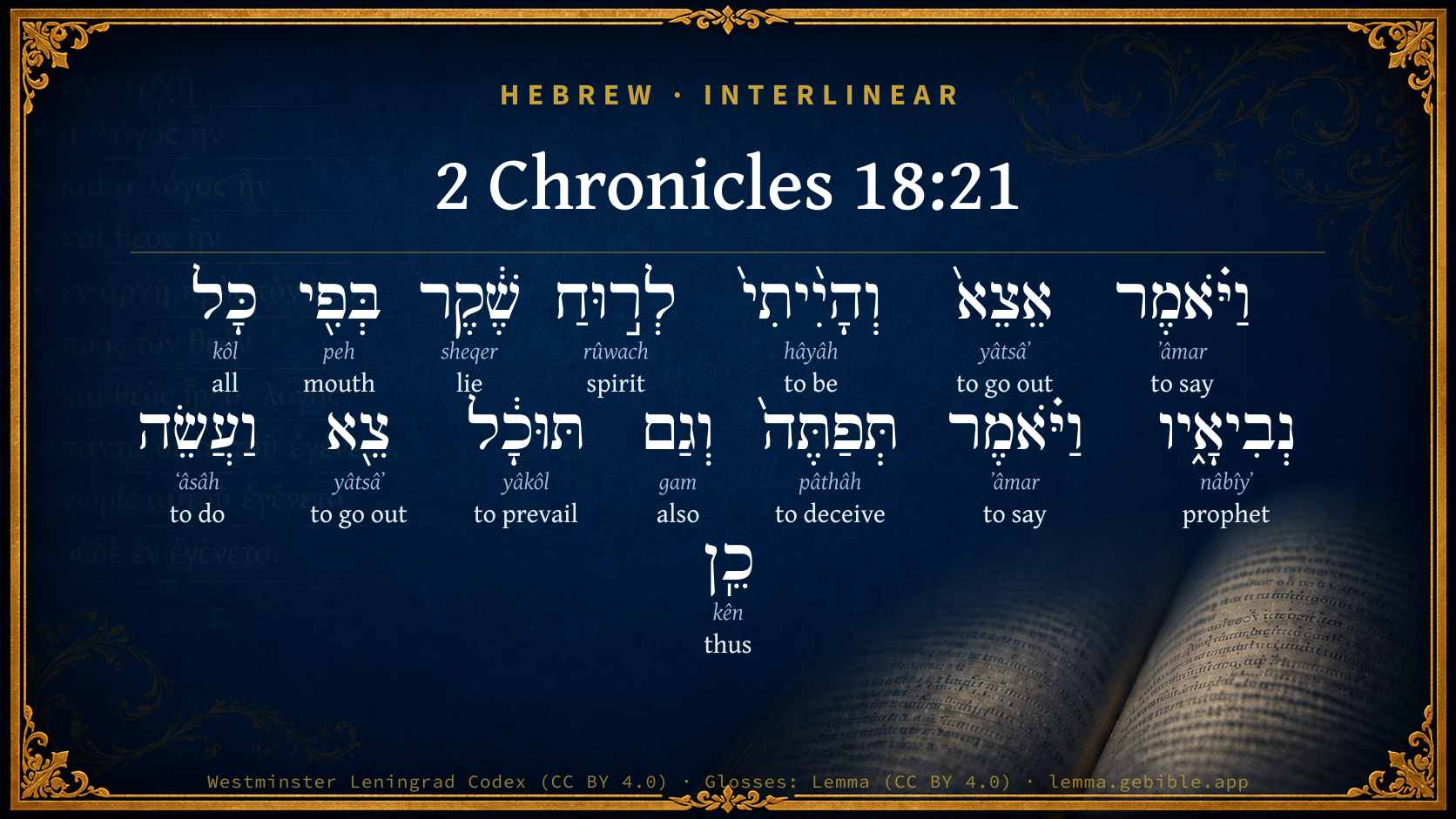
2 Chronicles 18:21

Hebrew (Westminster Leningrad Codex) 2 Chronicles 18:21 appears in the Hebrew Old Testament. The text above is from the Westminster Leningrad Codex. Each word links to its Strong’s number, a concise gloss, and parsing drawn from the Open Scriptures Hebrew Bible morphology. Click any word for its full Brown-Driver-Briggs (BDB) entry.
Download image
Cite this verse

2 Chronicles 18:21 (World English Bible). Public Domain. Lemma interlinear Bible study tool, https://lemma.gebible.app/v/2-chronicles/18/21.

Show BibTeX & RIS
BibTeX
RIS
English Translation
He said, 'I will go forth, and will be a lying spirit in the mouth of all his prophets.' He said, 'You shall entice him, and shall prevail also: go forth, and do so.'
World English Bible · Public Domain
Download a study sheet

One document with this verse’s original text, its word-by-word gloss line, the meaning frame, cross-references with their text, attributed commentary, and full source and license credits — printable, and it pastes into notes with its structure intact.

This verse Autodidact and up

Study sheet (.html) Plain text (.txt)

A passage Seminary Student

Up to 50 verses in one chapter. A passage sheet keeps up to 6 commentary sources and 12 cross-references per verse, in the order this page ranks them, and says so on the sheet whenever that leaves anything out. Ask for a single verse and you get the Autodidact verse sheet above.

Everything on this page stays free to read, with no account — the sheet is a download of what is already on screen, not access to it.

Want to remove ads? Support Godless Engineer
Compare translations 3

The same verse in 3 English versions, stacked beneath the original-language interlinear above. Click any original word for its lexicon entry.

Each is an independent rendering of the whole verse — the interlinear is not word-aligned to these translations.

Highlighted words mark where these versions differ — a whole-verse word diff, not a word-by-word alignment.

  • World English Bible Public Domain
    He said, 'I will go forth, and will be a lying spirit in the mouth of all his prophets.' He said, 'You shall entice him, and shall prevail also: go forth, and do so.'
  • King James Version Public Domain
    And he said, I will go out, and be a lying spirit in the mouth of all his prophets. And the Lord said, Thou shalt entice him, and thou shalt also prevail: go out, and do even so.
  • unfoldingWord Literal Text CC BY-SA 4.0
    And he said, ‘I will go out and I will become a spirit of deception in the mouth of all his prophets.’ And he said, ‘You will entice, and also you will be able. Go out and do thus.’

unfoldingWord Literal Text — © unfoldingWord, licensed CC BY-SA 4.0. Word-aligned USFM3 via Door43 (git.door43.org/unfoldingWord/en_ult).

Versions to compare (up to 4)

3 of 4 selected

Show all 18 translations

Every available English version of this verse, each an independent rendering of the whole verse.

  • World English Bible Public Domain
    He said, 'I will go forth, and will be a lying spirit in the mouth of all his prophets.' He said, 'You shall entice him, and shall prevail also: go forth, and do so.'
  • Berean Standard Bible Public Domain
    And he replied, ‘I will go out and be a lying spirit in the mouths of all his prophets.’ ‘You will surely entice him and prevail,’ said the LORD. ‘Go and do it.’
  • Majority Standard Bible Public Domain
    And he replied, ‘I will go out and be a lying spirit in the mouths of all his prophets.’ ‘You will surely entice him and prevail,’ said the LORD. ‘Go and do it.’
  • King James Version Public Domain
    And he said, I will go out, and be a lying spirit in the mouth of all his prophets. And the Lord said, Thou shalt entice him, and thou shalt also prevail: go out, and do even so.
  • American Standard Version (1901) Public Domain
    And he said, I will go forth, and will be a lying spirit in the mouth of all his prophets. And he said, Thou shalt entice him, and shalt prevail also: go forth, and do so.
  • Revised Version (1885) Public Domain
    And he said, I will go forth, and will be a lying spirit in the mouth of all his prophets. And he said, Thou shalt entice him, and shalt prevail also: go forth, and do so.
  • Geneva Bible (1599) Public Domain
    And he saide, I will goe out, and bee a false spirit in the mouth of all his Prophets. And hee said, Thou shalt perswade, and shalt also preuaile: goe forth and do so.
  • Douay-Rheims (1899) Public Domain
    And he answered: I will go out, and be a lying spirit in the mouth of all his prophets. And the Lord said: Thou shalt deceive, and shalt prevail: go out, and do so.
  • Young's Literal Translation Public Domain
    and he saith, I go out, and have become a spirit of falsehood in the mouth of all his prophets. And He saith, Thou dost entice, and also, thou art able; go out and do so.
  • Literal Standard Version CC BY-SA 4.0
    And he says, I go out, and have become a spirit of falsehood in the mouth of all his prophets. And He says, You entice, and also, you are able; go out and do so.
  • Unlocked Literal Bible CC BY-SA 4.0
    The spirit replied, 'I will go out and I will become a lying spirit in the mouth of all his prophets.' Yahweh replied, 'You will entice him, and you will also be successful. Go now and do so.'
  • unfoldingWord Literal Text CC BY-SA 4.0
    And he said, ‘I will go out and I will become a spirit of deception in the mouth of all his prophets.’ And he said, ‘You will entice, and also you will be able. Go out and do thus.’
  • Darby Bible Public Domain
    And he said, I will go forth, and will be a lying spirit in the mouth of all his prophets. And he said, Thou shalt entice [him], and also succeed: go forth, and do so.
  • World Messianic Bible Public Domain
    “He said, ‘I will go, and will be a lying spirit in the mouth of all his prophets.’ “He said, ‘You will entice him, and will prevail also. Go and do so.’
  • Webster's Bible Public Domain
    And he said, I will go out, and be a lying spirit in the mouth of all his prophets. And the LORD said, Thou shalt entice him, and thou shalt also prevail: go out and do even so.
  • Free Bible Version CC BY-SA 4.0
    ‘I will go and be a lying spirit and make all his prophets tell lies,’ the spirit replied. ‘That will work,’ the Lord responded. ‘Go and do it.’
  • Bible in Basic English Public Domain
    And he said, I will go out and be a spirit of deceit in the mouth of all his prophets. And the Lord said, Your trick will have its effect on him: go out and do so.
  • JPS Tanakh (1917) Public Domain
    And he said: I will go forth, and will be a lying spirit in the mouth of all his prophets. And He said: Thou shalt entice him, and shalt prevail also; go forth, and do so.

Literal Standard Version (2020), Covenant Press — licensed CC BY-SA 4.0. Text via the HelloAO Bible API (eBible.org). Unlocked Literal Bible (unfoldingWord) — licensed CC BY-SA 4.0. Text via the HelloAO Bible API (eBible.org). unfoldingWord Literal Text — © unfoldingWord, licensed CC BY-SA 4.0. Word-aligned USFM3 via Door43 (git.door43.org/unfoldingWord/en_ult). Free Bible Version, Dr. Jonathan Gallagher — licensed CC BY-SA 4.0. Text via the HelloAO Bible API (eBible.org).

Word by word

More ways to search: Search by grammar → Find every occurrence → Compare this word →

Practice this passage: Drill this verse → Learn its vocabulary →

תְּפַתֶּה֙
pâthâh
H6601
“to deceive”
Verb, Piel, Imperfect, 2nd Person, Masculine, Singular
Part of Speech
Verb
Stem
Piel
Form
Imperfect
Person
2nd Person
Gender
Masculine
Number
Singular
Full BDB Definition

Origin: a primitive root

TWOT: 1853

to be spacious, be open, be wide - (Qal) to be spacious or open or wide - (Hiphil) to make spacious, make open - to be simple, entice, deceive, persuade - (Qal) - to be open-minded, be simple, be naive - to be enticed, be deceived - (Niphal) to be deceived, be gullible - (Piel) - to persuade, seduce - to deceive - (Pual) - to be persuaded - to be deceived
  1. וַיֹּ֗אמֶר ʼâmar H559 “and · to say” Conjunction + Verb, Qal, Sequential Imperfect, 3rd Person, Masculine, Singular
  2. אֵצֵא֙ yâtsâʼ H3318 “to go out” Verb, Qal, Imperfect, 1st Person, Common, Singular
  3. וְהָיִ֨יתִי֙ hâyâh H1961 “and · to be” Conjunction + Verb, Qal, Sequential Perfect, 1st Person, Common, Singular
  4. לְר֣וּחַ rûwach H7307 “to/for · spirit of” Preposition + Noun, Common, Both, Singular, Construct
  5. שֶׁ֔קֶר sheqer H8267 “lie” Noun, Common, Masculine, Singular, Absolute
  6. בְּפִ֖י peh H6310 “in/at · mouth of” Preposition + Noun, Common, Masculine, Singular, Construct
  7. כָּל kôl H3605 “all of” Noun, Common, Masculine, Singular, Construct
  8. נְבִיאָ֑יו nâbîyʼ H5030 “prophets · his” Noun, Common, Masculine, Plural, Construct + Suffix, Personal, 3rd Person, Masculine, Singular
  9. וַיֹּ֗אמֶר ʼâmar H559 “and · to say” Conjunction + Verb, Qal, Sequential Imperfect, 3rd Person, Masculine, Singular
  10. וְגַם gam H1571 “and · also” Conjunction + Particle, Accusative
  11. תּוּכָ֔ל yâkôl H3201 “to prevail” Verb, Qal, Imperfect, 2nd Person, Masculine, Singular
  12. צֵ֖א yâtsâʼ H3318 “go out” Verb, Qal, Imperative, 2nd Person, Masculine, Singular
  13. וַעֲשֵׂה ʻâsâh H6213 “and · do” Conjunction + Verb, Qal, Imperative, 2nd Person, Masculine, Singular
  14. כֵֽן kên H3651 “thus” Adverb

About this verse

These counts appear in no published source. They are computed here, from the morphology-tagged text and Lemma’s own curated glosses. What Lemma adds →

15
words
13
distinct lemmas
Historical
section

Shared distinctive vocabulary

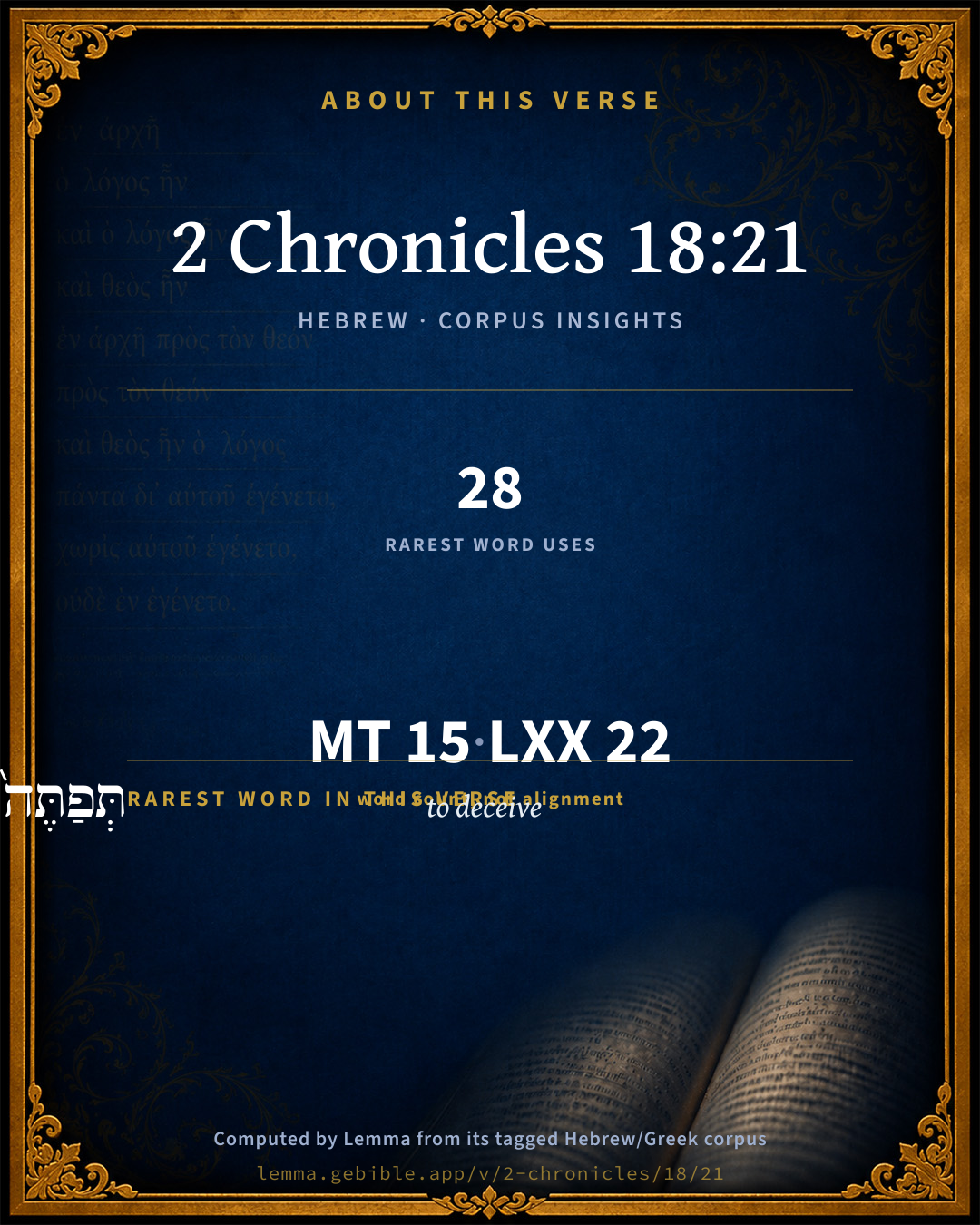
תְּפַתֶּה֙ to deceive H6601 occurs in 26 verses of the Hebrew Bible. Also found in:

Grammatical profile

  • 8 verbs
  • 5 nouns
  • 1 adverb
  • 1 particle

Verb forms

  • וַיֹּ֗אמֶר Qal · Sequential Imperfect
  • אֵצֵא֙ Qal · Imperfect
  • וְהָיִ֨יתִי֙ Qal · Sequential Perfect
  • וַיֹּ֗אמֶר Qal · Sequential Imperfect
  • תְּפַתֶּה֙ Piel · Imperfect
  • תּוּכָ֔ל Qal · Imperfect
  • צֵ֖א Qal · Imperative
  • וַעֲשֵׂה Qal · Imperative

Repetition

Words recur within this verse — often emphatic in Hebrew:

  • וַיֹּ֗אמֶר to say H559 ×2
  • אֵצֵא֙ to go out H3318 ×2

Hebrew & Septuagint length

In English translation the verse runs 34 words from the Hebrew and 36 from the Septuagint (LXX English) — closely comparable.

A rough comparison of the two English renderings, which tokenize alike — not a word-level alignment.

Word counts can differ between the Hebrew and the Greek without any difference in meaning — e.g. the Hebrew direct-object marker אֵת has no separate Greek word, and Greek often adds the article ὁ.

In the original languages it is 15 Hebrew tokens and 22 Greek tokens — but the two are counted differently (Hebrew bundles its prefixes and suffixes into one token; the Greek is in lemma form), so that isn’t a like-for-like length.

Cross-references

13

Topical passages linked to 2 Chronicles 18:21 in the Treasury of Scripture Knowledge — connected by theme and wording, ordered by reader-vote popularity; previews shown in the World English Bible.

  • John 8:44 You are of your Father, the devil, and you want to do the desires of your father. He was a murderer from the beginning, and doesn't stand in the truth, because there is no truth in him. When he speaks a lie, he speaks on his own; for he is a liar, and the father of it.
  • 1 Kings 22:21–22 There came forth a spirit, and stood before Yahweh, and said, I will entice him.
  • Genesis 3:4–5 The serpent said to the woman, "You won't surely die,
  • Judges 9:23 God sent an evil spirit between Abimelech and the men of Shechem; and the men of Shechem dealt treacherously with Abimelech:
  • 2 Chronicles 18:19 Yahweh said, Who shall entice Ahab king of Israel, that he may go up and fall at Ramoth-gilead? One spoke saying after this manner, and another saying after that manner.
  • 2 Chronicles 18:22 Now therefore, behold, Yahweh has put a lying spirit in the mouth of these your prophets; and Yahweh has spoken evil concerning you.
  • Job 1:12 Yahweh said to Satan, "Behold, all that he has is in your power. Only on himself don't put forth your hand." So Satan went forth from the presence of Yahweh.
  • Job 2:6 Yahweh said to Satan, "Behold, he is in your hand. Only spare his life."
  • Psalms 109:17 Yes, he loved cursing, and it came to him. He didn't delight in blessing, and it was far from him.
  • 1 John 4:6 We are of God. He who knows God listens to us. He who is not of God doesn't listen to us. By this we know the spirit of truth, and the spirit of error.
  • Revelation 12:9 The great dragon was thrown down, the old serpent, he who is called the devil and Satan, the deceiver of the whole world. He was thrown down to the earth, and his angels were thrown down with him.
  • Revelation 13:14 He deceives my own people who dwell on the earth because of the signs he was granted to do in front of the beast; saying to those who dwell on the earth, that they should make an image to the beast who had the sword wound and lived.
  • Revelation 20:8 and he will come out to deceive the nations which are in the four corners of the earth, Gog and Magog, to gather them together to the war; the number of whom is as the sand of the sea.

Cross-references courtesy of OpenBible.info (CC BY 4.0).

Hebrew and Greek witnesses Masoretic Hebrew ↔ Greek Septuagint

The same verse in the two great witnesses to the Old Testament, shown verse-for-verse.

These are two independent witnesses, not word-aligned to each other, and the Septuagint is shown in lemma (dictionary) form.

Hebrew 2 Chronicles 18:21 Masoretic · Westminster Leningrad Codex

וַיֹּ֗אמֶר אֵצֵא֙ וְהָיִ֨יתִי֙ לְר֣וּחַ שֶׁ֔קֶר בְּפִ֖י כָּל נְבִיאָ֑יו וַיֹּ֗אמֶר תְּפַתֶּה֙ וְגַם תּוּכָ֔ל צֵ֖א וַעֲשֵׂה כֵֽן

He said, 'I will go forth, and will be a lying spirit in the mouth of all his prophets.' He said, 'You shall entice him, and shall prevail also: go forth, and do so.'

World English Bible · Public Domain

Greek LXX 2 Chronicles 18:21 Septuagint · lemma form

καί εἶπον ἐκἔρχομαι καί εἰμί πνεῦμα ψευδής ἐν στόμα πᾶς ὁ προφήτης αὐτός καί εἶπον ἀπατάω καί δύναμαι ἐκἔρχομαι καί ποιέω οὕτως

And he said, I will go forth, and will be a lying spirit in the mouth of all his prophets. And the Lord said, You shall deceive him, and shall prevail: go forth, and do so.

LXX2012 (modern English Septuagint) · Public Domain

On this verse, Ellicott's Commentary for English Readers discusses the Septuagint’s reading. Read the note in Commentary ↓

Hebrew: Westminster Leningrad Codex (CC BY 4.0). Greek: Septuagint (public domain); English from LXX2012 (modern English Septuagint) (Public Domain). How the Septuagint differs from the Hebrew →

Commentary

Notes on 2 Chronicles 18:21 from classic Christian and Jewish commentators (each source and its license shown beneath its notes). The classic Christian expositions comment on the surrounding passage and are grouped to its opening verse, so a note may address several verses; the Jewish commentaries on the Tanakh (Rashi and others) are per-verse, so they appear only where the commentator wrote on this verse.

Lemma curates 59 commentaries, every one of them public domain or Creative Commons licensed, each selected and text-cleaned for this edition rather than reprinted as found. About our sources →

Geneva Bible (1599)

Geneva Bible translators

That is, the Lord.

Geneva Bible (1599) marginal notes — public domain. Text via Bolls.life.

Ellicott's Commentary for English Readers

(21) And be.—Become (wĕhâyîthî lĕ). Kings omits the particle.

A lying spirit.—A spirit of falsehood. (Comp. Isa_11:2; Isa_19:14; Eze_14:9 : “And the prophet, if he be deceived, and speak a word, it is I, Jehovah, who have deceived that prophet.” The verb “deceive” is that which is rendered “entice” here and in 2Ch_18:19, pittah. LXX., Ἀπατήσεις (See also 2Th_2:11.)

A Bible Commentary for English Readers, edited by Charles John Ellicott (1878–1897) — public domain. Text from a community e-Sword module.

The Cambridge Bible for Schools and Colleges

gen. ed. J. J. S. Perowne

21. go out] R.V. go forth.

The Cambridge Bible for Schools and Colleges (gen. ed. J. J. S. Perowne; Cambridge University Press, 1878–1918) — public domain. Text from a community e-Sword module.

Haydock's Catholic Bible Commentary

So. The Lord permits evil, but he does not approve of it. C. --- Homer makes Jupiter send a deluding dream to Agamemnon. Iliad B. --- The delusive predictions of impostors, are one great source of calamities. D.

George Leo Haydock (1774–1849), Haydock's Catholic Family Bible and Commentary, 1859 edition — public domain. Excludes Psalms (Douay-Rheims chapter numbering differs from Protestant) and Deuterocanonical books (Catholic canon only).

Rashi

Rabbi Shlomo Yitzchaki (Rashi)

in the mouth of all his prophets He should place the words “Go up and triumph,” in their mouths and he [Ahab] will go up and fall. This proves that they were true prophets who would prophesy only that which the Lord put into their mouths.

You will entice and you will prevail When an enticer comes to entice his fellow, the one being enticed sometimes understands that this one wishes to entice him, and he takes heed and does not allow himself to be enticed, but with Ahab, you will entice and you will prevail.

Rashi on the Tanakh — English translations: “The Judaica Press complete Tanach with Rashi, translated by A. J. Rosenberg” (CC BY 4.0); “Pentateuch with Rashi's commentary by M. Rosenbaum and A.M. Silbermann, 1929-1934” (public domain); “The Metsudah Tanach series, Lakewood, N.J” (CC BY 4.0); and “The Book of Joshua, Metsudah Publications, 1997” (CC BY 4.0). Text via Sefaria.

Lesson kit

Teaching starters — assembled from the data on this page, not authored interpretation. Every prompt links to the verse data it draws on. Edit before teaching.

2 Chronicles, in the Historical, opens this verse with 15 words (13 distinct Hebrew lemmas). Its most distinctive word is pâthâh (“to deceive”). A historical commentator’s framing appears above. Read the whole chapter for the surrounding context.

Discussion questions

  1. How does “to deceive” (pâthâh) shape what this verse is saying?
  2. Genesis 9:27 shares the word «to deceive» with this verse. How do the two illuminate each other?
  3. “to say” occurs 2× in this one verse. What is the effect of the repetition?
  4. These translations render this verse differently; the difference is in the English rendering, not the original. What questions does that raise?
  5. The verb «וַיֹּ֗אמֶר» is Qal Sequential Imperfect. How does its form color the action?
  6. Reading how Geneva Bible (1599) and Ellicott's Commentary for English Readers read this verse, where do the two commentators agree and where do they part?

Things to notice

Reading settings

Reading text

Shown beneath each verse's original-language words.

Old Testament
Old Testament edition

Read the OT as the Masoretic Hebrew (MT) or the Greek Septuagint (LXX).

English shown for the Greek Septuagint (in the Hebrew ↔ Greek comparison).

Comparing translations? Open the Compare panel on any verse page to stack up to four side by side.