Nehemiah 3:26

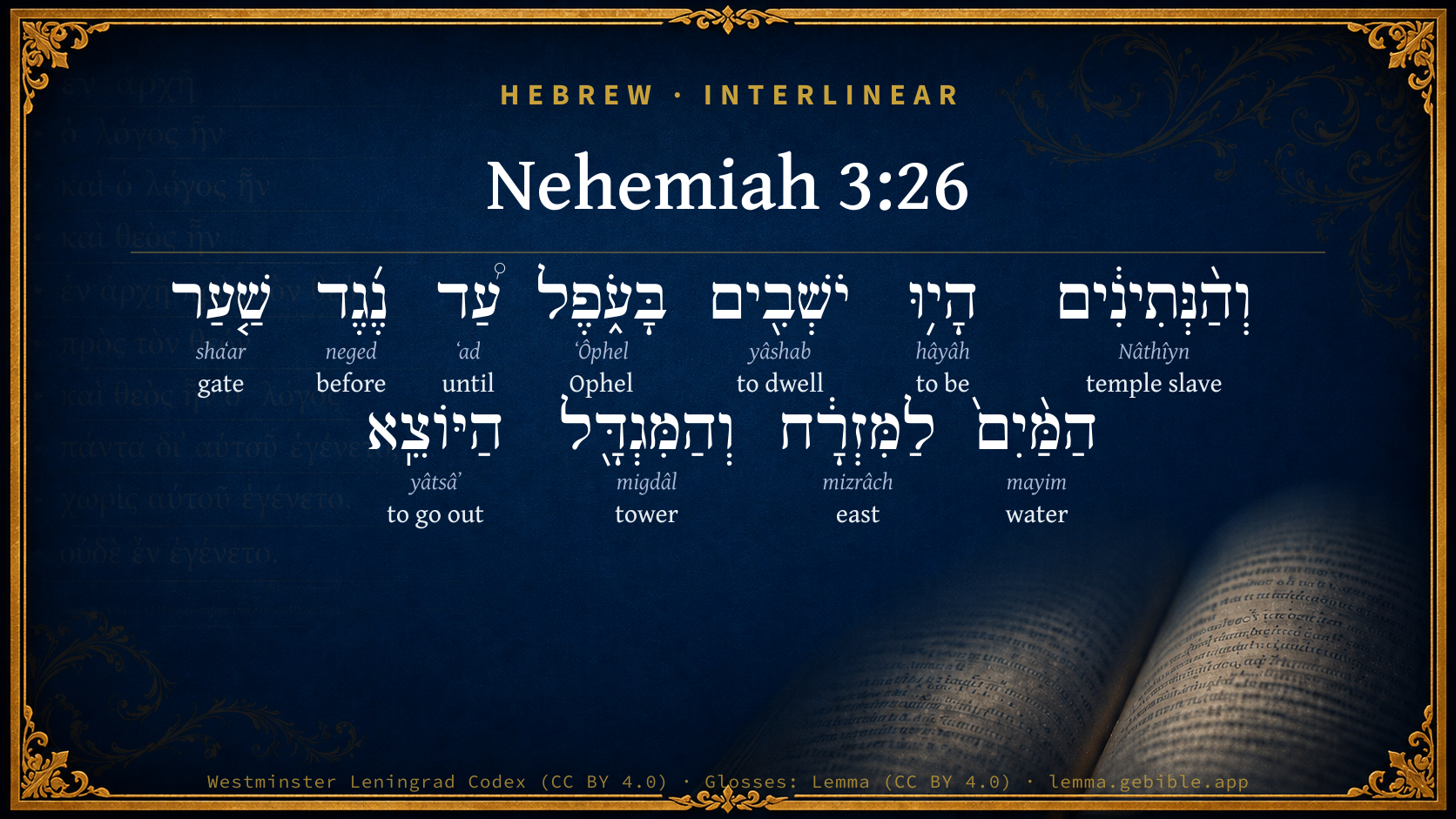
Hebrew (Westminster Leningrad Codex) Nehemiah 3:26 appears in the Hebrew Old Testament. The text above is from the Westminster Leningrad Codex. Each word links to its Strong’s number, a concise gloss, and parsing drawn from the Open Scriptures Hebrew Bible morphology. Click any word for its full Brown-Driver-Briggs (BDB) entry.
Download image
Cite this verse

Nehemiah 3:26 (World English Bible). Public Domain. Lemma interlinear Bible study tool, https://lemma.gebible.app/v/nehemiah/3/26.

Show BibTeX & RIS
BibTeX
RIS
English Translation
(Now the Nethinim lived in Ophel, to the place over against the water gate toward the east, and the tower that stands out.)
World English Bible · Public Domain
Download a study sheet

One document with this verse’s original text, its word-by-word gloss line, the meaning frame, cross-references with their text, attributed commentary, and full source and license credits — printable, and it pastes into notes with its structure intact.

This verse Autodidact and up

Study sheet (.html) Plain text (.txt)

A passage Seminary Student

Up to 50 verses in one chapter. A passage sheet keeps up to 6 commentary sources and 12 cross-references per verse, in the order this page ranks them, and says so on the sheet whenever that leaves anything out. Ask for a single verse and you get the Autodidact verse sheet above.

Everything on this page stays free to read, with no account — the sheet is a download of what is already on screen, not access to it.

Want to remove ads? Support Godless Engineer
Compare translations 3

The same verse in 3 English versions, stacked beneath the original-language interlinear above. Click any original word for its lexicon entry.

Each is an independent rendering of the whole verse — the interlinear is not word-aligned to these translations.

Highlighted words mark where these versions differ — a whole-verse word diff, not a word-by-word alignment.

  • World English Bible Public Domain
    (Now the Nethinim lived in Ophel, to the place over against the water gate toward the east, and the tower that stands out.)
  • King James Version Public Domain
    Moreover the Nethinims dwelt in Ophel, unto the place over against the water gate toward the east, and the tower that lieth out.
  • unfoldingWord Literal Text CC BY-SA 4.0
    And the Nethinim were dwelling in the Ophel, as far as in front of the gate of water to the east and the projecting tower.

unfoldingWord Literal Text — © unfoldingWord, licensed CC BY-SA 4.0. Word-aligned USFM3 via Door43 (git.door43.org/unfoldingWord/en_ult).

Versions to compare (up to 4)

3 of 4 selected

Show all 18 translations

Every available English version of this verse, each an independent rendering of the whole verse.

  • World English Bible Public Domain
    (Now the Nethinim lived in Ophel, to the place over against the water gate toward the east, and the tower that stands out.)
  • Berean Standard Bible Public Domain
    and the temple servants living on the hill of Ophel made repairs opposite the Water Gate toward the east and the tower that juts out.
  • Majority Standard Bible Public Domain
    and the temple servants living on the hill of Ophel made repairs opposite the Water Gate toward the east and the tower that juts out.
  • King James Version Public Domain
    Moreover the Nethinims dwelt in Ophel, unto the place over against the water gate toward the east, and the tower that lieth out.
  • American Standard Version (1901) Public Domain
    (Now the Nethinim dwelt in Ophel, unto the place over against the water gate toward the east, and the tower that standeth out.)
  • Revised Version (1885) Public Domain
    (Now the Nethinim dwelt in Ophel, unto the place over against the water gate toward the east, and the tower that standeth out.)
  • Geneva Bible (1599) Public Domain
    And the Nethinims they dwelt in ye fortresse vnto the place ouer against the water gate, Eastwarde, and to the tower that lyeth out.
  • Douay-Rheims (1899) Public Domain
    And the Nathinites dwelt in Ophel, as far as over against the water gate toward the east, and the tower that stood out.
  • Young's Literal Translation Public Domain
    And the Nethinim have been dwelling in Ophel, unto over-against the water-gate at the east, and the tower that goeth out.
  • Literal Standard Version CC BY-SA 4.0
    And the Nethinim have been dwelling in Ophel, to opposite the Water Gate at the east, and the tower that goes out.
  • Unlocked Literal Bible CC BY-SA 4.0
    Now the temple servants living in Ophel repaired to the point opposite the Water Gate on the east and the projecting tower.
  • unfoldingWord Literal Text CC BY-SA 4.0
    And the Nethinim were dwelling in the Ophel, as far as in front of the gate of water to the east and the projecting tower.
  • Darby Bible Public Domain
    (Now the Nethinim dwelt in Ophel, even over against the water-gate toward the east, and the tower which lies out.)
  • World Messianic Bible Public Domain
    (Now the temple servants lived in Ophel, to the place opposite the water gate toward the east, and the tower that stands out.)
  • Webster's Bible Public Domain
    Moreover, the Nethinims dwelt in Ophel, to the place over against the water-gate towards the east, and the projecting tower.
  • Free Bible Version CC BY-SA 4.0
    and the Temple servants that lived on the hill of Ophel who made repairs opposite the Water Gate toward the east and the tower that extends.
  • Bible in Basic English Public Domain
    (Now the Nethinim were living in the Ophel, as far as the place facing the water doorway to the east, and the tower which comes out.)
  • JPS Tanakh (1917) Public Domain
    Now the Nethinim dwelt in Ophel, unto the place over against the water gate toward the east, and the tower that standeth out. —

Literal Standard Version (2020), Covenant Press — licensed CC BY-SA 4.0. Text via the HelloAO Bible API (eBible.org). Unlocked Literal Bible (unfoldingWord) — licensed CC BY-SA 4.0. Text via the HelloAO Bible API (eBible.org). unfoldingWord Literal Text — © unfoldingWord, licensed CC BY-SA 4.0. Word-aligned USFM3 via Door43 (git.door43.org/unfoldingWord/en_ult). Free Bible Version, Dr. Jonathan Gallagher — licensed CC BY-SA 4.0. Text via the HelloAO Bible API (eBible.org).

Word by word

More ways to search: Search by grammar → Find every occurrence → Compare this word →

Practice this passage: Drill this verse → Learn its vocabulary →

בָּעֹ֑פֶל
ʻÔphel
H6077
“in/at the · Ophel”
Preposition, Determined + Noun, Common, Masculine, Singular, Absolute
Part of Speech
Preposition + Noun
Type
Common
Gender
Masculine
Number
Singular
State
Absolute
Full BDB Definition

Origin: the same as H6076

TWOT: 1662a

Ophel = "hill" - a ridge of hills in Jerusalem, fortified for defense of the city
  1. וְהַ֨נְּתִינִ֔ים Nâthîyn H5411 “and · the · temple slaves” Conjunction + Particle, Definite Article + Noun, Common, Masculine, Plural, Absolute
  2. הָי֥וּ hâyâh H1961 “to be” Verb, Qal, Perfect, 3rd Person, Common, Plural
  3. יֹשְׁבִ֖ים yâshab H3427 “dwelling” Verb, Qal, Participle Active, Masculine, Plural, Absolute
  4. עַ֠ד ʻad H5704 “until” Preposition
  5. נֶ֜גֶד neged H5048 “before” Preposition
  6. שַׁ֤עַר shaʻar H8179 “gate of” Noun, Common, Masculine, Singular, Construct
  7. הַמַּ֨יִם֙ mayim H4325 “the · water(s)” Particle, Definite Article + Noun, Common, Masculine, Plural, Absolute
  8. לַמִּזְרָ֔ח mizrâch H4217 “to/for the · east” Preposition, Determined + Noun, Common, Masculine, Singular, Absolute
  9. וְהַמִּגְדָּ֖ל migdâl H4026 “and · the · tower” Conjunction + Particle, Definite Article + Noun, Common, Both, Singular, Absolute
  10. הַיּוֹצֵֽא yâtsâʼ H3318 “the · going out” Particle, Definite Article + Verb, Qal, Participle Active, Masculine, Singular, Absolute

About this verse

These counts appear in no published source. They are computed here, from the morphology-tagged text and Lemma’s own curated glosses. What Lemma adds →

11
words
11
distinct lemmas
Historical
section

Notable vocabulary

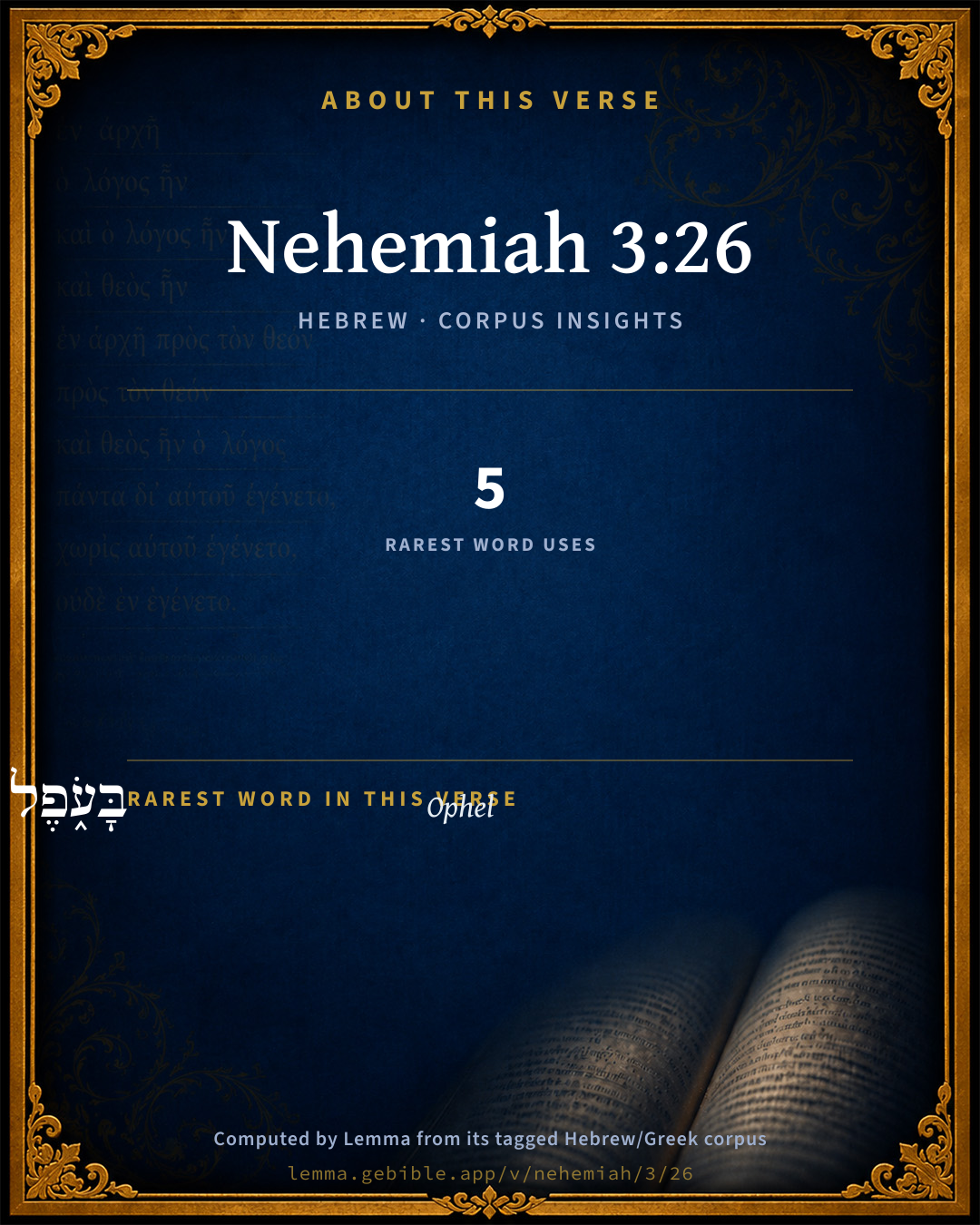
The rarest word here is בָּעֹ֑פֶל Ophel H6077 — appearing just 5 times in the whole Hebrew Bible.

Shared distinctive vocabulary

בָּעֹ֑פֶל Ophel H6077 occurs in 5 verses of the Hebrew Bible. Also found in:

Grammatical profile

  • 3 verbs
  • 6 nouns
  • 2 prepositions

Verb forms

  • הָי֥וּ Qal · Perfect
  • יֹשְׁבִ֖ים Qal · Participle Active
  • הַיּוֹצֵֽא Qal · Participle Active

Cross-references

12

Topical passages linked to Nehemiah 3:26 in the Treasury of Scripture Knowledge — connected by theme and wording, ordered by reader-vote popularity; previews shown in the World English Bible.

  • Nehemiah 8:1 All the people gathered themselves together as one man into the broad place that was before the water gate; and they spoke to Ezra the scribe to bring the book of the law of Moses, which Yahweh had commanded to Israel.
  • Nehemiah 11:21 But the Nethinim lived in Ophel: and Ziha and Gishpa were over the Nethinim.
  • Nehemiah 8:3 He read therein before the broad place that was before the water gate from early morning until midday, in the presence of the men and the women, and of those who could understand; and the ears of all the people were [attentive] to the book of the law.
  • Nehemiah 12:37 By the spring gate, and straight before them, they went up by the stairs of the city of David, at the ascent of the wall, above the house of David, even to the water gate eastward.
  • 2 Chronicles 33:14 Now after this he built an outer wall to the city of David, on the west side of Gihon, in the valley, even to the entrance at the fish gate; and he compassed Ophel about [with it], and raised it up to a very great height: and he put valiant captains in all the fortified cities of Judah.
  • 1 Chronicles 9:2 Now the first inhabitants who lived in their possessions in their cities were Israel, the priests, the Levites, and the Nethinim.
  • 2 Chronicles 27:3 He built the upper gate of the house of Yahweh, and on the wall of Ophel he built much.
  • Ezra 2:43–58 The Nethinim: the children of Ziha, the children of Hasupha, the children of Tabbaoth,
  • Nehemiah 3:27 After him the Tekoites repaired another portion, over against the great tower that stands out, and to the wall of Ophel.
  • Nehemiah 7:46–56 The Nethinim: the children of Ziha, the children of Hasupha, the children of Tabbaoth,
  • Nehemiah 8:16 So the people went forth, and brought them, and made themselves booths, everyone on the roof of his house, and in their courts, and in the courts of the house of God, and in the broad place of the water gate, and in the broad place of the gate of Ephraim.
  • Nehemiah 10:28 The rest of the people, the priests, the Levites, the porters, the singers, the Nethinim, and all those who had separated themselves from the peoples of the lands to the law of God, their wives, their sons, and their daughters, everyone who had knowledge, and understanding;

Cross-references courtesy of OpenBible.info (CC BY 4.0).

Hebrew and Greek witnesses Masoretic Hebrew ↔ Greek Septuagint

The same verse in the two great witnesses to the Old Testament, shown verse-for-verse.

These are two independent witnesses, not word-aligned to each other, and the Septuagint is shown in lemma (dictionary) form.

Hebrew Nehemiah 3:26 Masoretic · Westminster Leningrad Codex

וְהַ֨נְּתִינִ֔ים הָי֥וּ יֹשְׁבִ֖ים בָּעֹ֑פֶל עַ֠ד נֶ֜גֶד שַׁ֤עַר הַמַּ֨יִם֙ לַמִּזְרָ֔ח וְהַמִּגְדָּ֖ל הַיּוֹצֵֽא

(Now the Nethinim lived in Ophel, to the place over against the water gate toward the east, and the tower that stands out.)

World English Bible · Public Domain

Greek LXX Structure differs

The Septuagint has no separate book of Nehemiah. Its Greek text is the second half of Esdras B (2 Esdras), chapters 11–23; Ezra is the first half (1–10).

A verse-for-verse comparison isn’t shown here because the chapters and verses don’t line up. Switch to the LXX edition with the MT / LXX toggle above to read the Greek directly.

Hebrew: Westminster Leningrad Codex (CC BY 4.0). Greek: Septuagint (public domain); English from a public-domain English Septuagint. How the Septuagint differs from the Hebrew →

Commentary

Notes on Nehemiah 3:26 from classic Christian and Jewish commentators (each source and its license shown beneath its notes). The classic Christian expositions comment on the surrounding passage and are grouped to its opening verse, so a note may address several verses; the Jewish commentaries on the Tanakh (Rashi and others) are per-verse, so they appear only where the commentator wrote on this verse.

Lemma curates 59 commentaries, every one of them public domain or Creative Commons licensed, each selected and text-cleaned for this edition rather than reprinted as found. About our sources →

Trapp's Complete Commentary

John Trapp

Neh 3:26 Moreover the Nethinims dwelt in Ophel, unto [the place] over against the water gate toward the east, and the tower that lieth out.

Ver. 26. Moreover the Nethinims dwelt in Ophel] Of Nethinims see Ezr 2:43. Their work was to carry wood and water to the Temple; therefore they dwelt near the water gate, for their own convenience.

John Trapp, A Commentary or Exposition upon All the Books of the Old and New Testament (1647–1656) — public domain. Text from a community e-Sword module.

Joseph Benson's Commentary

Neh 3:26. The Nethinims dwelt in Ophel — Or, who dwelt in Ophel. For this seems to be only a description of the persons whose work follows. Not only the priests and Levites, but the meanest persons that belonged to the house of God, inferior officers, contributed to this work. Over against the water-gate — So called, because by that gate water was brought in, either by the people, for the use of that part of the city, or rather, by these Nethinims, who were Gibeonites, for the uses of the temple, for which they were drawers of water, Jos 9:21.

Joseph Benson's Commentary on the Old and New Testaments (1811–1818) — public domain. Text from a community e-Sword module.

Keil & Delitzsch

C. F. Keil & F. Delitzsch

Having now reached the place where the wall encloses Ophel, a remark is inserted, Neh 3:26, on the dwellings of Nethinim, i.e., of the temple servants. The Nethinim dwelt in Ophel as far as (the place) before the water-gate toward the east, and the tower that standeth out. הי המּגדּל still depends upon נגד עד. The water-gate towards the east, judging from Neh 12:37, lay beyond the south-eastern corner of the temple area. Bertheau, reasoning upon the view that the open space of the house of God, where Ezra spoke to the assembled people (Ezr 10:9), is identical with the open place before the water-gate mentioned Neh 8:1, Neh 8:3, Neh 8:16, places it on the east side of the temple area, near where the golden gate (Rab er Rahme) now stands. This identity, however, cannot be proved; and even if it could, it would by no means follow that this open space lay on the east side of the temple area. And as little does it follow from Neh 12:37, as we shall show when we reach this passage. היּוצא המּגדּל is said by Bertheau to have belonged perhaps to the water-gate towards the east, since, by reason of the statements contained in Neh 3:31 and Neh 3:32, we must not seek it so far northwards on the east side of the temple area, as to combine it with the remains of a tower projecting seven and a half feet from the line of wall at the north-east corner, and described by Robinson (Biblical Researches, p. 226). But even if the tower in question must not be identified with these remains, it by no means follows that it stood in the neighbourhood of the golden gate. Even Arnold, in his work already cited, p. 636, remarks, in opposition to Bertheau's view, that "it is evident from the whole statement that the tower standing out from the king's house, in Neh 3:25, Neh 3:26, and Neh 3:27, is one and the same, and that Bertheau's view of our having here three separate towers can hardly be maintained," although he, as well as Bertheau, transposes both the king's house and the court of the prison to the south of the Temple area. The similar appellation of this tower as היּוצא in the three verses speaks so decidedly for its identity, that very forcible reasons must be adduced before the opposite view can be adopted. In Neh 3:26 it is not a locality near the water-gate in the east which is indicted by היּוצא המּגדּל, but the western boundary of the dwellings of the Nethinim lying opposite. They dwelt, that is, upon Ophel, southwards of the temple area, on a tract of land reaching from the water-gate in the east to opposite the outstanding tower of the royal citadel in the west, i.e., from the eastern slope of the ridge of Ophel down to the Tyropoean valley.

Neh 3:27

After them the Tekoites repaired a second piece from opposite the great tower that standeth out to the wall of Ophel. The great (high) tower of the king's house within the city wall being some distance removed therefrom, the portion of wall on the eastern ridge of Zion from south to north, reaching as far as the turning and the corner, and the commencement of the wall running from this corner eastwards, might both be designated as lying opposite to this tower. The portion mentioned in our verse passed along the Tyropoean valley as far as the wall of Ophel. King Jotham had built much on the wall of Ophel (Ch2 27:3); and Manasseh had surrounded Ophel with a very high wall (Ch2 33:14), i.e., carried the wall round its western, southern, and eastern sides. On the north no wall was needed, Ophel being protected on this side by the southern wall of the temple area.

Keil & Delitzsch — Biblical Commentary on the Old Testament (1861–1891) — public domain (CC PDM 1.0). Text via the HelloAO Bible API. (Old Testament only.)

Geneva Bible (1599)

Geneva Bible translators

Read Ezra 2:43.

Geneva Bible (1599) marginal notes — public domain. Text via Bolls.life.

Jamieson, Fausset & Brown

Robert Jamieson, A. R. Fausset & David Brown

the Nethinims--Not only the priests and the Levites, but the common persons that belonged to the house of God, contributed to the work. The names of those who repaired the walls of Jerusalem are commemorated because it was a work of piety and patriotism to repair the holy city. It was an instance of religion and courage to defend the true worshippers of God, that they might serve Him in quietness and safety, and, in the midst of so many enemies, go on with this work, piously confiding in the power of God to support them [BISHOP PATRICK].

Next: Nehemiah Chapter 4

Jamieson, Fausset & Brown — Commentary Critical and Explanatory on the Whole Bible (1871) — public domain (CC PDM 1.0). Text via the HelloAO Bible API.

Ellicott's Commentary for English Readers

(26) The Nethinims dwelt in Ophel.—It has been proposed to insert “who” before dwelt (following the Syriac); but this is not necessary. Ophel was the long rounded spur running out south of the Temple, on the sides of which the ancient “temple servants” still dwelt, separated from others, on a tract of land reaching from the “water-gate toward the east” to the outlying tower of the king’s citadel in the west. Nothing is said of their part in the general labour.

A Bible Commentary for English Readers, edited by Charles John Ellicott (1878–1897) — public domain. Text from a community e-Sword module.

The Cambridge Bible for Schools and Colleges

gen. ed. J. J. S. Perowne

26. Moreover the Nethinims dwelt in Ophel … lieth out] R.V. (Now the Nethinim dwelt in Ophel … standeth out). The parenthesis probably includes the whole verse. We prefer the R.V. translation to that of the margin of the R.V., which limits the parenthesis to the first clause, and connects the second clause with the previous verse.

(1) The omission of the verb at the close of Neh_3:25 creates no real difficulty; for we have had a similar omission at the beginning of the verse.

(2) We should not expect that a parenthetical clause relating to the dwellingplace of the Nethinim would, in the midst of so much detailed topography, describe it in such brief and general terms as ‘in Ophel.’ (In Neh_11:21, where the same words occur, they are possibly based on this passage.)

(3) The reference to ‘the tower that standeth out’ is an allusion to the same tower as that mentioned in the previous verse. The parenthesis seems to be introduced in order to connect the dwelling of the Nethinim with the tower just spoken of.

(4) Neh_3:27 opens with (R.V.) ‘After him:’ and although in view of Neh_3:2; Neh_3:23; Neh_3:29 this is not conclusive, it certainly favours the R.V. treatment of the parenthesis.

in Ophel] This may possibly mean on the brow of the Ophel hill to the east of the Temple. The wall of ‘Ophel’ was built on by Jotham (2Ch_27:3). And the ‘hill’ was surrounded by a wall in Manasseh’s reign, 2Ch_33:14. ‘Ophel’ means ‘a mound,’ and was the name applied to the S. continuance of the Temple hill.

over against the water gate toward the east] Between the Temple and the water gate there seems to have been a large open space in which the people could assemble (see Neh_8:1; Neh_8:3; Neh_8:16, Neh_12:37; Neh_12:39; Ezr_10:9). The houses of the Nethinim approached or abutted on the city wall at this point.

The ‘water gate’ was obviously so called because the path leading from the spring of Gihon, the Virgin’s Spring, entered the city here. Water-carriers passing in and out gave the gate its name. On Gihon, cf. 1Ki_1:33; 1Ki_1:38. It is “the one spring of Jerusalem, known as the Virgin’s Fountain to Christians, and as ‘the Mother of Steps’ to Moslems, because of the steps which lead down into the vault from the present surface of the valley” (Conder’s Palestine, p. 26).

From here the wall led northward or north-eastward to ‘the corner’ (Neh_3:31).

the tower that lieth out] Probably the same as that mentioned in Neh_3:25. Perhaps the tower was intended especially to protect ‘the water gate,’ in connexion with which it is here mentioned.

The Cambridge Bible for Schools and Colleges (gen. ed. J. J. S. Perowne; Cambridge University Press, 1878–1918) — public domain. Text from a community e-Sword module.

John Gill's Exposition

From above the horse gate repaired the priests,.... So called, either because near it were stables for horses; or through it horses were led to be watered at the brook of Kidron, to which it was near; or to be exercised in the valley; Josephus (c) speaks of the "hippie", or horse tower, which might be near it:

everyone over against his house; for it seems there was a row of houses in which the priests dwelt, and each of them repaired as much of the wall as was right against his house.

(c) Ut supra. (De Bello Jud. l. 5. c. 4. sect. 2, 3.)

John Gill's Exposition of the Whole Bible (1746–1763) — public domain (CC PDM 1.0). Text via the HelloAO Bible API.

Haydock's Catholic Bible Commentary

Ophel. A very strong tower. See 2 Paralipomenon xxvii. 3., and xxxiii. 14. --- East of the great court of the temple, from which it was not remote, as Esdras here harangued the people, chap. xii. 36., and 3 Esdras viii. 1. Out of the gate was a pond of water, (Calmet) for the service of the temple. (Menochius)

George Leo Haydock (1774–1849), Haydock's Catholic Family Bible and Commentary, 1859 edition — public domain. Excludes Psalms (Douay-Rheims chapter numbering differs from Protestant) and Deuterocanonical books (Catholic canon only).

Matthew Poole's English Annotations

Dwelt in Ophel, or, who dwelt in Ophel; for this seems to be only a description of the persons, whose work follows.

The water-gate; so called because by that gate water was brought in, either by the people for the use of that part of the city, or rather by these Nethinims, who were Gibeonites, for the uses of the temple, for which they were drawers of water, Jos 9:21.

Matthew Poole's English Annotations on the Holy Bible (1683–1685) — public domain. Text from a community e-Sword/MySword module.

Whedon's Commentary on the Bible

Daniel D. Whedon

26. Dwelt in Ophel — Ophel is the name of the sloping ridge that runs down, south of the temple area, between the mouth of the Tyropoeon and the valley of Kedron, and ends in a rocky bluff just above the pool of Siloam. The water gate toward the east is an expression so obscure as to baffle any plausible conjecture as to its locality. According to chap. 8. 1, 3. it faced the street in which the people assembled to hear the law read and expounded, and hence could not well have been a gate in the outer wall of the city, near the present golden gate, as Bertheau thinks. The mention again of the tower that lieth out, leads rather to the opinion that the water gate was also in the vicinity of the bridge over the Tyropoeon, perhaps in the western wall of the temple area.

Daniel D. Whedon (gen. ed.), Commentary on the Old and New Testaments (1874–1909) — public domain. Text from a community e-Sword module.

The Pulpit Commentary

The Nethinims dwelt in Ophel. Ophel was "the long, narrowish, rounded spur or promontory which intervenes between the central valley of Jerusalem (the Tyropoeon) and the Kidron, or Valley of Jehoshaphat" (Grove). The Nethinims, who had their dwellings on this spur, were set to fortify a portion of the eastern circuit, but apparently restored not so much their own wall as that which lay north of it, at the edge of the present Haram area. Here must have been the water gate, which carried off the superfluous water from the temple reservoirs; and here was the great tower that lieth out, whose foundations have been recently discovered. It stood at the southeastern angle of the great platform on which the temple was built.

The Pulpit Commentary (1880–1919), ed. H.D.M. Spence-Jones & Joseph S. Exell — public domain. Text from a community e-Sword module.

Scofield Reference Notes

C. I. Scofield

Nethinims

i.e. dedicated (persons), probably descendants of the Gibeonites 2Sa 21:1-3 devoted to the service of the Levites. But see Jos 9:17-21.

The Scofield Reference Bible (1917 edition), notes by C. I. Scofield — public domain. Text from a community e-Sword module.

Rashi

Rabbi Shlomo Yitzchaki (Rashi)

And the Nethinites dwelt in the Ophel And the Nethinites were dwelling in that district, and they were building their district, which was near the wall, until opposite the Water Gate of the eastern side.

Rashi on the Tanakh — English translations: “The Judaica Press complete Tanach with Rashi, translated by A. J. Rosenberg” (CC BY 4.0); “Pentateuch with Rashi's commentary by M. Rosenbaum and A.M. Silbermann, 1929-1934” (public domain); “The Metsudah Tanach series, Lakewood, N.J” (CC BY 4.0); and “The Book of Joshua, Metsudah Publications, 1997” (CC BY 4.0). Text via Sefaria.

Lesson kit

Teaching starters — assembled from the data on this page, not authored interpretation. Every prompt links to the verse data it draws on. Edit before teaching.

Nehemiah, in the Historical, opens this verse with 11 words (11 distinct Hebrew lemmas). Its most distinctive word is ʻÔphel (“Ophel”). A historical commentator’s framing appears above. Read the whole chapter for the surrounding context.

Discussion questions

  1. The word ʻÔphel carries the sense “Ophel.” How does it shape the verse?
  2. 2 Chronicles 27:3 shares the word «Ophel» with this verse. How do the two illuminate each other?
  3. These translations render this verse differently. What is at stake in choosing one wording over another?
  4. The verb «הָי֥וּ» is Qal Perfect. How does its form color the action?
  5. Reading how Trapp's Complete Commentary and Joseph Benson's Commentary read this verse, where do the two commentators agree and where do they part?

Things to notice

Reading settings

Reading text

Shown beneath each verse's original-language words.

Old Testament
Old Testament edition

Read the OT as the Masoretic Hebrew (MT) or the Greek Septuagint (LXX).

English shown for the Greek Septuagint (in the Hebrew ↔ Greek comparison).

Comparing translations? Open the Compare panel on any verse page to stack up to four side by side.