
2 Chronicles 6:20

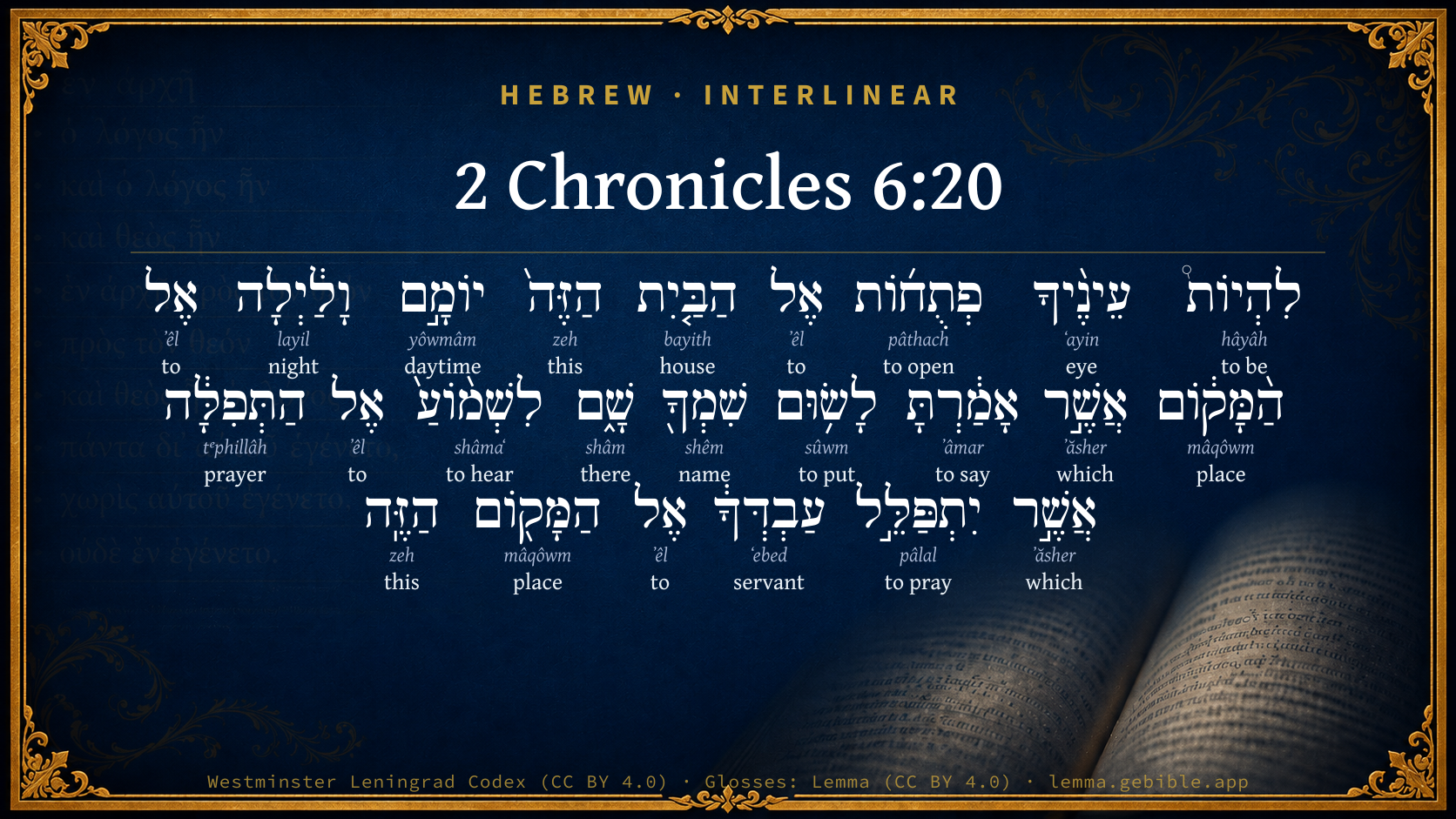
Hebrew (Westminster Leningrad Codex) 2 Chronicles 6:20 appears in the Hebrew Old Testament. The text above is from the Westminster Leningrad Codex. Each word links to its Strong’s number, a concise gloss, and parsing drawn from the Open Scriptures Hebrew Bible morphology. Click any word for its full Brown-Driver-Briggs (BDB) entry.
Download image
Cite this verse

2 Chronicles 6:20 (World English Bible). Public Domain. Lemma interlinear Bible study tool, https://lemma.gebible.app/v/2-chronicles/6/20.

Show BibTeX & RIS
BibTeX
RIS
English Translation
that your eyes may be open toward this house day and night, even toward the place where you have said that you would put your name there; to listen to the prayer which your servant shall pray toward this place.
World English Bible · Public Domain
Download a study sheet

One document with this verse’s original text, its word-by-word gloss line, the meaning frame, cross-references with their text, attributed commentary, and full source and license credits — printable, and it pastes into notes with its structure intact.

This verse Autodidact and up

Study sheet (.html) Plain text (.txt)

A passage Seminary Student

Up to 50 verses in one chapter. A passage sheet keeps up to 6 commentary sources and 12 cross-references per verse, in the order this page ranks them, and says so on the sheet whenever that leaves anything out. Ask for a single verse and you get the Autodidact verse sheet above.

Everything on this page stays free to read, with no account — the sheet is a download of what is already on screen, not access to it.

Want to remove ads? Support Godless Engineer
Compare translations 3

The same verse in 3 English versions, stacked beneath the original-language interlinear above. Click any original word for its lexicon entry.

Each is an independent rendering of the whole verse — the interlinear is not word-aligned to these translations.

Highlighted words mark where these versions differ — a whole-verse word diff, not a word-by-word alignment.

  • World English Bible Public Domain
    that your eyes may be open toward this house day and night, even toward the place where you have said that you would put your name there; to listen to the prayer which your servant shall pray toward this place.
  • King James Version Public Domain
    That thine eyes may be open upon this house day and night, upon the place whereof thou hast said that thou wouldest put thy name there; to hearken unto the prayer which thy servant prayeth toward this place.
  • unfoldingWord Literal Text CC BY-SA 4.0
    your eyes to be open to this house days and night, to the place where you said to put your name there, to listen to the prayer which your servant prays toward this place.

unfoldingWord Literal Text — © unfoldingWord, licensed CC BY-SA 4.0. Word-aligned USFM3 via Door43 (git.door43.org/unfoldingWord/en_ult).

Versions to compare (up to 4)

3 of 4 selected

Show all 18 translations

Every available English version of this verse, each an independent rendering of the whole verse.

  • World English Bible Public Domain
    that your eyes may be open toward this house day and night, even toward the place where you have said that you would put your name there; to listen to the prayer which your servant shall pray toward this place.
  • Berean Standard Bible Public Domain
    May Your eyes be open toward this temple day and night, toward the place where You said You would put Your Name, so that You may hear the prayer that Your servant prays toward this place.
  • Majority Standard Bible Public Domain
    May Your eyes be open toward this temple day and night, toward the place where You said You would put Your Name, so that You may hear the prayer that Your servant prays toward this place.
  • King James Version Public Domain
    That thine eyes may be open upon this house day and night, upon the place whereof thou hast said that thou wouldest put thy name there; to hearken unto the prayer which thy servant prayeth toward this place.
  • American Standard Version (1901) Public Domain
    that thine eyes may be open toward this house day and night, even toward the place whereof thou hast said that thou wouldest put thy name there; to hearken unto the prayer which thy servant shall pray toward this place.
  • Revised Version (1885) Public Domain
    that thine eyes may be open toward this house day and night, even toward the place whereof thou hast said that thou wouldest put thy name there; to hearken unto the prayer which thy servant shall pray toward this place.
  • Geneva Bible (1599) Public Domain
    That thine eyes may be open toward this house day and night, euen toward the place, whereof thou hast sayde, that thou wouldest put thy Name there, that thou mayest hearken vnto the prayer, which thy seruant prayeth in this place.
  • Douay-Rheims (1899) Public Domain
    That thou mayest open thy eyes upon this house day and night, upon the place wherein thou hast promised that thy name should be called upon,
  • Young's Literal Translation Public Domain
    for Thine eyes being open towards this house by day and by night, towards the place that Thou hast said to put Thy name there, to hearken unto the prayer that Thy servant prayeth towards this place.
  • Literal Standard Version CC BY-SA 4.0
    for Your eyes being open toward this house by day and by night, toward the place that You have said to put Your Name there, to listen to the prayer that Your servant prays toward this place.
  • Unlocked Literal Bible CC BY-SA 4.0
    May your eyes be open toward this temple day and night, the place where you promised to put your name. May you listen to the prayer your servant prays toward this place.
  • unfoldingWord Literal Text CC BY-SA 4.0
    your eyes to be open to this house days and night, to the place where you said to put your name there, to listen to the prayer which your servant prays toward this place.
  • Darby Bible Public Domain
    that thine eyes may be open upon this house day and night, upon the place in which thou hast said thou wouldest put thy name: to hearken unto the prayer which thy servant prayeth toward this place.
  • World Messianic Bible Public Domain
    that your eyes may be open toward this house day and night, even toward the place where you have said that you would put your name, to listen to the prayer which your servant will pray toward this place.
  • Webster's Bible Public Domain
    That thy eyes may be open upon this house day and night, upon the place of which thou hast said, that thou wouldst put thy name there; to hearken to the prayer which thy servant prayeth towards this place.
  • Free Bible Version CC BY-SA 4.0
    May you watch over this Temple day and night, caring for the place where you said you would be honored. May you hear the prayer your servant prays toward this place,
  • Bible in Basic English Public Domain
    That your eyes may be open to this house day and night, to this place of which you have said that you would put your name there; to give ear to the prayer which your servant may make, turning to this place.
  • JPS Tanakh (1917) Public Domain
    that Thine eyes may be open toward this house day and night, even toward the place whereof Thou hast said that thou wouldest put Thy name there; to hearken unto the prayer which Thy servant shall pray toward this place.

Literal Standard Version (2020), Covenant Press — licensed CC BY-SA 4.0. Text via the HelloAO Bible API (eBible.org). Unlocked Literal Bible (unfoldingWord) — licensed CC BY-SA 4.0. Text via the HelloAO Bible API (eBible.org). unfoldingWord Literal Text — © unfoldingWord, licensed CC BY-SA 4.0. Word-aligned USFM3 via Door43 (git.door43.org/unfoldingWord/en_ult). Free Bible Version, Dr. Jonathan Gallagher — licensed CC BY-SA 4.0. Text via the HelloAO Bible API (eBible.org).

Word by word

More ways to search: Search by grammar → Find every occurrence → Compare this word →

Practice this passage: Drill this verse → Learn its vocabulary →

יוֹמָ֣ם
yôwmâm
H3119
“daytime”
Adverb
Part of Speech
Adverb
Full BDB Definition

Origin: from H3117

TWOT: 852a

by day, in the daytime (adverb) - daytime (substantive)
  1. לִהְיוֹת֩ hâyâh H1961 “to be” Preposition + Verb, Qal, Infinitive Construct
  2. עֵינֶ֨יךָ ʻayin H5869 “eyes · your” Noun, Common, Both, Dual, Construct + Suffix, Personal, 2nd Person, Masculine, Singular
  3. פְתֻח֜וֹת pâthach H6605 “opened” Verb, Qal, Participle Passive, Feminine, Plural, Absolute
  4. אֶל ʼêl H413 “to” Preposition
  5. הַבַּ֤יִת bayith H1004 “the · house” Particle, Definite Article + Noun, Common, Masculine, Singular, Absolute
  6. הַזֶּה֙ zeh H2088 “the · this” Particle, Definite Article + Pronoun, Demonstrative, Masculine, Singular
  7. וָלַ֔יְלָה layil H3915 “and · night” Conjunction + Noun, Common, Masculine, Singular, Absolute
  8. אֶל ʼêl H413 “to” Preposition
  9. הַ֨מָּק֔וֹם mâqôwm H4725 “the · place” Particle, Definite Article + Noun, Common, Masculine, Singular, Absolute
  10. אֲשֶׁ֣ר ʼăsher H834 “which” Particle, Relative
  11. אָמַ֔רְתָּ ʼâmar H559 “to say” Verb, Qal, Perfect, 2nd Person, Masculine, Singular
  12. לָשׂ֥וּם sûwm H7760 “to put” Preposition + Verb, Qal, Infinitive Construct
  13. שִׁמְךָ֖ shêm H8034 “name · your” Noun, Common, Masculine, Singular, Construct + Suffix, Personal, 2nd Person, Masculine, Singular
  14. שָׁ֑ם shâm H8033 “there” Adverb
  15. לִשְׁמ֨וֹעַ֙ shâmaʻ H8085 “to hear” Preposition + Verb, Qal, Infinitive Construct
  16. אֶל ʼêl H413 “to” Preposition
  17. הַתְּפִלָּ֔ה tᵉphillâh H8605 “the · prayer” Particle, Definite Article + Noun, Common, Feminine, Singular, Absolute
  18. אֲשֶׁ֣ר ʼăsher H834 “which” Particle, Relative
  19. יִתְפַּלֵּ֣ל pâlal H6419 “to pray” Verb, Hithpael, Imperfect, 3rd Person, Masculine, Singular
  20. עַבְדְּךָ֔ ʻebed H5650 “servant · your” Noun, Common, Masculine, Singular, Construct + Suffix, Personal, 2nd Person, Masculine, Singular
  21. אֶל ʼêl H413 “to” Preposition
  22. הַמָּק֖וֹם mâqôwm H4725 “the · place” Particle, Definite Article + Noun, Common, Masculine, Singular, Absolute
  23. הַזֶּֽה zeh H2088 “the · this” Particle, Definite Article + Pronoun, Demonstrative, Masculine, Singular

About this verse

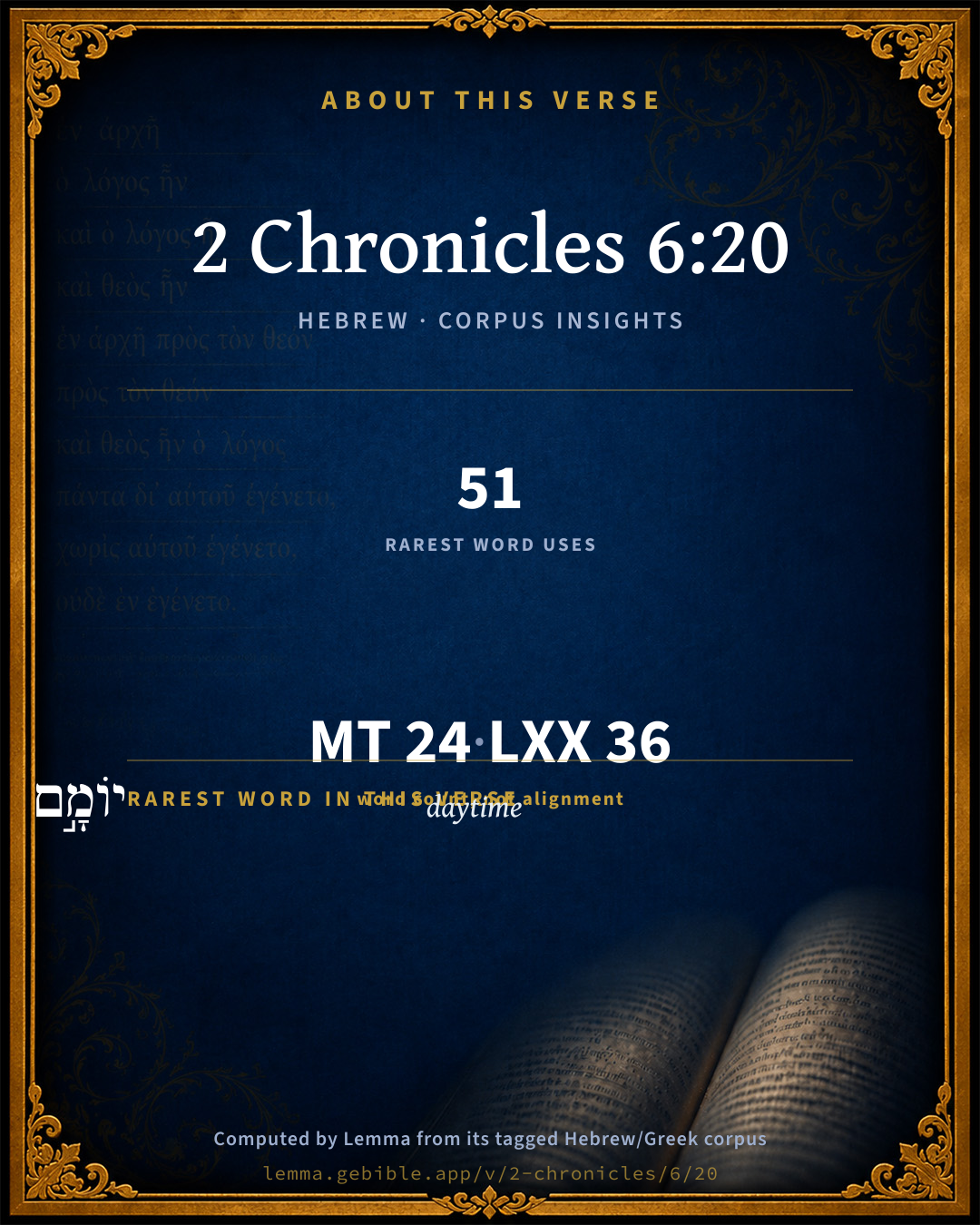
These counts appear in no published source. They are computed here, from the morphology-tagged text and Lemma’s own curated glosses. What Lemma adds →

24
words
18
distinct lemmas
Historical
section

Shared distinctive vocabulary

יוֹמָ֣ם daytime H3119 occurs in 50 verses of the Hebrew Bible. Also found in:

Grammatical profile

  • 6 verbs
  • 8 nouns
  • 2 pronouns
  • 4 prepositions
  • 2 adverbs
  • 2 particles

Verb forms

  • לִהְיוֹת֩ Qal · Infinitive Construct
  • פְתֻח֜וֹת Qal · Participle Passive
  • אָמַ֔רְתָּ Qal · Perfect
  • לָשׂ֥וּם Qal · Infinitive Construct
  • לִשְׁמ֨וֹעַ֙ Qal · Infinitive Construct
  • יִתְפַּלֵּ֣ל Hithpael · Imperfect

Repetition

Words recur within this verse — often emphatic in Hebrew:

  • הַ֨מָּק֔וֹם place H4725 ×2
  • אֶל to H413 ×4
  • הַזֶּה֙ this H2088 ×2
  • אֲשֶׁ֣ר which H834 ×2

Hebrew & Septuagint length

In English translation the verse runs 40 words from the Hebrew and 39 from the Septuagint (LXX English) — closely comparable.

A rough comparison of the two English renderings, which tokenize alike — not a word-level alignment.

Word counts can differ between the Hebrew and the Greek without any difference in meaning — e.g. the Hebrew direct-object marker אֵת has no separate Greek word, and Greek often adds the article ὁ.

In the original languages it is 24 Hebrew tokens and 36 Greek tokens — but the two are counted differently (Hebrew bundles its prefixes and suffixes into one token; the Greek is in lemma form), so that isn’t a like-for-like length.

Cross-references

11

Topical passages linked to 2 Chronicles 6:20 in the Treasury of Scripture Knowledge — connected by theme and wording, ordered by reader-vote popularity; previews shown in the World English Bible.

  • Psalms 34:15 Yahweh's eyes are toward the righteous. His ears listen to their cry.
  • 2 Chronicles 6:6 but I have chosen Jerusalem, that my name might be there; and have chosen David to be over my people Israel.
  • Psalms 121:5 Yahweh is your keeper. Yahweh is your shade on your right hand.
  • Daniel 6:10 When Daniel knew that the writing was signed, he went into his house (now his windows were open in his chamber toward Jerusalem) and he kneeled on his knees three times a day, and prayed, and gave thanks before his God, as he did before.
  • Deuteronomy 12:11 then it shall happen that to the place which Yahweh your God shall choose, to cause his name to dwell there, there shall you bring all that I command you: your burnt offerings, and your sacrifices, your tithes, and the heave-offering of your hand, and all your choice vows which you vow to Yahweh.
  • Deuteronomy 26:2 that you shall take of the first of all the fruit of the ground, which you shall bring in from your land that Yahweh your God gives you; and you shall put it in a basket, and shall go to the place which Yahweh your God shall choose, to cause his name to dwell there.
  • Nehemiah 1:6 Let your ear now be attentive, and your eyes open, that you may listen to the prayer of your servant, which I pray before you at this time, day and night, for the children of Israel your servants while I confess the sins of the children of Israel, which we have sinned against you. Yes, I and my father's house have sinned:
  • 1 Kings 8:29–30 that your eyes may be open toward this house night and day, even toward the place of which you have said, My name shall be there; to listen to the prayer which your servant shall pray toward this place.
  • 2 Kings 19:16 Incline your ear, Yahweh, and hear; open your eyes, Yahweh, and see; and hear the words of Sennacherib, with which he has sent him to defy the living God.
  • 2 Chronicles 16:9 For the eyes of Yahweh run back and forth throughout the whole earth, to show himself strong in the behalf of them whose heart is perfect toward him. Herein you have done foolishly; for from henceforth you shall have wars.
  • Colossians 2:9 For in him all the fullness of the Godhead dwells bodily,

Cross-references courtesy of OpenBible.info (CC BY 4.0).

Hebrew and Greek witnesses Masoretic Hebrew ↔ Greek Septuagint

The same verse in the two great witnesses to the Old Testament, shown verse-for-verse.

These are two independent witnesses, not word-aligned to each other, and the Septuagint is shown in lemma (dictionary) form.

Hebrew 2 Chronicles 6:20 Masoretic · Westminster Leningrad Codex

לִהְיוֹת֩ עֵינֶ֨יךָ פְתֻח֜וֹת אֶל הַבַּ֤יִת הַזֶּה֙ יוֹמָ֣ם וָלַ֔יְלָה אֶל הַ֨מָּק֔וֹם אֲשֶׁ֣ר אָמַ֔רְתָּ לָשׂ֥וּם שִׁמְךָ֖ שָׁ֑ם לִשְׁמ֨וֹעַ֙ אֶל הַתְּפִלָּ֔ה אֲשֶׁ֣ר יִתְפַּלֵּ֣ל עַבְדְּךָ֔ אֶל הַמָּק֖וֹם הַזֶּֽה

that your eyes may be open toward this house day and night, even toward the place where you have said that you would put your name there; to listen to the prayer which your servant shall pray toward this place.

World English Bible · Public Domain

Greek LXX 2 Chronicles 6:20 Septuagint · lemma form

ὁ εἰμί ὀφθαλμός σύ ἀναοἴγω ἐπί ὁ οἶκος οὗτος ἡμέρα καί νύξ εἰς ὁ τόπος οὗτος ὅς εἶπον ἐπικαλέω ὁ ὄνομα σύ ἐκεῖ ὁ ἀκούω ὁ προσευχή ὅς ὁ παῖς σύ προςεὔχομαι εἰς ὁ τόπος οὗτος

so that your eyes should be open over this house by day and by night, towards this place, whereon you said your name should be called, so as to hear the prayer which your servant prays towards this house.

LXX2012 (modern English Septuagint) · Public Domain

Hebrew: Westminster Leningrad Codex (CC BY 4.0). Greek: Septuagint (public domain); English from LXX2012 (modern English Septuagint) (Public Domain). How the Septuagint differs from the Hebrew →

Commentary

Notes on 2 Chronicles 6:20 from classic Christian and Jewish commentators (each source and its license shown beneath its notes). The classic Christian expositions comment on the surrounding passage and are grouped to its opening verse, so a note may address several verses; the Jewish commentaries on the Tanakh (Rashi and others) are per-verse, so they appear only where the commentator wrote on this verse.

Lemma curates 59 commentaries, every one of them public domain or Creative Commons licensed, each selected and text-cleaned for this edition rather than reprinted as found. About our sources →

Geneva Bible (1599)

Geneva Bible translators

That thou mayest declare in effect that thou hast a continual care over this place.

Geneva Bible (1599) marginal notes — public domain. Text via Bolls.life.

Ellicott's Commentary for English Readers

(20) Upon.—Unto or toward. “Day and night” (as in Psa_1:2); Kings, “night and day” (as in Isa_27:3); for which the chronicler has substituted a more usual phrase. The Syriac and Arabic follow Kings.

Prayeth.—Shall pray, scil., at any time.

Toward this place.—The margin is wrong, though supported by the Syriac, Arabic, and Vulg. The Temple of Jerusalem was, and is, the Kebla of the Jew. (Comp. Dan_6:10, and 2Ch_6:34 infr., which is a kind of paraphrase of this expression.)

A Bible Commentary for English Readers, edited by Charles John Ellicott (1878–1897) — public domain. Text from a community e-Sword module.

The Cambridge Bible for Schools and Colleges

gen. ed. J. J. S. Perowne

20. which thy servant prayeth] R.V. which they servant shall pray. Solomon refers in this ver. to future prayers, not (as in 2Ch_6:19) to the prayer he is now praying.

The Cambridge Bible for Schools and Colleges (gen. ed. J. J. S. Perowne; Cambridge University Press, 1878–1918) — public domain. Text from a community e-Sword module.

The Pulpit Commentary

This house .... the place whereof; this place (so Exo_29:43; Deu_12:5 Deu_14:23 Deu_15:20 Deu_16:2)

The Pulpit Commentary (1880–1919), ed. H.D.M. Spence-Jones & Joseph S. Exell — public domain. Text from a community e-Sword module.

Rashi

Rabbi Shlomo Yitzchaki (Rashi)

That Your eyes may be open, etc. whenever they pray to You.

Rashi on the Tanakh — English translations: “The Judaica Press complete Tanach with Rashi, translated by A. J. Rosenberg” (CC BY 4.0); “Pentateuch with Rashi's commentary by M. Rosenbaum and A.M. Silbermann, 1929-1934” (public domain); “The Metsudah Tanach series, Lakewood, N.J” (CC BY 4.0); and “The Book of Joshua, Metsudah Publications, 1997” (CC BY 4.0). Text via Sefaria.

Lesson kit

Teaching starters — assembled from the data on this page, not authored interpretation. Every prompt links to the verse data it draws on. Edit before teaching.

2 Chronicles, in the Historical, opens this verse with 24 words (18 distinct Hebrew lemmas). Its most distinctive word is yôwmâm (“daytime”). A historical commentator’s framing appears above. Read the whole chapter for the surrounding context.

Discussion questions

  1. What does “daytime” (yôwmâm) contribute to the verse as a whole?
  2. Exodus 13:21 shares the word «daytime» with this verse. How do the two illuminate each other?
  3. “place” occurs 2× in this one verse. What is the effect of the repetition?
  4. The translations on this page render this verse differently — a whole-verse word diff, not a word-by-word alignment. What might account for the different wordings?
  5. The verb «לִהְיוֹת֩» is Qal Infinitive Construct. How does its form color the action?
  6. Reading how Geneva Bible (1599) and Ellicott's Commentary for English Readers read this verse, where do the two commentators agree and where do they part?

Things to notice

Reading settings

Reading text

Shown beneath each verse's original-language words.

Old Testament
Old Testament edition

Read the OT as the Masoretic Hebrew (MT) or the Greek Septuagint (LXX).

English shown for the Greek Septuagint (in the Hebrew ↔ Greek comparison).

Comparing translations? Open the Compare panel on any verse page to stack up to four side by side.