
2 Chronicles 20:25

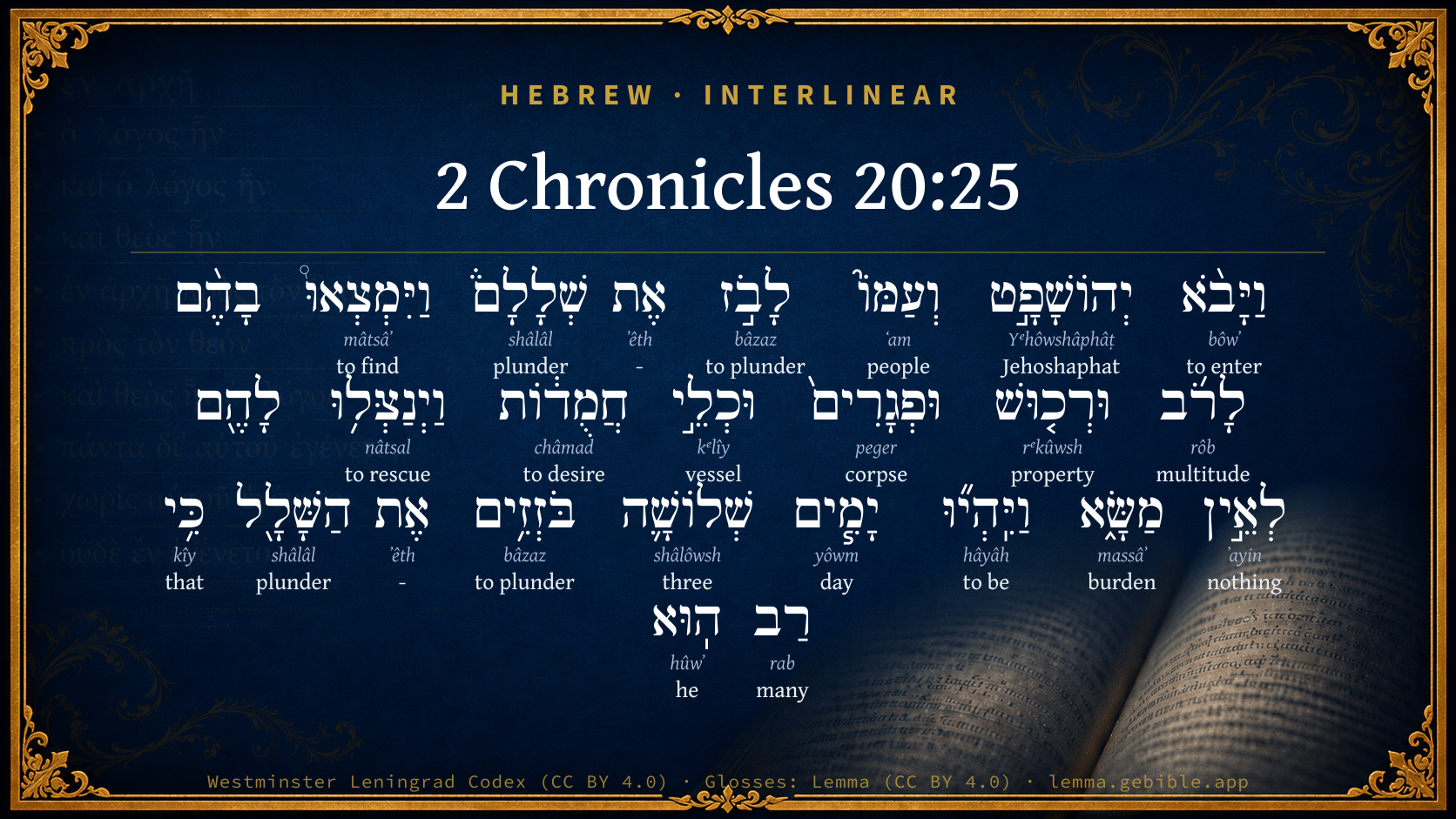
Hebrew (Westminster Leningrad Codex) 2 Chronicles 20:25 appears in the Hebrew Old Testament. The text above is from the Westminster Leningrad Codex. Each word links to its Strong’s number, a concise gloss, and parsing drawn from the Open Scriptures Hebrew Bible morphology. Click any word for its full Brown-Driver-Briggs (BDB) entry.
Download image
Cite this verse

2 Chronicles 20:25 (World English Bible). Public Domain. Lemma interlinear Bible study tool, https://lemma.gebible.app/v/2-chronicles/20/25.

Show BibTeX & RIS
BibTeX
RIS
English Translation
When Jehoshaphat and his people came to take the spoil of them, they found among them in abundance both riches and dead bodies, and precious jewels, which they stripped off for themselves, more than they could carry away: and they were three days in taking the spoil, it was so much.
World English Bible · Public Domain
Download a study sheet

One document with this verse’s original text, its word-by-word gloss line, the meaning frame, cross-references with their text, attributed commentary, and full source and license credits — printable, and it pastes into notes with its structure intact.

This verse Autodidact and up

Study sheet (.html) Plain text (.txt)

A passage Seminary Student

Up to 50 verses in one chapter. A passage sheet keeps up to 6 commentary sources and 12 cross-references per verse, in the order this page ranks them, and says so on the sheet whenever that leaves anything out. Ask for a single verse and you get the Autodidact verse sheet above.

Everything on this page stays free to read, with no account — the sheet is a download of what is already on screen, not access to it.

Want to remove ads? Support Godless Engineer
Compare translations 3

The same verse in 3 English versions, stacked beneath the original-language interlinear above. Click any original word for its lexicon entry.

Each is an independent rendering of the whole verse — the interlinear is not word-aligned to these translations.

Highlighted words mark where these versions differ — a whole-verse word diff, not a word-by-word alignment.

  • World English Bible Public Domain
    When Jehoshaphat and his people came to take the spoil of them, they found among them in abundance both riches and dead bodies, and precious jewels, which they stripped off for themselves, more than they could carry away: and they were three days in taking the spoil, it was so much.
  • King James Version Public Domain
    And when Jehoshaphat and his people came to take away the spoil of them, they found among them in abundance both riches with the dead bodies, and precious jewels, which they stripped off for themselves, more than they could carry away: and they were three days in gathering of the spoil, it was so much.
  • unfoldingWord Literal Text CC BY-SA 4.0
    And Jehoshaphat and his people came to plunder the spoils, and they found among them in abundance goods, and corpses, and precious items. And they took for themselves, so there was no carrying away. And there were three days of plundering the spoils, for it was great.

unfoldingWord Literal Text — © unfoldingWord, licensed CC BY-SA 4.0. Word-aligned USFM3 via Door43 (git.door43.org/unfoldingWord/en_ult).

Versions to compare (up to 4)

3 of 4 selected

Show all 18 translations

Every available English version of this verse, each an independent rendering of the whole verse.

  • World English Bible Public Domain
    When Jehoshaphat and his people came to take the spoil of them, they found among them in abundance both riches and dead bodies, and precious jewels, which they stripped off for themselves, more than they could carry away: and they were three days in taking the spoil, it was so much.
  • Berean Standard Bible Public Domain
    Then Jehoshaphat and his people went to carry off the plunder, and they found on the bodies an abundance of goods and valuables—more than they could carry away. They were gathering the plunder for three days because there was so much.
  • Majority Standard Bible Public Domain
    Then Jehoshaphat and his people went to carry off the plunder, and they found on the bodies an abundance of goods and valuables—more than they could carry away. They were gathering the plunder for three days because there was so much.
  • King James Version Public Domain
    And when Jehoshaphat and his people came to take away the spoil of them, they found among them in abundance both riches with the dead bodies, and precious jewels, which they stripped off for themselves, more than they could carry away: and they were three days in gathering of the spoil, it was so much.
  • American Standard Version (1901) Public Domain
    And when Jehoshaphat and his people came to take the spoil of them, they found among them in abundance both riches and dead bodies, and precious jewels, which they stripped off for themselves, more than they could carry away: and they were three days in taking the spoil, it was so much.
  • Revised Version (1885) Public Domain
    And when Jehoshaphat and his people came to take the spoil of them, they found among them in abundance both riches and dead bodies, and precious jewels, which they stripped off for themselves, more than they could carry away: and they were three days in taking of the spoil, it was so much.
  • Geneva Bible (1599) Public Domain
    And when Iehoshaphat and his people came to take away the spoyle of them, they founde among them in abundance both of substance and also of bodies laden with precious iewels, which they tooke for themselues, till they could cary no more: they were three dayes in gathering of the spoyle: for it was much.
  • Douay-Rheims (1899) Public Domain
    Then Josaphat came, and all the people with him to take away the spoils of the dead, and they found among the dead bodies, stuff of various kinds, and garments, and most precious vessels: and they took them for themselves, insomuch that they could not carry all, nor in three days take away the spoils, the booty was so great.
  • Young's Literal Translation Public Domain
    and Jehoshaphat cometh in, and his people, to seize their spoil, and they find among them, in abundance, both goods and carcases, and desirable vessels, and they take spoil to themselves without prohibition, and they are three days seizing the spoil, for it `is' abundant.
  • Literal Standard Version CC BY-SA 4.0
    and Jehoshaphat comes in, and his people, to seize their spoil, and they find among them, in abundance, both goods and carcasses, and desirable vessels, and they take spoil for themselves without prohibition, and they are seizing the spoil [for] three days, for it [is] abundant.
  • Unlocked Literal Bible CC BY-SA 4.0
    When Jehoshaphat and his people came to take plunder from them, they found among them abundant goods, clothing, and valuable articles, which they took for themselves, more than they could carry away. It took them three days to carry off the plunder, there was so much of it.
  • unfoldingWord Literal Text CC BY-SA 4.0
    And Jehoshaphat and his people came to plunder the spoils, and they found among them in abundance goods, and corpses, and precious items. And they took for themselves, so there was no carrying away. And there were three days of plundering the spoils, for it was great.
  • Darby Bible Public Domain
    And Jehoshaphat and his people came to plunder the spoil of them, and they found among them in abundance, both riches with the dead bodies, and precious things, and they stripped off for themselves more than they could carry away; and they were three days in plundering the spoil, it was so much.
  • World Messianic Bible Public Domain
    When Jehoshaphat and his people came to take their plunder, they found among them in abundance both riches and dead bodies with precious jewels, which they stripped off for themselves, more than they could carry away. They took plunder for three days, it was so much.
  • Webster's Bible Public Domain
    And when Jehoshaphat and his people came to take away the spoil of them, they found among them in abundance both riches with the dead bodies, and precious jewels, which they stripped off for themselves, more than they could carry away: and they were three days in gathering the spoil, it was so much.
  • Free Bible Version CC BY-SA 4.0
    When Jehoshaphat and his people came to collect the plunder, they found a great deal of cattle, equipment, clothing, and other valuable articles, more than they could carry. It took three days to collect the plunder because there was so much of it.
  • Bible in Basic English Public Domain
    And when Jehoshaphat and his people came to take their goods from them, they saw beasts in great numbers, and wealth and clothing and things of value, more than they were able to take away; all this they took for themselves, and they were three days getting it away, there was so much.
  • JPS Tanakh (1917) Public Domain
    And when Jehoshaphat and his people came to take the spoil of them, they found among them in abundance both riches and dead bodies, and precious jewels, which they stripped off for themselves, more than they could carry away; and they were three days in taking the spoil, it was so much.

Literal Standard Version (2020), Covenant Press — licensed CC BY-SA 4.0. Text via the HelloAO Bible API (eBible.org). Unlocked Literal Bible (unfoldingWord) — licensed CC BY-SA 4.0. Text via the HelloAO Bible API (eBible.org). unfoldingWord Literal Text — © unfoldingWord, licensed CC BY-SA 4.0. Word-aligned USFM3 via Door43 (git.door43.org/unfoldingWord/en_ult). Free Bible Version, Dr. Jonathan Gallagher — licensed CC BY-SA 4.0. Text via the HelloAO Bible API (eBible.org).

Word by word

More ways to search: Search by grammar → Find every occurrence → Compare this word →

Practice this passage: Drill this verse → Learn its vocabulary →

וּפְגָרִים֙
peger
H6297
“and · corpses”
Conjunction + Noun, Common, Masculine, Plural, Absolute
Part of Speech
Conjunction + Noun
Type
Common
Gender
Masculine
Number
Plural
State
Absolute
Full BDB Definition

Origin: from H6296

TWOT: 1732a

corpse, carcass, monument, stela - corpse (of man) - carcass (of animals)
  1. וַיָּבֹ֨א bôwʼ H935 “and · to enter” Conjunction + Verb, Qal, Sequential Imperfect, 3rd Person, Masculine, Singular
  2. יְהוֹשָׁפָ֣ט Yᵉhôwshâphâṭ H3092 “Jehoshaphat” Noun, Proper
  3. וְעַמּוֹ֮ ʻam H5971 “and · people · his” Conjunction + Noun, Common, Masculine, Singular, Construct + Suffix, Personal, 3rd Person, Masculine, Singular
  4. לָבֹ֣ז bâzaz H962 “to plunder” Preposition + Verb, Qal, Infinitive Construct
  5. אֶת ʼêth H853 “-” Particle, Direct Object
  6. שְׁלָלָם֒ shâlâl H7998 “plunder · their” Noun, Common, Masculine, Singular, Construct + Suffix, Personal, 3rd Person, Masculine, Plural
  7. וַיִּמְצְאוּ֩ mâtsâʼ H4672 “and · to find” Conjunction + Verb, Qal, Sequential Imperfect, 3rd Person, Masculine, Plural
  8. לָרֹ֜ב rôb H7230 “to/for · multitude” Preposition + Noun, Common, Both, Singular, Absolute
  9. וּרְכ֤וּשׁ rᵉkûwsh H7399 “and · property” Conjunction + Noun, Common, Masculine, Singular, Absolute
  10. וּכְלֵ֣י kᵉlîy H3627 “and · vessels of” Conjunction + Noun, Common, Masculine, Plural, Construct
  11. חֲמֻד֔וֹת châmad H2530 “desirable things” Noun, Common, Feminine, Plural, Absolute
  12. וַיְנַצְּל֥וּ nâtsal H5337 “and · to rescue” Conjunction + Verb, Piel, Sequential Imperfect, 3rd Person, Masculine, Plural
  13. לְאֵ֣ין ʼayin H369 “to/for · nothing” Preposition + Particle, Negative
  14. מַשָּׂ֑א massâʼ H4853 “burden” Noun, Common, Masculine, Singular, Absolute
  15. וַיִּֽהְי֞וּ hâyâh H1961 “and · to be” Conjunction + Verb, Qal, Sequential Imperfect, 3rd Person, Masculine, Plural
  16. יָמִ֧ים yôwm H3117 “days” Noun, Common, Masculine, Plural, Absolute
  17. שְׁלוֹשָׁ֛ה shâlôwsh H7969 “three” Adjective, Cardinal number, Masculine, Singular, Absolute
  18. בֹּזְזִ֥ים bâzaz H962 “plundering” Verb, Qal, Participle Active, Masculine, Plural, Absolute
  19. אֶת ʼêth H853 “-” Particle, Direct Object
  20. הַשָּׁלָ֖ל shâlâl H7998 “the · plunder” Particle, Definite Article + Noun, Common, Masculine, Singular, Absolute
  21. כִּ֥י kîy H3588 “that” Conjunction
  22. רַב rab H7227 “many” Adjective, Adjective, Masculine, Singular, Absolute
  23. הֽוּא hûwʼ H1931 “he” Pronoun, Personal, 3rd Person, Masculine, Singular

About this verse

These counts appear in no published source. They are computed here, from the morphology-tagged text and Lemma’s own curated glosses. What Lemma adds →

26
words
21
distinct lemmas
Historical
section

Notable vocabulary

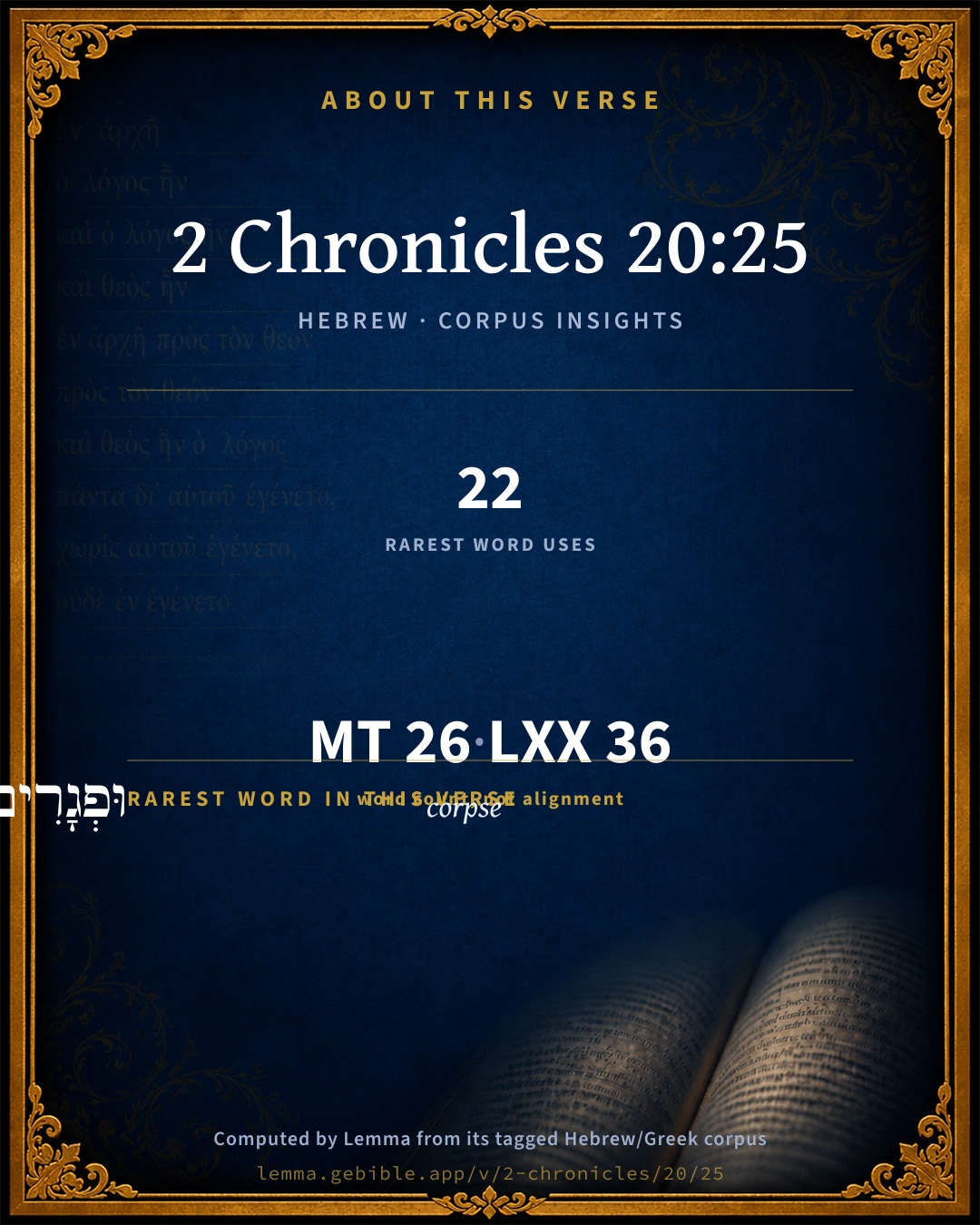
The rarest word here is וּפְגָרִים֙ corpse H6297 — appearing just 22 times in the whole Hebrew Bible.

Shared distinctive vocabulary

וּפְגָרִים֙ corpse H6297 occurs in 21 verses of the Hebrew Bible. Also found in:

Grammatical profile

  • 6 verbs
  • 11 nouns
  • 2 adjectives
  • 1 pronoun
  • 2 prepositions
  • 1 conjunction
  • 3 particles

Verb forms

  • וַיָּבֹ֨א Qal · Sequential Imperfect
  • לָבֹ֣ז Qal · Infinitive Construct
  • וַיִּמְצְאוּ֩ Qal · Sequential Imperfect
  • וַיְנַצְּל֥וּ Piel · Sequential Imperfect
  • וַיִּֽהְי֞וּ Qal · Sequential Imperfect
  • בֹּזְזִ֥ים Qal · Participle Active

Repetition

Words recur within this verse — often emphatic in Hebrew:

  • לָבֹ֣ז to plunder H962 ×2
  • שְׁלָלָם֒ plunder H7998 ×2

Hebrew & Septuagint length

In English translation the verse runs 51 words from the Hebrew and 38 from the Septuagint (LXX English) — closely comparable.

A rough comparison of the two English renderings, which tokenize alike — not a word-level alignment.

Word counts can differ between the Hebrew and the Greek without any difference in meaning — e.g. the Hebrew direct-object marker אֵת has no separate Greek word, and Greek often adds the article ὁ.

In the original languages it is 26 Hebrew tokens and 36 Greek tokens — but the two are counted differently (Hebrew bundles its prefixes and suffixes into one token; the Greek is in lemma form), so that isn’t a like-for-like length.

Cross-references

9

Topical passages linked to 2 Chronicles 20:25 in the Treasury of Scripture Knowledge — connected by theme and wording, ordered by reader-vote popularity; previews shown in the World English Bible.

  • 1 Samuel 30:19–20 There was nothing lacking to them, neither small nor great, neither sons nor daughters, neither spoil, nor anything that they had taken to them: David brought back all.
  • Numbers 31:15 Moses said to them, Have you saved all the women alive?
  • 2 Kings 7:9–16 Then they said one to another, We aren't doing right. This day is a day of good news, and we hold our peace: if we wait until the morning light, punishment will overtake us; now therefore come, let us go and tell the king's household.
  • Psalms 68:12 "Kings of armies flee! They flee!" She who waits at home divides the spoil,
  • Proverbs 3:15 She is more precious than rubies. None of the things you can desire are to be compared to her.
  • Ezekiel 39:8–9 Behold, it comes, and it shall be done, says the Lord Yahweh; this is the day about which I have spoken.
  • Exodus 3:22 But every woman shall ask of her neighbor, and of her who visits her house, jewels of silver, jewels of gold, and clothing; and you shall put them on your sons, and on your daughters. You shall despoil the Egyptians.
  • Exodus 12:35–36 The children of Israel did according to the word of Moses; and they asked of the Egyptians jewels of silver, and jewels of gold, and clothing.
  • Judges 8:24–26 Gideon said to them, I would make a request of you, that you would give me every man the ear-rings of his spoil. (For they had golden ear-rings, because they were Ishmaelites.)

Cross-references courtesy of OpenBible.info (CC BY 4.0).

Hebrew and Greek witnesses Masoretic Hebrew ↔ Greek Septuagint

The same verse in the two great witnesses to the Old Testament, shown verse-for-verse.

These are two independent witnesses, not word-aligned to each other, and the Septuagint is shown in lemma (dictionary) form.

Hebrew 2 Chronicles 20:25 Masoretic · Westminster Leningrad Codex

וַיָּבֹ֨א יְהוֹשָׁפָ֣ט וְעַמּוֹ֮ לָבֹ֣ז אֶת שְׁלָלָם֒ וַיִּמְצְאוּ֩ בָהֶ֨ם לָרֹ֜ב וּרְכ֤וּשׁ וּפְגָרִים֙ וּכְלֵ֣י חֲמֻד֔וֹת וַיְנַצְּל֥וּ לָהֶ֖ם לְאֵ֣ין מַשָּׂ֑א וַיִּֽהְי֞וּ יָמִ֧ים שְׁלוֹשָׁ֛ה בֹּזְזִ֥ים אֶת הַשָּׁלָ֖ל כִּ֥י רַב הֽוּא

When Jehoshaphat and his people came to take the spoil of them, they found among them in abundance both riches and dead bodies, and precious jewels, which they stripped off for themselves, more than they could carry away: and they were three days in taking the spoil, it was so much.

World English Bible · Public Domain

Greek LXX 2 Chronicles 20:25 Septuagint · lemma form

καί ἔρχομαι ιωσαφατ καί ὁ λαός αὐτός σκυλεύω ὁ σκῦλον αὐτός καί εὑρίσκω κτῆνος πολύς καί ἀποσκευή καί σκῦλον καί σκεῦος ἐπιθυμητός καί σκυλεύω ἑαυτοῦ καί γίγνομαι ἡμέρα τρεῖς σκυλεύω αὐτός ὁ σκῦλον ὅτι πολύς εἰμί

And Josaphat and his people went out to spoil them, and they found much cattle, and furniture, and spoils, and precious things: and they spoiled them, and they were three days gathering the spoil, for it was abundant.

LXX2012 (modern English Septuagint) · Public Domain

On this verse, Ellicott's Commentary for English Readers discusses the Septuagint’s reading. Read the note in Commentary ↓

Hebrew: Westminster Leningrad Codex (CC BY 4.0). Greek: Septuagint (public domain); English from LXX2012 (modern English Septuagint) (Public Domain). How the Septuagint differs from the Hebrew →

Commentary

Notes on 2 Chronicles 20:25 from classic Christian and Jewish commentators (each source and its license shown beneath its notes). The classic Christian expositions comment on the surrounding passage and are grouped to its opening verse, so a note may address several verses; the Jewish commentaries on the Tanakh (Rashi and others) are per-verse, so they appear only where the commentator wrote on this verse.

Lemma curates 59 commentaries, every one of them public domain or Creative Commons licensed, each selected and text-cleaned for this edition rather than reprinted as found. About our sources →

Trapp's Complete Commentary

John Trapp

2Ch 20:25 And when Jehoshaphat and his people came to take away the spoil of them, they found among them in abundance both riches with the dead bodies, and precious jewels, which they stripped off for themselves, more than they could carry away: and they were three days in gathering of the spoil, it was so much.

Ver. 25. Both riches.] The Hebrew Recush sounds like it. It signifieth substance, or gathered goods; for it hath the name of getting and gathering.

And precious jewels.] Vasa desideriorum, gold rings, precious stones, chains of pearl, &c. Pharaoh’s horses had golden trappings. {Son 1:8} And the Midianitish camels had chains of gold about their necks. {Jdg 8:26}

John Trapp, A Commentary or Exposition upon All the Books of the Old and New Testament (1647–1656) — public domain. Text from a community e-Sword module.

Joseph Benson's Commentary

2Ch 20:25. They found among them in abundance both riches and jewels, &c. — Which they had brought with them to corrupt any of Jehoshaphat’s officers as they saw occasion: to procure necessaries for their vast army from time to time: and because they came as to triumph rather than to fight, being confident of the victory on account of their numbers, and especially because they thought to surprise Jehoshaphat ere he could make any considerable preparations against them; God also permitting them to be puffed up to their own destruction. See how rich in mercy God is to them that call upon him in truth, and how often he out-does the prayers and expectations of his people. Jehoshaphat prayed to be delivered from being spoiled by the enemy, and God not only did that, but enriched them with the spoils of the enemy. Now it appeared what was God’s end in bringing this great army against Judah; it was to humble them, and prove them, that he might do them good in their latter end. It seemed, at first, to be a disturbance to their reformation, but it proves to be a recompense of it.

Joseph Benson's Commentary on the Old and New Testaments (1811–1818) — public domain. Text from a community e-Sword module.

Adam Clarke's Commentary

Verse 25. Both riches with the dead bodies] For פגרים peparim, dead bodies, בגדים begadim, garments, is the reading of eight MSS. in the collections of Kennicott and De Rossi, and in several ancient editions. None of the versions have dead bodies except the Chaldee. The words might be easily mistaken for each other, as the פ pe, if a little faint in the under dot might easily pass for a ב beth; and we know that the ר resh and ד daleth, are frequently interchanged and mistaken for each other, both in Hebrew and Syriac. I believe garments to be the true reading; and as to the clause which they stripped off for themselves, it should be understood thus: Which they seized for themselves, &c.

Adam Clarke's Commentary on the Bible (1810–1826) — public domain. Text from a community e-Sword/MySword module.

Ellicott's Commentary for English Readers

(25) When.—Omit.

They found.—And found.

Among them in abundance both riches.—Instead of bâhèm, “among them,” the LXX. reads bĕhçmâh, “cattle,” which seems preferable. “And found cattle in abundance and substance” (rĕkûsh, movable goods of all sorts, including flocks and herds; Gen_12:5).

With the dead bodies.—And corpses, which they stripped of their ornaments and clothing. But bĕgâdîm, “clothes,” not pĕgârhn, “corpses,” should be read with some MSS., and apparently the Vulg., “inter cadavera . . . vestes quoque.” The Syriac has, “and they found among them a very great spoil and property, and bridles, and horses, and vessels of desire;” the Arabic, “and he found an immense booty, and herds and splendid garments.” The LXX. has τκῦλα, “spoils.”

Precious jewels.—Literally, vessels of desirable things, i.e.,costly articles; a phrase only met with hero: LXX., well, σκεύη ἐπιθυμητὰ.

Which they stripped off for themselves.—Or, and they spoiled them, i.e., the enemy. (Comp. Exo_3:22; LXX., e ἐσκύλευσαν ἑαυτοῖς.)

More than they could carry away.—Literally, until there was no loading or carrying.

Gathering—i.e., taking away (bôzĕzîm, “plundering”). Comp. Jdg_8:24-26 (the spoils of Midian). The amount of the spoil is explained by the circumstance that the invaders had intended to effect a permanent settlement in Judah, and so brought all their goods with them (2Ch_20:11). (Comp. Psa_83:12.) The invasion was thus similar in character to the migrations of the barbarian hordes, which broke repeatedly over the declining Roman empire, though of course it was on a much smaller scale. Its repulse, however, has proved not less momentous in the history of mankind, than that of the Persians at Marathon, or of the Saracens at Roncesvalles. The greatness of the overthrow may be inferred from the fact that the prophet Joel makes it a type of the coming judgment of Israel’s enemies in the “Valley of Jehoshaphat”—a prophetic designation which alludes at once to the catastrophe recorded here, and to the truth that “Jehovah is judge” of all the earth (Joe_3:2; Joe_3:12; Joe_3:14).

A Bible Commentary for English Readers, edited by Charles John Ellicott (1878–1897) — public domain. Text from a community e-Sword module.

The Cambridge Bible for Schools and Colleges

gen. ed. J. J. S. Perowne

25. to take away the spoil] R.V. to take the spoil.

they found among them in abundance both riches with the dead bodies] The Heb. text is faulty. LXX. εὗρον κτήνη πολλὰ καὶ ἀποσκευὴν καὶ σκῦλα, i.e. “they found much cattle and property and spoils.”

in gathering] R.V. in taking.

The Cambridge Bible for Schools and Colleges (gen. ed. J. J. S. Perowne; Cambridge University Press, 1878–1918) — public domain. Text from a community e-Sword module.

John Gill's Exposition

And when Jehoshaphat and his people came to take the spoil of them,.... Which was all they had to do; they had no need to fight, as they were told, the Lord had fought for them:

they found among them in abundance both riches with the dead bodies; rich garments on them, and gold and silver on them:

and precious jewels, which they stripped of for themselves; with which their clothes, or some part of their bodies, were ornamented:

more than they could carry away; they were so many, that they made too great a burden for them:

and they were three days in gathering of the spoil, it was so much; it took up so much time to strip the bodies, to search for their money and jewels, rings, chains, and such like things of value, worn by them.

John Gill's Exposition of the Whole Bible (1746–1763) — public domain (CC PDM 1.0). Text via the HelloAO Bible API.

Albert Barnes' Notes on the Bible

Riches with the dead bodies - Several manuscripts give another reading: “riches, and garments.”

Albert Barnes' Notes on the Bible (1834–1885) — public domain. Text from a community e-Sword/MySword module.

Haydock's Catholic Bible Commentary

Insomuch. Heb. and Sept. "Three days passed, while they gathered the spoils, because it was great," (H.) "without weight," or estimation. C.

George Leo Haydock (1774–1849), Haydock's Catholic Family Bible and Commentary, 1859 edition — public domain. Excludes Psalms (Douay-Rheims chapter numbering differs from Protestant) and Deuterocanonical books (Catholic canon only).

Matthew Poole's English Annotations

Riches and precious jewels; which they brought with them, partly, to corrupt any of Jehoshaphat’s officers as they saw occasion; partly, to procure necessaries for their vast army from time to time; and partly, because they came as to a triumph rather than to a fight, being secure and confident of the victory because of their great numbers, and especially because they thought to surprise Jehoshaphat ere he could make any considerable preparations against them; God also permitting them to be puffed up to their own destruction.

Matthew Poole's English Annotations on the Holy Bible (1683–1685) — public domain. Text from a community e-Sword/MySword module.

The Pulpit Commentary

Both riches with the dead bodies. The Hebrew text reads literally, both riches and dead bodies (no article). The of the text, however, appears in several ("old authorities," Revised Version) manuscripts, as ("garments"), and the versions of both Septuagint and Vulgate lend their authority to this reading. Jewels. The Hebrew term is ylek, the most frequent rendering of which is "vessels," so rendered, that is, a hundred and sixty times out of about three hundred and eight times in all of its occurrence. It is, however, a word of very generic quality, and is rendered as here "jewels" about twenty-five other times. It would seem nugatory to tell us that there were "dead bodies," in the bald rendering of "and dead bodies." Our Authorized Version rendering, "riches with the dead bodies," of course both ingeniously glosses the difficulty and makes a sufficiently good meaning.

The Pulpit Commentary (1880–1919), ed. H.D.M. Spence-Jones & Joseph S. Exell — public domain. Text from a community e-Sword module.

John Wesley's Explanatory Notes

Jewels - Which they brought with them to corrupt any of Jehoshaphat's officers as they saw occasion: to procure necessaries for their vast army from time to time: and because they came as to triumph rather than to fight, being confident of the victory because of their numbers, and especially because they thought to surprize Jehoshaphat ere he could make any considerable preparations against them; God also permitting them to be puffed up to their own destruction.

John Wesley, Explanatory Notes Upon the Whole Bible (1754–1765) — public domain. Text via the GEBible commentary corpus.

Keil & Delitzsch

C. F. Keil & F. Delitzsch

So Jehoshaphat, with his people, came (as Jahaziel had announced, not to fight, but only to make booty) and found among them (בּהם, among or by the fallen) in abundance both wealth and corpses and precious vessels. The mention of פּגרים as part of the booty, between רכוּשׁ and the precious vessels, is somewhat surprising. Some Codd. (4 Kennic. and 3 de Rossi) and various ancient editions (Complut., the Brixenian used by Luther, the Bomberg. of date 1518 and 21, and the Mnster) have, instead of it, בּנדים; but it is very questionable if the lxx and Vulg. have it (cf. de Rossi Variae Lectt. ad h. l.). בּגדים, garments, along with רכוּשׁ, moveable property (cattle, tents, etc.), seems to suit better, and is therefore held by Dathe and Berth. to be the correct and original reading. Yet the proofs of this are not decisive, for פגרים is much better attested, and we need not necessarily take רכוּשׁ to mean living and dead cattle; but just as רכוּשׁ denotes property of any kind, which, among nomadic tribes, consists principally in cattle, we may also take פּגרים in the signification of slain men and beasts - the clothes of the men and the accoutrements and ornaments of the beasts (cf. Jdg 8:26) being a by no means worthless booty. Garments as such are not elsewhere met with in enumerations of things taken as booty, in Jdg 8:26 only the purple robes of the Midianite princes being spoken of; and to the remark that the before-mentioned פּגרים has given rise to the changing of בּגדים into פּגרים, we may oppose the equally well-supported conjecture, that the apparently unsuitable meaning of the word פגרים may have given rise to the alteration of it into בּגדים. חמדות כּלי are probably in the main gold and silver ornaments, such as are enumerated in Jdg 8:25. And they spoiled for themselves משּׂא לאין, "there was not carrying," i.e., in such abundance that it could not be carried away, removed, and plundered in three days, because the booty was so great. The unusually large quantity of booty is accounted for by the fact that these peoples had gone forth with all their property to drive the Israelites out of their inheritance, and to take possession of their land for themselves; so that this invasion of Judah was a kind of migration of the peoples, such as those which, at a later time, have been repeated on a gigantic scale, and have poured forth from Central Asia over the whole of Europe. In this, the purpose of the hostile hordes, we must seek the reason for their destruction by a miracle wrought of God. Because they intended to drive the people of Israel out of the land given them by God, and to destroy them, the Lord was compelled to come to the help of His people, and to destroy their enemies.

Keil & Delitzsch — Biblical Commentary on the Old Testament (1861–1891) — public domain (CC PDM 1.0). Text via the HelloAO Bible API. (Old Testament only.)

unfoldingWord translationNotes

Door43 World Missions Community

the fourth day

"day 4" (See: Ordinal Numbers)

Valley of Berakah

This is the name of a place. (See: How to Translate Names)

to this day

This means the day on which the writer wrote. See how you translated this in 2 Chronicles 5:9.

translationWords

Jehoshaphat

praise

Yahweh

unfoldingWord translationNotes — © Distant Shores Media and the Door43 World Missions Community, licensed CC BY-SA 4.0. Source: git.door43.org/Door43/en_tn.

Rashi

Rabbi Shlomo Yitzchaki (Rashi)

to the extent that they could not carry them away because of the quantity.

Rashi on the Tanakh — English translations: “The Judaica Press complete Tanach with Rashi, translated by A. J. Rosenberg” (CC BY 4.0); “Pentateuch with Rashi's commentary by M. Rosenbaum and A.M. Silbermann, 1929-1934” (public domain); “The Metsudah Tanach series, Lakewood, N.J” (CC BY 4.0); and “The Book of Joshua, Metsudah Publications, 1997” (CC BY 4.0). Text via Sefaria.

Lesson kit

Teaching starters — assembled from the data on this page, not authored interpretation. Every prompt links to the verse data it draws on. Edit before teaching.

2 Chronicles, in the Historical, opens this verse with 26 words (21 distinct Hebrew lemmas). Its most distinctive word is peger (“corpse”). A historical commentator’s framing appears above. Read the whole chapter for the surrounding context.

Discussion questions

  1. How does “corpse” (peger) shape what this verse is saying?
  2. How does Genesis 15:11, which shares the word «corpse», read alongside this verse?
  3. What does the repetition of “to plunder” (2× in this one verse) do in this verse?
  4. These translations render this verse differently. What is at stake in choosing one wording over another?
  5. «וַיָּבֹ֨א» is a Qal Sequential Imperfect verb. How does that grammatical form shape the action described?
  6. Compare how Trapp's Complete Commentary and Joseph Benson's Commentary read this verse. Where do they agree or differ?

Things to notice

Reading settings

Reading text

Shown beneath each verse's original-language words.

Old Testament
Old Testament edition

Read the OT as the Masoretic Hebrew (MT) or the Greek Septuagint (LXX).

English shown for the Greek Septuagint (in the Hebrew ↔ Greek comparison).

Comparing translations? Open the Compare panel on any verse page to stack up to four side by side.