
2 Chronicles 26:15

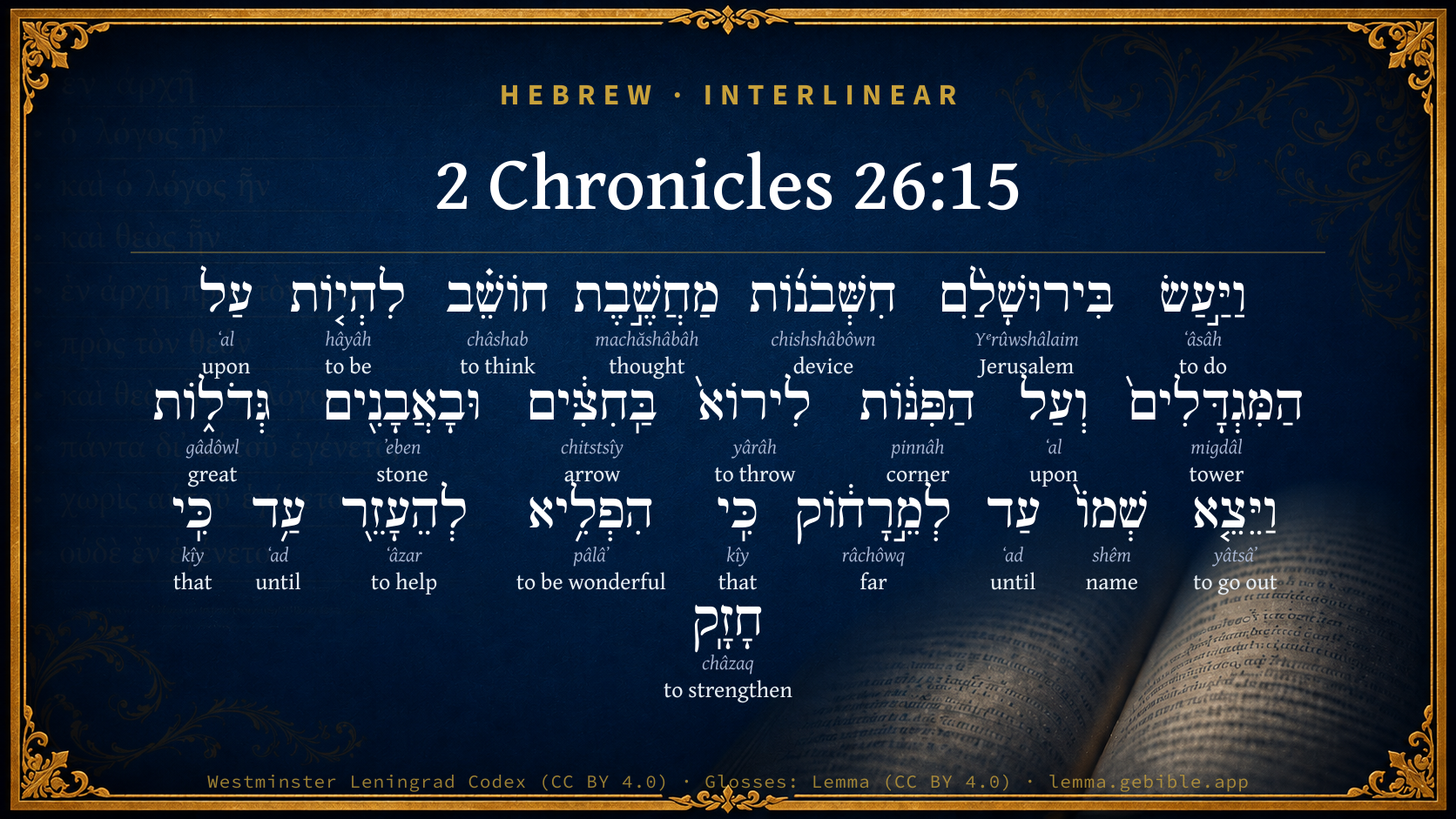
Hebrew (Westminster Leningrad Codex) 2 Chronicles 26:15 appears in the Hebrew Old Testament. The text above is from the Westminster Leningrad Codex. Each word links to its Strong’s number, a concise gloss, and parsing drawn from the Open Scriptures Hebrew Bible morphology. Click any word for its full Brown-Driver-Briggs (BDB) entry.
Download image
Cite this verse

2 Chronicles 26:15 (World English Bible). Public Domain. Lemma interlinear Bible study tool, https://lemma.gebible.app/v/2-chronicles/26/15.

Show BibTeX & RIS
BibTeX
RIS
English Translation
He made in Jerusalem engines, invented by skillful men, to be on the towers and on the battlements, with which to shoot arrows and great stones. His name spread far abroad; for he was marvelously helped, until he was strong.
World English Bible · Public Domain
Highlights
  • 1 first appearance in the Hebrew Bible
Full analysis ↓
Download a study sheet

One document with this verse’s original text, its word-by-word gloss line, the meaning frame, cross-references with their text, attributed commentary, and full source and license credits — printable, and it pastes into notes with its structure intact.

This verse Autodidact and up

Study sheet (.html) Plain text (.txt)

A passage Seminary Student

Up to 50 verses in one chapter. A passage sheet keeps up to 6 commentary sources and 12 cross-references per verse, in the order this page ranks them, and says so on the sheet whenever that leaves anything out. Ask for a single verse and you get the Autodidact verse sheet above.

Everything on this page stays free to read, with no account — the sheet is a download of what is already on screen, not access to it.

Want to remove ads? Support Godless Engineer
Compare translations 3

The same verse in 3 English versions, stacked beneath the original-language interlinear above. Click any original word for its lexicon entry.

Each is an independent rendering of the whole verse — the interlinear is not word-aligned to these translations.

Highlighted words mark where these versions differ — a whole-verse word diff, not a word-by-word alignment.

  • World English Bible Public Domain
    He made in Jerusalem engines, invented by skillful men, to be on the towers and on the battlements, with which to shoot arrows and great stones. His name spread far abroad; for he was marvelously helped, until he was strong.
  • King James Version Public Domain
    And he made in Jerusalem engines, invented by cunning men, to be on the towers and upon the bulwarks, to shoot arrows and great stones withal. And his name spread far abroad; for he was marvelously helped, till he was strong.
  • unfoldingWord Literal Text CC BY-SA 4.0
    And he made in Jerusalem war machines, invention of an inventor, to be on the towers and on the corners to shoot arrows and great stones. And his name went out as far as a distance, for he did wondrously to be helped until when he was strong.

unfoldingWord Literal Text — © unfoldingWord, licensed CC BY-SA 4.0. Word-aligned USFM3 via Door43 (git.door43.org/unfoldingWord/en_ult).

Versions to compare (up to 4)

3 of 4 selected

Show all 18 translations

Every available English version of this verse, each an independent rendering of the whole verse.

  • World English Bible Public Domain
    He made in Jerusalem engines, invented by skillful men, to be on the towers and on the battlements, with which to shoot arrows and great stones. His name spread far abroad; for he was marvelously helped, until he was strong.
  • Berean Standard Bible Public Domain
    And in Jerusalem he made skillfully designed devices to shoot arrows and catapult large stones from the towers and corners. So his fame spread far and wide, for he was helped tremendously so that he became powerful.
  • Majority Standard Bible Public Domain
    And in Jerusalem he made skillfully designed devices to shoot arrows and catapult large stones from the towers and corners. So his fame spread far and wide, for he was helped tremendously until he became powerful.
  • King James Version Public Domain
    And he made in Jerusalem engines, invented by cunning men, to be on the towers and upon the bulwarks, to shoot arrows and great stones withal. And his name spread far abroad; for he was marvelously helped, till he was strong.
  • American Standard Version (1901) Public Domain
    And he made in Jerusalem engines, invented by skilful men, to be on the towers and upon the battlements, wherewith to shoot arrows and great stones. And his name spread far abroad; for he was marvellously helped, till he was strong.
  • Revised Version (1885) Public Domain
    And he made in Jerusalem engines, invented by cunning men, to be on the towers and upon the battlements, to shoot arrows and great stones withal. And his name spread far abroad; for he was marvelously helped, till he was strong.
  • Geneva Bible (1599) Public Domain
    He made also very artificial engins in Ierusalem, to be vpon the towres and vpon the corners, to shoote arrowes and great stones: and his name spred farre abroade, because God did helpe him marueilously, till he was mightie.
  • Douay-Rheims (1899) Public Domain
    And he made in Jerusalem engines of diverse kinds, which he placed in the towers, and in the corners of the walls, to shoot arrows, and great stones: and his name went forth far abroad, for the Lord helped him, and had strengthened him.
  • Young's Literal Translation Public Domain
    And he maketh in Jerusalem inventions -- a device of an inventor -- to be on the towers, and on the corners, to shoot with arrows and with great stones, and his name goeth out unto a distance, for he hath been wonderfully helped till that he hath been strong.
  • Literal Standard Version CC BY-SA 4.0
    And he makes inventions in Jerusalem—a device of an inventor—to be on the towers, and on the corners, to shoot with arrows and with great stones, and his name goes out to a distance, for he has been wonderfully helped until he has been strong.
  • Unlocked Literal Bible CC BY-SA 4.0
    In Jerusalem he built machines that were designed by skillful men to be on the towers and on the battlements to shoot arrows and large stones. His fame spread to distant lands, for he was greatly helped and so he became very powerful.
  • unfoldingWord Literal Text CC BY-SA 4.0
    And he made in Jerusalem war machines, invention of an inventor, to be on the towers and on the corners to shoot arrows and great stones. And his name went out as far as a distance, for he did wondrously to be helped until when he was strong.
  • Darby Bible Public Domain
    And he made in Jerusalem machines invented by skilful men, to be upon the towers and upon the bulwarks, wherewith to shoot arrows and great stones. And his name spread far abroad; for he was marvellously helped, till he became strong.
  • World Messianic Bible Public Domain
    In Jerusalem, he made devices, invented by skillful men, to be on the towers and on the battlements, with which to shoot arrows and great stones. His name spread far abroad, because he was marvelously helped until he was strong.
  • Webster's Bible Public Domain
    And he made in Jerusalem engines, invented by skillful men, to be on the towers and upon the bulwarks, to shoot arrows and great stones. And his name spread far abroad; for he was helped in a wonderful manner, till he was strong.
  • Free Bible Version CC BY-SA 4.0
    He also made skillfully designed war machines to fire arrows and large stones from the towers and corners of the wall. His reputation spread far and wide, for he received extraordinary help until he became really powerful.
  • Bible in Basic English Public Domain
    And in Jerusalem he made machines, the invention of expert men, to be placed on the towers and angles of the walls for sending arrows and great stones. And his name was honoured far and wide; for he was greatly helped till he was strong.
  • JPS Tanakh (1917) Public Domain
    And he made in Jerusalem engines, invented by skilful men, to be on the towers and upon the corners, wherewith to shoot arrows and great stones. And his name spread far abroad; for he was marvellously helped, till he was strong.

Literal Standard Version (2020), Covenant Press — licensed CC BY-SA 4.0. Text via the HelloAO Bible API (eBible.org). Unlocked Literal Bible (unfoldingWord) — licensed CC BY-SA 4.0. Text via the HelloAO Bible API (eBible.org). unfoldingWord Literal Text — © unfoldingWord, licensed CC BY-SA 4.0. Word-aligned USFM3 via Door43 (git.door43.org/unfoldingWord/en_ult). Free Bible Version, Dr. Jonathan Gallagher — licensed CC BY-SA 4.0. Text via the HelloAO Bible API (eBible.org).

Word by word

More ways to search: Search by grammar → Find every occurrence → Compare this word →

Practice this passage: Drill this verse → Learn its vocabulary →

חִשְּׁבֹנ֜וֹת
chishshâbôwn
H2810
“devices”
Noun, Common, Masculine, Plural, Absolute
Part of Speech
Noun
Type
Common
Gender
Masculine
Number
Plural
State
Absolute
Full BDB Definition

Origin: from H2803

TWOT: 767c

device, invention
  1. וַיַּ֣עַשׂ ʻâsâh H6213 “and · to do” Conjunction + Verb, Qal, Sequential Imperfect, 3rd Person, Masculine, Singular
  2. בִּירוּשָׁלִַ֨ם Yᵉrûwshâlaim H3389 “in/at · Jerusalem” Preposition + Noun, Proper
  3. מַחֲשֶׁ֣בֶת machăshâbâh H4284 “thought of” Noun, Common, Feminine, Singular, Construct
  4. חוֹשֵׁ֗ב châshab H2803 “thinking” Verb, Qal, Participle Active, Masculine, Singular, Absolute
  5. לִהְי֤וֹת hâyâh H1961 “to be” Preposition + Verb, Qal, Infinitive Construct
  6. עַל ʻal H5921 “upon” Preposition
  7. הַמִּגְדָּלִים֙ migdâl H4026 “the · towers” Particle, Definite Article + Noun, Common, Both, Plural, Absolute
  8. וְעַל ʻal H5921 “and · upon” Conjunction + Preposition
  9. הַפִּנּ֔וֹת pinnâh H6438 “the · corners” Particle, Definite Article + Noun, Common, Feminine, Plural, Absolute
  10. לִירוֹא֙ yârâh H3384 “to throw” Preposition + Verb, Qal, Infinitive Construct
  11. בַּֽחִצִּ֔ים chitstsîy H2678 “in/at the · arrows” Preposition, Determined + Noun, Common, Masculine, Plural, Absolute
  12. וּבָאֲבָנִ֖ים ʼeben H68 “and · in/at the · stones” Conjunction + Preposition, Determined + Noun, Common, Feminine, Plural, Absolute
  13. גְּדֹל֑וֹת gâdôwl H1419 “great” Adjective, Adjective, Feminine, Plural, Absolute
  14. וַיֵּצֵ֤א yâtsâʼ H3318 “and · to go out” Conjunction + Verb, Qal, Sequential Imperfect, 3rd Person, Masculine, Singular
  15. שְׁמוֹ֙ shêm H8034 “name · his” Noun, Common, Masculine, Singular, Construct + Suffix, Personal, 3rd Person, Masculine, Singular
  16. עַד ʻad H5704 “until” Preposition
  17. לְמֵ֣רָח֔וֹק râchôwq H7350 “to/for · from · far” Preposition + Preposition + Adjective, Adjective, Masculine, Singular, Absolute
  18. כִּֽי kîy H3588 “that” Conjunction
  19. הִפְלִ֥יא pâlâʼ H6381 “to be wonderful” Verb, Hiphil, Perfect, 3rd Person, Masculine, Singular
  20. לְהֵעָזֵ֖ר ʻâzar H5826 “to help” Preposition + Verb, Niphal, Infinitive Construct
  21. עַ֥ד ʻad H5704 “until” Preposition
  22. כִּֽי kîy H3588 “that” Conjunction
  23. חָזָֽק châzaq H2388 “to strengthen” Verb, Qal, Perfect, 3rd Person, Masculine, Singular

About this verse

These counts appear in no published source. They are computed here, from the morphology-tagged text and Lemma’s own curated glosses. What Lemma adds →

24
words
21
distinct lemmas
Historical
section

Notable vocabulary

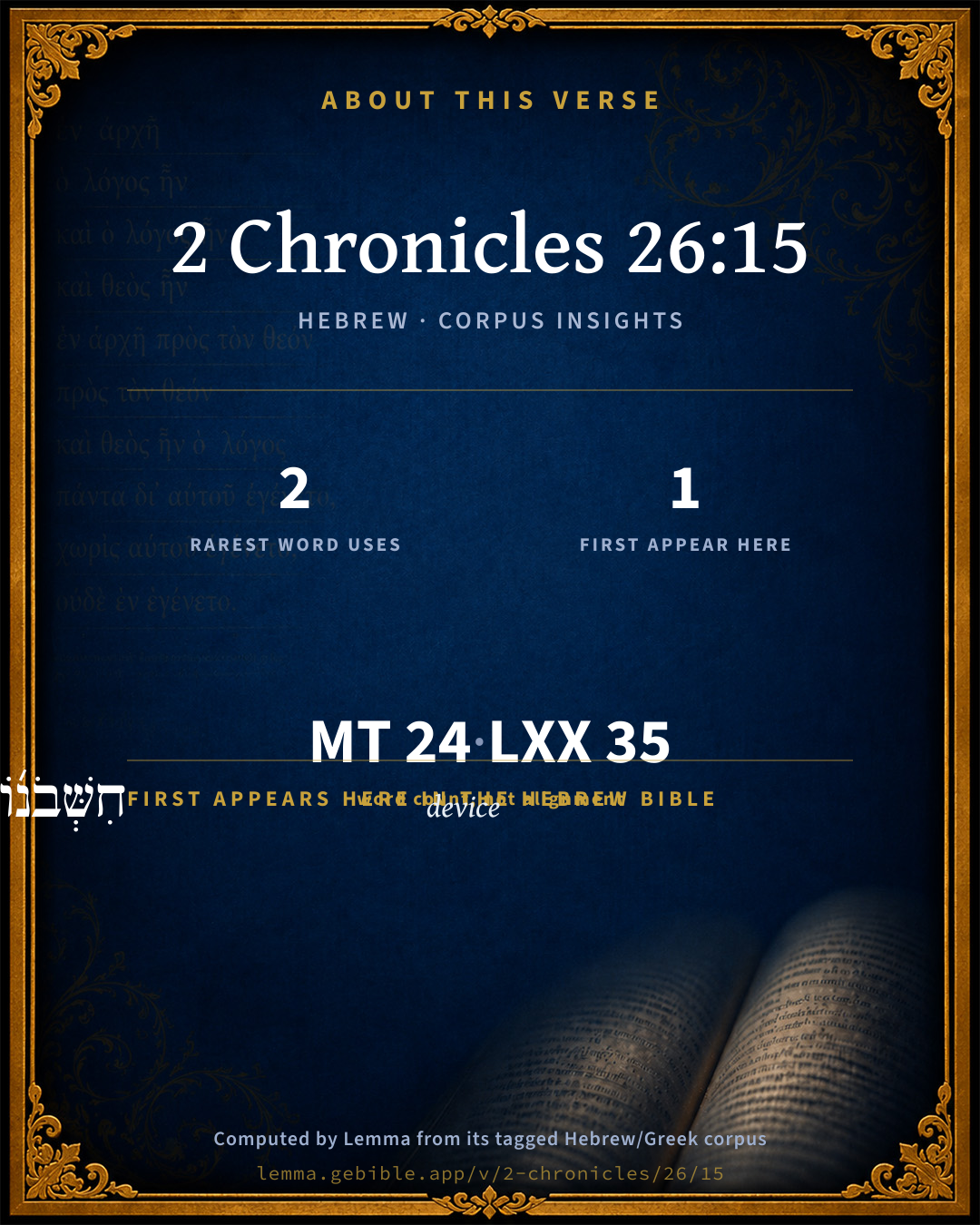
The rarest word here is חִשְּׁבֹנ֜וֹת device H2810 — appearing just 2 times in the whole Hebrew Bible.

First appearance in Scripture

This word makes its first canonical appearance in the Hebrew Bible here:

  • חִשְּׁבֹנ֜וֹת device H2810

Shared distinctive vocabulary

חִשְּׁבֹנ֜וֹת device H2810 occurs in 2 verses of the Hebrew Bible. Also found in:

Grammatical profile

  • 8 verbs
  • 8 nouns
  • 2 adjectives
  • 4 prepositions
  • 2 conjunctions

Verb forms

  • וַיַּ֣עַשׂ Qal · Sequential Imperfect
  • חוֹשֵׁ֗ב Qal · Participle Active
  • לִהְי֤וֹת Qal · Infinitive Construct
  • לִירוֹא֙ Qal · Infinitive Construct
  • וַיֵּצֵ֤א Qal · Sequential Imperfect
  • הִפְלִ֥יא Hiphil · Perfect
  • לְהֵעָזֵ֖ר Niphal · Infinitive Construct
  • חָזָֽק Qal · Perfect

Repetition

Words recur within this verse — often emphatic in Hebrew:

Hebrew & Septuagint length

In English translation the verse runs 40 words from the Hebrew and 46 from the Septuagint (LXX English) — closely comparable.

A rough comparison of the two English renderings, which tokenize alike — not a word-level alignment.

Word counts can differ between the Hebrew and the Greek without any difference in meaning — e.g. the Hebrew direct-object marker אֵת has no separate Greek word, and Greek often adds the article ὁ.

In the original languages it is 24 Hebrew tokens and 35 Greek tokens — but the two are counted differently (Hebrew bundles its prefixes and suffixes into one token; the Greek is in lemma form), so that isn’t a like-for-like length.

Cross-references

4

Topical passages linked to 2 Chronicles 26:15 in the Treasury of Scripture Knowledge — connected by theme and wording, ordered by reader-vote popularity; previews shown in the World English Bible.

  • Exodus 31:4 to devise skillful works, to work in gold, and in silver, and in brass,
  • Matthew 4:24 The report about him went out into all Syria. They brought to him all who were sick, afflicted with various diseases and torments, possessed with demons, epileptics, and paralytics; and he healed them.
  • 2 Chronicles 2:7 Now therefore send me a man skillful to work in gold, and in silver, and in brass, and in iron, and in purple, and crimson, and blue, and who knows how to engrave [all manner of] engravings, [to be] with the skillful men who are with me in Judah and in Jerusalem, whom David my father did provide.
  • 2 Chronicles 2:14 the son of a woman of the daughters of Dan; and his father was a man of Tyre, skillful to work in gold, and in silver, in brass, in iron, in stone, and in timber, in purple, in blue, and in fine linen, and in crimson, also to engrave any manner of engraving, and to devise any device; that there may be [a place] appointed to him with your skillful men, and with the skillful men of my lord David your father.

Cross-references courtesy of OpenBible.info (CC BY 4.0).

Hebrew and Greek witnesses Masoretic Hebrew ↔ Greek Septuagint

The same verse in the two great witnesses to the Old Testament, shown verse-for-verse.

These are two independent witnesses, not word-aligned to each other, and the Septuagint is shown in lemma (dictionary) form.

Hebrew 2 Chronicles 26:15 Masoretic · Westminster Leningrad Codex

וַיַּ֣עַשׂ בִּירוּשָׁלִַ֨ם חִשְּׁבֹנ֜וֹת מַחֲשֶׁ֣בֶת חוֹשֵׁ֗ב לִהְי֤וֹת עַל הַמִּגְדָּלִים֙ וְעַל הַפִּנּ֔וֹת לִירוֹא֙ בַּֽחִצִּ֔ים וּבָאֲבָנִ֖ים גְּדֹל֑וֹת וַיֵּצֵ֤א שְׁמוֹ֙ עַד לְמֵ֣רָח֔וֹק כִּֽי הִפְלִ֥יא לְהֵעָזֵ֖ר עַ֥ד כִּֽי חָזָֽק

He made in Jerusalem engines, invented by skillful men, to be on the towers and on the battlements, with which to shoot arrows and great stones. His name spread far abroad; for he was marvelously helped, until he was strong.

World English Bible · Public Domain

Greek LXX 2 Chronicles 26:15 Septuagint · lemma form

καί ποιέω ἐν ἰερουσαλήμ μηχανή μησανεύομαι λογιστής ὁ εἰμί ἐπί ὁ πύργος καί ἐπί ὁ γωνία βάλλω βέλος καί λίθος μέγας καί ἀκούω ὁ κατασκευή αὐτός ἕως πόρρω ὅτι θαυμάζω ὁ βοηθέω ἕως ὅς καταἰσχύω

And he made in Jerusalem machines invented by a wise contriver, to be upon the towers and upon the corners, to cast darts and great stones: and the fame of their preparation was heard at a distance; for he was wonderfully helped, till he was strong.

LXX2012 (modern English Septuagint) · Public Domain

On this verse, Ellicott's Commentary for English Readers discusses the Septuagint’s reading. Read the note in Commentary ↓

Hebrew: Westminster Leningrad Codex (CC BY 4.0). Greek: Septuagint (public domain); English from LXX2012 (modern English Septuagint) (Public Domain). How the Septuagint differs from the Hebrew →

Commentary

Notes on 2 Chronicles 26:15 from classic Christian and Jewish commentators (each source and its license shown beneath its notes). The classic Christian expositions comment on the surrounding passage and are grouped to its opening verse, so a note may address several verses; the Jewish commentaries on the Tanakh (Rashi and others) are per-verse, so they appear only where the commentator wrote on this verse.

Lemma curates 59 commentaries, every one of them public domain or Creative Commons licensed, each selected and text-cleaned for this edition rather than reprinted as found. About our sources →

Trapp's Complete Commentary

John Trapp

2Ch 26:15 And he made in Jerusalem engines, invented by cunning men, to be on the towers and upon the bulwarks, to shoot arrows and great stones withal. And his name spread far abroad; for he was marvellously helped, till he was strong.

Ver. 15. And he made in Jerusalem engines.] These were anciently much in use, but laid by ever since great guns were invented.

Invented by cunning men.] Heb., Excogitata excogitatione excogitantis, invented by the invention of the inventor. This is an emphatical Hebraism.

For he was marvellously helped (by God) till he was strong.] And then he served him a slippery trick, as we say. Hypocrites have God in admiration only for advantage; when they have what they would have, they start aside like a broken bow. {Hos 7:16 2Ch 12:1}

John Trapp, A Commentary or Exposition upon All the Books of the Old and New Testament (1647–1656) — public domain. Text from a community e-Sword module.

The Biblical Illustrator

Joseph S. Exell

2Ch_26:15

For he was marvellously helped till he was strong.

Marvellously helped till strong

Two kinds of help, natural and supernatural.

1. A time when we cannot help ourselves. Infancy.

2. A time of growth, when we can help ourselves. Youth, manhood.

3. When thus strong the supernatural help ceases.

Not less provision made on that account. There is joy and co-operation with God. As an earthly father requires to be obeyed and served, beholds strength and disposition to co-operate, so the heavenly Father, etc. (G. Matheson.)

Prosperity

I. Uzziahs prosperity.

1. The particulars of his prosperity.

(1) He prospered in war. He had an army of 307,500 men, over whom were 2,600 mighty and valorous captains. All were fully equipped for service. With these soldiers Uzziah fought against the Philistines, the Arabians that dwelt in Gur-baal, the Mehunims and the Amorites, and in each case he was victorious.

(2) He prospered in building. He repaired and fortified the walls of Jerusalem, reared towers a hundred and fifty cubits high (Josephus), built walled towns in the desert, and made channels for the conveyance of water.

(3) He prospered in agriculture. He planted it with all sorts of plants, and sowed it with all sorts of seeds.

(4) Uzziahs prosperity appears to have been general. He did not keep up a great military establishment at the expense of other departments. His name spread far abroad, and he was acknowledged to be an illustrious and a highly-favoured prince.

2. The author of his prosperity. This was God (Uzziah signifies strength from Jehovah.) He was marvellously helped. God helped him against his enemies, and in all he undertook. It might have been otherwise. Instead of victory he might have experienced defeat. His building and agricultural schemes might have proved unsuccessful. It is always well to set the Lord at our right hand. We may plough and plant, but He only can cause the seed to germinate, and grow, and fructify. We may contrive and work, but He only can bless our endeavours.

3. The secret of Uzziahs prosperity. It is distinctly set forth in the fifth verse of this (26) chapter, He sought God in the days of Zechariah, who had understanding in the visions of God: and so long as he sought the Lord God made him to prosper. What is there that God cannot do for a man who takes Him into his counsels? He can help him marvellously. He can exalt valleys and level mountains, make crooked places straight and rough places plain. He can bring clients into the office and ready-money customers into the shop. He has the hearts of all men in His hands, and all the forces of the universe; and He can do whatsoever He will.

II. Uzziahs pride.

1. His prosperity made him proud. His heart was lifted up. A great change for the worse was wrought in him. Whether it was brought about suddenly or gradually we are not told. We assume that Uzziah did not become proud all at once. He who had formerly recognised God as the prime cause of his splendid achievements became wilfully blind, and we shall soon see what effect this had upon his conduct.

2. His pride led him into presumption. The tendency of pride is to make men giddy, and as the result their vision is beclouded, their judgment is perverted.

(1) The occasion of his presumption. Josephus tells us that it was a remarkable day, a general festival, and we are left to supply the rest.

(2) The nature of his presumption. He usurped the office of the priest. There are hereditary moral diseases as well as those which are physical and mental. Uzziahs folly was in some respects a reproduction of the folly of which Amaziah his father had been guilty.

III. Uzziahs punishment.

1. He was resisted in his attempt to do that which was unlawful; resisted by the proper guardians of the temple. Azariah, the high priest, seeing what he was about to do, went in after him, and with him fourscore priests of the Lord, who were valiant men. No time was lost (verse. 18).

2. He was smitten with leprosy. The leprosy rose up in his forehead before the priests in the house of the Lord. There was the bright scaly spot which told its own terrible tale--the mark of Gods disapprobation, and it was on his brow, where all could see it.

3. He was thrust out of the temple as unclean. It was not necessary, however, to use force; conscious that God had smitten him, he hurried out, self-condemned, probably shrieking out his woe, and cursing his folly.

4. He was separated from society (Lev_13:46).

5. He, being a leper, was buried alone. Josephus tells us that he was buried by himself in his own garden. In all likelihood his resting-place was a field or garden adjoining the usual burial-place of the kings.

Lessons:

1. God is the giver of prosperity.

2. Prosperous men are in danger of becoming proud.

3. Pride is often followed by presumption.

4. Presumption is sure of punishment. (J. Baker Norton.)

The Biblical Illustrator, edited by Joseph S. Exell (c. 1880s–1900s) — public domain. Text from a community e-Sword module.

Geneva Bible (1599)

Geneva Bible translators

Hebrew, engines by the invention of an inventive man.

Geneva Bible (1599) marginal notes — public domain. Text via Bolls.life.

Jamieson, Fausset & Brown

Robert Jamieson, A. R. Fausset & David Brown

he made . . . engines, invented by cunning men . . . to shoot arrows and great stones--This is the first notice that occurs in history of the use of machines for throwing projectiles. The invention is apparently ascribed to the reign of Uzziah, and PLINY expressly says they originated in Syria.

he was marvellously helped till he was strong--He conducted himself as became the viceroy of the Divine King, and prospered.

Jamieson, Fausset & Brown — Commentary Critical and Explanatory on the Whole Bible (1871) — public domain (CC PDM 1.0). Text via the HelloAO Bible API.

Adam Clarke's Commentary

Verse 15. Engines - to shoot arrows and great stones] The Targum says, "He made in Jerusalem ingenious instruments, and little hollow towers, to stand upon the towers and upon the bastions, for the shooting of arrows, and projecting of great stones."

This is the very first intimation on record of any warlike engines for the attack or defense of besieged places; and this account is long prior to any thing of the kind among either the Greeks or Romans. Previously to such inventions, the besieged could only be starved out, and hence sieges were very long and tedious. Shalmaneser consumed three years before such an inconsiderable place as Samaria, 2Kg 17:5-6; Sardanapalus maintained himself in Nineveh for seven years, because the besiegers had no engines proper for the attack and destruction of walls, c., and it is well known that Troy sustained a siege of ten years, the Greeks not possessing any machine of the kind here referred to. The Jews alone were the inventors of such engines and the invention took place in the reign of Uzziah, about eight hundred years before the Christian era. It is no wonder that, in consequence of this, his name spread far abroad, and struck terror into his enemies.

Adam Clarke's Commentary on the Bible (1810–1826) — public domain. Text from a community e-Sword/MySword module.

Ellicott's Commentary for English Readers

(15) Engines, invented by cunning men.—The first mention of artillery. Literally, devices, a devising of a deviser. The word “engine” (i.e., ingenium, which is late Latin for ballista) fairly represents chishshâbôn. LXX., μηχανὰς, Vulg., machinas.

Bulwarks.—Pinnôth. Zep_1:16, “towers.”

To shoot arrows and great stones.—So that they were like the well-known catapults and ballisters of Roman warfare. An instrument like the ballista is represented on the Assyrian sculptures, and probably both kinds of artillery passed from Assyria to Palestine.

And his name spread.—Went forth (2Ch_26:8).

He was marvellously helped.—The Hebrew phrase only occurs here.

Till.—So that he became strong.

A Bible Commentary for English Readers, edited by Charles John Ellicott (1878–1897) — public domain. Text from a community e-Sword module.

The Cambridge Bible for Schools and Colleges

gen. ed. J. J. S. Perowne

15. engines] Cp. 1Ma_6:51-52 and article Engine Hastings’ Bible Dictionary.

bulwarks] R.V. battlements (lit. “corners”).

helped] Cp. 2Ch_26:7.

The Cambridge Bible for Schools and Colleges (gen. ed. J. J. S. Perowne; Cambridge University Press, 1878–1918) — public domain. Text from a community e-Sword module.

John Gill's Exposition

And Azariah the priest went in after him,.... To hinder him from doing it, and to persuade him to go out. This was the high priest, as appears from Ch2 26:20 and is thought to be the same that is spoken of in Ch1 6:10.

and with him eighty priests of the Lord, that were valiant men; not only able bodied men, but men of spirit and courage, and zealous for the honour of God.

John Gill's Exposition of the Whole Bible (1746–1763) — public domain (CC PDM 1.0). Text via the HelloAO Bible API.

Albert Barnes' Notes on the Bible

Uzziah’s engines seem to have corresponded respectively to the Roman balista and catapulta. The balista, which threw stones, was known to the Assyrians as early as the time of Sardanapalus I, the contemporary of Jehoshaphat. The catapult is not represented either on the Assyrian or the Egyptian sculptures. It would seem on the whole most probable that both kinds of engines were invented in Assyria and introduced from thence into Palestine.

Albert Barnes' Notes on the Bible (1834–1885) — public domain. Text from a community e-Sword/MySword module.

Haydock's Catholic Bible Commentary

Engines. They are here mentioned for the first time. C. --- For the. Heb. "for he was wonderfully helped till he was established." H. --- He invented may things for the defence of his kingdom. C.

George Leo Haydock (1774–1849), Haydock's Catholic Family Bible and Commentary, 1859 edition — public domain. Excludes Psalms (Douay-Rheims chapter numbering differs from Protestant) and Deuterocanonical books (Catholic canon only).

Whedon's Commentary on the Bible

Daniel D. Whedon

15. Engines… to shoot arrows and great stones — These must have been of somewhat similar construction to the Roman balista and catapults — enormous bows or springs, set in a wooden framework, and so contrived as to hurl with the greatest violence both darts and stones.

Daniel D. Whedon (gen. ed.), Commentary on the Old and New Testaments (1874–1909) — public domain. Text from a community e-Sword module.

The Pulpit Commentary

Engines; Hebrew, twOnboVji used only here and, Ecc_7:29 (where it is rendered "inventions") but the related word wOBvj, is found three times: (Ecc_7:25) (the "reason") 27 (the "account"); 9:10 ("device"); while the verb root bvj to "devise," occurs about a hundred and thirty times, as in next sub-clause bvewOj tbvj A strict rendering of the clause would make it read, "He made inventions, the inventing of an inventive man;" and the force of the words might be to appraise very highly the virtue of the invention or machine, while to himself may have been due the credit thereof. The balista which discharged stones is depicted on Assyrian sculptures; not so the machine for discharging darts and arrows, the catapult. Although, as just suggested, it were conceivable that to Uzziah himself was due in part the invention or the great improving of the machines in question, yet the verse may be regarded as simply saying that the introduction of them into Jerusalem was his work. He was marvellously helped (see ver. 7).

The Pulpit Commentary (1880–1919), ed. H.D.M. Spence-Jones & Joseph S. Exell — public domain. Text from a community e-Sword module.

Rashi

Rabbi Shlomo Yitzchaki (Rashi)

engines, invented by skillful men - Heb. חִשְּׁבֹנוֹת מַחֲשֶׁבֶת חוֹשֵׁב, similar to (Exod. 28:6): “expert work (מַעֲשֵׂה חֹשֵׁב.)” He made war engines with craftsmanship, such as siege mounds and battering rams, as it is written (Prov. 24:6): “For you shall wage war with strategies.”

Rashi on the Tanakh — English translations: “The Judaica Press complete Tanach with Rashi, translated by A. J. Rosenberg” (CC BY 4.0); “Pentateuch with Rashi's commentary by M. Rosenbaum and A.M. Silbermann, 1929-1934” (public domain); “The Metsudah Tanach series, Lakewood, N.J” (CC BY 4.0); and “The Book of Joshua, Metsudah Publications, 1997” (CC BY 4.0). Text via Sefaria.

Lesson kit

Teaching starters — assembled from the data on this page, not authored interpretation. Every prompt links to the verse data it draws on. Edit before teaching.

2 Chronicles, in the Historical, opens this verse with 24 words (21 distinct Hebrew lemmas). Its most distinctive word is chishshâbôwn (“device”). A historical commentator’s framing appears above. Read the whole chapter for the surrounding context.

Discussion questions

  1. What does “device” (chishshâbôwn) contribute to the verse as a whole?
  2. The word “device” first appears here in Scripture. What is being introduced at this debut?
  3. Ecclesiastes 7:29 shares the word «device» with this verse. How do the two illuminate each other?
  4. “upon” occurs 2× in this one verse. What is the effect of the repetition?
  5. The translations on this page render this verse differently — a whole-verse word diff, not a word-by-word alignment. What might account for the different wordings?
  6. The verb «וַיַּ֣עַשׂ» is Qal Sequential Imperfect. How does its form color the action?
  7. Reading how Trapp's Complete Commentary and The Biblical Illustrator read this verse, where do the two commentators agree and where do they part?

Things to notice

Reading settings

Reading text

Shown beneath each verse's original-language words.

Old Testament
Old Testament edition

Read the OT as the Masoretic Hebrew (MT) or the Greek Septuagint (LXX).

English shown for the Greek Septuagint (in the Hebrew ↔ Greek comparison).

Comparing translations? Open the Compare panel on any verse page to stack up to four side by side.