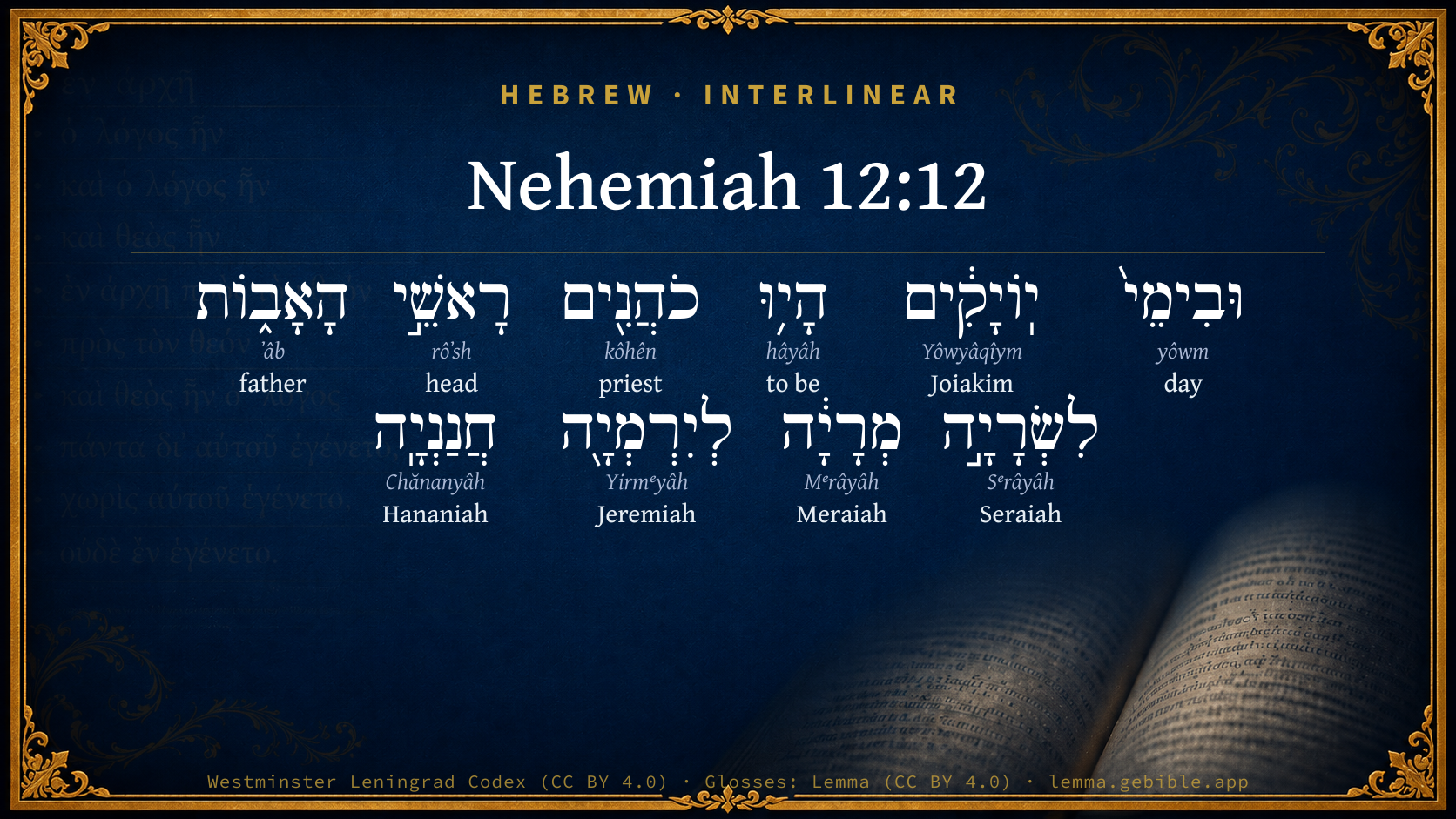
Nehemiah 12:12

Hebrew (Westminster Leningrad Codex) Nehemiah 12:12 appears in the Hebrew Old Testament. The text above is from the Westminster Leningrad Codex. Each word links to its Strong’s number, a concise gloss, and parsing drawn from the Open Scriptures Hebrew Bible morphology. Click any word for its full Brown-Driver-Briggs (BDB) entry.
Download image
Cite this verse

Nehemiah 12:12 (World English Bible). Public Domain. Lemma interlinear Bible study tool, https://lemma.gebible.app/v/nehemiah/12/12.

Show BibTeX & RIS
BibTeX
RIS
English Translation
In the days of Joiakim were priests, heads of fathers' [houses]: of Seraiah, Meraiah; of Jeremiah, Hananiah;
World English Bible · Public Domain
Highlights
  • 1 hapax legomenon — only here in the Hebrew Bible
  • 1 first appearance in the Hebrew Bible
Full analysis ↓
Download a study sheet

One document with this verse’s original text, its word-by-word gloss line, the meaning frame, cross-references with their text, attributed commentary, and full source and license credits — printable, and it pastes into notes with its structure intact.

This verse Autodidact and up

Study sheet (.html) Plain text (.txt)

A passage Seminary Student

Up to 50 verses in one chapter. A passage sheet keeps up to 6 commentary sources and 12 cross-references per verse, in the order this page ranks them, and says so on the sheet whenever that leaves anything out. Ask for a single verse and you get the Autodidact verse sheet above.

Everything on this page stays free to read, with no account — the sheet is a download of what is already on screen, not access to it.

Want to remove ads? Support Godless Engineer
Compare translations 3

The same verse in 3 English versions, stacked beneath the original-language interlinear above. Click any original word for its lexicon entry.

Each is an independent rendering of the whole verse — the interlinear is not word-aligned to these translations.

Highlighted words mark where these versions differ — a whole-verse word diff, not a word-by-word alignment.

  • World English Bible Public Domain
    In the days of Joiakim were priests, heads of fathers' [houses]: of Seraiah, Meraiah; of Jeremiah, Hananiah;
  • King James Version Public Domain
    And in the days of Joiakim were priests, the chief of the fathers: of Seraiah, Meraiah; of Jeremiah, Hananiah;
  • unfoldingWord Literal Text CC BY-SA 4.0
    And in the days of Joiakim priests were the heads of the fathers: of Seraiah, Meraiah; of Jeremiah, Hananiah;

unfoldingWord Literal Text — © unfoldingWord, licensed CC BY-SA 4.0. Word-aligned USFM3 via Door43 (git.door43.org/unfoldingWord/en_ult).

Versions to compare (up to 4)

3 of 4 selected

Show all 18 translations

Every available English version of this verse, each an independent rendering of the whole verse.

  • World English Bible Public Domain
    In the days of Joiakim were priests, heads of fathers' [houses]: of Seraiah, Meraiah; of Jeremiah, Hananiah;
  • Berean Standard Bible Public Domain
    In the days of Joiakim, these were the heads of the priestly families: of the family of Seraiah, Meraiah; of Jeremiah, Hananiah;
  • Majority Standard Bible Public Domain
    In the days of Joiakim, these were the heads of the priestly families: of the family of Seraiah, Meraiah; of Jeremiah, Hananiah;
  • King James Version Public Domain
    And in the days of Joiakim were priests, the chief of the fathers: of Seraiah, Meraiah; of Jeremiah, Hananiah;
  • American Standard Version (1901) Public Domain
    And in the days of Joiakim were priests, heads of fathers' `houses': of Seraiah, Meraiah; of Jeremiah, Hananiah;
  • Revised Version (1885) Public Domain
    And in the days of Joiakim were priests, heads of fathers’ houses: of Seraiah, Meraiah; of Jeremiah, Hananiah;
  • Geneva Bible (1599) Public Domain
    And in the daies of Ioiakim were these, the chiefe fathers of the Priests: vnder Seraiah was Meraiah, vnder Ieremiah, Hananiah,
  • Douay-Rheims (1899) Public Domain
    And in the days of Joacim the priests and heads of the families were: Of Saraia, Maraia: of Jeremias, Hanania:
  • Young's Literal Translation Public Domain
    And in the days of Joiakim have been priests, heads of the fathers; of Seraiah, Meraiah; of Jeremiah, Hananiah;
  • Literal Standard Version CC BY-SA 4.0
    And in the days of Joiakim have been priests, heads of the fathers: of Seraiah, Meraiah; of Jeremiah, Hananiah;
  • Unlocked Literal Bible CC BY-SA 4.0
    In the days of Joiakim these were the priests, the leaders of the families: Meraiah was the leader of Seraiah, Hananiah was the leader of Jeremiah,
  • unfoldingWord Literal Text CC BY-SA 4.0
    And in the days of Joiakim priests were the heads of the fathers: of Seraiah, Meraiah; of Jeremiah, Hananiah;
  • Darby Bible Public Domain
    And in the days of Joiakim were priests, chief fathers: of Seraiah, Meraiah; of Jeremiah, Hananiah;
  • World Messianic Bible Public Domain
    In the days of Joiakim were priests, heads of fathers’ households: of Seraiah, Meraiah; of Jeremiah, Hananiah;
  • Webster's Bible Public Domain
    And in the days of Joiakim were priests, the chief of the fathers: of Seraiah, Meraiah; of Jeremiah, Hananiah;
  • Free Bible Version CC BY-SA 4.0
    In Joiakim's time, these were the family leaders of the priests: of the family of Seraiah, Meraiah; of Jeremiah, Hananiah;
  • Bible in Basic English Public Domain
    And in the days of Joiakim there were priests, heads of families: of Seraiah, Meraiah; of Jeremiah, Hananiah;
  • JPS Tanakh (1917) Public Domain
    And in the days of Joiakim were priests, heads of fathers' houses: of Seraiah, Meraiah; of Jeremiah, Hananiah;

Literal Standard Version (2020), Covenant Press — licensed CC BY-SA 4.0. Text via the HelloAO Bible API (eBible.org). Unlocked Literal Bible (unfoldingWord) — licensed CC BY-SA 4.0. Text via the HelloAO Bible API (eBible.org). unfoldingWord Literal Text — © unfoldingWord, licensed CC BY-SA 4.0. Word-aligned USFM3 via Door43 (git.door43.org/unfoldingWord/en_ult). Free Bible Version, Dr. Jonathan Gallagher — licensed CC BY-SA 4.0. Text via the HelloAO Bible API (eBible.org).

Word by word

More ways to search: Search by grammar → Find every occurrence → Compare this word →

Practice this passage: Drill this verse → Learn its vocabulary →

About this verse

These counts appear in no published source. They are computed here, from the morphology-tagged text and Lemma’s own curated glosses. What Lemma adds →

10
words
10
distinct lemmas
Historical
section

Notable vocabulary

1 hapax legomenon — a word that appears only here in the entire Hebrew Bible:

  • מְרָיָ֔ה Meraiah H4811

First appearance in Scripture

This word makes its first canonical appearance in the Hebrew Bible here:

  • מְרָיָ֔ה Meraiah H4811

Shared distinctive vocabulary

יֽוֹיָקִ֔ים Joiakim H3113 occurs in 3 verses of the Hebrew Bible. Also found in:

Grammatical profile

  • 1 verb
  • 9 nouns

Verb forms

  • הָי֥וּ Qal · Perfect

Cross-references

4

Topical passages linked to Nehemiah 12:12 in the Treasury of Scripture Knowledge — connected by theme and wording, ordered by reader-vote popularity; previews shown in the World English Bible.

  • 1 Chronicles 9:33–34 These are the singers, heads of fathers' [houses] of the Levites, [who lived] in the chambers [and were] free [from other service]; for they were employed in their work day and night.
  • 1 Chronicles 15:12 and said to them, You are the heads of the fathers' [houses] of the Levites: sanctify yourselves, both you and your brothers, that you may bring up the ark of Yahweh, the God of Israel, to [the place] that I have prepared for it.
  • 1 Chronicles 24:6–31 Shemaiah the son of Nethanel the scribe, who was of the Levites, wrote them in the presence of the king, and the princes, and Zadok the priest, and Ahimelech the son of Abiathar, and the heads of the fathers' [houses] of the priests and of the Levites; one fathers' house being taken for Eleazar, and one taken for Ithamar.
  • Nehemiah 12:22 As for the Levites, in the days of Eliashib, Joiada, and Johanan, and Jaddua, there were recorded the heads of fathers' [houses]; also the priests, in the reign of Darius the Persian.

Cross-references courtesy of OpenBible.info (CC BY 4.0).

Hebrew and Greek witnesses Masoretic Hebrew ↔ Greek Septuagint

The same verse in the two great witnesses to the Old Testament, shown verse-for-verse.

These are two independent witnesses, not word-aligned to each other, and the Septuagint is shown in lemma (dictionary) form.

Hebrew Nehemiah 12:12 Masoretic · Westminster Leningrad Codex

וּבִימֵי֙ יֽוֹיָקִ֔ים הָי֥וּ כֹהֲנִ֖ים רָאשֵׁ֣י הָאָב֑וֹת לִשְׂרָיָ֣ה מְרָיָ֔ה לְיִרְמְיָ֖ה חֲנַנְיָֽה

In the days of Joiakim were priests, heads of fathers' [houses]: of Seraiah, Meraiah; of Jeremiah, Hananiah;

World English Bible · Public Domain

Greek LXX Structure differs

The Septuagint has no separate book of Nehemiah. Its Greek text is the second half of Esdras B (2 Esdras), chapters 11–23; Ezra is the first half (1–10).

A verse-for-verse comparison isn’t shown here because the chapters and verses don’t line up. Switch to the LXX edition with the MT / LXX toggle above to read the Greek directly.

On this verse, Haydock's Catholic Bible Commentary discusses the Septuagint’s reading. Read the note in Commentary ↓

Hebrew: Westminster Leningrad Codex (CC BY 4.0). Greek: Septuagint (public domain); English from a public-domain English Septuagint. How the Septuagint differs from the Hebrew →

Commentary

Notes on Nehemiah 12:12 from classic Christian and Jewish commentators (each source and its license shown beneath its notes). The classic Christian expositions comment on the surrounding passage and are grouped to its opening verse, so a note may address several verses; the Jewish commentaries on the Tanakh (Rashi and others) are per-verse, so they appear only where the commentator wrote on this verse.

Lemma curates 59 commentaries, every one of them public domain or Creative Commons licensed, each selected and text-cleaned for this edition rather than reprinted as found. About our sources →

John Gill's Exposition

And in the days of Joiakim were priests, the chief of the fathers,.... This was the son and successor of Jeshua, or Joshua, the first high priest of the second temple; the principal men of the priesthood in his time were as follow, and who were the sons, or however the descendants of the priests in the time of his father before mentioned: these were Meraiah, Hananiah, Meshullam, Jehohanan, Jonathan, Joseph, Adna, Helkai, Zechariah, (the prophet of that name,) Meshullam, Zichri, Piltai, Shammua, Jehonathan, Mattenai, Uzzi, Kallai, Eber, Hashabiah, Nethaneel; in all twenty, whereas there are twenty two named, as in his father's days, there being no sons or descendants from two of them, namely, Hattush and Miamin.

And in the days of Joiakim were priests, the chief of the fathers,.... This was the son and successor of Jeshua, or Joshua, the first high priest of the second temple; the principal men of the priesthood in his time were as follow, and who were the sons, or however the descendants of the priests in the time of his father before mentioned: these were Meraiah, Hananiah, Meshullam, Jehohanan, Jonathan, Joseph, Adna, Helkai, Zechariah, (the prophet of that name,) Meshullam, Zichri, Piltai, Shammua, Jehonathan, Mattenai, Uzzi, Kallai, Eber, Hashabiah, Nethaneel; in all twenty, whereas there are twenty two named, as in his father's days, there being no sons or descendants from two of them, namely, Hattush and Miamin.

Nehemiah 12:22

neh 12:22

neh 12:22

neh 12:22The Levites, in the days of Eliashib,.... The third priest of the second temple:

Joiada; he was the son of Eliashib, and the fourth high priest:

and Johanan; the same with Jonathan, Neh 12:11 and whom Josephus (o) also calls Joannes:

and Jaddua; the same as in Neh 12:10 in the days of each of these were

recorded chief of the fathers; the principal men among the Levites:

also the priests, to the reign of Darius the Persian; thought to be Darius Codomannus, the last king of the Persian monarchy, whom Alexander conquered; and if so, this verse must be inserted after the death of Nehemiah, and as the next verse also seems to be; for these two verses interrupt the natural order of the relation: an account is given of the priests in the times of Joiakim, Neh 12:12, these verses being inserted, the account goes on, Neh 12:24, &c. of the chief of the Levites in the times of Joiakim only.

(o) Antiqu. l. 11. c. 7. sect. 1.

John Gill's Exposition of the Whole Bible (1746–1763) — public domain (CC PDM 1.0). Text via the HelloAO Bible API.

Joseph Benson's Commentary

Neh 12:12. In the days of Joiakim were priests — As the writer had mentioned those who were the chief of the priests in the days of Jeshua, so now he mentions the sons of every one of them who officiated in the days of Joiakim the son of Jeshua, either as assistants to their fathers, or succeeding them when they were dead. He begins with the three named in this verse, and so proceeds in order to give an account of the rest, which reaches to Neh 12:22.

Joseph Benson's Commentary on the Old and New Testaments (1811–1818) — public domain. Text from a community e-Sword module.

The Pulpit Commentary

LIST OF THE HEADS OF THE PRIESTLY COURSES IN THE TIME OF THE HIGH PRIEST JOIAKIM. (Neh_12:12-21) Joiakim must have been contemporary with Xerxes, and consequently have been high priest at the time when the very existence of the Jewish people was threatened by Haman. It is curious that we have no record of his high priesthood, nor of the condition of the Palestinian Jews at the time, beyond the slight hints furnished by this chapter. These hints seem to imply that under him special attention was paid to the formation of lists, especially of the chief priests and Levites, and that the temple service was celebrated with great exactness and regularity (vers. 24-26). The present list is particularly valuable, as enabling us to check that with which the chapter opens, and as establishing the family character of the names whereof that list is made up.

Of Seraiah, Meraiah. It will be observed that the family names of the priestly, courses follow the order of the same names in vers. 1-7, and exactly accord with them, excepting in minute differences of spelling, and in one omission that of the name of "Hattush." It might be supposed that the family of Hattush had died out; but this is contradicted by its reappearance among the signatures to the covenant; (Neh_10:4) the omission here would therefore appear to be accidental.

The Pulpit Commentary (1880–1919), ed. H.D.M. Spence-Jones & Joseph S. Exell — public domain. Text from a community e-Sword module.

Keil & Delitzsch

C. F. Keil & F. Delitzsch

Neh 12:12-21 contains the list of the priestly houses and their heads, which has been already explained in conjunction with that in Neh 12:1-7. Neh 12:22-26. The list of the heads of the Levites, Neh 12:22 and Neh 12:24, is, according to Neh 12:26, that of the days of Joiakim, and of the days of Nehemiah and Ezra. Whence it follows, that it does not apply only to the time of Joiakim; for though Ezra might indeed have come to Jerusalem in the latter days of Joiakim's high-priesthood, yet Nehemiah's arrival found his successor Eliashib already in office, and the statements of Neh 12:22 and Neh 12:23 must be understood accordingly.

Keil & Delitzsch — Biblical Commentary on the Old Testament (1861–1891) — public domain (CC PDM 1.0). Text via the HelloAO Bible API. (Old Testament only.)

Tyndale Open Study Notes

Tyndale Open Resources

12:12-21 This list was probably compiled when Joiakim was high priest (12:12) to verify the legitimacy of the priests and Levites who were in office. Except for the omission of Hattush (see 12:2), this list contains the same names as 12:1-7.

Tyndale Open Study Notes — © Tyndale Open Resources, licensed CC BY-SA 4.0. Text via the HelloAO Bible API.

Geneva Bible (1599)

Geneva Bible translators

That is, next to Seraiah, or rather of the order, which was called after the name of Seraiah.

Geneva Bible (1599) marginal notes — public domain. Text via Bolls.life.

Jamieson, Fausset & Brown

Robert Jamieson, A. R. Fausset & David Brown

in the days of Joiakim were priests, the chief of the fathers--As there had been priests in the days of Jeshua, so in the time of Joiakim, the son and successor of Jeshua, the sons of those persons filled the priestly office in the place of their fathers, some of whom were still alive, though many were dead.

Jamieson, Fausset & Brown — Commentary Critical and Explanatory on the Whole Bible (1871) — public domain (CC PDM 1.0). Text via the HelloAO Bible API.

Ellicott's Commentary for English Readers

(12-26) List of representatives of Zerubbabel’s priests in the days of Joiakim; to which is added an account of the Levites in his day. Between these there is an interpolation (Neh_12:22-23).

A Bible Commentary for English Readers, edited by Charles John Ellicott (1878–1897) — public domain. Text from a community e-Sword module.

The Cambridge Bible for Schools and Colleges

gen. ed. J. J. S. Perowne

12. And in the days of Joiakim] See note on Neh_12:10.

the chief of the fathers] R.V. heads of fathers’ houses.

On the list contained in these verses, see note on Neh_12:1.

The Cambridge Bible for Schools and Colleges (gen. ed. J. J. S. Perowne; Cambridge University Press, 1878–1918) — public domain. Text from a community e-Sword module.

Haydock's Catholic Bible Commentary

Saraia had given his name to one of the principal families, at the head of which was Maraia, at this time. The Latin manuscripts, Septuagint, and Syriac style him Amaria.

George Leo Haydock (1774–1849), Haydock's Catholic Family Bible and Commentary, 1859 edition — public domain. Excludes Psalms (Douay-Rheims chapter numbering differs from Protestant) and Deuterocanonical books (Catholic canon only).

Matthew Poole's English Annotations

As their fathers were priests in the days of Joshua, so in the days of Joiakim, the son of Joshua, the sons of those persons executed the priesthood in their fathers’ steads, some of their fathers probably being yet living, and many of them now dead.

Matthew Poole's English Annotations on the Holy Bible (1683–1685) — public domain. Text from a community e-Sword/MySword module.

John Wesley's Explanatory Notes

Priests - As their fathers were priests in the days of Joshua, so in the days of Joiakim the son of Joshua, the sons of those persons executed the priesthood in their father's steads, some of their fathers probably being yet living, and many of them dead.

John Wesley, Explanatory Notes Upon the Whole Bible (1754–1765) — public domain. Text via the GEBible commentary corpus.

unfoldingWord translationNotes

Door43 World Missions Community

Joiakim ... Meraiah ... Hananiah ... Meshullam ... Jehohanan ... Jonathan ... Joseph

These are names of men. (See: How to Translate Names)

Seraiah ... Jeremiah ... Ezra ... Amariah ... Malluk ... Shebaniah

These are names of families named after men. (See: How to Translate Names)

translationWords

priest

Ezra

unfoldingWord translationNotes — © Distant Shores Media and the Door43 World Missions Community, licensed CC BY-SA 4.0. Source: git.door43.org/Door43/en_tn.

Rashi

Rabbi Shlomo Yitzchaki (Rashi)

And in the days of Joiakim who was the high priest. These priests were the leaders of the fathers’ houses of their watches.

of Seraiah was Meraiah Of the watch of Seraiah, the head of the father’s house was Meraiah, and of the watch of Jeremiah, the head of the father’s house was Hananiah, and so it is with them all, and the reason Scripture did not list all twenty-four watches is that it is not exacting in enumerating them all.

Rashi on the Tanakh — English translations: “The Judaica Press complete Tanach with Rashi, translated by A. J. Rosenberg” (CC BY 4.0); “Pentateuch with Rashi's commentary by M. Rosenbaum and A.M. Silbermann, 1929-1934” (public domain); “The Metsudah Tanach series, Lakewood, N.J” (CC BY 4.0); and “The Book of Joshua, Metsudah Publications, 1997” (CC BY 4.0). Text via Sefaria.

Lesson kit

Teaching starters — assembled from the data on this page, not authored interpretation. Every prompt links to the verse data it draws on. Edit before teaching.

Nehemiah, in the Historical, opens this verse with 10 words (10 distinct Hebrew lemmas). Its most distinctive word is Mᵉrâyâh (“Meraiah”). A historical commentator’s framing appears above. Read the whole chapter for the surrounding context.

Discussion questions

  1. What does “Meraiah” (Mᵉrâyâh) contribute to the verse as a whole?
  2. 1 word here appears nowhere else in the Hebrew Bible. Why might the author reach for such rare wording?
  3. This is the first place “Meraiah” appears in Scripture (first appears here). What does its debut here establish?
  4. How does Nehemiah 12:10, which shares the word «Joiakim», read alongside this verse?
  5. The translations on this page render this verse differently — a whole-verse word diff, not a word-by-word alignment. What might account for the different wordings?
  6. «הָי֥וּ» is a Qal Perfect verb. How does that grammatical form shape the action described?
  7. Compare how John Gill's Exposition and Joseph Benson's Commentary read this verse. Where do they agree or differ?

Things to notice

  • 1 word in this verse appears nowhere else in the Hebrew Bible.
  • 1 word makes its first canonical appearance in Scripture here.
  • These translations choose different wording for 3 words in this verse.
  • 10 distinct Hebrew lemmas span 10 words in this verse.

Reading settings

Reading text

Shown beneath each verse's original-language words.

Old Testament
Old Testament edition

Read the OT as the Masoretic Hebrew (MT) or the Greek Septuagint (LXX).

English shown for the Greek Septuagint (in the Hebrew ↔ Greek comparison).

Comparing translations? Open the Compare panel on any verse page to stack up to four side by side.