
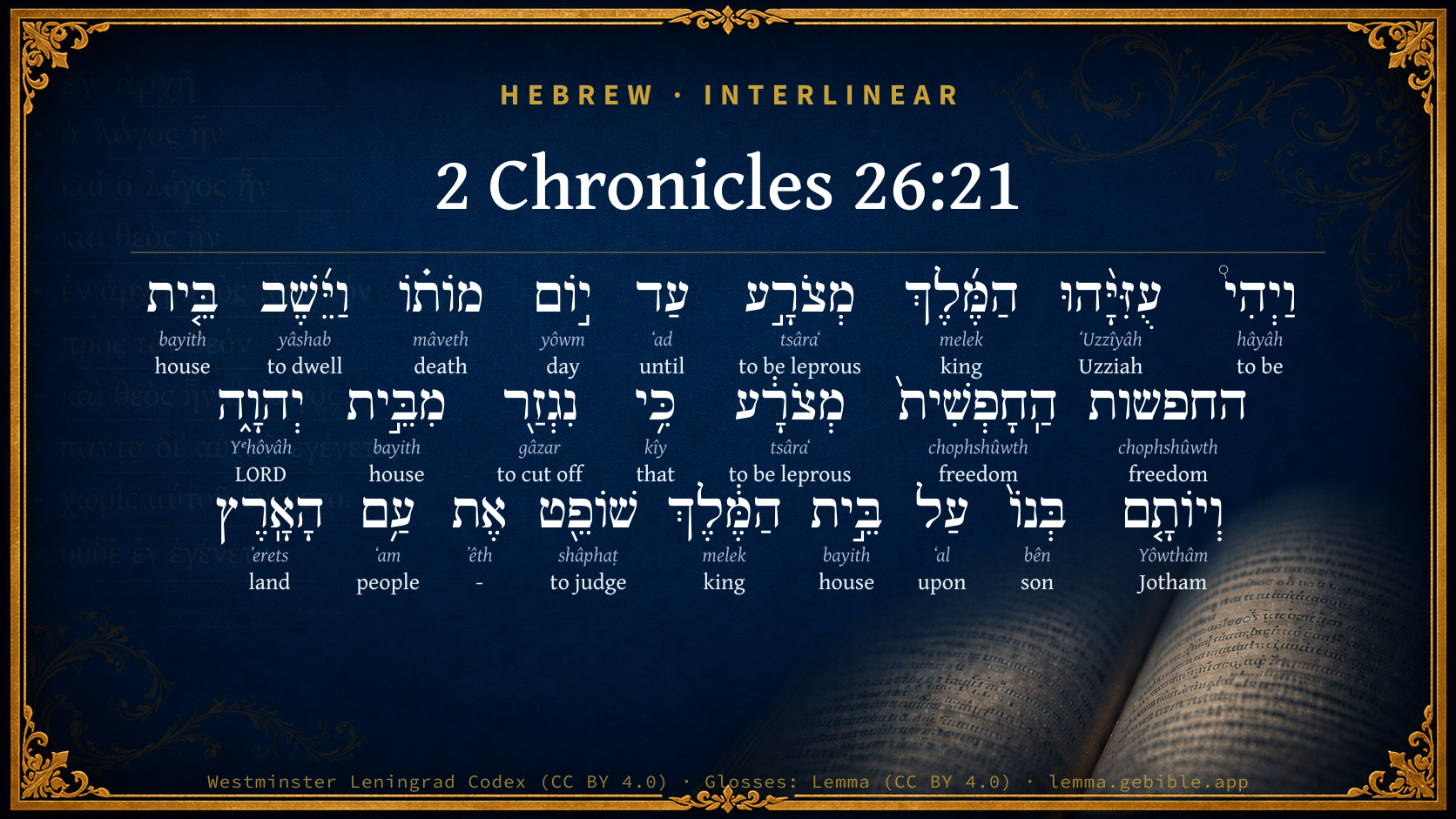
2 Chronicles 26:21

Hebrew (Westminster Leningrad Codex) 2 Chronicles 26:21 appears in the Hebrew Old Testament. The text above is from the Westminster Leningrad Codex. Each word links to its Strong’s number, a concise gloss, and parsing drawn from the Open Scriptures Hebrew Bible morphology. Click any word for its full Brown-Driver-Briggs (BDB) entry.
Download image
Cite this verse

2 Chronicles 26:21 (World English Bible). Public Domain. Lemma interlinear Bible study tool, https://lemma.gebible.app/v/2-chronicles/26/21.

Show BibTeX & RIS
BibTeX
RIS
English Translation
Uzziah the king was a leper to the day of his death, and lived in a separate house, being a leper; for he was cut off from the house of Yahweh: and Jotham his son was over the king's house, judging the people of the land.
World English Bible · Public Domain
Download a study sheet

One document with this verse’s original text, its word-by-word gloss line, the meaning frame, cross-references with their text, attributed commentary, and full source and license credits — printable, and it pastes into notes with its structure intact.

This verse Autodidact and up

Study sheet (.html) Plain text (.txt)

A passage Seminary Student

Up to 50 verses in one chapter. A passage sheet keeps up to 6 commentary sources and 12 cross-references per verse, in the order this page ranks them, and says so on the sheet whenever that leaves anything out. Ask for a single verse and you get the Autodidact verse sheet above.

Everything on this page stays free to read, with no account — the sheet is a download of what is already on screen, not access to it.

Want to remove ads? Support Godless Engineer
Compare translations 3

The same verse in 3 English versions, stacked beneath the original-language interlinear above. Click any original word for its lexicon entry.

Each is an independent rendering of the whole verse — the interlinear is not word-aligned to these translations.

Highlighted words mark where these versions differ — a whole-verse word diff, not a word-by-word alignment.

  • World English Bible Public Domain
    Uzziah the king was a leper to the day of his death, and lived in a separate house, being a leper; for he was cut off from the house of Yahweh: and Jotham his son was over the king's house, judging the people of the land.
  • King James Version Public Domain
    And Uzziah the king was a leper unto the day of his death, and dwelt in a several house, being a leper; for he was cut off from the house of the LORD: and Jotham his son was over the king's house, judging the people of the land.
  • unfoldingWord Literal Text CC BY-SA 4.0
    And Uzziah the king was leprous until the day of his death. And he dwelled in the house of separation, being leprous, for he was cut off from the house of Yahweh. And Jotham his son was over the house of the king, judging the people of the land.

unfoldingWord Literal Text — © unfoldingWord, licensed CC BY-SA 4.0. Word-aligned USFM3 via Door43 (git.door43.org/unfoldingWord/en_ult).

Versions to compare (up to 4)

3 of 4 selected

Show all 18 translations

Every available English version of this verse, each an independent rendering of the whole verse.

  • World English Bible Public Domain
    Uzziah the king was a leper to the day of his death, and lived in a separate house, being a leper; for he was cut off from the house of Yahweh: and Jotham his son was over the king's house, judging the people of the land.
  • Berean Standard Bible Public Domain
    So King Uzziah was a leper until the day of his death. He lived in isolation, leprous and cut off from the house of the LORD, while his son Jotham had charge of the royal palace to govern the people of the land.
  • Majority Standard Bible Public Domain
    So King Uzziah was a leper until the day of his death. He lived in isolation, leprous and cut off from the house of the LORD, while his son Jotham had charge of the royal palace and governed the people of the land.
  • King James Version Public Domain
    And Uzziah the king was a leper unto the day of his death, and dwelt in a several house, being a leper; for he was cut off from the house of the LORD: and Jotham his son was over the king's house, judging the people of the land.
  • American Standard Version (1901) Public Domain
    And Uzziah the king was a leper unto the day of his death, and dwelt in a separate house, being a leper; for he was cut off from the house of Jehovah: and Jotham his son was over the king's house, judging the people of the land.
  • Revised Version (1885) Public Domain
    And Uzziah the king was a leper unto the day of his death, and dwelt in a several house, being a leper; for he was cut off from the house of the LORD: and Jotham his son was over the king’s house, judging the people of the land.
  • Geneva Bible (1599) Public Domain
    And Vzziah the king was a leper vnto the day of his death, and dwelt as a leper in an house apart, because he was cut off from the house of ye Lord: and Iotham his sonne ruled ouer the Kings house, and iudged the people of the land.
  • Douay-Rheims (1899) Public Domain
    And Ozias the king was a leper unto the day of his death, and he dwelt in a house apart being full of the leprosy, for which he had been cast out of the house of the Lord. And Joatham his son governed the king's house, and judged the people of the land.
  • Young's Literal Translation Public Domain
    And Uzziah the king is a leper unto the day of his death, and inhabiteth a separate house -- a leper, for he hath been cut off from the house of Jehovah, and Jotham his son `is' over the house of the king, judging the people of the land.
  • Literal Standard Version CC BY-SA 4.0
    And Uzziah the king is a leper to the day of his death, and inhabits a separate house—a leper, for he has been cut off from the house of YHWH, and his son Jotham [is] over the house of the king, judging the people of the land.
  • Unlocked Literal Bible CC BY-SA 4.0
    Uzziah, the king, was a leper to the day of his death and lived in a separate house since he was a leper, for he was cut off from the house of Yahweh. Jotham, his son, was over the king's house and ruled the people of the land.
  • unfoldingWord Literal Text CC BY-SA 4.0
    And Uzziah the king was leprous until the day of his death. And he dwelled in the house of separation, being leprous, for he was cut off from the house of Yahweh. And Jotham his son was over the house of the king, judging the people of the land.
  • Darby Bible Public Domain
    And Uzziah the king was a leper to the day of his death, and dwelt in a separate house, being a leper; for he was cut off from the house of Jehovah. And Jotham his son was over the king's house, judging the people of the land.
  • World Messianic Bible Public Domain
    Uzziah the king was a leper to the day of his death, and lived in a separate house, being a leper; for he was cut off from the LORD’s house. Jotham his son was over the king’s house, judging the people of the land.
  • Webster's Bible Public Domain
    And Uzziah the king was a leper to the day of his death, and dwelt in a separate house, being a leper; for he was cut off from the house of the LORD: and Jotham his son was over the king's house, judging the people of the land.
  • Free Bible Version CC BY-SA 4.0
    King Uzziah was a leper until the day he died. He lived by himself as a leper, barred from entering the Lord's Temple, while his son Jotham was placed in charge of the king's affairs and governed the country.
  • Bible in Basic English Public Domain
    So King Uzziah was a leper till the day of his death, living separately in his private house; for he was cut off from the house of God; and Jotham his son was ruling over his house, judging the people of the land.
  • JPS Tanakh (1917) Public Domain
    And Uzziah the king was a leper unto the day of his death, and dwelt in a house set apart, being a leper; for he was cut off from the house of the LORD; and Jotham his son was over the king's house, judging the people of the land.

Literal Standard Version (2020), Covenant Press — licensed CC BY-SA 4.0. Text via the HelloAO Bible API (eBible.org). Unlocked Literal Bible (unfoldingWord) — licensed CC BY-SA 4.0. Text via the HelloAO Bible API (eBible.org). unfoldingWord Literal Text — © unfoldingWord, licensed CC BY-SA 4.0. Word-aligned USFM3 via Door43 (git.door43.org/unfoldingWord/en_ult). Free Bible Version, Dr. Jonathan Gallagher — licensed CC BY-SA 4.0. Text via the HelloAO Bible API (eBible.org).

Word by word

More ways to search: Search by grammar → Find every occurrence → Compare this word →

Practice this passage: Drill this verse → Learn its vocabulary →

החפשות
chophshûwth
H2669
“the · freedom”
Particle, Definite Article + Noun, Common, Feminine, Singular, Absolute
Part of Speech
Particle + Noun
Type
Common
Gender
Feminine
Number
Singular
State
Absolute
Full BDB Definition

Origin: from H2666

TWOT: 717d

separateness, freedom
  1. וַיְהִי֩ hâyâh H1961 “and · to be” Conjunction + Verb, Qal, Sequential Imperfect, 3rd Person, Masculine, Singular
  2. עֻזִּיָּ֨הוּ ʻUzzîyâh H5818 “Uzziah” Noun, Proper
  3. הַמֶּ֜לֶךְ melek H4428 “the · king” Particle, Definite Article + Noun, Common, Masculine, Singular, Absolute
  4. מְצֹרָ֣ע tsâraʻ H6879 “leprous” Verb, Pual, Participle Passive, Masculine, Singular, Absolute
  5. עַד ʻad H5704 “until” Preposition
  6. י֣וֹם yôwm H3117 “day of” Noun, Common, Masculine, Singular, Construct
  7. מוֹת֗וֹ mâveth H4194 “death · his” Noun, Common, Masculine, Singular, Construct + Suffix, Personal, 3rd Person, Masculine, Singular
  8. וַיֵּ֜שֶׁב yâshab H3427 “and · to dwell” Conjunction + Verb, Qal, Sequential Imperfect, 3rd Person, Masculine, Singular
  9. בֵּ֤ית bayith H1004 “house of” Noun, Common, Masculine, Singular, Construct
  10. הַֽחָפְשִׁית֙ chophshûwth H2669 “the · freedom” Particle, Definite Article + Noun, Common, Feminine, Singular, Absolute
  11. מְצֹרָ֔ע tsâraʻ H6879 “leprous” Verb, Pual, Participle Passive, Masculine, Singular, Absolute
  12. כִּ֥י kîy H3588 “that” Conjunction
  13. נִגְזַ֖ר gâzar H1504 “to cut off” Verb, Niphal, Perfect, 3rd Person, Masculine, Singular
  14. מִבֵּ֣ית bayith H1004 “from · house of” Preposition + Noun, Common, Masculine, Singular, Construct
  15. יְהוָ֑ה Yᵉhôvâh H3068 “LORD” Noun, Proper
  16. וְיוֹתָ֤ם Yôwthâm H3147 “and · Jotham” Conjunction + Noun, Proper
  17. בְּנוֹ֙ bên H1121 “son · his” Noun, Common, Masculine, Singular, Construct + Suffix, Personal, 3rd Person, Masculine, Singular
  18. עַל ʻal H5921 “upon” Preposition
  19. בֵּ֣ית bayith H1004 “house of” Noun, Common, Masculine, Singular, Construct
  20. הַמֶּ֔לֶךְ melek H4428 “the · king” Particle, Definite Article + Noun, Common, Masculine, Singular, Absolute
  21. שׁוֹפֵ֖ט shâphaṭ H8199 “judging” Verb, Qal, Participle Active, Masculine, Singular, Absolute
  22. אֶת ʼêth H853 “-” Particle, Direct Object
  23. עַ֥ם ʻam H5971 “people of” Noun, Common, Masculine, Singular, Construct
  24. הָאָֽרֶץ ʼerets H776 “the · land” Particle, Definite Article + Noun, Common, Both, Singular, Absolute

About this verse

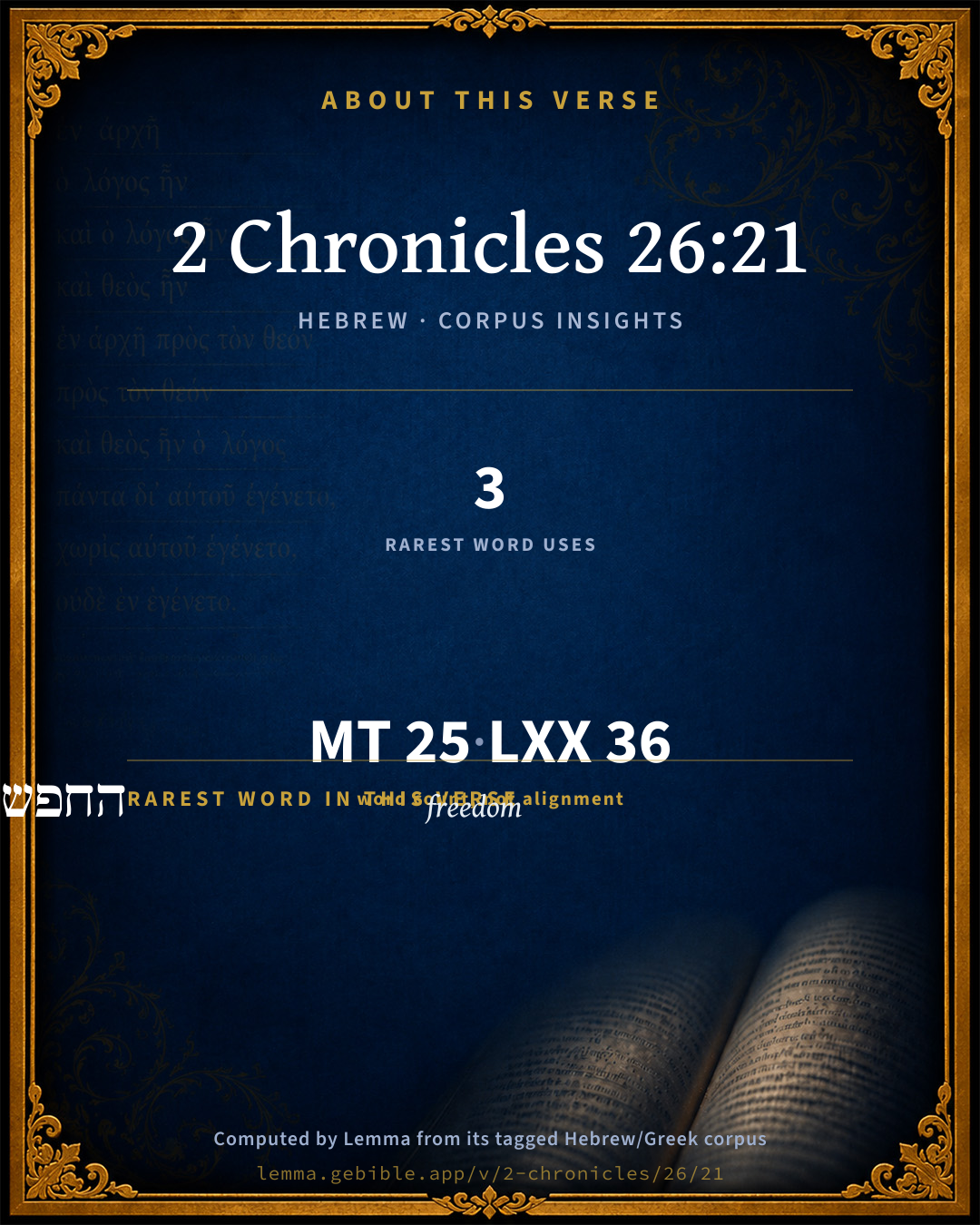
These counts appear in no published source. They are computed here, from the morphology-tagged text and Lemma’s own curated glosses. What Lemma adds →

25
words
20
distinct lemmas
Historical
section

Notable vocabulary

The rarest word here is החפשות freedom H2669 — appearing just 3 times in the whole Hebrew Bible.

Shared distinctive vocabulary

החפשות freedom H2669 occurs in 2 verses of the Hebrew Bible. Also found in:

Grammatical profile

  • 6 verbs
  • 15 nouns
  • 2 prepositions
  • 1 conjunction
  • 1 particle

Verb forms

  • וַיְהִי֩ Qal · Sequential Imperfect
  • מְצֹרָ֣ע Pual · Participle Passive
  • וַיֵּ֜שֶׁב Qal · Sequential Imperfect
  • מְצֹרָ֔ע Pual · Participle Passive
  • נִגְזַ֖ר Niphal · Perfect
  • שׁוֹפֵ֖ט Qal · Participle Active

Repetition

Words recur within this verse — often emphatic in Hebrew:

  • בֵּ֤ית house H1004 ×3
  • הַמֶּ֜לֶךְ king H4428 ×2
  • מְצֹרָ֣ע to be leprous H6879 ×2
  • החפשות freedom H2669 ×2

Hebrew & Septuagint length

In English translation the verse runs 46 words from the Hebrew and 49 from the Septuagint (LXX English) — closely comparable.

A rough comparison of the two English renderings, which tokenize alike — not a word-level alignment.

Word counts can differ between the Hebrew and the Greek without any difference in meaning — e.g. the Hebrew direct-object marker אֵת has no separate Greek word, and Greek often adds the article ὁ.

In the original languages it is 25 Hebrew tokens and 36 Greek tokens — but the two are counted differently (Hebrew bundles its prefixes and suffixes into one token; the Greek is in lemma form), so that isn’t a like-for-like length.

Cross-references

5

Topical passages linked to 2 Chronicles 26:21 in the Treasury of Scripture Knowledge — connected by theme and wording, ordered by reader-vote popularity; previews shown in the World English Bible.

  • Leviticus 13:46 All the days in which the plague is in him he shall be unclean. He is unclean. He shall dwell alone. Outside of the camp shall be his dwelling.
  • Numbers 5:2–3 "Command the children of Israel that they put out of the camp every leper, and everyone who has an issue, and whoever is unclean by the dead.
  • Numbers 12:15 Miriam was shut up outside of the camp seven days: and the people didn't travel until Miriam was brought in again.
  • 2 Kings 7:3 Now there were four leprous men at the entrance of the gate: and they said one to another, Why sit we here until we die?
  • 2 Kings 15:5–7 Yahweh struck the king, so that he was a leper to the day of his death, and lived in a separate house. Jotham the king's son was over the household, judging the people of the land.

Cross-references courtesy of OpenBible.info (CC BY 4.0).

Hebrew and Greek witnesses Masoretic Hebrew ↔ Greek Septuagint

The same verse in the two great witnesses to the Old Testament, shown verse-for-verse.

These are two independent witnesses, not word-aligned to each other, and the Septuagint is shown in lemma (dictionary) form.

Hebrew 2 Chronicles 26:21 Masoretic · Westminster Leningrad Codex

וַיְהִי֩ עֻזִּיָּ֨הוּ הַמֶּ֜לֶךְ מְצֹרָ֣ע עַד י֣וֹם מוֹת֗וֹ וַיֵּ֜שֶׁב בֵּ֤ית החפשות הַֽחָפְשִׁית֙ מְצֹרָ֔ע כִּ֥י נִגְזַ֖ר מִבֵּ֣ית יְהוָ֑ה וְיוֹתָ֤ם בְּנוֹ֙ עַל בֵּ֣ית הַמֶּ֔לֶךְ שׁוֹפֵ֖ט אֶת עַ֥ם הָאָֽרֶץ

Uzziah the king was a leper to the day of his death, and lived in a separate house, being a leper; for he was cut off from the house of Yahweh: and Jotham his son was over the king's house, judging the people of the land.

World English Bible · Public Domain

Greek LXX 2 Chronicles 26:21 Septuagint · lemma form

καί εἰμί οζιας ὁ βασιλεύς λεπρός ἕως ἡμέρα ὁ τελευτή αὐτός καί ἐν οἶκος αφφουσωθ καταἧμαι λεπρός ὅτι ἀποσχίζω ἀπό οἶκος κύριος καί ιωαθαμ ὁ υἱός αὐτός ἐπί ὁ βασιλεία αὐτός κρίνω ὁ λαός ὁ γῆ

And Ozias the king was a leper to the day of his death, and he lived as a leper in a separate house; for he was cut off from the house of the Lord: and Joathan his son was set over his kingdom, judging the people of the land.

LXX2012 (modern English Septuagint) · Public Domain

Hebrew: Westminster Leningrad Codex (CC BY 4.0). Greek: Septuagint (public domain); English from LXX2012 (modern English Septuagint) (Public Domain). How the Septuagint differs from the Hebrew →

Commentary

Notes on 2 Chronicles 26:21 from classic Christian and Jewish commentators (each source and its license shown beneath its notes). The classic Christian expositions comment on the surrounding passage and are grouped to its opening verse, so a note may address several verses; the Jewish commentaries on the Tanakh (Rashi and others) are per-verse, so they appear only where the commentator wrote on this verse.

Lemma curates 59 commentaries, every one of them public domain or Creative Commons licensed, each selected and text-cleaned for this edition rather than reprinted as found. About our sources →

Trapp's Complete Commentary

John Trapp

2Ch 26:21 And Uzziah the king was a leper unto the day of his death, and dwelt in a several house, [being] a leper; for he was cut off from the house of the LORD: and Jotham his son [was] over the king’s house, judging the people of the land.

Ver. 21. A leper until the day of his death.] Some leprosy was curable, and some not.

John Trapp, A Commentary or Exposition upon All the Books of the Old and New Testament (1647–1656) — public domain. Text from a community e-Sword module.

Joseph Benson's Commentary

2Ch 26:21. Uzziah was a leper unto the day of his death — God would have this leprosy to be incurable, as a lasting monument of his anger against such presumptuous invaders of the priest’s office. Dwelt in a several house, &c. — As he was obliged to do by law, which he durst not now resist, being under the hand of God, and under the fear of worse plagues, if he did not so. For he was cut off from the house of the Lord — He dwelt in a several house, because he might not come into the temple and courts, nor consequently into any public assembly. So the punishment answers the sin, as face does to face in a glass. He thrust himself into the temple of God, whither the priests only had admission: and for that was thrust out of the very courts of the temple, into which the meanest of his subjects might enter. He invaded the dignity of the priesthood, to which he had no right, and is for that deprived of the royal dignity, to which he had an undoubted right.

Joseph Benson's Commentary on the Old and New Testaments (1811–1818) — public domain. Text from a community e-Sword module.

Tyndale Open Study Notes

Tyndale Open Resources

26:21 The leprosy forced King Uzziah to spend the end of his life in quarantine in a separate house (literally a free house). The significance of this term is not known; it is often interpreted to mean that he was free from the duties of the monarchy. In Ugaritic texts, it seems to be a euphemism for a place of total confinement.

Tyndale Open Study Notes — © Tyndale Open Resources, licensed CC BY-SA 4.0. Text via the HelloAO Bible API.

Geneva Bible (1599)

Geneva Bible translators

According to the commandment of the Lord, Lev. 13:46.

Geneva Bible (1599) marginal notes — public domain. Text via Bolls.life.

Jamieson, Fausset & Brown

Robert Jamieson, A. R. Fausset & David Brown

dwelt in a several house--in an infirmary [BERTHEAU].

Jamieson, Fausset & Brown — Commentary Critical and Explanatory on the Whole Bible (1871) — public domain (CC PDM 1.0). Text via the HelloAO Bible API.

Adam Clarke's Commentary

Verse 21. And dwelt in a several house] He was separated, because of the infectious nature of his disorder, from all society, domestic, civil, and religious.

Jotham - was over the king's house] He became regent of the land; his father being no longer able to perform the functions of the regal office.

Adam Clarke's Commentary on the Bible (1810–1826) — public domain. Text from a community e-Sword/MySword module.

Ellicott's Commentary for English Readers

(21) Was a leper . . . several house.—2Ki_14:5. Rather, in the hospital, or lazar house.

For he was cut off (Psa_88:5; Isa_53:8) from the house of the Lord.—This ground of Uzziah’s dwelling in a sick house is added by the chronicler. Having been formally excluded as a leper from the sacred precincts, he was obliged to isolate himself from society. (Comp. Lev_13:46.)

A Bible Commentary for English Readers, edited by Charles John Ellicott (1878–1897) — public domain. Text from a community e-Sword module.

The Cambridge Bible for Schools and Colleges

gen. ed. J. J. S. Perowne

21–23 (= 2Ki_15:5-7). The End of Uzziah

21. a several house] i.e. separate, special; cp. Num_28:13; Mat_25:15. The same Heb. word is used in Psa_88:5, “free (R.V. “cast off”) among the dead.”

cut off] The same Heb. word is translated in the same way in Isa_53:8.

The Cambridge Bible for Schools and Colleges (gen. ed. J. J. S. Perowne; Cambridge University Press, 1878–1918) — public domain. Text from a community e-Sword module.

John Gill's Exposition

So Uzziah slept with his fathers,.... Died as they did, the same year, according to Dr. Lightfoot (e), in which he was smitten with the leprosy; and in the year of his death it was Isaiah had the vision related in Isa 6:1, &c.

and they buried him with his fathers; See Gill on Kg2 15:7.

(e) Works, vol. 1. p. 99.

Next: 2 Chronicles Chapter 27

John Gill's Exposition of the Whole Bible (1746–1763) — public domain (CC PDM 1.0). Text via the HelloAO Bible API.

Albert Barnes' Notes on the Bible

A several house - See the marginal reference “q” note; and compare Ps. 88, which is supposed by some to refer to Uzziah.

Albert Barnes' Notes on the Bible (1834–1885) — public domain. Text from a community e-Sword/MySword module.

Matthew Poole's English Annotations

Unto the day of his death: God would have this leprosy to be incurable, as a lasting monument of his anger against such presumptuous invaders of the priest’s office.

Dwelt in a several house; as he was obliged to do by law, Lev 13:16, which he durst not now resist, being under the hand and stroke of God, and under the fear of further and worse plagues, if he did so.

For he was cut off; so the following words are a reason of the former; he dwelt in a several house, because he might not come into the temple or courts, nor consequently into any public assembly, or the society of others. Or, and therefore, as the Hebrew chi often signifies; and the particle and is oft understood. So it is an inference from the next foregoing words, He was a leper, and therefore he was cut off, &c. He who could not content himself with God’s allowance, but usurped the priest’s place and office, is now deprived of the privilege of the meanest of his people. A just and most suitable judgment.

Matthew Poole's English Annotations on the Holy Bible (1683–1685) — public domain. Text from a community e-Sword/MySword module.

Whedon's Commentary on the Bible

Daniel D. Whedon

21. A several house — Free from, or apart from, others, as the law required. Lev_13:46; Num_5:3. See note on 2Ki_15:5. Jotham his son was over the king’s house — Thus the son was pro-rex some time before his father’s death.

Daniel D. Whedon (gen. ed.), Commentary on the Old and New Testaments (1874–1909) — public domain. Text from a community e-Sword module.

The Pulpit Commentary

And dwelt in a several house. The Hebrew for "several house" is twOvpjh the parallel (2Ki_15:5) showing yod instead of van in the last syllable. The verbal root is vpj and occurs once. (Lev_19:20, with the Authorized Version rendering "was free;" in the same verse is also found a feminine noun derived from it, and rendered in the Authorized Version "freedom The adjective yvipj; occurs sixteen times, and is always rendered in the Authorized Version "free," except once "at liberty". (Jer_34:16) The "freedom" conveyed by the word is that of separation, in the use of it as found here. The leper and the house in which he lived were kept free from contact with others. (Lev_13:46) Gesenius appears, however, to prefer the idea of "infirmity," "sickness," as determining the cast of the meaning of the word in our text, and goes so far as to translate it an "hospital," quoting the word of Suidas, to nosokomeion.

The Pulpit Commentary (1880–1919), ed. H.D.M. Spence-Jones & Joseph S. Exell — public domain. Text from a community e-Sword module.

John Wesley's Explanatory Notes

His death - God would have this leprosy to be incurable, as a lasting monument of his anger against such presumptuous invaders of the priest's office. Dwelt, &c. - As he was obliged to do by law, which he durst not now resist, being under the hand of God, and under the fear of worse plagues, if he did not so. For - He dwelt in a several house, because he might not come into the temple or courts, nor consequently into any publick assembly. So the punishment answered the sin, as face does to face in a glass. He thrust himself into the temple of God, whether the priests only had admission: and for that was thrust out of the very courts of the temple, into which the meanest of, his subjects might enter. He invaded the dignity of the priesthood, to which he had no right, and is for that deprived of the royal dignity, to which he had an undoubted right.

John Wesley, Explanatory Notes Upon the Whole Bible (1754–1765) — public domain. Text via the GEBible commentary corpus.

unfoldingWord translationNotes

Door43 World Missions Community

to the day of his death

"until he died" or "the rest of his life"

lived in a separate house

This indicates that he lived away from other houses and other people.

he was cut off from the house of Yahweh

Here being "cut off" from Yahweh's house represents being excluded from the temple. AT: "he was excluded from the house of Yahweh" or "he was not allowed to go to the temple" (See: Metaphor)

Jotham, his son, was over the king's house

Here being over something represents having responsibility or authority for it. AT: "Jotham, his son, was responsible for the king's house" or "Jotham, his son, was in charge of the palace" (See: Metaphor)

the king's house

This refers to the king's palace, which the king was no longer living in.

translationWords

die

cut off

Jotham

people group

unfoldingWord translationNotes — © Distant Shores Media and the Door43 World Missions Community, licensed CC BY-SA 4.0. Source: git.door43.org/Door43/en_tn.

Rashi

Rabbi Shlomo Yitzchaki (Rashi)

in a house of retirement Heb. בֵּית הַחָפְשִׁית. And in Yerushalmi (unknown) it is explained that he made himself a house in the cemetery, reminiscent of (Ps. 88:6): “Among the dead, a free man (חָפְשִׁי).”

for it had been decreed upon him to come no longer among people, similar to (Esther 2:1): “and that which was decreed upon her.”

Rashi on the Tanakh — English translations: “The Judaica Press complete Tanach with Rashi, translated by A. J. Rosenberg” (CC BY 4.0); “Pentateuch with Rashi's commentary by M. Rosenbaum and A.M. Silbermann, 1929-1934” (public domain); “The Metsudah Tanach series, Lakewood, N.J” (CC BY 4.0); and “The Book of Joshua, Metsudah Publications, 1997” (CC BY 4.0). Text via Sefaria.

Lesson kit

Teaching starters — assembled from the data on this page, not authored interpretation. Every prompt links to the verse data it draws on. Edit before teaching.

2 Chronicles, in the Historical, opens this verse with 25 words (20 distinct Hebrew lemmas). Its most distinctive word is chophshûwth (“freedom”). A historical commentator’s framing appears above. Read the whole chapter for the surrounding context.

Discussion questions

  1. The word chophshûwth carries the sense “freedom.” How does it shape the verse?
  2. How does 2 Kings 15:5, which shares the word «freedom», read alongside this verse?
  3. What does the repetition of “house” (3× in this one verse) do in this verse?
  4. These translations render this verse differently. What is at stake in choosing one wording over another?
  5. «וַיְהִי֩» is a Qal Sequential Imperfect verb. How does that grammatical form shape the action described?
  6. Compare how Trapp's Complete Commentary and Joseph Benson's Commentary read this verse. Where do they agree or differ?

Things to notice

Reading settings

Reading text

Shown beneath each verse's original-language words.

Old Testament
Old Testament edition

Read the OT as the Masoretic Hebrew (MT) or the Greek Septuagint (LXX).

English shown for the Greek Septuagint (in the Hebrew ↔ Greek comparison).

Comparing translations? Open the Compare panel on any verse page to stack up to four side by side.