
Deuteronomy 26:5

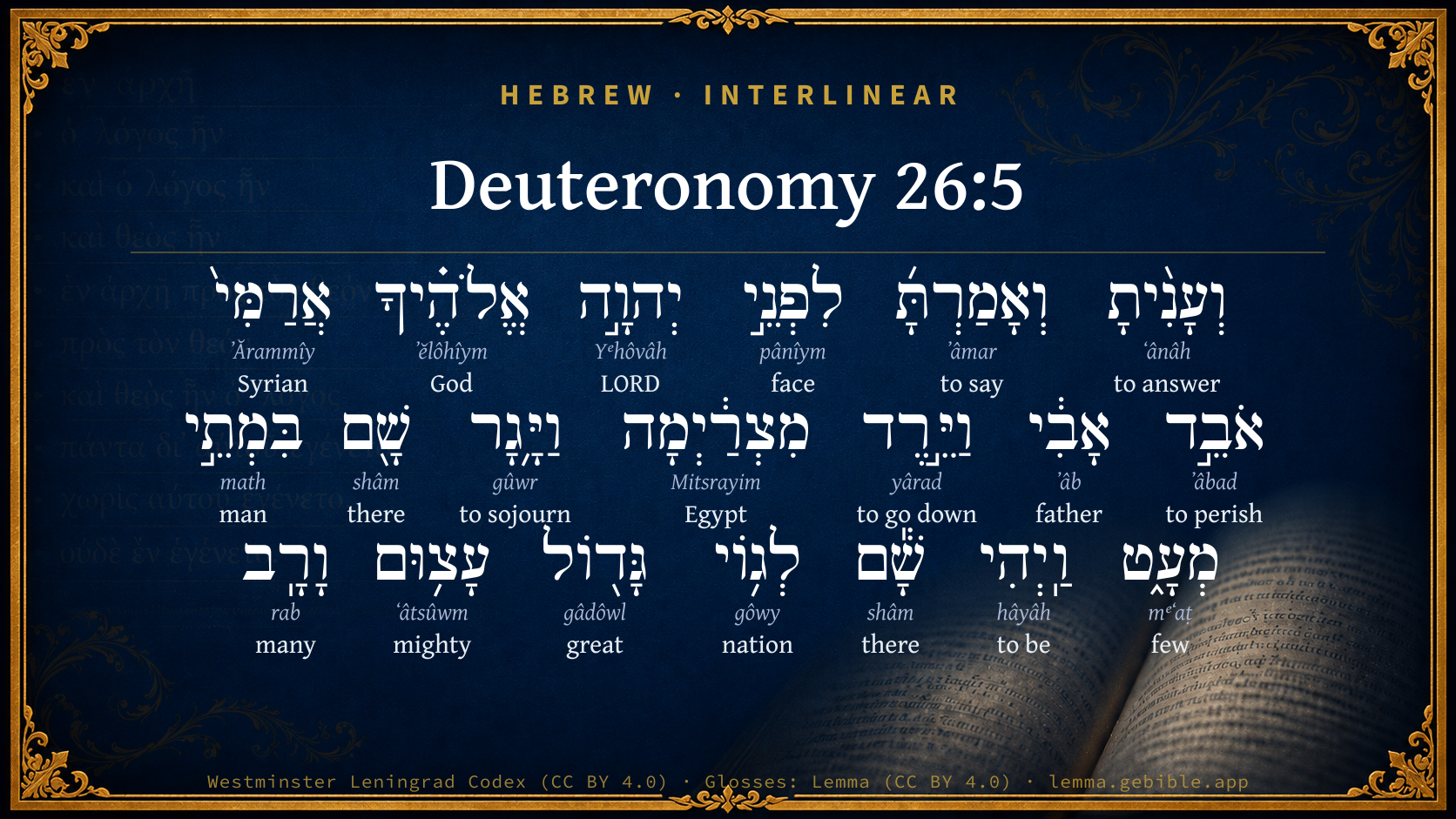
Hebrew (Westminster Leningrad Codex) Deuteronomy 26:5 appears in the Hebrew Old Testament. The text above is from the Westminster Leningrad Codex. Each word links to its Strong’s number, a concise gloss, and parsing drawn from the Open Scriptures Hebrew Bible morphology. Click any word for its full Brown-Driver-Briggs (BDB) entry.
Download image
Cite this verse

Deuteronomy 26:5 (World English Bible). Public Domain. Lemma interlinear Bible study tool, https://lemma.gebible.app/v/deuteronomy/26/5.

Show BibTeX & RIS
BibTeX
RIS
English Translation
You shall answer and say before Yahweh your God, A Syrian ready to perish was my father; and he went down into Egypt, and sojourned there, few in number; and he became there a nation, great, mighty, and populous.
World English Bible · Public Domain
Download a study sheet

One document with this verse’s original text, its word-by-word gloss line, the meaning frame, cross-references with their text, attributed commentary, and full source and license credits — printable, and it pastes into notes with its structure intact.

This verse Autodidact and up

Study sheet (.html) Plain text (.txt)

A passage Seminary Student

Up to 50 verses in one chapter. A passage sheet keeps up to 6 commentary sources and 12 cross-references per verse, in the order this page ranks them, and says so on the sheet whenever that leaves anything out. Ask for a single verse and you get the Autodidact verse sheet above.

Everything on this page stays free to read, with no account — the sheet is a download of what is already on screen, not access to it.

Want to remove ads? Support Godless Engineer
Compare translations 3

The same verse in 3 English versions, stacked beneath the original-language interlinear above. Click any original word for its lexicon entry.

Each is an independent rendering of the whole verse — the interlinear is not word-aligned to these translations.

Highlighted words mark where these versions differ — a whole-verse word diff, not a word-by-word alignment.

  • World English Bible Public Domain
    You shall answer and say before Yahweh your God, A Syrian ready to perish was my father; and he went down into Egypt, and sojourned there, few in number; and he became there a nation, great, mighty, and populous.
  • King James Version Public Domain
    And thou shalt speak and say before the LORD thy God, A Syrian ready to perish was my father, and he went down into Egypt, and sojourned there with a few, and became there a nation, great, mighty, and populous:
  • unfoldingWord Literal Text CC BY-SA 4.0
    And you shall respond and say to the face of Yahweh your God, ‘My father a wandering Aramean. And he went down to Egypt and stayed there, his people few, and there he became a great, mighty, and numerous nation.

unfoldingWord Literal Text — © unfoldingWord, licensed CC BY-SA 4.0. Word-aligned USFM3 via Door43 (git.door43.org/unfoldingWord/en_ult).

Versions to compare (up to 4)

3 of 4 selected

Show all 18 translations

Every available English version of this verse, each an independent rendering of the whole verse.

  • World English Bible Public Domain
    You shall answer and say before Yahweh your God, A Syrian ready to perish was my father; and he went down into Egypt, and sojourned there, few in number; and he became there a nation, great, mighty, and populous.
  • Berean Standard Bible Public Domain
    and you are to declare before the LORD your God, “My father was a wandering Aramean, and he went down to Egypt few in number and lived there and became a great nation, mighty and numerous.
  • Majority Standard Bible Public Domain
    and you are to declare before the LORD your God, “My father was a wandering Aramean, and he went down to Egypt few in number and lived there and became a great nation, mighty and numerous.
  • King James Version Public Domain
    And thou shalt speak and say before the LORD thy God, A Syrian ready to perish was my father, and he went down into Egypt, and sojourned there with a few, and became there a nation, great, mighty, and populous:
  • American Standard Version (1901) Public Domain
    And thou shalt answer and say before Jehovah thy God, A Syrian ready to perish was my father; and he went down into Egypt, and sojourned there, few in number; and he became there a nation, great, mighty, and populous.
  • Revised Version (1885) Public Domain
    And thou shalt answer and say before the LORD thy God, A Syrian ready to perish was my father, and he went down into Egypt, and sojourned there, few in number; and he became there a nation, great, mighty, and populous:
  • Geneva Bible (1599) Public Domain
    And thou shalt answere and say before the Lord thy God, A Syrian was my father, who being ready to perish for hunger, went downe into Egypt, and soiourned there with a small company, and grew there vnto a nation great, mightie and full of people.
  • Douay-Rheims (1899) Public Domain
    And thou shalt speak thus in the sight of the Lord thy God: The Syrian pursued my father, who went down into Egypt, and sojourned there in a very small number, and grew into a nation great and strong and of an infinite multitude.
  • Young's Literal Translation Public Domain
    `And thou hast answered and said before Jehovah thy God, A perishing Aramaean `is' my father! and he goeth down to Egypt, and sojourneth there with few men, and becometh there a nation, great, mighty, and numerous;
  • Literal Standard Version CC BY-SA 4.0
    And you have answered and said before your God YHWH, My father [is] a perishing Aramean! And he goes down to Egypt, and sojourns there with few men, and becomes a great, mighty, and populous nation there;
  • Unlocked Literal Bible CC BY-SA 4.0
    You must say before Yahweh your God, 'My ancestor was a wandering Aramean. He went down into Egypt and stayed there, and his people were few in number. There he became a great, mighty, and populous nation.
  • unfoldingWord Literal Text CC BY-SA 4.0
    And you shall respond and say to the face of Yahweh your God, ‘My father a wandering Aramean. And he went down to Egypt and stayed there, his people few, and there he became a great, mighty, and numerous nation.
  • Darby Bible Public Domain
    And thou shalt speak and say before Jehovah thy God, A perishing Aramean was my father, and he went down to Egypt with a few, and sojourned there, and became there a nation, great, mighty, and populous.
  • World Messianic Bible Public Domain
    You shall answer and say before the LORD your God, “My father was a Syrian ready to perish. He went down into Egypt, and lived there, few in number. There he became a great, mighty, and populous nation.
  • Webster's Bible Public Domain
    And thou shalt speak and say before the LORD thy God, A Syrian ready to perish was my father, and he went down to Egypt, and sojourned there with a few, and became there a nation, great, mighty, and populous:
  • Free Bible Version CC BY-SA 4.0
    Then this is what you are to publicly declare before the Lord your God, “My father was an Aramean who moved from place to place. There were only a few of them when he and his family went to live in Egypt. But they became a large and powerful nation.
  • Bible in Basic English Public Domain
    And these are the words which you will say before the Lord your God: My father was a wandering Aramaean, and he went down with a small number of people into Egypt; there he became a great and strong nation:
  • JPS Tanakh (1917) Public Domain
    And thou shalt speak and say before the LORD thy God: 'A wandering Aramean was my father, and he went down into Egypt, and sojourned there, few in number; and he became there a nation, great, mighty, and populous.

Literal Standard Version (2020), Covenant Press — licensed CC BY-SA 4.0. Text via the HelloAO Bible API (eBible.org). Unlocked Literal Bible (unfoldingWord) — licensed CC BY-SA 4.0. Text via the HelloAO Bible API (eBible.org). unfoldingWord Literal Text — © unfoldingWord, licensed CC BY-SA 4.0. Word-aligned USFM3 via Door43 (git.door43.org/unfoldingWord/en_ult). Free Bible Version, Dr. Jonathan Gallagher — licensed CC BY-SA 4.0. Text via the HelloAO Bible API (eBible.org).

Word by word

More ways to search: Search by grammar → Find every occurrence → Compare this word →

Practice this passage: Drill this verse → Learn its vocabulary →

אֲרַמִּי֙
ʼĂrammîy
H761
“Syrian”
Noun, Gentilic, Masculine, Singular, Absolute
Part of Speech
Noun
Type
Gentilic
Gender
Masculine
Number
Singular
State
Absolute
Full BDB Definition

Origin: patrial from H758

TWOT: None

Syrian or Aramean = "exalted" - a thing or a person from Syria or Aram
  1. וְעָנִ֨יתָ ʻânâh H6030 “and · to answer” Conjunction + Verb, Qal, Sequential Perfect, 2nd Person, Masculine, Singular
  2. וְאָמַרְתָּ֜ ʼâmar H559 “and · to say” Conjunction + Verb, Qal, Sequential Perfect, 2nd Person, Masculine, Singular
  3. לִפְנֵ֣י pânîym H6440 “to/for · face(s) of” Preposition + Noun, Common, Both, Plural, Construct
  4. יְהוָ֣ה Yᵉhôvâh H3068 “LORD” Noun, Proper
  5. אֱלֹהֶ֗יךָ ʼĕlôhîym H430 “God(s) · your” Noun, Common, Masculine, Plural, Construct + Suffix, Personal, 2nd Person, Masculine, Singular
  6. אֹבֵ֣ד ʼâbad H6 “perishing” Verb, Qal, Participle Active, Masculine, Singular, Absolute
  7. אָבִ֔י ʼâb H1 “father · my” Noun, Common, Masculine, Singular, Construct + Suffix, Personal, 1st Person, Common, Singular
  8. וַיֵּ֣רֶד yârad H3381 “and · to go down” Conjunction + Verb, Qal, Sequential Imperfect, 3rd Person, Masculine, Singular
  9. מִצְרַ֔יְמָה Mitsrayim H4714 “Egypt · toward” Noun, Proper + Suffix, Demonstrative
  10. וַיָּ֥גָר gûwr H1481 “and · to sojourn” Conjunction + Verb, Qal, Sequential Imperfect, 3rd Person, Masculine, Singular
  11. שָׁ֖ם shâm H8033 “there” Adverb
  12. בִּמְתֵ֣י math H4962 “in/at · men of” Preposition + Noun, Common, Masculine, Plural, Construct
  13. מְעָ֑ט mᵉʻaṭ H4592 “few” Noun, Common, Masculine, Singular, Absolute
  14. וַֽיְהִי hâyâh H1961 “and · to be” Conjunction + Verb, Qal, Sequential Imperfect, 3rd Person, Masculine, Singular
  15. שָׁ֕ם shâm H8033 “there” Adverb
  16. לְג֥וֹי gôwy H1471 “to/for · nation” Preposition + Noun, Common, Masculine, Singular, Absolute
  17. גָּד֖וֹל gâdôwl H1419 “great” Adjective, Adjective, Masculine, Singular, Absolute
  18. עָצ֥וּם ʻâtsûwm H6099 “mighty” Adjective, Adjective, Masculine, Singular, Absolute
  19. וָרָֽב rab H7227 “and · many” Conjunction + Adjective, Adjective, Masculine, Singular, Absolute

About this verse

These counts appear in no published source. They are computed here, from the morphology-tagged text and Lemma’s own curated glosses. What Lemma adds →

20
words
19
distinct lemmas
Pentateuch
section

Notable vocabulary

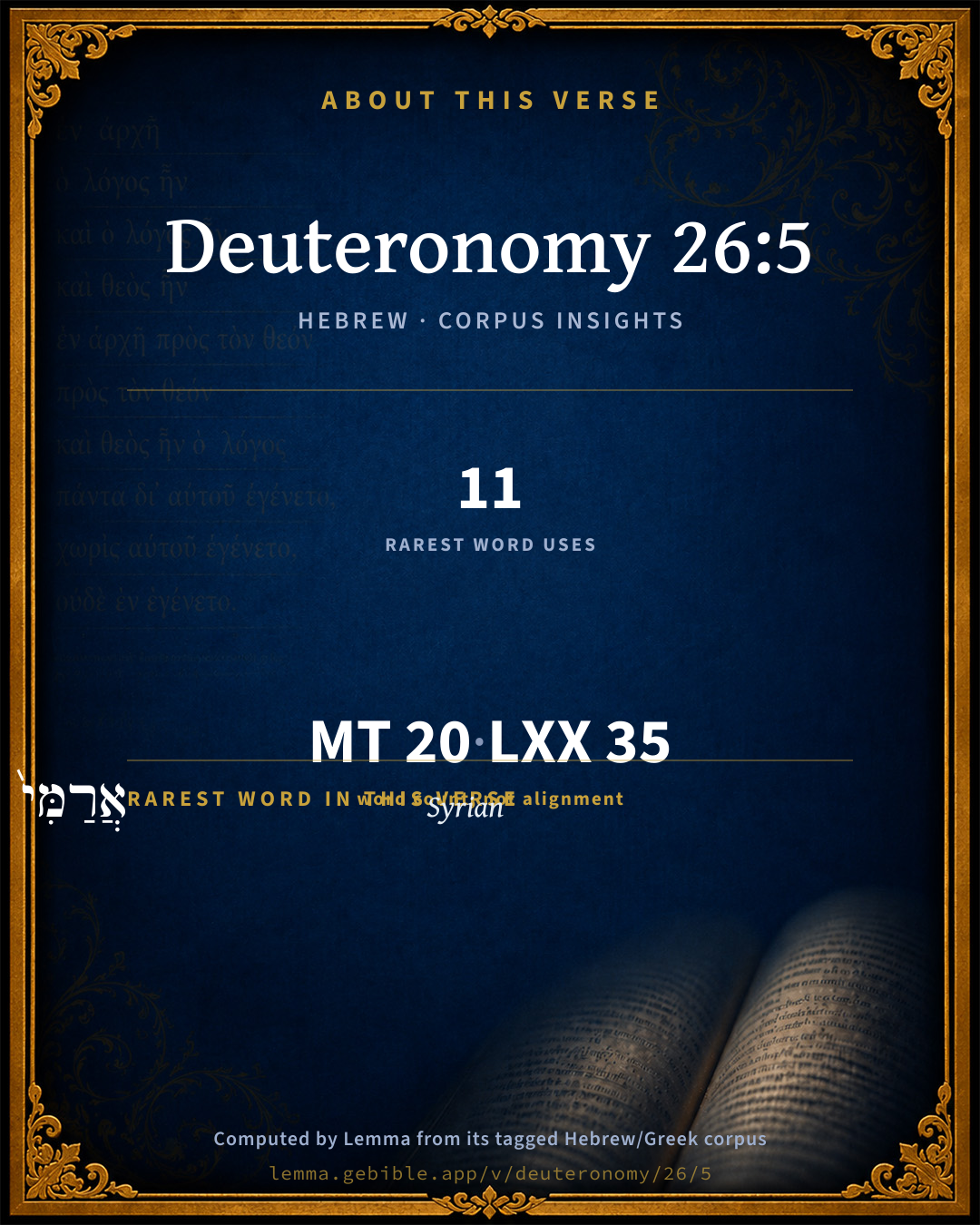
The rarest word here is אֲרַמִּי֙ Syrian H761 — appearing just 11 times in the whole Hebrew Bible.

Shared distinctive vocabulary

אֲרַמִּי֙ Syrian H761 occurs in 10 verses of the Hebrew Bible. Also found in:

Grammatical profile

  • 6 verbs
  • 9 nouns
  • 3 adjectives
  • 2 adverbs

Verb forms

  • וְעָנִ֨יתָ Qal · Sequential Perfect
  • וְאָמַרְתָּ֜ Qal · Sequential Perfect
  • אֹבֵ֣ד Qal · Participle Active
  • וַיֵּ֣רֶד Qal · Sequential Imperfect
  • וַיָּ֥גָר Qal · Sequential Imperfect
  • וַֽיְהִי Qal · Sequential Imperfect

Repetition

A word recurs within this verse — often emphatic in Hebrew:

  • שָׁ֖ם there H8033 ×2

Hebrew & Septuagint length

In English translation the verse runs 39 words from the Hebrew and 37 from the Septuagint (LXX English) — closely comparable.

A rough comparison of the two English renderings, which tokenize alike — not a word-level alignment.

Word counts can differ between the Hebrew and the Greek without any difference in meaning — e.g. the Hebrew direct-object marker אֵת has no separate Greek word, and Greek often adds the article ὁ.

In the original languages it is 20 Hebrew tokens and 35 Greek tokens — but the two are counted differently (Hebrew bundles its prefixes and suffixes into one token; the Greek is in lemma form), so that isn’t a like-for-like length.

Cross-references

23

Topical passages linked to Deuteronomy 26:5 in the Treasury of Scripture Knowledge — connected by theme and wording, ordered by reader-vote popularity; previews shown in the World English Bible.

  • Genesis 46:27 The sons of Joseph, who were born to him in Egypt, were two souls. All the souls of the house of Jacob, who came into Egypt, were seventy.
  • Deuteronomy 10:22 Your fathers went down into Egypt with seventy persons; and now Yahweh your God has made you as the stars of the sky for multitude.
  • Genesis 31:20 Jacob deceived Laban the Syrian, in that he didn't tell him that he was running away.
  • Genesis 43:1–2 The famine was severe in the land.
  • Genesis 31:24 God came to Laban, the Syrian, in a dream of the night, and said to him, "Take heed to yourself that you don't speak to Jacob either good or bad."
  • Genesis 43:12 and take double money in your hand, with the money that was returned in the mouth of your sacks carry again in your hand. Perhaps it was an oversight.
  • Genesis 45:7 God sent me before you to preserve you a remnant in the earth, and to save you alive by a great deliverance.
  • Genesis 45:11 There I will nourish you; for there are yet five years of famine; lest you come to poverty, you, and your household, and all that you have."'
  • Genesis 24:4 But you shall go to my country, and to my relatives, and take a wife for my son Isaac."
  • Genesis 25:20 Isaac was forty years old when he took Rebekah, the daughter of Bethuel the Syrian of Paddan Aram, the sister of Laban the Syrian, to be his wife.
  • Psalms 105:23–24 Israel also came into Egypt. Jacob sojourned in the land of Ham.
  • Isaiah 51:1–2 Listen to me, you who follow after righteousness, you who seek Yahweh: look to the rock whence you were hewn, and to the hold of the pit whence you were dug.
  • Hosea 12:12 Jacob fled into the country of Aram, And Israel served to get a wife, And for a wife he tended flocks and herds.
  • Acts 7:15 Jacob went down into Egypt, and he died, himself and our fathers,
  • Genesis 27:41 Esau hated Jacob because of the blessing with which his father blessed him. Esau said in his heart, "The days of mourning for my father are at hand. Then I will kill my brother Jacob."
  • Genesis 28:5 Isaac sent Jacob away. He went to Paddan Aram to Laban, son of Bethuel the Syrian, Rebekah's brother, Jacob's and Esau's mother.
  • Genesis 31:40 Thus I was; in the day the drought consumed me, and the frost by night; and my sleep fled from my eyes.
  • Genesis 46:1–7 Israel traveled with all that he had, and came to Beersheba, and offered sacrifices to the God of his father, Isaac.
  • Genesis 47:27 Israel lived in the land of Egypt, in the land of Goshen; and they got themselves possessions therein, and were fruitful, and multiplied exceedingly.
  • Exodus 1:5 All the souls who came out of the Jacob's body were seventy souls, and Joseph was in Egypt already.
  • Exodus 1:7 The children of Israel were fruitful, and increased abundantly, and multiplied, and grew exceedingly mighty; and the land was filled with them.
  • Exodus 1:12 But the more they afflicted them, the more they multiplied and the more they spread out. They were grieved because of the children of Israel.
  • Deuteronomy 7:7 Yahweh didn't set his love on you, nor choose you, because you were more in number than any people; for you were the fewest of all peoples:

Cross-references courtesy of OpenBible.info (CC BY 4.0).

Hebrew and Greek witnesses Masoretic Hebrew ↔ Greek Septuagint

The same verse in the two great witnesses to the Old Testament, shown verse-for-verse.

These are two independent witnesses, not word-aligned to each other, and the Septuagint is shown in lemma (dictionary) form.

Hebrew Deuteronomy 26:5 Masoretic · Westminster Leningrad Codex

וְעָנִ֨יתָ וְאָמַרְתָּ֜ לִפְנֵ֣י יְהוָ֣ה אֱלֹהֶ֗יךָ אֲרַמִּי֙ אֹבֵ֣ד אָבִ֔י וַיֵּ֣רֶד מִצְרַ֔יְמָה וַיָּ֥גָר שָׁ֖ם בִּמְתֵ֣י מְעָ֑ט וַֽיְהִי שָׁ֕ם לְג֥וֹי גָּד֖וֹל עָצ֥וּם וָרָֽב

You shall answer and say before Yahweh your God, A Syrian ready to perish was my father; and he went down into Egypt, and sojourned there, few in number; and he became there a nation, great, mighty, and populous.

World English Bible · Public Domain

Greek LXX Deuteronomy 26:5 Septuagint · lemma form

καί ἀποκρίνω καί εἶπον ἔναντι κύριος ὁ θεός σύ συρία ἀποβάλλω ὁ πατήρ ἐγώ καί καταβαίνω εἰς αἴγυπτος καί παραοἰκέω ἐκεῖ ἐν ἀριθμός βραχύς καί γίγνομαι ἐκεῖ εἰς ἔθνος μέγας καί πλῆθος πολύς καί μέγας

and he shall answer and say before the Lord your God, My father abandoned Syria, and went down into Egypt, and sojourned there with a small number, and became there a mighty nation and a great multitude.

LXX2012 (modern English Septuagint) · Public Domain

On this verse, Adam Clarke's Commentary discusses the Septuagint’s reading. Read the note in Commentary ↓

Hebrew: Westminster Leningrad Codex (CC BY 4.0). Greek: Septuagint (public domain); English from LXX2012 (modern English Septuagint) (Public Domain). How the Septuagint differs from the Hebrew →

Targum (Aramaic paraphrase)

2

The Targum is the ancient Jewish Aramaic paraphrase of the Hebrew Scriptures — an interpretive translation, not the Hebrew text itself. Onkelos (literal) and Pseudo-Jonathan (expansive) render the Torah, and Jonathan the Prophets. Coverage is partial: where no permissively-licensed English translation exists for a verse, only the Aramaic is shown. This is verse-level text, not a word-by-word alignment to the Hebrew.

  1. Targum Onkelos Torah (Genesis–Deuteronomy)
    וְתָתֵיב וְתֵימַר קֳדָם יְיָ אֱלָהָךְ לָבָן אֲרָמָאָה בָּעָא לְאוֹבָדָא יָת אַבָּא וּנְחַת לְמִצְרַיִם וְדָר תַּמָן בְּעַם זְעֵר וַהֲוָה תַמָן לְעַם רַב תַּקִיף וְסַגִי

    (no public-domain English translation for this verse)

    Targum Onkelos — Aramaic: “Onkelos Genesis” (public domain); “Onkelos Exodus” (public domain); “Onkelos Leviticus” (public domain); “Onkelos Numbers” (public domain); “Onkelos Deuteronomy” (public domain). English: “Sefaria Community Translation” (CC0 1.0 (public-domain dedication)); “J.W. Etheridge. The Targums of Onkelos and Jonathan Ben Uzziel on the Pentateuch. London: Longmans, Green, 1862” (public domain). Text via Sefaria.

  2. Targum Pseudo-Jonathan Torah (Genesis–Deuteronomy)
    וְתָתִיבוּן וְתֵימְרוּן קֳדָם יְיָ אֱלָהָכוֹן לַאֲרַם נַהֲרַיָא נַחֲתַת אָבוּנָן יַעֲקב מִן שֵׁירוּיָא וּבְעָא לְאוֹבְדוֹתֵיהּ וְשֵׁזְבֵיהּ מֵימְרָא דַיְיָ מִן יְדוֹי וּמִבָּתַר כְּדֵין נָחַת לְמִצְרַיִם וְאִיתוֹתַב תַּמָן לְעַם קָלִיל וַהֲוָה תַמָן לְאוּמָא רַבָּא וְתַקִיפָא וּמְסַגְיָא

    And you shall respond, and say before the Lord your God: Our father Jakob went down into Aram Naharia at the beginning, and (Laban) sought to destroy him; but the Word of the Lord saved him out of his hands. And afterwards went he down into Mizraim and sojourned there, a few people; but there did he become a great people, and mighty and many.

    Targum Pseudo-Jonathan — Aramaic: “Targum Jonathan on Genesis” (public domain); “Targum Jonathan on Exodus” (public domain); “Targum Jonathan on Leviticus” (public domain); “Targum Jonathan on Numbers” (public domain); “Targum Jonathan on Deuteronomy” (public domain). English: “The Targum of Jonathan ben Uzziel, trans. J. W. Etheridge, London, 1862” (public domain). Text via Sefaria.

Commentary

Notes on Deuteronomy 26:5 from classic Christian and Jewish commentators (each source and its license shown beneath its notes). The classic Christian expositions comment on the surrounding passage and are grouped to its opening verse, so a note may address several verses; the Jewish commentaries on the Tanakh (Rashi and others) are per-verse, so they appear only where the commentator wrote on this verse.

Lemma curates 59 commentaries, every one of them public domain or Creative Commons licensed, each selected and text-cleaned for this edition rather than reprinted as found. About our sources →

Trapp's Complete Commentary

John Trapp

Deu 26:5 And thou shalt speak and say before the LORD thy God, A Syrian ready to perish [was] my father, and he went down into Egypt, and sojourned there with a few, and became there a nation, great, mighty, and populous:

Ver. 5. A Syrian ready to perish.] Jacob, whose original was from Haran in Syria, {Gen 11:31} and whose abode had been with Laban the Syrian, in much poverty, affliction, and misery. {Hos 12:12} How low and mean were we of this nation at first! Brith signifies blue-coloured, sc., with woad: hence we were called Britons. Instead of fine clothes our ancestors dyed their skins, and painted upon them sundry sorts of birds and beasts: for food they had barks of trees, &c. This should never be forgotten.

And became there a nation.] Consider we likewise what we were by nature, and should have been; what we are by grace, and shall be; and then take we up that most modest speech of that noble Athenian captain, Iphicrates, in the midst of all his glory, εξ οιων εις οια; {a} from how great baseness and misery, to what great blessedness and glory are we advanced; being "raised up together, and made to sit together in heavenly places in Christ Jesus" {Eph 2:9; Eph 2:11-13} {See Trapp on "Eph 2:11"} {See Trapp on "Eph 2:12"} {See Trapp on "Eph 2:13"} What was there in us, said Tamerlane to Bajazet the great Turk, now his prisoner, that God should set us over two great empires of Turks and Tartars, to command many more worthy than ourselves, you being blind of one eye, and I lame of a leg, &c.? {b} Peter Martyr told Queen Elizabeth in an epistle, that princes must be doubly thankful to God: (1.) As men; (2.) As eminent men, exalted above others. So must all God’s servants, who being his firstborn, are in that respect "higher than the kings of the earth," {Psa 89:27} and being "the firstfruits of his revenue," are therefore "holiness to the Lord." {Jer 2:3}

{a} Arist., Rhetor., lib, v. cap. 9.

{b} Leonclav., Annal. Turc.

John Trapp, A Commentary or Exposition upon All the Books of the Old and New Testament (1647–1656) — public domain. Text from a community e-Sword module.

The Biblical Illustrator

Joseph S. Exell

Deu_26:5

A Syrian ready to perish was my father.

Humiliation in connection with gratitude

Such was the confession required of every priest of Israel when he presented, before the altar, the offering of first-fruits. It was, therefore, in the midst of abundance, a memorial of former destitution, and an acknowledgment of utter unworthiness, under circumstances of peculiar obligation. The text is capable of divers renderings; but take whichever we may, the lesson is the same. It teaches us, that when the Divine promises are all fulfilled, and our salvation is complete, we are still to remember the past (Isa_51:1). The connection between acceptable thanksgiving and profound humiliation is a fact which none but a Pharisee would dare to disregard, and which it behoves the Christian to bear in mind in all his devout meditations and religious exercises. Should pride ever rise within his bosom--Who maketh thee to differ? is a consideration which may suffice to put it down: nor will he, if walking in the fear of God, and in the comfort of the Holy Ghost, when, by virtue of his royal priesthood, he has boldness to enter into the holiest by the blood of Jesus, forget to say there--A Syrian ready to perish was my father. The natural philosopher may rejoice that he is not a brute, and a pagan may glory in the attributes peculiar to man, but the devout student learns some very humbling facts concerning the position of our race. Among the rest is this, that, of intelligent beings, man is probably the lowest in the scale. That angels excel us in strength is obvious from everything we know concerning them; and that devils have far greater intellectual power than belongs to man, none acquainted with their devices will be disposed to question. To boast of our mental superiority, then, is but to mingle ignorance with pride. The humiliation which these considerations may be supposed to engender is deepened by the recollection, that our case is not one of poverty alone, but of degradation. Whatever may have been mans original glory, that glory has long since departed. His boast of heraldry is vain; traced back to its earliest antiquity, it bespeaks his ruin. His crest is an inverted crown. And this is his motto--Man that was in honour abode not. The grace of God works wonders. It copes with depravity, and subdues it. It rescues the sinner from his degradation, and renders him meet to be a partaker of the inheritance of the saints in light. But it also teaches him never to forget, even amidst the splendours of the heavenly temple, to which it ultimately introduces him, the ancient acknowledgment of the adoring Israelite--A Syrian ready to perish was my father. (D. E. Ford.)

The Biblical Illustrator, edited by Joseph S. Exell (c. 1880s–1900s) — public domain. Text from a community e-Sword module.

Joseph Benson's Commentary

Deu 26:5. A Syrian was my father — That is, Jacob; for though born in Canaan, he was a Syrian by descent, his mother Rebecca, and his grandfather Abraham, being both of Chaldea or Mesopotamia, which in Scripture is comprehended under the name of Syria. His wives and children, by their mothers’ side, and his relations, were Syrians, and he himself had lived twenty years in Syria with Laban. Ready to perish — Through want and poverty, or through the rage of his brother Esau, and the treachery of his father-in-law Laban: see Gen 28:11; Gen 28:20; Gen 32:10.

Or perhaps this refers to the state of Jacob a little before he went down into Egypt, when he and his family were in danger of perishing by famine, had he not been sustained by his son.

Joseph Benson's Commentary on the Old and New Testaments (1811–1818) — public domain. Text from a community e-Sword module.

Tyndale Open Study Notes

Tyndale Open Resources

26:5 Jacob’s mother (Rebekah) was an Aramean (Gen 24:10; 25:20, 26), and Jacob also lived in Aram for many years (Gen 31:41-42). His lifestyle was seminomadic (wandering). • few in number: Jacob and his family totaled only seventy when they went to Egypt (see Gen 46:27; Exod 1:5).

Tyndale Open Study Notes — © Tyndale Open Resources, licensed CC BY-SA 4.0. Text via the HelloAO Bible API.

Geneva Bible (1599)

Geneva Bible translators

Meaning, Jacob, who served 20 years in Syria.

Only by God’s mercy, and not by their fathers’ deservings.

Geneva Bible (1599) marginal notes — public domain. Text via Bolls.life.

Jamieson, Fausset & Brown

Robert Jamieson, A. R. Fausset & David Brown

thou shalt say . . . A Syrian ready to perish was my father--rather, "a wandering Syrian." The ancestors of the Hebrews were nomad shepherds, either Syrians by birth as Abraham, or by long residence as Jacob. When they were established as a nation in the possession of the promised land, they were indebted to God's unmerited goodness for their distinguished privileges, and in token of gratitude they brought this basket of first-fruits.

Jamieson, Fausset & Brown — Commentary Critical and Explanatory on the Whole Bible (1871) — public domain (CC PDM 1.0). Text via the HelloAO Bible API.

Adam Clarke's Commentary

Verse 5. A Syrian ready to perish was my father] This passage has been variously understood, both by the ancient versions and by modern commentators. The Vulgate renders it thus: Syrus persequebatur patrem meum, "A Syrian persecuted my father." The Septuagint thus: Συριαν απεβαλεν ὁ πατηρ μου, "My father abandoned Syria." The Targum thus: לבן ארמאה בעא לאובדא ית אבא Laban arammaah bea leobada yath abba, "Laban the Syrian endeavoured to destroy my father." The Syriac: "My father was led out of Syria into Egypt." The Arabic: "Surely, Laban the Syrian had almost destroyed my father." The Targum of Jonathan ben Uzziel: "Our father Jacob went at first into Syria of Mesopotamia, and Laban sought to destroy him."

Father Houbigant dissents from all, and renders the original thus: Fames urgebat patrem meum, qui in AEgyptum descendit, "Famine oppressed my father, who went down into Egypt." This interpretation Houbigant gives the text, by taking the י yod from the word ארמי arammi, which signifies an Aramite or Syrian, and joining it to יאבד yeabud, the future for the perfect, which is common enough in Hebrew, and which may signify constrained; and seeking for the meaning of ארם aram in the Arabic [Arabic] arama, which signifies famine, dearth, &c., he thus makes out his version, and this version he defends at large in his notes. It is pretty evident, from the text, that by a Syrian we are to understand Jacob, so called from his long residence in Syria with his father-in-law Laban. And his being ready to perish may signify the hard usage and severe labour he had in Laban's service, by which, as his health was much impaired, so his life might have often been in imminent danger.

Adam Clarke's Commentary on the Bible (1810–1826) — public domain. Text from a community e-Sword/MySword module.

The Cambridge Bible for Schools and Colleges

gen. ed. J. J. S. Perowne

5. answer] testify, as in Deu_5:20, Deu_19:16; Deu_19:18, Deu_21:7, Deu_25:9.

A nomad Aramean was my father] Jacob-Israel, the son of an Aramean (Gen_24:10, cp. Deu_24:4), himself a nomad shepherd in Aram (Hos_12:12, Genesis 29-31), with Aramean mothers to his children. EVV. ready to perish and R.V. marg. wandering or lost are all possible transl. of the Heb. ’ôbed, used of lost or ‘wandered’ beasts, Deu_22:3, 1Sa_9:3; 1Sa_9:20, Eze_34:4; Eze_34:16, Psa_119:176; and of men perishing, Deu_4:26, Deu_7:20, Deu_8:19 f., Deu_28:20, 2Sa_1:27, Job_6:18 and frequently. Here no doubt intended to mark the nomad origins of Israel in contrast to their present state as cultivators of their own land.

Dillm. ‘verlorner oder verkommender,’ Dri. ‘ready to perish,’ Steuern. ‘dem Untergang naher,’ Berth. ‘dem Untergang zugehend,’ Marti, ‘umherirrender.’ The LXX, at a time when Aramean = heathen, avoided such a reproach to Israel by differently dividing the two words (’Aram yo’bed) and producing the renderings ‘threw off’ or ‘lost’ and ‘forsook’ or ‘recovered (!) Syria’: Συρίαν ἀπέβαλεν (LXX B), ἀπέλιπεν (N, etc.), ἀπέλαβεν (A, F).

went down] So always from Palestine to Egypt, e.g. JE, Num_20:15.

sojourned] Was a gçr, cp. Deu_23:7 (8).

few in number] Deu_10:22.

great, and mighty, and populous] So Sam., Vulg., etc. J, Exo_1:9, more and mightier than we (Egyptians), 12, 20, multiplied, waxed mighty.

The Cambridge Bible for Schools and Colleges (gen. ed. J. J. S. Perowne; Cambridge University Press, 1878–1918) — public domain. Text from a community e-Sword module.

John Gill's Exposition

And thou shalt speak and say before the Lord thy God,.... Speak with a loud voice, lifting up the voice, as Jarchi interprets it; or "answer" (e), to the question the priest will ask, saying, what is this thou hast brought? as Aben Ezra remarks; and this being said in the tabernacle, and before the priest of the Lord, and as in the presence of the Lord, is represented as said before him, which is as follows:

a Syrian ready to perish was my father; meaning Jacob, who though born in Canaan, his mother was a Syrian, and his grandfather Abraham was of Chaldea, a part of Syria; and Jacob married two wives in Syria, and all his children were born there but Benjamin, and where he lived twenty years; and sometimes persons are denominated, as from the place of their birth, so from the place of their dwelling, as Christ was called a Nazarene from Nazareth, where he dwelt, though he was born at Bethlehem, Mat 2:23; and Jether, though an Israelite, as Aben Ezra observes, is called an Ishmaelite, perhaps because he dwelt some time among that people, Ch1 2:17. Now Jacob might be said to be ready to perish when he fled for his life from his brother Esau, and was poor and penniless when he came to Laban; so the last mentioned writer interprets this phrase; to which may be added, that when in his service he was exposed to cold and heat, and had his wages frequently changed, and afterwards, when obliged to flee from Laban, was pursued by him with an intention to do him mischief, had not the Lord prevented him. The reason of this part of the confession was to show that it was not owing to the greatness of their ancestors from whence they sprung, whose condition was mean, but to the gift of God, and his goodness, that they enjoyed the land of Canaan. So every sensible soul, when he brings his sacrifice of praise to God for his mercies, especially spiritual ones, frankly acknowledges his lost perishing condition by nature, of which he is sensible; and that in order to magnify the riches of the grace of God in his salvation, to endear Christ as a Saviour the more, and to keep humble, and make thankful:

and he went down into Egypt; not directly, but some years after his former afflicted circumstances; so the Targum of Jonathan expresses it,"after these things he went down into Egypt;''after he had been in perishing circumstances in Syria, and when he was sore pressed with famine in Canaan:

and sojourned there with a few; with seventy souls, as Jarchi:

and became there a great nation, mighty and populous; insomuch that the king of Egypt was jealous of them, lest through their strength and numbers they should get away from them, when any favourable incident happened; they being when they came out from thence six hundred thousand men able to bear arms, besides women and children.

(e) "et respondebis", Montanus, Vatablus; "et respondens dices", Munster.

John Gill's Exposition of the Whole Bible (1746–1763) — public domain (CC PDM 1.0). Text via the HelloAO Bible API.

Albert Barnes' Notes on the Bible

A Syrian ready to perish was my father - The reference is shown by the context to be to Jacob, as the ancestor in whom particularly the family of Abraham began to develop into a nation (compare Isa 43:22, Isa 43:28, etc.). Jacob is called a Syrian (literally, Aramaean), not only because of his own long residence in Syria with Laban Gen. 29–31, as our Lord was called a Nazarene because of his residence at Nazareth Mat 2:23, but because he there married and had his children (compare Hos 12:12); and might be said accordingly to belong to that more than to any other land.

Albert Barnes' Notes on the Bible (1834–1885) — public domain. Text from a community e-Sword/MySword module.

Haydock's Catholic Bible Commentary

The Syrian. Laban. See Genesis xxvii. (Challoner) --- Hebrew, "My father was a Syrian, poor, (or ready to perish) and he went down," &c. The ancestors of Jacob had, in effect, come from beyond the Euphrates, and he had dwelt in Mesopotamia for twenty years. But the translation of the Septuagint seems preferable, "My father abandoned (apebalen) Syria." (Calmet)

George Leo Haydock (1774–1849), Haydock's Catholic Family Bible and Commentary, 1859 edition — public domain. Excludes Psalms (Douay-Rheims chapter numbering differs from Protestant) and Deuterocanonical books (Catholic canon only).

Matthew Poole's English Annotations

Jacob was a

Syrian, partly, by his original, as being born of Syrian parents, as were Abraham and Rebekah, both of Chaldea or Mesopotamia, which was a part of Syria largely so called, as is confessed by Strabo, b. 16. and by Pliny, b. 5. c. 12; partly, by his education and conversation, for which reason Christ is called a Nazarene, and a Capernaite; and partly, by his relations, his wives being such, and his children too by their mothers. Ready to perish; either through want and poverty; see Gen 28:11,20; 32:10; or through the rage of his brother Esau, and the treachery and cruelty of his father-in-law Laban.

Matthew Poole's English Annotations on the Holy Bible (1683–1685) — public domain. Text from a community e-Sword/MySword module.

Whedon's Commentary on the Bible

Daniel D. Whedon

5. A Syrian ready to perish — Rather, a wandering Syrian. Jacob is here referred to. He is called an Aramaean, or Syrian. For in Aramaea he lived for a long period. Here he served Laban. Here he married his wives. Here most of his children were born.

Daniel D. Whedon (gen. ed.), Commentary on the Old and New Testaments (1874–1909) — public domain. Text from a community e-Sword module.

The Pulpit Commentary

A Syrian ready to perish was my father. The reference is to Jacob, the stem-father of the twelve tribes, tie is here called a Syrian, or Aramaean, because of his long residence in Mesopotamia (Genesis 29-31), whence Abraham had originally come, (Gen_11:31) and because there the family of which he was the head was founded. The translation "ready to perish" fairly represents the Hebrew; the verb dba means not merely to stray or wander, but also to lose one"s self, to perish, to be in danger of perishing. (cf. Deu_4:26; Job_29:13; Pro_31:6, etc.) Different renderings of this clause have been given. The Targum, Vulgate, Luther, etc., have, "The Aramaean (i.e . Laban) oppressed my father;" The LXX, Surian ajpelipen oJ pathr mou ("My father left Syria"); others, "To the Aramaean my father wandered." But these either follow another reading than that of the received text, or they are expedients to soften down the apparent ignominy of the description. The probable allusion to the wandering, nomadic life of the patriarch, however, is not to be lost sight of. With a few; literally, in men of few; i.e. consisting of few men, as a small company; the father and head of the tribe is named for those belonging to him. (cf. Gen_34:30 Gen_46:27) A great nation, etc. (cf. Exo_1:7, Exo_1:9)

The Pulpit Commentary (1880–1919), ed. H.D.M. Spence-Jones & Joseph S. Exell — public domain. Text from a community e-Sword module.

John Wesley's Explanatory Notes

A Syrian - So Jacob was, partly by his original, as being born of Syrian parents, as were Abraham and Rebecca, both of Chaldea or Mesopotamia, which was a part of Syria largely so called, partly by his education and conversation; and partly by his relations, his wives being such, and his children too by their mother's. Ready to perish - Either through want and poverty; (See Gen. xxviii, 11, 20; xxxii, 10,) or through the rage of his brother Esau, and the treachery of his father-in-law Laban.

John Wesley, Explanatory Notes Upon the Whole Bible (1754–1765) — public domain. Text via the GEBible commentary corpus.

unfoldingWord translationNotes

Door43 World Missions Community

General Information:

Moses speaks to the Israelites as if they were one man, so the words "you" and "your" here are singular. (See: Forms of You)

My ancestor was a wandering Aramean

This is the beginning of the statement that the Israelite male should make when bringing his basket.

a wandering Aramean

This refers to Jacob, who was the ancestor of all the Israelites. He lived for many years in Aram-Nahairam, a region located in Syria.

stayed there

"lived the rest of his life there"

There he became

The word "he" is a metonym for "Jacob's descendants." (See: Metonymy)

a great, mighty

These words mean basically the same thing. They emphasize that Israel became a large and powerful nation. AT: "very great" (See: Doublet)

translationWords

Aram

Egypt

people group

might

nation

unfoldingWord translationNotes — © Distant Shores Media and the Door43 World Missions Community, licensed CC BY-SA 4.0. Source: git.door43.org/Door43/en_tn.

Rashi

Rabbi Shlomo Yitzchaki (Rashi)

וענית is an expression for raising one’s voice (speaking loudly) (Sotah 32b).

ארמי אבד אבי A SYRIAN DESTROYED MY FATHER — He mentions the loving kindness of the Omnipresent saying, ארמי אבד אבי, a Syrian destroyed my father, which means: “Laban wished to exterminate the whole nation” (cf. the Haggadah for Passover) when he pursued Jacob. Because he intended to do it the Omnipresent accounted it unto him as though he had actually done it (and therefore the expression אבד which refers to the past is used), for as far as the nations of the world are concerned the Holy One, blessed be He, accounts unto them intention as an actual deed (cf. Sifrei Devarim 301:3; Onkelos).

וירד מצרימה AND HE WENT DOWN INTO EGYPT — But there were others, too, “who came against us to destroy us” (cf. the Passover Haggadah), for afterwards Jacob went down into Egypt with his children and these were enslaved there).

במתי מעט WITH A FEW PERSONS — with only seventy souls (Sifrei Devarim 301:4; Onkelos).

Rashi on the Tanakh — English translations: “The Judaica Press complete Tanach with Rashi, translated by A. J. Rosenberg” (CC BY 4.0); “Pentateuch with Rashi's commentary by M. Rosenbaum and A.M. Silbermann, 1929-1934” (public domain); “The Metsudah Tanach series, Lakewood, N.J” (CC BY 4.0); and “The Book of Joshua, Metsudah Publications, 1997” (CC BY 4.0). Text via Sefaria.

Sforno

Rabbi Ovadia Sforno

The Aramite. My father, Yaakov, was for many years a wandering Aramite. He had not fixed abode, and therefore was not able to establish a nation worthy of inheriting the land of Israel.

Sforno on the Tanakh — English translation: “Yalkut, Sifsei Chachomim Chumash, Metsudah Publications, 2009” (CC BY 4.0). Text via Sefaria.

Lesson kit

Teaching starters — assembled from the data on this page, not authored interpretation. Every prompt links to the verse data it draws on. Edit before teaching.

Deuteronomy, in the Pentateuch, opens this verse with 20 words (19 distinct Hebrew lemmas). Its most distinctive word is ʼĂrammîy (“Syrian”). A historical commentator’s framing appears above. Read the whole chapter for the surrounding context.

Discussion questions

  1. What does “Syrian” (ʼĂrammîy) contribute to the verse as a whole?
  2. Genesis 25:20 shares the word «Syrian» with this verse. How do the two illuminate each other?
  3. “there” occurs 2× in this one verse. What is the effect of the repetition?
  4. The translations on this page render this verse differently — a whole-verse word diff, not a word-by-word alignment. What might account for the different wordings?
  5. The verb «וְעָנִ֨יתָ» is Qal Sequential Perfect. How does its form color the action?
  6. Reading how Trapp's Complete Commentary and The Biblical Illustrator read this verse, where do the two commentators agree and where do they part?

Things to notice

Reading settings

Reading text

Shown beneath each verse's original-language words.

Old Testament
Old Testament edition

Read the OT as the Masoretic Hebrew (MT) or the Greek Septuagint (LXX).

English shown for the Greek Septuagint (in the Hebrew ↔ Greek comparison).

Comparing translations? Open the Compare panel on any verse page to stack up to four side by side.