
Genesis 29:10

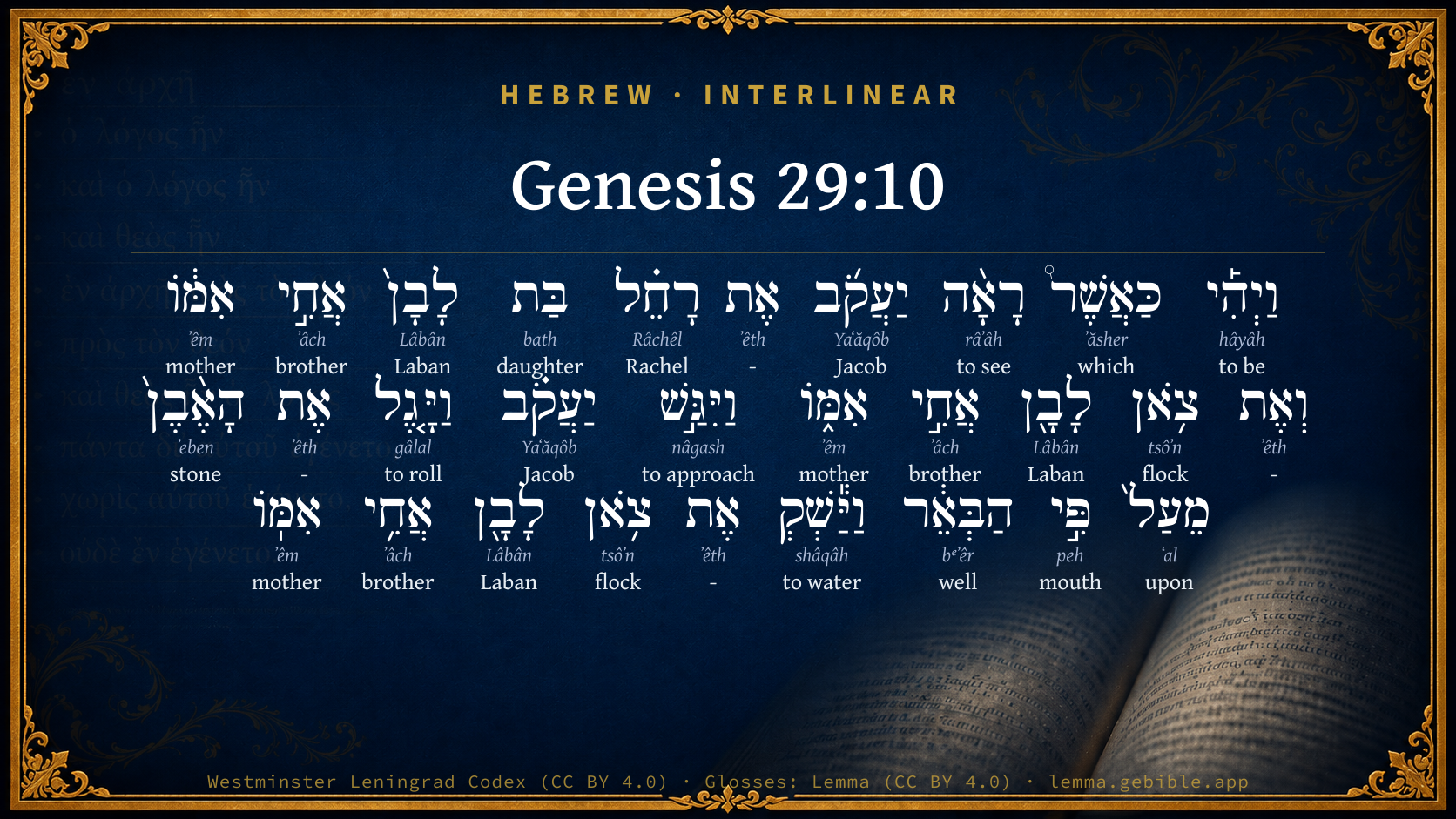
Hebrew (Westminster Leningrad Codex) Genesis 29:10 appears in the Hebrew Old Testament. The text above is from the Westminster Leningrad Codex. Each word links to its Strong’s number, a concise gloss, and parsing drawn from the Open Scriptures Hebrew Bible morphology. Click any word for its full Brown-Driver-Briggs (BDB) entry.
Download image
Cite this verse

Genesis 29:10 (World English Bible). Public Domain. Lemma interlinear Bible study tool, https://lemma.gebible.app/v/genesis/29/10.

Show BibTeX & RIS
BibTeX
RIS
English Translation
It happened, when Jacob saw Rachel the daughter of Laban, his mother's brother, and the sheep of Laban, his mother's brother, that Jacob went near, and rolled the stone from the well's mouth, and watered the flock of Laban his mother's brother.
World English Bible · Public Domain
Download a study sheet

One document with this verse’s original text, its word-by-word gloss line, the meaning frame, cross-references with their text, attributed commentary, and full source and license credits — printable, and it pastes into notes with its structure intact.

This verse Autodidact and up

Study sheet (.html) Plain text (.txt)

A passage Seminary Student

Up to 50 verses in one chapter. A passage sheet keeps up to 6 commentary sources and 12 cross-references per verse, in the order this page ranks them, and says so on the sheet whenever that leaves anything out. Ask for a single verse and you get the Autodidact verse sheet above.

Everything on this page stays free to read, with no account — the sheet is a download of what is already on screen, not access to it.

Want to remove ads? Support Godless Engineer
Compare translations 3

The same verse in 3 English versions, stacked beneath the original-language interlinear above. Click any original word for its lexicon entry.

Each is an independent rendering of the whole verse — the interlinear is not word-aligned to these translations.

Highlighted words mark where these versions differ — a whole-verse word diff, not a word-by-word alignment.

  • World English Bible Public Domain
    It happened, when Jacob saw Rachel the daughter of Laban, his mother's brother, and the sheep of Laban, his mother's brother, that Jacob went near, and rolled the stone from the well's mouth, and watered the flock of Laban his mother's brother.
  • King James Version Public Domain
    And it came to pass, when Jacob saw Rachel the daughter of Laban his mother's brother, and the sheep of Laban his mother's brother, that Jacob went near, and rolled the stone from the well's mouth, and watered the flock of Laban his mother's brother.
  • unfoldingWord Literal Text CC BY-SA 4.0
    Then it happened, when Jacob saw Rachel, the daughter of Laban his mother’s brother, and the sheep of Laban his mother’s brother, then Jacob went over and rolled the stone from over the mouth of the well, and watered the sheep of Laban his mother’s brother.

unfoldingWord Literal Text — © unfoldingWord, licensed CC BY-SA 4.0. Word-aligned USFM3 via Door43 (git.door43.org/unfoldingWord/en_ult).

Versions to compare (up to 4)

3 of 4 selected

Show all 18 translations

Every available English version of this verse, each an independent rendering of the whole verse.

  • World English Bible Public Domain
    It happened, when Jacob saw Rachel the daughter of Laban, his mother's brother, and the sheep of Laban, his mother's brother, that Jacob went near, and rolled the stone from the well's mouth, and watered the flock of Laban his mother's brother.
  • Berean Standard Bible Public Domain
    As soon as Jacob saw Rachel, the daughter of his mother’s brother Laban, with Laban’s sheep, he went up and rolled the stone away from the mouth of the well and watered his uncle’s sheep.
  • Majority Standard Bible Public Domain
    As soon as Jacob saw Rachel, the daughter of his mother’s brother Laban, with Laban’s sheep, he went up and rolled the stone away from the mouth of the well and watered his uncle’s sheep.
  • King James Version Public Domain
    And it came to pass, when Jacob saw Rachel the daughter of Laban his mother's brother, and the sheep of Laban his mother's brother, that Jacob went near, and rolled the stone from the well's mouth, and watered the flock of Laban his mother's brother.
  • American Standard Version (1901) Public Domain
    And it came to pass, when Jacob saw Rachel the daughter of Laban his mother's brother, and the sheep of Laban his mother's brother, that Jacob went near, and rolled the stone from the well's mouth, and watered the flock of Laban his mother's brother.
  • Revised Version (1885) Public Domain
    And it came to pass, when Jacob saw Rachel the daughter of Laban his mother’s brother, and the sheep of Laban his mother’s brother, that Jacob went near, and rolled the stone from the well’s mouth, and watered the flock of Laban his mother’s brother.
  • Geneva Bible (1599) Public Domain
    And assoone as Iaakob saw Rahel ye daughter of Laban his mothers brother, and the sheepe of Laban his mothers brother, then came Iaakob neere, and rolled the stone from the welles mouth, and watered ye flocke of Laban his mothers brother.
  • Douay-Rheims (1899) Public Domain
    And when Jacob saw her, and knew her to be his cousin-german, and that they were the sheep of Laban, his uncle: he removed the stone wherewith the well was closed.
  • Young's Literal Translation Public Domain
    and it cometh to pass when Jacob hath seen Rachel, daughter of Laban his mother's brother, and the flock of Laban his mother's brother, that Jacob cometh nigh and rolleth the stone from off the mouth of the well, and watereth the flock of Laban his mother's brother.
  • Literal Standard Version CC BY-SA 4.0
    and it comes to pass, when Jacob has seen Rachel, daughter of his mother’s brother Laban, and the flock of his mother’s brother Laban, that Jacob comes near and rolls the stone from off the mouth of the well, and waters the flock of his mother’s brother Laban.
  • Unlocked Literal Bible CC BY-SA 4.0
    When Jacob saw Rachel, the daughter of Laban, his mother's brother, and the sheep of Laban, his mother's brother, Jacob came over, rolled the stone from the well's mouth, and watered the flock of Laban, his mother's brother.
  • unfoldingWord Literal Text CC BY-SA 4.0
    Then it happened, when Jacob saw Rachel, the daughter of Laban his mother’s brother, and the sheep of Laban his mother’s brother, then Jacob went over and rolled the stone from over the mouth of the well, and watered the sheep of Laban his mother’s brother.
  • Darby Bible Public Domain
    And it came to pass when Jacob saw Rachel the daughter of Laban his mother's brother, and the sheep of Laban his mother's brother, that Jacob went near, and rolled the stone from the mouth of the well, and watered the sheep of Laban his mother's brother.
  • World Messianic Bible Public Domain
    When Jacob saw Rachel the daughter of Laban, his mother’s brother, and the sheep of Laban, his mother’s brother, Jacob went near, and rolled the stone from the well’s mouth, and watered the flock of Laban his mother’s brother.
  • Webster's Bible Public Domain
    And it came to pass, when Jacob saw Rachel, the daughter of Laban his mother's brother, and the sheep of Laban his mother's brother; that Jacob went near, and rolled the stone from the well's mouth, and watered the flock of Laban his mother's brother.
  • Free Bible Version CC BY-SA 4.0
    When Jacob saw Rachel, the daughter of Laban, his mother's brother, he went over and rolled away the stone from the well so Laban's sheep could drink.
  • Bible in Basic English Public Domain
    Then when Jacob saw Rachel, the daughter of Laban, his mother's brother, coming with Laban's sheep, he came near, and rolling the stone away from the mouth of the hole, he got water for Laban's flock.
  • JPS Tanakh (1917) Public Domain
    And it came to pass, when Jacob saw Rachel the daughter of Laban his mother's brother, and the sheep of Laban his mother's brother, that Jacob went near, and rolled the stone from the well's mouth, and watered the flock of Laban his mother's brother.

Literal Standard Version (2020), Covenant Press — licensed CC BY-SA 4.0. Text via the HelloAO Bible API (eBible.org). Unlocked Literal Bible (unfoldingWord) — licensed CC BY-SA 4.0. Text via the HelloAO Bible API (eBible.org). unfoldingWord Literal Text — © unfoldingWord, licensed CC BY-SA 4.0. Word-aligned USFM3 via Door43 (git.door43.org/unfoldingWord/en_ult). Free Bible Version, Dr. Jonathan Gallagher — licensed CC BY-SA 4.0. Text via the HelloAO Bible API (eBible.org).

Word by word

More ways to search: Search by grammar → Find every occurrence → Compare this word →

Practice this passage: Drill this verse → Learn its vocabulary →

וַיָּ֤גֶל
gâlal
H1556
“and · to roll”
Conjunction + Verb, Qal, Sequential Imperfect, 3rd Person, Masculine, Singular
Part of Speech
Conjunction + Verb
Stem
Qal
Form
Sequential Imperfect
Person
3rd Person
Gender
Masculine
Number
Singular
Full BDB Definition

Origin: a primitive root

TWOT: 353

to roll, roll away, roll down, roll together - (Qal) to roll - (Niphal) - to roll up - to flow down - (Pilpel) to roll - (Poal) to be rolled - (Hithpoel) to roll oneself - (Hithpalpel) to roll oneself - (Hiphil) to roll away
  1. וַיְהִ֡י hâyâh H1961 “and · to be” Conjunction + Verb, Qal, Sequential Imperfect, 3rd Person, Masculine, Singular
  2. כַּאֲשֶׁר֩ ʼăsher H834 “like/as · which” Preposition + Particle, Relative
  3. רָאָ֨ה râʼâh H7200 “to see” Verb, Qal, Perfect, 3rd Person, Masculine, Singular
  4. יַעֲקֹ֜ב Yaʻăqôb H3290 “Jacob” Noun, Proper
  5. אֶת ʼêth H853 “-” Particle, Direct Object
  6. רָחֵ֗ל Râchêl H7354 “Rachel” Noun, Proper
  7. בַּת bath H1323 “daughter of” Noun, Common, Feminine, Singular, Construct
  8. לָבָן֙ Lâbân H3837 “Laban” Noun, Proper
  9. אֲחִ֣י ʼâch H251 “brother of” Noun, Common, Masculine, Singular, Construct
  10. אִמּ֔וֹ ʼêm H517 “mother · his” Noun, Common, Feminine, Singular, Construct + Suffix, Personal, 3rd Person, Masculine, Singular
  11. וְאֶת ʼêth H853 “and · -” Conjunction + Particle, Direct Object
  12. צֹ֥אן tsôʼn H6629 “flock of” Noun, Common, Both, Singular, Construct
  13. לָבָ֖ן Lâbân H3837 “Laban” Noun, Proper
  14. אֲחִ֣י ʼâch H251 “brother of” Noun, Common, Masculine, Singular, Construct
  15. אִמּ֑וֹ ʼêm H517 “mother · his” Noun, Common, Feminine, Singular, Construct + Suffix, Personal, 3rd Person, Masculine, Singular
  16. וַיִּגַּ֣שׁ nâgash H5066 “and · to approach” Conjunction + Verb, Qal, Sequential Imperfect, 3rd Person, Masculine, Singular
  17. יַעֲקֹ֗ב Yaʻăqôb H3290 “Jacob” Noun, Proper
  18. אֶת ʼêth H853 “-” Particle, Direct Object
  19. הָאֶ֨בֶן֙ ʼeben H68 “the · stone” Particle, Definite Article + Noun, Common, Feminine, Singular, Absolute
  20. מֵעַל֙ ʻal H5921 “from · upon” Preposition + Preposition
  21. פִּ֣י peh H6310 “mouth of” Noun, Common, Masculine, Singular, Construct
  22. הַבְּאֵ֔ר bᵉʼêr H875 “the · well” Particle, Definite Article + Noun, Common, Feminine, Singular, Absolute
  23. וַיַּ֕שְׁקְ shâqâh H8248 “and · to water” Conjunction + Verb, Hiphil, Sequential Imperfect, 3rd Person, Masculine, Singular
  24. אֶת ʼêth H853 “-” Particle, Direct Object
  25. צֹ֥אן tsôʼn H6629 “flock of” Noun, Common, Both, Singular, Construct
  26. לָבָ֖ן Lâbân H3837 “Laban” Noun, Proper
  27. אֲחִ֥י ʼâch H251 “brother of” Noun, Common, Masculine, Singular, Construct
  28. אִמּֽוֹ ʼêm H517 “mother · his” Noun, Common, Feminine, Singular, Construct + Suffix, Personal, 3rd Person, Masculine, Singular

About this verse

These counts appear in no published source. They are computed here, from the morphology-tagged text and Lemma’s own curated glosses. What Lemma adds →

29
words
18
distinct lemmas
Pentateuch
section

Notable vocabulary

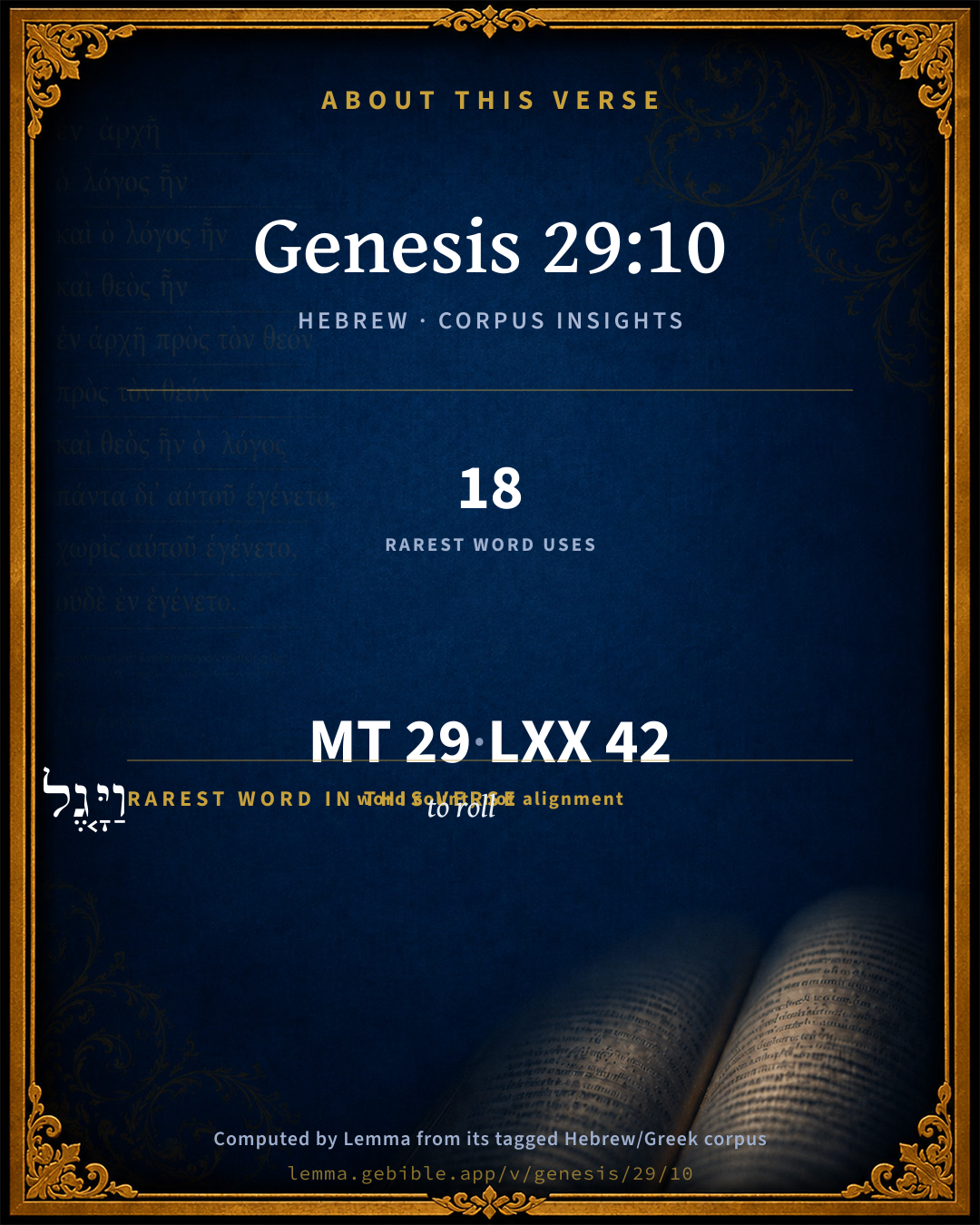
The rarest word here is וַיָּ֤גֶל to roll H1556 — appearing just 18 times in the whole Hebrew Bible.

Shared distinctive vocabulary

וַיָּ֤גֶל to roll H1556 occurs in 18 verses of the Hebrew Bible. Also found in:

Grammatical profile

  • 5 verbs
  • 18 nouns
  • 1 preposition
  • 5 particles

Verb forms

  • וַיְהִ֡י Qal · Sequential Imperfect
  • רָאָ֨ה Qal · Perfect
  • וַיִּגַּ֣שׁ Qal · Sequential Imperfect
  • וַיָּ֤גֶל Qal · Sequential Imperfect
  • וַיַּ֕שְׁקְ Hiphil · Sequential Imperfect

Repetition

Words recur within this verse — often emphatic in Hebrew:

  • לָבָן֙ Laban H3837 ×3
  • אֲחִ֣י brother H251 ×3
  • אִמּ֔וֹ mother H517 ×3
  • יַעֲקֹ֜ב Jacob H3290 ×2
  • צֹ֥אן flock H6629 ×2

Hebrew & Septuagint length

In English translation the verse runs 42 words from the Hebrew and 47 from the Septuagint (LXX English) — closely comparable.

A rough comparison of the two English renderings, which tokenize alike — not a word-level alignment.

Word counts can differ between the Hebrew and the Greek without any difference in meaning — e.g. the Hebrew direct-object marker אֵת has no separate Greek word, and Greek often adds the article ὁ.

In the original languages it is 29 Hebrew tokens and 42 Greek tokens — but the two are counted differently (Hebrew bundles its prefixes and suffixes into one token; the Greek is in lemma form), so that isn’t a like-for-like length.

Cross-references

1

Topical passages linked to Genesis 29:10 in the Treasury of Scripture Knowledge — connected by theme and wording, ordered by reader-vote popularity; previews shown in the World English Bible.

  • Exodus 2:17 The shepherds came and drove them away; but Moses stood up and helped them, and watered their flock.

Cross-references courtesy of OpenBible.info (CC BY 4.0).

Hebrew and Greek witnesses Masoretic Hebrew ↔ Greek Septuagint

The same verse in the two great witnesses to the Old Testament, shown verse-for-verse.

These are two independent witnesses, not word-aligned to each other, and the Septuagint is shown in lemma (dictionary) form.

Hebrew Genesis 29:10 Masoretic · Westminster Leningrad Codex

וַיְהִ֡י כַּאֲשֶׁר֩ רָאָ֨ה יַעֲקֹ֜ב אֶת רָחֵ֗ל בַּת לָבָן֙ אֲחִ֣י אִמּ֔וֹ וְאֶת צֹ֥אן לָבָ֖ן אֲחִ֣י אִמּ֑וֹ וַיִּגַּ֣שׁ יַעֲקֹ֗ב וַיָּ֤גֶל אֶת הָאֶ֨בֶן֙ מֵעַל֙ פִּ֣י הַבְּאֵ֔ר וַיַּ֕שְׁקְ אֶת צֹ֥אן לָבָ֖ן אֲחִ֥י אִמּֽוֹ

It happened, when Jacob saw Rachel the daughter of Laban, his mother's brother, and the sheep of Laban, his mother's brother, that Jacob went near, and rolled the stone from the well's mouth, and watered the flock of Laban his mother's brother.

World English Bible · Public Domain

Greek LXX Genesis 29:10 Septuagint · lemma form

γίγνομαι δέ ὡς ὁράω ἰακώβ ὁ ραχηλ θυγάτηρ λαβαν ἀδελφός ὁ μήτηρ αὐτός καί ὁ πρόβατον λαβαν ἀδελφός ὁ μήτηρ αὐτός καί προςἔρχομαι ἰακώβ ἀποκυλίω ὁ λίθος ἀπό ὁ στόμα ὁ φρέαρ καί ποτίζω ὁ πρόβατον λαβαν ὁ ἀδελφός ὁ μήτηρ αὐτός

And it came to pass when Jacob saw Rachel the daughter of Laban, his mother's brother, and the sheep of Laban, his mother's brother, that Jacob came and rolled away the stone from the mouth of the well, and watered the sheep of Laban, his mother's brother.

LXX2012 (modern English Septuagint) · Public Domain

Hebrew: Westminster Leningrad Codex (CC BY 4.0). Greek: Septuagint (public domain); English from LXX2012 (modern English Septuagint) (Public Domain). How the Septuagint differs from the Hebrew →

Targum (Aramaic paraphrase)

2

The Targum is the ancient Jewish Aramaic paraphrase of the Hebrew Scriptures — an interpretive translation, not the Hebrew text itself. Onkelos (literal) and Pseudo-Jonathan (expansive) render the Torah, and Jonathan the Prophets. Coverage is partial: where no permissively-licensed English translation exists for a verse, only the Aramaic is shown. This is verse-level text, not a word-by-word alignment to the Hebrew.

  1. Targum Onkelos Torah (Genesis–Deuteronomy)
    וַהֲוָה כַּד חֲזָא יַעֲקֹב יָת רָחֵל בַּת לָבָן אֲחוּהָא דְאִמֵהּ וְיָת עָנָא דְלָבָן אֲחוּהָא דְאִמֵהּ וּקְרֵב יַעֲקֹב וּגַנְדַר יָת אַבְנָא מֵעַל פּוּמָא דְבֵירָא וְאַשְׁקֵי יָת עָנָא דְלָבָן אֲחוּהָא דְאִמֵהּ

    (no public-domain English translation for this verse)

    Targum Onkelos — Aramaic: “Onkelos Genesis” (public domain); “Onkelos Exodus” (public domain); “Onkelos Leviticus” (public domain); “Onkelos Numbers” (public domain); “Onkelos Deuteronomy” (public domain). English: “Sefaria Community Translation” (CC0 1.0 (public-domain dedication)); “J.W. Etheridge. The Targums of Onkelos and Jonathan Ben Uzziel on the Pentateuch. London: Longmans, Green, 1862” (public domain). Text via Sefaria.

  2. Targum Pseudo-Jonathan Torah (Genesis–Deuteronomy)
    וַהֲוָה כְּדִי חָמָא יַעֲקב יַת רָחֵל בְּרַת לָבָן אֲחוּהָא דְאִמֵיהּ וְקָרֵב יַעֲקב וְגַלְגֵיל יַת אַבְנָא בַּחֲדָא מִן אֶדְרָעוֹי מֵעִילוֹי פּוּם בֵּירָא וְטָפַת בֵּירָא וּסְלִיקוּ מַיָא לְאַנְפּוֹי וְאַשְׁקֵי יַת עָנָא דְלָבָן אָחוּהָא דְאִימֵיהּ וַהֲוַת טַיְיפָא עַשְרִין שְׁנִין

    And it was when Jakob saw Rahel the daughter of Laban his mother's brother that Jakob went nigh, and rolled the stone with one of his arms from the mouth of the Well; and the well uprose, and the waters ascended to the top of it; and he watered the sheep of Laban his mothor's brother; and it uprose for twenty years.

    Targum Pseudo-Jonathan — Aramaic: “Targum Jonathan on Genesis” (public domain); “Targum Jonathan on Exodus” (public domain); “Targum Jonathan on Leviticus” (public domain); “Targum Jonathan on Numbers” (public domain); “Targum Jonathan on Deuteronomy” (public domain). English: “The Targum of Jonathan ben Uzziel, trans. J. W. Etheridge, London, 1862” (public domain). Text via Sefaria.

Commentary

Notes on Genesis 29:10 from classic Christian and Jewish commentators (each source and its license shown beneath its notes). The classic Christian expositions comment on the surrounding passage and are grouped to its opening verse, so a note may address several verses; the Jewish commentaries on the Tanakh (Rashi and others) are per-verse, so they appear only where the commentator wrote on this verse.

Lemma curates 59 commentaries, every one of them public domain or Creative Commons licensed, each selected and text-cleaned for this edition rather than reprinted as found. About our sources →

Trapp's Complete Commentary

John Trapp

Gen 29:10 And it came to pass, when Jacob saw Rachel the daughter of Laban his mother’s brother, and the sheep of Laban his mother’s brother, that Jacob went near, and rolled the stone from the well’s mouth, and watered the flock of Laban his mother’s brother.

Ver. 10. Went near, and rolled the stone, &c.] If he did this alone, as the text seemeth to say, it was very strange. He might put forth his strength, to gratify Rachel, and to insinuate himself into her love.

John Trapp, A Commentary or Exposition upon All the Books of the Old and New Testament (1647–1656) — public domain. Text from a community e-Sword module.

Tyndale Open Study Notes

Tyndale Open Resources

29:10 In contrast to the lazy, unhelpful shepherds (29:7-8), Jacob is portrayed as generous, industrious, and energetic. • Jacob . . . watered his uncle’s flock: Laban’s flocks would flourish under Jacob’s care.

Tyndale Open Study Notes — © Tyndale Open Resources, licensed CC BY-SA 4.0. Text via the HelloAO Bible API.

Adam Clarke's Commentary

Verse 10. Jacob went near, and rolled the stone] Probably the flock of Laban was the last of those which had a right to the well; that flock being now come, Jacob assisted the shepherds to roll off the stone, (for it is not likely he did it by himself,) and so assisted his cousin, to whom he was as yet unknown, to water her flock.

Adam Clarke's Commentary on the Bible (1810–1826) — public domain. Text from a community e-Sword/MySword module.

Ellicott's Commentary for English Readers

(10) Laban his mother’s brother.—The threefold repetition of these words has no other reason than that given in the Note on Gen_28:5.

A Bible Commentary for English Readers, edited by Charles John Ellicott (1878–1897) — public domain. Text from a community e-Sword module.

The Cambridge Bible for Schools and Colleges

gen. ed. J. J. S. Perowne

10. went near, and rolled] Jacob disregards the rule of the well; and at the risk of incurring the wrath of the local herdsmen and shepherds, by a feat of great personal strength, removes unaided the stone covering, and renders Rachel the service of watering Laban’s flock. The shepherds were apparently kept quiet by the appearance of the stranger’s energy and strength. For the whole scene, cf. the story of Moses, Exo_2:16-21.

The Cambridge Bible for Schools and Colleges (gen. ed. J. J. S. Perowne; Cambridge University Press, 1878–1918) — public domain. Text from a community e-Sword module.

John Gill's Exposition

And it came to pass, when Jacob saw Rachel, the daughter of Laban his mother's brother,.... Coming with her flock towards the well, and for whom and whose flock only the shepherds might be waiting:

and the sheep of Laban his mother's brother; wherefore out of respect to him and his, he being so nearly allied to him, it was

that Jacob went near, and rolled the stone from the well's mouth, either with the help of the shepherds, or of himself by his own strength; which the Jewish writers (h) say amazed the shepherds, that he should do that himself, which required their united strength. The Targum of Jonathan says, he did it with one of his arms; and Jarchi, that he removed it as easily as a man takes off the lid cover of a pot:

and watered the flock of Laban his mother's brother; this he did partly out of respect to his relations, and partly that he might be taken notice of by Rachel.

(h) Pirke Eliezer, c. 36.

John Gill's Exposition of the Whole Bible (1746–1763) — public domain (CC PDM 1.0). Text via the HelloAO Bible API.

Haydock's Catholic Bible Commentary

Cousin-german, and uncle, are put for brevity’s sake by St. Jerome, instead of the Hebrew, "the daughter of Laban, brother of Rebecca his mother," and "his mother’s brother." (Haydock)

George Leo Haydock (1774–1849), Haydock's Catholic Family Bible and Commentary, 1859 edition — public domain. Excludes Psalms (Douay-Rheims chapter numbering differs from Protestant) and Deuterocanonical books (Catholic canon only).

Matthew Poole's English Annotations

Either with the assistance of others, or by himself, he being then strong and lusty, and putting forth all his might before Rachel.

Matthew Poole's English Annotations on the Holy Bible (1683–1685) — public domain. Text from a community e-Sword/MySword module.

Whedon's Commentary on the Bible

Daniel D. Whedon

10. Jacob saw… went near… rolled… watered — There is a romantic gallantry about Jacob’s conduct here that is noticeable. The thrice repeated Laban his mother’s brother deepens and intensifies the thought that he felt himself among his own; his mother had ever been his warmest friend and helper.

Daniel D. Whedon (gen. ed.), Commentary on the Old and New Testaments (1874–1909) — public domain. Text from a community e-Sword module.

The Pulpit Commentary

And it came to pass, when Jacob saw Rachel the daughter of Laban his mother"s brother, term mother"s brother is not unintentionally repeated three times in this verse to describe with the greatest possible stress that Jacob had met with his own relations, with "his bone and his flesh" (Kalisch)and the sheep of Laban his mother"s brother (Jacob from the first takes particular notice of Laban"s flock, perhaps regarding them as a sign of Laban s wealth. If Laban s daughter had her attractions for the son of Isaac, so also had Laban s sheep), that Jacob went near, and rolled the stone from the well"s mouth (probably disregarding the shepherds" rule to wait for the gathering of all the flocks, unless, indeed, Rachel s was the last), and watered the flock of Laban his mother"s brother. The threefold repetition of this phrase does not prove that Jacob acted in all this purely as a cousin (Lange). The phrase is the historian"s, and Jacob had not yet informed Rachel of his name.

The Pulpit Commentary (1880–1919), ed. H.D.M. Spence-Jones & Joseph S. Exell — public domain. Text from a community e-Sword module.

Rashi

Rabbi Shlomo Yitzchaki (Rashi)

ויגש יעקב ויגל JACOB STEPPED NEAR AND ROLLED [THE STONE]- as easily as one draws the stopper from the mouth of a bottle — thus showing you how strong he was. (Bereishit Rabbah 70:12)

Rashi on the Tanakh — English translations: “The Judaica Press complete Tanach with Rashi, translated by A. J. Rosenberg” (CC BY 4.0); “Pentateuch with Rashi's commentary by M. Rosenbaum and A.M. Silbermann, 1929-1934” (public domain); “The Metsudah Tanach series, Lakewood, N.J” (CC BY 4.0); and “The Book of Joshua, Metsudah Publications, 1997” (CC BY 4.0). Text via Sefaria.

Radak

Rabbi David Kimhi (Radak)

ויהי...ויגל את האבן, either together with the other three shepherds on hand, or all by himself. In the event that he did it all by himself, G’d blessed him with extraordinary physical strength at that time.

Radak on the Tanakh — English translations: “Sefaria Community Translation” (CC0 1.0 (public-domain dedication)); “Eliyahu Munk, HaChut Hameshulash” (CC BY 4.0); “Rabbi Mike Feuer, Jerusalem Anthology” (CC BY 4.0); and “R. David Kimhi on the first book of Psalms, Translated by R.G. Finch, London, 1919” (public domain). Text via Sefaria.

Lesson kit

Teaching starters — assembled from the data on this page, not authored interpretation. Every prompt links to the verse data it draws on. Edit before teaching.

Genesis, in the Pentateuch, opens this verse with 29 words (18 distinct Hebrew lemmas). Its most distinctive word is gâlal (“to roll”). A historical commentator’s framing appears above. Read the whole chapter for the surrounding context.

Discussion questions

  1. The word gâlal carries the sense “to roll.” How does it shape the verse?
  2. Genesis 29:3 shares the word «to roll» with this verse. How do the two illuminate each other?
  3. “Laban” occurs 3× in this one verse. What is the effect of the repetition?
  4. The translations on this page render this verse differently — a whole-verse word diff, not a word-by-word alignment. What might account for the different wordings?
  5. The verb «וַיְהִ֡י» is Qal Sequential Imperfect. How does its form color the action?
  6. Reading how Trapp's Complete Commentary and Tyndale Open Study Notes read this verse, where do the two commentators agree and where do they part?

Things to notice

Reading settings

Reading text

Shown beneath each verse's original-language words.

Old Testament
Old Testament edition

Read the OT as the Masoretic Hebrew (MT) or the Greek Septuagint (LXX).

English shown for the Greek Septuagint (in the Hebrew ↔ Greek comparison).

Comparing translations? Open the Compare panel on any verse page to stack up to four side by side.