
2 Chronicles 22:7

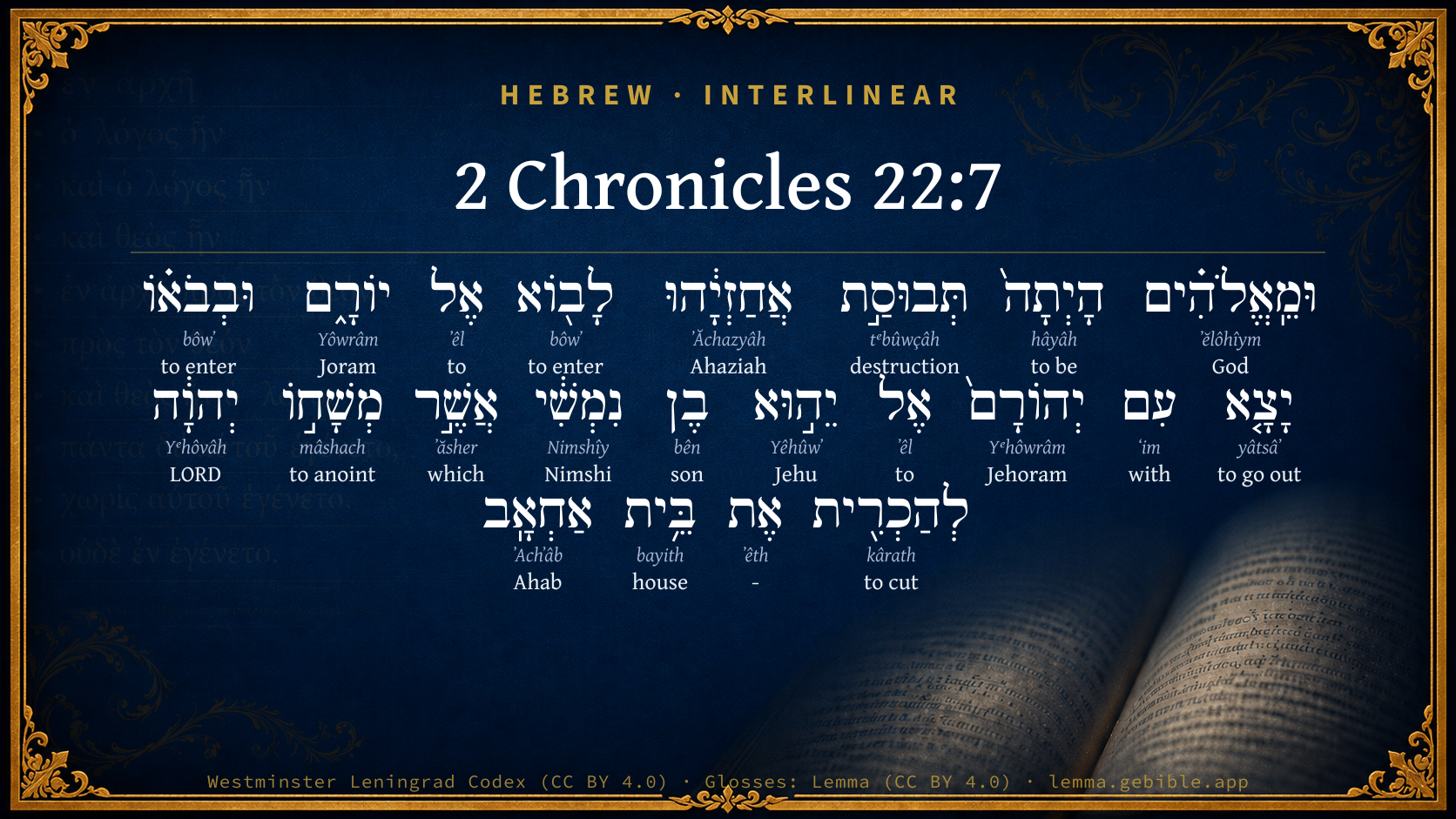
Hebrew (Westminster Leningrad Codex) 2 Chronicles 22:7 appears in the Hebrew Old Testament. The text above is from the Westminster Leningrad Codex. Each word links to its Strong’s number, a concise gloss, and parsing drawn from the Open Scriptures Hebrew Bible morphology. Click any word for its full Brown-Driver-Briggs (BDB) entry.
Download image
Cite this verse

2 Chronicles 22:7 (World English Bible). Public Domain. Lemma interlinear Bible study tool, https://lemma.gebible.app/v/2-chronicles/22/7.

Show BibTeX & RIS
BibTeX
RIS
English Translation
Now the destruction of Ahaziah was of God, in that he went to Joram: for when he was come, he went out with Jehoram against Jehu the son of Nimshi, whom Yahweh had anointed to cut off the house of Ahab.
World English Bible · Public Domain
Highlights
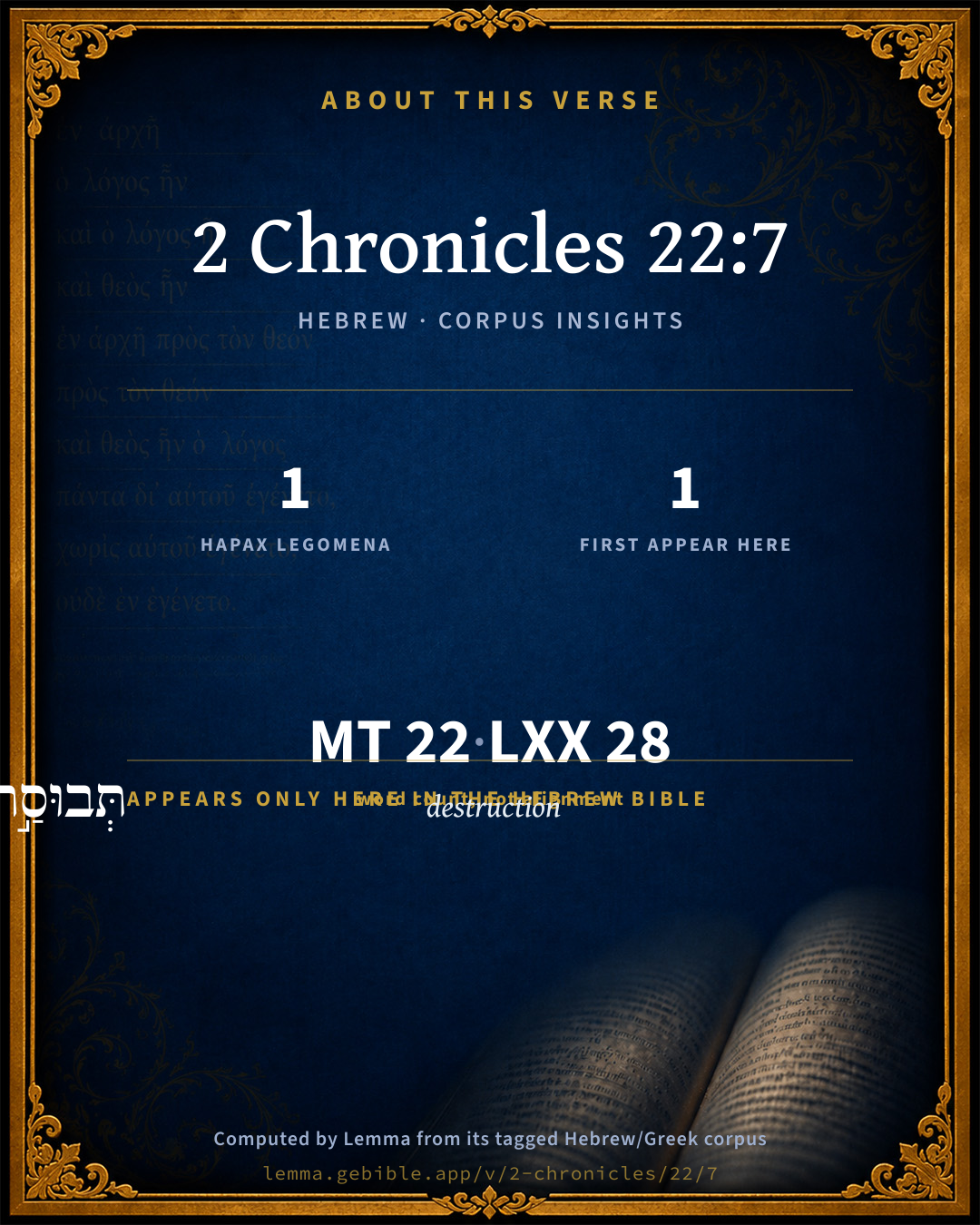
  • 1 hapax legomenon — only here in the Hebrew Bible
  • 1 first appearance in the Hebrew Bible
Full analysis ↓
Download a study sheet

One document with this verse’s original text, its word-by-word gloss line, the meaning frame, cross-references with their text, attributed commentary, and full source and license credits — printable, and it pastes into notes with its structure intact.

This verse Autodidact and up

Study sheet (.html) Plain text (.txt)

A passage Seminary Student

Up to 50 verses in one chapter. A passage sheet keeps up to 6 commentary sources and 12 cross-references per verse, in the order this page ranks them, and says so on the sheet whenever that leaves anything out. Ask for a single verse and you get the Autodidact verse sheet above.

Everything on this page stays free to read, with no account — the sheet is a download of what is already on screen, not access to it.

Want to remove ads? Support Godless Engineer
Compare translations 3

The same verse in 3 English versions, stacked beneath the original-language interlinear above. Click any original word for its lexicon entry.

Each is an independent rendering of the whole verse — the interlinear is not word-aligned to these translations.

Highlighted words mark where these versions differ — a whole-verse word diff, not a word-by-word alignment.

  • World English Bible Public Domain
    Now the destruction of Ahaziah was of God, in that he went to Joram: for when he was come, he went out with Jehoram against Jehu the son of Nimshi, whom Yahweh had anointed to cut off the house of Ahab.
  • King James Version Public Domain
    And the destruction of Ahaziah was of God by coming to Joram: for when he was come, he went out with Jehoram against Jehu the son of Nimshi, whom the LORD had anointed to cut off the house of Ahab.
  • unfoldingWord Literal Text CC BY-SA 4.0
    And from God was the downfall of Ahaziah for going to Joram. And when he came, he went out with Jehoram against Jehu the son of Nimshi, whom Yahweh anointed him to cut off the house of Ahab.

unfoldingWord Literal Text — © unfoldingWord, licensed CC BY-SA 4.0. Word-aligned USFM3 via Door43 (git.door43.org/unfoldingWord/en_ult).

Versions to compare (up to 4)

3 of 4 selected

Show all 18 translations

Every available English version of this verse, each an independent rendering of the whole verse.

  • World English Bible Public Domain
    Now the destruction of Ahaziah was of God, in that he went to Joram: for when he was come, he went out with Jehoram against Jehu the son of Nimshi, whom Yahweh had anointed to cut off the house of Ahab.
  • Berean Standard Bible Public Domain
    Ahaziah’s downfall came from God when he went to visit Joram. When Ahaziah arrived, he went out with Joram to meet Jehu son of Nimshi, whom the LORD had anointed to destroy the house of Ahab.
  • Majority Standard Bible Public Domain
    Ahaziah’s downfall came from God when he went to visit Joram. When Ahaziah arrived, he went out with Joram to meet Jehu son of Nimshi, whom the LORD had anointed to destroy the house of Ahab.
  • King James Version Public Domain
    And the destruction of Ahaziah was of God by coming to Joram: for when he was come, he went out with Jehoram against Jehu the son of Nimshi, whom the LORD had anointed to cut off the house of Ahab.
  • American Standard Version (1901) Public Domain
    Now the destruction of Ahaziah was of God, in that he went unto Joram: for when he was come, he went out with Jehoram against Jehu the son of Nimshi, whom Jehovah had anointed to cut off the house of Ahab.
  • Revised Version (1885) Public Domain
    Now the destruction of Ahaziah was of God, in that he went unto Joram: for when he was come, he went out with Jehoram against Jehu the son of Nimshi, whom the LORD had anointed to cut off the house of Ahab.
  • Geneva Bible (1599) Public Domain
    And the destruction of Ahaziah came of God in that he went to Ioram: for when he was come, he went forth with Iehoram against Iehu the sonne of Nimshi, whom the Lord had anointed to destroy the house of Ahab.
  • Douay-Rheims (1899) Public Domain
    For it was the will of God against Ochozias that he should come to Joram: and when he was come should go out also against Jehu the son of Namsi, whom the Lord had anointed to destroy the house of Achab.
  • Young's Literal Translation Public Domain
    and from God hath been the destruction of Ahaziah, to come unto Joram: and in his coming he hath gone out with Jehoram unto Jehu son of Nimshi, whom Jehovah anointed to cut off the house of Ahab.
  • Literal Standard Version CC BY-SA 4.0
    and to come to Joram has been from God [for] the destruction of Ahaziah; and in his coming he has gone out with Jehoram to Jehu son of Nimshi, whom YHWH anointed to cut off the house of Ahab.
  • Unlocked Literal Bible CC BY-SA 4.0
    Now the destruction of Ahaziah was brought about by God through Ahaziah's visit to Joram. When he had arrived, he went with Jehoram to attack Jehu son of Nimshi, whom Yahweh had chosen to destroy the house of Ahab.
  • unfoldingWord Literal Text CC BY-SA 4.0
    And from God was the downfall of Ahaziah for going to Joram. And when he came, he went out with Jehoram against Jehu the son of Nimshi, whom Yahweh anointed him to cut off the house of Ahab.
  • Darby Bible Public Domain
    But his coming to Joram was from God the complete ruin of Ahaziah. And when he had come, he went out with Jehoram against Jehu the son of Nimshi, whom Jehovah had anointed to cut off the house of Ahab.
  • World Messianic Bible Public Domain
    Now the destruction of Ahaziah was of God, in that he went to Joram; for when he had come, he went out with Jehoram against Jehu the son of Nimshi, whom the LORD had anointed to cut off Ahab’s house.
  • Webster's Bible Public Domain
    And the destruction of Ahaziah was from God by coming to Joram: for when he had come, he went out with Jehoram against Jehu the son of Nimshi, whom the LORD had anointed to cut off the house of Ahab.
  • Free Bible Version CC BY-SA 4.0
    Ahaziah's downfall came from God when he went to see Joram. When Ahaziah got there, he went with Joram to meet Jehu, son of Nimri. The Lord had anointed Jehu to destroy Ahab and his family.
  • Bible in Basic English Public Domain
    Now by the purpose of God, Ahaziah's journey to see Jehoram was the cause of his downfall: for when he came there, he went out with Jehoram against Jehu, the son of Nimshi, who had been marked out by the Lord for the destruction of the family of Ahab.
  • JPS Tanakh (1917) Public Domain
    Now the downfall of Ahaziah was of God, in that he went unto Joram; for when he was come, he went out with Jehoram against Jehu the son of Nimshi, whom the LORD had anointed to cut off the house of Ahab.

Literal Standard Version (2020), Covenant Press — licensed CC BY-SA 4.0. Text via the HelloAO Bible API (eBible.org). Unlocked Literal Bible (unfoldingWord) — licensed CC BY-SA 4.0. Text via the HelloAO Bible API (eBible.org). unfoldingWord Literal Text — © unfoldingWord, licensed CC BY-SA 4.0. Word-aligned USFM3 via Door43 (git.door43.org/unfoldingWord/en_ult). Free Bible Version, Dr. Jonathan Gallagher — licensed CC BY-SA 4.0. Text via the HelloAO Bible API (eBible.org).

Word by word

More ways to search: Search by grammar → Find every occurrence → Compare this word →

Practice this passage: Drill this verse → Learn its vocabulary →

תְּבוּסַ֣ת
tᵉbûwçâh
H8395
“destruction of”
Noun, Common, Feminine, Singular, Construct
Part of Speech
Noun
Type
Common
Gender
Feminine
Number
Singular
State
Construct
Full BDB Definition

Origin: from H947

TWOT: 216c

a treading down, downtreading, ruin, downfall, destruction
  1. וּמֵֽאֱלֹהִ֗ים ʼĕlôhîym H430 “and · from · God(s)” Conjunction + Preposition + Noun, Common, Masculine, Plural, Absolute
  2. הָיְתָה֙ hâyâh H1961 “to be” Verb, Qal, Perfect, 3rd Person, Feminine, Singular
  3. אֲחַזְיָ֔הוּ ʼĂchazyâh H274 “Ahaziah” Noun, Proper
  4. לָב֖וֹא bôwʼ H935 “to enter” Preposition + Verb, Qal, Infinitive Construct
  5. אֶל ʼêl H413 “to” Preposition
  6. יוֹרָ֑ם Yôwrâm H3141 “Joram” Noun, Proper
  7. וּבְבֹא֗וֹ bôwʼ H935 “and · in/at · to enter · him” Conjunction + Preposition + Verb, Qal, Infinitive Construct + Suffix, Personal, 3rd Person, Masculine, Singular
  8. יָצָ֤א yâtsâʼ H3318 “to go out” Verb, Qal, Perfect, 3rd Person, Masculine, Singular
  9. עִם ʻim H5973 “with” Preposition
  10. יְהוֹרָם֙ Yᵉhôwrâm H3088 “Jehoram” Noun, Proper
  11. אֶל ʼêl H413 “to” Preposition
  12. יֵה֣וּא Yêhûwʼ H3058 “Jehu” Noun, Proper
  13. בֶן bên H1121 “son of” Noun, Common, Masculine, Singular, Construct
  14. נִמְשִׁ֔י Nimshîy H5250 “Nimshi” Noun, Proper
  15. אֲשֶׁ֣ר ʼăsher H834 “which” Particle, Relative
  16. מְשָׁח֣וֹ mâshach H4886 “to anoint · him” Verb, Qal, Perfect, 3rd Person, Masculine, Singular + Suffix, Personal, 3rd Person, Masculine, Singular
  17. יְהוָ֔ה Yᵉhôvâh H3068 “LORD” Noun, Proper
  18. לְהַכְרִ֖ית kârath H3772 “to cut” Preposition + Verb, Hiphil, Infinitive Construct
  19. אֶת ʼêth H853 “-” Particle, Direct Object
  20. בֵּ֥ית bayith H1004 “house of” Noun, Common, Masculine, Singular, Construct
  21. אַחְאָֽב ʼAchʼâb H256 “Ahab” Noun, Proper

About this verse

These counts appear in no published source. They are computed here, from the morphology-tagged text and Lemma’s own curated glosses. What Lemma adds →

22
words
20
distinct lemmas
Historical
section

Notable vocabulary

1 hapax legomenon — a word that appears only here in the entire Hebrew Bible:

  • תְּבוּסַ֣ת destruction H8395

First appearance in Scripture

This word makes its first canonical appearance in the Hebrew Bible here:

  • תְּבוּסַ֣ת destruction H8395

Shared distinctive vocabulary

נִמְשִׁ֔י Nimshi H5250 occurs in 5 verses of the Hebrew Bible. Also found in:

Grammatical profile

  • 6 verbs
  • 11 nouns
  • 3 prepositions
  • 2 particles

Verb forms

  • הָיְתָה֙ Qal · Perfect
  • לָב֖וֹא Qal · Infinitive Construct
  • וּבְבֹא֗וֹ Qal · Infinitive Construct
  • יָצָ֤א Qal · Perfect
  • מְשָׁח֣וֹ Qal · Perfect
  • לְהַכְרִ֖ית Hiphil · Infinitive Construct

Repetition

Words recur within this verse — often emphatic in Hebrew:

  • לָב֖וֹא to enter H935 ×2
  • אֶל to H413 ×2

Hebrew & Septuagint length

In English translation the verse runs 41 words from the Hebrew and 38 from the Septuagint (LXX English) — closely comparable.

A rough comparison of the two English renderings, which tokenize alike — not a word-level alignment.

Word counts can differ between the Hebrew and the Greek without any difference in meaning — e.g. the Hebrew direct-object marker אֵת has no separate Greek word, and Greek often adds the article ὁ.

In the original languages it is 22 Hebrew tokens and 28 Greek tokens — but the two are counted differently (Hebrew bundles its prefixes and suffixes into one token; the Greek is in lemma form), so that isn’t a like-for-like length.

Cross-references

12

Topical passages linked to 2 Chronicles 22:7 in the Treasury of Scripture Knowledge — connected by theme and wording, ordered by reader-vote popularity; previews shown in the World English Bible.

  • 2 Kings 9:21 Joram said, Make ready. They made ready his chariot. Joram king of Israel and Ahaziah king of Judah went out, each in his chariot, and they went out to meet Jehu, and found him in the portion of Naboth the Jezreelite.
  • 2 Chronicles 10:15 So the king didn't listen to the people; for it was brought about of God, that Yahweh might establish his word, which he spoke by Ahijah the Shilonite to Jeroboam the son of Nebat.
  • Deuteronomy 32:35 Vengeance is mine, and recompense, At the time when their foot shall slide: For the day of their calamity is at hand, The things that are to come on them shall make haste.
  • Judges 14:4 But his father and his mother didn't know that it was of Yahweh; for he sought an occasion against the Philistines. Now at that time the Philistines had rule over Israel.
  • 1 Kings 12:15 So the king didn't listen to the people; for it was a thing brought about of Yahweh, that he might establish his word, which Yahweh spoke by Ahijah the Shilonite to Jeroboam the son of Nebat.
  • 1 Kings 19:16 and Jehu the son of Nimshi shall you anoint to be king over Israel; and Elisha the son of Shaphat of Abel Meholah shall you anoint to be prophet in your room.
  • 1 Kings 22:20 Yahweh said, Who shall entice Ahab, that he may go up and fall at Ramoth-gilead? One said on this manner; and another said on that manner.
  • 2 Kings 9:1–7 Elisha the prophet called one of the sons of the prophets, and said to him, Gird up your loins, and take this vial of oil in your hand, and go to Ramoth-gilead.
  • Psalms 9:16 Yahweh has made himself known. He has executed judgment. The wicked is snared by the work of his own hands. Meditation. Selah.
  • Isaiah 46:10 declaring the end from the beginning, and from ancient times things that are not [yet] done; saying, My counsel shall stand, and I will do all my pleasure;
  • Hosea 14:9 Who is wise, that he may understand these things? Who is prudent, that he may know them? For the ways of Yahweh are right, And the righteous walk in them; But the rebellious stumble in them.
  • Malachi 4:3 You shall tread down the wicked; for they will be ashes under the soles of your feet in the day that I make," says Yahweh of Hosts.

Cross-references courtesy of OpenBible.info (CC BY 4.0).

Hebrew and Greek witnesses Masoretic Hebrew ↔ Greek Septuagint

The same verse in the two great witnesses to the Old Testament, shown verse-for-verse.

These are two independent witnesses, not word-aligned to each other, and the Septuagint is shown in lemma (dictionary) form.

Hebrew 2 Chronicles 22:7 Masoretic · Westminster Leningrad Codex

וּמֵֽאֱלֹהִ֗ים הָיְתָה֙ תְּבוּסַ֣ת אֲחַזְיָ֔הוּ לָב֖וֹא אֶל יוֹרָ֑ם וּבְבֹא֗וֹ יָצָ֤א עִם יְהוֹרָם֙ אֶל יֵה֣וּא בֶן נִמְשִׁ֔י אֲשֶׁ֣ר מְשָׁח֣וֹ יְהוָ֔ה לְהַכְרִ֖ית אֶת בֵּ֥ית אַחְאָֽב

Now the destruction of Ahaziah was of God, in that he went to Joram: for when he was come, he went out with Jehoram against Jehu the son of Nimshi, whom Yahweh had anointed to cut off the house of Ahab.

World English Bible · Public Domain

Greek LXX 2 Chronicles 22:7 Septuagint · lemma form

καί παρά ὁ θεός γίγνομαι καταστροφή οχοζιας ἔρχομαι πρός ιωραμ καί ἐν ὁ ἔρχομαι αὐτός ἐκἔρχομαι μετά αὐτός ιωραμ πρός ιου υἱός ναμεσσι χριστός κύριος ὁ οἶκος αχααβ

And destruction from God came upon Ochozias in his coming to Joram; for when he had come, Joram went out with him against Jeu the son of Namessei, the anointed of the Lord against the house of Achaab.

LXX2012 (modern English Septuagint) · Public Domain

On this verse, The Cambridge Bible for Schools and Colleges discusses the Septuagint’s reading. Read the note in Commentary ↓

Hebrew: Westminster Leningrad Codex (CC BY 4.0). Greek: Septuagint (public domain); English from LXX2012 (modern English Septuagint) (Public Domain). How the Septuagint differs from the Hebrew →

Commentary

Notes on 2 Chronicles 22:7 from classic Christian and Jewish commentators (each source and its license shown beneath its notes). The classic Christian expositions comment on the surrounding passage and are grouped to its opening verse, so a note may address several verses; the Jewish commentaries on the Tanakh (Rashi and others) are per-verse, so they appear only where the commentator wrote on this verse.

Lemma curates 59 commentaries, every one of them public domain or Creative Commons licensed, each selected and text-cleaned for this edition rather than reprinted as found. About our sources →

Trapp's Complete Commentary

John Trapp

2Ch 22:7 And the destruction of Ahaziah was of God by coming to Joram: for when he was come, he went out with Jehoram against Jehu the son of Nimshi, whom the LORD had anointed to cut off the house of Ahab.

Ver. 7. And the destruction.] Heb., The treading down, sc., with the feet of Jehu.

By coming to Joram.] See 2Ki 9:21, &c.

John Trapp, A Commentary or Exposition upon All the Books of the Old and New Testament (1647–1656) — public domain. Text from a community e-Sword module.

Joseph Benson's Commentary

2Ch 22:7-8. The destruction of Ahaziah was of God — By his providence so disposing occasions, and Ahaziah’s inclinations, that he should come, at that particular time, to receive his deserved judgment. See on 2Ki 10:12-14.

Joseph Benson's Commentary on the Old and New Testaments (1811–1818) — public domain. Text from a community e-Sword module.

Tyndale Open Study Notes

Tyndale Open Resources

22:7-9 The death of Ahaziah was a punishment for his alliance with the king of Israel. The Judahite king who lived by the counsel of the Israelite house of Omri shared their fate and found no refuge there at the time of his death. Ahaziah’s infidelity brought David’s line almost to the same point as Saul’s line, with no one left to assume the throne.

Tyndale Open Study Notes — © Tyndale Open Resources, licensed CC BY-SA 4.0. Text via the HelloAO Bible API.

Geneva Bible (1599)

Geneva Bible translators

Hereby we see how nothing can come to any but by God’s providence and as he hath appointed, and therefore he causeth all means to serve to his will.

Geneva Bible (1599) marginal notes — public domain. Text via Bolls.life.

Ellicott's Commentary for English Readers

(7) And the destruction of Ahaziah was of God.—Literally, And from God came the downtreading of Ahaziah, so that he went to Joram. The coin cidence of the visit with Jehu’s rebellion revealed the working of Divine providence. It thus came to pass that the three chief representatives of the house of Ahab—Joram, Jezebel, and Ahaziah—were involved in one catastrophe of ruin; Athaliah, however, escaped for the time. “Downtreading” (tebûsah) occurs here only. (Comp. mebûsah, Isa_22:5.)

For.—And.

With Jehoram.—So 2Ki_9:21.

Against Jehu.—Rather, unto Jehu. Kings, l.c., “to meet Jehu.”

The son of Nimshi—i.e., grandson. Jehu was son of Jehoshaphat, son of Nimshi (2Ki_9:2).

Whom the Lord had anointed.—Comp. 1Ki_19:16; 2Ki_9:1-10.

A Bible Commentary for English Readers, edited by Charles John Ellicott (1878–1897) — public domain. Text from a community e-Sword module.

The Cambridge Bible for Schools and Colleges

gen. ed. J. J. S. Perowne

7. destruction] Rather, ruin, or downfall, LXX., καταστροφή. Ahaziah’s brethren fell with him (2Ch_22:8).

by coming to Joram] R.V. in that he went unto Joram.

had anointed] Cp. 2Ki_9:1-10.

The Cambridge Bible for Schools and Colleges (gen. ed. J. J. S. Perowne; Cambridge University Press, 1878–1918) — public domain. Text from a community e-Sword module.

John Gill's Exposition

And it came to pass, that when Jehu was executing judgment on the house of Ahab,.... On Joram, his son, and seventy more sons, his kinsfolks, courtiers, and priests:

and found the princes of Judah, and or even the sons of the brethren of Ahaziah; whose number was forty two:

that ministered to Ahaziah; had offices in his court, or in obedience to his will, went to visit the children of the king and queen of Israel:

and he slew them; Jehu did; of the occasion, time, and place of his meeting with them, and slaying them, see Kg2 10:12.

John Gill's Exposition of the Whole Bible (1746–1763) — public domain (CC PDM 1.0). Text via the HelloAO Bible API.

Albert Barnes' Notes on the Bible

The destruction of Ahaziah was of God - i. e. his untimely end was a judgment upon him for his idolatry.

Albert Barnes' Notes on the Bible (1834–1885) — public domain. Text from a community e-Sword/MySword module.

Haydock's Catholic Bible Commentary

For. Prot. "and the destruction of Ahaziah was of God, by coming to Joram." God had decreed to punish him by the hand of Jehu, 4 K. ix.

George Leo Haydock (1774–1849), Haydock's Catholic Family Bible and Commentary, 1859 edition — public domain. Excludes Psalms (Douay-Rheims chapter numbering differs from Protestant) and Deuterocanonical books (Catholic canon only).

Matthew Poole's English Annotations

The destruction of Ahaziah was of God; by his providence so disposing occasions and Ahaziah’s inclinations, that he should come at that season to receive his deserved judgment.

Matthew Poole's English Annotations on the Holy Bible (1683–1685) — public domain. Text from a community e-Sword/MySword module.

The Pulpit Commentary

He went out with Jehoram against Jehu. The "against" is the simple preposition la, and need intend nothing more than "to meet" Jehu; not to meet him hostilely. What the manner of the meeting was, however, we know from 2Ki_9:21, 2Ki_9:22, 2Ki_9:27, 2Ki_9:28. The history of this and following two verses is here given very briefly; much must be filled in to give its full explanation, as in 2Ki_9:11-29. Whom the Lord had anointed to out off the house of Ahab; i.e. had raised him to the throne, possessed of the characteristic qualities which he had for this purpose (2Ki_9:1-7; 1Ki_19:16) Jehu the son of Nimshi. Strictly, "the son of Jehoshaphat the son of Nimshi". (2Ki_9:2)

The Pulpit Commentary (1880–1919), ed. H.D.M. Spence-Jones & Joseph S. Exell — public domain. Text from a community e-Sword module.

unfoldingWord translationNotes

Door43 World Missions Community

Now the destruction of Ahaziah was brought about by God

The abstract noun "destruction" can be stated as an action. This can be stated in active form. AT: "God caused Ahaziah to die" (See: Abstract Nouns and Active or Passive)

visit to Joram ... went with Jehoram

"Joram" and "Jehoram" are two names for the same person.

Nimshi

This is the name of a man. (See: How to Translate Names)

It came about

This phrase is used here to mark an important event in the story. If your language has a way for doing this, you could consider using it here.

carrying out God's judgment on the house of Ahab

This refers to killing the descendants of Ahab. AT: "killing all the descendants of Ahab as God had commanded"

the house of Ahab

The word "house" is a metonym for the family that lives in the house. In this case it refers to the descendants of Ahab. See how you translated this in 2 Chronicles 21:6. AT: "the descendants of Ahab" (See: Metonymy)

the sons of Ahaziah's brothers

Possible meanings are 1) Ahaziah's nephews or 2) the sons of Ahaziah's relatives .

translationWords

God

Jehoram

Jehu

judge

servant

unfoldingWord translationNotes — © Distant Shores Media and the Door43 World Missions Community, licensed CC BY-SA 4.0. Source: git.door43.org/Door43/en_tn.

Rashi

Rabbi Shlomo Yitzchaki (Rashi)

downfall Heb. תְּבוּסַת. The meaning is confusion, like (Ezek. 16:6): “wallowing (מִתְבּוֹסֶסֶת) in your blood.”

Rashi on the Tanakh — English translations: “The Judaica Press complete Tanach with Rashi, translated by A. J. Rosenberg” (CC BY 4.0); “Pentateuch with Rashi's commentary by M. Rosenbaum and A.M. Silbermann, 1929-1934” (public domain); “The Metsudah Tanach series, Lakewood, N.J” (CC BY 4.0); and “The Book of Joshua, Metsudah Publications, 1997” (CC BY 4.0). Text via Sefaria.

Lesson kit

Teaching starters — assembled from the data on this page, not authored interpretation. Every prompt links to the verse data it draws on. Edit before teaching.

2 Chronicles, in the Historical, opens this verse with 22 words (20 distinct Hebrew lemmas). Its most distinctive word is tᵉbûwçâh (“destruction”). A historical commentator’s framing appears above. Read the whole chapter for the surrounding context.

Discussion questions

  1. What does “destruction” (tᵉbûwçâh) contribute to the verse as a whole?
  2. 1 word here appears nowhere else in the Hebrew Bible. Why might the author reach for such rare wording?
  3. This is the first place “destruction” appears in Scripture (first appears here). What does its debut here establish?
  4. How does 1 Kings 19:16, which shares the word «Nimshi», read alongside this verse?
  5. What does the repetition of “to enter” (2× in this one verse) do in this verse?
  6. These translations render this verse differently; the difference is in the English rendering, not the original. What questions does that raise?
  7. «הָיְתָה֙» is a Qal Perfect verb. How does that grammatical form shape the action described?
  8. Compare how Trapp's Complete Commentary and Joseph Benson's Commentary read this verse. Where do they agree or differ?

Things to notice

  • 1 word in this verse appears nowhere else in the Hebrew Bible.
  • 1 word makes its first canonical appearance in Scripture here.
  • This verse counts 22 Hebrew ↔ 28 Greek words.
  • These translations choose different wording for 11 words in this verse.
  • “to enter” occurs 2× in this single verse.

Reading settings

Reading text

Shown beneath each verse's original-language words.

Old Testament
Old Testament edition

Read the OT as the Masoretic Hebrew (MT) or the Greek Septuagint (LXX).

English shown for the Greek Septuagint (in the Hebrew ↔ Greek comparison).

Comparing translations? Open the Compare panel on any verse page to stack up to four side by side.