2 Chronicles 33:4

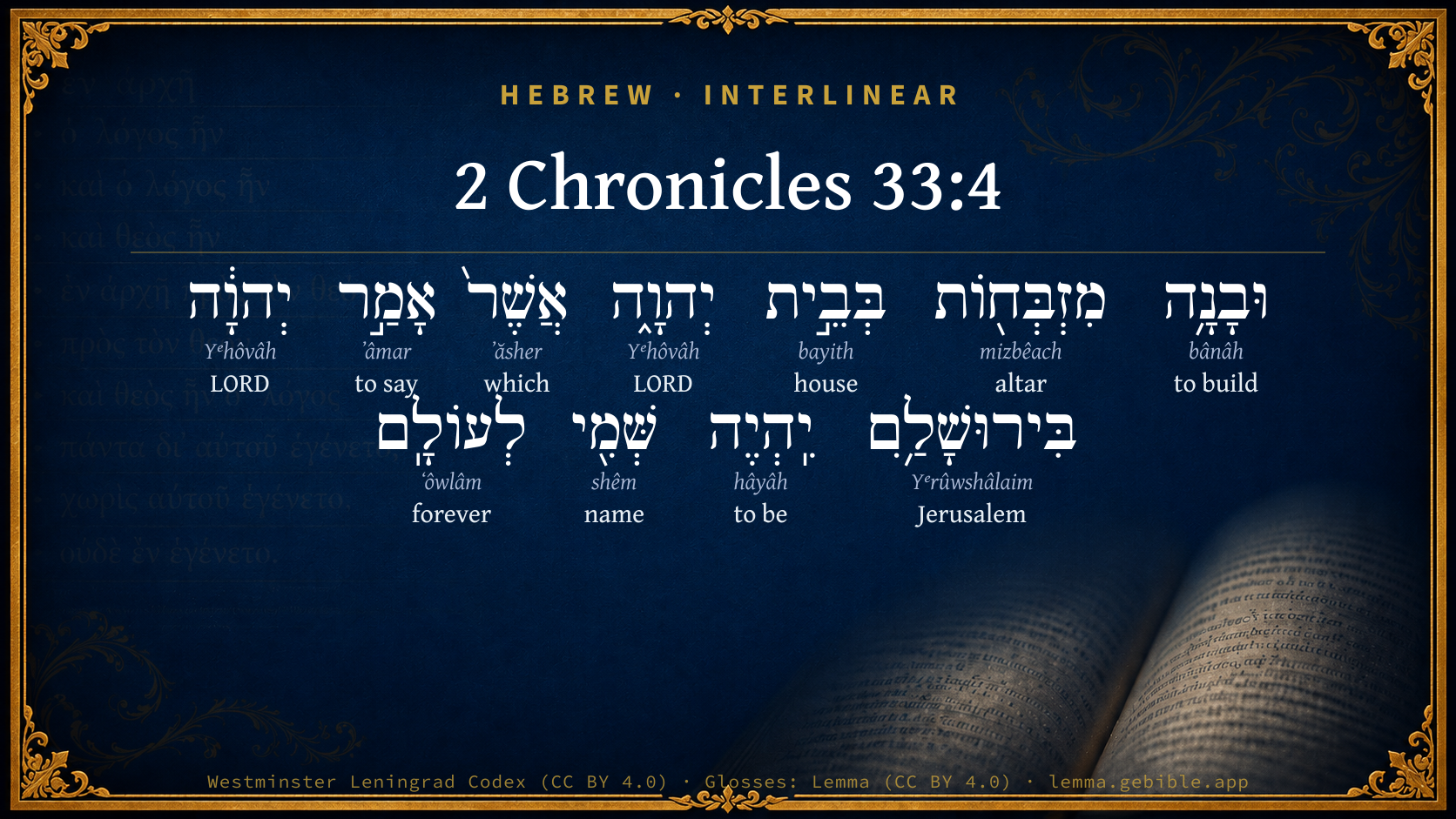
Hebrew (Westminster Leningrad Codex) 2 Chronicles 33:4 appears in the Hebrew Old Testament. The text above is from the Westminster Leningrad Codex. Each word links to its Strong’s number, a concise gloss, and parsing drawn from the Open Scriptures Hebrew Bible morphology. Click any word for its full Brown-Driver-Briggs (BDB) entry.
Download image
Cite this verse

2 Chronicles 33:4 (World English Bible). Public Domain. Lemma interlinear Bible study tool, https://lemma.gebible.app/v/2-chronicles/33/4.

Show BibTeX & RIS
BibTeX
RIS
English Translation
He built altars in the house of Yahweh, of which Yahweh said, In Jerusalem shall my name be forever.
World English Bible · Public Domain
Download a study sheet

One document with this verse’s original text, its word-by-word gloss line, the meaning frame, cross-references with their text, attributed commentary, and full source and license credits — printable, and it pastes into notes with its structure intact.

This verse Autodidact and up

Study sheet (.html) Plain text (.txt)

A passage Seminary Student

Up to 50 verses in one chapter. A passage sheet keeps up to 6 commentary sources and 12 cross-references per verse, in the order this page ranks them, and says so on the sheet whenever that leaves anything out. Ask for a single verse and you get the Autodidact verse sheet above.

Everything on this page stays free to read, with no account — the sheet is a download of what is already on screen, not access to it.

Want to remove ads? Support Godless Engineer
Compare translations 3

The same verse in 3 English versions, stacked beneath the original-language interlinear above. Click any original word for its lexicon entry.

Each is an independent rendering of the whole verse — the interlinear is not word-aligned to these translations.

Highlighted words mark where these versions differ — a whole-verse word diff, not a word-by-word alignment.

  • World English Bible Public Domain
    He built altars in the house of Yahweh, of which Yahweh said, In Jerusalem shall my name be forever.
  • King James Version Public Domain
    Also he built altars in the house of the LORD, whereof the LORD had said, In Jerusalem shall my name be for ever.
  • unfoldingWord Literal Text CC BY-SA 4.0
    And he built altars in the house of Yahweh, about which Yahweh had said, “In Jerusalem, my name will be forever.”

unfoldingWord Literal Text — © unfoldingWord, licensed CC BY-SA 4.0. Word-aligned USFM3 via Door43 (git.door43.org/unfoldingWord/en_ult).

Versions to compare (up to 4)

3 of 4 selected

Show all 18 translations

Every available English version of this verse, each an independent rendering of the whole verse.

  • World English Bible Public Domain
    He built altars in the house of Yahweh, of which Yahweh said, In Jerusalem shall my name be forever.
  • Berean Standard Bible Public Domain
    Manasseh also built altars in the house of the LORD, of which the LORD had said, “My Name will remain in Jerusalem forever.”
  • Majority Standard Bible Public Domain
    Manasseh also built altars in the house of the LORD, of which the LORD had said, “My Name will remain in Jerusalem forever.”
  • King James Version Public Domain
    Also he built altars in the house of the LORD, whereof the LORD had said, In Jerusalem shall my name be for ever.
  • American Standard Version (1901) Public Domain
    And he built altars in the house of Jehovah, whereof Jehovah said, In Jerusalem shall my name be for ever.
  • Revised Version (1885) Public Domain
    And he built altars in the house of the LORD, whereof the LORD said, In Jerusalem shall my name be forever.
  • Geneva Bible (1599) Public Domain
    Also he built altars in the house of the Lord, whereof the Lord had saide, In Ierusalem shall my Name be for euer.
  • Douay-Rheims (1899) Public Domain
    He built also altars in the house of the Lord, whereof the Lord had said: In Jerusalem shall my name be for ever.
  • Young's Literal Translation Public Domain
    And he hath built altars in the house of Jehovah of which Jehovah had said, `In Jerusalem is My name to the age.'
  • Literal Standard Version CC BY-SA 4.0
    And he has built altars in the house of YHWH of which YHWH had said, “My Name is in Jerusalem for all time.”
  • Unlocked Literal Bible CC BY-SA 4.0
    Manasseh built altars in the house of Yahweh, although Yahweh had commanded, “It is in Jerusalem that my name will be forever.”
  • unfoldingWord Literal Text CC BY-SA 4.0
    And he built altars in the house of Yahweh, about which Yahweh had said, “In Jerusalem, my name will be forever.”
  • Darby Bible Public Domain
    And he built altars in the house of Jehovah, of which Jehovah had said, In Jerusalem shall my name be for ever.
  • World Messianic Bible Public Domain
    He built altars in the LORD’s house, of which the LORD said, “My name shall be in Jerusalem forever.”
  • Webster's Bible Public Domain
    Also he built altars in the house of the LORD, of which the LORD had said, In Jerusalem shall my name be for ever.
  • Free Bible Version CC BY-SA 4.0
    He built altars in the Lord's Temple, about which the Lord had said, “I shall be honored in Jerusalem forever.”
  • Bible in Basic English Public Domain
    And he made altars in the house of the Lord, of which the Lord had said, In Jerusalem will my name be for ever.
  • JPS Tanakh (1917) Public Domain
    And he built altars in the house of the LORD, whereof the LORD said: 'In Jerusalem shall My name be for ever.'

Literal Standard Version (2020), Covenant Press — licensed CC BY-SA 4.0. Text via the HelloAO Bible API (eBible.org). Unlocked Literal Bible (unfoldingWord) — licensed CC BY-SA 4.0. Text via the HelloAO Bible API (eBible.org). unfoldingWord Literal Text — © unfoldingWord, licensed CC BY-SA 4.0. Word-aligned USFM3 via Door43 (git.door43.org/unfoldingWord/en_ult). Free Bible Version, Dr. Jonathan Gallagher — licensed CC BY-SA 4.0. Text via the HelloAO Bible API (eBible.org).

Word by word

More ways to search: Search by grammar → Find every occurrence → Compare this word →

Practice this passage: Drill this verse → Learn its vocabulary →

וּבָנָ֥ה
bânâh
H1129
“and · to build”
Conjunction + Verb, Qal, Perfect, 3rd Person, Masculine, Singular
Part of Speech
Conjunction + Verb
Stem
Qal
Form
Perfect
Person
3rd Person
Gender
Masculine
Number
Singular
Full BDB Definition

Origin: a primitive root

TWOT: 255

to build, rebuild, establish, cause to continue - (Qal) - to build, rebuild - to build a house (i.e., establish a family) - (Niphal) - to be built - to be rebuilt - established (of restored exiles) (figuratively) - established (made permanent) - to be built up (of childless wife becoming the mother of a family through the children of a concubine)
  1. מִזְבְּח֖וֹת mizbêach H4196 “altars” Noun, Common, Masculine, Plural, Absolute
  2. בְּבֵ֣ית bayith H1004 “in/at · house of” Preposition + Noun, Common, Masculine, Singular, Construct
  3. יְהוָ֑ה Yᵉhôvâh H3068 “LORD” Noun, Proper
  4. אֲשֶׁר֙ ʼăsher H834 “which” Particle, Relative
  5. אָמַ֣ר ʼâmar H559 “to say” Verb, Qal, Perfect, 3rd Person, Masculine, Singular
  6. יְהוָ֔ה Yᵉhôvâh H3068 “LORD” Noun, Proper
  7. בִּירוּשָׁלִַ֥ם Yᵉrûwshâlaim H3389 “in/at · Jerusalem” Preposition + Noun, Proper
  8. יִֽהְיֶה hâyâh H1961 “to be” Verb, Qal, Imperfect, 3rd Person, Masculine, Singular
  9. שְּׁמִ֖י shêm H8034 “name · my” Noun, Common, Masculine, Singular, Construct + Suffix, Personal, 1st Person, Common, Singular
  10. לְעוֹלָֽם ʻôwlâm H5769 “to/for · forever” Preposition + Noun, Common, Masculine, Singular, Absolute

About this verse

These counts appear in no published source. They are computed here, from the morphology-tagged text and Lemma’s own curated glosses. What Lemma adds →

11
words
10
distinct lemmas
Historical
section

Grammatical profile

  • 3 verbs
  • 7 nouns
  • 1 particle

Verb forms

  • וּבָנָ֥ה Qal · Perfect
  • אָמַ֣ר Qal · Perfect
  • יִֽהְיֶה Qal · Imperfect

Repetition

A word recurs within this verse — often emphatic in Hebrew:

  • יְהוָ֑ה LORD H3068 ×2

Hebrew & Septuagint length

In English translation the verse runs 19 words from the Hebrew and 23 from the Septuagint (LXX English) — closely comparable.

A rough comparison of the two English renderings, which tokenize alike — not a word-level alignment.

Word counts can differ between the Hebrew and the Greek without any difference in meaning — e.g. the Hebrew direct-object marker אֵת has no separate Greek word, and Greek often adds the article ὁ.

In the original languages it is 11 Hebrew tokens and 18 Greek tokens — but the two are counted differently (Hebrew bundles its prefixes and suffixes into one token; the Greek is in lemma form), so that isn’t a like-for-like length.

Cross-references

10

Topical passages linked to 2 Chronicles 33:4 in the Treasury of Scripture Knowledge — connected by theme and wording, ordered by reader-vote popularity; previews shown in the World English Bible.

  • 2 Chronicles 7:16 For now have I chosen and made this house holy, that my name may be there forever; and my eyes and my heart shall be there perpetually.
  • Deuteronomy 12:11 then it shall happen that to the place which Yahweh your God shall choose, to cause his name to dwell there, there shall you bring all that I command you: your burnt offerings, and your sacrifices, your tithes, and the heave-offering of your hand, and all your choice vows which you vow to Yahweh.
  • 1 Kings 8:29 that your eyes may be open toward this house night and day, even toward the place of which you have said, My name shall be there; to listen to the prayer which your servant shall pray toward this place.
  • 2 Chronicles 6:6 but I have chosen Jerusalem, that my name might be there; and have chosen David to be over my people Israel.
  • 1 Kings 9:3 Yahweh said to him, I have heard your prayer and your supplication, that you have made before me: I have made this house holy, which you have built, to put my name there forever; and my eyes and my heart shall be there perpetually.
  • 2 Kings 21:4–5 He built altars in the house of Yahweh, of which Yahweh said, In Jerusalem will I put my name.
  • 2 Chronicles 32:19 They spoke of the God of Jerusalem, as of the gods of the peoples of the earth, which are the work of men's hands.
  • 2 Chronicles 33:15 He took away the foreign gods, and the idol out of the house of Yahweh, and all the altars that he had built in the mountain of the house of Yahweh, and in Jerusalem, and cast them out of the city.
  • 2 Chronicles 34:3–4 For in the eighth year of his reign, while he was yet young, he began to seek after the God of David his father; and in the twelfth year he began to purge Judah and Jerusalem from the high places, and the Asherim, and the engraved images, and the molten images.
  • Jeremiah 7:30 For the children of Judah have done that which is evil in my sight, says Yahweh: they have set their abominations in the house which is called by my name, to defile it.

Cross-references courtesy of OpenBible.info (CC BY 4.0).

Hebrew and Greek witnesses Masoretic Hebrew ↔ Greek Septuagint

The same verse in the two great witnesses to the Old Testament, shown verse-for-verse.

These are two independent witnesses, not word-aligned to each other, and the Septuagint is shown in lemma (dictionary) form.

Hebrew 2 Chronicles 33:4 Masoretic · Westminster Leningrad Codex

וּבָנָ֥ה מִזְבְּח֖וֹת בְּבֵ֣ית יְהוָ֑ה אֲשֶׁר֙ אָמַ֣ר יְהוָ֔ה בִּירוּשָׁלִַ֥ם יִֽהְיֶה שְּׁמִ֖י לְעוֹלָֽם

He built altars in the house of Yahweh, of which Yahweh said, In Jerusalem shall my name be forever.

World English Bible · Public Domain

Greek LXX 2 Chronicles 33:4 Septuagint · lemma form

καί οἰκοδομέω θυσιαστήριον ἐν οἶκος κύριος ὅς εἶπον κύριος ἐν ἰερουσαλήμ εἰμί ὁ ὄνομα ἐγώ εἰς ὁ αἰών

And he built altars in the house of the Lord, concerning which the Lord said, In Jerusalem shall be my name for ever.

LXX2012 (modern English Septuagint) · Public Domain

Hebrew: Westminster Leningrad Codex (CC BY 4.0). Greek: Septuagint (public domain); English from LXX2012 (modern English Septuagint) (Public Domain). How the Septuagint differs from the Hebrew →

Commentary

Notes on 2 Chronicles 33:4 from classic Christian and Jewish commentators (each source and its license shown beneath its notes). The classic Christian expositions comment on the surrounding passage and are grouped to its opening verse, so a note may address several verses; the Jewish commentaries on the Tanakh (Rashi and others) are per-verse, so they appear only where the commentator wrote on this verse.

Lemma curates 59 commentaries, every one of them public domain or Creative Commons licensed, each selected and text-cleaned for this edition rather than reprinted as found. About our sources →

Trapp's Complete Commentary

John Trapp

2Ch 33:4 Also he built altars in the house of the LORD, whereof the LORD had said, In Jerusalem shall my name be for ever.

Ver. 4. In the house of the Lord.] Which was as bad as for a wife to bring her paramours into her husband’s bed.

John Trapp, A Commentary or Exposition upon All the Books of the Old and New Testament (1647–1656) — public domain. Text from a community e-Sword module.

Ellicott's Commentary for English Readers

(4) Also he built . . . In Jerusalem.—Literally as Kings. Manasseh built altars in the Temple, as Ahaz had done (2Ki_16:10, seq.).

Shall my name be for ever.—A heightening of the phrase in Kings, “I will set mv name.”

A Bible Commentary for English Readers, edited by Charles John Ellicott (1878–1897) — public domain. Text from a community e-Sword module.

The Cambridge Bible for Schools and Colleges

gen. ed. J. J. S. Perowne

4. shall my name be for ever] Cp. 2Ch_7:16.

The Cambridge Bible for Schools and Colleges (gen. ed. J. J. S. Perowne; Cambridge University Press, 1878–1918) — public domain. Text from a community e-Sword module.

The Pulpit Commentary

In Jerusalem. (so 2Ch_6:6 2Ch_7:16) The quotation is Deu_12:11.

The Pulpit Commentary (1880–1919), ed. H.D.M. Spence-Jones & Joseph S. Exell — public domain. Text from a community e-Sword module.

unfoldingWord translationNotes

Door43 World Missions Community

It is in Jerusalem that my name will be forever

The name is a metonym for the person. AT: "Jerusalem is where I will forever make known who I am" (See: Metonymy)

He built altars for all the stars of heaven in the two courtyards of the house of Yahweh

It is implied that he built these altars so people could make sacrifices and worship the stars. Also, he would not have built these altars himself, rather he would have commanded his workers to do it. AT: "He had his workers build altars in the two courtyards of the house of Yahweh so that the people could worship the stars and offer them sacrifices" (See: Assumed Knowledge and Implicit Information and Metonymy)

Valley of Ben Hinnom

This is the name of a place near Jerusalem that is also known as Gehenna. (See: How to Translate Names)

he caused his sons to pass through the fire

You may need to make explicit why he put his son in the fire and what happened after he did so. AT: "he burned his sons to death as an offering to his gods" (See: Assumed Knowledge and Implicit Information)

consulted with

"asked for information from"

the dead

This refers to dead people. AT: "dead people" or "those who are dead" (See: Nominal Adjectives)

Manasseh did much evil in the sight of Yahweh

Here Yahweh's "sight" refers to how he judges or decides on the value of something. See how you translated a similar phrase in 2 Chronicles 14:2. AT: "Manasseh did many things that Yahweh said were evil" or "He practiced the things that Yahweh considered evil" (See: Metaphor)

he provoked him to anger

"Manasseh made Yahweh very angry"

translationWords

pagan

altar

house of God

name

command

eternity

heaven

court

sorcerer

spirit

anger

unfoldingWord translationNotes — © Distant Shores Media and the Door43 World Missions Community, licensed CC BY-SA 4.0. Source: git.door43.org/Door43/en_tn.

Rashi

Rabbi Shlomo Yitzchaki (Rashi)

“In Jerusalem, My name shall be forever” Scripture decries Manasseh, who built altars to pagan deities in the very House concerning which the Holy One, blessed be He, said, “I wish My name to rest there.” The verse stated after this (verse 7) is also an expression of decrying: “And he placed the graven image of the idol that he made in the House of God, concerning which, etc.” And also the verse (8): “And I will not continue to remove Israel’s feet, etc.”

Rashi on the Tanakh — English translations: “The Judaica Press complete Tanach with Rashi, translated by A. J. Rosenberg” (CC BY 4.0); “Pentateuch with Rashi's commentary by M. Rosenbaum and A.M. Silbermann, 1929-1934” (public domain); “The Metsudah Tanach series, Lakewood, N.J” (CC BY 4.0); and “The Book of Joshua, Metsudah Publications, 1997” (CC BY 4.0). Text via Sefaria.

Lesson kit

Teaching starters — assembled from the data on this page, not authored interpretation. Every prompt links to the verse data it draws on. Edit before teaching.

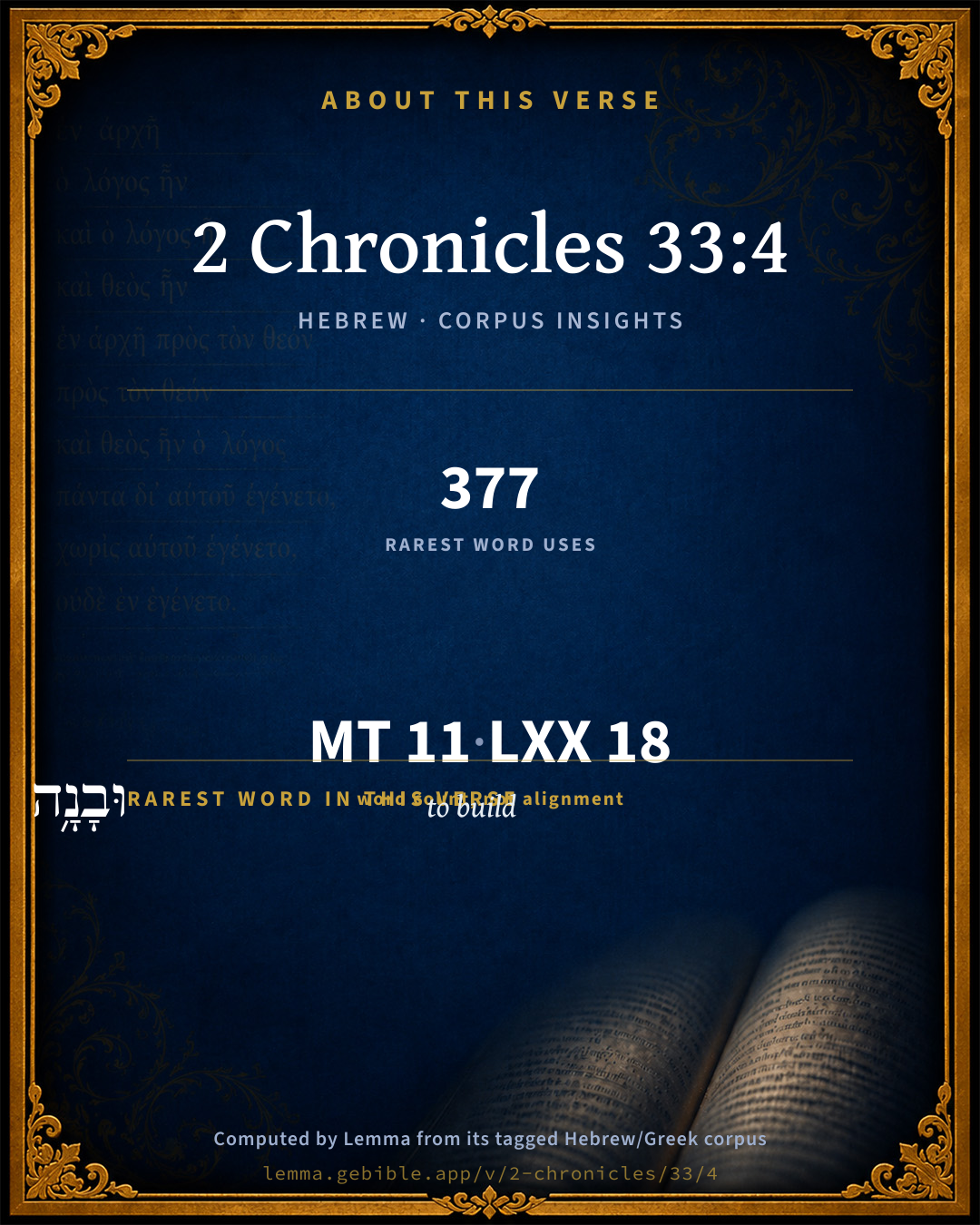
2 Chronicles, in the Historical, opens this verse with 11 words (10 distinct Hebrew lemmas). Its most distinctive word is bânâh (“to build”). A historical commentator’s framing appears above. Read the whole chapter for the surrounding context.

Discussion questions

  1. The word bânâh carries the sense “to build.” How does it shape the verse?
  2. 2 Chronicles 7:16 shares this passage’s theme. How do the two illuminate each other?
  3. “LORD” occurs 2× in this one verse. What is the effect of the repetition?
  4. These translations render this verse differently; the difference is in the English rendering, not the original. What questions does that raise?
  5. The verb «וּבָנָ֥ה» is Qal Perfect. How does its form color the action?
  6. Reading how Trapp's Complete Commentary and Ellicott's Commentary for English Readers read this verse, where do the two commentators agree and where do they part?

Things to notice

Reading settings

Reading text

Shown beneath each verse's original-language words.

Old Testament
Old Testament edition

Read the OT as the Masoretic Hebrew (MT) or the Greek Septuagint (LXX).

English shown for the Greek Septuagint (in the Hebrew ↔ Greek comparison).

Comparing translations? Open the Compare panel on any verse page to stack up to four side by side.