2 Chronicles 25:3

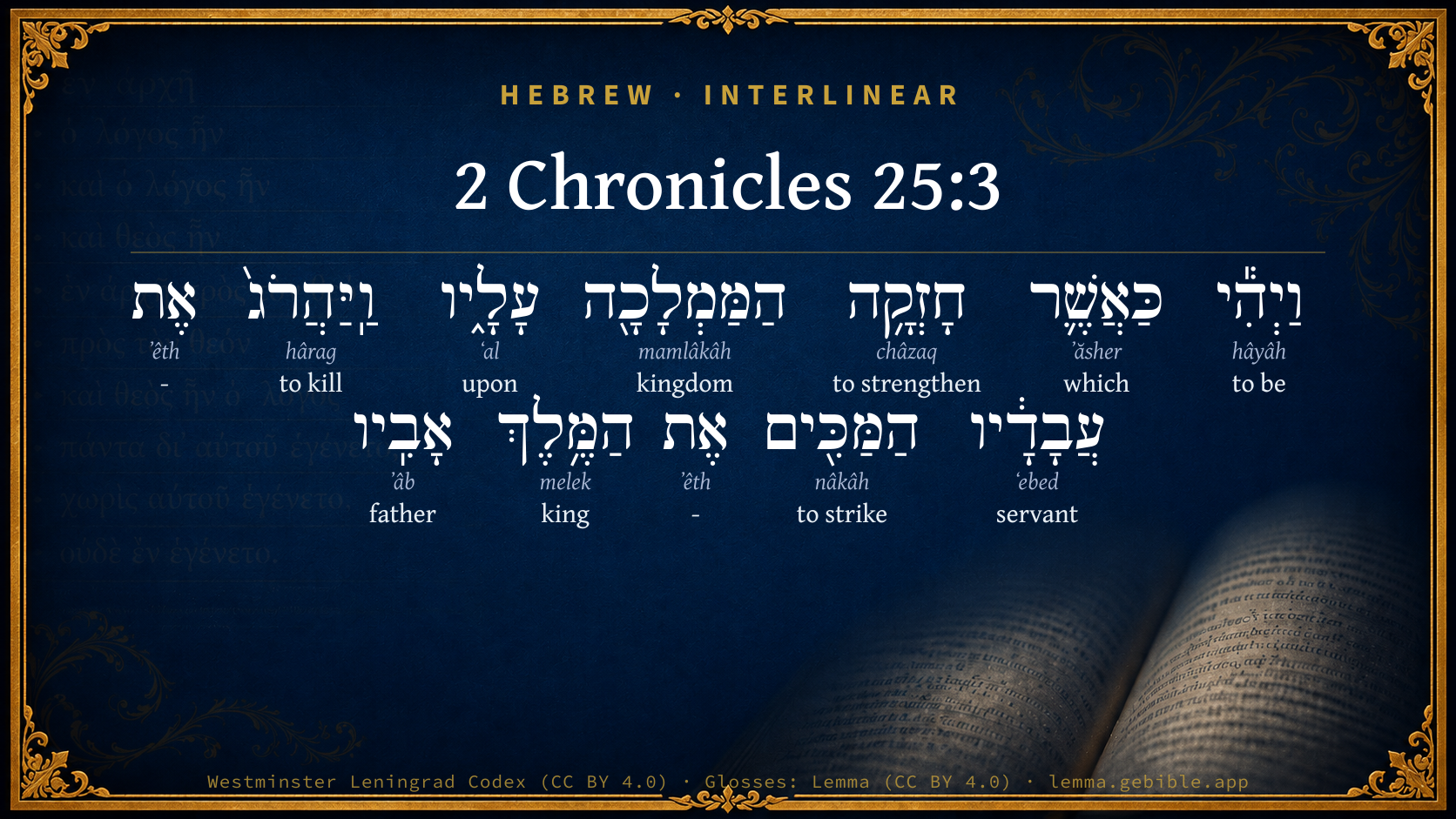
Hebrew (Westminster Leningrad Codex) 2 Chronicles 25:3 appears in the Hebrew Old Testament. The text above is from the Westminster Leningrad Codex. Each word links to its Strong’s number, a concise gloss, and parsing drawn from the Open Scriptures Hebrew Bible morphology. Click any word for its full Brown-Driver-Briggs (BDB) entry.
Download image
Cite this verse

2 Chronicles 25:3 (World English Bible). Public Domain. Lemma interlinear Bible study tool, https://lemma.gebible.app/v/2-chronicles/25/3.

Show BibTeX & RIS
BibTeX
RIS
English Translation
Now it happened, when the kingdom was established to him, that he killed his servants who had killed the king his father.
World English Bible · Public Domain
Download a study sheet

One document with this verse’s original text, its word-by-word gloss line, the meaning frame, cross-references with their text, attributed commentary, and full source and license credits — printable, and it pastes into notes with its structure intact.

This verse Autodidact and up

Study sheet (.html) Plain text (.txt)

A passage Seminary Student

Up to 50 verses in one chapter. A passage sheet keeps up to 6 commentary sources and 12 cross-references per verse, in the order this page ranks them, and says so on the sheet whenever that leaves anything out. Ask for a single verse and you get the Autodidact verse sheet above.

Everything on this page stays free to read, with no account — the sheet is a download of what is already on screen, not access to it.

Want to remove ads? Support Godless Engineer
Compare translations 3

The same verse in 3 English versions, stacked beneath the original-language interlinear above. Click any original word for its lexicon entry.

Each is an independent rendering of the whole verse — the interlinear is not word-aligned to these translations.

Highlighted words mark where these versions differ — a whole-verse word diff, not a word-by-word alignment.

  • World English Bible Public Domain
    Now it happened, when the kingdom was established to him, that he killed his servants who had killed the king his father.
  • King James Version Public Domain
    Now it came to pass, when the kingdom was established to him, that he slew his servants that had killed the king his father.
  • unfoldingWord Literal Text CC BY-SA 4.0
    And it happened when the kingdom was strong upon him, then he killed his servants, the ones who struck down the king, his father.

unfoldingWord Literal Text — © unfoldingWord, licensed CC BY-SA 4.0. Word-aligned USFM3 via Door43 (git.door43.org/unfoldingWord/en_ult).

Versions to compare (up to 4)

3 of 4 selected

Show all 18 translations

Every available English version of this verse, each an independent rendering of the whole verse.

  • World English Bible Public Domain
    Now it happened, when the kingdom was established to him, that he killed his servants who had killed the king his father.
  • Berean Standard Bible Public Domain
    As soon as the kingdom was firmly in his grasp, Amaziah executed the servants who had murdered his father the king.
  • Majority Standard Bible Public Domain
    As soon as the kingdom was firmly in his grasp, Amaziah executed the servants who had murdered his father the king.
  • King James Version Public Domain
    Now it came to pass, when the kingdom was established to him, that he slew his servants that had killed the king his father.
  • American Standard Version (1901) Public Domain
    Now it came to pass, when the kingdom was established unto him, that he slew his servants that had killed the king his father.
  • Revised Version (1885) Public Domain
    Now it came to pass, when the kingdom was established unto him, that he slew his servants which had killed the king his father.
  • Geneva Bible (1599) Public Domain
    And when the kingdome was established vnto him, he slewe his seruants, that had slaine the King his father.
  • Douay-Rheims (1899) Public Domain
    And when he saw himself strengthened in his kingdom, he put to death the servants that had slain the king his father.
  • Young's Literal Translation Public Domain
    And it cometh to pass, when the kingdom hath been strong upon him, that he slayeth his servants, those smiting the king his father,
  • Literal Standard Version CC BY-SA 4.0
    And it comes to pass, when the kingdom has been strong on him, that he slays his servants, those striking his father the king,
  • Unlocked Literal Bible CC BY-SA 4.0
    It came about that as soon as his rule was well established, he killed the servants who had murdered his father, the king.
  • unfoldingWord Literal Text CC BY-SA 4.0
    And it happened when the kingdom was strong upon him, then he killed his servants, the ones who struck down the king, his father.
  • Darby Bible Public Domain
    And it came to pass when the kingdom was established unto him, that he killed his servants who had smitten the king his father.
  • World Messianic Bible Public Domain
    Now when the kingdom was established to him, he killed his servants who had killed his father the king.
  • Webster's Bible Public Domain
    Now it came to pass, when the kingdom was established to him, that he slew his servants that had killed the king his father.
  • Free Bible Version CC BY-SA 4.0
    After he had made sure his rule was secure, he executed the officers who had murdered his father the king.
  • Bible in Basic English Public Domain
    Now when he became strong in the kingdom, he put to death those men who had taken the life of the king his father.
  • JPS Tanakh (1917) Public Domain
    Now it came to pass, when the kingdom was established unto him, that he slew his servants who had killed the king his father.

Literal Standard Version (2020), Covenant Press — licensed CC BY-SA 4.0. Text via the HelloAO Bible API (eBible.org). Unlocked Literal Bible (unfoldingWord) — licensed CC BY-SA 4.0. Text via the HelloAO Bible API (eBible.org). unfoldingWord Literal Text — © unfoldingWord, licensed CC BY-SA 4.0. Word-aligned USFM3 via Door43 (git.door43.org/unfoldingWord/en_ult). Free Bible Version, Dr. Jonathan Gallagher — licensed CC BY-SA 4.0. Text via the HelloAO Bible API (eBible.org).

Word by word

More ways to search: Search by grammar → Find every occurrence → Compare this word →

Practice this passage: Drill this verse → Learn its vocabulary →

הַמַּמְלָכָ֖ה
mamlâkâh
H4467
“the · kingdom”
Particle, Definite Article + Noun, Common, Feminine, Singular, Absolute
Part of Speech
Particle + Noun
Type
Common
Gender
Feminine
Number
Singular
State
Absolute
Full BDB Definition

Origin: from H4427

TWOT: 1199f

kingdom, dominion, reign, sovereignty - kingdom, realm - sovereignty, dominion - reign
  1. וַיְהִ֕י hâyâh H1961 “and · to be” Conjunction + Verb, Qal, Sequential Imperfect, 3rd Person, Masculine, Singular
  2. כַּאֲשֶׁ֛ר ʼăsher H834 “like/as · which” Preposition + Particle, Relative
  3. חָזְקָ֥ה châzaq H2388 “to strengthen” Verb, Qal, Perfect, 3rd Person, Feminine, Singular
  4. עָלָ֑יו ʻal H5921 “upon · him” Preposition + Suffix, Personal, 3rd Person, Masculine, Singular
  5. וַֽיַּהֲרֹג֙ hârag H2026 “and · to kill” Conjunction + Verb, Qal, Sequential Imperfect, 3rd Person, Masculine, Singular
  6. אֶת ʼêth H853 “-” Particle, Direct Object
  7. עֲבָדָ֔יו ʻebed H5650 “servants · his” Noun, Common, Masculine, Plural, Construct + Suffix, Personal, 3rd Person, Masculine, Singular
  8. הַמַּכִּ֖ים nâkâh H5221 “the · striking” Particle, Definite Article + Verb, Hiphil, Participle Active, Masculine, Plural, Absolute
  9. אֶת ʼêth H853 “-” Particle, Direct Object
  10. הַמֶּ֥לֶךְ melek H4428 “the · king” Particle, Definite Article + Noun, Common, Masculine, Singular, Absolute
  11. אָבִֽיו ʼâb H1 “father · his” Noun, Common, Masculine, Singular, Construct + Suffix, Personal, 3rd Person, Masculine, Singular

About this verse

These counts appear in no published source. They are computed here, from the morphology-tagged text and Lemma’s own curated glosses. What Lemma adds →

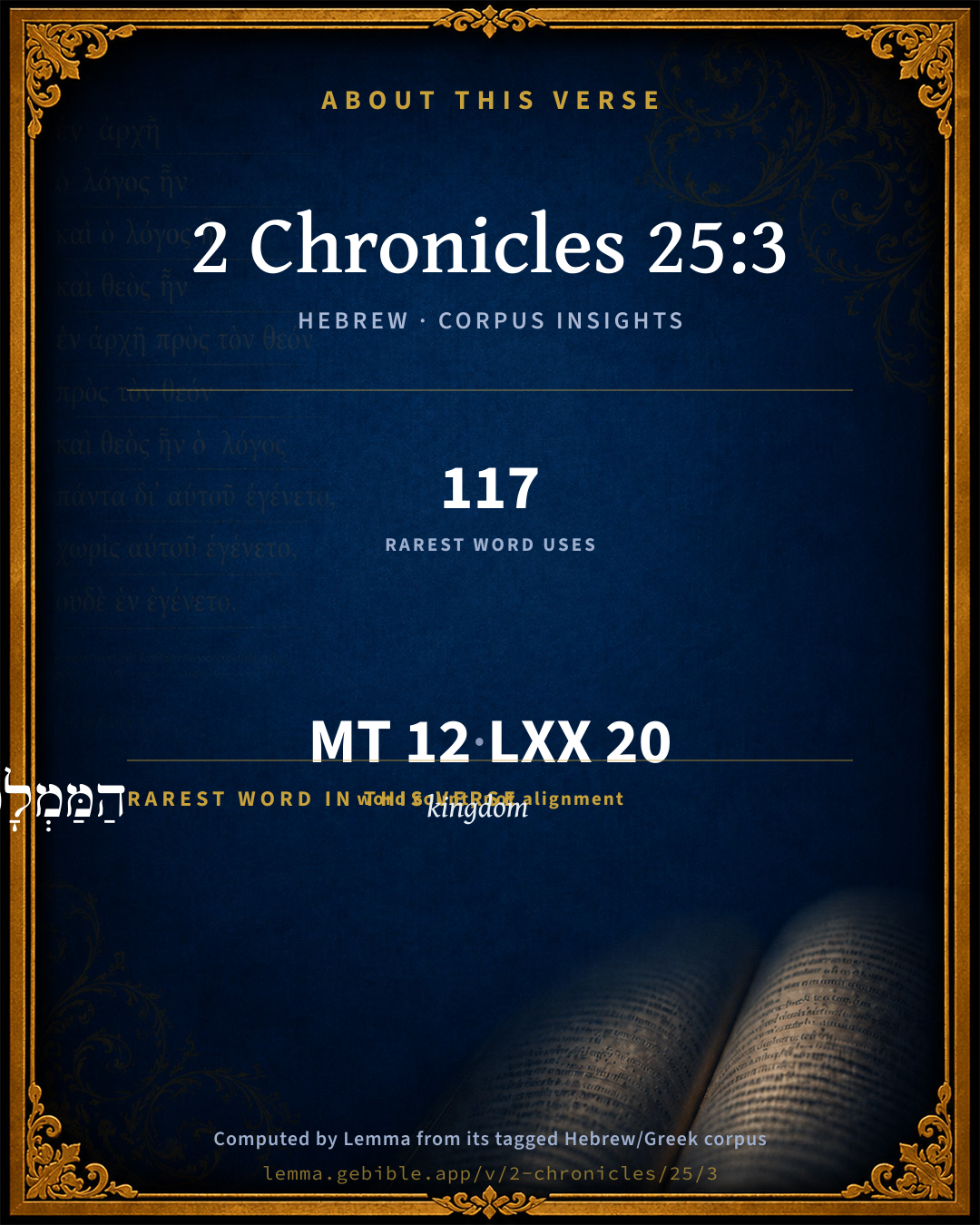
12
words
11
distinct lemmas
Historical
section

Grammatical profile

  • 4 verbs
  • 4 nouns
  • 1 preposition
  • 3 particles

Verb forms

  • וַיְהִ֕י Qal · Sequential Imperfect
  • חָזְקָ֥ה Qal · Perfect
  • וַֽיַּהֲרֹג֙ Qal · Sequential Imperfect
  • הַמַּכִּ֖ים Hiphil · Participle Active

Hebrew & Septuagint length

In English translation the verse runs 22 words from the Hebrew and 25 from the Septuagint (LXX English) — closely comparable.

A rough comparison of the two English renderings, which tokenize alike — not a word-level alignment.

Word counts can differ between the Hebrew and the Greek without any difference in meaning — e.g. the Hebrew direct-object marker אֵת has no separate Greek word, and Greek often adds the article ὁ.

In the original languages it is 12 Hebrew tokens and 20 Greek tokens — but the two are counted differently (Hebrew bundles its prefixes and suffixes into one token; the Greek is in lemma form), so that isn’t a like-for-like length.

Cross-references

5

Topical passages linked to 2 Chronicles 25:3 in the Treasury of Scripture Knowledge — connected by theme and wording, ordered by reader-vote popularity; previews shown in the World English Bible.

  • 2 Kings 14:5–22 It happened, as soon as the kingdom was established in his hand, that he killed his servants who had slain the king his father:
  • 2 Chronicles 24:25–26 When they were departed for him (for they left him very sick), his own servants conspired against him for the blood of the sons of Jehoiada the priest, and killed him on his bed, and he died; and they buried him in the city of David, but they didn't bury him in the tombs of the kings.
  • Genesis 9:5–6 I will surely require your blood of your lives. At the hand of every animal I will require it. At the hand of man, even at the hand of every man's brother, I will require the life of man.
  • Exodus 21:14 If a man schemes and comes presumptuously on his neighbor to kill him, you shall take him from my altar, that he may die.
  • Numbers 35:31–33 Moreover you shall take no ransom for the life of a murderer who is guilty of death; but he shall surely be put to death.

Cross-references courtesy of OpenBible.info (CC BY 4.0).

Hebrew and Greek witnesses Masoretic Hebrew ↔ Greek Septuagint

The same verse in the two great witnesses to the Old Testament, shown verse-for-verse.

These are two independent witnesses, not word-aligned to each other, and the Septuagint is shown in lemma (dictionary) form.

Hebrew 2 Chronicles 25:3 Masoretic · Westminster Leningrad Codex

וַיְהִ֕י כַּאֲשֶׁ֛ר חָזְקָ֥ה הַמַּמְלָכָ֖ה עָלָ֑יו וַֽיַּהֲרֹג֙ אֶת עֲבָדָ֔יו הַמַּכִּ֖ים אֶת הַמֶּ֥לֶךְ אָבִֽיו

Now it happened, when the kingdom was established to him, that he killed his servants who had killed the king his father.

World English Bible · Public Domain

Greek LXX 2 Chronicles 25:3 Septuagint · lemma form

καί γίγνομαι ὡς καταἵστημι ὁ βασιλεία ἐν χείρ αὐτός καί θανατόω ὁ παῖς αὐτός ὁ φονεύω ὁ βασιλεύς πατήρ αὐτός

And it came to pass, when the kingdom was established in his hand, that he killed his servants who had slain the king his father.

LXX2012 (modern English Septuagint) · Public Domain

On this verse, The Cambridge Bible for Schools and Colleges discusses the Septuagint’s reading. Read the note in Commentary ↓

Hebrew: Westminster Leningrad Codex (CC BY 4.0). Greek: Septuagint (public domain); English from LXX2012 (modern English Septuagint) (Public Domain). How the Septuagint differs from the Hebrew →

Commentary

Notes on 2 Chronicles 25:3 from classic Christian and Jewish commentators (each source and its license shown beneath its notes). The classic Christian expositions comment on the surrounding passage and are grouped to its opening verse, so a note may address several verses; the Jewish commentaries on the Tanakh (Rashi and others) are per-verse, so they appear only where the commentator wrote on this verse.

Lemma curates 59 commentaries, every one of them public domain or Creative Commons licensed, each selected and text-cleaned for this edition rather than reprinted as found. About our sources →

Trapp's Complete Commentary

John Trapp

2Ch 25:3 Now it came to pass, when the kingdom was established to him, that he slew his servants that had killed the king his father.

2Ch 25:4 But he slew not their children, but [did] as [it is] written in the law in the book of Moses, where the LORD commanded, saying, The fathers shall not die for the children, neither shall the children die for the fathers, but every man shall die for his own sin.

Ver. 3,4. {See Trapp on "2Ki 14:5"} {See Trapp on "2Ki 14:6"}

John Trapp, A Commentary or Exposition upon All the Books of the Old and New Testament (1647–1656) — public domain. Text from a community e-Sword module.

Tyndale Open Study Notes

Tyndale Open Resources

25:3-4 Amaziah . . . executed the officials to avenge his father and carry out the justice prescribed in the Law.

Tyndale Open Study Notes — © Tyndale Open Resources, licensed CC BY-SA 4.0. Text via the HelloAO Bible API.

Ellicott's Commentary for English Readers

(3) The kingdom was established to him.—Or, The sovereignty (power) was confirmed to him. Vulg., “cumque roboratum videret sibi imperium.”

A Bible Commentary for English Readers, edited by Charles John Ellicott (1878–1897) — public domain. Text from a community e-Sword module.

The Cambridge Bible for Schools and Colleges

gen. ed. J. J. S. Perowne

3. to him] R.V. unto him; LXX., ἐν χειρὶ αὐτοῦ; in Kings, “in his hand.”

The Cambridge Bible for Schools and Colleges (gen. ed. J. J. S. Perowne; Cambridge University Press, 1878–1918) — public domain. Text from a community e-Sword module.

The Pulpit Commentary

Was established to him; Hebrew, hqzj This is kal conjugation of the verb, which we found in piel in ver. 5 of foregoing chapter, and there rendered "repair." The kal force of the word is simply to "be strong" (Gen_41:57; Jos_17:13; 2Ki_14:5) The hiph., to "make strong," or "confirm," as it is rendered here, is found in 2Ki_15:19. Again and again the disorders of the kingdom and the violent deaths of prophets and kings must have greatly contributed to nervous apprehensions, in fact only too just, when a new king ascended the throne. In the parallel and in passage last quoted the words, "in his hand," follow the verb. Amaziah both needed to get his own hand in, according to modern phrase, and to get things well into his hand. His servants. It may be held surprising that they should have been found "in the place," or should now be his servants at all. The explanation may be either that their guilt had not yet been known, or, if known, had not been fixed upon them.

The Pulpit Commentary (1880–1919), ed. H.D.M. Spence-Jones & Joseph S. Exell — public domain. Text from a community e-Sword module.

unfoldingWord translationNotes

Door43 World Missions Community

It came about that

This phrase is used here to mark the beginning of a new part of the story. If your language has a way for doing this, you could consider using it here.

the Book of Moses

This is a reference to the books of Genesis, Exodus, Leviticus, Numbers, and Deuteronomy.

translationWords

rule

servant

king

die

law

command

sin

unfoldingWord translationNotes — © Distant Shores Media and the Door43 World Missions Community, licensed CC BY-SA 4.0. Source: git.door43.org/Door43/en_tn.

Lesson kit

Teaching starters — assembled from the data on this page, not authored interpretation. Every prompt links to the verse data it draws on. Edit before teaching.

2 Chronicles, in the Historical, opens this verse with 12 words (11 distinct Hebrew lemmas). Its most distinctive word is mamlâkâh (“kingdom”). A historical commentator’s framing appears above. Read the whole chapter for the surrounding context.

Discussion questions

  1. What does “kingdom” (mamlâkâh) contribute to the verse as a whole?
  2. 2 Kings 14:5–22 shares this passage’s theme. How do the two illuminate each other?
  3. The translations on this page render this verse differently — a whole-verse word diff, not a word-by-word alignment. What might account for the different wordings?
  4. The verb «וַיְהִ֕י» is Qal Sequential Imperfect. How does its form color the action?
  5. Reading how Trapp's Complete Commentary and Tyndale Open Study Notes read this verse, where do the two commentators agree and where do they part?

Things to notice

Reading settings

Reading text

Shown beneath each verse's original-language words.

Old Testament
Old Testament edition

Read the OT as the Masoretic Hebrew (MT) or the Greek Septuagint (LXX).

English shown for the Greek Septuagint (in the Hebrew ↔ Greek comparison).

Comparing translations? Open the Compare panel on any verse page to stack up to four side by side.