
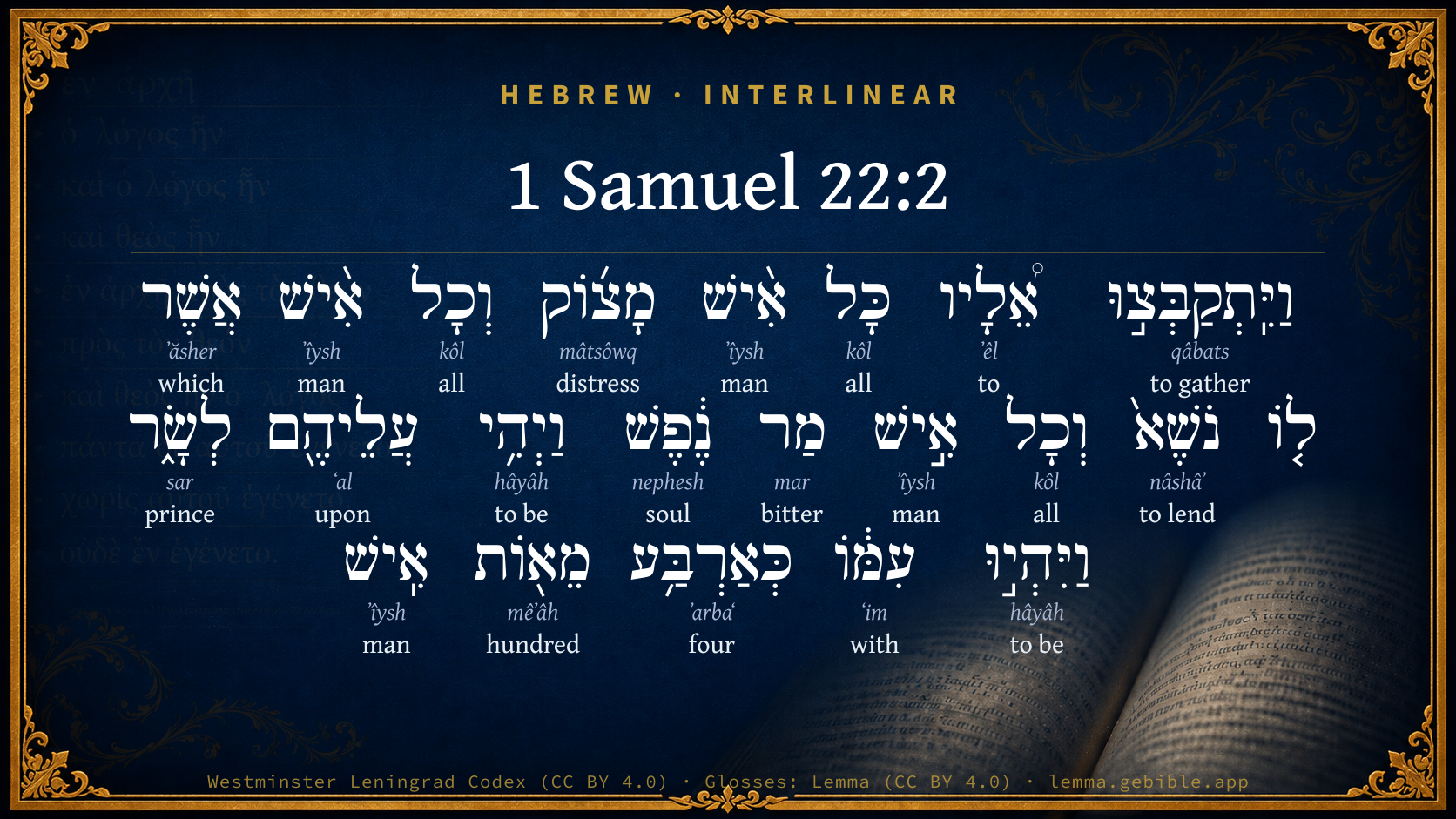
1 Samuel 22:2

Hebrew (Westminster Leningrad Codex) 1 Samuel 22:2 appears in the Hebrew Old Testament. The text above is from the Westminster Leningrad Codex. Each word links to its Strong’s number, a concise gloss, and parsing drawn from the Open Scriptures Hebrew Bible morphology. Click any word for its full Brown-Driver-Briggs (BDB) entry.
Download image
Cite this verse

1 Samuel 22:2 (World English Bible). Public Domain. Lemma interlinear Bible study tool, https://lemma.gebible.app/v/1-samuel/22/2.

Show BibTeX & RIS
BibTeX
RIS
English Translation
Everyone who was in distress, and everyone who was in debt, and everyone who was discontented, gathered themselves to him; and he became captain over them: and there were with him about four hundred men.
World English Bible · Public Domain
Highlights
  • 1 first appearance in the Hebrew Bible
Full analysis ↓
Download a study sheet

One document with this verse’s original text, its word-by-word gloss line, the meaning frame, cross-references with their text, attributed commentary, and full source and license credits — printable, and it pastes into notes with its structure intact.

This verse Autodidact and up

Study sheet (.html) Plain text (.txt)

A passage Seminary Student

Up to 50 verses in one chapter. A passage sheet keeps up to 6 commentary sources and 12 cross-references per verse, in the order this page ranks them, and says so on the sheet whenever that leaves anything out. Ask for a single verse and you get the Autodidact verse sheet above.

Everything on this page stays free to read, with no account — the sheet is a download of what is already on screen, not access to it.

Want to remove ads? Support Godless Engineer
Compare translations 3

The same verse in 3 English versions, stacked beneath the original-language interlinear above. Click any original word for its lexicon entry.

Each is an independent rendering of the whole verse — the interlinear is not word-aligned to these translations.

Highlighted words mark where these versions differ — a whole-verse word diff, not a word-by-word alignment.

  • World English Bible Public Domain
    Everyone who was in distress, and everyone who was in debt, and everyone who was discontented, gathered themselves to him; and he became captain over them: and there were with him about four hundred men.
  • King James Version Public Domain
    And every one that was in distress, and every one that was in debt, and every one that was discontented, gathered themselves unto him; and he became a captain over them: and there were with him about four hundred men.
  • unfoldingWord Literal Text CC BY-SA 4.0
    And they gathered themselves to him, every man of distress and every man for whom a creditor and every man bitter of soul. And he became a commander over them. And they with him, about 400 men.

unfoldingWord Literal Text — © unfoldingWord, licensed CC BY-SA 4.0. Word-aligned USFM3 via Door43 (git.door43.org/unfoldingWord/en_ult).

Versions to compare (up to 4)

3 of 4 selected

Show all 18 translations

Every available English version of this verse, each an independent rendering of the whole verse.

  • World English Bible Public Domain
    Everyone who was in distress, and everyone who was in debt, and everyone who was discontented, gathered themselves to him; and he became captain over them: and there were with him about four hundred men.
  • Berean Standard Bible Public Domain
    And all who were distressed or indebted or discontented rallied around him, and he became their leader. About four hundred men were with him.
  • Majority Standard Bible Public Domain
    And all who were distressed or indebted or discontented rallied around him, and he became their leader. About four hundred men were with him.
  • King James Version Public Domain
    And every one that was in distress, and every one that was in debt, and every one that was discontented, gathered themselves unto him; and he became a captain over them: and there were with him about four hundred men.
  • American Standard Version (1901) Public Domain
    And every one that was in distress, and every one that was in debt, and every one that was discontented, gathered themselves unto him; and he became captain over them: and there were with him about four hundred men.
  • Revised Version (1885) Public Domain
    And every one that was in distress, and every one that was in debt, and every one that was discontented, gathered themselves unto him; and he became captain over them: and there were with him about four hundred men.
  • Geneva Bible (1599) Public Domain
    And there gathered vnto him all men that were in trouble and all men that were in dette, and all those that were vexed in minde, and he was their prince, and there were with him about foure hundreth men.
  • Douay-Rheims (1899) Public Domain
    And all that were in distress and oppressed with debt, and under affliction of mind gathered themselves unto him: and he became their prince, and there were with him about four hundred men.
  • Young's Literal Translation Public Domain
    and gather themselves unto him do every man in distress, and every man who hath an exactor, and every man bitter in soul, and he is over them for head, and there are with him about four hundred men.
  • Literal Standard Version CC BY-SA 4.0
    and every man in distress gathers themselves to him, and every man who has an exactor, and every man bitter in soul, and he is for head over them, and there are about four hundred men with him.
  • Unlocked Literal Bible CC BY-SA 4.0
    Everyone who was in distress, everyone who was in debt, and everyone who was discontented—they all gathered to him. David became captain over them. There were about four hundred men with him.
  • unfoldingWord Literal Text CC BY-SA 4.0
    And they gathered themselves to him, every man of distress and every man for whom a creditor and every man bitter of soul. And he became a commander over them. And they with him, about 400 men.
  • Darby Bible Public Domain
    And every one in distress, and every one that was in debt, and every one of embittered spirit collected round him; and he became a captain over them; and there were with him about four hundred men.
  • World Messianic Bible Public Domain
    Everyone who was in distress, everyone who was in debt, and everyone who was discontented gathered themselves to him; and he became captain over them. There were with him about four hundred men.
  • Webster's Bible Public Domain
    And every one that was in distress, and every one that was in debt, and every one that was discontented, resorted to him; and he became a captain over them: and there were with him about four hundred men.
  • Free Bible Version CC BY-SA 4.0
    Everyone who was in trouble or in debt or resentful also came to him and he became their leader. He had around four hundred men with him.
  • Bible in Basic English Public Domain
    And everyone who was in trouble, and everyone who was in debt, and everyone who was bitter in soul, came together to him, and he became captain over them: about four hundred men were joined to him.
  • JPS Tanakh (1917) Public Domain
    And every one that was in distress, and every one that was in debt, and every one that was discontented, gathered themselves unto him; and he became captain over them; and there were with him about four hundred men.

Literal Standard Version (2020), Covenant Press — licensed CC BY-SA 4.0. Text via the HelloAO Bible API (eBible.org). Unlocked Literal Bible (unfoldingWord) — licensed CC BY-SA 4.0. Text via the HelloAO Bible API (eBible.org). unfoldingWord Literal Text — © unfoldingWord, licensed CC BY-SA 4.0. Word-aligned USFM3 via Door43 (git.door43.org/unfoldingWord/en_ult). Free Bible Version, Dr. Jonathan Gallagher — licensed CC BY-SA 4.0. Text via the HelloAO Bible API (eBible.org).

Word by word

More ways to search: Search by grammar → Find every occurrence → Compare this word →

Practice this passage: Drill this verse → Learn its vocabulary →

נֹשֶׁא֙
nâshâʼ
H5378
“lending”
Verb, Qal, Participle Active, Masculine, Singular, Absolute
Part of Speech
Verb
Stem
Qal
Form
Participle Active
Gender
Masculine
Number
Singular
State
Absolute
Full BDB Definition

Origin: a primitive root [perhaps identical with H5377 , through the idea of imposition]

TWOT: 1424

to lend on interest or usury, be a creditor - (Qal) creditor (participle) - (Hiphil) to act as a creditor
  1. וַיִּֽתְקַבְּצ֣וּ qâbats H6908 “and · to gather” Conjunction + Verb, Hithpael, Sequential Imperfect, 3rd Person, Masculine, Plural
  2. אֵ֠לָיו ʼêl H413 “to · him” Preposition + Suffix, Personal, 3rd Person, Masculine, Singular
  3. כָּל kôl H3605 “all of” Noun, Common, Masculine, Singular, Construct
  4. אִ֨ישׁ ʼîysh H376 “man” Noun, Common, Masculine, Singular, Absolute
  5. מָצ֜וֹק mâtsôwq H4689 “distress” Noun, Common, Masculine, Singular, Absolute
  6. וְכָל kôl H3605 “and · all of” Conjunction + Noun, Common, Masculine, Singular, Construct
  7. אִ֨ישׁ ʼîysh H376 “man” Noun, Common, Masculine, Singular, Absolute
  8. אֲשֶׁר ʼăsher H834 “which” Particle, Relative
  9. וְכָל kôl H3605 “and · all of” Conjunction + Noun, Common, Masculine, Singular, Construct
  10. אִ֣ישׁ ʼîysh H376 “man” Noun, Common, Masculine, Singular, Absolute
  11. מַר mar H4751 “bitter of” Adjective, Adjective, Masculine, Singular, Construct
  12. נֶ֔פֶשׁ nephesh H5315 “soul” Noun, Common, Both, Singular, Absolute
  13. וַיְהִ֥י hâyâh H1961 “and · to be” Conjunction + Verb, Qal, Sequential Imperfect, 3rd Person, Masculine, Singular
  14. עֲלֵיהֶ֖ם ʻal H5921 “upon · them” Preposition + Suffix, Personal, 3rd Person, Masculine, Plural
  15. לְשָׂ֑ר sar H8269 “to/for · prince” Preposition + Noun, Common, Masculine, Singular, Absolute
  16. וַיִּהְי֣וּ hâyâh H1961 “and · to be” Conjunction + Verb, Qal, Sequential Imperfect, 3rd Person, Masculine, Plural
  17. עִמּ֔וֹ ʻim H5973 “with · him” Preposition + Suffix, Personal, 3rd Person, Masculine, Singular
  18. כְּאַרְבַּ֥ע ʼarbaʻ H702 “like/as · four” Preposition + Adjective, Cardinal number, Feminine, Singular, Absolute
  19. מֵא֖וֹת mêʼâh H3967 “hundred” Adjective, Cardinal number, Both, Plural, Absolute
  20. אִֽישׁ ʼîysh H376 “man” Noun, Common, Masculine, Singular, Absolute

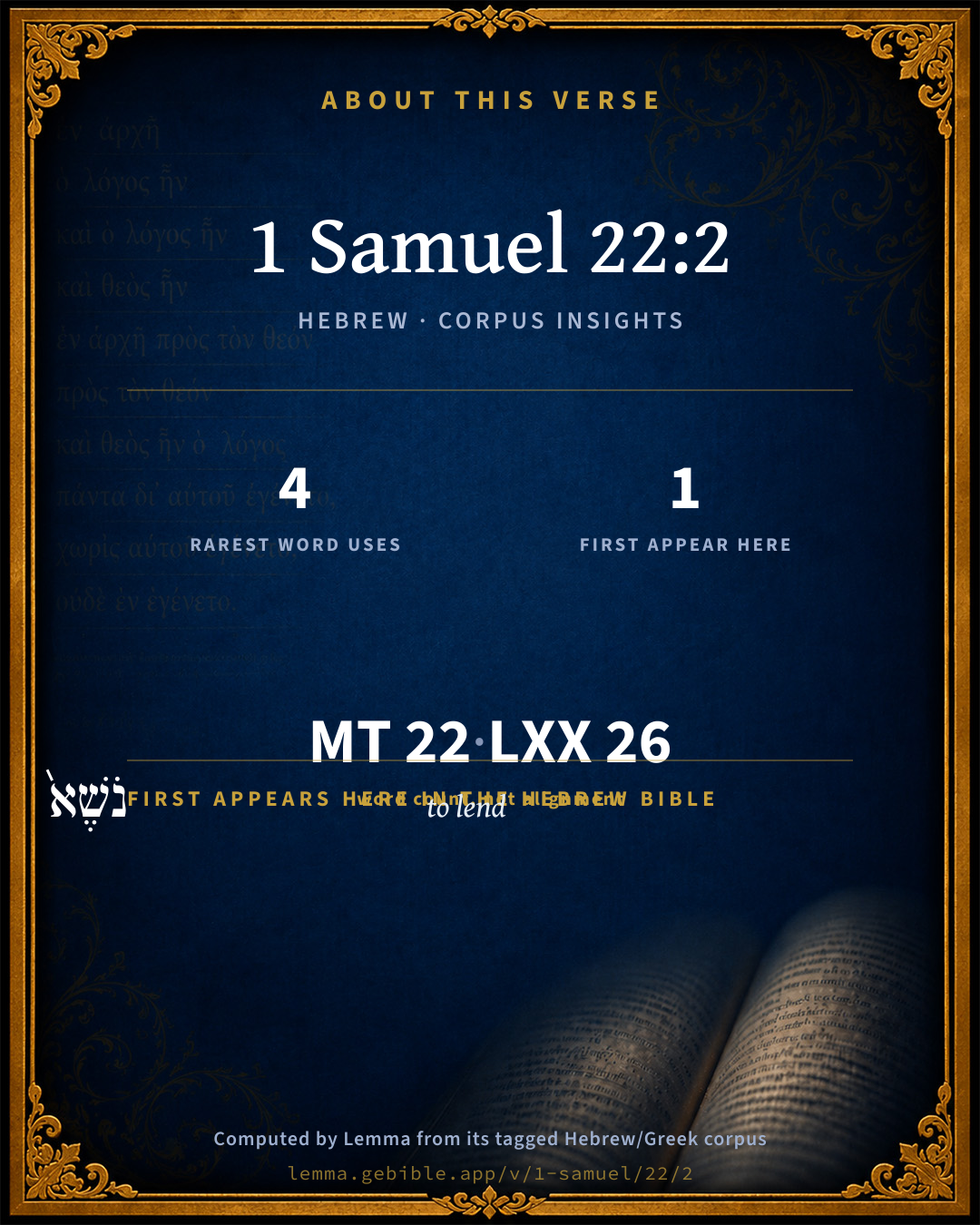
About this verse

These counts appear in no published source. They are computed here, from the morphology-tagged text and Lemma’s own curated glosses. What Lemma adds →

22
words
15
distinct lemmas
Historical
section

Notable vocabulary

The rarest word here is נֹשֶׁא֙ to lend H5378 — appearing just 4 times in the whole Hebrew Bible.

First appearance in Scripture

This word makes its first canonical appearance in the Hebrew Bible here:

  • נֹשֶׁא֙ to lend H5378

Shared distinctive vocabulary

נֹשֶׁא֙ to lend H5378 occurs in 4 verses of the Hebrew Bible. Also found in:

Grammatical profile

  • 4 verbs
  • 10 nouns
  • 3 adjectives
  • 4 prepositions
  • 1 particle

Verb forms

  • וַיִּֽתְקַבְּצ֣וּ Hithpael · Sequential Imperfect
  • נֹשֶׁא֙ Qal · Participle Active
  • וַיְהִ֥י Qal · Sequential Imperfect
  • וַיִּהְי֣וּ Qal · Sequential Imperfect

Repetition

Words recur within this verse — often emphatic in Hebrew:

  • אִ֨ישׁ man H376 ×4
  • כָּל all H3605 ×3
  • וַיְהִ֥י to be H1961 ×2

Hebrew & Septuagint length

In English translation the verse runs 35 words from the Hebrew and 42 from the Septuagint (LXX English) — closely comparable.

A rough comparison of the two English renderings, which tokenize alike — not a word-level alignment.

Word counts can differ between the Hebrew and the Greek without any difference in meaning — e.g. the Hebrew direct-object marker אֵת has no separate Greek word, and Greek often adds the article ὁ.

In the original languages it is 22 Hebrew tokens and 26 Greek tokens — but the two are counted differently (Hebrew bundles its prefixes and suffixes into one token; the Greek is in lemma form), so that isn’t a like-for-like length.

Cross-references

20

Topical passages linked to 1 Samuel 22:2 in the Treasury of Scripture Knowledge — connected by theme and wording, ordered by reader-vote popularity; previews shown in the World English Bible.

  • Matthew 11:28 "Come to me, all you who labor and are heavily burdened, and I will give you rest.
  • Psalms 72:12–14 For he will deliver the needy when he cries; The poor, who has no helper.
  • 1 Samuel 1:10 She was in bitterness of soul, and prayed to Yahweh, and wept sore.
  • 1 Samuel 25:13 David said to his men, Gird you on every man his sword. They girded on every man his sword; and David also girded on his sword: and there went up after David about four hundred men; and two hundred abode by the baggage.
  • 1 Samuel 30:6 David was greatly distressed; for the people spoke of stoning him, because the soul of all the people was grieved, every man for his sons and for his daughters: but David strengthened himself in Yahweh his God.
  • 1 Samuel 30:22–24 Then answered all the wicked men and base fellows, of those who went with David, and said, Because they didn't go with us, we will not give them anything of the spoil that we have recovered, except to every man his wife and his children, that he may lead them away, and depart.
  • 1 Samuel 25:15–16 But the men were very good to us, and we were not hurt, neither missed we anything, as long as we went with them, when we were in the fields:
  • Judges 11:3 Then Jephthah fled from his brothers, and lived in the land of Tob: and there were gathered vain fellows to Jephthah, and they went out with him.
  • 1 Samuel 9:16 Tomorrow about this time I will send you a man out of the land of Benjamin, and you shall anoint him to be prince over my people Israel; and he shall save my people out of the hand of the Philistines: for I have looked on my people, because their cry is come to me.
  • 1 Samuel 23:13 Then David and his men, who were about six hundred, arose and departed out of Keilah, and went wherever they could go. It was told Saul that David was escaped from Keilah; and he gave up going there.
  • Matthew 18:25–34 But because he couldn't pay, his lord commanded him to be sold, with his wife, his children, and all that he had, and payment to be made.
  • Judges 18:25 The children of Dan said to him, "Don't let your voice be heard among us, lest angry fellows fall on you, and you lose your life, with the lives of your household."
  • 2 Samuel 5:2 In times past, when Saul was king over us, it was you who led out and brought in Israel: and Yahweh said to you, You shall be shepherd of my people Israel, and you shall be prince over Israel.
  • 2 Samuel 17:8 Hushai said moreover, You know your father and his men, that they are mighty men, and they are fierce in their minds, as a bear robbed of her cubs in the field; and your father is a man of war, and will not lodge with the people.
  • 2 Kings 20:5 Turn back, and tell Hezekiah the prince of my people, Thus says Yahweh, the God of David your father, I have heard your prayer, I have seen your tears: behold, I will heal you; on the third day you shall go up to the house of Yahweh.
  • 1 Chronicles 11:15–19 Three of the thirty chief men went down to the rock to David, into the cave of Adullam; and the host of the Philistines were encamped in the valley of Rephaim.
  • Proverbs 31:6 Give strong drink to him who is ready to perish; And wine to the bitter in soul:
  • Matthew 9:12–13 When Jesus heard it, he said to them, "Those who are healthy have no need for a physician, but those who are sick do.
  • Matthew 11:12 From the days of John the Baptizer until now, the Kingdom of Heaven suffers violence, and the violent take it by force.
  • Hebrews 2:10 For it became him, for whom are all things, and through whom are all things, in bringing many children to glory, to make the author of their salvation perfect through sufferings.

Cross-references courtesy of OpenBible.info (CC BY 4.0).

Hebrew and Greek witnesses Masoretic Hebrew ↔ Greek Septuagint

The same verse in the two great witnesses to the Old Testament, shown verse-for-verse.

These are two independent witnesses, not word-aligned to each other, and the Septuagint is shown in lemma (dictionary) form.

Hebrew 1 Samuel 22:2 Masoretic · Westminster Leningrad Codex

וַיִּֽתְקַבְּצ֣וּ אֵ֠לָיו כָּל אִ֨ישׁ מָצ֜וֹק וְכָל אִ֨ישׁ אֲשֶׁר ל֤וֹ נֹשֶׁא֙ וְכָל אִ֣ישׁ מַר נֶ֔פֶשׁ וַיְהִ֥י עֲלֵיהֶ֖ם לְשָׂ֑ר וַיִּהְי֣וּ עִמּ֔וֹ כְּאַרְבַּ֥ע מֵא֖וֹת אִֽישׁ

Everyone who was in distress, and everyone who was in debt, and everyone who was discontented, gathered themselves to him; and he became captain over them: and there were with him about four hundred men.

World English Bible · Public Domain

Greek LXX 1 Samuel 22:2 Septuagint · lemma form

καί συνἄγω πρός αὐτός πᾶς ἐν ἀνάγκη καί πᾶς ὑπόχρεως καί πᾶς κατώδυνος ψυχή καί εἰμί ἐπί αὐτός ἡγέομαι καί εἰμί μετά αὐτός ὡς τετρακόσιοι ἀνήρ

And there gathered to him every one that was in distress, and every one that was in debt, and every one that was troubled in mind; and he was a leader over them, and there were with him about four hundred men.

LXX2012 (modern English Septuagint) · Public Domain

Hebrew: Westminster Leningrad Codex (CC BY 4.0). Greek: Septuagint (public domain); English from LXX2012 (modern English Septuagint) (Public Domain). How the Septuagint differs from the Hebrew →

Targum (Aramaic paraphrase)

1

The Targum is the ancient Jewish Aramaic paraphrase of the Hebrew Scriptures — an interpretive translation, not the Hebrew text itself. Onkelos (literal) and Pseudo-Jonathan (expansive) render the Torah, and Jonathan the Prophets. Coverage is partial: where no permissively-licensed English translation exists for a verse, only the Aramaic is shown. This is verse-level text, not a word-by-word alignment to the Hebrew.

  1. Targum Jonathan Prophets (Joshua–Malachi)
    וְאִתְכְּנִישׁוּ לְוָתֵיהּ כָּל גְבַר מָעִיק רוּחַ וְכָל גְבַר דִי לֵיהּ מָרֵי רְשׁוּ וְכָל גְבַר מָרִיר נְפַשׁ וַהֲוָה עֲלֵיהוֹן לְרַבָּא וַהֲווֹ עִמֵיהּ כְּאַרְבַּע מְאָה גַבְרָא:

    (no public-domain English translation for this verse)

    Targum Jonathan — Aramaic: “Mikraot Gedolot” (public domain). English: “Sefaria Community Translation” (CC0 1.0 (public-domain dedication)); “London "Chaldee Paraphrase," 1871” (public domain). Text via Sefaria.

Commentary

Notes on 1 Samuel 22:2 from classic Christian and Jewish commentators (each source and its license shown beneath its notes). The classic Christian expositions comment on the surrounding passage and are grouped to its opening verse, so a note may address several verses; the Jewish commentaries on the Tanakh (Rashi and others) are per-verse, so they appear only where the commentator wrote on this verse.

Lemma curates 59 commentaries, every one of them public domain or Creative Commons licensed, each selected and text-cleaned for this edition rather than reprinted as found. About our sources →

Trapp's Complete Commentary

John Trapp

1Sa 22:2 And every one [that was] in distress, and every one that [was] in debt, and every one [that was] discontented, gathered themselves unto him; and he became a captain over them: and there were with him about four hundred men.

Ver. 2. And every one that was in distress.] Herein David became a type of Christ, the Captain of our salvation, who cried, "Come unto me, all ye that are weary," and who are sensible that ye have Suffered more under Satan’s tyranny, than these had under Saul’s: and yet in his time, as afterwards in Tiberius’s, there was crimen ex silentio, ex voce, {a} danger either to speak, or to hold one’s peace, to have done anything, or nothing.

And every one that was in debt.] Heb., That had a creditor or an oppressor, extortioner, usurer, who cruelly handled him.

And every one that was discontented.] Heb., Bitter of soul. Not such ruffians and rakehells as Abimelech, {Jdg 9:4} and of later time Mohammed, that grand impostor, got together to spoil and do mischief; but these came to David upon a better principle, and for a better purpose, viz., for his and their own just and necessary defence: and for their carriage, see what a testimony Nabal’s servants gave them, though that brute their master had basely reviled them. {1Sa 25:15} In the Gospel we read that our Saviour received him that had been born blind, and was now cast out. {Joh 9:35} And in the civil law we find provision made for such as were cast out and exposed to the wide world; some hospitals to entertain them, some liberties to comfort and compensate their troubles.

{a} Tacit.

John Trapp, A Commentary or Exposition upon All the Books of the Old and New Testament (1647–1656) — public domain. Text from a community e-Sword module.

The Biblical Illustrator

Joseph S. Exell

1Sa_22:2

And everyone that was in distress, and everyone that was in debt, and everyone that was discontented, gathered themselves unto him.

A refuge for the distressed

At the period of which the text speaks, David was leading the life of an outcast and an outlaw. Being expelled from Israel and Philistia, nothing remained for him to do but to gather around him a band of equally unfortunate men and defend himself with his sword. Cannot we see in David collecting around him all who were in distress, in debt, or for any reason discontented, a foreshadow of the Friend of publicans and sinners, of Him who said, Come unto Me, all ye that labour and are heavy laden, and I will give you rest. Again a mans religion may be concealed in his heart, and may not do the good it ought to do as an example till distress come upon him and cause it to be seen in all its power. In many a true believer piety is like a drum, which nobody hears of unless it be beaten. The cave of Adullam was a refuge for debtors, and so is the Church of Christ. The third class of people who came to David at the cave of Adullam were those who were discontented. So, too, there is a Divine discontent which brings people to Christ. Are you dissatisfied? Then go to Christ and fill up the hollowness of your soul with Him. This is the truth which is contained in the common saying, that when people become disappointed with the world, it is the last resource to turn saint. The last thing we note about the miserable men who came for refuge to David is that they were taught by him to live good lives. They were a rough, lawless set of men, yet they could be kept in check by the influence of their beloved captain, David. So useful and helpful to their neighbours did these soldiers become, that the servants of Nabal could not help acknowledging as much. But the men were very good unto us, and we were not hurt, neither missed we anything, as long as we were conversant with them. Now surely if mens lives were made good by coming to David, the effect which coming to Christ should have upon our characters is infinitely more beneficial. (E. J. Hardy, M. A.)

The Biblical Illustrator, edited by Joseph S. Exell (c. 1880s–1900s) — public domain. Text from a community e-Sword module.

Joseph Benson's Commentary

1Sa 22:2. Every one that was in distress — אישׁ מצוק, ish matsok, the man straitened or oppressed. And every one that was in debt — אשׁר לו נשׁאasher lo noshee, the man that had a creditor. Probably poor debtors, whom their creditors were obliged to spare, Exo 22:25. And others, whose lands and goods their creditors might seize when their persons were with David. It must be observed that the Jews frequently used their debtors with great severity, (see Neh 5:5,) taking forcible possession of their lands and vineyards, and bringing their children into bondage. Every one that was discontented — Hebrew, מר נפשׁmar nephesh, the man bitter of soul, aggrieved in his mind, made uneasy and discontented, “probably,” says Dr. Dodd, “with Saul’s tyrannical government, and his implacable persecution of David, who, by this time, must have been well known to have been the intended successor of Saul.” It does not appear, from this description, that these were men of abandoned characters and profligate principles, as some have thought, who joined themselves to David purposely to cheat their creditors, and for the sake of the plunder they were in hopes of getting under him. Indeed, had this been the case, David would not have been able to have kept them under that strict order and discipline under which we find he did keep them, but we should have read of their plundering, and murdering, and committing other outrages. Nor would they have continued with him so long, and abode with him in dreary forests, destitute of most of the conveniences and comforts of life; or have followed him whithersoever he was disposed to lead them. This is not the temper or behaviour of men of profligate principles. And, therefore, there is reason to conclude, that they were persons who were brought into distress and poverty by other causes, such as, in the course of divine providence, are frequently permitted to afflict the best of men, for their trial, humiliation, or correction. But if they were not virtuous when they resorted to David, that they became so by his discipline, influence, and example, is sufficiently evident from their subsequent behaviour. And he became a captain over them — Being forced to take this course in his own defence, that he might not be suddenly surprised. But David did not take these men into his service, till by information from Jonathan, and by many other certain proofs, it evidently appeared that his life was in imminent danger. And then he neither assaulted any place with them, nor sought for an occasion to fight, but avoided it by seeking for secret and secure places of retreat, sometimes in the deserts, sometimes, in foreign nations, always taking care not to hurt his countrymen, and never allowing his men to make incursions upon any but the enemies of Israel.

Joseph Benson's Commentary on the Old and New Testaments (1811–1818) — public domain. Text from a community e-Sword module.

Tyndale Open Study Notes

Tyndale Open Resources

22:2 in trouble . . . in debt . . . discontented: By attracting such down-and-out people to himself, David foreshadowed Jesus, who would attract to himself the hurting, the burdened, and the outcast (Matt 11:25-30).

Tyndale Open Study Notes — © Tyndale Open Resources, licensed CC BY-SA 4.0. Text via the HelloAO Bible API.

Geneva Bible (1599)

Geneva Bible translators

Or, captain.

Geneva Bible (1599) marginal notes — public domain. Text via Bolls.life.

Jamieson, Fausset & Brown

Robert Jamieson, A. R. Fausset & David Brown

every one that was in distress--(See on Jdg 11:3).

Jamieson, Fausset & Brown — Commentary Critical and Explanatory on the Whole Bible (1871) — public domain (CC PDM 1.0). Text via the HelloAO Bible API.

Adam Clarke's Commentary

Verse 2. And every one that was in distress - debt - discontented] It is very possible that these several disaffected and exceptionable characters might at first have supposed that David, unjustly persecuted, would be glad to avail himself of their assistance that he might revenge himself upon Saul, and so they in the mean time might profit by plunder, c. But if this were their design they were greatly disappointed, for David never made any improper use of them. They are never found plundering or murdering on the contrary, they always appear under good discipline, and are only employed in services of a beneficent nature, and in defence of their country. Whatever they were before they came to David, we find that he succeeded in civilizing them, and making profitable to the state those who were before unprofitable. It is not necessary to strain the words of the original in order to prove that these were oppressed people, and not exceptionable characters, as some have done.

Adam Clarke's Commentary on the Bible (1810–1826) — public domain. Text from a community e-Sword/MySword module.

Ellicott's Commentary for English Readers

(2) Every one that was in distress.—Ewald writes on this statement:—“The situation of the country, which was becoming more and more melancholy under Saul, . . . drove men to seek a leader from whom they might hope for better things for the future . . . David did not send away these refugees, many of them distinguished and prominent Israelites, but organised them into a military force. He foresaw that while commanding such a company as this, he might, without injuring his king and former benefactor, be of the very greatest use to the people, and protect the southern frontiers of the kingdom—sadly exposed in these later years of King Saul—from the plundering incursions of the neighbouring nomadic tribes. This state of things, with a few interruptions, really came to pass, and David won great repute and popularity among the protected districts during these years when he was a wanderer and an outlaw—a popularity which in after years stood him in good stead.”

These persons “in distress” were especially those who were persecuted by Saul and his men for their attachment to David. The several statements of the refugees who took shelter in David’s armed camp, of course go over a considerable time. They did not all flock to his standard at once. Some went to him in the first days of his exile, others after the massacre at the sanctuary at Nob, others later, and thus gradually 400 gathered round him. Soon after, these numbers were swelled to 600, and these probably only were the chosen men-at-arms of the little force, which, no doubt, was numerically far greater.

And every one that was in debt.—Throughout the whole long story of Israel this unhappy love of greed and gain has been a characteristic feature of the chosen race, ever a prominent and ugly sin. In the Mosaic Law, most stringent regulations were laid down to correct and mitigate this ruling passion of avarice among the Jews. (See such passages as Exo_22:25; Lev_25:36; Deu_23:19.) The poor, improvident, or perhaps unfortunate, debtor was protected by wise laws against the greedy avaricious spirit of his merciless creditor. These beneficent regulations of the great lawgiver had, under the capricious, faulty rule of King Saul, of course fallen into abeyance, and a terrible amount of misery, no doubt, was the consequence. In the Divine record sad scenes (see 2Ki_4:1-7), exemplifying this pitiless spirit, are casually related, but they are so woven into the mosaic of the history, as to show us they were, alas! no uncommon occurrence in the daily life of the people. In Proverbs, for instance, we have some conspicuous instances. The chronicles of the Middle Ages in all countries teem with similar stories about the chosen people. Our own great dramatist, some three centuries ago, evidently without attempt at exaggeration, selects the avaricious, grasping Jew as the central figure of one of his most famous dramas. In our own time the same spirit, as is too well known, is still abroad, and constitutes the bitterest reproach which the many enemies of the strange, deathless race can promulgate against a people evidently walled in by a Divine protection and a changeless eternal love.

And he became a captain over them.—It was evidently no undisciplined band, these outlaws of Adullam and the hold of Moab, of Hareth and Keilah, of Ziph and Engedi. David quickly organised the refugees, among whom, by degrees, many a man of mark and approved valour and ability were numbered.

To complete the picture of this First Book of Samuel, we must unite in one the scattered notices of this same period which occur in the Second Book of Samuel and in the Books of Kings and Chronicles. (See Excursus I. at the end of this Book.)

A Bible Commentary for English Readers, edited by Charles John Ellicott (1878–1897) — public domain. Text from a community e-Sword module.

The Cambridge Bible for Schools and Colleges

gen. ed. J. J. S. Perowne

2. And every one, &c.] To the cave of Adullam resorted some who were smarting under the oppression of Saul’s tyranny; some who were involved in debt through the neglect of the laws concerning usury (Exo_22:25; Lev_25:35-37); some who were in despair at the condition of the kingdom, and desired a leader from whom they might hope for better things.

he became a captain over them] That he could keep such a motley band in order is an evidence of David’s natural genius for ruling, which was further developed by this training.

about four hundred men] Soon increased to six hundred (1Sa_23:13). Among them were the three heroes who brought water from the well at Bethlehem (2Sa_23:13 ff.; 1Ch_11:15 ff.); possibly the stalwart Gadites whose names are given in 1Ch_12:8-15; and also the detachment from Judah and Benjamin led by Amasai (1Ch_12:16-18).

The Cambridge Bible for Schools and Colleges (gen. ed. J. J. S. Perowne; Cambridge University Press, 1878–1918) — public domain. Text from a community e-Sword module.

John Gill's Exposition

And everyone that was in distress,.... In straitened circumstances, through the oppression of men, through poverty, and afflictive providences in their families:

and everyone that was in debt; and not able to pay their debts, and whose creditors were pressing upon them:

and everyone that was discontented; with Saul's government and conduct: or "bitter in soul" (x); distressed and uneasy in their minds, being pinched with want, or pressed with sore afflictions, which made them very disconsolate: these

gathered themselves unto him; to help him, or rather to be helped by him; hoping in time things would take a favourable turn with him, and he should be advanced to the throne, and so their circumstances would be mended thereby:

and he became a captain over them; they enlisted themselves in his service, and he took the command of them; he might not know the circumstances of those in debt, nor of any of them thoroughly, nor their views in joining him; however he meant not to shelter them from paying their just debts if able, nor to encourage them in disloyalty to their king, only to make use of them for his own preservation for the present. In this he was a type of Christ, who receives sinners distressed with a sense of sin, discontented in their present state, and in debt, and, unable to pay their debts; see Mat 11:28,

and there were with him about four hundred men; among whom some think were the three mighty men spoken of in Sa2 23:13.

(x) "amarus animo", Pagninus, Montanus.

John Gill's Exposition of the Whole Bible (1746–1763) — public domain (CC PDM 1.0). Text via the HelloAO Bible API.

Albert Barnes' Notes on the Bible

Discontented - See the margin. (Compare 1Sa 30:6; 2Sa 17:8.) The phrase here denotes those who were exasperated by Saul’s tyranny.

Albert Barnes' Notes on the Bible (1834–1885) — public domain. Text from a community e-Sword/MySword module.

Haydock's Catholic Bible Commentary

Men. His title to the crown was incontestable, so that he might justly make war, particularly in his own defence, and receive those who flocked to him to screen themselves from the persecution of Saul, and from their debtors, whom they would thus enable themselves to repay in time, by the plunder which they would take from the enemy. David maintained the strictest discipline, and withheld his men from making any disturbance, always manifesting the greatest respect for the person of the king. (Calmet) --- The soldiers of Jephte were of the same description as these of David, Judges xi. 3. (Haydock)

George Leo Haydock (1774–1849), Haydock's Catholic Family Bible and Commentary, 1859 edition — public domain. Excludes Psalms (Douay-Rheims chapter numbering differs from Protestant) and Deuterocanonical books (Catholic canon only).

Matthew Poole's English Annotations

Every one that was in distress, through want, or oppression, or otherwise.

Every one that was in debt. How could David receive and countenance such persons to the wrong of their creditors?

Answ.

1. David might be ignorant of their debts; and it is most likely they concealed that, and pretended other causes of their coming to him, as the protection of the innocent, and the defence of his just rights, &c.

2. They might be, and probably were, poor debtors, whom their creditors were obliged to spare and favour, Exo 22:25. And though their persons were with David, yet their land and goods were liable to their creditors.

Every one that was discontented, or, bitter in soul, i.e. in an afflicted and calamitous condition.

He became a captain over them; he did not justify nor maintain any injustice or wickedness, which some of them possibly might be guilty of; but, on the contrary, he instructed and obliged them to the practice of all justice and honesty; as appears from 1Sa 25:15; and he only used them for his just defence.

Matthew Poole's English Annotations on the Holy Bible (1683–1685) — public domain. Text from a community e-Sword/MySword module.

Whedon's Commentary on the Bible

Daniel D. Whedon

2. Every one… in distress — Suffering from want, or in difficulty with their neighbours.

In debt — Hebrew, had a creditor; and who, having no means of meeting their obligations, were likely to be sold to their creditors. Lev_25:39.

Discontented — Dissatisfied with the government of Saul.

About four hundred men — A band of outlaws, who, however, under David’s wise management, became a band of mighty heroes. A catalogue of the bravest is given in 2Sa_23:8-39; 1Ch_11:10-47. How long David remained in the cave of Adullam before his flight to Moab we are nowhere told.

Daniel D. Whedon (gen. ed.), Commentary on the Old and New Testaments (1874–1909) — public domain. Text from a community e-Sword module.

The Pulpit Commentary

Everyone that was in distress, in debt, or discontented (Hebrew, bitter of soul), gathered themselves unto him. Had Saul"s government been just and upright David would have had no followers; but he never rose above the level of a soldier, had developed all that arbitrariness which military command fosters in self-willed minds, and seems entirely unaware of its being his duty to attend to the righteous administration of the law. The Israelites had in him the very king they had desired, but they found that a brave general might at home be a ruthless tyrant. Debt was one of the worst evils of ancient times. The rate of usury was so exorbitant that a loan was sure to end in utter ruin, and not only the debtor, but his children might be made slaves to repay the debt. (2Ki_4:1) It was one of the first duties of an upright governor to enforce the Mosaic law against usury; (Lev_25:36) but all such cares Saul despised, and there were probably many in the land impoverished by Saul"s own exactions and favouritism (ver. 7), and made bitter of soul by his cruelty and injustice. All such were glad to join in what seemed to them the banner of revolt. Afterwards at Ziklag David was joined by nobler followers. (see on 1Sa_27:6) With David we may compare Jephthah"s case in the old days of anarchy, (Jud 11:3-6) and note that bad government leads to lawlessness just as surely as no government.

The Pulpit Commentary (1880–1919), ed. H.D.M. Spence-Jones & Joseph S. Exell — public domain. Text from a community e-Sword module.

John Wesley's Explanatory Notes

Debt - Probably poor debtors, whom the creditors were obliged to spare, Exod. xxii, 25. And though their persons were with David, yet their lands and goods were liable to their creditors. Captain over them - He did not maintain any injustice or wickedness, which some of them possibly might be guilty of; but on the contrary, he instructed and obliged them to the practice of all justice and honesty.

John Wesley, Explanatory Notes Upon the Whole Bible (1754–1765) — public domain. Text via the GEBible commentary corpus.

Lesson kit

Teaching starters — assembled from the data on this page, not authored interpretation. Every prompt links to the verse data it draws on. Edit before teaching.

1 Samuel, in the Historical, opens this verse with 22 words (15 distinct Hebrew lemmas). Its most distinctive word is nâshâʼ (“to lend”). A historical commentator’s framing appears above. Read the whole chapter for the surrounding context.

Discussion questions

  1. How does “to lend” (nâshâʼ) shape what this verse is saying?
  2. The word “to lend” first appears here in Scripture. What is being introduced at this debut?
  3. 1 Kings 8:31 shares the word «to lend» with this verse. How do the two illuminate each other?
  4. “man” occurs 4× in this one verse. What is the effect of the repetition?
  5. These translations render this verse differently; the difference is in the English rendering, not the original. What questions does that raise?
  6. The verb «וַיִּֽתְקַבְּצ֣וּ» is Hithpael Sequential Imperfect. How does its form color the action?
  7. Reading how Trapp's Complete Commentary and The Biblical Illustrator read this verse, where do the two commentators agree and where do they part?

Things to notice

Reading settings

Reading text

Shown beneath each verse's original-language words.

Old Testament
Old Testament edition

Read the OT as the Masoretic Hebrew (MT) or the Greek Septuagint (LXX).

English shown for the Greek Septuagint (in the Hebrew ↔ Greek comparison).

Comparing translations? Open the Compare panel on any verse page to stack up to four side by side.