
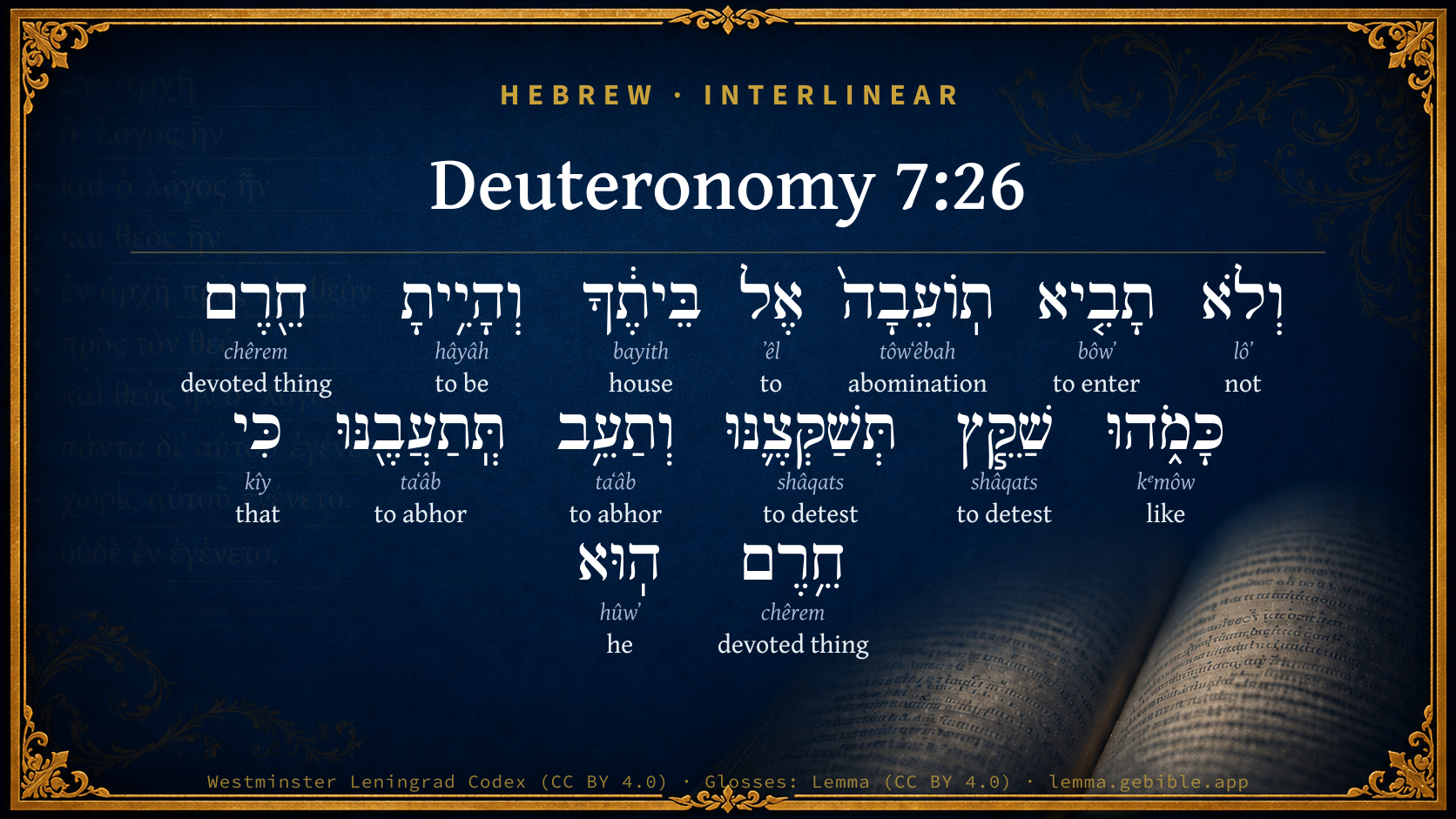
Deuteronomy 7:26

Hebrew (Westminster Leningrad Codex) Deuteronomy 7:26 appears in the Hebrew Old Testament. The text above is from the Westminster Leningrad Codex. Each word links to its Strong’s number, a concise gloss, and parsing drawn from the Open Scriptures Hebrew Bible morphology. Click any word for its full Brown-Driver-Briggs (BDB) entry.
Download image
Cite this verse

Deuteronomy 7:26 (World English Bible). Public Domain. Lemma interlinear Bible study tool, https://lemma.gebible.app/v/deuteronomy/7/26.

Show BibTeX & RIS
BibTeX
RIS
English Translation
You shall not bring an abomination into your house, and become a devoted thing like it: you shall utterly detest it, and you shall utterly abhor it; for it is a devoted thing.
World English Bible · Public Domain
Highlights
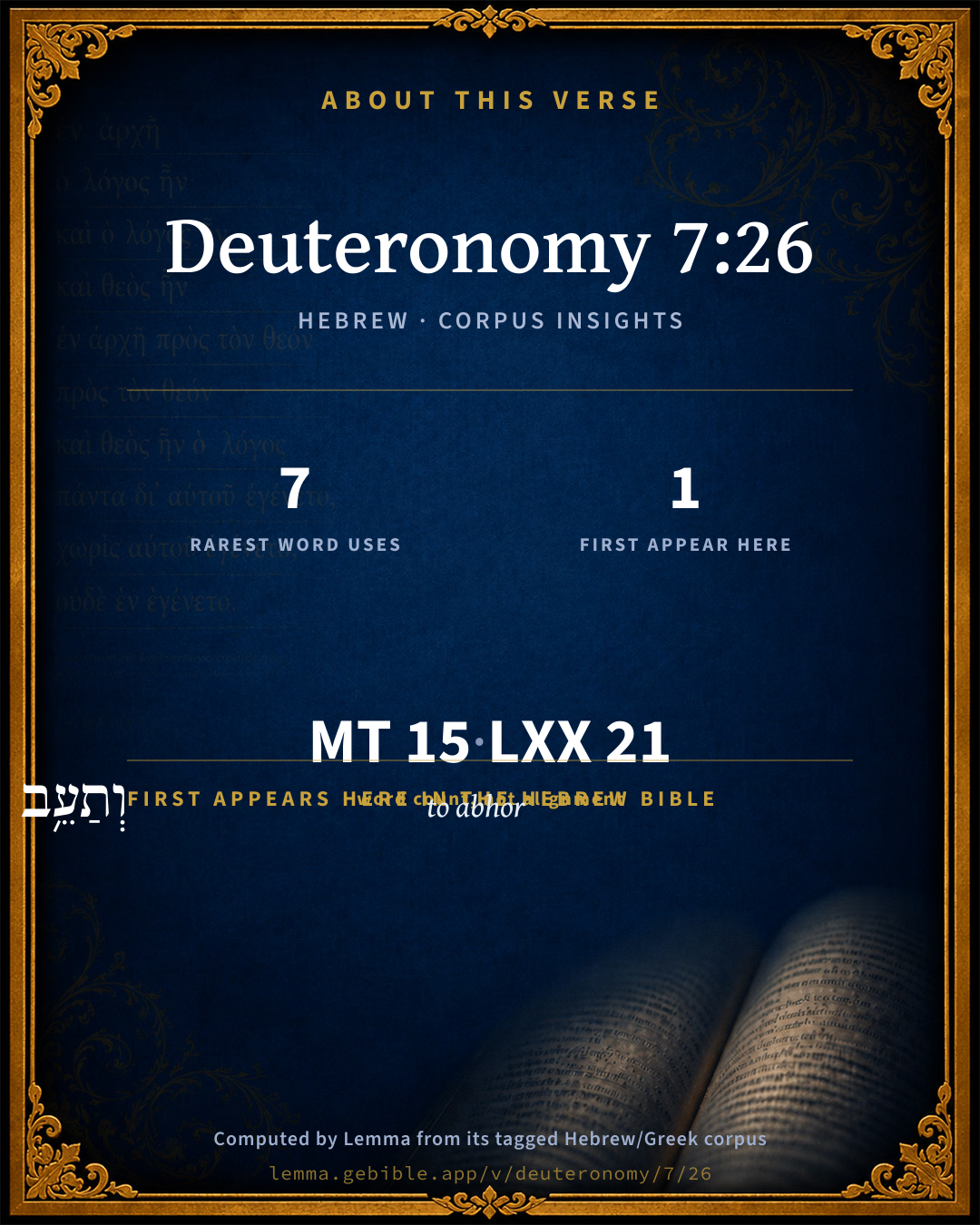
  • 1 first appearance in the Hebrew Bible
Full analysis ↓
Download a study sheet

One document with this verse’s original text, its word-by-word gloss line, the meaning frame, cross-references with their text, attributed commentary, and full source and license credits — printable, and it pastes into notes with its structure intact.

This verse Autodidact and up

Study sheet (.html) Plain text (.txt)

A passage Seminary Student

Up to 50 verses in one chapter. A passage sheet keeps up to 6 commentary sources and 12 cross-references per verse, in the order this page ranks them, and says so on the sheet whenever that leaves anything out. Ask for a single verse and you get the Autodidact verse sheet above.

Everything on this page stays free to read, with no account — the sheet is a download of what is already on screen, not access to it.

Want to remove ads? Support Godless Engineer
Compare translations 3

The same verse in 3 English versions, stacked beneath the original-language interlinear above. Click any original word for its lexicon entry.

Each is an independent rendering of the whole verse — the interlinear is not word-aligned to these translations.

Highlighted words mark where these versions differ — a whole-verse word diff, not a word-by-word alignment.

  • World English Bible Public Domain
    You shall not bring an abomination into your house, and become a devoted thing like it: you shall utterly detest it, and you shall utterly abhor it; for it is a devoted thing.
  • King James Version Public Domain
    Neither shalt thou bring an abomination into thine house, lest thou be a cursed thing like it: but thou shalt utterly detest it, and thou shalt utterly abhor it; for it is a cursed thing.
  • unfoldingWord Literal Text CC BY-SA 4.0
    And do not bring an abomination to your house and you become a devoted thing like it. Detesting, you shall detest it, and abhorring, you shall abhor it, for it a devoted thing.

unfoldingWord Literal Text — © unfoldingWord, licensed CC BY-SA 4.0. Word-aligned USFM3 via Door43 (git.door43.org/unfoldingWord/en_ult).

Versions to compare (up to 4)

3 of 4 selected

Show all 18 translations

Every available English version of this verse, each an independent rendering of the whole verse.

  • World English Bible Public Domain
    You shall not bring an abomination into your house, and become a devoted thing like it: you shall utterly detest it, and you shall utterly abhor it; for it is a devoted thing.
  • Berean Standard Bible Public Domain
    And you must not bring any detestable thing into your house, or you, like it, will be set apart for destruction. You are to utterly detest and abhor it, because it is set apart for destruction.
  • Majority Standard Bible Public Domain
    And you must not bring any detestable thing into your house, or you, like it, will be set apart for destruction. You are to utterly detest and abhor it, because it is set apart for destruction.
  • King James Version Public Domain
    Neither shalt thou bring an abomination into thine house, lest thou be a cursed thing like it: but thou shalt utterly detest it, and thou shalt utterly abhor it; for it is a cursed thing.
  • American Standard Version (1901) Public Domain
    And thou shalt not bring an abomination into thy house, and become a devoted thing like unto it: thou shalt utterly detest it, and thou shalt utterly abhor it; for it is a devoted thing.
  • Revised Version (1885) Public Domain
    and thou shalt not bring an abomination into thine house, and become a devoted thing like unto it: thou shalt utterly detest it, and thou shalt utterly abhor it; for it is a devoted thing.
  • Geneva Bible (1599) Public Domain
    Bring not therefore abomination into thine house, lest, thou be accursed like it, but vtterly abhorre it, and count it most abominable: for it is accursed.
  • Douay-Rheims (1899) Public Domain
    Neither shalt thou bring any thing of the idol into thy house, lest thou become an anathema, like it. Thou shalt detest it as dung, and shalt utterly abhor it as uncleanness and filth, because it is an anathema.
  • Young's Literal Translation Public Domain
    and thou dost not bring in an abomination unto thy house -- or thou hast been devoted like it; -- thou dost utterly detest it, and thou dost utterly abominate it; for it `is' devoted.
  • Literal Standard Version CC BY-SA 4.0
    and you do not bring in an abomination to your house, or you have been devoted like it—you utterly detest it and you utterly abhor it; for it [is] devoted.”
  • Unlocked Literal Bible CC BY-SA 4.0
    You will not bring any abomination into your house and start to worship it. You will utterly detest and abhor it, for it is set apart for destruction.
  • unfoldingWord Literal Text CC BY-SA 4.0
    And do not bring an abomination to your house and you become a devoted thing like it. Detesting, you shall detest it, and abhorring, you shall abhor it, for it a devoted thing.
  • Darby Bible Public Domain
    And thou shalt not bring an abomination into thy house, lest thou be a cursed thing like it: thou shalt utterly detest it, and thou shalt utterly abhor it; for it is a cursed thing.
  • World Messianic Bible Public Domain
    You shall not bring an abomination into your house and become a devoted thing like it. You shall utterly detest it. You shall utterly abhor it; for it is a devoted thing.
  • Webster's Bible Public Domain
    Neither shalt thou bring an abomination into thy house, lest thou shouldst be a cursed thing like it: but thou shalt utterly detest it, and thou shalt utterly abhor it; for it is a cursed thing.
  • Free Bible Version CC BY-SA 4.0
    Don't bring any detestable idol into your house, otherwise you will be treated just like it—by being set apart for destruction. You are to treat idols as totally despicable, and stay far away from them, because they are set apart for destruction.
  • Bible in Basic English Public Domain
    And you may not take a disgusting thing into your house, and so become cursed with its curse: but keep yourselves from it, turning from it with fear and hate, for it is a cursed thing.
  • JPS Tanakh (1917) Public Domain
    And thou shalt not bring an abomination into thy house, and be accursed like unto it; thou shalt utterly detest it, and thou shalt utterly abhor it; for it is a devoted thing.

Literal Standard Version (2020), Covenant Press — licensed CC BY-SA 4.0. Text via the HelloAO Bible API (eBible.org). Unlocked Literal Bible (unfoldingWord) — licensed CC BY-SA 4.0. Text via the HelloAO Bible API (eBible.org). unfoldingWord Literal Text — © unfoldingWord, licensed CC BY-SA 4.0. Word-aligned USFM3 via Door43 (git.door43.org/unfoldingWord/en_ult). Free Bible Version, Dr. Jonathan Gallagher — licensed CC BY-SA 4.0. Text via the HelloAO Bible API (eBible.org).

Word by word

More ways to search: Search by grammar → Find every occurrence → Compare this word →

Practice this passage: Drill this verse → Learn its vocabulary →

שַׁקֵּ֧ץ
shâqats
H8262
“to detest”
Verb, Piel, Infinitive Absolute
Part of Speech
Verb
Stem
Piel
Form
Infinitive Absolute
Full BDB Definition

Origin: a primitive root

TWOT: 2459

(Piel) to detest, make abominable, count filthy, make detestable - to detest - to make detestable
  1. וְלֹא lôʼ H3808 “and · not” Conjunction + Particle, Negative
  2. תָבִ֤יא bôwʼ H935 “to enter” Verb, Hiphil, Imperfect, 2nd Person, Masculine, Singular
  3. תֽוֹעֵבָה֙ tôwʻêbah H8441 “abomination” Noun, Common, Feminine, Singular, Absolute
  4. אֶל ʼêl H413 “to” Preposition
  5. בֵּיתֶ֔ךָ bayith H1004 “house · your” Noun, Common, Masculine, Singular, Construct + Suffix, Personal, 2nd Person, Masculine, Singular
  6. וְהָיִ֥יתָ hâyâh H1961 “and · to be” Conjunction + Verb, Qal, Sequential Perfect, 2nd Person, Masculine, Singular
  7. חֵ֖רֶם chêrem H2764 “devoted thing” Noun, Common, Masculine, Singular, Absolute
  8. כָּמֹ֑הוּ kᵉmôw H3644 “like · him” Preposition + Suffix, Personal, 3rd Person, Masculine, Singular
  9. תְּשַׁקְּצֶ֛נּוּ shâqats H8262 “to detest · him” Verb, Piel, Imperfect, 2nd Person, Masculine, Singular + Suffix, Personal, 3rd Person, Masculine, Singular
  10. וְתַעֵ֥ב taʻâb H8581 “and · to abhor” Conjunction + Verb, Piel, Infinitive Absolute
  11. תְּֽתַעֲבֶ֖נּוּ taʻâb H8581 “to abhor · him” Verb, Piel, Imperfect, 2nd Person, Masculine, Singular + Suffix, Personal, 3rd Person, Masculine, Singular
  12. כִּי kîy H3588 “that” Conjunction
  13. חֵ֥רֶם chêrem H2764 “devoted thing” Noun, Common, Masculine, Singular, Absolute
  14. הֽוּא hûwʼ H1931 “he” Pronoun, Personal, 3rd Person, Masculine, Singular

About this verse

These counts appear in no published source. They are computed here, from the morphology-tagged text and Lemma’s own curated glosses. What Lemma adds →

15
words
12
distinct lemmas
Pentateuch
section

Notable vocabulary

The rarest word here is שַׁקֵּ֧ץ to detest H8262 — appearing just 7 times in the whole Hebrew Bible.

First appearance in Scripture

This word makes its first canonical appearance in the Hebrew Bible here:

  • וְתַעֵ֥ב to abhor H8581

Shared distinctive vocabulary

שַׁקֵּ֧ץ to detest H8262 occurs in 6 verses of the Hebrew Bible. Also found in:

Grammatical profile

  • 6 verbs
  • 4 nouns
  • 1 pronoun
  • 2 prepositions
  • 1 conjunction
  • 1 particle

Verb forms

  • תָבִ֤יא Hiphil · Imperfect
  • וְהָיִ֥יתָ Qal · Sequential Perfect
  • שַׁקֵּ֧ץ Piel · Infinitive Absolute
  • תְּשַׁקְּצֶ֛נּוּ Piel · Imperfect
  • וְתַעֵ֥ב Piel · Infinitive Absolute
  • תְּֽתַעֲבֶ֖נּוּ Piel · Imperfect

Repetition

Words recur within this verse — often emphatic in Hebrew:

  • חֵ֖רֶם devoted thing H2764 ×2
  • שַׁקֵּ֧ץ to detest H8262 ×2
  • וְתַעֵ֥ב to abhor H8581 ×2

Hebrew & Septuagint length

In English translation the verse runs 33 words from the Hebrew and 34 from the Septuagint (LXX English) — closely comparable.

A rough comparison of the two English renderings, which tokenize alike — not a word-level alignment.

Word counts can differ between the Hebrew and the Greek without any difference in meaning — e.g. the Hebrew direct-object marker אֵת has no separate Greek word, and Greek often adds the article ὁ.

In the original languages it is 15 Hebrew tokens and 21 Greek tokens — but the two are counted differently (Hebrew bundles its prefixes and suffixes into one token; the Greek is in lemma form), so that isn’t a like-for-like length.

Cross-references

12

Topical passages linked to Deuteronomy 7:26 in the Treasury of Scripture Knowledge — connected by theme and wording, ordered by reader-vote popularity; previews shown in the World English Bible.

  • Deuteronomy 13:17 There shall cleave nothing of the devoted thing to your hand; that Yahweh may turn from the fierceness of his anger, and show you mercy, and have compassion on you, and multiply you, as he has sworn to your fathers;
  • Hosea 14:8 Ephraim, what have I to do any more with idols? I answer, and will take care of him. I am like a green fir tree; From me your fruit is found."
  • Isaiah 30:22 You shall defile the overlaying of your engraved images of silver, and the plating of your molten images of gold: you shall cast them away as an unclean thing; you shall tell it, Get you hence.
  • Ezekiel 11:18 They shall come there, and they shall take away all the detestable things of it and all the abominations of it from there.
  • Romans 2:22 You who say a man shouldn't commit adultery, do you commit adultery? You who abhor idols, do you rob temples?
  • Leviticus 27:28–29 "'Notwithstanding, no devoted thing, that a man shall devote to Yahweh of all that he has, whether of man or animal, or of the field of his possession, shall be sold or redeemed: every devoted thing is most holy to Yahweh.
  • Joshua 6:17–24 The city shall be devoted, even it and all that is therein, to Yahweh: only Rahab the prostitute shall live, she and all who are with her in the house, because she hid the messengers that we sent.
  • Joshua 7:1–26 But the children of Israel committed a trespass in the devoted thing; for Achan, the son of Carmi, the son of Zabdi, the son of Zerah, of the tribe of Judah, took of the devoted thing: and the anger of Yahweh was kindled against the children of Israel.
  • Ezekiel 14:7 For everyone of the house of Israel, or of the strangers who sojourn in Israel, who separates himself from me, and takes his idols into his heart, and puts the stumbling block of his iniquity before his face, and comes to the prophet to inquire for himself of me; I Yahweh will answer him by myself:
  • Isaiah 2:20 In that day, men shall cast away their idols of silver, And their idols of gold, Which have been made for themselves to worship, To the moles and to the bats;
  • Habakkuk 2:9–11 Woe to him who gets an evil gain for his house, that he may set his nest on high, that he may be delivered from the hand of evil!
  • Zechariah 5:4 I will cause it to go out," says Yahweh of Hosts, "and it will enter into the house of the thief, and into the house of him who swears falsely by my name; and it will remain in the midst of his house, and will destroy it with its timber and its stones."

Cross-references courtesy of OpenBible.info (CC BY 4.0).

Hebrew and Greek witnesses Masoretic Hebrew ↔ Greek Septuagint

The same verse in the two great witnesses to the Old Testament, shown verse-for-verse.

These are two independent witnesses, not word-aligned to each other, and the Septuagint is shown in lemma (dictionary) form.

Hebrew Deuteronomy 7:26 Masoretic · Westminster Leningrad Codex

וְלֹא תָבִ֤יא תֽוֹעֵבָה֙ אֶל בֵּיתֶ֔ךָ וְהָיִ֥יתָ חֵ֖רֶם כָּמֹ֑הוּ שַׁקֵּ֧ץ תְּשַׁקְּצֶ֛נּוּ וְתַעֵ֥ב תְּֽתַעֲבֶ֖נּוּ כִּי חֵ֥רֶם הֽוּא

You shall not bring an abomination into your house, and become a devoted thing like it: you shall utterly detest it, and you shall utterly abhor it; for it is a devoted thing.

World English Bible · Public Domain

Greek LXX Deuteronomy 7:26 Septuagint · lemma form

καί οὐ εἰςφέρω βδέλυγμα εἰς ὁ οἶκος σύ καί εἰμί ἀνάθεμα ὥσπερ οὗτος προσόχθισμα προςὀχθίζω καί βδέλυγμα βδελύσσω ὅτι ἀνάθεμα εἰμί

And you shall not bring an abomination into your house, so should you be an accursed thing like it; you shall utterly hate it, and altogether abominate it, because it is an accursed thing.

LXX2012 (modern English Septuagint) · Public Domain

Hebrew: Westminster Leningrad Codex (CC BY 4.0). Greek: Septuagint (public domain); English from LXX2012 (modern English Septuagint) (Public Domain). How the Septuagint differs from the Hebrew →

Targum (Aramaic paraphrase)

2

The Targum is the ancient Jewish Aramaic paraphrase of the Hebrew Scriptures — an interpretive translation, not the Hebrew text itself. Onkelos (literal) and Pseudo-Jonathan (expansive) render the Torah, and Jonathan the Prophets. Coverage is partial: where no permissively-licensed English translation exists for a verse, only the Aramaic is shown. This is verse-level text, not a word-by-word alignment to the Hebrew.

  1. Targum Onkelos Torah (Genesis–Deuteronomy)
    וְלָא תָעֵל דִמְרָחָק לְבֵיתָךְ וּתְהֵי חֶרְמָא כְּוָתֵהּ שַׁקָצָא תְשַׁקְצִנֵהּ וְרַחָקָא תְּרַחֲקִנֵהּ אֲרֵי חֶרְמָה הוּא

    (no public-domain English translation for this verse)

    Targum Onkelos — Aramaic: “Onkelos Genesis” (public domain); “Onkelos Exodus” (public domain); “Onkelos Leviticus” (public domain); “Onkelos Numbers” (public domain); “Onkelos Deuteronomy” (public domain). English: “Sefaria Community Translation” (CC0 1.0 (public-domain dedication)); “J.W. Etheridge. The Targums of Onkelos and Jonathan Ben Uzziel on the Pentateuch. London: Longmans, Green, 1862” (public domain). Text via Sefaria.

  2. Targum Pseudo-Jonathan Torah (Genesis–Deuteronomy)
    וְלָא תֵיעֲלוּן רִיחוּקֵי טַעֲוָותָא וְתִשְׁמִישָׁתָא לְבָתֵּיכוֹן דְּלָא תֶהֱווֹן שְׁמִיתִין כְּוַותְהוֹן שִׁיקְצָא תְּשַׁקְצִינוּן הֵיךְ סָאִיב שִׁיקְצָא וְרִיחֲקָא תְּרַחֲקִינוּן מְטוּל דְּשַׁמְתִּין הִינוּן

    Neither may you bring their abominable idols or their servicejvessels into your houses, that you be not accursed as they but you shall utterly loathe them as a loathsome reptile, and abhor them altogether, because they are accursed.

    Targum Pseudo-Jonathan — Aramaic: “Targum Jonathan on Genesis” (public domain); “Targum Jonathan on Exodus” (public domain); “Targum Jonathan on Leviticus” (public domain); “Targum Jonathan on Numbers” (public domain); “Targum Jonathan on Deuteronomy” (public domain). English: “The Targum of Jonathan ben Uzziel, trans. J. W. Etheridge, London, 1862” (public domain). Text via Sefaria.

Commentary

Notes on Deuteronomy 7:26 from classic Christian and Jewish commentators (each source and its license shown beneath its notes). The classic Christian expositions comment on the surrounding passage and are grouped to its opening verse, so a note may address several verses; the Jewish commentaries on the Tanakh (Rashi and others) are per-verse, so they appear only where the commentator wrote on this verse.

Lemma curates 59 commentaries, every one of them public domain or Creative Commons licensed, each selected and text-cleaned for this edition rather than reprinted as found. About our sources →

Joseph Benson's Commentary

Deu 7:26. Lest thou be a cursed thing — Hebrew, חרם, cherem, devoted to utter destruction, as that and every thing was that had been employed to an idolatrous use.

Joseph Benson's Commentary on the Old and New Testaments (1811–1818) — public domain. Text from a community e-Sword module.

Tyndale Open Study Notes

Tyndale Open Resources

7:26 set apart for destruction (Hebrew kherem): See study note on 2:34.

Tyndale Open Study Notes — © Tyndale Open Resources, licensed CC BY-SA 4.0. Text via the HelloAO Bible API.

The Cambridge Bible for Schools and Colleges

gen. ed. J. J. S. Perowne

26. a devoted thing] ḥerem, see on Deu_2:34; cp. Deu_13:17 (18). Persons using or touching anything that was ḥerem or under the ban, themselves became ḥerem, cp. Jos_6:18; Jos_7:12.

utterly detest … utterly abhor] The latter verb is that of the noun tô‘ebah, abomination, see Deu_7:25; the former verb, shiḳḳeṣ, with its noun, is also used with respect to what is ritually forbidden or unclean, but chiefly in P, e.g. Lev_11:10-13; Lev_11:20; Lev_11:23; Lev_11:41 f.

The Cambridge Bible for Schools and Colleges (gen. ed. J. J. S. Perowne; Cambridge University Press, 1878–1918) — public domain. Text from a community e-Sword module.

Haydock's Catholic Bible Commentary

An anathema. That is, a thing devoted to destruction; and which carries along with it a curse. (Challoner) --- Like it. The curse rested upon those who kept any of the spoils. This brought death upon Achan, (Josue vii. 1,) and upon some of the soldiers of Judas the Machabee, who had secreted some of the donaries of the idols of Jamnia, which the law forbiddeth to the Jews, 2 Machabees xii. 40. (Calmet)

George Leo Haydock (1774–1849), Haydock's Catholic Family Bible and Commentary, 1859 edition — public domain. Excludes Psalms (Douay-Rheims chapter numbering differs from Protestant) and Deuterocanonical books (Catholic canon only).

Matthew Poole's English Annotations

A cursed thing, i.e. devoted to utter destruction, as that was. See Jos 7:11,21,24, &c.

Matthew Poole's English Annotations on the Holy Bible (1683–1685) — public domain. Text from a community e-Sword/MySword module.

Whedon's Commentary on the Bible

Daniel D. Whedon

26. A cursed thing — All objects connected with idolatrous worship were to be destroyed. Comp. Jos_7:1-21, where the case of Achan is narrated. It was held by the strict observers of the law in later times that if a man broke an idolatrous image, and melted the fragments and sold the gold or silver, he violated the commandment.

Daniel D. Whedon (gen. ed.), Commentary on the Old and New Testaments (1874–1909) — public domain. Text from a community e-Sword module.

The Pulpit Commentary

Cursed thing; a thing devoted ( either, as in this case, to destruction (comp. also 1Ki_20:42; Zec_14:11; Mal 3) or, as elsewhere, to God (Lev_27:21; Num_18:14)

The Pulpit Commentary (1880–1919), ed. H.D.M. Spence-Jones & Joseph S. Exell — public domain. Text from a community e-Sword module.

Lesson kit

Teaching starters — assembled from the data on this page, not authored interpretation. Every prompt links to the verse data it draws on. Edit before teaching.

Deuteronomy, in the Pentateuch, opens this verse with 15 words (12 distinct Hebrew lemmas). Its most distinctive word is shâqats (“to detest”). A historical commentator’s framing appears above. Read the whole chapter for the surrounding context.

Discussion questions

  1. How does “to detest” (shâqats) shape what this verse is saying?
  2. The word “to abhor” first appears here in Scripture. What is being introduced at this debut?
  3. Leviticus 11:11 shares the word «to detest» with this verse. How do the two illuminate each other?
  4. “devoted thing” occurs 2× in this one verse. What is the effect of the repetition?
  5. The translations on this page render this verse differently — a whole-verse word diff, not a word-by-word alignment. What might account for the different wordings?
  6. The verb «תָבִ֤יא» is Hiphil Imperfect. How does its form color the action?
  7. Reading how Joseph Benson's Commentary and Tyndale Open Study Notes read this verse, where do the two commentators agree and where do they part?

Things to notice

Reading settings

Reading text

Shown beneath each verse's original-language words.

Old Testament
Old Testament edition

Read the OT as the Masoretic Hebrew (MT) or the Greek Septuagint (LXX).

English shown for the Greek Septuagint (in the Hebrew ↔ Greek comparison).

Comparing translations? Open the Compare panel on any verse page to stack up to four side by side.