
2 Chronicles 29:34

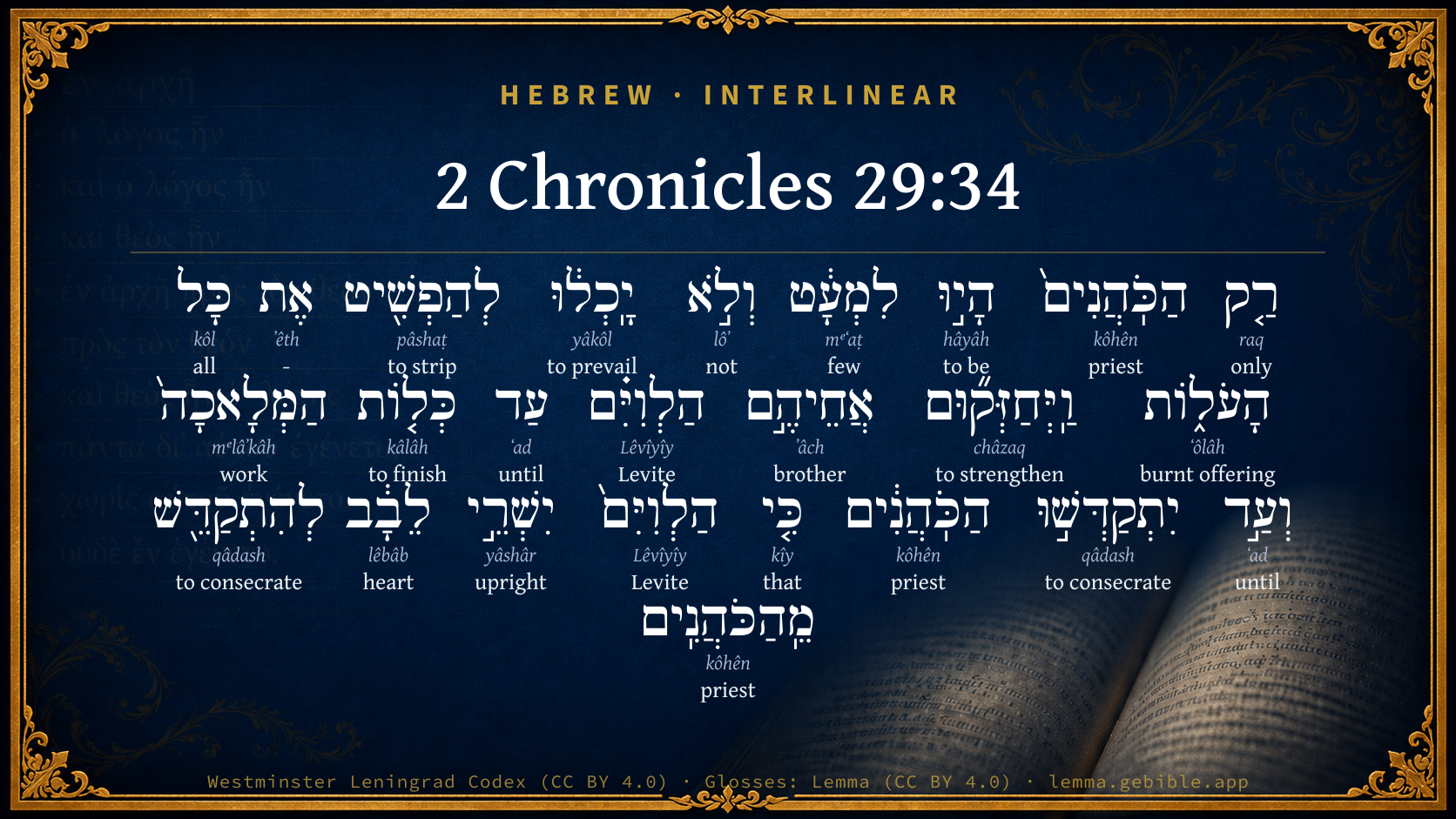
Hebrew (Westminster Leningrad Codex) 2 Chronicles 29:34 appears in the Hebrew Old Testament. The text above is from the Westminster Leningrad Codex. Each word links to its Strong’s number, a concise gloss, and parsing drawn from the Open Scriptures Hebrew Bible morphology. Click any word for its full Brown-Driver-Briggs (BDB) entry.
Download image
Cite this verse

2 Chronicles 29:34 (World English Bible). Public Domain. Lemma interlinear Bible study tool, https://lemma.gebible.app/v/2-chronicles/29/34.

Show BibTeX & RIS
BibTeX
RIS
English Translation
But the priests were too few, so that they could not flay all the burnt offerings: therefore their brothers the Levites helped them, until the work was ended, and until the priests had sanctified themselves; for the Levites were more upright in heart to sanctify themselves than the priests.
World English Bible · Public Domain
Download a study sheet

One document with this verse’s original text, its word-by-word gloss line, the meaning frame, cross-references with their text, attributed commentary, and full source and license credits — printable, and it pastes into notes with its structure intact.

This verse Autodidact and up

Study sheet (.html) Plain text (.txt)

A passage Seminary Student

Up to 50 verses in one chapter. A passage sheet keeps up to 6 commentary sources and 12 cross-references per verse, in the order this page ranks them, and says so on the sheet whenever that leaves anything out. Ask for a single verse and you get the Autodidact verse sheet above.

Everything on this page stays free to read, with no account — the sheet is a download of what is already on screen, not access to it.

Want to remove ads? Support Godless Engineer
Compare translations 3

The same verse in 3 English versions, stacked beneath the original-language interlinear above. Click any original word for its lexicon entry.

Each is an independent rendering of the whole verse — the interlinear is not word-aligned to these translations.

Highlighted words mark where these versions differ — a whole-verse word diff, not a word-by-word alignment.

  • World English Bible Public Domain
    But the priests were too few, so that they could not flay all the burnt offerings: therefore their brothers the Levites helped them, until the work was ended, and until the priests had sanctified themselves; for the Levites were more upright in heart to sanctify themselves than the priests.
  • King James Version Public Domain
    But the priests were too few, so that they could not flay all the burnt offerings: wherefore their brethren the Levites did help them, till the work was ended, and until the other priests had sanctified themselves: for the Levites were more upright in heart to sanctify themselves than the priests.
  • unfoldingWord Literal Text CC BY-SA 4.0
    Except the priests were too few and they were not able to skin all the burnt offerings, so their brothers, the Levites, made them strong until the work was finished, and until the priests consecrated themselves, for the Levites were right of heart to consecrate themselves more than the priests.

unfoldingWord Literal Text — © unfoldingWord, licensed CC BY-SA 4.0. Word-aligned USFM3 via Door43 (git.door43.org/unfoldingWord/en_ult).

Versions to compare (up to 4)

3 of 4 selected

Show all 18 translations

Every available English version of this verse, each an independent rendering of the whole verse.

  • World English Bible Public Domain
    But the priests were too few, so that they could not flay all the burnt offerings: therefore their brothers the Levites helped them, until the work was ended, and until the priests had sanctified themselves; for the Levites were more upright in heart to sanctify themselves than the priests.
  • Berean Standard Bible Public Domain
    However, since there were not enough priests to skin all the burnt offerings, their Levite brothers helped them until the work was finished and until the priests had been consecrated. For the Levites had been more diligent in consecrating themselves than the priests had been.
  • Majority Standard Bible Public Domain
    However, since there were not enough priests to skin all the burnt offerings, their Levite brothers helped them until the work was finished and until the priests had consecrated themselves. For the Levites had been more diligent in consecrating themselves than the priests had been.
  • King James Version Public Domain
    But the priests were too few, so that they could not flay all the burnt offerings: wherefore their brethren the Levites did help them, till the work was ended, and until the other priests had sanctified themselves: for the Levites were more upright in heart to sanctify themselves than the priests.
  • American Standard Version (1901) Public Domain
    But the priests were too few, so that they could not flay all the burnt-offerings: wherefore their brethren the Levites did help them, till the work was ended, and until the priests had sanctified themselves; for the Levites were more upright in heart to sanctify themselves than the priests.
  • Revised Version (1885) Public Domain
    But the priests were too few, so that they could not flay all the burnt offerings: wherefore their brethren the Levites did help them, till the work was ended, and until the priests had sanctified themselves: for the Levites were more upright in heart to sanctify themselves than the priests.
  • Geneva Bible (1599) Public Domain
    But the Priests were too few, and were not able to flay all the burnt offrings: therefore their brethren the Leuites did helpe them, til they had ended the worke, and vntill other Priests were sanctified: for the Leuites were more vpright in heart to sanctifie themselues, then the Priests.
  • Douay-Rheims (1899) Public Domain
    But the priests were few, and were not enough to flay the holocausts: wherefore the Levites their brethren helped them, till the work was ended, and priests were sanctified, for the Levites are sanctified with an easier rite than the priests.
  • Young's Literal Translation Public Domain
    Only, the priests have become few, and have not been able to strip the whole of the burnt-offerings, and their brethren the Levites strengthen them till the completion of the work, and till the priests sanctify themselves, for the Levites `are' more upright of heart to sanctify themselves than the priests.
  • Literal Standard Version CC BY-SA 4.0
    Only, the priests have become few, and have not been able to strip the whole of the burnt-offerings, and their brothers the Levites strengthen them until the completion of the work, and until the priests sanctify themselves, for the Levites [are] more upright of heart to sanctify themselves than the priests.
  • Unlocked Literal Bible CC BY-SA 4.0
    But the priests were too few to skin all the burnt offerings, so their brothers, the Levites, helped them until the work was done, and until the priests could consecrate themselves, for the Levites had been more careful to consecrate themselves than the priests.
  • unfoldingWord Literal Text CC BY-SA 4.0
    Except the priests were too few and they were not able to skin all the burnt offerings, so their brothers, the Levites, made them strong until the work was finished, and until the priests consecrated themselves, for the Levites were right of heart to consecrate themselves more than the priests.
  • Darby Bible Public Domain
    Only the priests were too few, and they could not flay all the burnt-offerings; therefore their brethren the Levites helped them, until the work was ended, and until the priests had hallowed themselves; for the Levites were more upright in heart to hallow themselves than the priests.
  • World Messianic Bible Public Domain
    But the priests were too few, so that they could not skin all the burnt offerings. Therefore their brothers the Levites helped them until the work was ended, and until the priests had sanctified themselves, for the Levites were more upright in heart to sanctify themselves than the priests.
  • Webster's Bible Public Domain
    But the priests were too few, so that they could not flay all the burnt-offerings: wherefore their brethren the Levites helped them, till the work was ended, and until the other priests had sanctified themselves: for the Levites were more upright in heart to sanctify themselves than the priests.
  • Free Bible Version CC BY-SA 4.0
    Since there weren't enough priests to skin all the burnt offerings, their Levite relatives helped them until the work was finished and the priests had been purified. (The Levites had been more conscientious in purifying themselves than the priests had.)
  • Bible in Basic English Public Domain
    There were not enough priests for the work of cutting up all the burned offerings; so their brothers the Levites gave them help till the work was done and the priests had made themselves holy: for the Levites were more upright in heart to make themselves holy than the priests.
  • JPS Tanakh (1917) Public Domain
    But the priests were too few, so that they could not flay all the burnt-offerings; wherefore their brethren the Levites did help them, till the work was ended, and until the priests had sanctified themselves; for the Levites were more upright in heart to sanctify themselves than the priests.

Literal Standard Version (2020), Covenant Press — licensed CC BY-SA 4.0. Text via the HelloAO Bible API (eBible.org). Unlocked Literal Bible (unfoldingWord) — licensed CC BY-SA 4.0. Text via the HelloAO Bible API (eBible.org). unfoldingWord Literal Text — © unfoldingWord, licensed CC BY-SA 4.0. Word-aligned USFM3 via Door43 (git.door43.org/unfoldingWord/en_ult). Free Bible Version, Dr. Jonathan Gallagher — licensed CC BY-SA 4.0. Text via the HelloAO Bible API (eBible.org).

Word by word

More ways to search: Search by grammar → Find every occurrence → Compare this word →

Practice this passage: Drill this verse → Learn its vocabulary →

לְהַפְשִׁ֖יט
pâshaṭ
H6584
“to strip”
Preposition + Verb, Hiphil, Infinitive Construct
Part of Speech
Preposition + Verb
Stem
Hiphil
Form
Infinitive Construct
Full BDB Definition

Origin: a primitive root

TWOT: 1845

to strip, invade, strip off, make a dash, raid, spread out - (Qal) - to strip off, put off - to put off (one's shelter), make a dash - (Piel) to strip - (Hiphil) - to strip of - to strip off - to flay - (Hithpael) to strip oneself of
  1. רַ֤ק raq H7535 “only” Particle, Accusative
  2. הַכֹּֽהֲנִים֙ kôhên H3548 “the · priests” Particle, Definite Article + Noun, Common, Masculine, Plural, Absolute
  3. הָי֣וּ hâyâh H1961 “to be” Verb, Qal, Perfect, 3rd Person, Common, Plural
  4. לִמְעָ֔ט mᵉʻaṭ H4592 “to/for · few” Preposition + Adjective, Adjective, Masculine, Singular, Absolute
  5. וְלֹ֣א lôʼ H3808 “and · not” Conjunction + Particle, Negative
  6. יָֽכְל֔וּ yâkôl H3201 “to prevail” Verb, Qal, Perfect, 3rd Person, Common, Plural
  7. אֶת ʼêth H853 “-” Particle, Direct Object
  8. כָּל kôl H3605 “all of” Noun, Common, Masculine, Singular, Construct
  9. הָעֹל֑וֹת ʻôlâh H5930 “the · burnt offerings” Particle, Definite Article + Noun, Common, Feminine, Plural, Absolute
  10. וַֽיְּחַזְּק֞וּם châzaq H2388 “and · to strengthen · them” Conjunction + Verb, Piel, Sequential Imperfect, 3rd Person, Masculine, Plural + Suffix, Personal, 3rd Person, Masculine, Plural
  11. אֲחֵיהֶ֣ם ʼâch H251 “brothers · their” Noun, Common, Masculine, Plural, Construct + Suffix, Personal, 3rd Person, Masculine, Plural
  12. הַלְוִיִּ֗ם Lêvîyîy H3881 “the · Levites” Particle, Definite Article + Noun, Gentilic, Masculine, Plural, Absolute
  13. עַד ʻad H5704 “until” Preposition
  14. כְּל֤וֹת kâlâh H3615 “to finish” Verb, Qal, Infinitive Construct
  15. הַמְּלָאכָה֙ mᵉlâʼkâh H4399 “the · work” Particle, Definite Article + Noun, Common, Feminine, Singular, Absolute
  16. וְעַ֣ד ʻad H5704 “and · until” Conjunction + Preposition
  17. יִתְקַדְּשׁ֣וּ qâdash H6942 “to consecrate” Verb, Hithpael, Imperfect, 3rd Person, Masculine, Plural
  18. הַכֹּֽהֲנִ֔ים kôhên H3548 “the · priests” Particle, Definite Article + Noun, Common, Masculine, Plural, Absolute
  19. כִּ֤י kîy H3588 “that” Conjunction
  20. הַלְוִיִּם֙ Lêvîyîy H3881 “the · Levites” Particle, Definite Article + Noun, Gentilic, Masculine, Plural, Absolute
  21. יִשְׁרֵ֣י yâshâr H3477 “upright of” Adjective, Adjective, Masculine, Plural, Construct
  22. לֵבָ֔ב lêbâb H3824 “heart” Noun, Common, Masculine, Singular, Absolute
  23. לְהִתְקַדֵּ֖שׁ qâdash H6942 “to consecrate” Preposition + Verb, Hithpael, Infinitive Construct
  24. מֵֽהַכֹּהֲנִֽים kôhên H3548 “from · the · priests” Preposition + Particle, Definite Article + Noun, Common, Masculine, Plural, Absolute

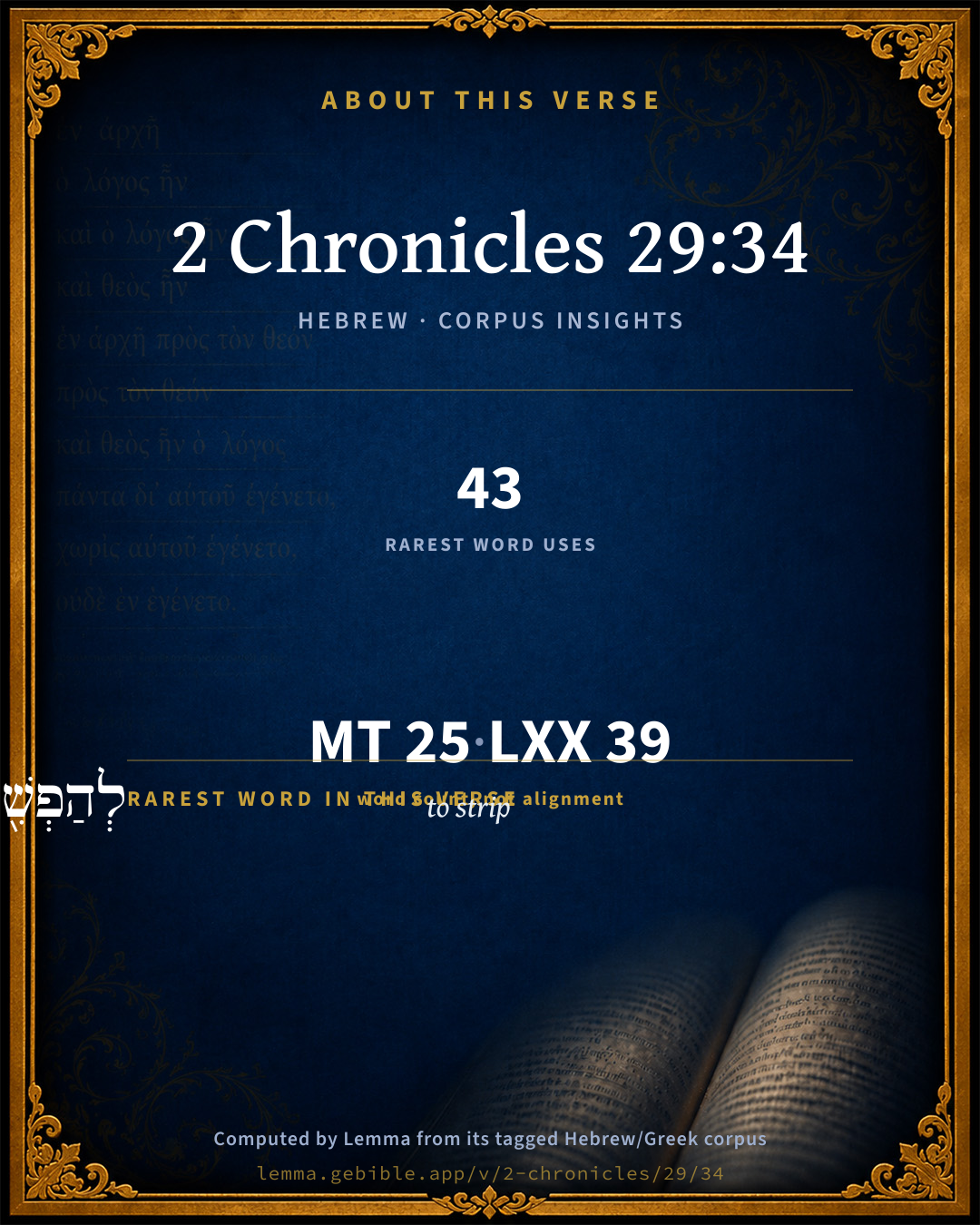
About this verse

These counts appear in no published source. They are computed here, from the morphology-tagged text and Lemma’s own curated glosses. What Lemma adds →

25
words
20
distinct lemmas
Historical
section

Shared distinctive vocabulary

לְהַפְשִׁ֖יט to strip H6584 occurs in 42 verses of the Hebrew Bible. Also found in:

Grammatical profile

  • 7 verbs
  • 10 nouns
  • 2 adjectives
  • 2 prepositions
  • 1 conjunction
  • 3 particles

Verb forms

  • הָי֣וּ Qal · Perfect
  • יָֽכְל֔וּ Qal · Perfect
  • לְהַפְשִׁ֖יט Hiphil · Infinitive Construct
  • וַֽיְּחַזְּק֞וּם Piel · Sequential Imperfect
  • כְּל֤וֹת Qal · Infinitive Construct
  • יִתְקַדְּשׁ֣וּ Hithpael · Imperfect
  • לְהִתְקַדֵּ֖שׁ Hithpael · Infinitive Construct

Repetition

Words recur within this verse — often emphatic in Hebrew:

  • הַכֹּֽהֲנִים֙ priest H3548 ×3
  • הַלְוִיִּ֗ם Levite H3881 ×2
  • עַד until H5704 ×2
  • יִתְקַדְּשׁ֣וּ to consecrate H6942 ×2

Hebrew & Septuagint length

In English translation the verse runs 49 words from the Hebrew and 42 from the Septuagint (LXX English) — closely comparable.

A rough comparison of the two English renderings, which tokenize alike — not a word-level alignment.

Word counts can differ between the Hebrew and the Greek without any difference in meaning — e.g. the Hebrew direct-object marker אֵת has no separate Greek word, and Greek often adds the article ὁ.

In the original languages it is 25 Hebrew tokens and 39 Greek tokens — but the two are counted differently (Hebrew bundles its prefixes and suffixes into one token; the Greek is in lemma form), so that isn’t a like-for-like length.

Cross-references

12

Topical passages linked to 2 Chronicles 29:34 in the Treasury of Scripture Knowledge — connected by theme and wording, ordered by reader-vote popularity; previews shown in the World English Bible.

  • 2 Chronicles 35:11 They killed the Passover, and the priests sprinkled [the blood which they received] of their hand, and the Levites flayed them.
  • 2 Chronicles 30:3 For they could not keep it at that time, because the priests had not sanctified themselves in sufficient number, neither had the people gathered themselves together to Jerusalem.
  • Numbers 8:15 "After that, the Levites shall go in to do the service of the Tent of Meeting: and you shall cleanse them, and offer them as a wave offering.
  • Numbers 8:19 I have given the Levites as a gift to Aaron and to his sons from among the children of Israel, to do the service of the children of Israel in the Tent of Meeting, and to make atonement for the children of Israel; that there be no plague among the children of Israel, when the children of Israel come near to the sanctuary."
  • Numbers 18:3 They shall keep your charge, and the charge of all the Tent: only they shall not come near to the vessels of the sanctuary and to the altar, that they not die, neither they, nor you.
  • Numbers 18:6–7 I, behold, I have taken your brothers the Levites from among the children of Israel: to you they are a gift, given to Yahweh, to do the service of the tent of meeting.
  • 1 Chronicles 29:17 I know also, my God, that you try the heart, and have pleasure in uprightness. As for me, in the uprightness of my heart I have willingly offered all these things: and now have I seen with joy your people, that are present here, offer willingly to you.
  • 2 Chronicles 29:5 and said to them, Hear me, you Levites; now sanctify yourselves, and sanctify the house of Yahweh, the God of your fathers, and carry forth the filthiness out of the holy place.
  • 2 Chronicles 30:16–17 They stood in their place after their order, according to the law of Moses the man of God: the priests sprinkled the blood [which they received] of the hand of the Levites.
  • Psalms 7:10 My shield is with God, Who saves the upright in heart.
  • Psalms 26:6 I will wash my hands in innocence, So I will go about your altar, Yahweh;
  • Psalms 94:15 For judgment will return to righteousness. All the upright in heart shall follow it.

Cross-references courtesy of OpenBible.info (CC BY 4.0).

Hebrew and Greek witnesses Masoretic Hebrew ↔ Greek Septuagint

The same verse in the two great witnesses to the Old Testament, shown verse-for-verse.

These are two independent witnesses, not word-aligned to each other, and the Septuagint is shown in lemma (dictionary) form.

Hebrew 2 Chronicles 29:34 Masoretic · Westminster Leningrad Codex

רַ֤ק הַכֹּֽהֲנִים֙ הָי֣וּ לִמְעָ֔ט וְלֹ֣א יָֽכְל֔וּ לְהַפְשִׁ֖יט אֶת כָּל הָעֹל֑וֹת וַֽיְּחַזְּק֞וּם אֲחֵיהֶ֣ם הַלְוִיִּ֗ם עַד כְּל֤וֹת הַמְּלָאכָה֙ וְעַ֣ד יִתְקַדְּשׁ֣וּ הַכֹּֽהֲנִ֔ים כִּ֤י הַלְוִיִּם֙ יִשְׁרֵ֣י לֵבָ֔ב לְהִתְקַדֵּ֖שׁ מֵֽהַכֹּהֲנִֽים

But the priests were too few, so that they could not flay all the burnt offerings: therefore their brothers the Levites helped them, until the work was ended, and until the priests had sanctified themselves; for the Levites were more upright in heart to sanctify themselves than the priests.

World English Bible · Public Domain

Greek LXX 2 Chronicles 29:34 Septuagint · lemma form

ἀλλά ἤ ὁ ἱερεύς ὀλίγος εἰμί καί οὐ δύναμαι δέρω ὁ ὁλοκαύτωσις καί ἀντιλαμβάνω αὐτός ὁ ἀδελφός αὐτός ὁ λευείτης ἕως ὅς συντελέω ὁ ἔργον καί ἕως ὅς ἁγνίζω ὁ ἱερεύς ὅτι ὁ λευείτης προθύμως ἁγνίζω παρά ὁ ἱερεύς

But the priests were few, and could not flay the whole burnt offering, so their brethren the Levites helped them, until the work was finished, and until the priests had purified themselves: for the Levites more zealously purified themselves than the priests.

LXX2012 (modern English Septuagint) · Public Domain

Hebrew: Westminster Leningrad Codex (CC BY 4.0). Greek: Septuagint (public domain); English from LXX2012 (modern English Septuagint) (Public Domain). How the Septuagint differs from the Hebrew →

Commentary

Notes on 2 Chronicles 29:34 from classic Christian and Jewish commentators (each source and its license shown beneath its notes). The classic Christian expositions comment on the surrounding passage and are grouped to its opening verse, so a note may address several verses; the Jewish commentaries on the Tanakh (Rashi and others) are per-verse, so they appear only where the commentator wrote on this verse.

Lemma curates 59 commentaries, every one of them public domain or Creative Commons licensed, each selected and text-cleaned for this edition rather than reprinted as found. About our sources →

Trapp's Complete Commentary

John Trapp

2Ch 29:34 But the priests were too few, so that they could not flay all the burnt offerings: wherefore their brethren the Levites did help them, till the work was ended, and until the [other] priests had sanctified themselves: for the Levites [were] more upright in heart to sanctify themselves than the priests.

Ver. 34. So that they could not slay all.] Slay them, and flay them, and lay them on the altar piecemeal.

For the Levites were more upright,] i.e., More free hearted, forward, and forth putting.

John Trapp, A Commentary or Exposition upon All the Books of the Old and New Testament (1647–1656) — public domain. Text from a community e-Sword module.

Joseph Benson's Commentary

2Ch 29:34. The priests were too few — Namely, such as were sanctified and fit for the work, as the following words show. Many of them, it is probable, had been suspended and laid aside as polluted, for having sacrificed to idols in the last reign, and the rest had not the zeal that might have been expected on such an occasion. Therefore they took no care to sanctify themselves: and being unsanctified, and so unqualified, they made their excuse for being absent from the service; as if their offence would be their defence. It is recorded here, to the perpetual shame of the priests, that though they were so well provided for out of the offerings of the Lord, yet they did not mind their business. Here was work to do, and there wanted proper hands to do it. So that they could not flay all the burnt-offerings — And much less all the other sacrifices, which were more numerous; the flaying whereof was the priests’ proper work, Lev 1:5-6. Wherefore the priests did help them — Necessity excusing a deviation from the rule, as it hath excused in other cases. For the Levites were more upright in heart, &c., than the priests — They were better affected to the work, and better prepared and qualified for it. This was their praise; and, in recompense for it, they had the honour of being employed in that which was the priests’ work. Thus encouragement was given to the faithful, zealous Levites, and a just disgrace cast upon the careless priests. What the Levites wanted in the ceremonial advantages of their birth and consecration, was abundantly made up in their eminent qualifications of knowledge and zeal for the work.

Joseph Benson's Commentary on the Old and New Testaments (1811–1818) — public domain. Text from a community e-Sword module.

Tyndale Open Study Notes

Tyndale Open Resources

29:34 The Chronicler shows surprise and delight at the people’s spontaneity and at the great number of devoted praise offerings consumed as part of the thanksgiving festivities. These things indicated that the Lord himself had prepared the people’s hearts for the event, far beyond what the priests and Levites had anticipated.

Tyndale Open Study Notes — © Tyndale Open Resources, licensed CC BY-SA 4.0. Text via the HelloAO Bible API.

Geneva Bible (1599)

Geneva Bible translators

Meaning, were more zealous to set forward the religion.

Geneva Bible (1599) marginal notes — public domain. Text via Bolls.life.

Jamieson, Fausset & Brown

Robert Jamieson, A. R. Fausset & David Brown

the priests were too few, . . . wherefore their brethren the Levites did help them--The skins of beasts intended as peace offerings might be taken off by the officers, because, in such cases, the carcass was not wholly laid upon the altar; but animals meant for burnt offerings which were wholly consumed by fire could be flayed by the priests alone, not even the Levites being allowed to touch them, except in cases of unavoidable necessity (Ch2 35:11). The duty being assigned by the law to the priests (Lev 1:6), was construed by consuetudinary practice as an exclusion of all others not connected with the Aaronic family.

for the Levites were more upright in heart to sanctify themselves than the priests--that is, displayed greater alacrity than the priests. This service was hastened by the irrepressible solicitude of the king. Whether it was that many of the priests, being absent in the country, had not arrived in time--whether from the long interruption of the public duties, some of them had relaxed in their wonted attentions to personal cleanliness, and had many preparations to make--or whether from some having participated in the idolatrous services introduced by Ahaz, they were backward in repairing to the temple--a reflection does seem to be cast upon their order as dilatory and not universally ready for duty (compare Ch2 30:15). Thus was the newly consecrated temple reopened to the no small joy of the pious king and all the people.

Next: 2 Chronicles Chapter 30

Jamieson, Fausset & Brown — Commentary Critical and Explanatory on the Whole Bible (1871) — public domain (CC PDM 1.0). Text via the HelloAO Bible API.

Adam Clarke's Commentary

Verse 34. They could not flay all the burnt-offerings] Peace-offerings, and such like, the Levites might flay and dress; but the whole burnt-offerings, that is, those which were entirely consumed on the altar, could be touched only by the priests, unless in a case of necessity, such as is mentioned here.

The Levites were more upright in heart] The priests seem to have been very backward in this good work; the Levites were more ready to help forward this glorious reformation. Why the former should have been so backward is not easy to tell; but it appears to have been the fact. Indeed, it often happens that the higher orders of the priesthood are less concerned for the prosperity of true religion than the lower. Why is this? They are generally too busy about worldly things, or too much satisfied with secular emoluments. A rich priesthood is not favourable either to the spread or depth of religion. Earthly gratifications are often put in the place of Divine influences: it is almost a miracle to see a very rich man deeply interested in behalf either of his own soul, or the souls of others.

Adam Clarke's Commentary on the Bible (1810–1826) — public domain. Text from a community e-Sword/MySword module.

Ellicott's Commentary for English Readers

(34) Flay all the burnt offerings.—In private offerings this was done by the worshipper himself (Lev_1:6). In national sacrifices it appears to have been the duty of the priests.

Did help them.—See margin; and Ezr_6:22.

Until the other priests had sanctified.—Began to sanctify themselves, as a body.

For the Levites . . . in heart.—The priests, as a class, were probably more deeply involved in the corruption of the last reign.

A Bible Commentary for English Readers, edited by Charles John Ellicott (1878–1897) — public domain. Text from a community e-Sword module.

The Cambridge Bible for Schools and Colleges

gen. ed. J. J. S. Perowne

34. the other priests] R.V. the priests.

The Cambridge Bible for Schools and Colleges (gen. ed. J. J. S. Perowne; Cambridge University Press, 1878–1918) — public domain. Text from a community e-Sword module.

Albert Barnes' Notes on the Bible

The Levites were more upright etc - See the marginal reference. Urijah, the high priest, had participated to some extent in the impieties of Ahaz 2Ki 16:10-16. He and many of the priests may, therefore, have looked coldly on the reforming zeal of Hezekiah.

Albert Barnes' Notes on the Bible (1834–1885) — public domain. Text from a community e-Sword/MySword module.

Haydock's Catholic Bible Commentary

Holocausts, as the law required, Lev. i. 6. See C. xxxv. 11. The skin might be taken off other victims, by laics. --- Priests. Syriac, "The Levites were more timid, or reserved than the priests, to purify themselves." C. --- Both are indirectly accused of negligence, C. xxx. 15. The Hebrew seems to give the preference to the latter, "for the Levites were more upright of heart, (Sept., willing) to purify themselves than the priests." But the Alexandrian Sept. may well agree with the Vulgate. The ceremonies attending the purification of both, may be seen Ex. xxix. 1., and Num. viii. 6. H. --- The priests had not sufficient time to collect themselves with the purity required, on such a short warning; and the paucity induced the king to put off the Passover till the next month, C. xxx. 3, 15.

George Leo Haydock (1774–1849), Haydock's Catholic Family Bible and Commentary, 1859 edition — public domain. Excludes Psalms (Douay-Rheims chapter numbering differs from Protestant) and Deuterocanonical books (Catholic canon only).

Matthew Poole's English Annotations

The priests were too few, to wit, such as were sanctified and fit for their work, as the following words show; for otherwise the number of the priests was more than sufficient for this employment.

They could not flay all the burnt-offerings; and much less all the other sacrifices, which were more numerous; the flaying whereof was the priest’s proper work, Lev 1:5,6.

The Levites did help them; necessity excusing their deviation from the rule, as it hath excused others in like cases.

Matthew Poole's English Annotations on the Holy Bible (1683–1685) — public domain. Text from a community e-Sword/MySword module.

The Pulpit Commentary

Originally, the worshipper who was moved to sacrifice was enjoined to slay, flay, and cut in pieces the victim. (Lev_1:2-6) Later the Levites performed these duties, and on great public occasions, at any rate, the priests themselves. The simple tale of this verse speaks volumes of the state of the ecclesiastical profession and of the ecclesiastical heart at this very time. Into the dishonoured sepulchre already two or three unsuspected and apparently unacknowledged chinks had let in reproving light as to this, and very lately the almost unavoidable inferences respecting Urijah (see note on our ver. 1, and on 2Ch_28:24, compared (2Ki_16:10-16) served the same purpose. How true to nature and to history, both secular and ecclesiastical also, the superiority, in sincerity and life and preparation for work, of the subordinates (the Levites), to those who fed on dignity rather than maintained it, in the highest sense, by religious life and conscientious practice!

The Pulpit Commentary (1880–1919), ed. H.D.M. Spence-Jones & Joseph S. Exell — public domain. Text from a community e-Sword module.

John Wesley's Explanatory Notes

Too few - Such as were sanctified and fit for their work, as the following words shew: for otherwise the number of the priests was more than sufficient for this employment. Burnt-offerings - And much less all the other sacrifices, which were more numerous; the slaying whereof was the priests proper work. The Levites - Necessity excusing their deviation from the rule.

John Wesley, Explanatory Notes Upon the Whole Bible (1754–1765) — public domain. Text via the GEBible commentary corpus.

unfoldingWord translationNotes

Door43 World Missions Community

to skin all the burnt offerings

"to remove the skins from all the burn offerings"

until the work was done

This can be stated in active form. AT: "until they had finished the work" (See: Active or Passive)

until the priests could consecrate themselves

Since there were some priests who were already consecrated, this implies that more priests consecrated themselves. AT: "until more of the priests could consecrate themselves" (See: Assumed Knowledge and Implicit Information)

had been more careful to consecrate themselves

There were enough Levites to do this work because they had been careful to consecrate themselves. This implies that the reason that there were not enough priests was because the priests were not careful to consecrate themselves.

translationWords

brother

works

unfoldingWord translationNotes — © Distant Shores Media and the Door43 World Missions Community, licensed CC BY-SA 4.0. Source: git.door43.org/Door43/en_tn.

Rashi

Rabbi Shlomo Yitzchaki (Rashi)

Only the priests were few i.e., Those who had consecrated themselves were still few; so their kinsmen, the Levites, reinforced them until the work was completed and until the priests consecrated themselves. Now, should you ask: How was it that the Levites consecrated themselves and the priests did not consecrate themselves? Scripture explains: “for the Levites were more conscientious than the priests to consecrate themselves”; the Levites were more conscientious than the priests, for the priests and the Levites and all God-fearing people had disguised themselves and made themselves appear unrecognizable, and had even hidden, all the days of the wicked kings, and when Hezekiah - who was righteous - came, they could not immediately consecrate themselves and cleanse themselves, for this was in the first year of his reign; so they came and consecrated themselves gradually, as it is written (Prov. 28:12): “When the righteous rejoice, there is much glory, but when the wicked rise up, a person disguises himself,” and it is written (ibid. verse 28): “When the wicked rise up, people hide; but when they perish, the righteous increase.” When the wicked Ahaz rose up, people hid, but when he perished, the righteous increased, i.e., Hezekiah and his company.

Rashi on the Tanakh — English translations: “The Judaica Press complete Tanach with Rashi, translated by A. J. Rosenberg” (CC BY 4.0); “Pentateuch with Rashi's commentary by M. Rosenbaum and A.M. Silbermann, 1929-1934” (public domain); “The Metsudah Tanach series, Lakewood, N.J” (CC BY 4.0); and “The Book of Joshua, Metsudah Publications, 1997” (CC BY 4.0). Text via Sefaria.

Lesson kit

Teaching starters — assembled from the data on this page, not authored interpretation. Every prompt links to the verse data it draws on. Edit before teaching.

2 Chronicles, in the Historical, opens this verse with 25 words (20 distinct Hebrew lemmas). Its most distinctive word is pâshaṭ (“to strip”). A historical commentator’s framing appears above. Read the whole chapter for the surrounding context.

Discussion questions

  1. How does “to strip” (pâshaṭ) shape what this verse is saying?
  2. Genesis 37:23 shares the word «to strip» with this verse. How do the two illuminate each other?
  3. “priest” occurs 3× in this one verse. What is the effect of the repetition?
  4. The translations on this page render this verse differently — a whole-verse word diff, not a word-by-word alignment. What might account for the different wordings?
  5. The verb «הָי֣וּ» is Qal Perfect. How does its form color the action?
  6. Reading how Trapp's Complete Commentary and Joseph Benson's Commentary read this verse, where do the two commentators agree and where do they part?

Things to notice

Reading settings

Reading text

Shown beneath each verse's original-language words.

Old Testament
Old Testament edition

Read the OT as the Masoretic Hebrew (MT) or the Greek Septuagint (LXX).

English shown for the Greek Septuagint (in the Hebrew ↔ Greek comparison).

Comparing translations? Open the Compare panel on any verse page to stack up to four side by side.