
1 Kings 1:27

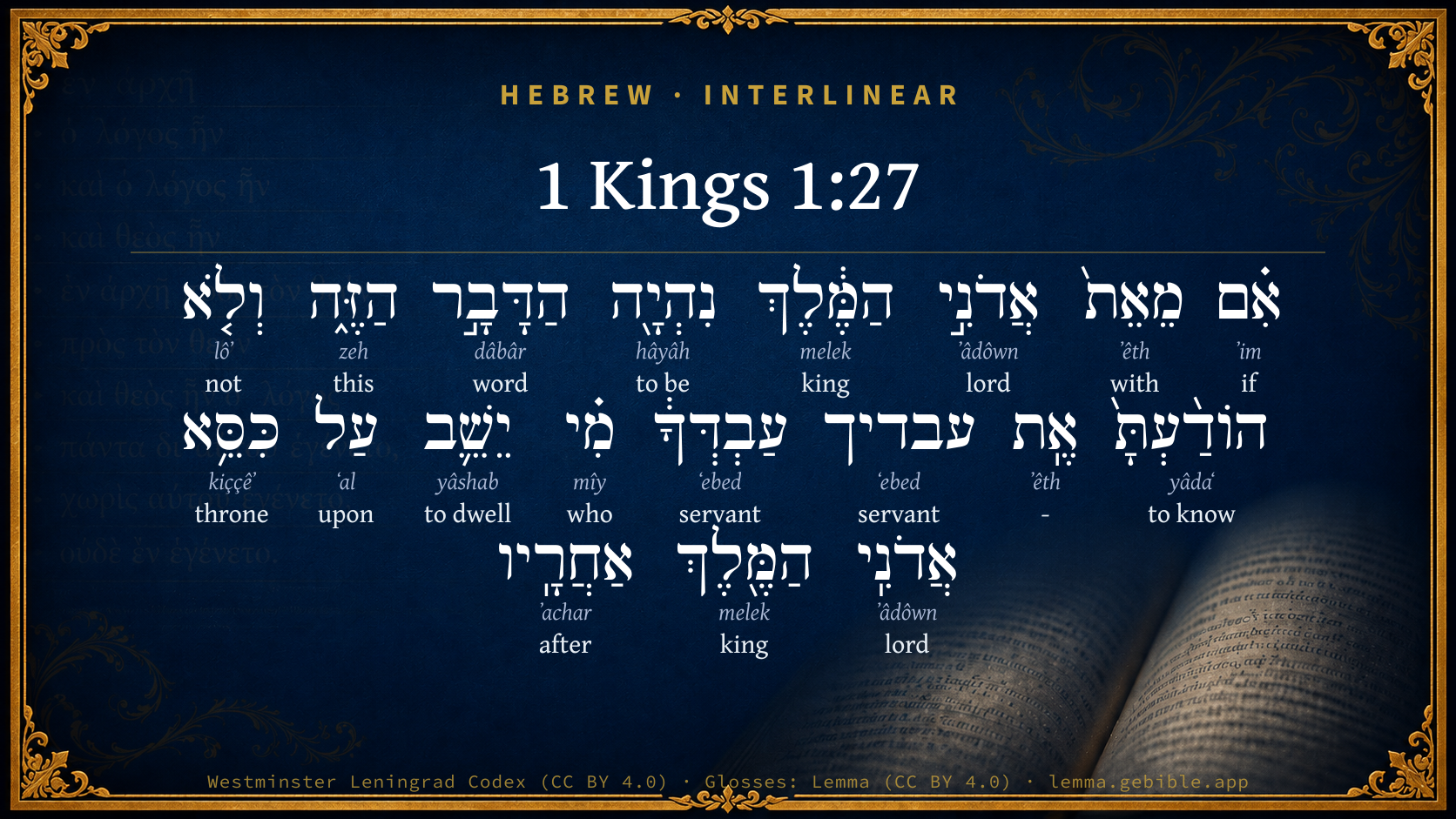
Hebrew (Westminster Leningrad Codex) 1 Kings 1:27 appears in the Hebrew Old Testament. The text above is from the Westminster Leningrad Codex. Each word links to its Strong’s number, a concise gloss, and parsing drawn from the Open Scriptures Hebrew Bible morphology. Click any word for its full Brown-Driver-Briggs (BDB) entry.
Download image
Cite this verse

1 Kings 1:27 (World English Bible). Public Domain. Lemma interlinear Bible study tool, https://lemma.gebible.app/v/1-kings/1/27.

Show BibTeX & RIS
BibTeX
RIS
English Translation
Is this thing done by my lord the king, and you haven't shown to your servants who should sit on the throne of my lord the king after him?
World English Bible · Public Domain
Download a study sheet

One document with this verse’s original text, its word-by-word gloss line, the meaning frame, cross-references with their text, attributed commentary, and full source and license credits — printable, and it pastes into notes with its structure intact.

This verse Autodidact and up

Study sheet (.html) Plain text (.txt)

A passage Seminary Student

Up to 50 verses in one chapter. A passage sheet keeps up to 6 commentary sources and 12 cross-references per verse, in the order this page ranks them, and says so on the sheet whenever that leaves anything out. Ask for a single verse and you get the Autodidact verse sheet above.

Everything on this page stays free to read, with no account — the sheet is a download of what is already on screen, not access to it.

Want to remove ads? Support Godless Engineer
Compare translations 3

The same verse in 3 English versions, stacked beneath the original-language interlinear above. Click any original word for its lexicon entry.

Each is an independent rendering of the whole verse — the interlinear is not word-aligned to these translations.

Highlighted words mark where these versions differ — a whole-verse word diff, not a word-by-word alignment.

  • World English Bible Public Domain
    Is this thing done by my lord the king, and you haven't shown to your servants who should sit on the throne of my lord the king after him?
  • King James Version Public Domain
    Is this thing done by my lord the king, and thou hast not showed it unto thy servant, who should sit on the throne of my lord the king after him?
  • unfoldingWord Literal Text CC BY-SA 4.0
    Has this thing been done from with my lord the king and you have not made your servants know who will sit on the throne of my lord the king after him?”

unfoldingWord Literal Text — © unfoldingWord, licensed CC BY-SA 4.0. Word-aligned USFM3 via Door43 (git.door43.org/unfoldingWord/en_ult).

Versions to compare (up to 4)

3 of 4 selected

Show all 18 translations

Every available English version of this verse, each an independent rendering of the whole verse.

  • World English Bible Public Domain
    Is this thing done by my lord the king, and you haven't shown to your servants who should sit on the throne of my lord the king after him?
  • Berean Standard Bible Public Domain
    Has my lord the king let this happen without informing your servant who should sit on the throne after my lord the king?”
  • Majority Standard Bible Public Domain
    Has my lord the king let this happen without informing your servant who should sit on the throne after my lord the king?”
  • King James Version Public Domain
    Is this thing done by my lord the king, and thou hast not showed it unto thy servant, who should sit on the throne of my lord the king after him?
  • American Standard Version (1901) Public Domain
    Is this thing done by my lord the king, and thou hast not showed unto thy servants who should sit on the throne of my lord the king after him?
  • Revised Version (1885) Public Domain
    Is this thing done by my lord the king, and thou hast not shewed unto thy servants who should sit on the throne of my lord the king after him?
  • Geneva Bible (1599) Public Domain
    Is this thing done by my lord the King, and thou hast not shewed it vnto thy seruant, who should sitte on the throne of my lorde the King after him?
  • Douay-Rheims (1899) Public Domain
    Is this word come out from my lord the king, and hast thou not told me thy servant who should sit on the throne of my lord the king after him?
  • Young's Literal Translation Public Domain
    if from my lord the king this thing hath been, then thou hast not caused thy servant to know who doth sit on the throne of my lord the king after him.'
  • Literal Standard Version CC BY-SA 4.0
    if this thing has been from my lord the king, then you have not caused your servant to know who sits on the throne of my lord the king after him.”
  • Unlocked Literal Bible CC BY-SA 4.0
    Has my master the king done this without telling us, your servants, who should sit on the throne after him?”
  • unfoldingWord Literal Text CC BY-SA 4.0
    Has this thing been done from with my lord the king and you have not made your servants know who will sit on the throne of my lord the king after him?”
  • Darby Bible Public Domain
    Is this thing done by my lord the king, and thou hast not shewn to thy servants who should sit on the throne of my lord the king after him?
  • World Messianic Bible Public Domain
    Was this thing done by my lord the king, and you haven’t shown to your servants who should sit on the throne of my lord the king after him?”
  • Webster's Bible Public Domain
    Is this thing done by my lord the king, and thou hast not shown it to thy servant, who should sit on the throne of my lord the king after him?
  • Free Bible Version CC BY-SA 4.0
    If Your Majesty did this, you certainly didn't inform your officials as to who is meant to sit on your throne as the next king.”
  • Bible in Basic English Public Domain
    Has this thing been done by my lord the king, without giving word to your servants who was to be placed on my lord the king's seat after him?
  • JPS Tanakh (1917) Public Domain
    Is this thing done by my lord the king, and thou hast not declared unto thy servant who should sit on the throne of my lord the king after him?'

Literal Standard Version (2020), Covenant Press — licensed CC BY-SA 4.0. Text via the HelloAO Bible API (eBible.org). Unlocked Literal Bible (unfoldingWord) — licensed CC BY-SA 4.0. Text via the HelloAO Bible API (eBible.org). unfoldingWord Literal Text — © unfoldingWord, licensed CC BY-SA 4.0. Word-aligned USFM3 via Door43 (git.door43.org/unfoldingWord/en_ult). Free Bible Version, Dr. Jonathan Gallagher — licensed CC BY-SA 4.0. Text via the HelloAO Bible API (eBible.org).

Word by word

More ways to search: Search by grammar → Find every occurrence → Compare this word →

Practice this passage: Drill this verse → Learn its vocabulary →

כִּסֵּ֥א
kiççêʼ
H3678
“throne of”
Noun, Common, Masculine, Singular, Construct
Part of Speech
Noun
Type
Common
Gender
Masculine
Number
Singular
State
Construct
Full BDB Definition

Origin: from H3680

TWOT: 1007

seat (of honour), throne, seat, stool - seat (of honour), throne - royal dignity, authority, power (figuratively)
  1. אִ֗ם ʼim H518 “if” Conjunction
  2. מֵאֵת֙ ʼêth H854 “from · with” Preposition + Preposition
  3. אֲדֹנִ֣י ʼâdôwn H113 “lord · my” Noun, Common, Masculine, Singular, Construct + Suffix, Personal, 1st Person, Common, Singular
  4. הַמֶּ֔לֶךְ melek H4428 “the · king” Particle, Definite Article + Noun, Common, Masculine, Singular, Absolute
  5. נִהְיָ֖ה hâyâh H1961 “to be” Verb, Niphal, Perfect, 3rd Person, Masculine, Singular
  6. הַדָּבָ֣ר dâbâr H1697 “the · word” Particle, Definite Article + Noun, Common, Masculine, Singular, Absolute
  7. הַזֶּ֑ה zeh H2088 “the · this” Particle, Definite Article + Pronoun, Demonstrative, Masculine, Singular
  8. וְלֹ֤א lôʼ H3808 “and · not” Conjunction + Particle, Negative
  9. הוֹדַ֨עְתָּ֙ yâdaʻ H3045 “to know” Verb, Hiphil, Perfect, 2nd Person, Masculine, Singular
  10. אֶֽת ʼêth H853 “-” Particle, Direct Object
  11. עבדיך ʻebed H5650 “servants · your” Noun, Common, Masculine, Plural, Construct + Suffix, Personal, 2nd Person, Masculine, Singular
  12. עַבְדְּךָ֔ ʻebed H5650 “servant · your” Noun, Common, Masculine, Singular, Construct + Suffix, Personal, 2nd Person, Masculine, Singular
  13. מִ֗י mîy H4310 “who” Particle, Interrogative
  14. יֵשֵׁ֛ב yâshab H3427 “to dwell” Verb, Qal, Imperfect, 3rd Person, Masculine, Singular
  15. עַל ʻal H5921 “upon” Preposition
  16. אֲדֹנִֽי ʼâdôwn H113 “lord · my” Noun, Common, Masculine, Singular, Construct + Suffix, Personal, 1st Person, Common, Singular
  17. הַמֶּ֖לֶךְ melek H4428 “the · king” Particle, Definite Article + Noun, Common, Masculine, Singular, Absolute
  18. אַחֲרָֽיו ʼachar H310 “after · him” Preposition + Suffix, Personal, 3rd Person, Masculine, Singular

About this verse

These counts appear in no published source. They are computed here, from the morphology-tagged text and Lemma’s own curated glosses. What Lemma adds →

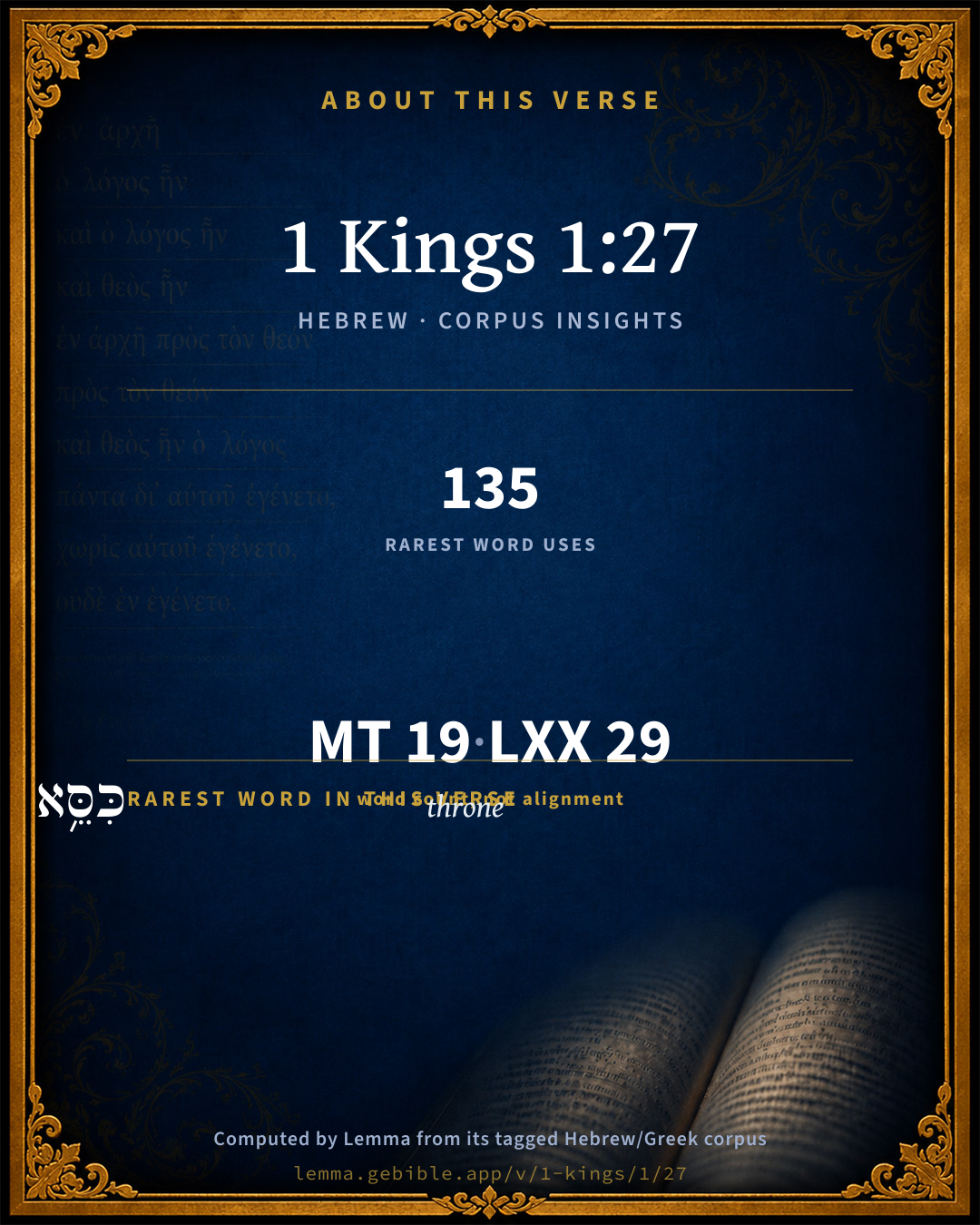
19
words
16
distinct lemmas
Historical
section

Grammatical profile

  • 3 verbs
  • 8 nouns
  • 1 pronoun
  • 3 prepositions
  • 1 conjunction
  • 3 particles

Verb forms

  • נִהְיָ֖ה Niphal · Perfect
  • הוֹדַ֨עְתָּ֙ Hiphil · Perfect
  • יֵשֵׁ֛ב Qal · Imperfect

Repetition

Words recur within this verse — often emphatic in Hebrew:

  • אֲדֹנִ֣י lord H113 ×2
  • הַמֶּ֔לֶךְ king H4428 ×2
  • עבדיך servant H5650 ×2

Hebrew & Septuagint length

In English translation the verse runs 29 words from the Hebrew and 34 from the Septuagint (LXX English) — closely comparable.

A rough comparison of the two English renderings, which tokenize alike — not a word-level alignment.

Word counts can differ between the Hebrew and the Greek without any difference in meaning — e.g. the Hebrew direct-object marker אֵת has no separate Greek word, and Greek often adds the article ὁ.

In the original languages it is 19 Hebrew tokens and 29 Greek tokens — but the two are counted differently (Hebrew bundles its prefixes and suffixes into one token; the Greek is in lemma form), so that isn’t a like-for-like length.

Cross-references

3

Topical passages linked to 1 Kings 1:27 in the Treasury of Scripture Knowledge — connected by theme and wording, ordered by reader-vote popularity; previews shown in the World English Bible.

  • 1 Kings 1:24 Nathan said, My lord, king, have you said, Adonijah shall reign after me, and he shall sit on my throne?
  • 2 Kings 4:27 When she came to the man of God to the hill, she caught hold of his feet. Gehazi came near to thrust her away; but the man of God said, Let her alone: for her soul is vexed within her; and Yahweh has hid it from me, and has not told me.
  • John 15:15 No longer do I call you servants, for the servant doesn't know what his lord does. But I have called you friends, for everything that I heard from my Father, I have made known to you.

Cross-references courtesy of OpenBible.info (CC BY 4.0).

Hebrew and Greek witnesses Masoretic Hebrew ↔ Greek Septuagint

The same verse in the two great witnesses to the Old Testament, shown verse-for-verse.

These are two independent witnesses, not word-aligned to each other, and the Septuagint is shown in lemma (dictionary) form.

Hebrew 1 Kings 1:27 Masoretic · Westminster Leningrad Codex

אִ֗ם מֵאֵת֙ אֲדֹנִ֣י הַמֶּ֔לֶךְ נִהְיָ֖ה הַדָּבָ֣ר הַזֶּ֑ה וְלֹ֤א הוֹדַ֨עְתָּ֙ אֶֽת עבדיך עַבְדְּךָ֔ מִ֗י יֵשֵׁ֛ב עַל כִּסֵּ֥א אֲדֹנִֽי הַמֶּ֖לֶךְ אַחֲרָֽיו

Is this thing done by my lord the king, and you haven't shown to your servants who should sit on the throne of my lord the king after him?

World English Bible · Public Domain

Greek LXX 1 Kings 1:27 Septuagint · lemma form

εἰ διά ὁ κύριος ἐγώ ὁ βασιλεύς γίγνομαι ὁ ῥῆμα οὗτος καί οὐ γνωρίζω ὁ δοῦλος σύ τίς καταἵημι ἐπί ὁ θρόνος ὁ κύριος ἐγώ ὁ βασιλεύς μετά αὐτός

Has this matter happened by the authority of my lord the king, and have you not made known to your servant who shall sit upon the throne of my lord the king after him?

LXX2012 (modern English Septuagint) · Public Domain

On this verse, The Pulpit Commentary discusses the Septuagint’s reading. Read the note in Commentary ↓

Hebrew: Westminster Leningrad Codex (CC BY 4.0). Greek: Septuagint (public domain); English from LXX2012 (modern English Septuagint) (Public Domain). How the Septuagint differs from the Hebrew →

Targum (Aramaic paraphrase)

1

The Targum is the ancient Jewish Aramaic paraphrase of the Hebrew Scriptures — an interpretive translation, not the Hebrew text itself. Onkelos (literal) and Pseudo-Jonathan (expansive) render the Torah, and Jonathan the Prophets. Coverage is partial: where no permissively-licensed English translation exists for a verse, only the Aramaic is shown. This is verse-level text, not a word-by-word alignment to the Hebrew.

  1. Targum Jonathan Prophets (Joshua–Malachi)
    אִם מִן רִבּוֹנִי מַלְכָּא הֲוָה פִּתְגָמָא הָדֵין וְלָא הוֹדַעְתְּ יַת עַבְדָךְ מַן יִתֵּיב עַל כּוּרְסֵי מַלְכוּתָא דְרִבּוֹנִי מַלְכָּא בַּתְרוֹהִי:

    (no public-domain English translation for this verse)

    Targum Jonathan — Aramaic: “Mikraot Gedolot” (public domain). English: “Sefaria Community Translation” (CC0 1.0 (public-domain dedication)); “London "Chaldee Paraphrase," 1871” (public domain). Text via Sefaria.

Commentary

Notes on 1 Kings 1:27 from classic Christian and Jewish commentators (each source and its license shown beneath its notes). The classic Christian expositions comment on the surrounding passage and are grouped to its opening verse, so a note may address several verses; the Jewish commentaries on the Tanakh (Rashi and others) are per-verse, so they appear only where the commentator wrote on this verse.

Lemma curates 59 commentaries, every one of them public domain or Creative Commons licensed, each selected and text-cleaned for this edition rather than reprinted as found. About our sources →

Trapp's Complete Commentary

John Trapp

1Ki 1:27 Is this thing done by my lord the king, and thou hast not shewed [it] unto thy servant, who should sit on the throne of my lord the king after him?

Ver. 27. And thou hast not showed it, &c.] See on 1Ki 1:23.

John Trapp, A Commentary or Exposition upon All the Books of the Old and New Testament (1647–1656) — public domain. Text from a community e-Sword module.

Geneva Bible (1599)

Geneva Bible translators

Meaning, that he ought in such affairs enterprise nothing except he had consulted with the Lord.

Geneva Bible (1599) marginal notes — public domain. Text via Bolls.life.

The Cambridge Bible for Schools and Colleges

gen. ed. J. J. S. Perowne

27. shewed it unto thy servant] There is a various reading, ‘thy servants,’ but the A. V. gives the better sense. There was a special reason why Nathan should know of all that was done in respect of the succession, which did not apply to the rest of David’s court.

The Cambridge Bible for Schools and Colleges (gen. ed. J. J. S. Perowne; Cambridge University Press, 1878–1918) — public domain. Text from a community e-Sword module.

John Gill's Exposition

Is this thing done by my lord the king,.... With his knowledge and consent, and by his orders:

and thou hast not showed it unto thy servant; meaning himself, who had brought him a message from the Lord, signifying that Solomon should succeed him; and therefore if that had been countermanded, it seemed strange that he should not have acquainted him with it: or "to thy servants", as the Arabic version; for the word has a plural ending, though pointed as singular; and so it may mean not only himself, but the rest of David's faithful servants that were about him at court, as Kimchi observes:

who should sit on the throne of my lord the king after him? if he had altered his mind, or had had any direction from the Lord to make any change, he wondered at it that he should neither acquaint him, nor any of his trusty friends, with it.

John Gill's Exposition of the Whole Bible (1746–1763) — public domain (CC PDM 1.0). Text via the HelloAO Bible API.

Matthew Poole's English Annotations

Thou hast not showed it unto thy servant; who, having been an instrument in delivering God’s message to thee concerning thy successor, might reasonably expect that if the king had changed his mind, or God had since made some revelation contrary to the former, thou wouldst have acquainted me with it, as being both a prophet of the Lord, and one whom thou hast always found faithful to thee, and to whom thou hast used to communicate thy secret counsels.

Matthew Poole's English Annotations on the Holy Bible (1683–1685) — public domain. Text from a community e-Sword/MySword module.

The Pulpit Commentary

Is this thing done an, or perhaps, num, "Is it then the ease that," etc. by lit., from with my lord the king i.e., with his privity and by his appointment, and thou hast not showed it unto thy servant Hebrews "made thy servant know." Nathan submits that he has a strong (2Sa_12:25) to be informed, should there be any change in the king"s plans, who should sit upon the throne of my lord the king after him? Same expression as in ver. 20. The repetition was well calculated to impress upon the king the importance of nominating a successor at once. Then the king answered and said He simply echoes the exact words of the mother. This is clear from the fact that the word dWly; natus, "the one born," here and in ver. 26 rendered child," is a very unusual one, Give her the living child, and in no wise slay it The LXX, which reads "Give the child to her who said, Give it to her," etc., obscures the evidently designed repetition she is the mother thereof Heb. she, his mother.

The Pulpit Commentary (1880–1919), ed. H.D.M. Spence-Jones & Joseph S. Exell — public domain. Text from a community e-Sword module.

John Wesley's Explanatory Notes

Shewed thy servant - Who, having been an instrument in delivering God's message to thee concerning thy successor, might reasonably expect that if the king had changed his mind, thou wouldest have acquainted me with it, as being both a prophet os the Lord, and one whom thou hast always found faithful to thee.

John Wesley, Explanatory Notes Upon the Whole Bible (1754–1765) — public domain. Text via the GEBible commentary corpus.

Lesson kit

Teaching starters — assembled from the data on this page, not authored interpretation. Every prompt links to the verse data it draws on. Edit before teaching.

1 Kings, in the Historical, opens this verse with 19 words (16 distinct Hebrew lemmas). Its most distinctive word is kiççêʼ (“throne”). A historical commentator’s framing appears above. Read the whole chapter for the surrounding context.

Discussion questions

  1. The word kiççêʼ carries the sense “throne.” How does it shape the verse?
  2. How does 1 Kings 1:24, which shares this passage’s theme, read alongside this verse?
  3. What does the repetition of “lord” (2× in this one verse) do in this verse?
  4. The translations on this page render this verse differently — a whole-verse word diff, not a word-by-word alignment. What might account for the different wordings?
  5. «נִהְיָ֖ה» is a Niphal Perfect verb. How does that grammatical form shape the action described?
  6. Compare how Trapp's Complete Commentary and Geneva Bible (1599) read this verse. Where do they agree or differ?

Things to notice

Reading settings

Reading text

Shown beneath each verse's original-language words.

Old Testament
Old Testament edition

Read the OT as the Masoretic Hebrew (MT) or the Greek Septuagint (LXX).

English shown for the Greek Septuagint (in the Hebrew ↔ Greek comparison).

Comparing translations? Open the Compare panel on any verse page to stack up to four side by side.